FINANCIAL STATEMENTS OF A
SOLE PROPRIETORSHIP
( Summarizing)
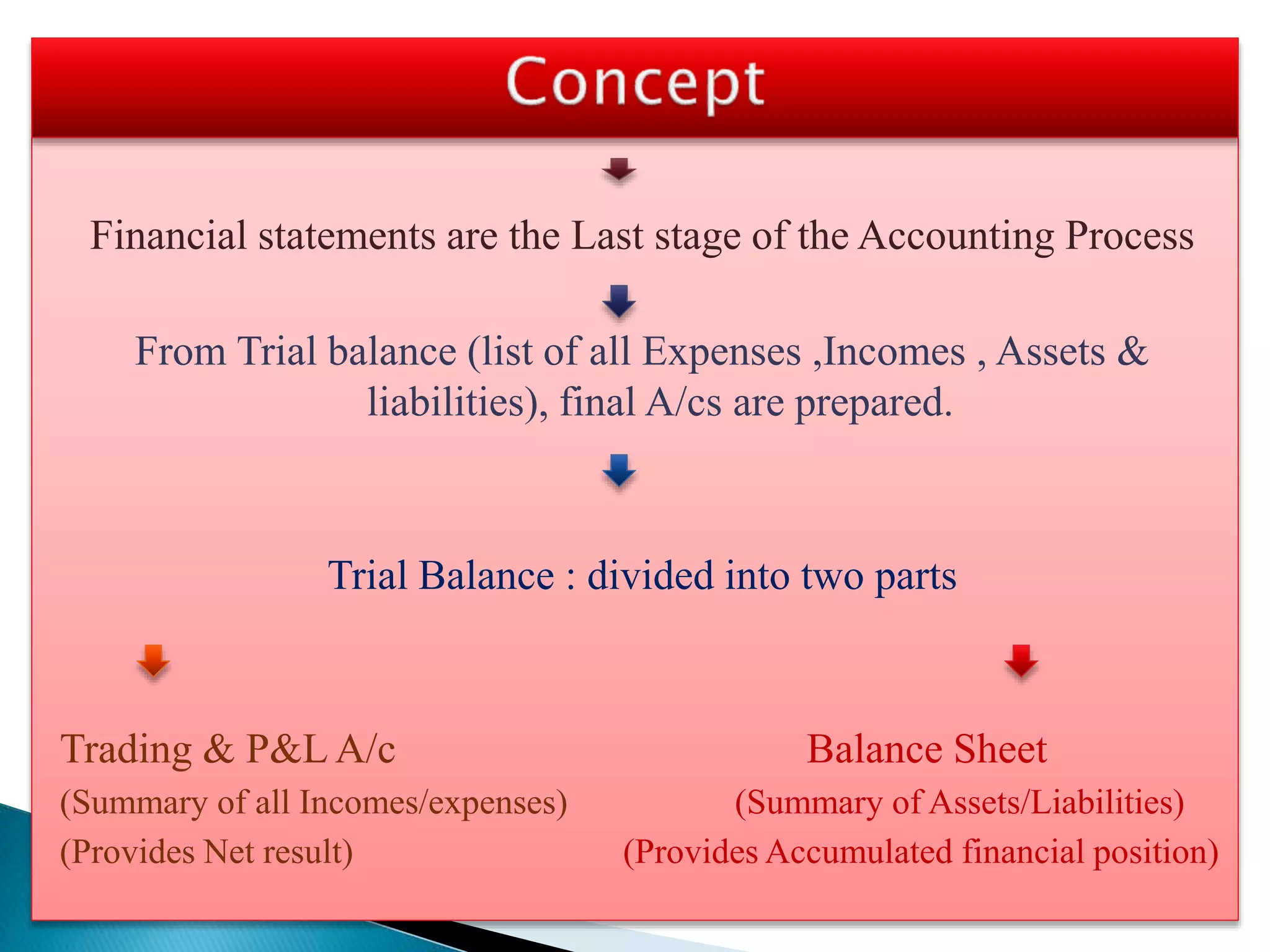
Financial statements are the Last stage of the Accounting Process
From Trial balance (list of all Expenses ,Incomes , Assets &
liabilities), final A/cs are prepared.
Trial Balance : divided into two parts
Trading & P&L A/c Balance Sheet
(Summary of all Incomes/expenses) (Summary of Assets/Liabilities)
(Provides Net result) (Provides Accumulated financial position)
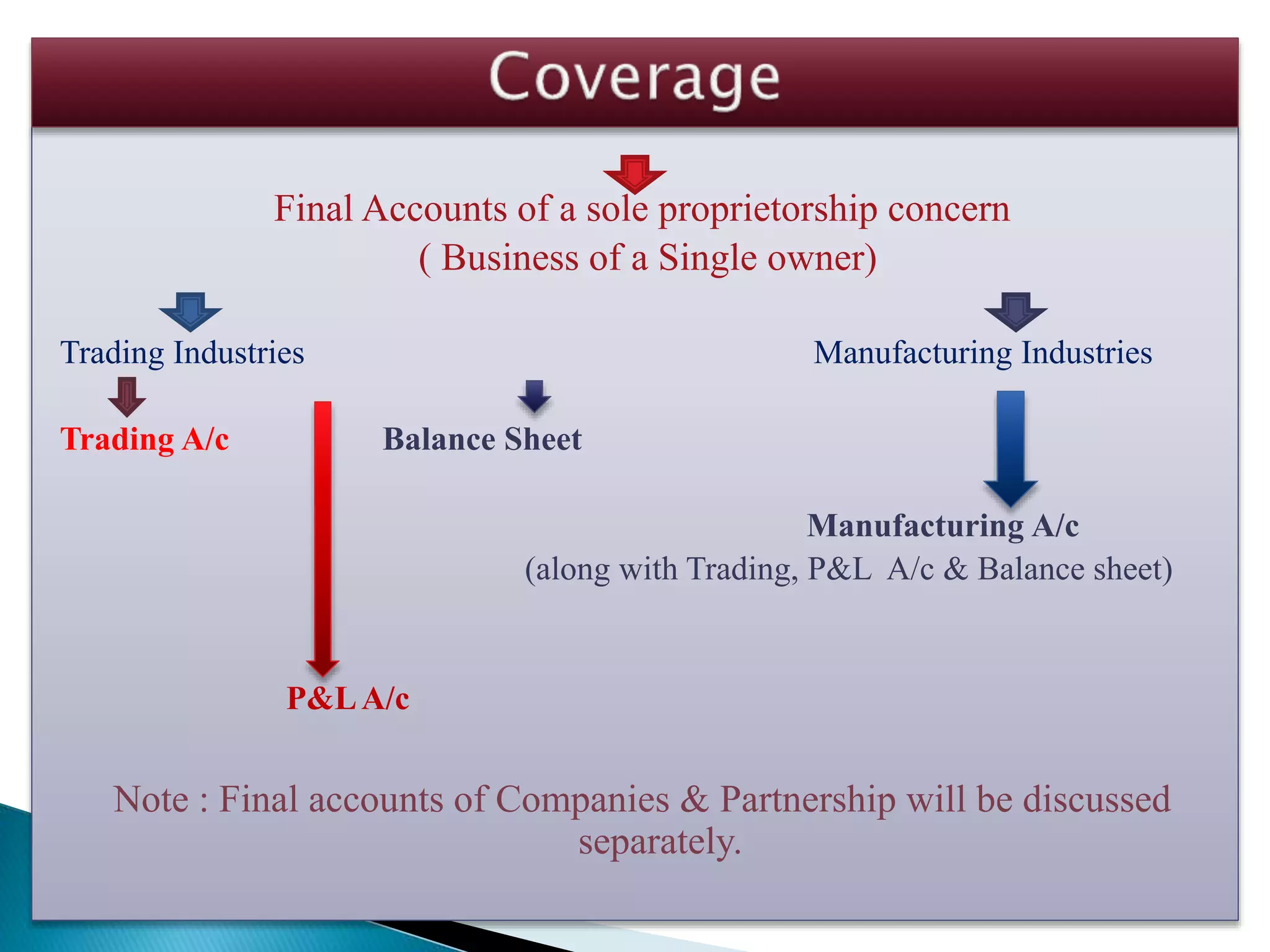
Final Accounts of a sole proprietorship concern
( Business of a Single owner)
Trading Industries Manufacturing Industries
Trading A/c Balance Sheet
Manufacturing A/c
(along with Trading, P&L A/c & Balance sheet)
P&LA/c
Note : Final accounts of Companies & Partnership will be discussed
separately.
Prepared by manufacturing industries (Conversion of raw
material into Finished Goods)before preparation of Trading,
P&L A/c
A Nominal A/c (records all the manufacturing expenses like
Raw material Consumed, Wages, Manufacturing expenses)
Provides the total Cost of goods produced- transferred to
Trading A/c
Also called as “Cost of Production” A/c
[Does not give any profit/loss]
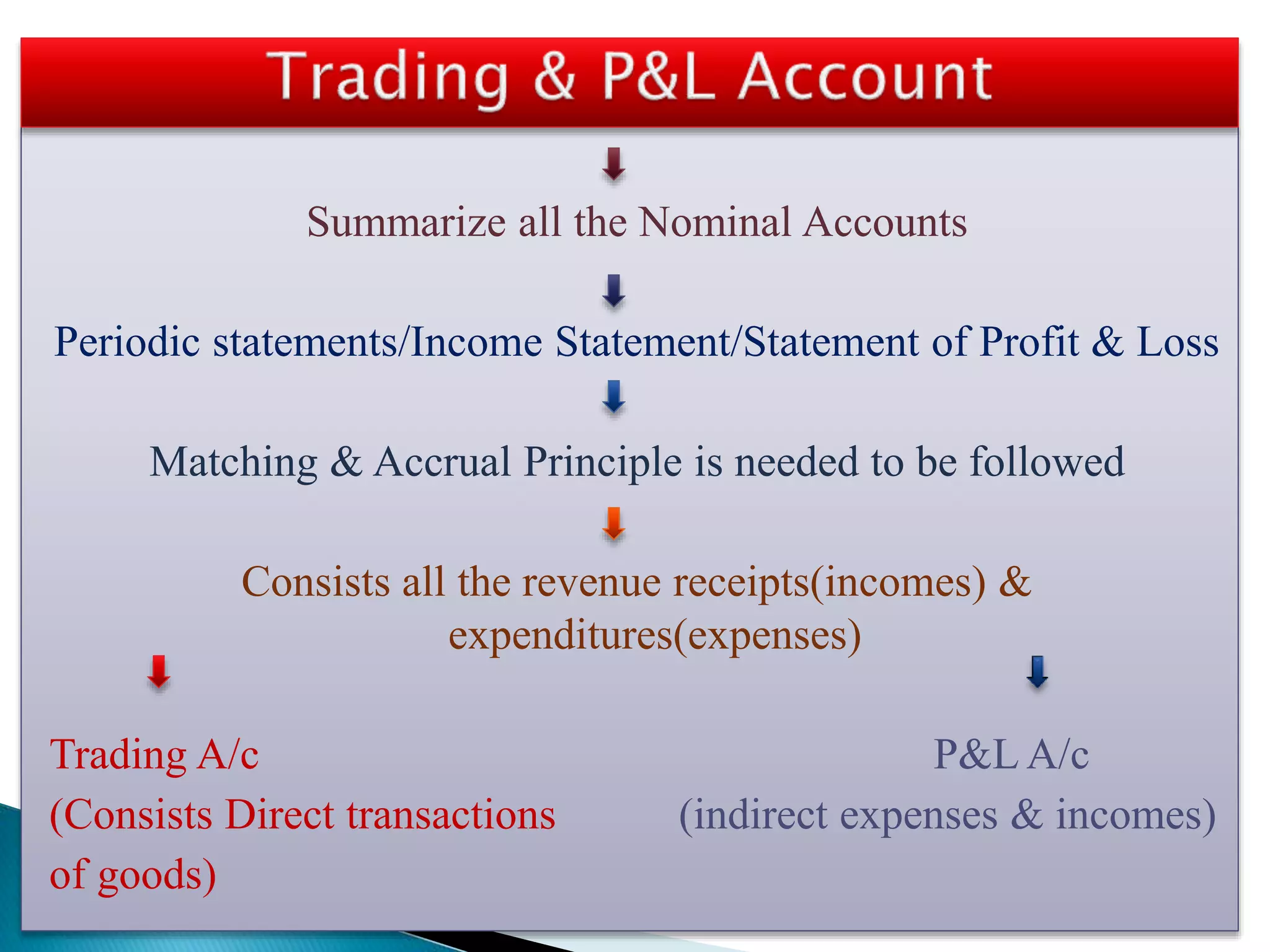
Summarize all the Nominal Accounts
Periodic statements/Income Statement/Statement of Profit & Loss
Matching & Accrual Principle is needed to be followed
Consists all the revenue receipts(incomes) &
expenditures(expenses)
Trading A/c P&L A/c
(Consists Direct transactions (indirect expenses & incomes)
of goods)
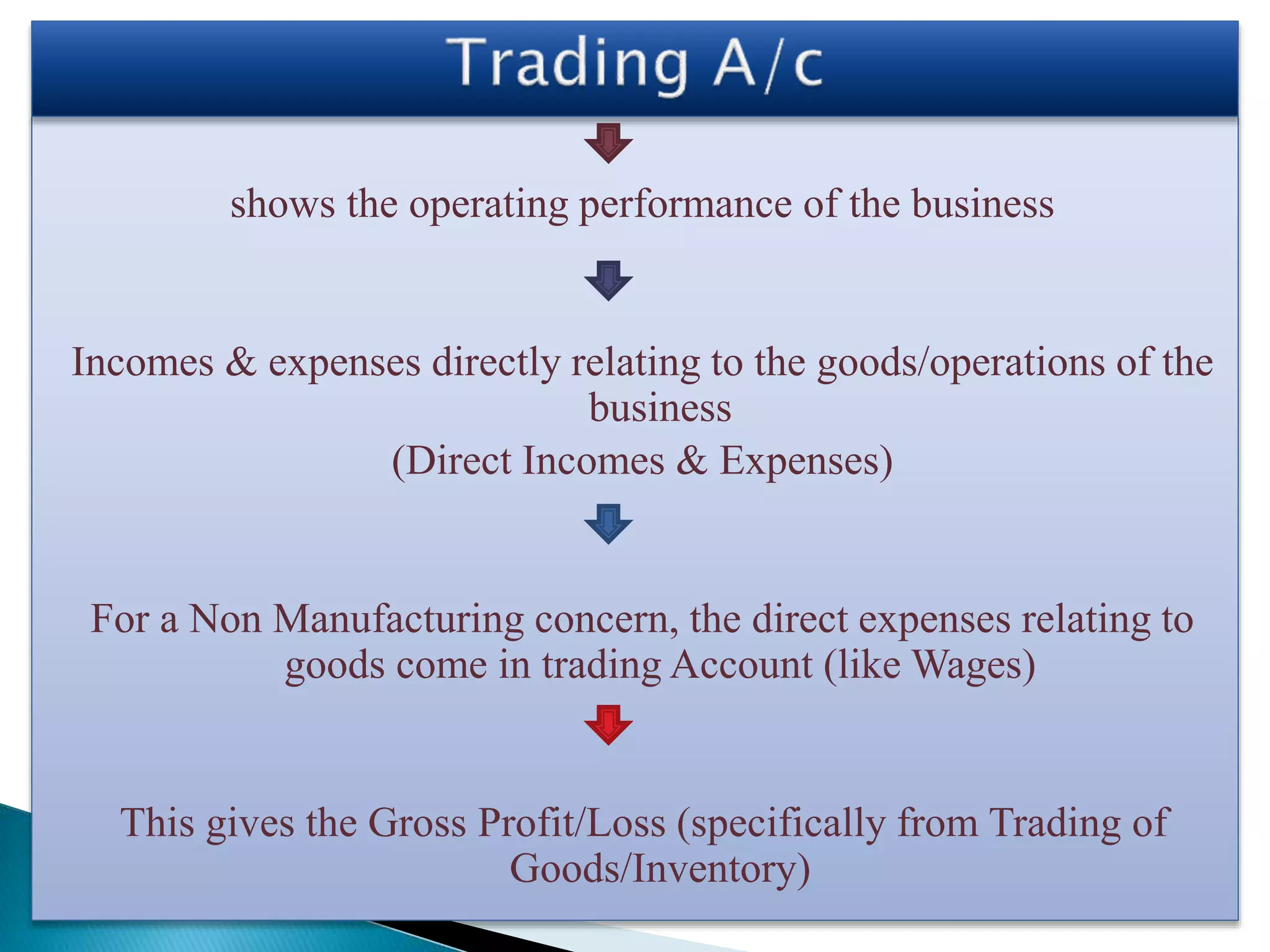
shows the operating performance of the business
Incomes & expenses directly relating to the goods/operations of the
business
(Direct Incomes & Expenses)
For a Non Manufacturing concern, the direct expenses relating to
goods come in trading Account (like Wages)
This gives the Gross Profit/Loss (specifically from Trading of
Goods/Inventory)
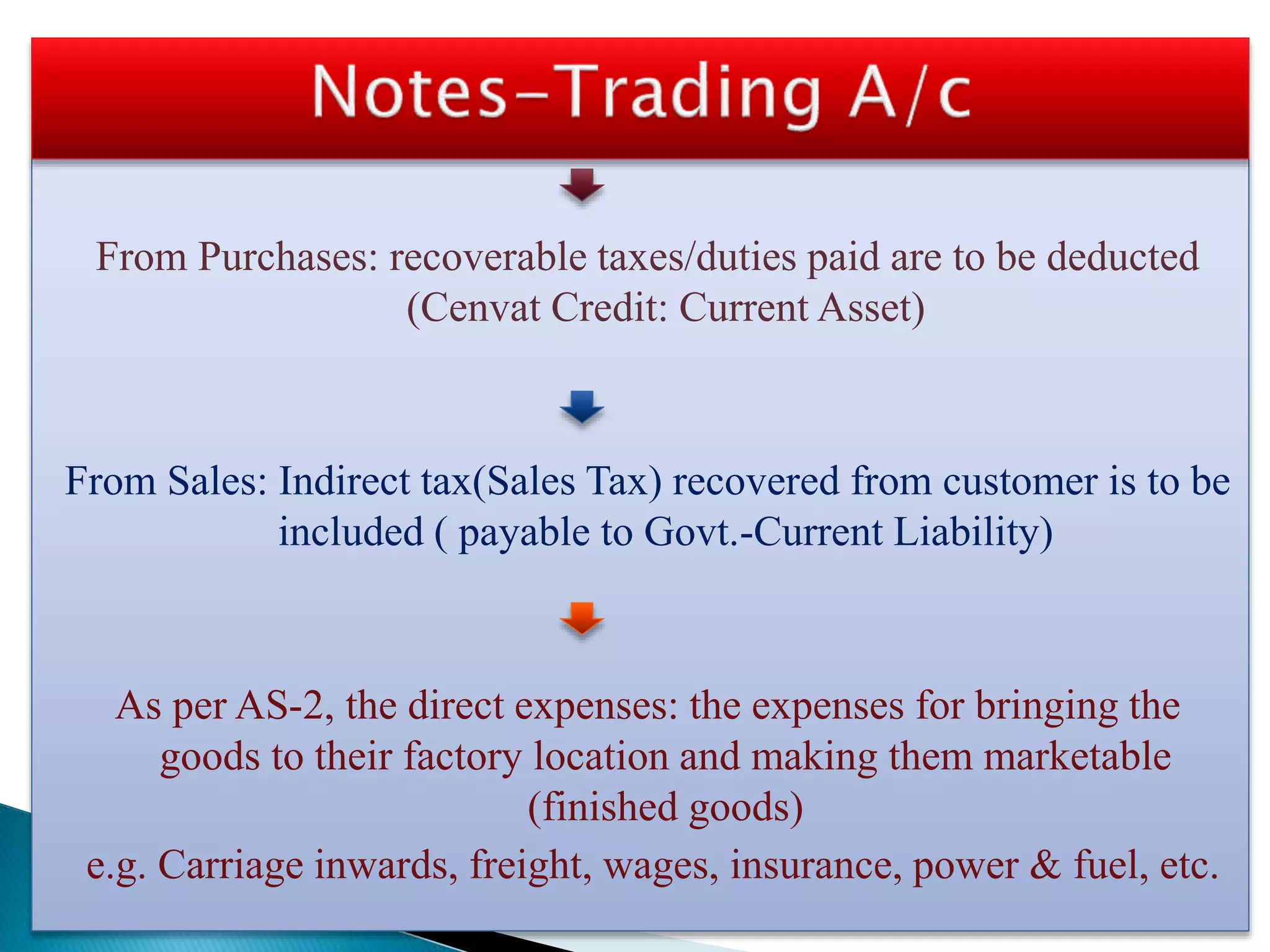
From Purchases: recoverable taxes/duties paid are to be deducted
(Cenvat Credit: Current Asset)
From Sales: Indirect tax(Sales Tax) recovered from customer is to be
included ( payable to Govt.-Current Liability)
As per AS-2, the direct expenses: the expenses for bringing the
goods to their factory location and making them marketable
(finished goods)
e.g. Carriage inwards, freight, wages, insurance, power & fuel, etc.
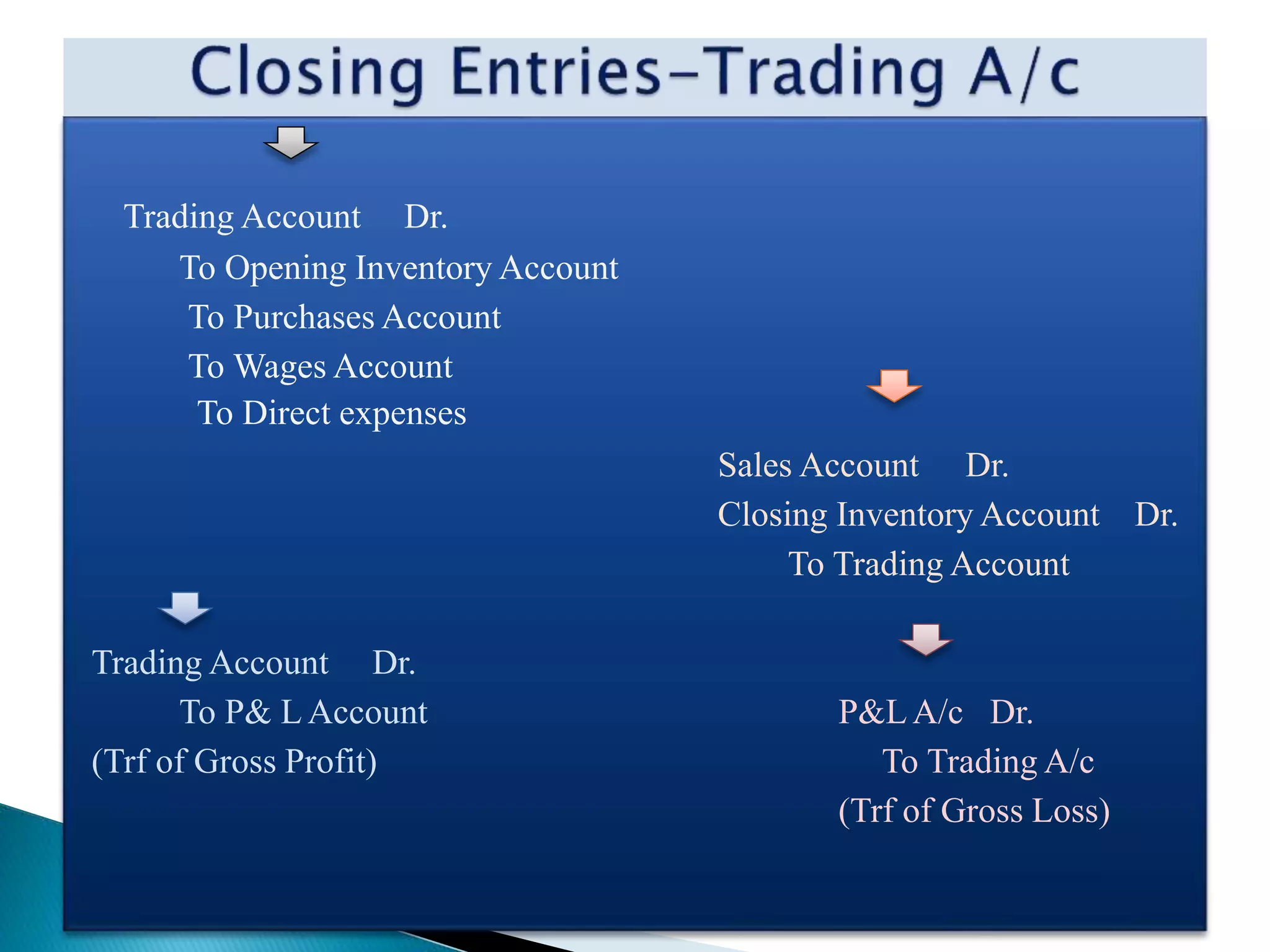
Trading Account Dr.
To Opening Inventory Account
To Purchases Account
To Wages Account
To Direct expenses
Sales Account Dr.
Closing Inventory Account Dr.
To Trading Account
Trading Account Dr.
To P& L Account P&LA/c Dr.
(Trf of Gross Profit) To Trading A/c
(Trf of Gross Loss)
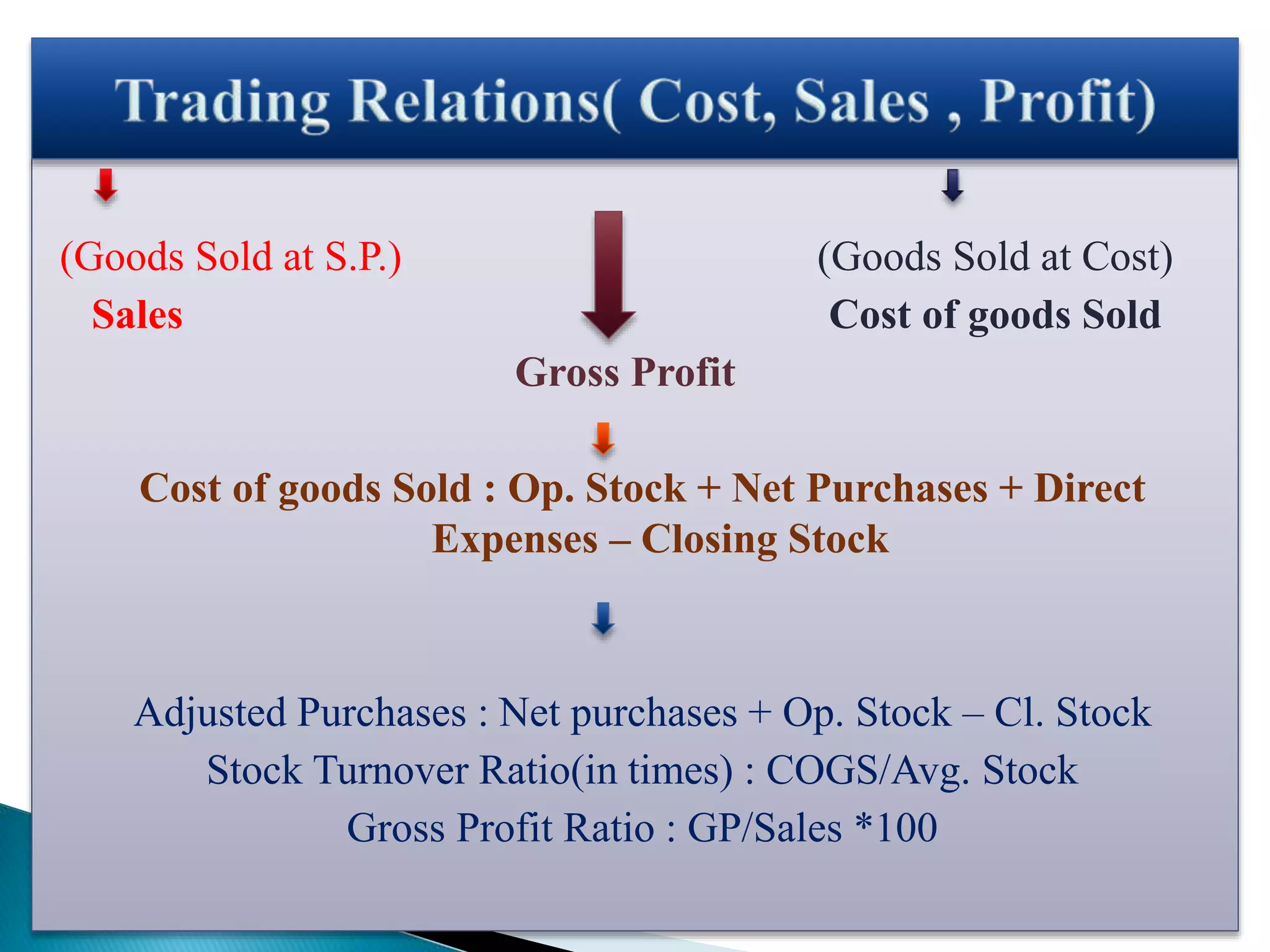
(Goods Sold at S.P.) (Goods Sold at Cost)
Sales Cost of goods Sold
Gross Profit
Cost of goods Sold : Op. Stock + Net Purchases + Direct
Expenses – Closing Stock
Adjusted Purchases : Net purchases + Op. Stock – Cl. Stock
Stock Turnover Ratio(in times) : COGS/Avg. Stock
Gross Profit Ratio : GP/Sales *100
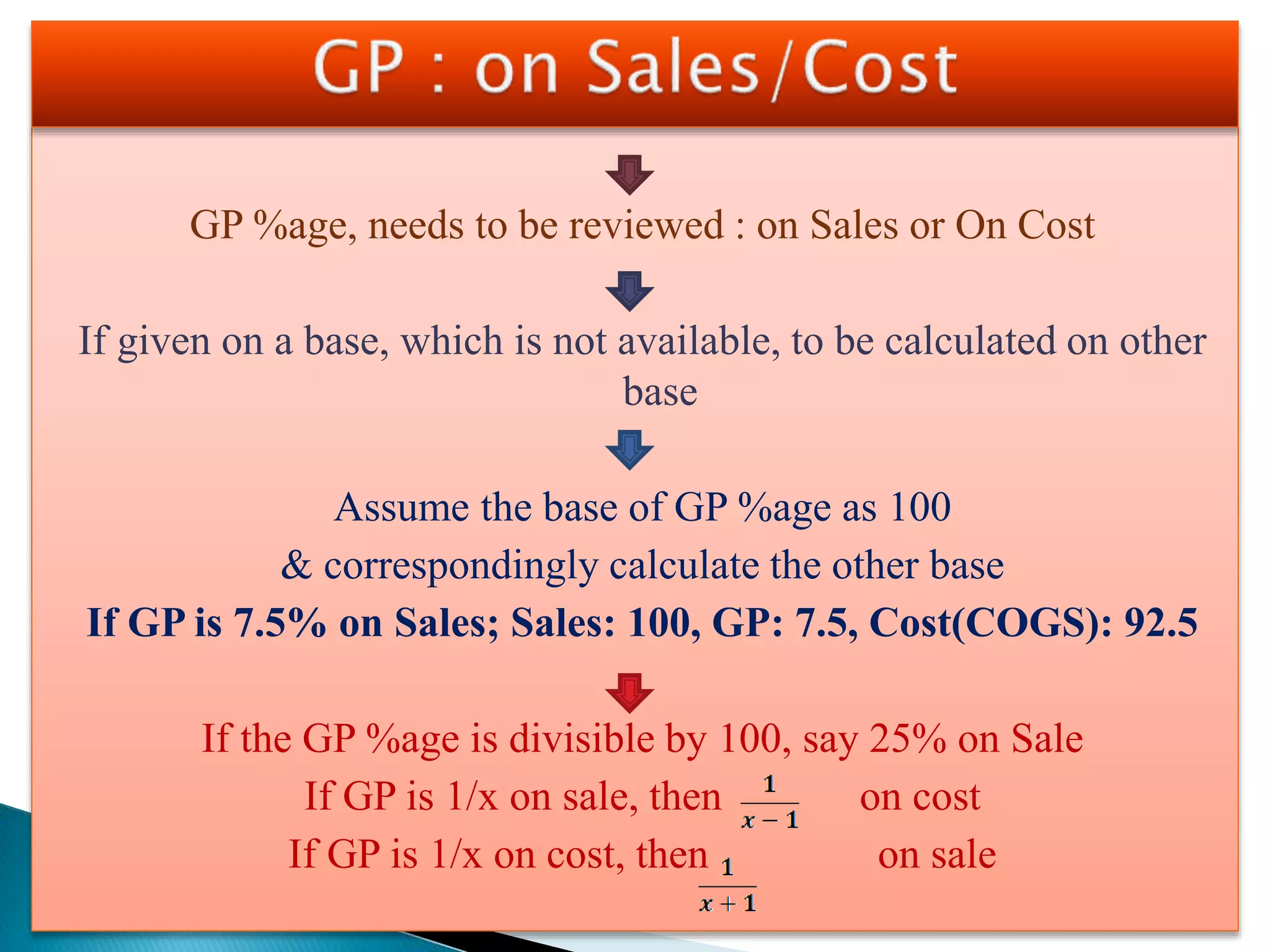
GP %age, needs to be reviewed : on Sales or On Cost
If given on a base, which is not available, to be calculated on other
base
Assume the base of GP %age as 100
& correspondingly calculate the other base
If GP is 7.5% on Sales; Sales: 100, GP: 7.5, Cost(COGS): 92.5
If the GP %age is divisible by 100, say 25% on Sale
If GP is 1/x on sale, then on cost
If GP is 1/x on cost, then on sale
Gross Profit/Loss in Trading A/c is Transferred to P&L
Records the business expenses & incomes not directly related to
goods/operations
(Indirect Expenses/Incomes)
The expenses of P&L can be categorized as
Administrative, Finance, Depreciation , Selling & Distribution
expenses
[Expenses: not in Trading A/c]
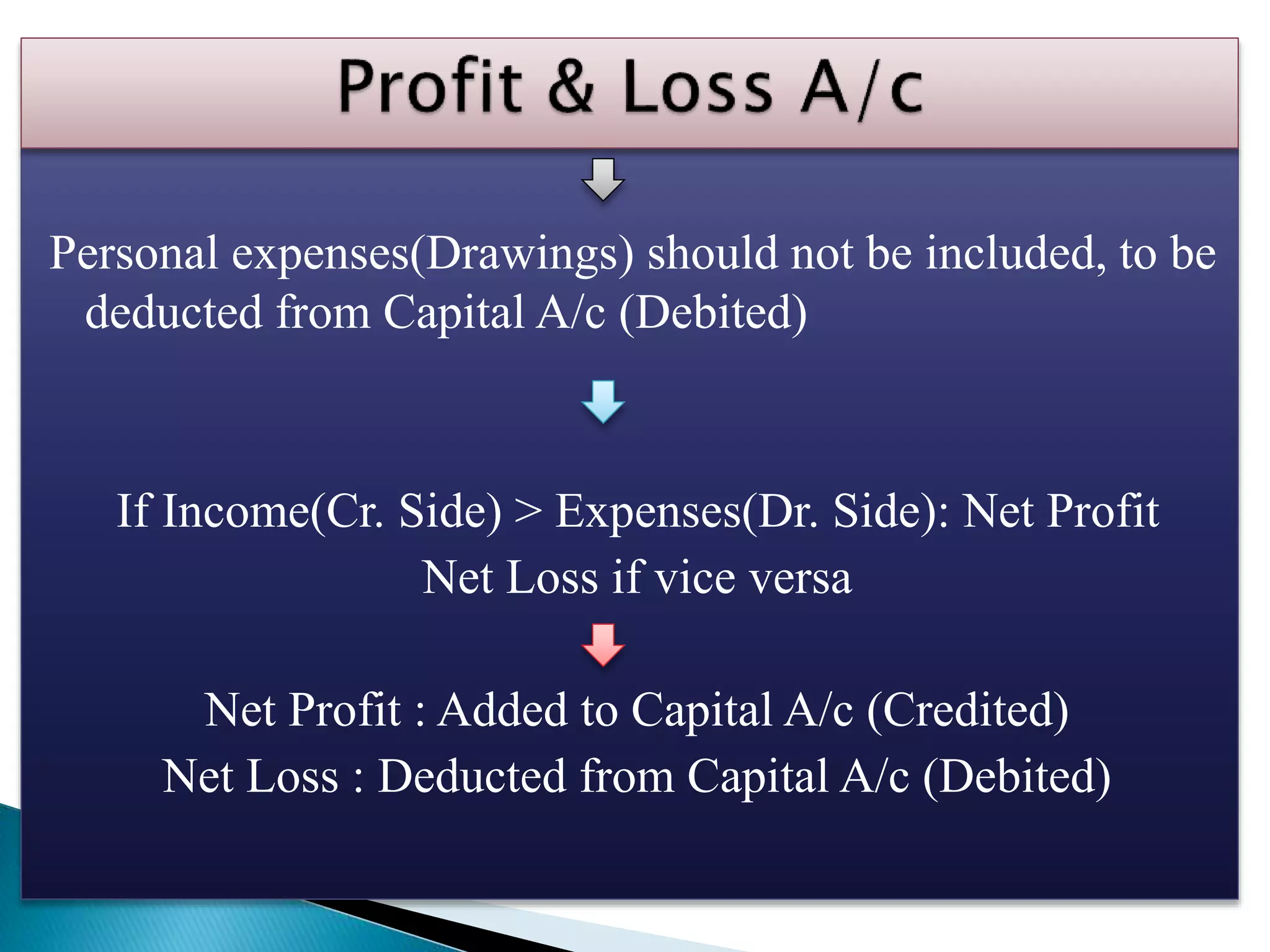
Personal expenses(Drawings) should not be included, to be
deducted from Capital A/c (Debited)
If Income(Cr. Side) > Expenses(Dr. Side): Net Profit
Net Loss if vice versa
Net Profit : Added to Capital A/c (Credited)
Net Loss : Deducted from Capital A/c (Debited)
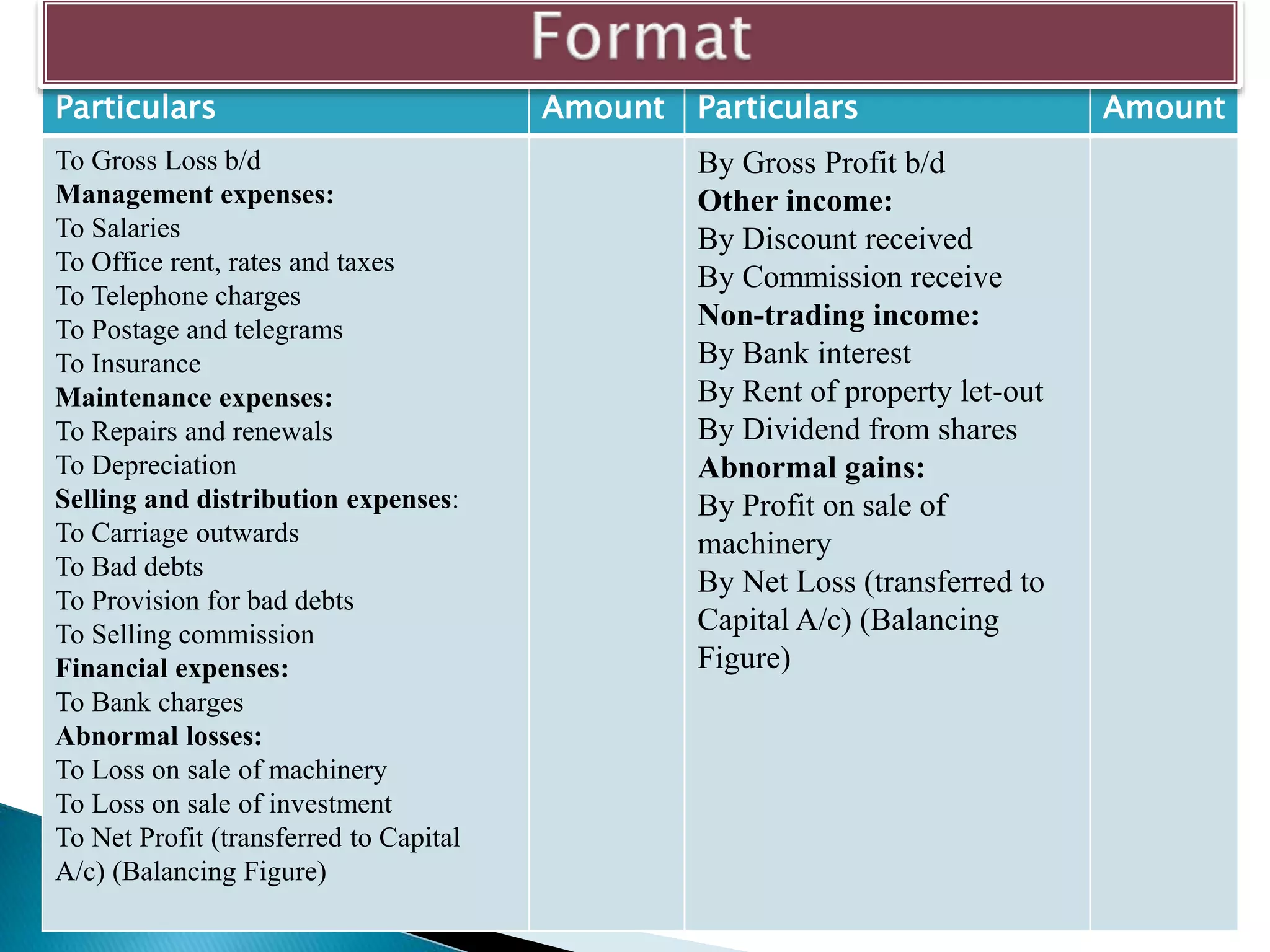
Particulars Amount Particulars Amount
To Gross Loss b/d
Management expenses:
To Salaries
To Office rent, rates and taxes
To Telephone charges
To Postage and telegrams
To Insurance
Maintenance expenses:
To Repairs and renewals
To Depreciation
Selling and distribution expenses:
To Carriage outwards
To Bad debts
To Provision for bad debts
To Selling commission
Financial expenses:
To Bank charges
Abnormal losses:
To Loss on sale of machinery
To Loss on sale of investment
To Net Profit (transferred to Capital
A/c) (Balancing Figure)
By Gross Profit b/d
Other income:
By Discount received
By Commission receive
Non-trading income:
By Bank interest
By Rent of property let-out
By Dividend from shares
Abnormal gains:
By Profit on sale of
machinery
By Net Loss (transferred to
Capital A/c) (Balancing
Figure)
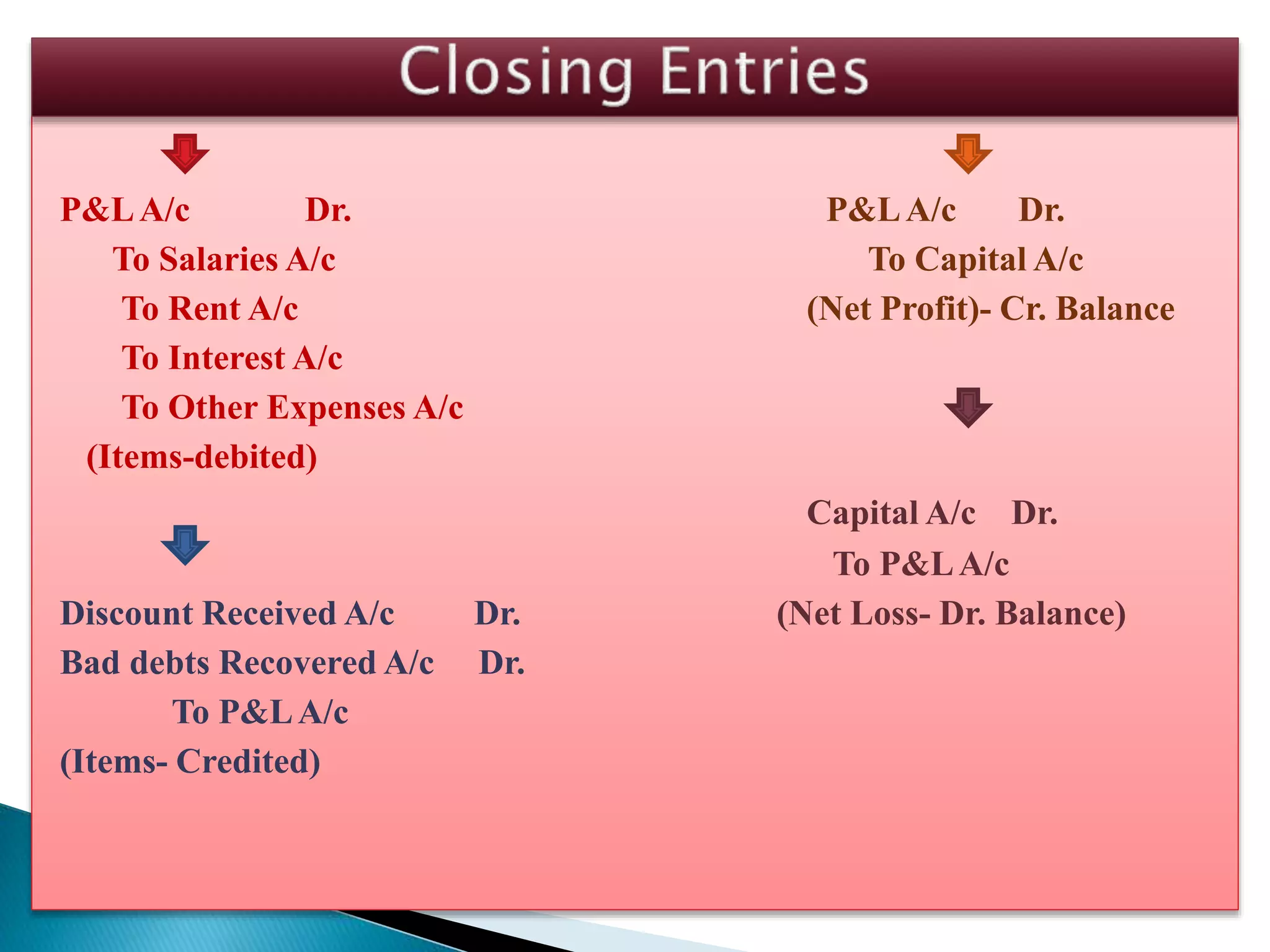
P&LA/c Dr. P&LA/c Dr.
To Salaries A/c To Capital A/c
To Rent A/c (Net Profit)- Cr. Balance
To Interest A/c
To Other Expenses A/c
(Items-debited)
Capital A/c Dr.
To P&LA/c
Discount Received A/c Dr. (Net Loss- Dr. Balance)
Bad debts Recovered A/c Dr.
To P&LA/c
(Items- Credited)
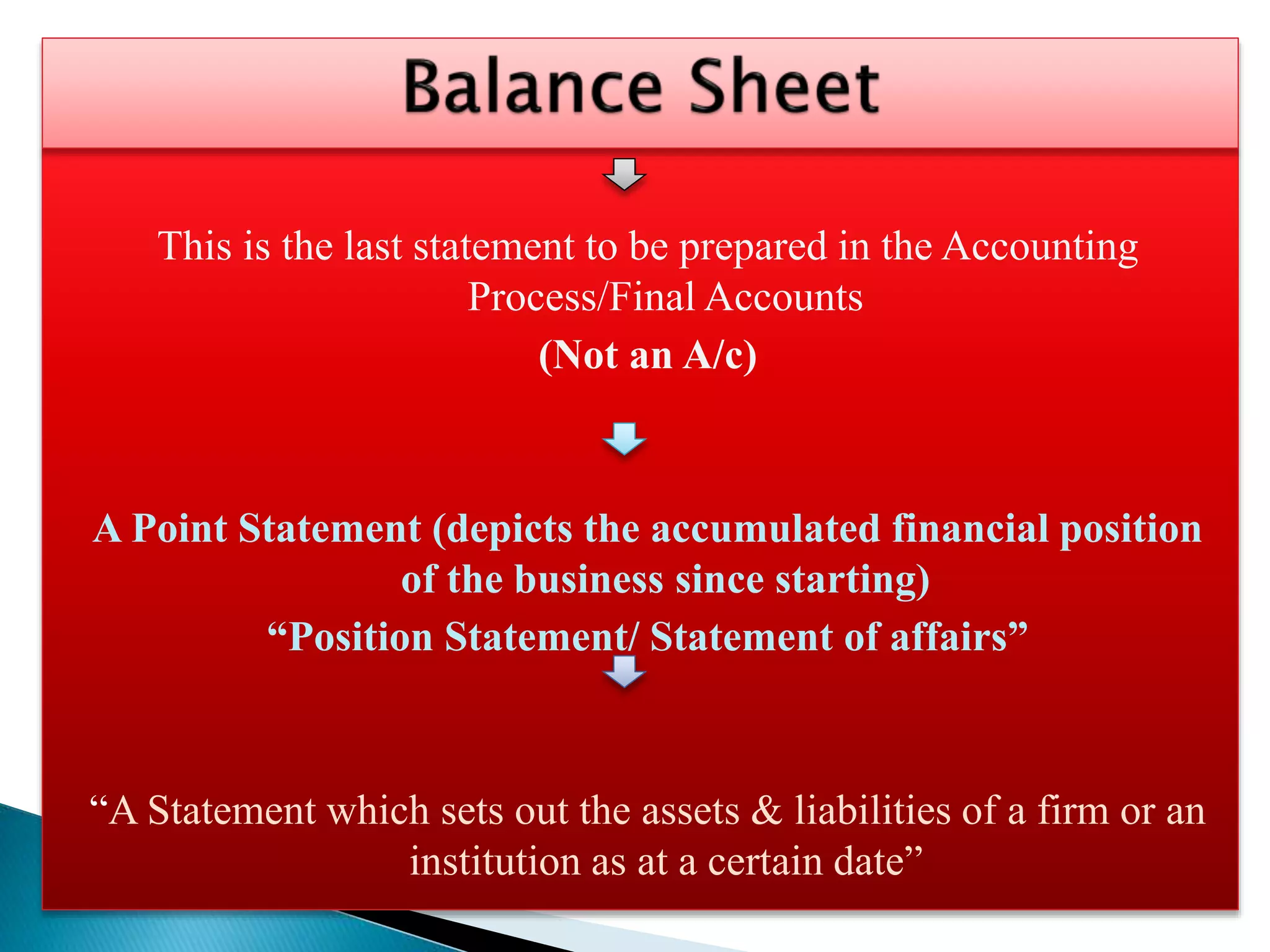
This is the last statement to be prepared in the Accounting
Process/Final Accounts
(Not an A/c)
A Point Statement (depicts the accumulated financial position
of the business since starting)
“Position Statement/ Statement of affairs”
“A Statement which sets out the assets & liabilities of a firm or an
institution as at a certain date”
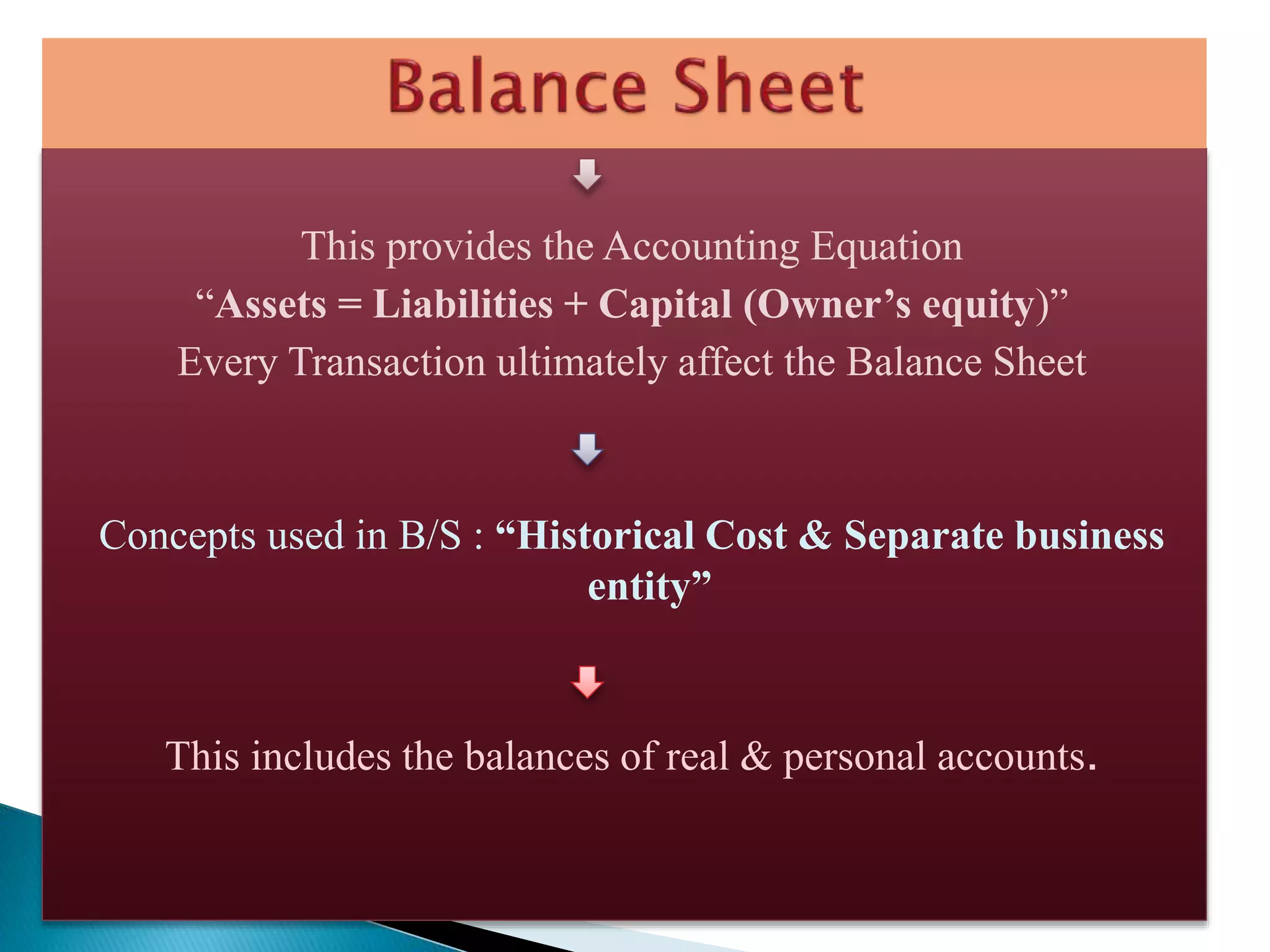
This provides the Accounting Equation
“Assets = Liabilities + Capital (Owner’s equity)”
Every Transaction ultimately affect the Balance Sheet
Concepts used in B/S : “Historical Cost & Separate business
entity”
This includes the balances of real & personal accounts.
Known as “ Marshalling of Balance Sheet”
In Liquidity Order
(Short term assets:
easily be converted into cash
to Long term assets)
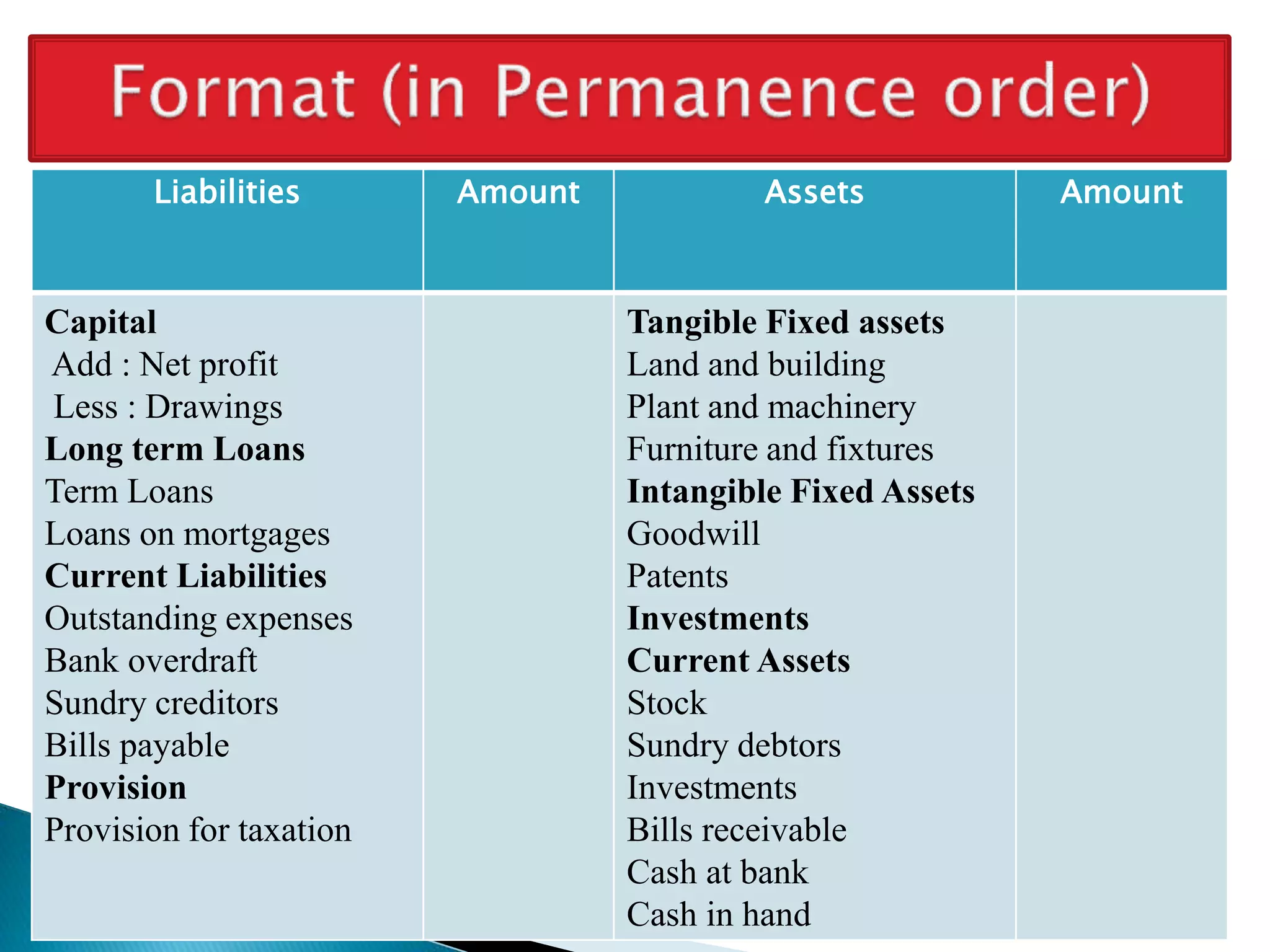
Permanence order
(Long term assets to Liquid assets)
Note : Generally the Permanence order is used.
Liabilities Amount Assets Amount
Capital
Add : Net profit
Less : Drawings
Long term Loans
Term Loans
Loans on mortgages
Current Liabilities
Outstanding expenses
Bank overdraft
Sundry creditors
Bills payable
Provision
Provision for taxation
Tangible Fixed assets
Land and building
Plant and machinery
Furniture and fixtures
Intangible Fixed Assets
Goodwill
Patents
Investments
Current Assets
Stock
Sundry debtors
Investments
Bills receivable
Cash at bank
Cash in hand

Final Accounts of a Sole proprietorship business part 1

  • 2.
    FINANCIAL STATEMENTS OFA SOLE PROPRIETORSHIP ( Summarizing)
  • 3.
    Financial statements arethe Last stage of the Accounting Process From Trial balance (list of all Expenses ,Incomes , Assets & liabilities), final A/cs are prepared. Trial Balance : divided into two parts Trading & P&L A/c Balance Sheet (Summary of all Incomes/expenses) (Summary of Assets/Liabilities) (Provides Net result) (Provides Accumulated financial position)
  • 4.
    Final Accounts ofa sole proprietorship concern ( Business of a Single owner) Trading Industries Manufacturing Industries Trading A/c Balance Sheet Manufacturing A/c (along with Trading, P&L A/c & Balance sheet) P&LA/c Note : Final accounts of Companies & Partnership will be discussed separately.
  • 5.
    Prepared by manufacturingindustries (Conversion of raw material into Finished Goods)before preparation of Trading, P&L A/c A Nominal A/c (records all the manufacturing expenses like Raw material Consumed, Wages, Manufacturing expenses) Provides the total Cost of goods produced- transferred to Trading A/c Also called as “Cost of Production” A/c [Does not give any profit/loss]
  • 6.
    Summarize all theNominal Accounts Periodic statements/Income Statement/Statement of Profit & Loss Matching & Accrual Principle is needed to be followed Consists all the revenue receipts(incomes) & expenditures(expenses) Trading A/c P&L A/c (Consists Direct transactions (indirect expenses & incomes) of goods)
  • 7.
    shows the operatingperformance of the business Incomes & expenses directly relating to the goods/operations of the business (Direct Incomes & Expenses) For a Non Manufacturing concern, the direct expenses relating to goods come in trading Account (like Wages) This gives the Gross Profit/Loss (specifically from Trading of Goods/Inventory)
  • 9.
    From Purchases: recoverabletaxes/duties paid are to be deducted (Cenvat Credit: Current Asset) From Sales: Indirect tax(Sales Tax) recovered from customer is to be included ( payable to Govt.-Current Liability) As per AS-2, the direct expenses: the expenses for bringing the goods to their factory location and making them marketable (finished goods) e.g. Carriage inwards, freight, wages, insurance, power & fuel, etc.
  • 10.
    Trading Account Dr. ToOpening Inventory Account To Purchases Account To Wages Account To Direct expenses Sales Account Dr. Closing Inventory Account Dr. To Trading Account Trading Account Dr. To P& L Account P&LA/c Dr. (Trf of Gross Profit) To Trading A/c (Trf of Gross Loss)
  • 11.
    (Goods Sold atS.P.) (Goods Sold at Cost) Sales Cost of goods Sold Gross Profit Cost of goods Sold : Op. Stock + Net Purchases + Direct Expenses – Closing Stock Adjusted Purchases : Net purchases + Op. Stock – Cl. Stock Stock Turnover Ratio(in times) : COGS/Avg. Stock Gross Profit Ratio : GP/Sales *100
  • 12.
    GP %age, needsto be reviewed : on Sales or On Cost If given on a base, which is not available, to be calculated on other base Assume the base of GP %age as 100 & correspondingly calculate the other base If GP is 7.5% on Sales; Sales: 100, GP: 7.5, Cost(COGS): 92.5 If the GP %age is divisible by 100, say 25% on Sale If GP is 1/x on sale, then on cost If GP is 1/x on cost, then on sale
  • 13.
    Gross Profit/Loss inTrading A/c is Transferred to P&L Records the business expenses & incomes not directly related to goods/operations (Indirect Expenses/Incomes) The expenses of P&L can be categorized as Administrative, Finance, Depreciation , Selling & Distribution expenses [Expenses: not in Trading A/c]
  • 14.
    Personal expenses(Drawings) shouldnot be included, to be deducted from Capital A/c (Debited) If Income(Cr. Side) > Expenses(Dr. Side): Net Profit Net Loss if vice versa Net Profit : Added to Capital A/c (Credited) Net Loss : Deducted from Capital A/c (Debited)
  • 15.
    Particulars Amount ParticularsAmount To Gross Loss b/d Management expenses: To Salaries To Office rent, rates and taxes To Telephone charges To Postage and telegrams To Insurance Maintenance expenses: To Repairs and renewals To Depreciation Selling and distribution expenses: To Carriage outwards To Bad debts To Provision for bad debts To Selling commission Financial expenses: To Bank charges Abnormal losses: To Loss on sale of machinery To Loss on sale of investment To Net Profit (transferred to Capital A/c) (Balancing Figure) By Gross Profit b/d Other income: By Discount received By Commission receive Non-trading income: By Bank interest By Rent of property let-out By Dividend from shares Abnormal gains: By Profit on sale of machinery By Net Loss (transferred to Capital A/c) (Balancing Figure)
  • 16.
    P&LA/c Dr. P&LA/cDr. To Salaries A/c To Capital A/c To Rent A/c (Net Profit)- Cr. Balance To Interest A/c To Other Expenses A/c (Items-debited) Capital A/c Dr. To P&LA/c Discount Received A/c Dr. (Net Loss- Dr. Balance) Bad debts Recovered A/c Dr. To P&LA/c (Items- Credited)
  • 17.
    This is thelast statement to be prepared in the Accounting Process/Final Accounts (Not an A/c) A Point Statement (depicts the accumulated financial position of the business since starting) “Position Statement/ Statement of affairs” “A Statement which sets out the assets & liabilities of a firm or an institution as at a certain date”
  • 18.
    This provides theAccounting Equation “Assets = Liabilities + Capital (Owner’s equity)” Every Transaction ultimately affect the Balance Sheet Concepts used in B/S : “Historical Cost & Separate business entity” This includes the balances of real & personal accounts.
  • 19.
    Known as “Marshalling of Balance Sheet” In Liquidity Order (Short term assets: easily be converted into cash to Long term assets) Permanence order (Long term assets to Liquid assets) Note : Generally the Permanence order is used.
  • 20.
    Liabilities Amount AssetsAmount Capital Add : Net profit Less : Drawings Long term Loans Term Loans Loans on mortgages Current Liabilities Outstanding expenses Bank overdraft Sundry creditors Bills payable Provision Provision for taxation Tangible Fixed assets Land and building Plant and machinery Furniture and fixtures Intangible Fixed Assets Goodwill Patents Investments Current Assets Stock Sundry debtors Investments Bills receivable Cash at bank Cash in hand