Chapter 2
THE MODERN MIXED ECONOMY
About This Chapter
What is a market?
Role of the market in the modern nations
Market mechanisms
How market solve the Three Fundamental Questions
Role of government in market economy
PROF JEAN-PIERRE MULUMBA 2
Learning Objectives
After studying this chapter students should be able to:
◦ •Define a Market.
◦ •Describe a modern advanced economy.
◦ •Describe the economic role of Modern Government in different economic organizations.
◦ •Sketch the market failures and assorted government responses nowadays.
◦ •Differentiate between various economic policies.
PROF JEAN-PIERRE MULUMBA 3
Introduction
Medieval Era, the aristocracy and town guilds directed much of the economic activity.
The 19th Century, the age of ”laissez-faire”, the era of the queen market.
In the 20th Century, some economies adopted the socialism
◦ Government control on the economic activities
◦ Around 90s communists countries adopted the market rule
Modern economies are mixed economies
◦ Combination of marketplace decision and government regulation
PROF JEAN-PIERRE MULUMBA 4
What Is A Market?
A market is a mechanism for coordinating activities through prices and markets.
◦ Allowing buyers and sellers to set price and exchange goods or services.
It is a communication device for pooling actions of diverse individuals. .
◦ It may be centralized.
◦ It may be decentralized, as is the case for most workers.
◦ it may exist only electronically’
PROF JEAN-PIERRE MULUMBA 5
What Is A Market? (1)
In a market system, everything has a price.
Prices are terms on which we exchange different commodities.
It is the value of the good in terms of money.
◦ They serve as signals to producers and consumers.
There is no chaos but economic order.
PROF JEAN-PIERRE MULUMBA 6
Market Equilibrium
When they balance all the forces operating on the economy
It is a balance among all the different buyers and sellers
◦ Finding the equilibrium price
◦ That simultaneously meets the desires of buyers and sellers
◦ Yielding an equilibrium of supply and demand
PROF JEAN-PIERRE MULUMBA 7
How Markets Solve the Three Economic
Problems?
By matching sellers and buyers
And simultaneously, solves the three problems of what, how and for whom.
The what problem is solved by
◦ Dollar votes of consumers, and
◦ Desire to maximize profits for firms.
How problem is determined by the competition among producers
For whom question depends on the supply and demand for factors of production
◦ Wage rates, interest rates, and profits
PROF JEAN-PIERRE MULUMBA 8
• Who Are The Rulers In A Market
Economy?
Forces affecting the market economy are tastes and technology
◦ Consumers with their tastes and dollar votes
◦ Producers with the available technology and resources
The market system deals out profits and losses
◦ To induce firms to produce desired goods efficiently
PROF JEAN-PIERRE MULUMBA 9
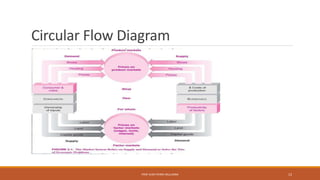
The Circular Flow Model
Market economy presents the following picture: The Circular Flow Model
◦ An overview of consumers and producers interactions to set prices and quantities
The model:
◦ Two economic agents:
◦ Households
◦ Firms, businesses, producers
◦ Two markets:
◦ Products Market
◦ Factors of production Market
◦ Assumption: households own all the factors of production
PROF JEAN-PIERRE MULUMBA 10
Economic Agents
A household is a domestic unit of a family who live together share their income & consumption.
A firm is a business enterprise that produces goods and services for sale.
Firms sell goods and services that they produce to households in Markets for Products.
Businesses buy resources they need to use—factors of production—in Factor Markets.
PROF JEAN-PIERRE MULUMBA 11
Circular Flow Diagram
PROF JEAN-PIERRE MULUMBA 12
The Functioning of Market Economy:
The Invisible Hand
Adam Smith:
The Invisible Hand: the way the market economy organizes the supply and demand.
◦ Private interest can lead to public gain in a well-functioning market mechanism
◦ Then, government’s interference in economy is almost injurious
◦ But when there are market failures government intervention is desirable
PROF JEAN-PIERRE MULUMBA 13
Trade, Money and Capital
Distinguishing traits of a modern economy:
◦ Elaborate network of trade based on specialization and division of labor
◦ Extensive use of money
◦ Use of vast stocks of capital
PROF JEAN-PIERRE MULUMBA 14
Trade, Specialization and Division of
Labor
The trade network depends on specialization and the division of labor
Specialization: effort limitation on special productions, or on particular sector of activity
◦ Division of labor: dividing production into a number of specialized steps or tasks
◦ Specialization and trade have produced the globalization
◦ High integration of nations economies
PROF JEAN-PIERRE MULUMBA 15
Money: The Lubricant Of Exchanges
Means of payment in the form of currency and checks
◦ Used when we buy goods and services
◦ Lubricant that facilitates exchanges
◦ Everyone accept them: medium of exchanges
Governments control the money circulation
◦ Money supply is major issue of macroeconomics
◦ Inflation
◦ Deflation
PROF JEAN-PIERRE MULUMBA 16
Capital
One of the three traditional factors of production
It is the most characteristic resource of advanced industrial economy
It is:
◦ A produced factor of production,
◦ A durable input
◦ An output of the economy
Obtained by abstaining from present consumption
In a market economy, it is privately owned
Gives it is name to the capitalist system
PROF JEAN-PIERRE MULUMBA 17
The Visible Hand of Government(1)
The invisible hand is an idealized functioning of the economy.
The economic imperfections lead to many ills.
That's why no government keeps its hands off the economy.
◦ In response to the flaws in the market mechanism
◦ Beside the typical government activities
◦ The socially useful ventures
◦ And regulation of some businesses
PROF JEAN-PIERRE MULUMBA 18
The Visible Hand of Government(2)
Government perform their functions by
◦ Requiring people to pay taxes
◦ Requiring people to obey regulations
◦ Requiring people to consume certain collective good and service
Governments have three economic functions in a market economy:
◦ Increase economic efficiency
◦ Promote equity
◦ Foster macroeconomic stability and growth
PROF JEAN-PIERRE MULUMBA 19
Efficiency Of The System
The invisible-hand doctrine applies to perfectly competitive markets
◦ A market in which no agent can affect the market price.
Perfectly competitive markets produce an efficient allocation of resources,
◦ The economy is on its production-possibility frontier.
The three important ways to imperfect competition are:
◦ Monopolies
◦ Externalities
◦ Public goods
PROF JEAN-PIERRE MULUMBA 20
Government: Increases The Efficiency Of
The System
Government increases efficiency by this kind of actions
Government promotes competition by fighting imperfect competition
◦ Monopoly is the extreme case
◦ Use regulation in concerned sectors
◦ Anti-trust laws
◦ Solution: market opening to many competitors.
PROF JEAN-PIERRE MULUMBA 21
Government: Increases The Efficiency Of
The System (1)
Government curbs externalities
◦ Spillovers which involve involuntary imposition of costs or benefits
◦ Activity that helps or hurt people outside the marketplace
◦ Negative externalities are nowadays major threats
◦ Government regulations: solution to control externalities
PROF JEAN-PIERRE MULUMBA 22
Government: Increases The Efficiency Of
The System (2)
Government provides public goods
◦ Commodities that can be enjoyed by everyone
◦ Commodities that no one can be excluded
◦ Commodities which the cost of extending the service to an additional person is zero
◦ Governments use revenues from taxation to provide them
◦ Taxes are also used to finance income-distribution programs
◦ They are levied on
◦ personal and corporate incomes,
◦ on wages,
◦ on sales of consumer goods, etc
PROF JEAN-PIERRE MULUMBA 23
PROF JEAN-PIERRE MULUMBA 24

Chapter 2(1)

  • 1.
    Chapter 2 THE MODERNMIXED ECONOMY
  • 2.
    About This Chapter Whatis a market? Role of the market in the modern nations Market mechanisms How market solve the Three Fundamental Questions Role of government in market economy PROF JEAN-PIERRE MULUMBA 2
  • 3.
    Learning Objectives After studyingthis chapter students should be able to: ◦ •Define a Market. ◦ •Describe a modern advanced economy. ◦ •Describe the economic role of Modern Government in different economic organizations. ◦ •Sketch the market failures and assorted government responses nowadays. ◦ •Differentiate between various economic policies. PROF JEAN-PIERRE MULUMBA 3
  • 4.
    Introduction Medieval Era, thearistocracy and town guilds directed much of the economic activity. The 19th Century, the age of ”laissez-faire”, the era of the queen market. In the 20th Century, some economies adopted the socialism ◦ Government control on the economic activities ◦ Around 90s communists countries adopted the market rule Modern economies are mixed economies ◦ Combination of marketplace decision and government regulation PROF JEAN-PIERRE MULUMBA 4
  • 5.
    What Is AMarket? A market is a mechanism for coordinating activities through prices and markets. ◦ Allowing buyers and sellers to set price and exchange goods or services. It is a communication device for pooling actions of diverse individuals. . ◦ It may be centralized. ◦ It may be decentralized, as is the case for most workers. ◦ it may exist only electronically’ PROF JEAN-PIERRE MULUMBA 5
  • 6.
    What Is AMarket? (1) In a market system, everything has a price. Prices are terms on which we exchange different commodities. It is the value of the good in terms of money. ◦ They serve as signals to producers and consumers. There is no chaos but economic order. PROF JEAN-PIERRE MULUMBA 6
  • 7.
    Market Equilibrium When theybalance all the forces operating on the economy It is a balance among all the different buyers and sellers ◦ Finding the equilibrium price ◦ That simultaneously meets the desires of buyers and sellers ◦ Yielding an equilibrium of supply and demand PROF JEAN-PIERRE MULUMBA 7
  • 8.
    How Markets Solvethe Three Economic Problems? By matching sellers and buyers And simultaneously, solves the three problems of what, how and for whom. The what problem is solved by ◦ Dollar votes of consumers, and ◦ Desire to maximize profits for firms. How problem is determined by the competition among producers For whom question depends on the supply and demand for factors of production ◦ Wage rates, interest rates, and profits PROF JEAN-PIERRE MULUMBA 8
  • 9.
    • Who AreThe Rulers In A Market Economy? Forces affecting the market economy are tastes and technology ◦ Consumers with their tastes and dollar votes ◦ Producers with the available technology and resources The market system deals out profits and losses ◦ To induce firms to produce desired goods efficiently PROF JEAN-PIERRE MULUMBA 9
  • 10.
    The Circular FlowModel Market economy presents the following picture: The Circular Flow Model ◦ An overview of consumers and producers interactions to set prices and quantities The model: ◦ Two economic agents: ◦ Households ◦ Firms, businesses, producers ◦ Two markets: ◦ Products Market ◦ Factors of production Market ◦ Assumption: households own all the factors of production PROF JEAN-PIERRE MULUMBA 10
  • 11.
    Economic Agents A householdis a domestic unit of a family who live together share their income & consumption. A firm is a business enterprise that produces goods and services for sale. Firms sell goods and services that they produce to households in Markets for Products. Businesses buy resources they need to use—factors of production—in Factor Markets. PROF JEAN-PIERRE MULUMBA 11
  • 12.
    Circular Flow Diagram PROFJEAN-PIERRE MULUMBA 12
  • 13.
    The Functioning ofMarket Economy: The Invisible Hand Adam Smith: The Invisible Hand: the way the market economy organizes the supply and demand. ◦ Private interest can lead to public gain in a well-functioning market mechanism ◦ Then, government’s interference in economy is almost injurious ◦ But when there are market failures government intervention is desirable PROF JEAN-PIERRE MULUMBA 13
  • 14.
    Trade, Money andCapital Distinguishing traits of a modern economy: ◦ Elaborate network of trade based on specialization and division of labor ◦ Extensive use of money ◦ Use of vast stocks of capital PROF JEAN-PIERRE MULUMBA 14
  • 15.
    Trade, Specialization andDivision of Labor The trade network depends on specialization and the division of labor Specialization: effort limitation on special productions, or on particular sector of activity ◦ Division of labor: dividing production into a number of specialized steps or tasks ◦ Specialization and trade have produced the globalization ◦ High integration of nations economies PROF JEAN-PIERRE MULUMBA 15
  • 16.
    Money: The LubricantOf Exchanges Means of payment in the form of currency and checks ◦ Used when we buy goods and services ◦ Lubricant that facilitates exchanges ◦ Everyone accept them: medium of exchanges Governments control the money circulation ◦ Money supply is major issue of macroeconomics ◦ Inflation ◦ Deflation PROF JEAN-PIERRE MULUMBA 16
  • 17.
    Capital One of thethree traditional factors of production It is the most characteristic resource of advanced industrial economy It is: ◦ A produced factor of production, ◦ A durable input ◦ An output of the economy Obtained by abstaining from present consumption In a market economy, it is privately owned Gives it is name to the capitalist system PROF JEAN-PIERRE MULUMBA 17
  • 18.
    The Visible Handof Government(1) The invisible hand is an idealized functioning of the economy. The economic imperfections lead to many ills. That's why no government keeps its hands off the economy. ◦ In response to the flaws in the market mechanism ◦ Beside the typical government activities ◦ The socially useful ventures ◦ And regulation of some businesses PROF JEAN-PIERRE MULUMBA 18
  • 19.
    The Visible Handof Government(2) Government perform their functions by ◦ Requiring people to pay taxes ◦ Requiring people to obey regulations ◦ Requiring people to consume certain collective good and service Governments have three economic functions in a market economy: ◦ Increase economic efficiency ◦ Promote equity ◦ Foster macroeconomic stability and growth PROF JEAN-PIERRE MULUMBA 19
  • 20.
    Efficiency Of TheSystem The invisible-hand doctrine applies to perfectly competitive markets ◦ A market in which no agent can affect the market price. Perfectly competitive markets produce an efficient allocation of resources, ◦ The economy is on its production-possibility frontier. The three important ways to imperfect competition are: ◦ Monopolies ◦ Externalities ◦ Public goods PROF JEAN-PIERRE MULUMBA 20
  • 21.
    Government: Increases TheEfficiency Of The System Government increases efficiency by this kind of actions Government promotes competition by fighting imperfect competition ◦ Monopoly is the extreme case ◦ Use regulation in concerned sectors ◦ Anti-trust laws ◦ Solution: market opening to many competitors. PROF JEAN-PIERRE MULUMBA 21
  • 22.
    Government: Increases TheEfficiency Of The System (1) Government curbs externalities ◦ Spillovers which involve involuntary imposition of costs or benefits ◦ Activity that helps or hurt people outside the marketplace ◦ Negative externalities are nowadays major threats ◦ Government regulations: solution to control externalities PROF JEAN-PIERRE MULUMBA 22
  • 23.
    Government: Increases TheEfficiency Of The System (2) Government provides public goods ◦ Commodities that can be enjoyed by everyone ◦ Commodities that no one can be excluded ◦ Commodities which the cost of extending the service to an additional person is zero ◦ Governments use revenues from taxation to provide them ◦ Taxes are also used to finance income-distribution programs ◦ They are levied on ◦ personal and corporate incomes, ◦ on wages, ◦ on sales of consumer goods, etc PROF JEAN-PIERRE MULUMBA 23
  • 24.

Editor's Notes

  • #3 The market is the core of the modern industrialized nations. The lesson here is centered on the meaning of the concept of market, on how markets solve the three fundamental economic questions, on the tools used in the functioning of market economies, and what role governments plays in this kind of economies. /* Style Definitions */ table.MsoNormalTable {mso-style-name:"Table Normal"; mso-tstyle-rowband-size:0; mso-tstyle-colband-size:0; mso-style-noshow:yes; mso-style-priority:99; mso-style-parent:""; mso-padding-alt:0in 5.4pt 0in 5.4pt; mso-para-margin-top:0in; mso-para-margin-right:0in; mso-para-margin-bottom:8.0pt; mso-para-margin-left:0in; line-height:107%; mso-pagination:widow-orphan; font-size:11.0pt; font-family:"Calibri","sans-serif"; mso-ascii-font-family:Calibri; mso-ascii-theme-font:minor-latin; mso-hansi-font-family:Calibri; mso-hansi-theme-font:minor-latin;}
  • #5 The contemporary economic organizations are a combination of a market economy with some degree of government intervention. To arrive to this organization, countries experienced, in medieval times, in Europe and in Asia, the aristocracy and town guilds that directed much of the economic activity. In the nineteenth century, the age of“”laissez-faire”, translated by leave us alone, was the era of the queen market. In this period the government could not interfere in economy. At the end of the 19th century many countries, exceeded by the excess of the unbridled capitalism, pushed their governments to adopt an expansive economic role, called welfare state having for objective to regulate monopolies, to collect taxes, and to organize social security. This system lasted until the beginning of the last century, in America and Europe, and after that, the tendency was to deregulate government’s control over the economy. This logic of government control was dramatized in socialist countries: Soviet Union, Eastern European countries, China, and some developing countries like Cuba and Vietnam. Around 1990, the socialist countries started a difficult transition toward a market economy, by allowing markets to operate, or at least to function in some areas of their countries. The modern economy of every country in the world is a mixed economy —a combination of private enterprise working through the marketplace and government regulation, taxation, and programs. /* Style Definitions */ table.MsoNormalTable {mso-style-name:"Table Normal"; mso-tstyle-rowband-size:0; mso-tstyle-colband-size:0; mso-style-noshow:yes; mso-style-priority:99; mso-style-parent:""; mso-padding-alt:0in 5.4pt 0in 5.4pt; mso-para-margin-top:0in; mso-para-margin-right:0in; mso-para-margin-bottom:8.0pt; mso-para-margin-left:0in; line-height:107%; mso-pagination:widow-orphan; font-size:11.0pt; font-family:"Calibri","sans-serif"; mso-ascii-font-family:Calibri; mso-ascii-theme-font:minor-latin; mso-hansi-font-family:Calibri; mso-hansi-theme-font:minor-latin;}
  • #6  A market economy is an elaborate mechanism for coordinating people, activities, and businesses through a system of prices and markets. Without central intelligence or computation, it solves problems of production and distribution involving billions of unknown variables and relations, problems that are far beyond the reach of even today’s fastest supercomputer. Nobody designed the market, yet it functions remarkably well. Originally, a market was an actual place where buyers and sellers could engage in face-to-face bargaining, where farmers brought their goods to sell. Markets are places where buyers and sellers interact, exchange goods and services or assets, and determine prices. There are markets for almost everything. A market may be centralized, like the stock market. It may be decentralized, as is the case for most workers. Or it may exist only electronically, as is
  • #7 Markets are places where buyers and sellers interact, exchange goods and services or assets, and determine prices. There are markets for almost everything. A market may be centralized, like the stock market. It may be decentralized, as is the case for most workers. Or it may exist only electronically, as is increasingly the case with “e-commerce” on the Internet. Prices coordinate the decisions of producers and consumers in a market. Higher prices tend to reduce consumer purchases and encourage production. Lower prices encourage consumption and discourage production. Prices are the balance wheel of the market mechanism.
  • #8 At every moment, some people are buying while others are selling. Yet in the midst of all this turmoil,markets are constantly solving the  what, how, and  for whom. As they balance all the forces operating on the economy, markets are finding a  market equilibrium of supply and demand.     A market equilibrium represents a balance among all the different buyers and sellers. Depending upon the price, households and firms all want to buy or sell different quantities. The market finds the equilibrium price that simultaneously meets the desires of buyers and sellers. Too high a price would mean a glut of goods with too much output; too low a price would produce long lines in stores and a deficiency of goods. Those prices for which buyers desire to buy exactly the quantity that sellers desire to sell yield an equilibrium of supply and demand.
  • #10 Who are the rulers in a market economy?   a) A dual monarchy shared by consumers and technology rules the market economy :  · Consumers are directed by their innate and acquired tastes, as expressed by their dollar votes.   · Producers with the constraint of the available resources and technology are also determinative in the decision of what to produce or to offer in the market.    Like a farmer using a carrot and a stick to coax a donkey forward, the market system deals out profits and losses to induce firms to produce desired goods efficiently.
  • #11 The market economy presents the following picture: The Circular Flow Model. The diagram provides an overview of how consumers and producers interact to determine prices and quantities for both inputs and outputs.   We have here two markets: Products Market in which outputs produced by the Producers are sold, and in which Households and Consumers buy these commodities and services to satisfy their needs by expressing the dollar vote. In the Factors Market Households sell factors of production they own, and receive wages, rents, and interests. Businesses and Producers stock up with the factors of production they will combine to get products that will be sold on the Products Market.
  • #12  A household is a person or a group of people that share their income. A firm is an organization that produces goods and services for sale. Firms sell goods and services that they produce to households in markets for goods and services. Firms buy the resources they need to produce—factors of production—in factor markets.
  • #14  The functioning of market economy follows a logical order first recognized by Adam Smith in his classic The Wealth if Nation 1876. This order was called The Principle of the Invisible Hand which holds that: in selfish pursuing his or her personal interest, every individual is led, as if by an invisible hand, to achieve the best good for all, and this end was no part of his intention ( See the resources to learn more). Then governments interference with market competition is almost certain to be injurious. This vision inspired modern economists in their critics or their admiration of capitalism. However, they have proved that under restrictive conditions, a perfectly competitive market is efficient (when it cannot increase the economic welfare of anyone without making someone else worse off).
  • #15 What are some of the distinguishing features of a modern economy? Three important ones are considered in this section: 1. An advanced economy is characterized by an elaborate network of trade that depends on specialization and an intricate division of labor. 2. Modern economies today make extensive use of money, which provides the yardstick for measuring economic values and is the means of payment. 3. Modern industrial technologies rest on the use of vast stocks of capital. Capital leverages human labor into a much more efficient factor of production and allows productivity many times greater than that possible in an earlier age.
  • #16  An elaborate network of trade among individual and among nations characterizes modern economies. This network depends on the specialization and the division of labor. The specialization occurs when people and countries limit their efforts of the production on special goods and services, or on particular sector of activity. That leads us to the notion of division of labor: dividing production into a number of specialized steps or tasks. Example: California, Bordeaux, Loire, and Champagne are specialized in wine production. Today, only a very few number of countries produce a whole complete set of items. Usually they produce entirely a tiny fraction of what they consume. The world economy is specialized in areas and sectors of activities that increase gains and incomes. This specialization and trade have produced the globalization: fruit of the decrease in transportation cost. It is a high level of integration of nations economies.

  • #17  · What is money?Money is the means of payment. It is the currency and checking deposits that we use when we buy goods and services. More precisely, money is a lubricant that facilitates exchanges, because everyone accepts it as the medium of exchanges. · By accepting money, countries and economic agents can specialize in some product ant services that they can trade for other (think about barter). · Because money is so important for an economy; governments control the money circulation in a country through the central bank. The money supply is one of the major issues for macroeconomic government policy in all countries. Its growth out of control can cause prices instability (inflation or deflation).
  • #18  Capital is the most characteristic resource that advanced industrial economy like the United States of America has and uses. · It is called also a component of traditional factors of production. The three major factors of production are capital, land and labor. Land and labor are called primary factors of production: they are determined by non-economic factors, such as fertility, geography, inheritance, and so on. · Capital is a produced factor of production, a durable input that is itself an output of the economy. · It is obtained by abstaining from present consumption and waiting for future consumption. It is a result of saving. · In a market economy, capital typically is privately owned, and the income from capital goes to individuals. · The ability of Individuals to owe and to profit from capital gives to market economy its name of capitalist system.
  • #19 In reality, however, no economy actually conforms totally to the idealized world of the smoothly functioning invisible hand. Rather, economic imperfections lead to such ills as pollution, unemployment, financial panics, and extremes of wealth and poverty.     No government anywhere in the world, at any time, keeps its hands off the economy. Governments take on many tasks in response to the flaws in the market mechanism. The military, the police, and the national weather service are typical areas of government activity. Socially useful ventures such as space exploration and scientific research benefit from government funding. Governments may regulate some businesses (such as finance and drugs) while subsidizing others (such as education and biomedical research). Governments tax their citizens and redistribute some of the proceeds to the elderly and needy.
  • #20 How do governments perform their functions?   Governments operate by requiring people to pay taxes, obey regulations, and consume certain collective goods and services. Because of its coercive powers, the government can perform functions that would not be possible under voluntary exchange.    Governments have three main economic functions in a market economy:   1.  Governments increase  efficiency by promoting competition, curbing externalities like pollution, and providing public goods.    2.  Governments promote  equity by using tax and expenditure programs to redistribute income toward particular groups.    3.  Governments foster  macroeconomic stability and growth —reducing unemployment and inflation while encouraging economic growth—through fiscal and monetary policy.    We will examine briefly each function.  
  • #21 Adam Smith recognized that the market mechanism is fully realized only in case of a perfect competition. What is meant by perfect competition ? This term refers to a market in which no firm or consumer is large enough to affect the market price. The invisible-hand doctrine applies to economies in which all markets are perfectly competitive. Perfectly competitive markets will produce an efficient allocation of resources. Alas, there are many ways that markets can fall short of efficient perfect competition. The three most important ones involve imperfect competition, such as monopolies; externalities, such as pollution; and public goods, such as national defense and light-houses. In each case, market failure leads to inefficient production or consumption, and government can play a useful role in curing the disease.
  • #22 Government increases efficiency by this kind of actions: · Government promotes competition by fighting imperfect competition, a situation in which a seller or a buyer can affect the price of a commodity in a market. The extreme case of imperfect competition is the monopoly. Over the years, governments attempt to fight this failure by regulating the concerned sector: the anti-trusts laws are the illustration of this attempt to restore perfect competition. But the most important step to this ideal competition is the market opening to many competitors.
  • #23 · Government curbs externalities like pollution. Externalities involve involuntary imposition of costs or benefits; they occur when firms or people impose costs or benefits to others. Many transactions of this kind take place outside the market. Example highways produce pollution that we cannot quantify, evaluate, and exchange in the markets. Generally, governments are concerned with the negative externalities.
  • #24 · Government provides public goods. Public goods are goods that cannot be bought and sold in the markets. They are commodities for which the cost of extending the service to an additional person is zero, and for which it is impossible to exclude individuals from enjoying it. Example: national defense, lighthouse, public radios, etc. Because private provision of them is generally insufficient, government must step in to encourage their production. Governments use revenues from taxation to provide them. Taxes are also used to finance income-distribution programs. They are levied on personal and corporate incomes, on wages, on sales of consumer goods, and on other items.