ERP based Accounting
After the end of this program:

 Participants will be able to use F&A Concepts,                 learnt   during
academics, effectively in ERP based Accounting environment

 Gain clarity on job profile/description       in   an   MNC/F&A   outsourcing
company/Indian corporate

   Candidates would be better prepared for an interview and on-job performance

Candidates would be more productive for a rapid growth by learning key F&A
and MS-Excel skills

 Candidates would be oriented on work culture and how to have right attitude
at work
   On macro level, India has become the major destination for KPO
    services

   Corporate spent is huge on recruitment & training

   Hit ratio at times is as low as 3 out of 100 resumes scanned

   After recruitment there is expectations mis-match for freshers with
    regards to job profile

   Industry-Academic gap is steep and students are not able to relate
    their existing knowledge to the job profile

   ERP accounting is not familiar to students of finance and accounts in
    the way businesses execute & record transactions
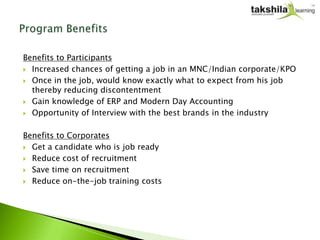
Benefits to Participants
 Increased chances of getting a job in an MNC/Indian corporate/KPO

 Once in the job, would know exactly what to expect from his job
  thereby reducing discontentment
 Gain knowledge of ERP and Modern Day Accounting

 Opportunity of Interview with the best brands in the industry


Benefits to Corporates
 Get a candidate who is job ready

 Reduce cost of recruitment

 Save time on recruitment

 Reduce on-the-job training costs
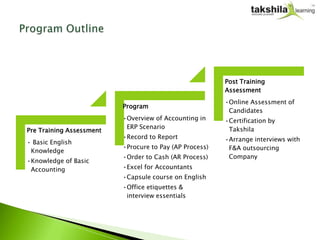
Post Training
                                                         Assessment
                                                         •Online Assessment of
                          Program
                                                          Candidates
                          •Overview of Accounting in     •Certification by
                           ERP Scenario                   Takshila
Pre Training Assessment
                          •Record to Report              •Arrange interviews with
• Basic English
                          •Procure to Pay (AP Process)    F&A outsourcing
 Knowledge
                          •Order to Cash (AR Process)     Company
•Knowledge of Basic
 Accounting               •Excel for Accountants
                          •Capsule course on English
                          •Office etiquettes &
                           interview essentials
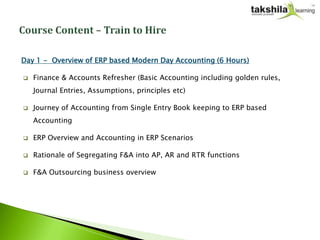
Day 1 - Overview of ERP based Modern Day Accounting (6 Hours)

   Finance & Accounts Refresher (Basic Accounting including golden rules,
    Journal Entries, Assumptions, principles etc)

   Journey of Accounting from Single Entry Book keeping to ERP based
    Accounting

   ERP Overview and Accounting in ERP Scenarios

   Rationale of Segregating F&A into AP, AR and RTR functions

   F&A Outsourcing business overview
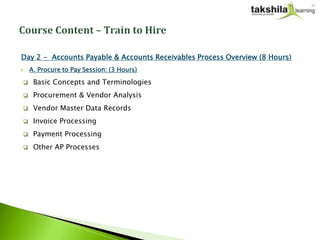
Day 2 - Accounts Payable & Accounts Receivables Process Overview (8 Hours)
   A. Procure to Pay Session: (3 Hours)

    Basic Concepts and Terminologies
    Procurement & Vendor Analysis
    Vendor Master Data Records
    Invoice Processing
    Payment Processing
    Other AP Processes
Day 2 - Accounts Payable & Accounts Receivables Process Overview (8 Hours)
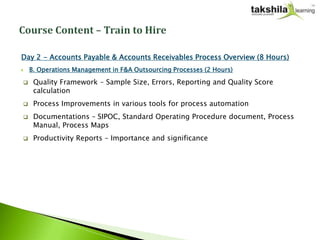
   B. Operations Management in F&A Outsourcing Processes (2 Hours)

    Quality Framework – Sample Size, Errors, Reporting and Quality Score
     calculation
    Process Improvements in various tools for process automation
    Documentations – SIPOC, Standard Operating Procedure document, Process
     Manual, Process Maps
    Productivity Reports – Importance and significance
Day 2 - Accounts Payable & Accounts Receivables Process Overview (8 Hours)
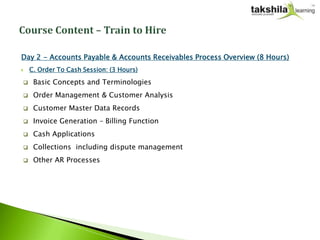
   C. Order To Cash Session: (3 Hours)

    Basic Concepts and Terminologies
    Order Management & Customer Analysis
    Customer Master Data Records
    Invoice Generation – Billing Function
    Cash Applications
    Collections including dispute management
    Other AR Processes
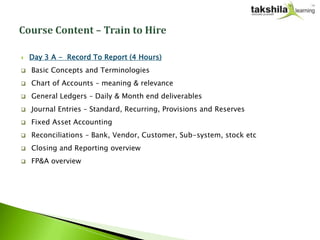
   Day 3 A - Record To Report (4 Hours)
   Basic Concepts and Terminologies
   Chart of Accounts – meaning & relevance
   General Ledgers – Daily & Month end deliverables
   Journal Entries – Standard, Recurring, Provisions and Reserves
   Fixed Asset Accounting
   Reconciliations – Bank, Vendor, Customer, Sub-system, stock etc
   Closing and Reporting overview
   FP&A overview
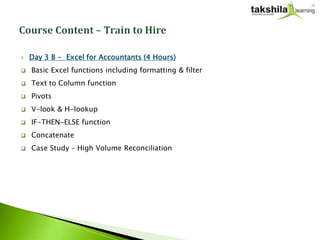
   Day 3 B - Excel for Accountants (4 Hours)
   Basic Excel functions including formatting & filter
   Text to Column function
   Pivots
   V-look & H-lookup
   IF-THEN-ELSE function
   Concatenate
   Case Study – High Volume Reconciliation
   Day 4 a - Capsule course on English (3 Hours)
   English Grammar
   Commercial correspondence
   Spoken English
   Day 4 b - Interview Essentials (3 Hours)
   Interview basics
   Preparation for the interview
   Body language - non-verbal
   Interview Mannerism
   Do’s and Don’t’s
   Day 4 c - Office etiquettes (3 Hours)
   Social & Communication skills at work place - Verbal & Non-verbal
   Presentation skills
   Managing and participating in meetings – group dynamics
   Business reports & Memo writing
   Cross-cultural skills
   Teaming skills
   Attitude at work – telephones handling, email writing, general behavior
   Day 5 (Optional) - Real Life Scenario Handling
   Mock Interviews
   Mock presentations
   Mock meetings
   Write and demonstrate the communication skills
Contact @ 8800999284
info@takshilalearning.com

Job Oriented Course - GetHired

  • 1.
  • 2.
    After the endof this program:  Participants will be able to use F&A Concepts, learnt during academics, effectively in ERP based Accounting environment  Gain clarity on job profile/description in an MNC/F&A outsourcing company/Indian corporate  Candidates would be better prepared for an interview and on-job performance Candidates would be more productive for a rapid growth by learning key F&A and MS-Excel skills  Candidates would be oriented on work culture and how to have right attitude at work
  • 3.
    On macro level, India has become the major destination for KPO services  Corporate spent is huge on recruitment & training  Hit ratio at times is as low as 3 out of 100 resumes scanned  After recruitment there is expectations mis-match for freshers with regards to job profile  Industry-Academic gap is steep and students are not able to relate their existing knowledge to the job profile  ERP accounting is not familiar to students of finance and accounts in the way businesses execute & record transactions
  • 4.
    Benefits to Participants Increased chances of getting a job in an MNC/Indian corporate/KPO  Once in the job, would know exactly what to expect from his job thereby reducing discontentment  Gain knowledge of ERP and Modern Day Accounting  Opportunity of Interview with the best brands in the industry Benefits to Corporates  Get a candidate who is job ready  Reduce cost of recruitment  Save time on recruitment  Reduce on-the-job training costs
  • 5.
    Post Training Assessment •Online Assessment of Program Candidates •Overview of Accounting in •Certification by ERP Scenario Takshila Pre Training Assessment •Record to Report •Arrange interviews with • Basic English •Procure to Pay (AP Process) F&A outsourcing Knowledge •Order to Cash (AR Process) Company •Knowledge of Basic Accounting •Excel for Accountants •Capsule course on English •Office etiquettes & interview essentials
  • 6.
    Day 1 -Overview of ERP based Modern Day Accounting (6 Hours)  Finance & Accounts Refresher (Basic Accounting including golden rules, Journal Entries, Assumptions, principles etc)  Journey of Accounting from Single Entry Book keeping to ERP based Accounting  ERP Overview and Accounting in ERP Scenarios  Rationale of Segregating F&A into AP, AR and RTR functions  F&A Outsourcing business overview
  • 7.
    Day 2 -Accounts Payable & Accounts Receivables Process Overview (8 Hours)  A. Procure to Pay Session: (3 Hours)  Basic Concepts and Terminologies  Procurement & Vendor Analysis  Vendor Master Data Records  Invoice Processing  Payment Processing  Other AP Processes
  • 8.
    Day 2 -Accounts Payable & Accounts Receivables Process Overview (8 Hours)  B. Operations Management in F&A Outsourcing Processes (2 Hours)  Quality Framework – Sample Size, Errors, Reporting and Quality Score calculation  Process Improvements in various tools for process automation  Documentations – SIPOC, Standard Operating Procedure document, Process Manual, Process Maps  Productivity Reports – Importance and significance
  • 9.
    Day 2 -Accounts Payable & Accounts Receivables Process Overview (8 Hours)  C. Order To Cash Session: (3 Hours)  Basic Concepts and Terminologies  Order Management & Customer Analysis  Customer Master Data Records  Invoice Generation – Billing Function  Cash Applications  Collections including dispute management  Other AR Processes
  • 10.
    Day 3 A - Record To Report (4 Hours)  Basic Concepts and Terminologies  Chart of Accounts – meaning & relevance  General Ledgers – Daily & Month end deliverables  Journal Entries – Standard, Recurring, Provisions and Reserves  Fixed Asset Accounting  Reconciliations – Bank, Vendor, Customer, Sub-system, stock etc  Closing and Reporting overview  FP&A overview
  • 11.
    Day 3 B - Excel for Accountants (4 Hours)  Basic Excel functions including formatting & filter  Text to Column function  Pivots  V-look & H-lookup  IF-THEN-ELSE function  Concatenate  Case Study – High Volume Reconciliation
  • 12.
    Day 4 a - Capsule course on English (3 Hours)  English Grammar  Commercial correspondence  Spoken English  Day 4 b - Interview Essentials (3 Hours)  Interview basics  Preparation for the interview  Body language - non-verbal  Interview Mannerism  Do’s and Don’t’s
  • 13.
    Day 4 c - Office etiquettes (3 Hours)  Social & Communication skills at work place - Verbal & Non-verbal  Presentation skills  Managing and participating in meetings – group dynamics  Business reports & Memo writing  Cross-cultural skills  Teaming skills  Attitude at work – telephones handling, email writing, general behavior
  • 14.
    Day 5 (Optional) - Real Life Scenario Handling  Mock Interviews  Mock presentations  Mock meetings  Write and demonstrate the communication skills
  • 15.