INTRODUCTION TO FINAL ACCOUNTSThe transition from the Trial Balance to the financial statements
Purpose of Preparing Financial Statements	Financial statements are prepared primarily for the business owner; but may be used by any interested third party with the owner’s consent.Owner needs to know what returns were gained on his investment.Buyers need to know if the business is a profitable going concern.Investors/Partners need to know if it is worth the opportunity costs.Banks/Lenders need to know if the business is able to repay the debt/interest.Creditors need to know if they can recover their money if the business liquidates.Taxes have to be calculated and paid into the government treasury.
Financial statements are sometimes refer to as Final AccountsFinancial Statements constitute –Trading AccountProfit & Loss accountBalance Sheet
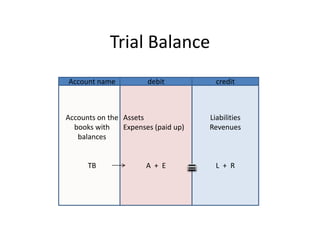
The Trial BalanceIs a list of all the balances in the ledgers at the end of the period in review.It uses two monetary columns [debit, credit]The debit column displays the  assets and paid up expenses [A + E ] as at the date of review;The credit column displays the liabilities and income gained [L + C] as at the date of reviewTrial Balance formula.. A + E = L + C
Trial BalanceAccounts on the books with balancesTB AssetsExpenses (paid up)A  +  ELiabilitiesRevenuesL  +  RAccount namedebitcredit
Trial Balance as on …The Bal c/d on the account should be posted to the opposing column on the Trial Balance [eg if the Cash bal c/d fell on the credit side then it should be recorded in the debit column of the Trial Balance]Assets, Expenses  Liabilities, Income
Creditors’ figure(the summary total of the amounts owing to the suppliers recorded in this ledger)Debtors’ figure(the summary total of the amounts owed by the customers recorded in this ledger)Posting – transfer data from the journals [Day Books] to the ledgersBalance off – the act of finding the figure that makes both side equalDebit – the act of recording data on the left hand side of the accountCredit – the act of recording data on the right hand side of the account
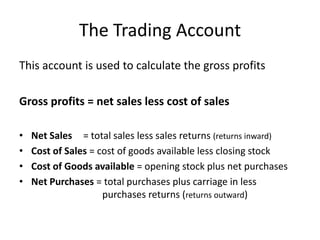
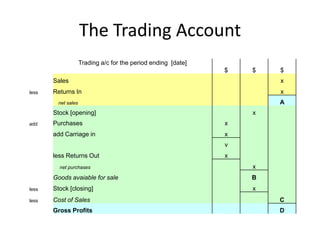
The Trading AccountThis account is used to calculate the gross profitsGross profits = net sales less cost of salesNet Sales 	= total sales less sales returns (returns inward)Cost of Sales = cost of goods available less closing stockCost of Goods available = opening stock plus net purchasesNet Purchases = total purchases plus carriage in less 			        purchases returns (returns outward)
The Trading Account
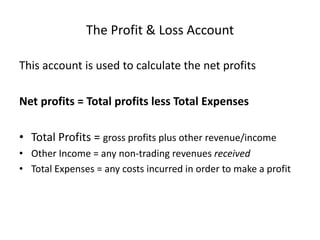
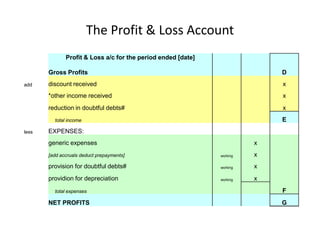
The Profit & Loss AccountThis account is used to calculate the net profitsNet profits = Total profits less Total ExpensesTotal Profits = gross profits plus other revenue/incomeOther Income = any non-trading revenues receivedTotal Expenses = any costs incurred in order to make a profit
The Profit & Loss Account
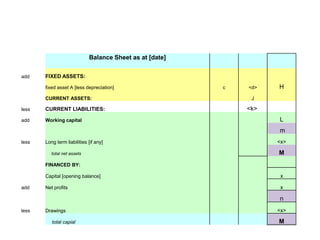
The Balance Sheet	This shows the financial status of the business at a given date.	It reveals the value of the assets, liabilities, and capital... such that -:Net Capital = Net Assets less long term liabilities   [C = A – L]Net Assets = Fixed Assets plus Working CapitalWorking Capital = Current Assets less Current LiabilitiesLong term Liabilities = debts which become due after 1 yearORNet Capital = opening capital plus net profits less drawings
Introduction to final accounts

Introduction to final accounts

  • 1.
    INTRODUCTION TO FINALACCOUNTSThe transition from the Trial Balance to the financial statements
  • 2.
    Purpose of PreparingFinancial Statements Financial statements are prepared primarily for the business owner; but may be used by any interested third party with the owner’s consent.Owner needs to know what returns were gained on his investment.Buyers need to know if the business is a profitable going concern.Investors/Partners need to know if it is worth the opportunity costs.Banks/Lenders need to know if the business is able to repay the debt/interest.Creditors need to know if they can recover their money if the business liquidates.Taxes have to be calculated and paid into the government treasury.
  • 3.
    Financial statements aresometimes refer to as Final AccountsFinancial Statements constitute –Trading AccountProfit & Loss accountBalance Sheet
  • 4.
    The Trial BalanceIsa list of all the balances in the ledgers at the end of the period in review.It uses two monetary columns [debit, credit]The debit column displays the assets and paid up expenses [A + E ] as at the date of review;The credit column displays the liabilities and income gained [L + C] as at the date of reviewTrial Balance formula.. A + E = L + C
  • 5.
    Trial BalanceAccounts onthe books with balancesTB AssetsExpenses (paid up)A + ELiabilitiesRevenuesL + RAccount namedebitcredit
  • 6.
    Trial Balance ason …The Bal c/d on the account should be posted to the opposing column on the Trial Balance [eg if the Cash bal c/d fell on the credit side then it should be recorded in the debit column of the Trial Balance]Assets, Expenses  Liabilities, Income
  • 7.
    Creditors’ figure(the summarytotal of the amounts owing to the suppliers recorded in this ledger)Debtors’ figure(the summary total of the amounts owed by the customers recorded in this ledger)Posting – transfer data from the journals [Day Books] to the ledgersBalance off – the act of finding the figure that makes both side equalDebit – the act of recording data on the left hand side of the accountCredit – the act of recording data on the right hand side of the account
  • 8.
    The Trading AccountThisaccount is used to calculate the gross profitsGross profits = net sales less cost of salesNet Sales = total sales less sales returns (returns inward)Cost of Sales = cost of goods available less closing stockCost of Goods available = opening stock plus net purchasesNet Purchases = total purchases plus carriage in less purchases returns (returns outward)
  • 9.
  • 10.
    The Profit &Loss AccountThis account is used to calculate the net profitsNet profits = Total profits less Total ExpensesTotal Profits = gross profits plus other revenue/incomeOther Income = any non-trading revenues receivedTotal Expenses = any costs incurred in order to make a profit
  • 11.
    The Profit &Loss Account
  • 12.
    The Balance Sheet Thisshows the financial status of the business at a given date. It reveals the value of the assets, liabilities, and capital... such that -:Net Capital = Net Assets less long term liabilities [C = A – L]Net Assets = Fixed Assets plus Working CapitalWorking Capital = Current Assets less Current LiabilitiesLong term Liabilities = debts which become due after 1 yearORNet Capital = opening capital plus net profits less drawings