SUBSIDIARY BOOKS
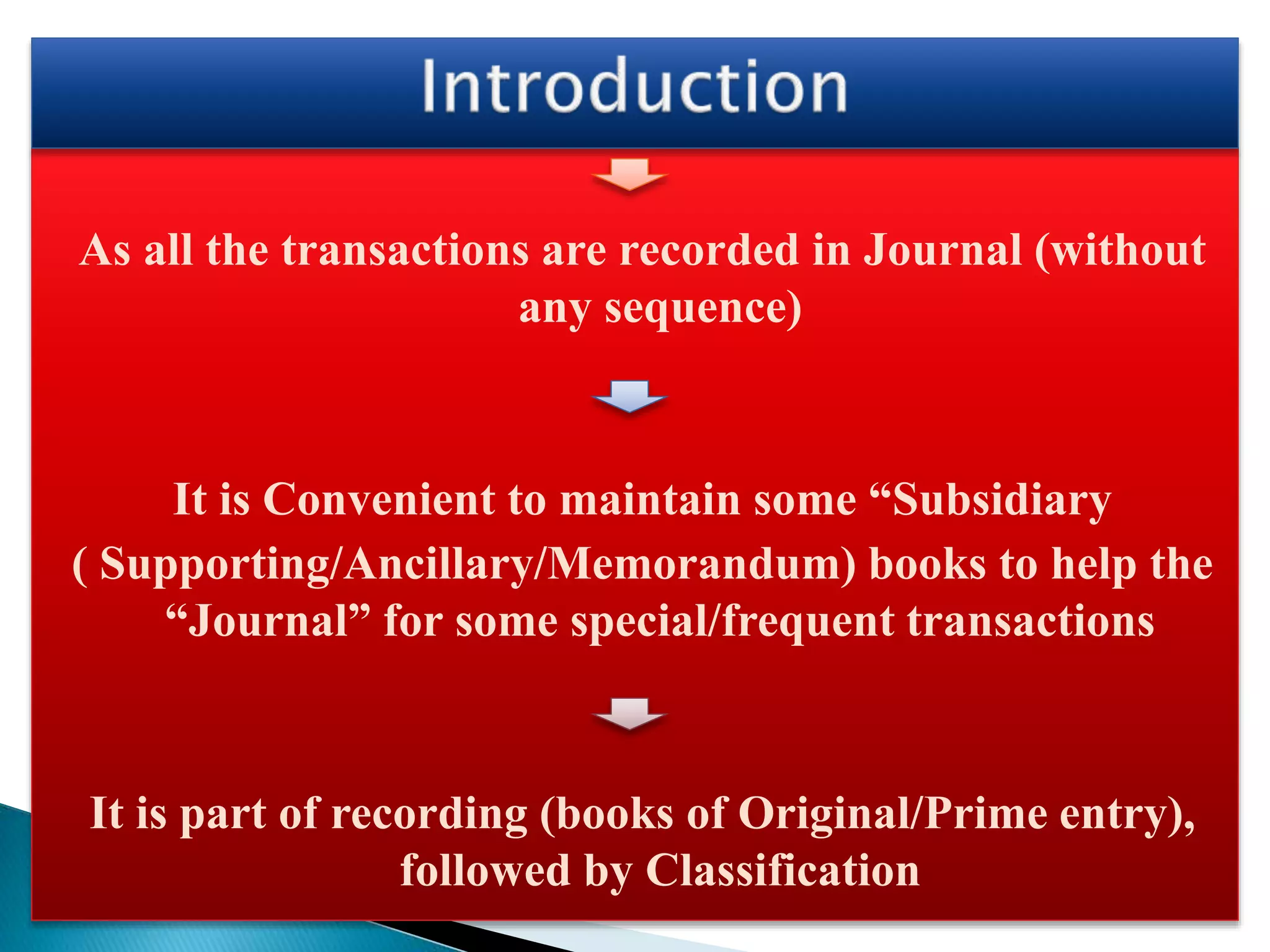
As all the transactions are recorded in Journal (without
any sequence)
It is Convenient to maintain some “Subsidiary
( Supporting/Ancillary/Memorandum) books to help the
“Journal” for some special/frequent transactions
It is part of recording (books of Original/Prime entry),
followed by Classification
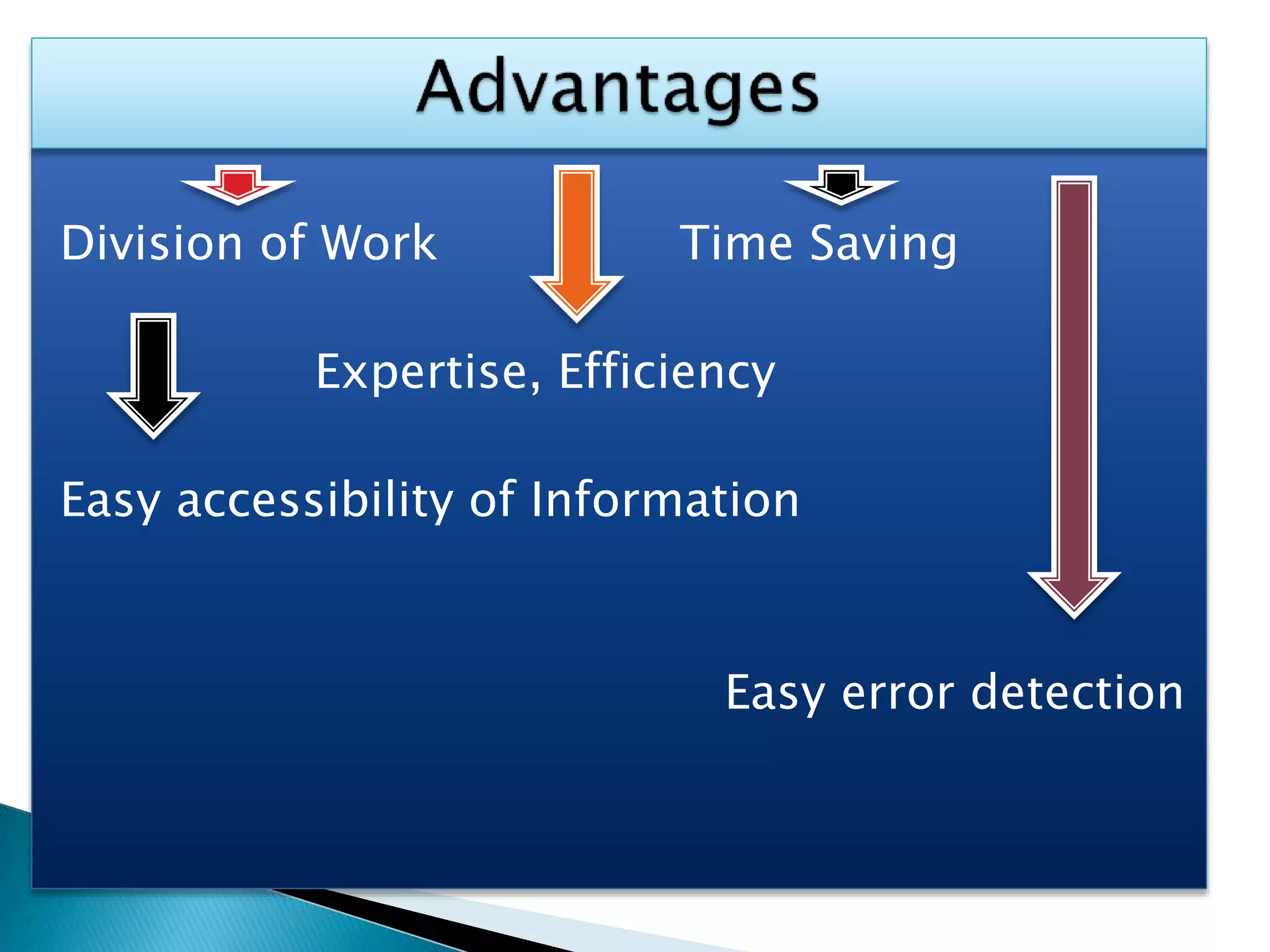
Division of Work Time Saving
Expertise, Efficiency
Easy accessibility of Information
Easy error detection
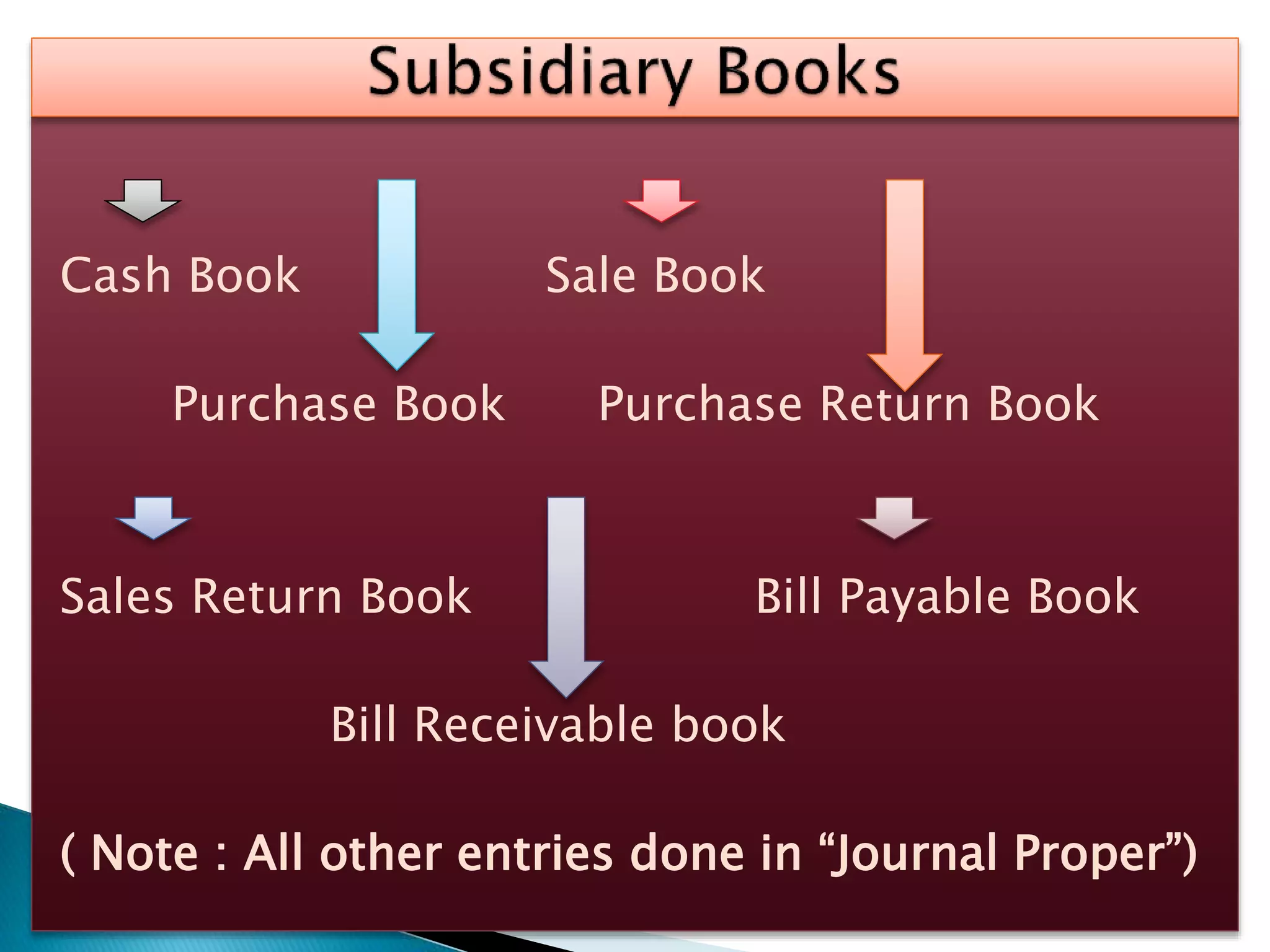
Cash Book Sale Book
Purchase Book Purchase Return Book
Sales Return Book Bill Payable Book
Bill Receivable book
( Note : All other entries done in “Journal Proper”)
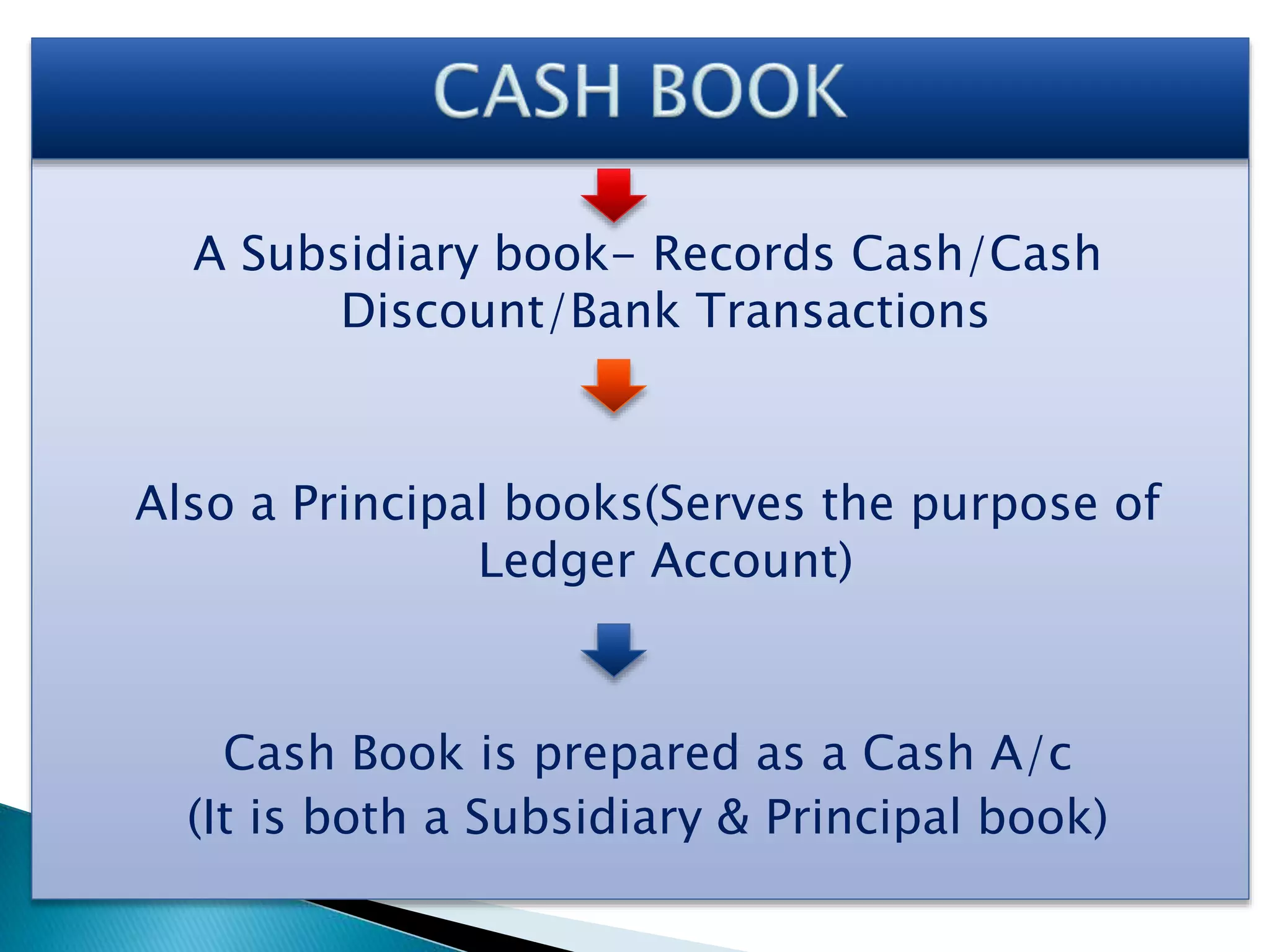
A Subsidiary book- Records Cash/Cash
Discount/Bank Transactions
Also a Principal books(Serves the purpose of
Ledger Account)
Cash Book is prepared as a Cash A/c
(It is both a Subsidiary & Principal book)
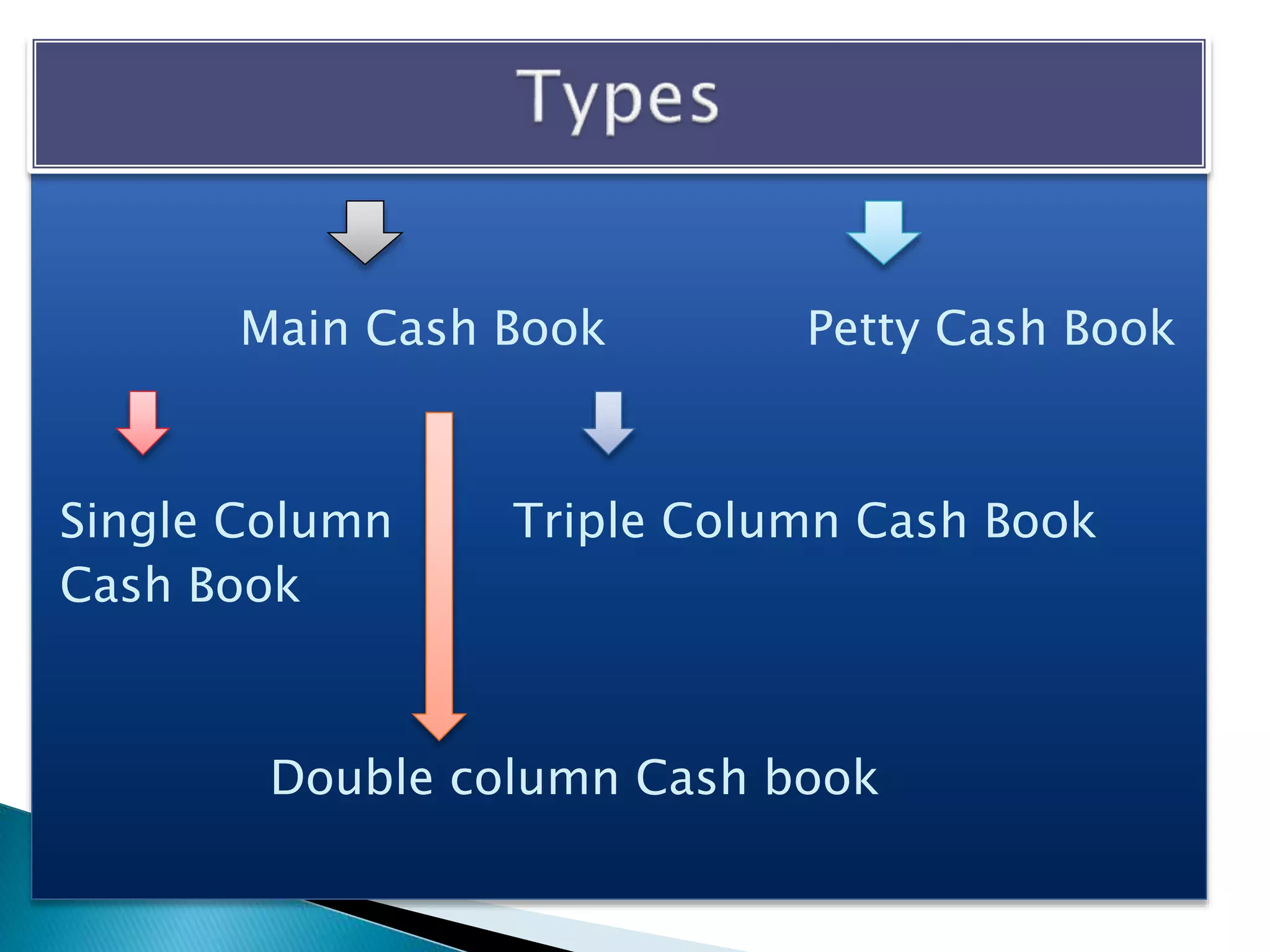
Main Cash Book Petty Cash Book
Single Column Triple Column Cash Book
Cash Book
Double column Cash book
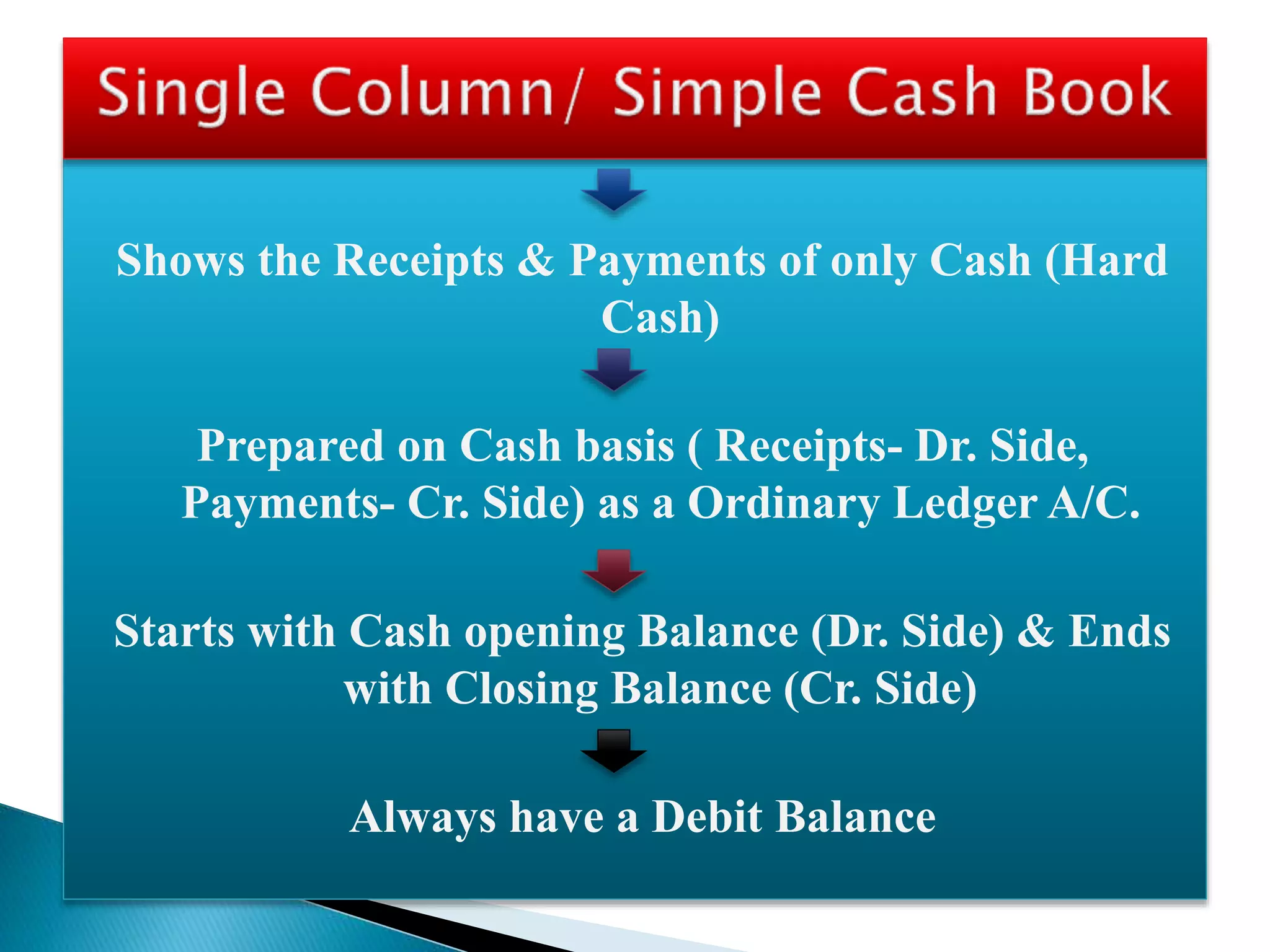
Shows the Receipts & Payments of only Cash (Hard
Cash)
Prepared on Cash basis ( Receipts- Dr. Side,
Payments- Cr. Side) as a Ordinary Ledger A/C.
Starts with Cash opening Balance (Dr. Side) & Ends
with Closing Balance (Cr. Side)
Always have a Debit Balance
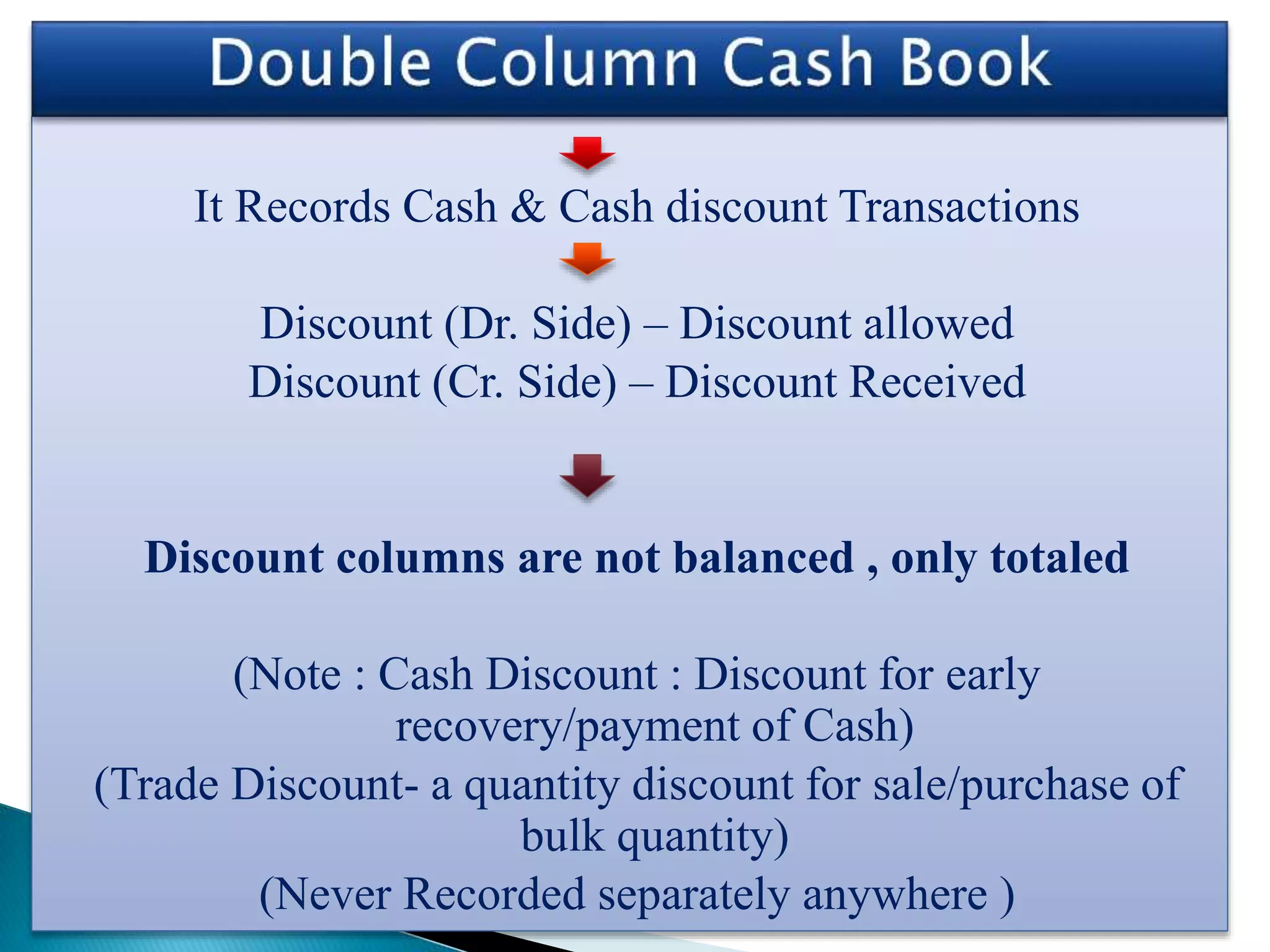
It Records Cash & Cash discount Transactions
Discount (Dr. Side) – Discount allowed
Discount (Cr. Side) – Discount Received
Discount columns are not balanced , only totaled
(Note : Cash Discount : Discount for early
recovery/payment of Cash)
(Trade Discount- a quantity discount for sale/purchase of
bulk quantity)
(Never Recorded separately anywhere )
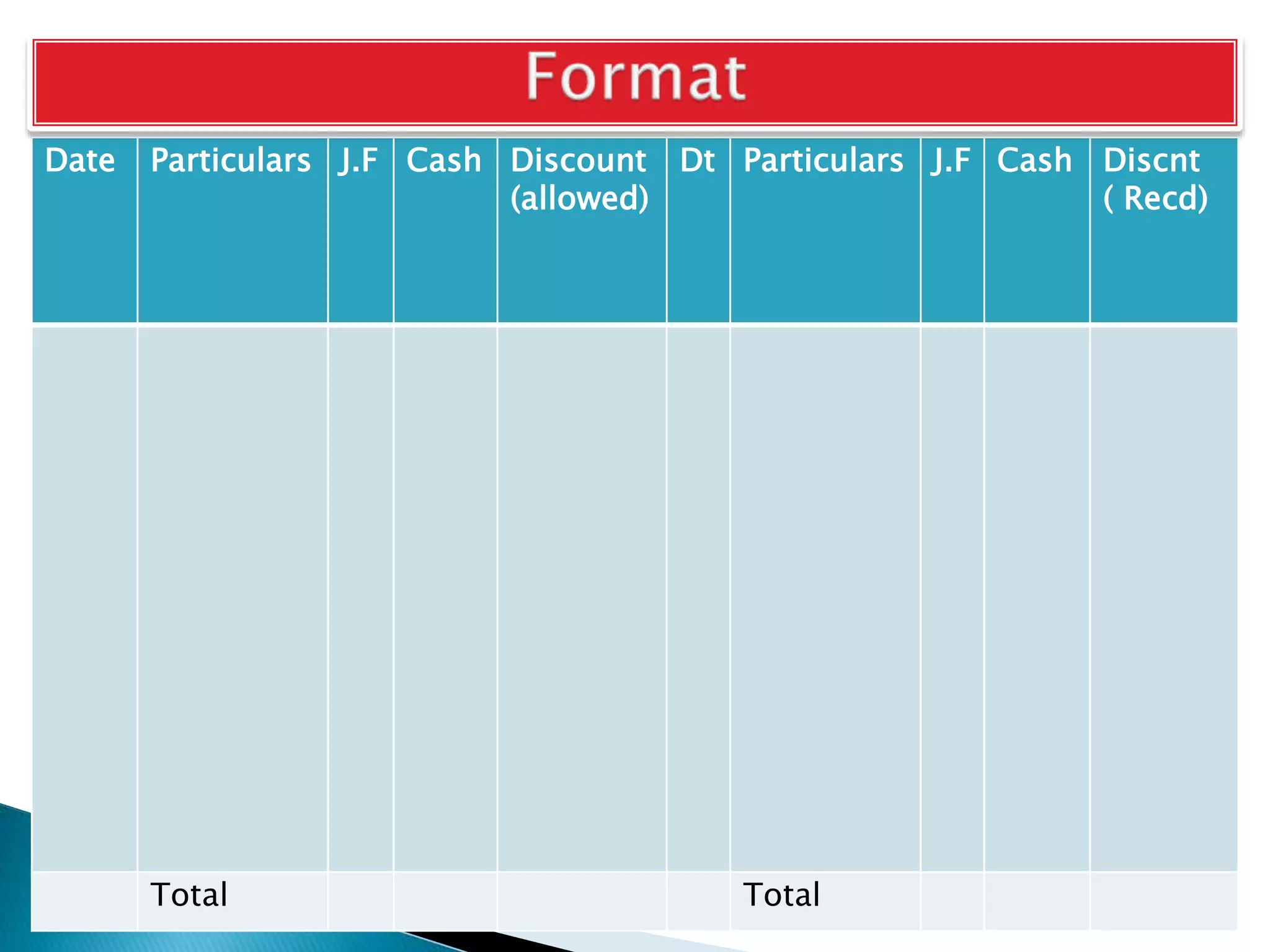
Date Particulars J.F Cash Discount
(allowed)
Dt Particulars J.F Cash Discnt
( Recd)
Total Total
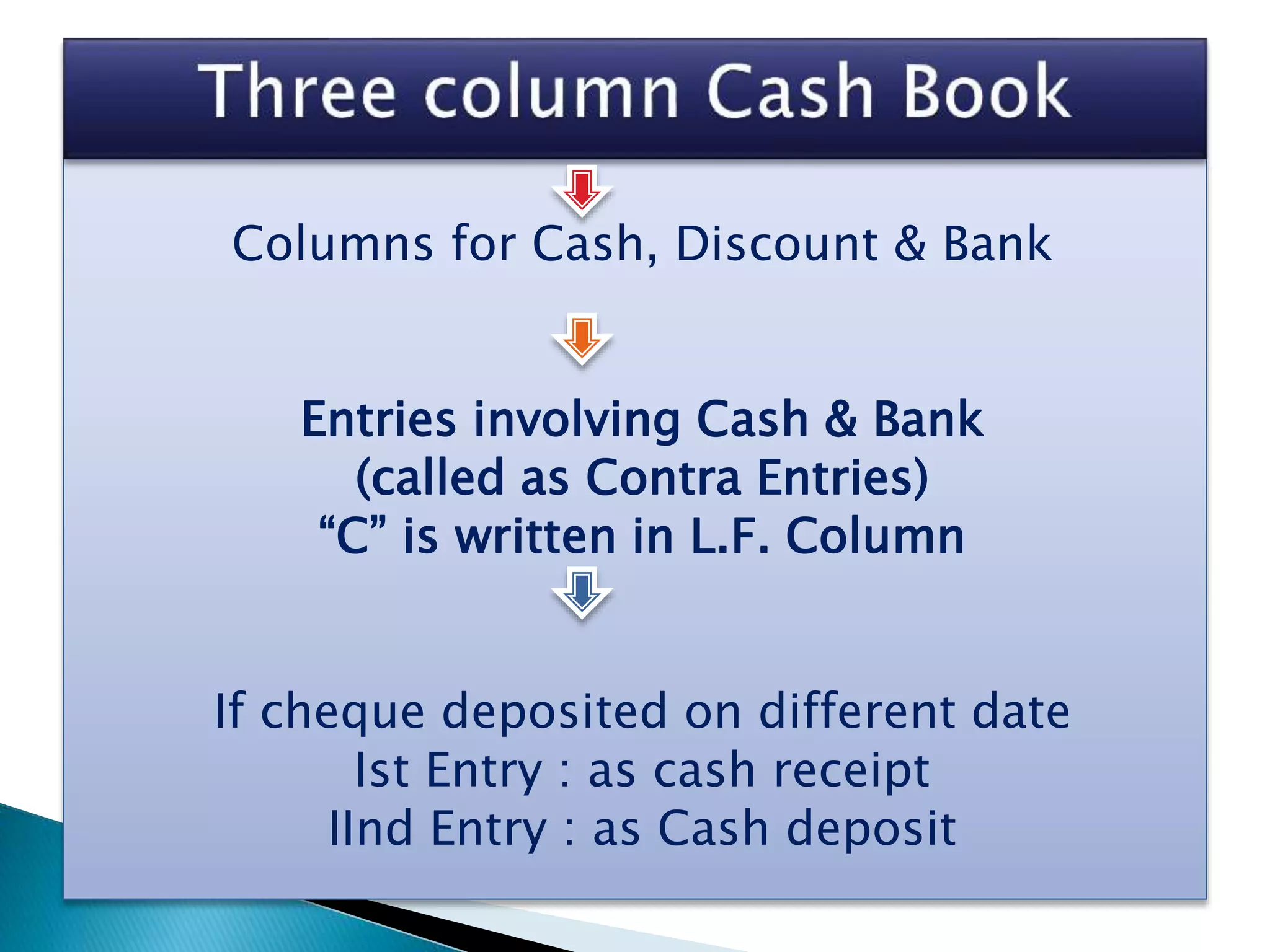
Columns for Cash, Discount & Bank
Entries involving Cash & Bank
(called as Contra Entries)
“C” is written in L.F. Column
If cheque deposited on different date
Ist Entry : as cash receipt
IInd Entry : as Cash deposit
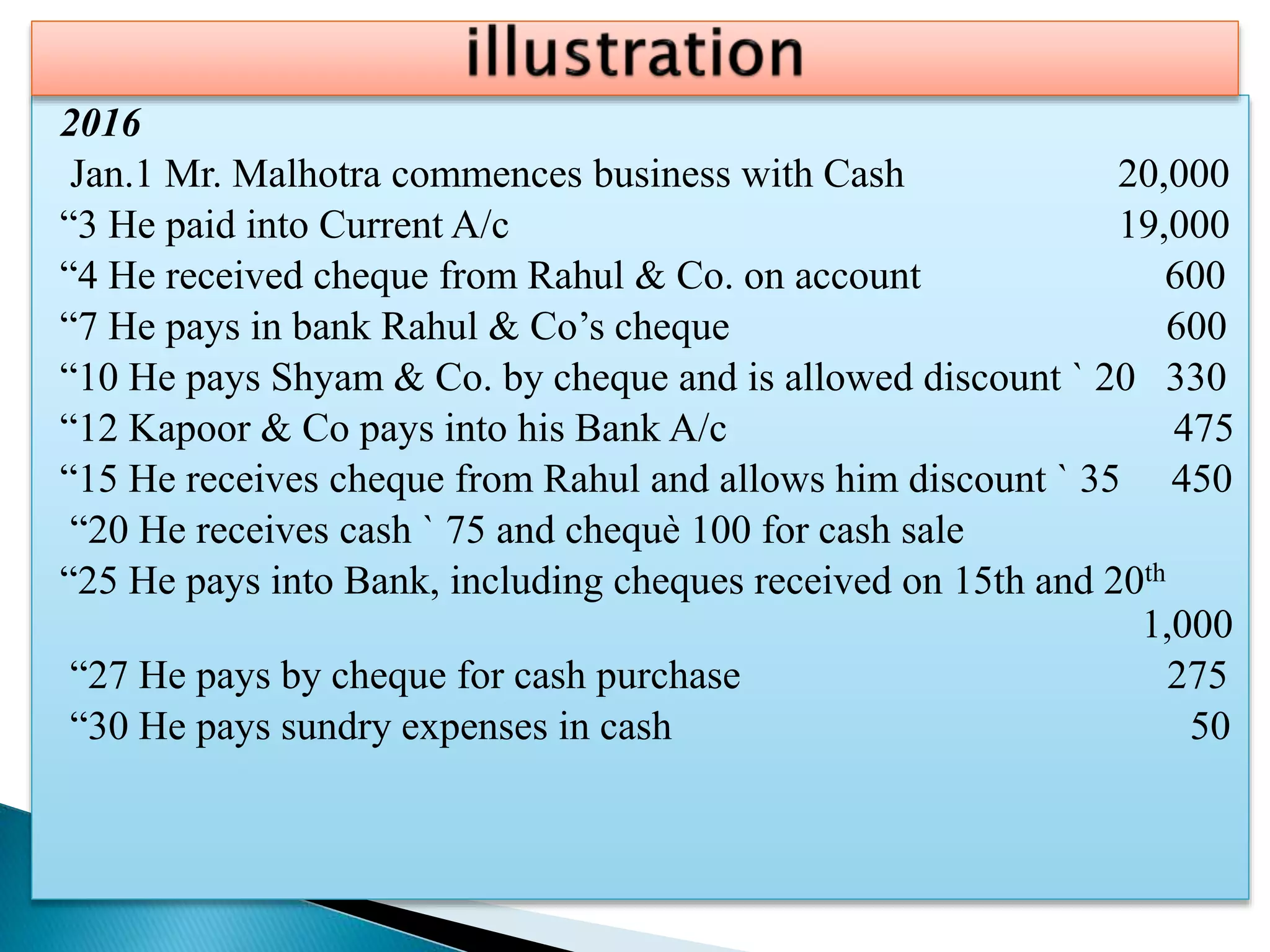
2016
Jan.1 Mr. Malhotra commences business with Cash 20,000
“3 He paid into Current A/c 19,000
“4 He received cheque from Rahul & Co. on account 600
“7 He pays in bank Rahul & Co’s cheque 600
“10 He pays Shyam & Co. by cheque and is allowed discount ` 20 330
“12 Kapoor & Co pays into his Bank A/c 475
“15 He receives cheque from Rahul and allows him discount ` 35 450
“20 He receives cash ` 75 and chequè 100 for cash sale
“25 He pays into Bank, including cheques received on 15th and 20th
1,000
“27 He pays by cheque for cash purchase 275
“30 He pays sundry expenses in cash 50
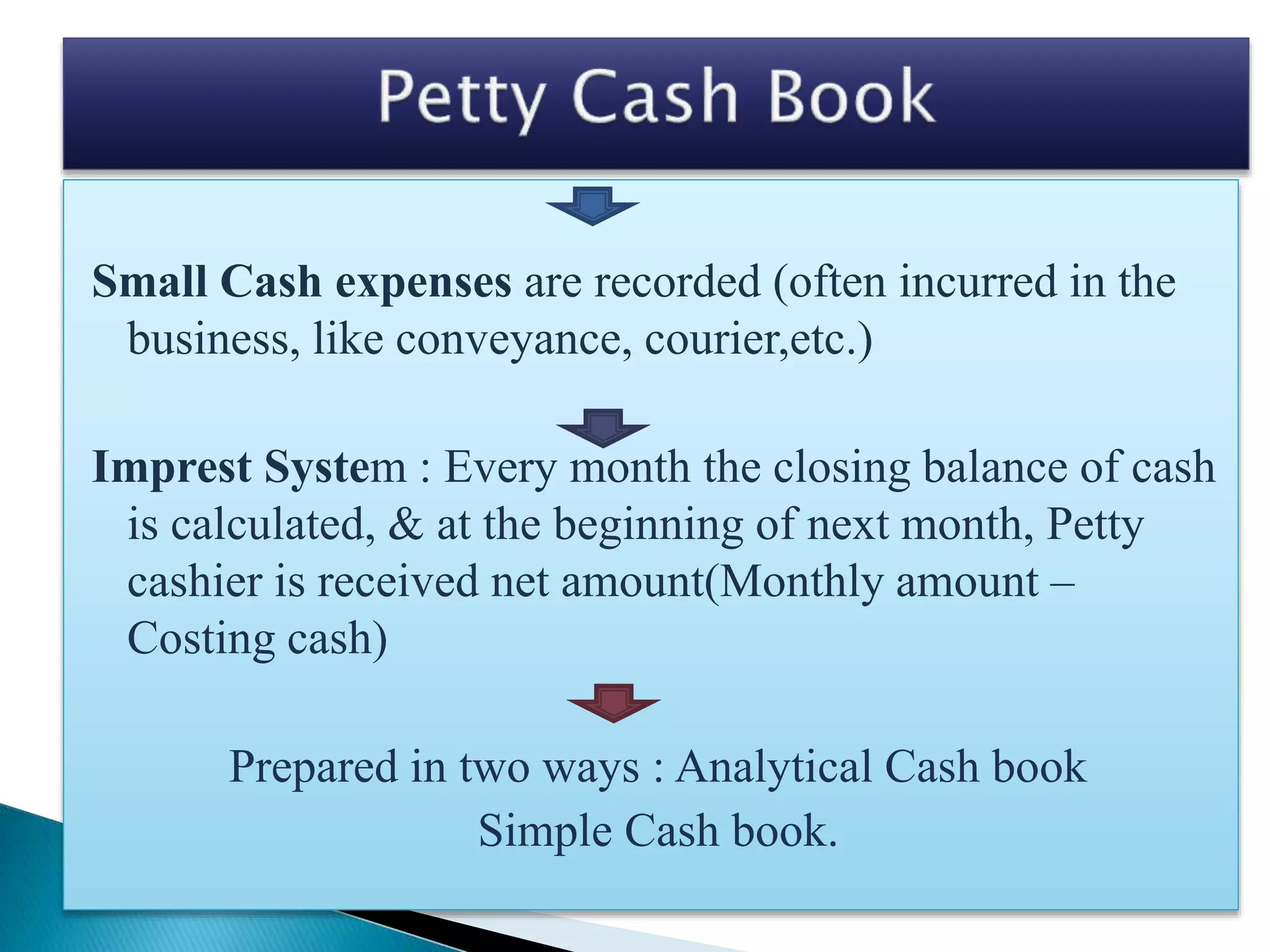
Small Cash expenses are recorded (often incurred in the
business, like conveyance, courier,etc.)
Imprest System : Every month the closing balance of cash
is calculated, & at the beginning of next month, Petty
cashier is received net amount(Monthly amount –
Costing cash)
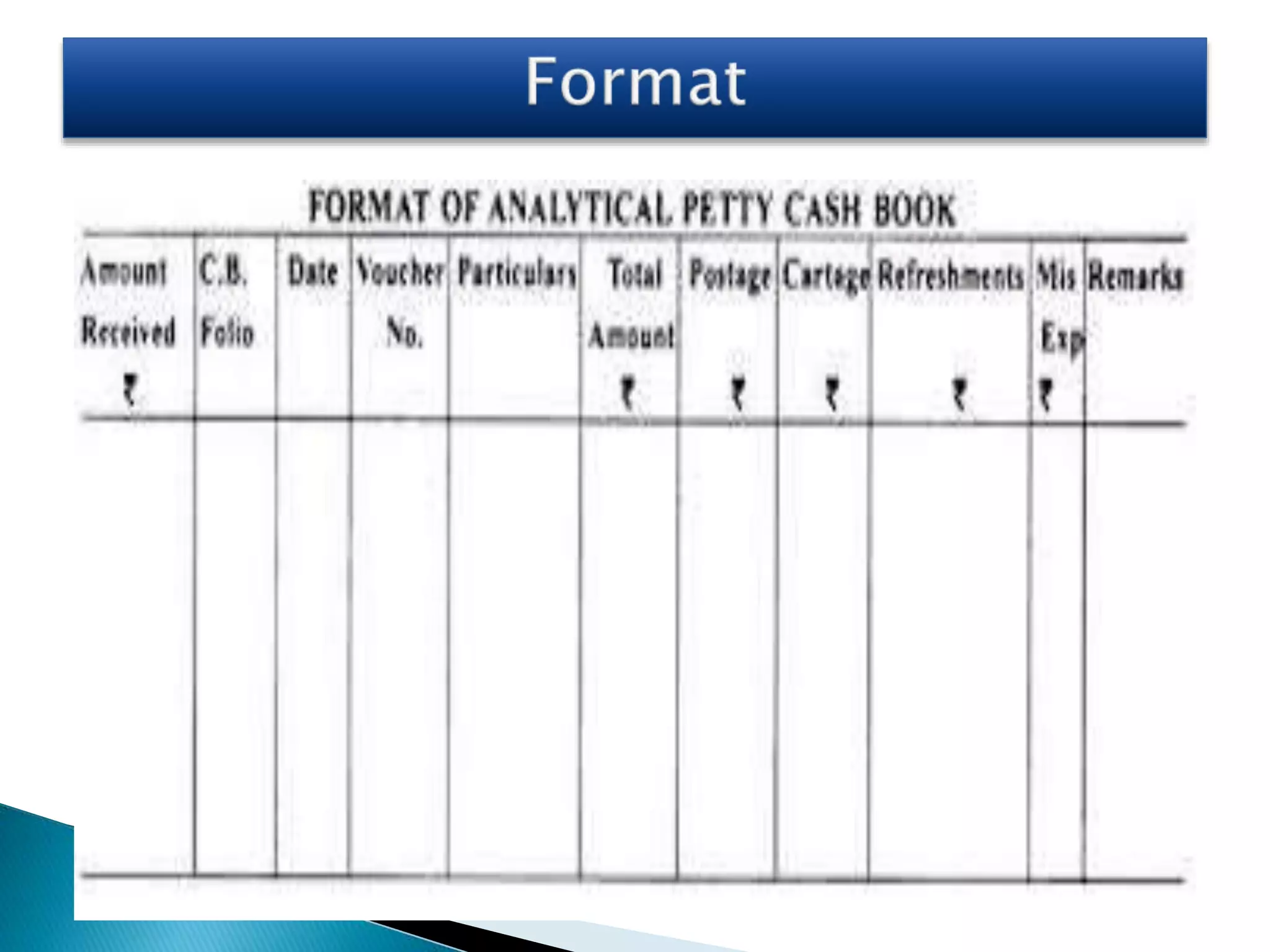
Prepared in two ways : Analytical Cash book
Simple Cash book.
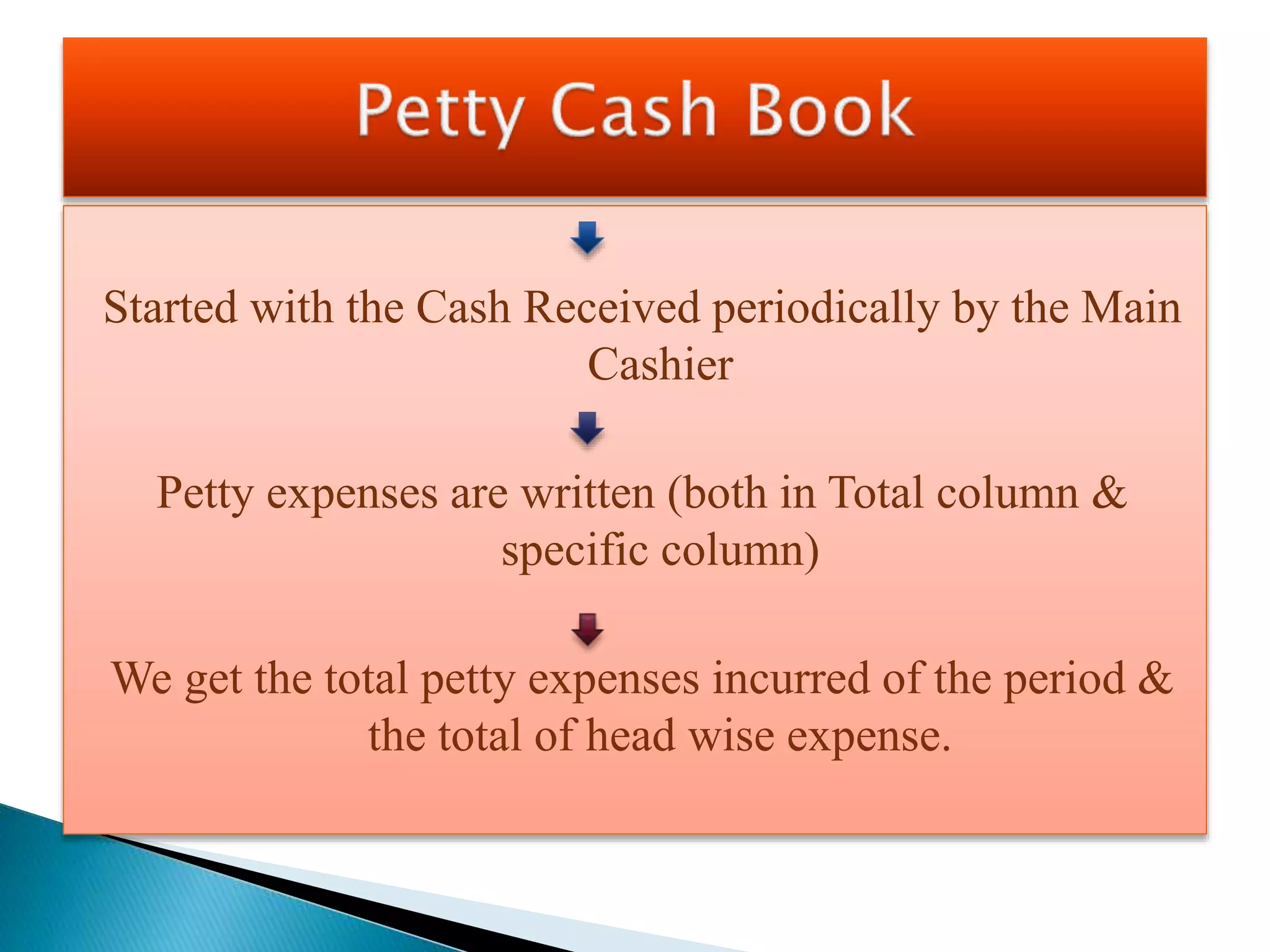
Started with the Cash Received periodically by the Main
Cashier
Petty expenses are written (both in Total column &
specific column)
We get the total petty expenses incurred of the period &
the total of head wise expense.
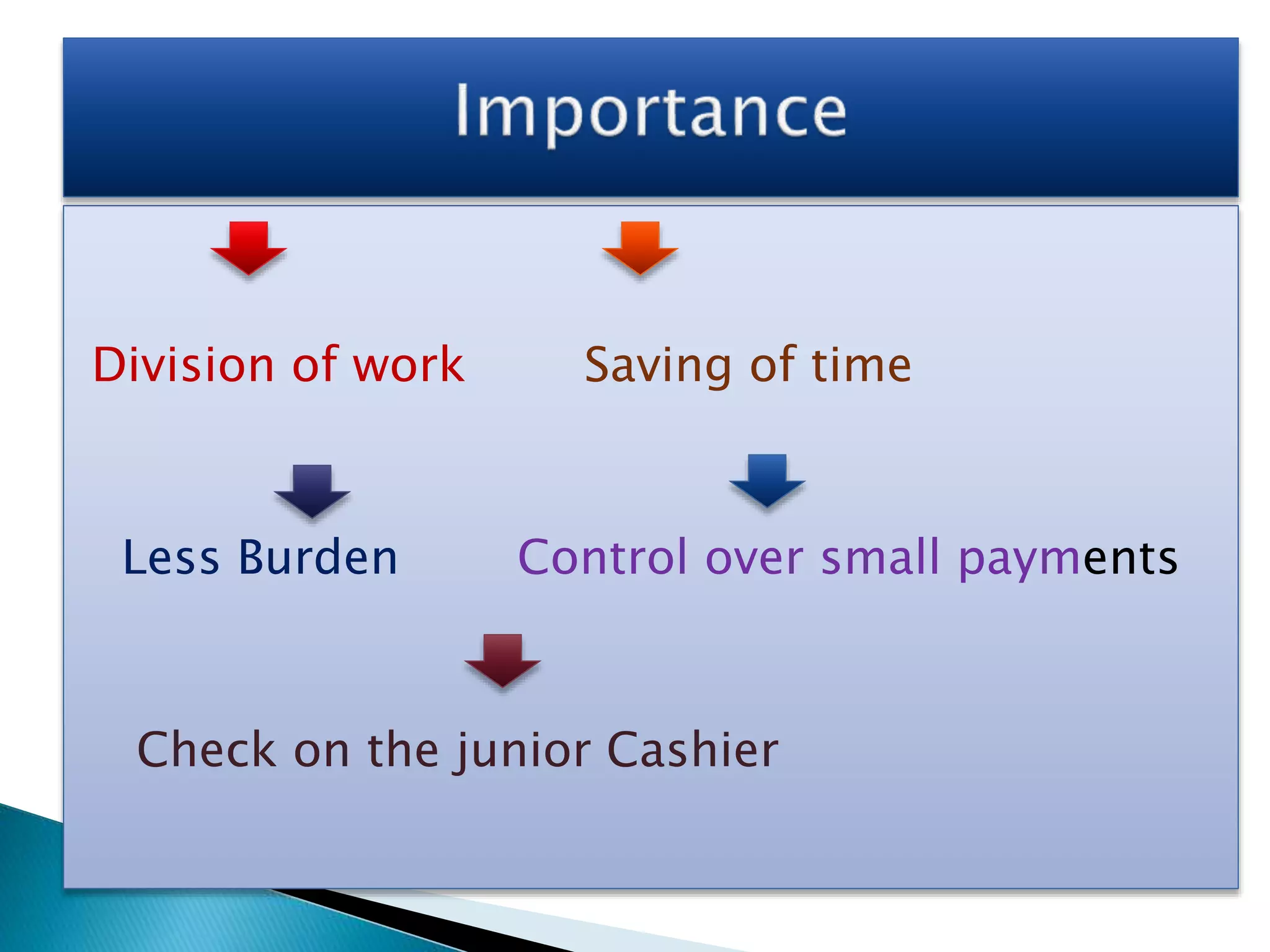
Division of work Saving of time
Less Burden Control over small payments
Check on the junior Cashier
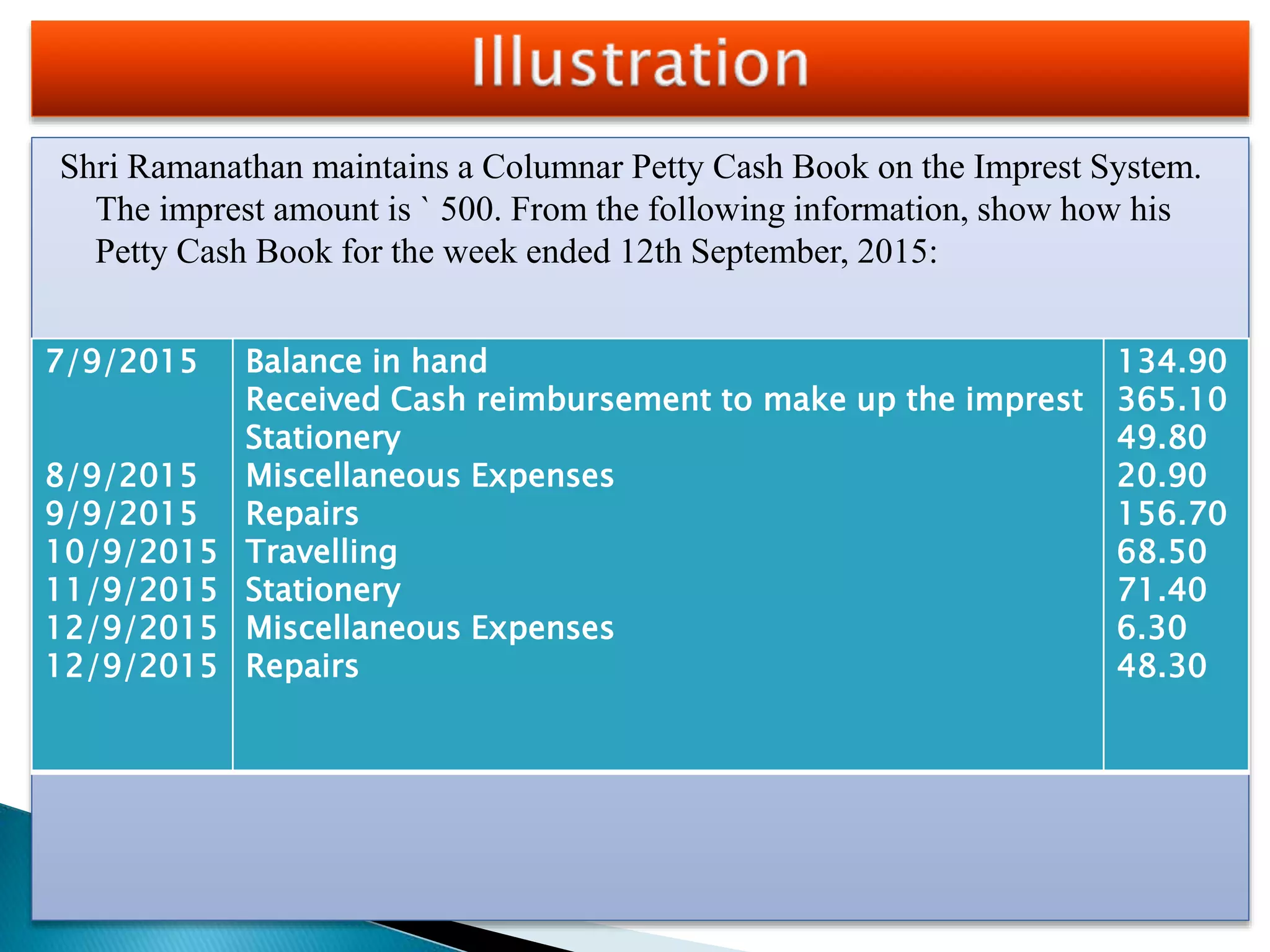
Shri Ramanathan maintains a Columnar Petty Cash Book on the Imprest System.
The imprest amount is ` 500. From the following information, show how his
Petty Cash Book for the week ended 12th September, 2015:
7/9/2015
8/9/2015
9/9/2015
10/9/2015
11/9/2015
12/9/2015
12/9/2015
Balance in hand
Received Cash reimbursement to make up the imprest
Stationery
Miscellaneous Expenses
Repairs
Travelling
Stationery
Miscellaneous Expenses
Repairs
134.90
365.10
49.80
20.90
156.70
68.50
71.40
6.30
48.30
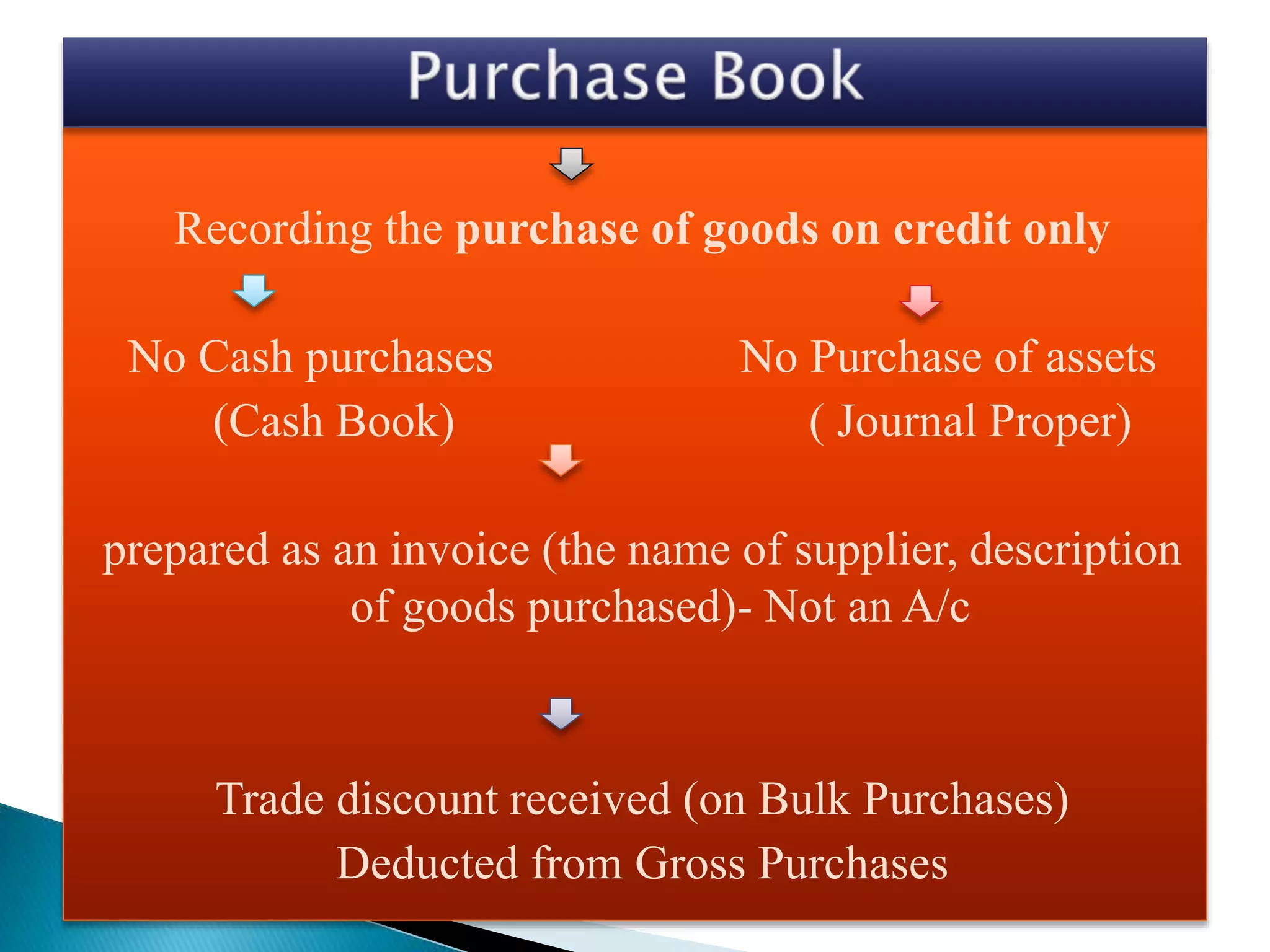
Recording the purchase of goods on credit only
No Cash purchases No Purchase of assets
(Cash Book) ( Journal Proper)
prepared as an invoice (the name of supplier, description
of goods purchased)- Not an A/c
Trade discount received (on Bulk Purchases)
Deducted from Gross Purchases
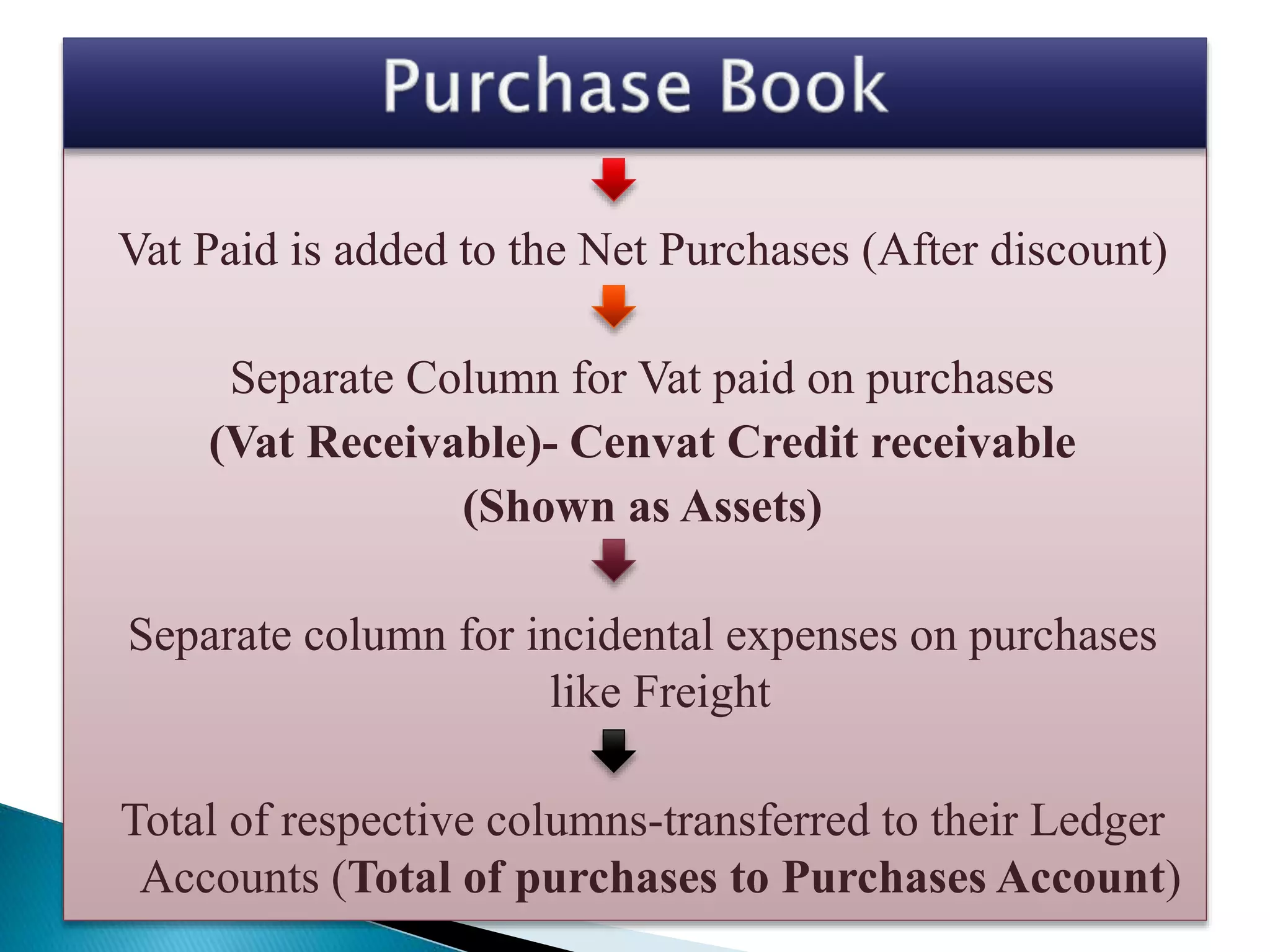
Vat Paid is added to the Net Purchases (After discount)
Separate Column for Vat paid on purchases
(Vat Receivable)- Cenvat Credit receivable
(Shown as Assets)
Separate column for incidental expenses on purchases
like Freight
Total of respective columns-transferred to their Ledger
Accounts (Total of purchases to Purchases Account)
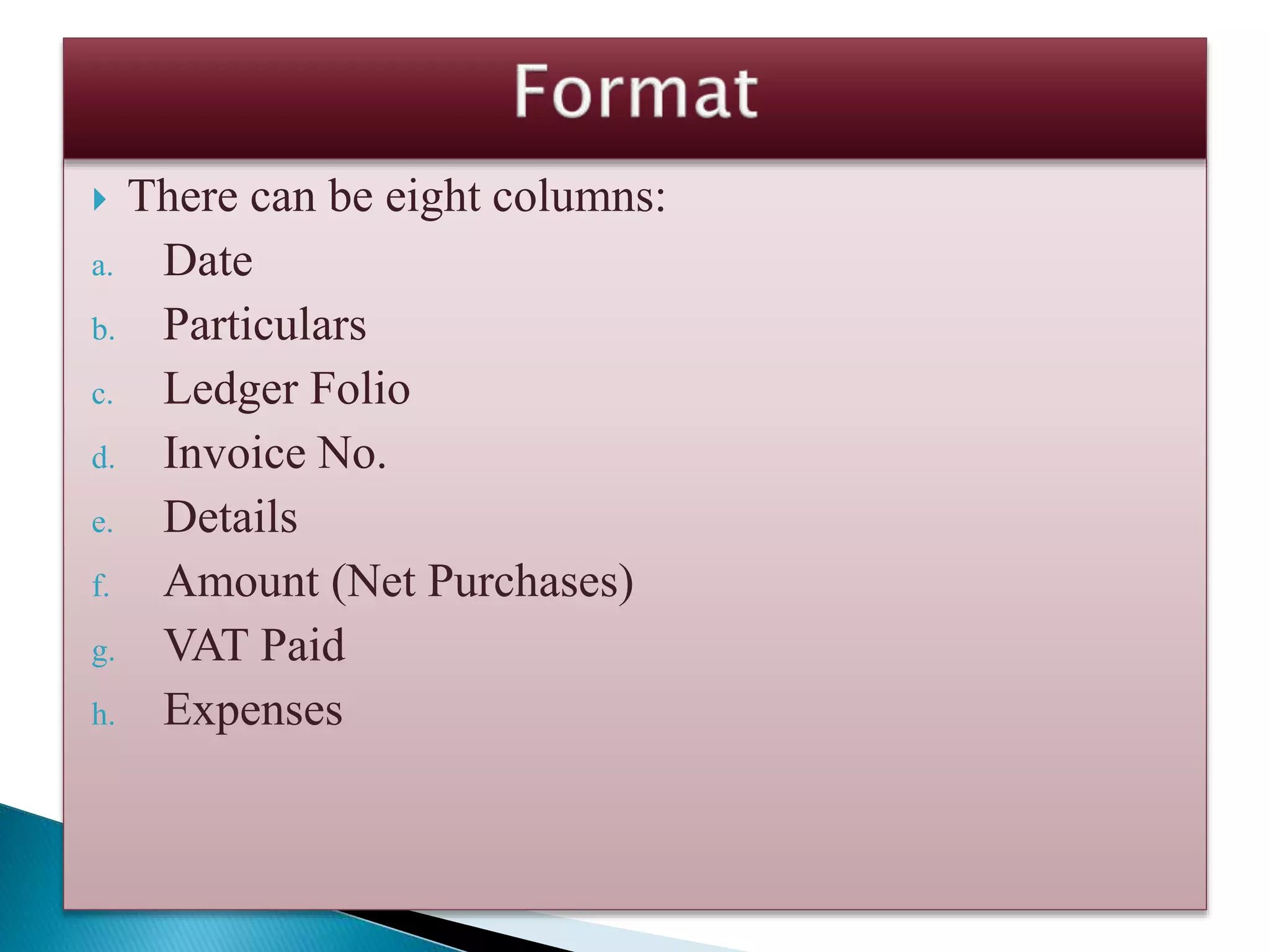
 There can be eight columns:
a. Date
b. Particulars
c. Ledger Folio
d. Invoice No.
e. Details
f. Amount (Net Purchases)
g. VAT Paid
h. Expenses
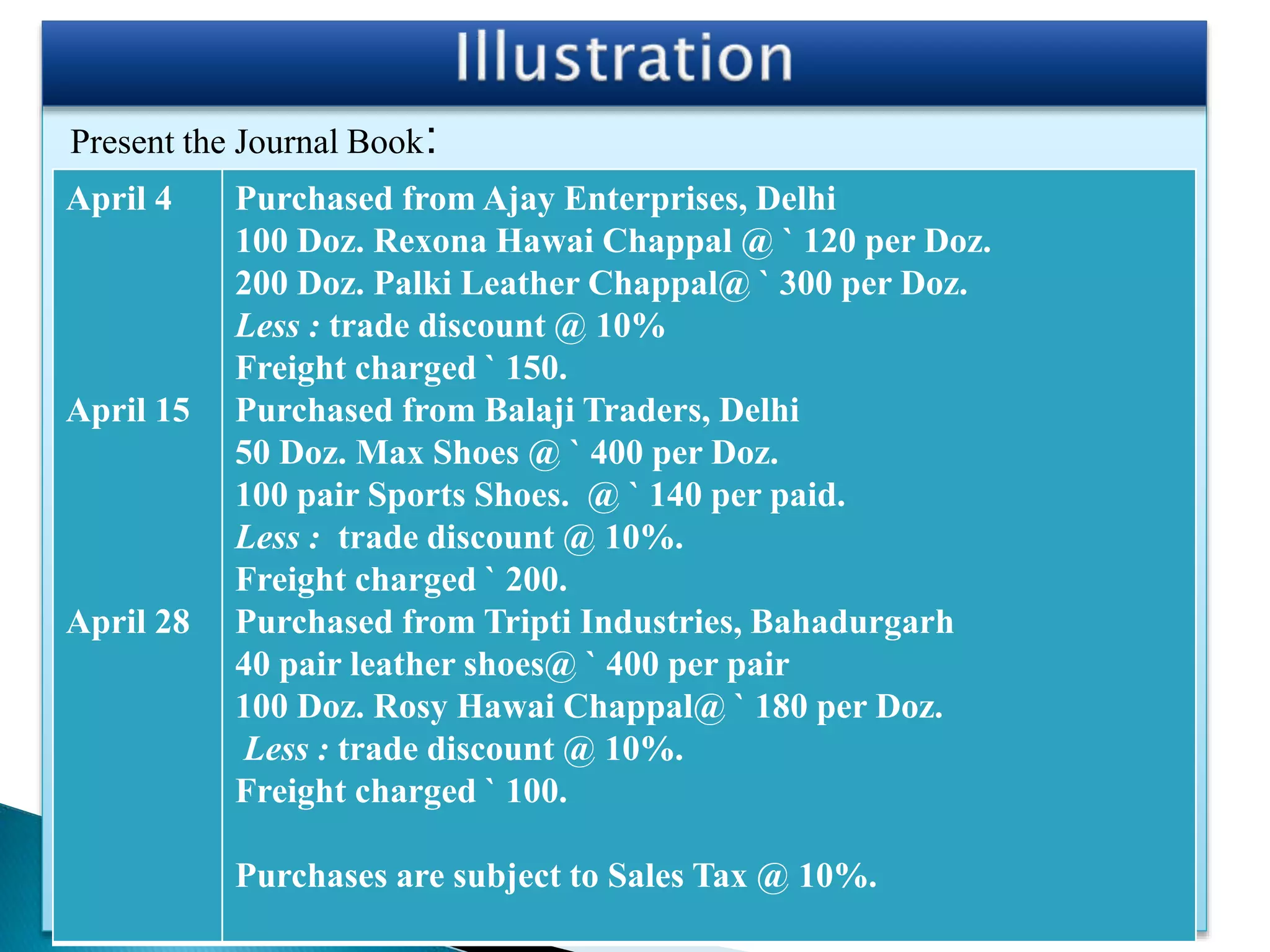
Present the Journal Book:
April 4
April 15
April 28
Purchased from Ajay Enterprises, Delhi
100 Doz. Rexona Hawai Chappal @ ` 120 per Doz.
200 Doz. Palki Leather Chappal@ ` 300 per Doz.
Less : trade discount @ 10%
Freight charged ` 150.
Purchased from Balaji Traders, Delhi
50 Doz. Max Shoes @ ` 400 per Doz.
100 pair Sports Shoes. @ ` 140 per paid.
Less : trade discount @ 10%.
Freight charged ` 200.
Purchased from Tripti Industries, Bahadurgarh
40 pair leather shoes@ ` 400 per pair
100 Doz. Rosy Hawai Chappal@ ` 180 per Doz.
Less : trade discount @ 10%.
Freight charged ` 100.
Purchases are subject to Sales Tax @ 10%.
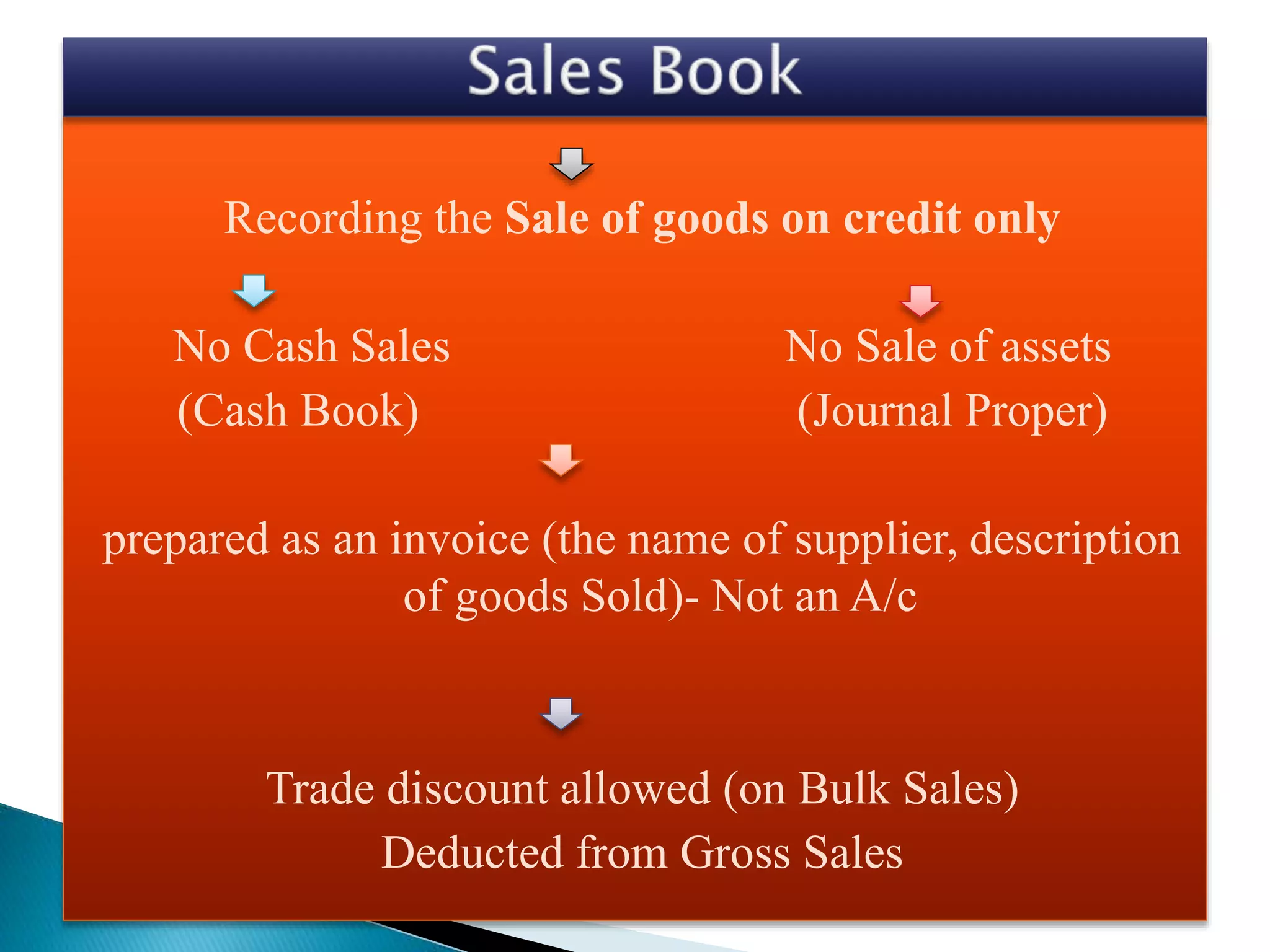
Recording the Sale of goods on credit only
No Cash Sales No Sale of assets
(Cash Book) (Journal Proper)
prepared as an invoice (the name of supplier, description
of goods Sold)- Not an A/c
Trade discount allowed (on Bulk Sales)
Deducted from Gross Sales
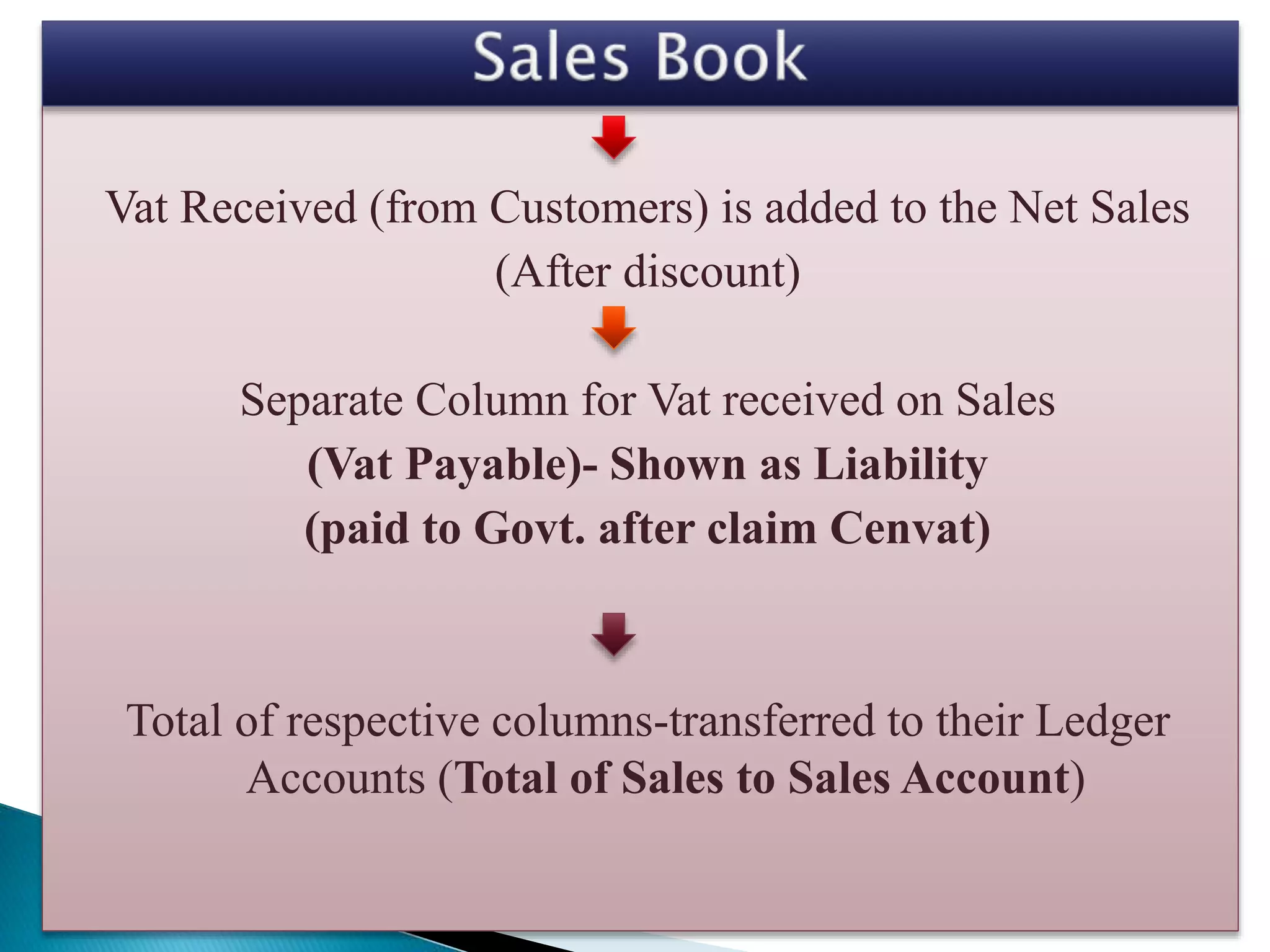
Vat Received (from Customers) is added to the Net Sales
(After discount)
Separate Column for Vat received on Sales
(Vat Payable)- Shown as Liability
(paid to Govt. after claim Cenvat)
Total of respective columns-transferred to their Ledger
Accounts (Total of Sales to Sales Account)
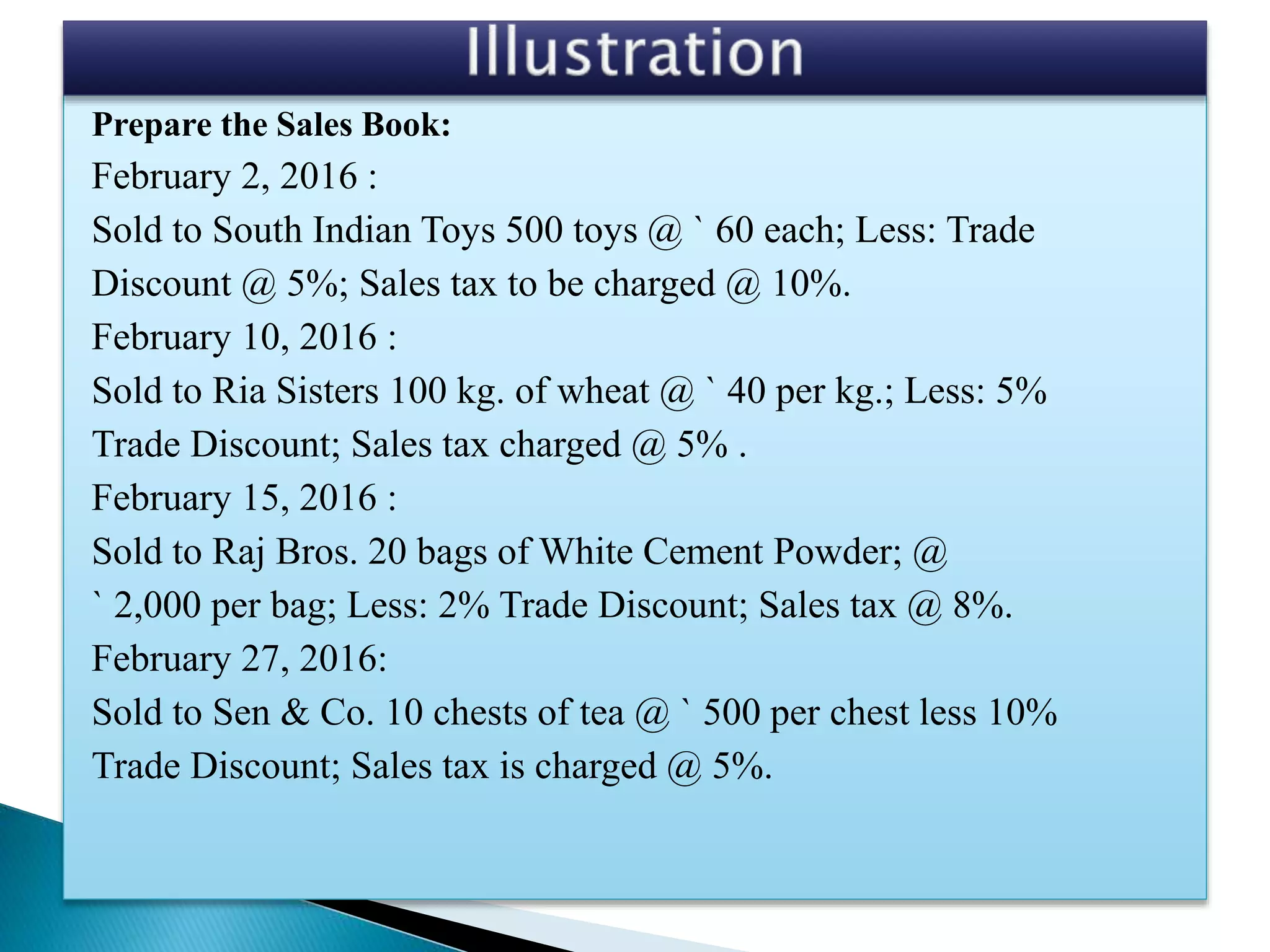
Prepare the Sales Book:
February 2, 2016 :
Sold to South Indian Toys 500 toys @ ` 60 each; Less: Trade
Discount @ 5%; Sales tax to be charged @ 10%.
February 10, 2016 :
Sold to Ria Sisters 100 kg. of wheat @ ` 40 per kg.; Less: 5%
Trade Discount; Sales tax charged @ 5% .
February 15, 2016 :
Sold to Raj Bros. 20 bags of White Cement Powder; @
` 2,000 per bag; Less: 2% Trade Discount; Sales tax @ 8%.
February 27, 2016:
Sold to Sen & Co. 10 chests of tea @ ` 500 per chest less 10%
Trade Discount; Sales tax is charged @ 5%.
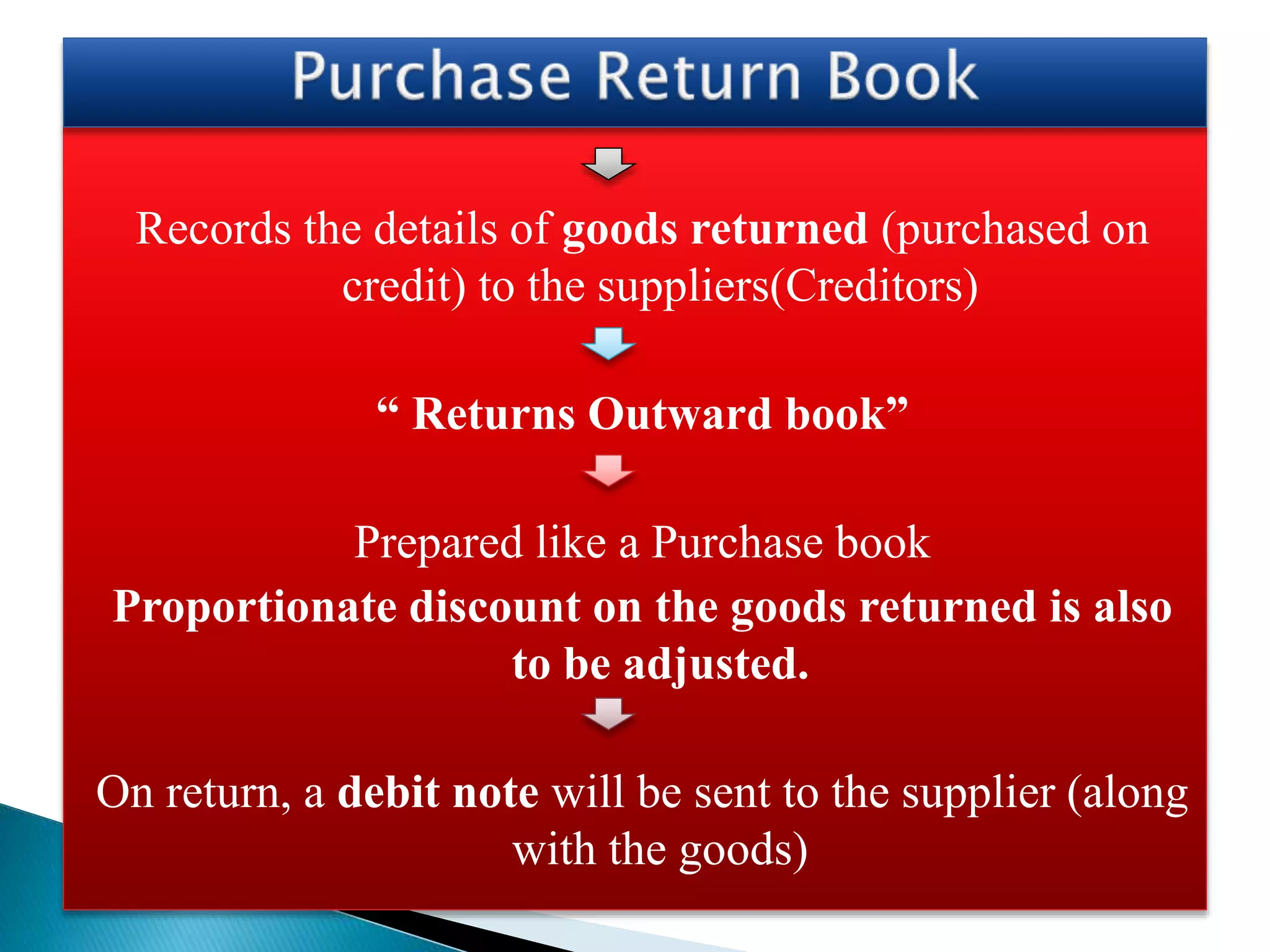
Records the details of goods returned (purchased on
credit) to the suppliers(Creditors)
“ Returns Outward book”
Prepared like a Purchase book
Proportionate discount on the goods returned is also
to be adjusted.
On return, a debit note will be sent to the supplier (along
with the goods)
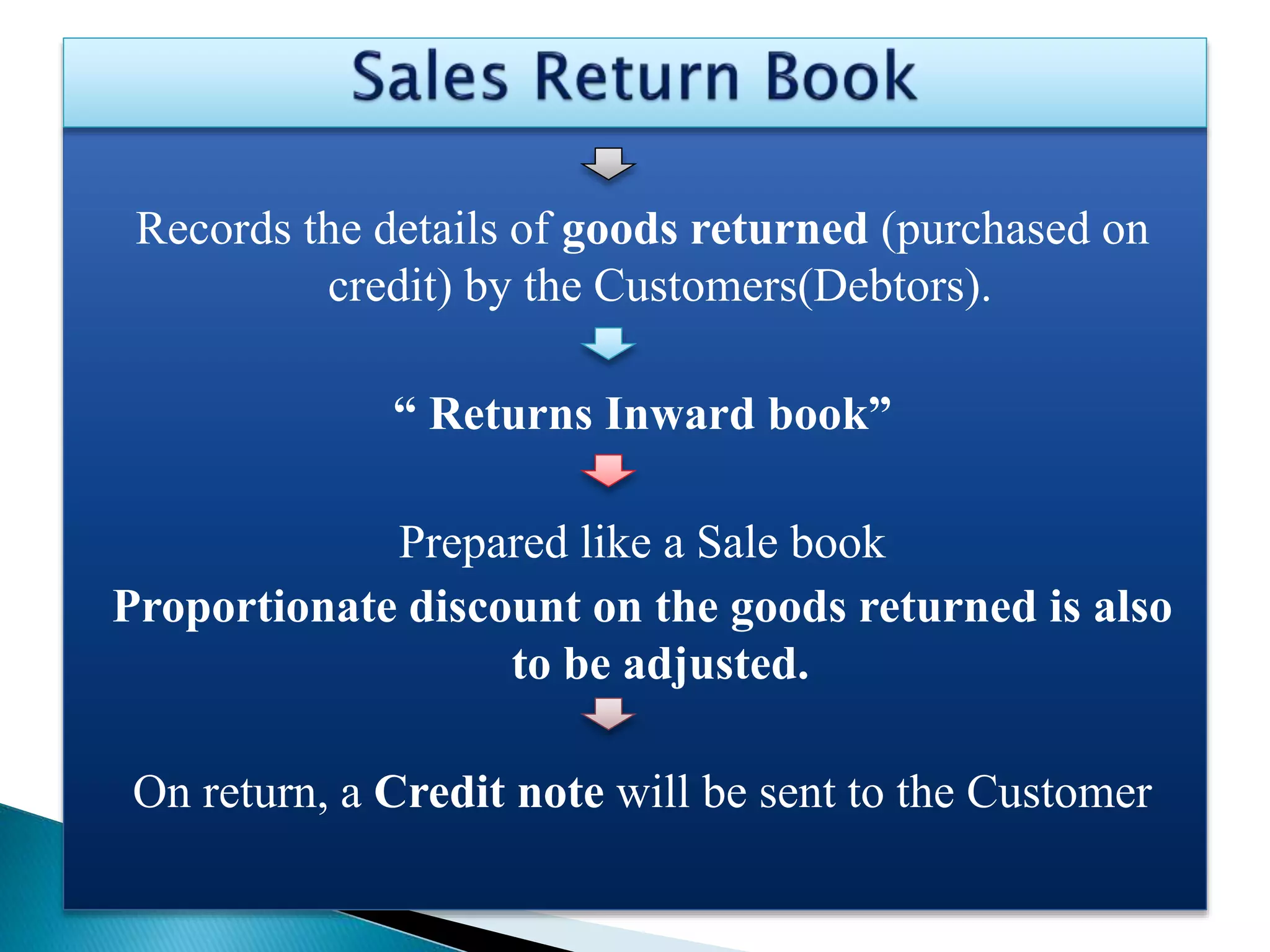
Records the details of goods returned (purchased on
credit) by the Customers(Debtors).
“ Returns Inward book”
Prepared like a Sale book
Proportionate discount on the goods returned is also
to be adjusted.
On return, a Credit note will be sent to the Customer
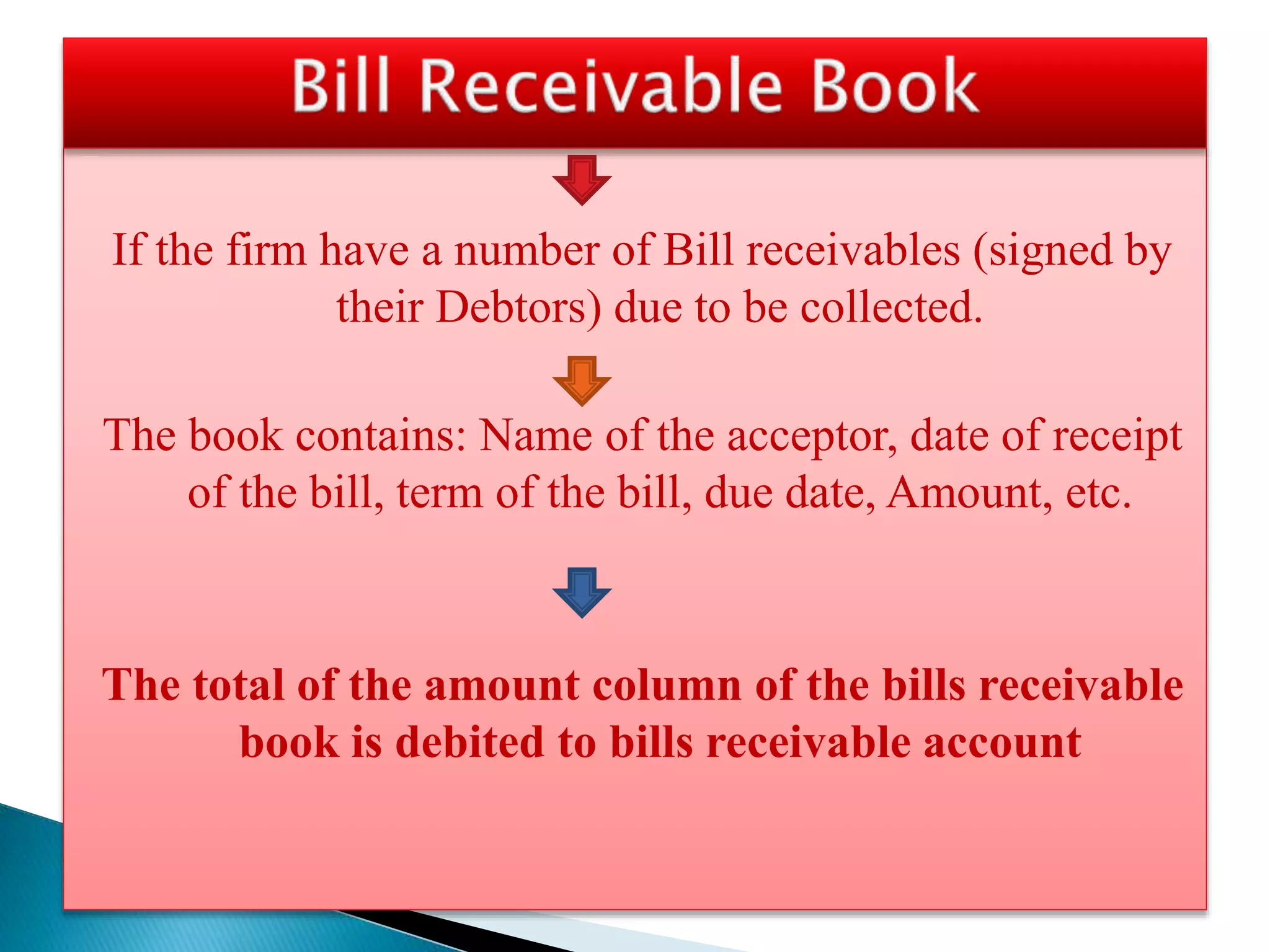
If the firm have a number of Bill receivables (signed by
their Debtors) due to be collected.
The book contains: Name of the acceptor, date of receipt
of the bill, term of the bill, due date, Amount, etc.
The total of the amount column of the bills receivable
book is debited to bills receivable account
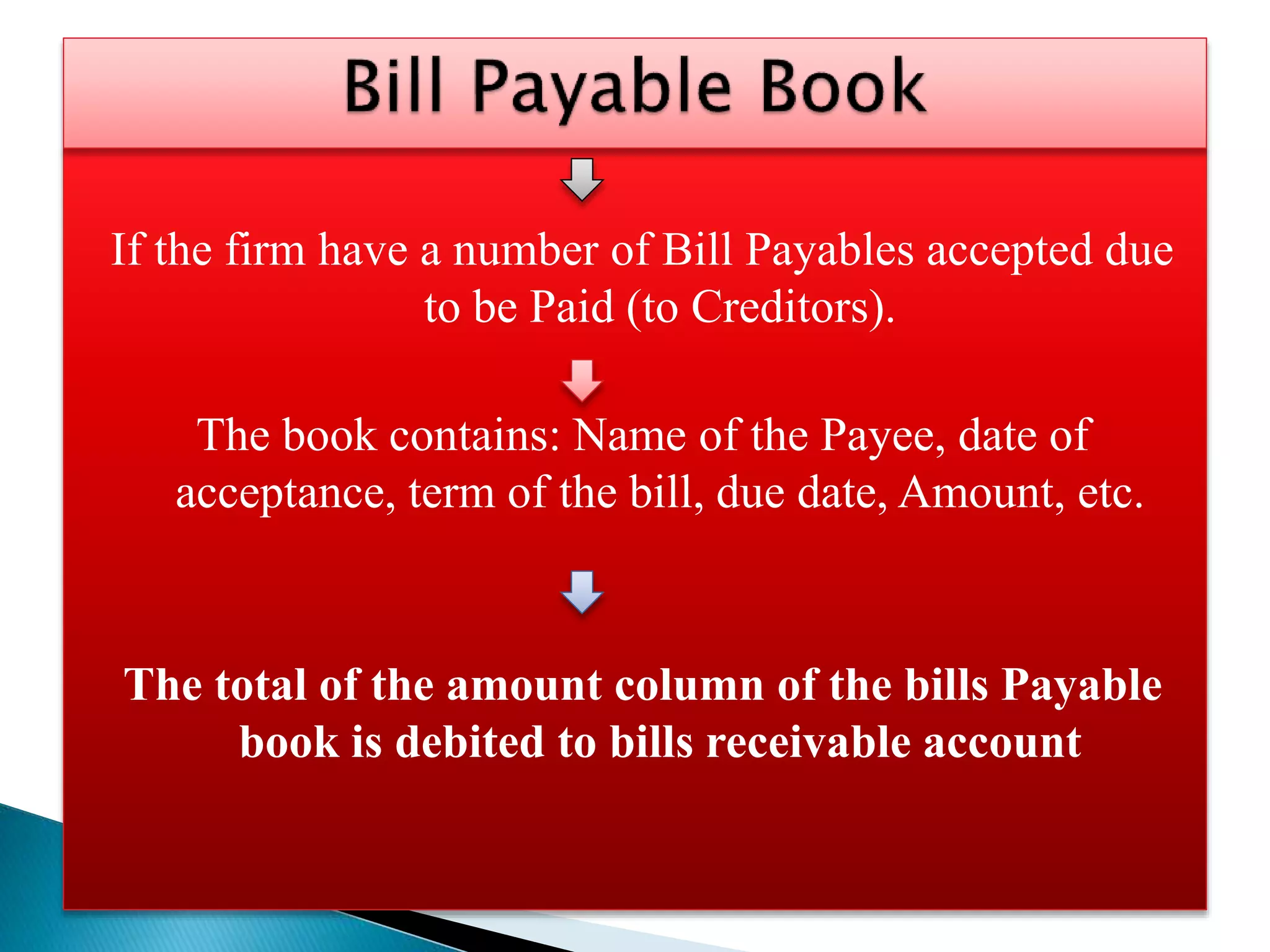
If the firm have a number of Bill Payables accepted due
to be Paid (to Creditors).
The book contains: Name of the Payee, date of
acceptance, term of the bill, due date, Amount, etc.
The total of the amount column of the bills Payable
book is debited to bills receivable account
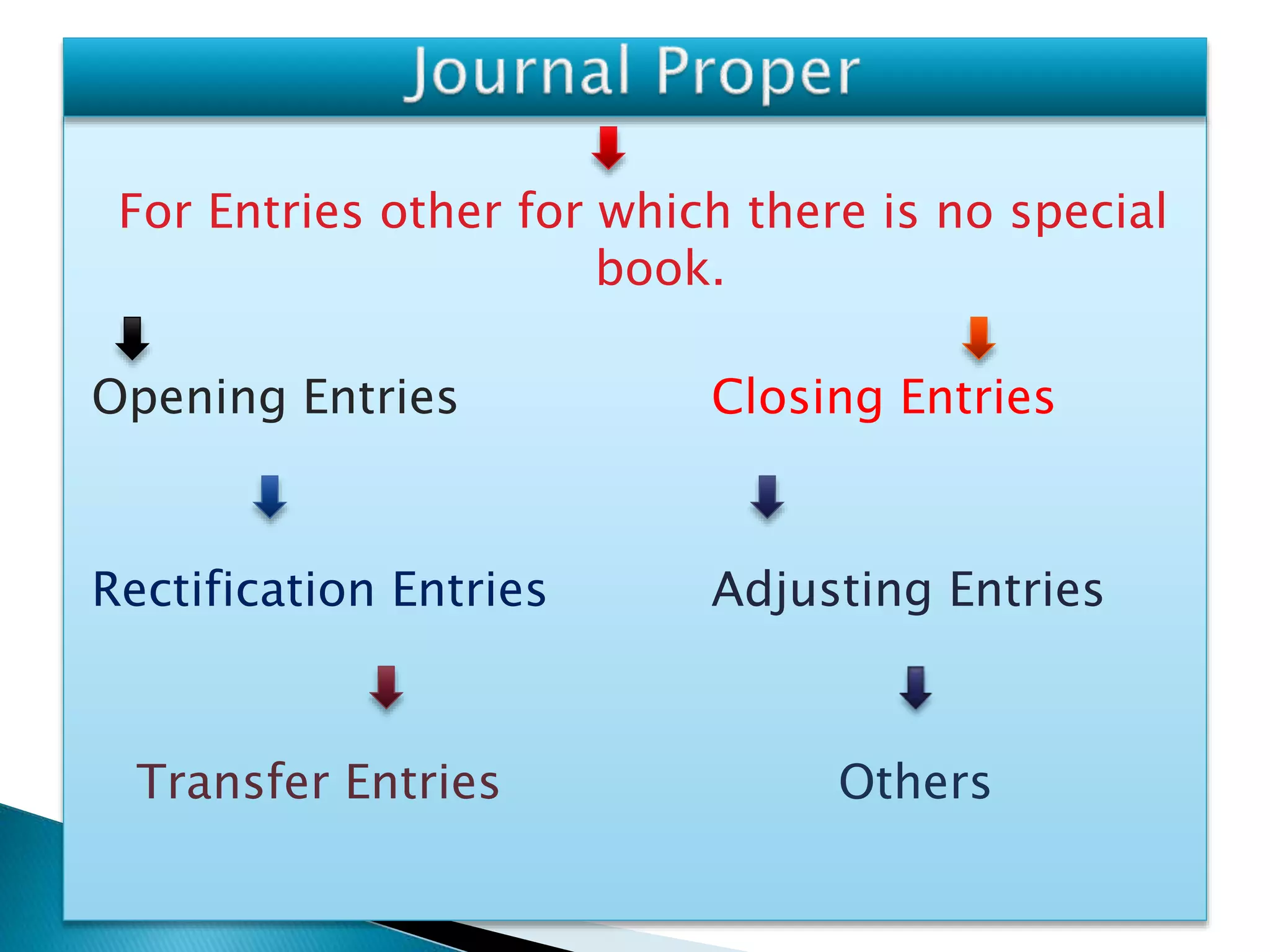
For Entries other for which there is no special
book.
Opening Entries Closing Entries
Rectification Entries Adjusting Entries
Transfer Entries Others
Other than these 7 subsidiary books,
there may be any other subsidiary
book like
Sales on Approval/Return basis book.
(if their transaction are frequent & Often)
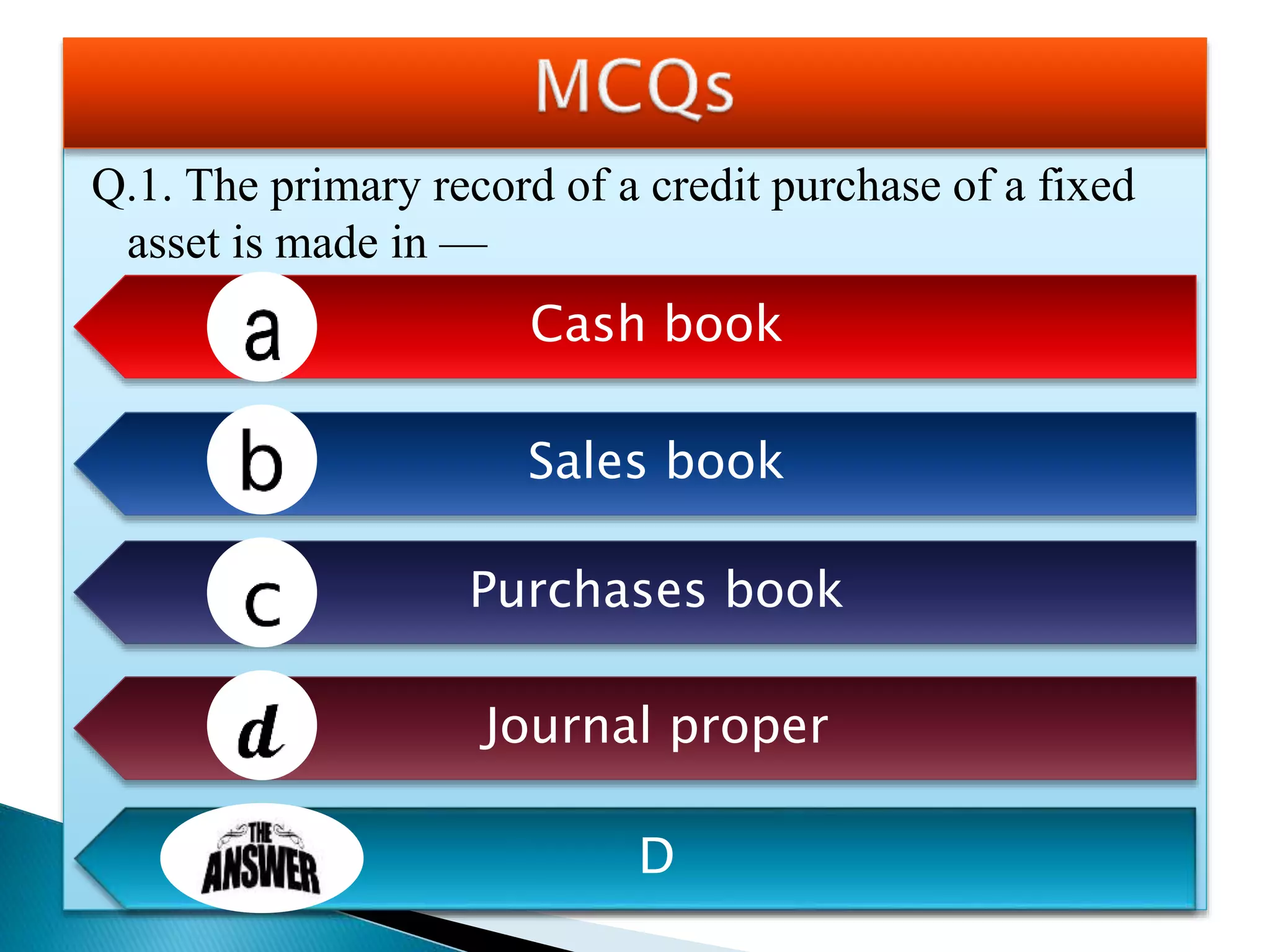
Q.1. The primary record of a credit purchase of a fixed
asset is made in —
Cash book
Sales book
Purchases book
Journal proper
D
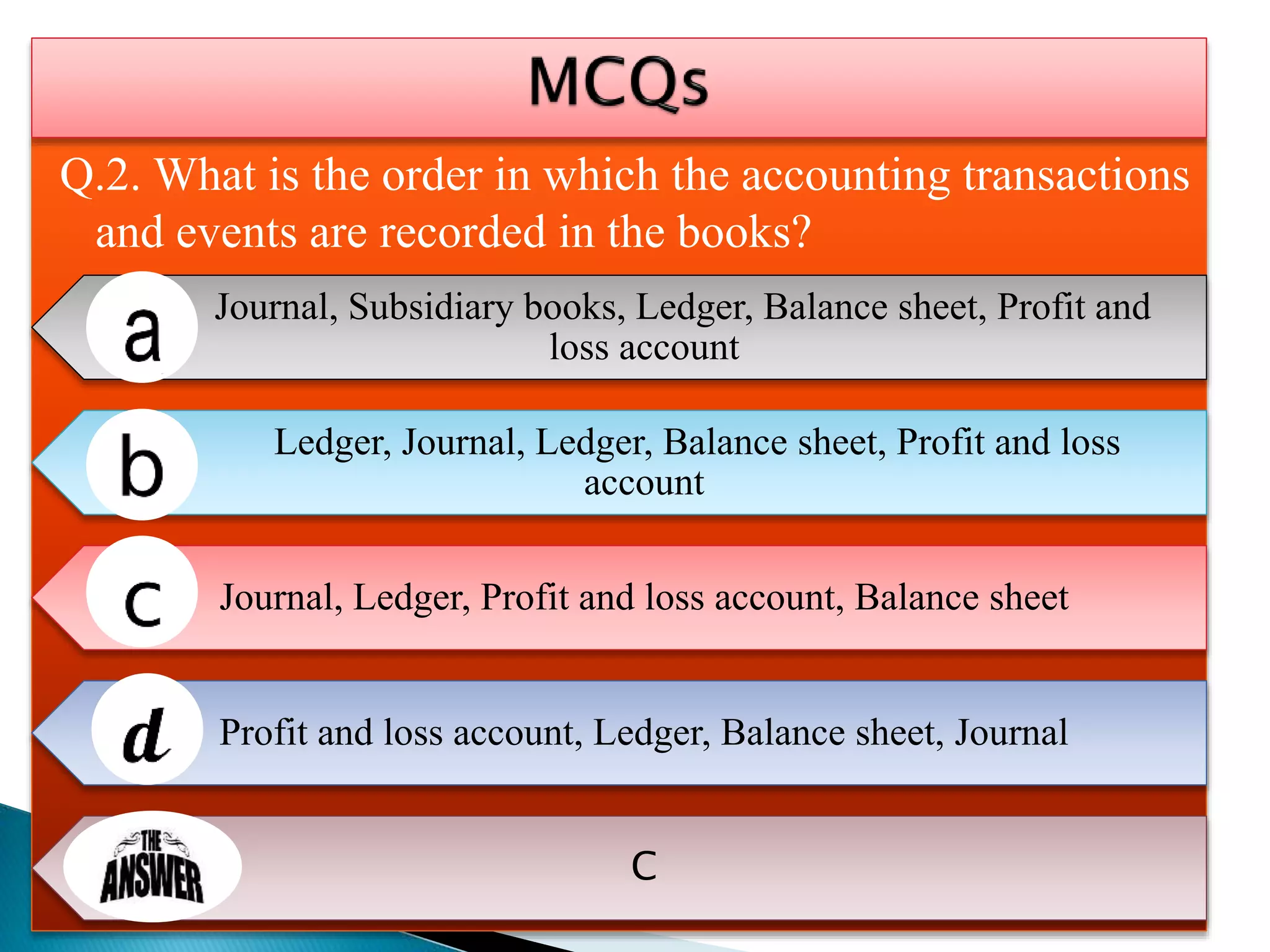
Q.2. What is the order in which the accounting transactions
and events are recorded in the books?
Journal, Subsidiary books, Ledger, Balance sheet, Profit and
loss account
Ledger, Journal, Ledger, Balance sheet, Profit and loss
account
Journal, Ledger, Profit and loss account, Balance sheet
Profit and loss account, Ledger, Balance sheet, Journal
C
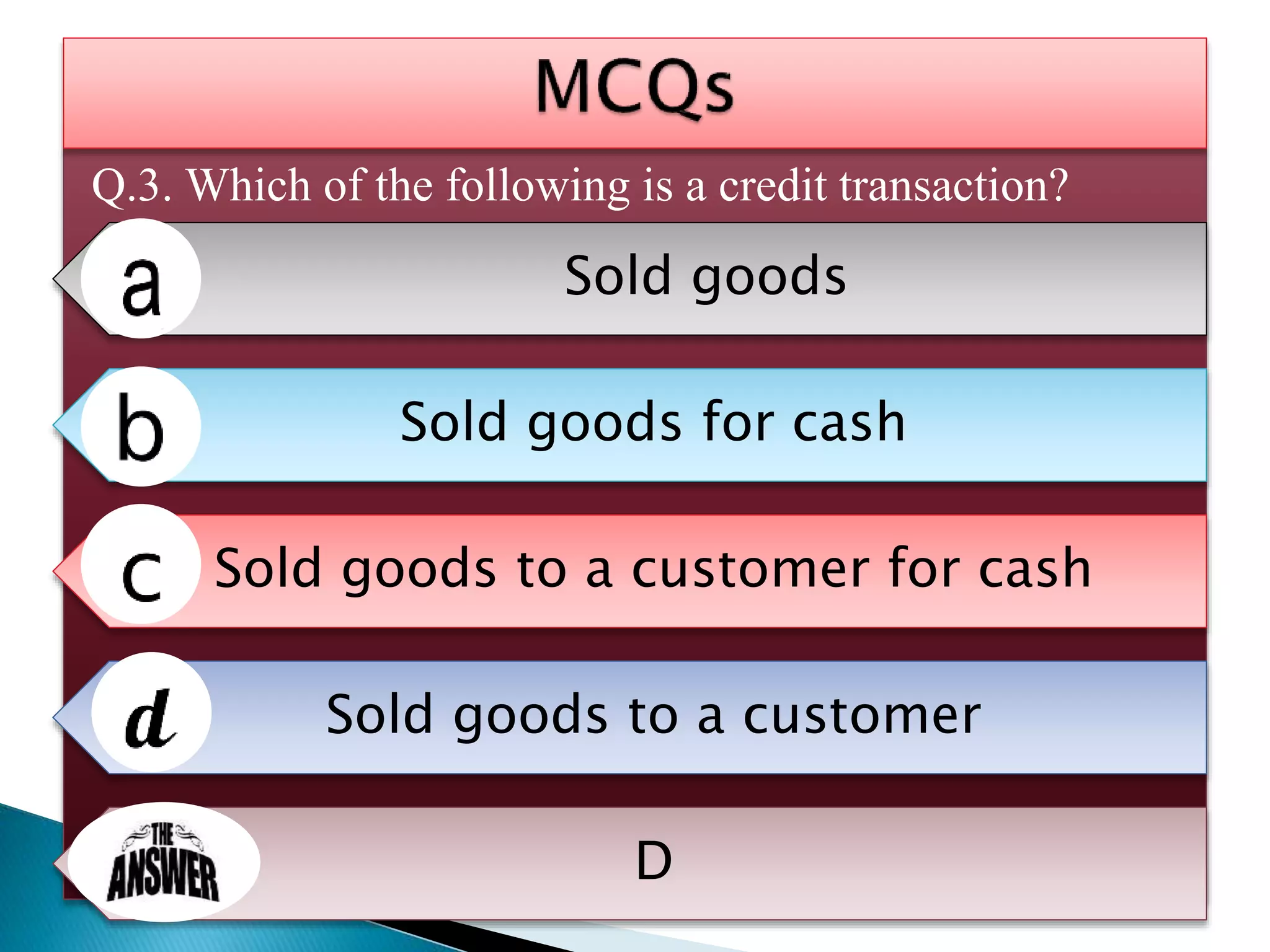
Q.3. Which of the following is a credit transaction?
Sold goods
Sold goods for cash
Sold goods to a customer for cash
Sold goods to a customer
D
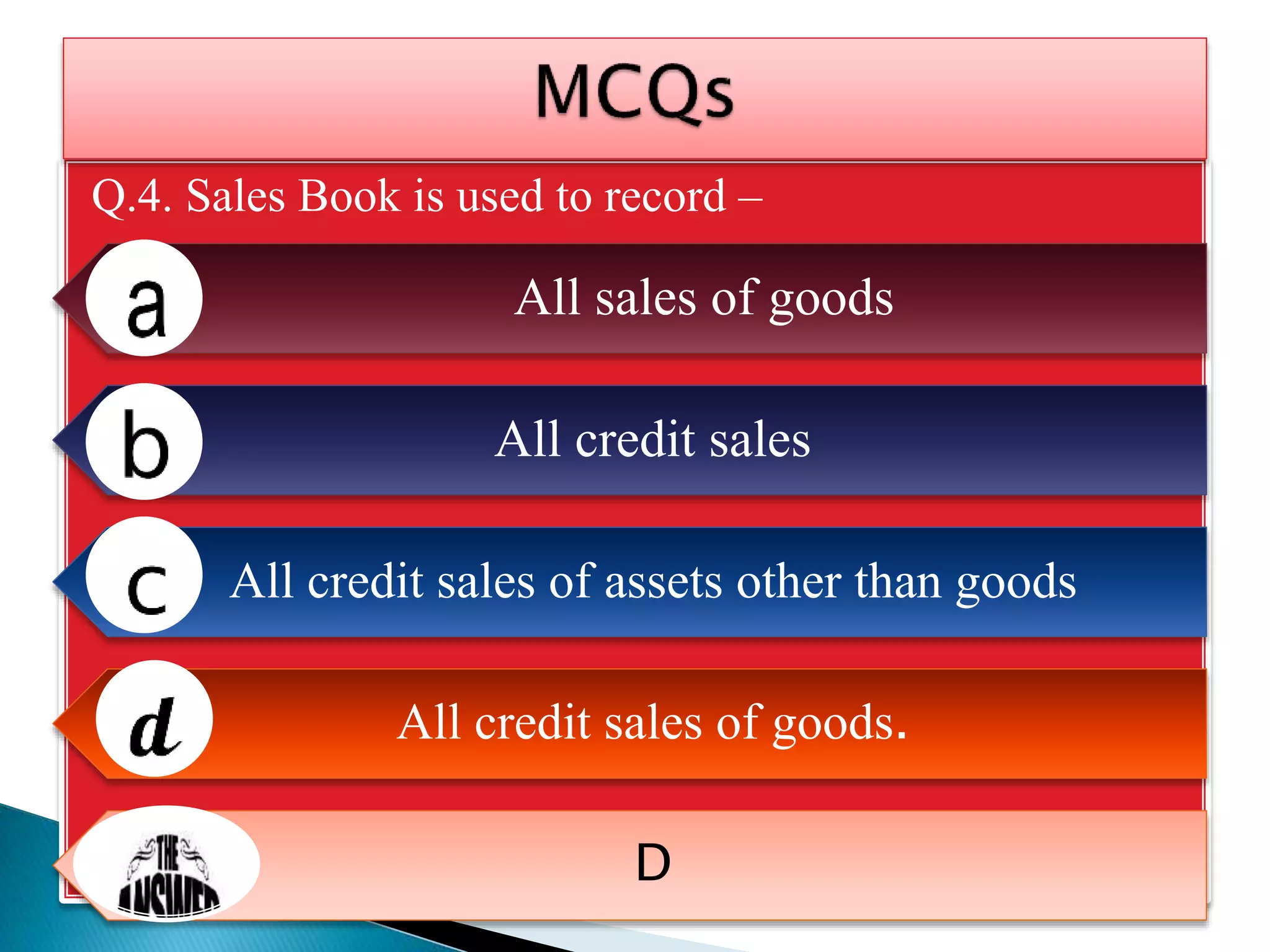
Q.4. Sales Book is used to record –
All sales of goods
All credit sales
All credit sales of assets other than goods
All credit sales of goods.
D
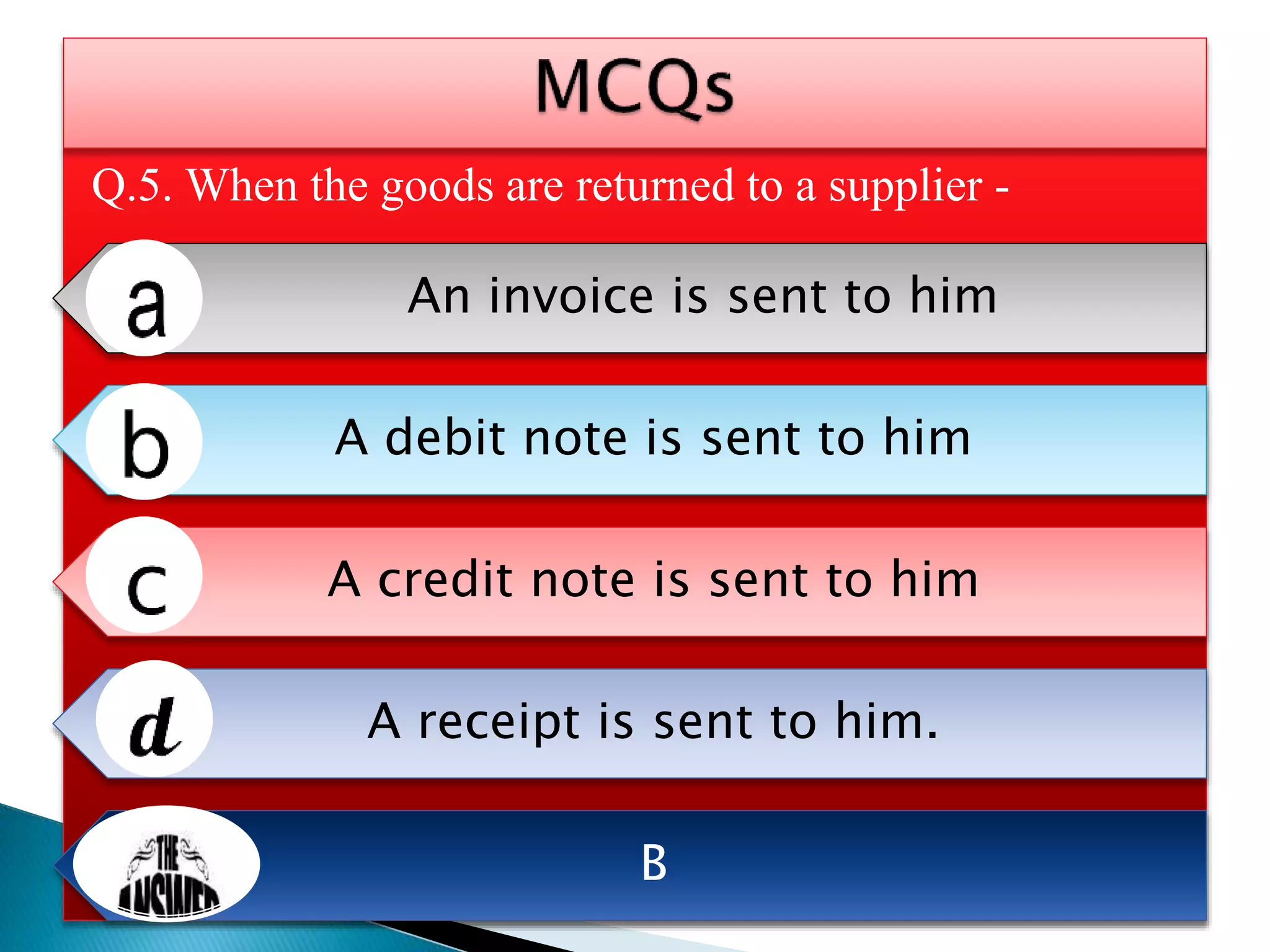
Q.5. When the goods are returned to a supplier -
An invoice is sent to him
A debit note is sent to him
A credit note is sent to him
A receipt is sent to him.
B
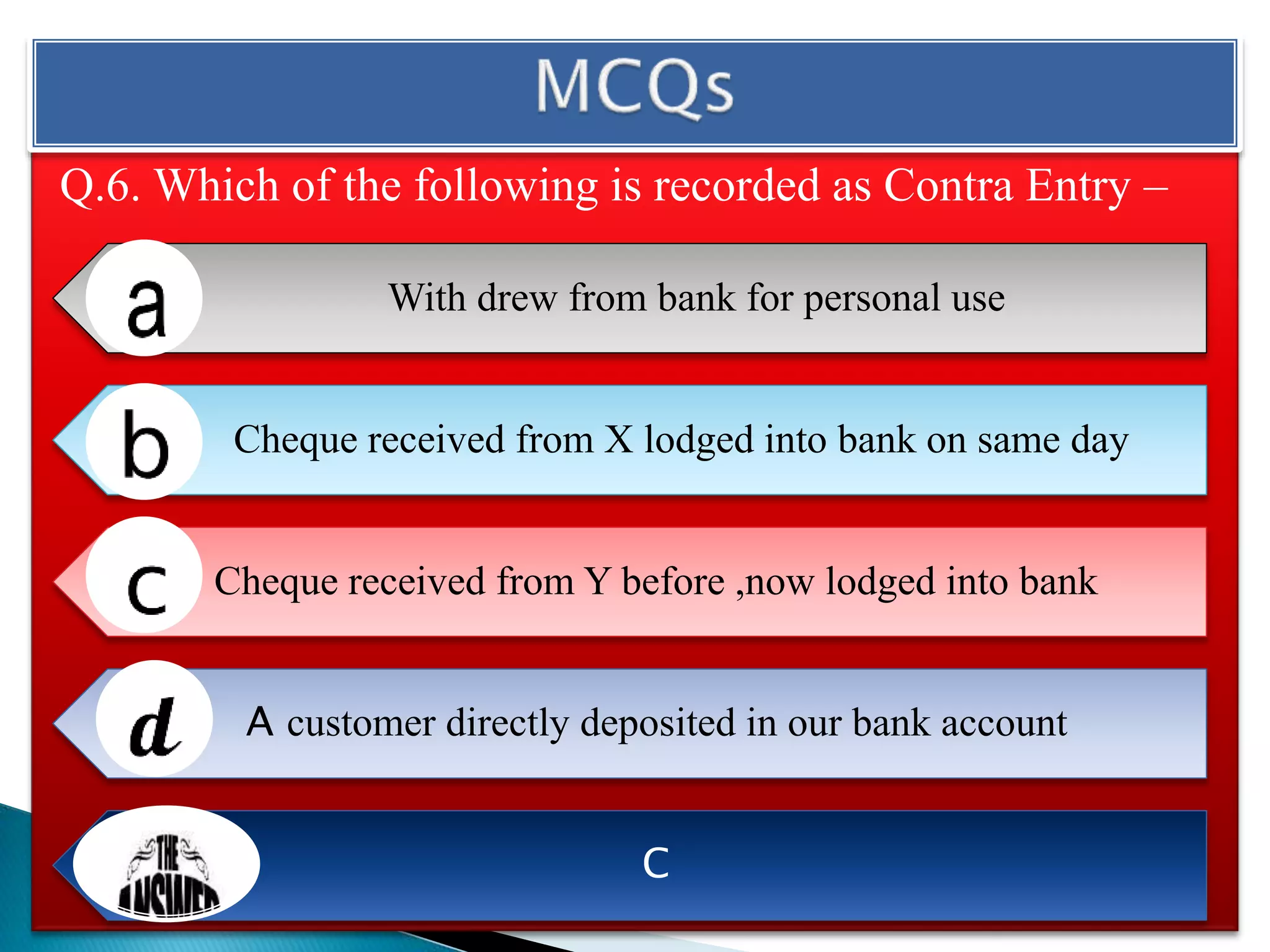
Q.6. Which of the following is recorded as Contra Entry –
With drew from bank for personal use
Cheque received from X lodged into bank on same day
Cheque received from Y before ,now lodged into bank
A customer directly deposited in our bank account
C
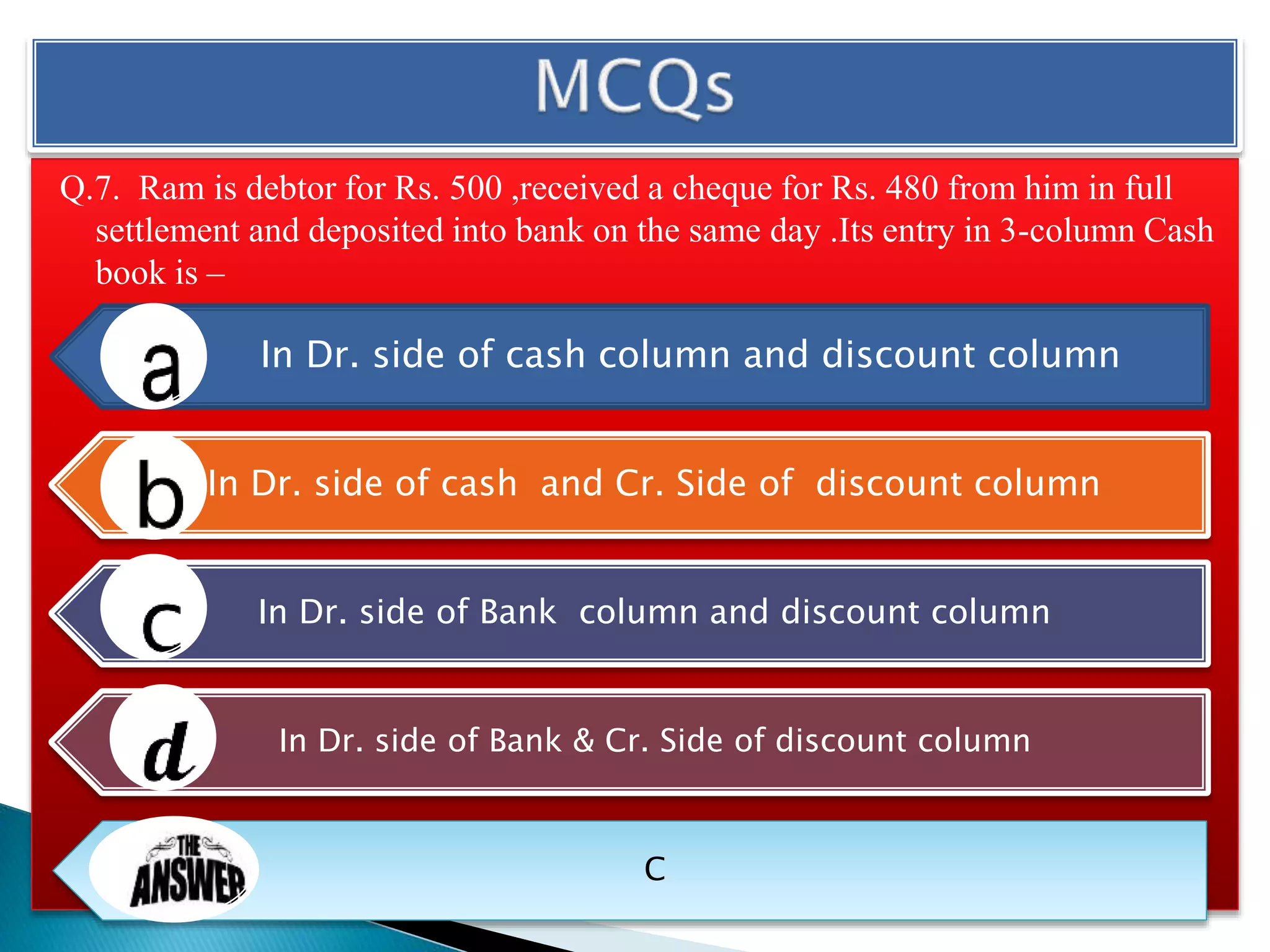
Q.7. Ram is debtor for Rs. 500 ,received a cheque for Rs. 480 from him in full
settlement and deposited into bank on the same day .Its entry in 3-column Cash
book is –
In Dr. side of cash column and discount column
In Dr. side of cash and Cr. Side of discount column
In Dr. side of Bank column and discount column
In Dr. side of Bank & Cr. Side of discount column
C
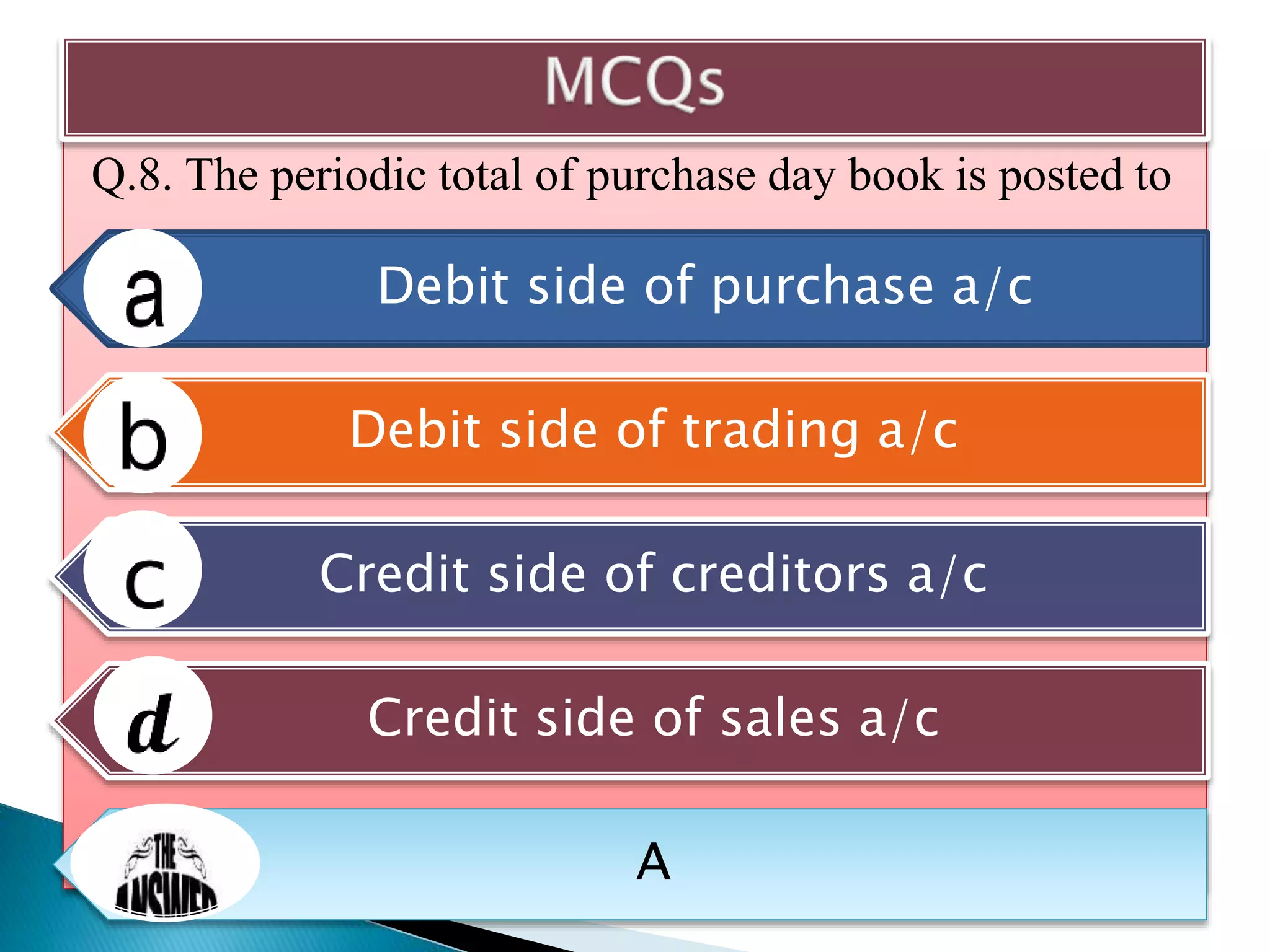
Q.8. The periodic total of purchase day book is posted to
Debit side of purchase a/c
Debit side of trading a/c
Credit side of creditors a/c
Credit side of sales a/c
A
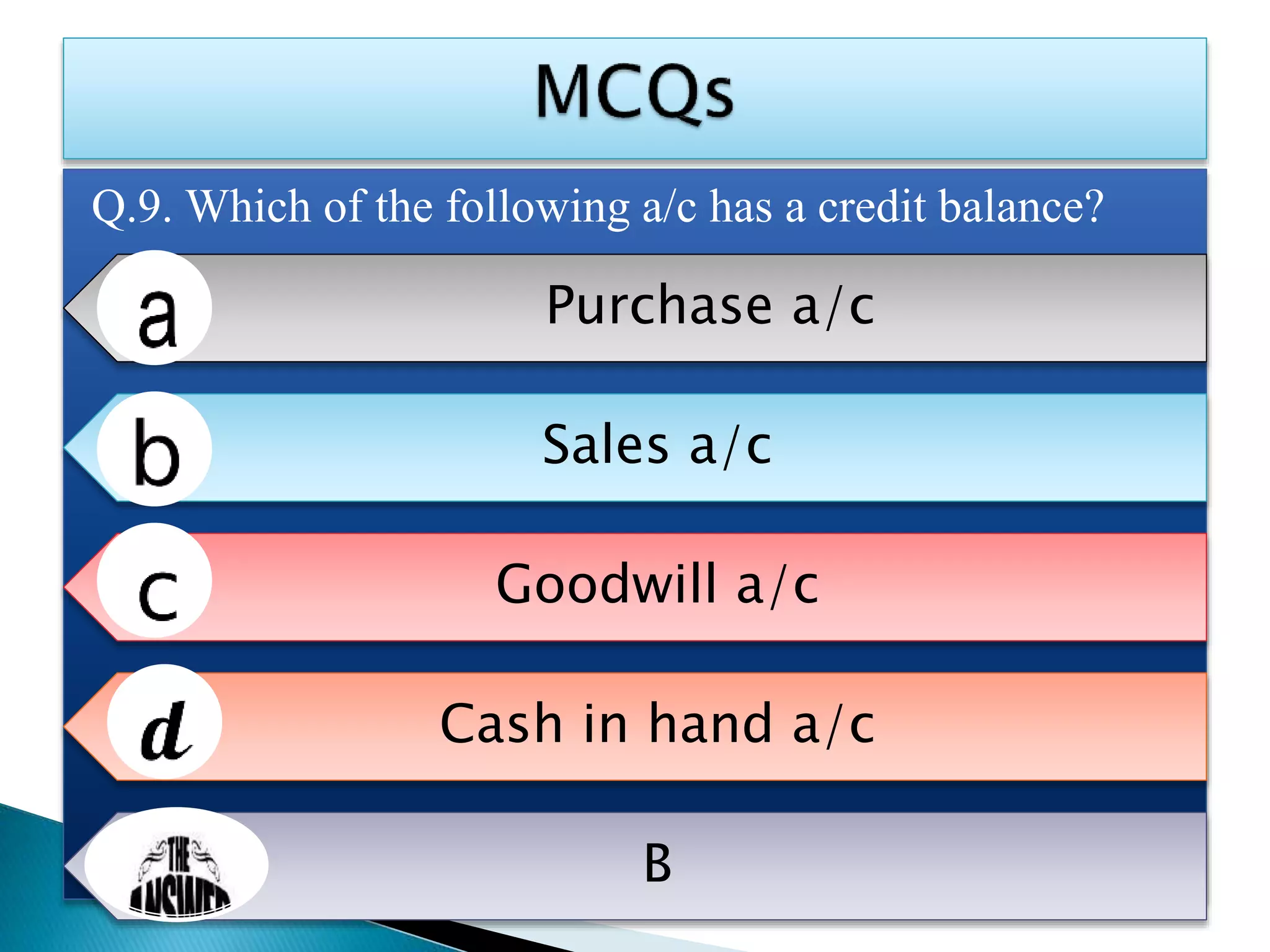
Q.9. Which of the following a/c has a credit balance?
Purchase a/c
Sales a/c
Goodwill a/c
Cash in hand a/c
B
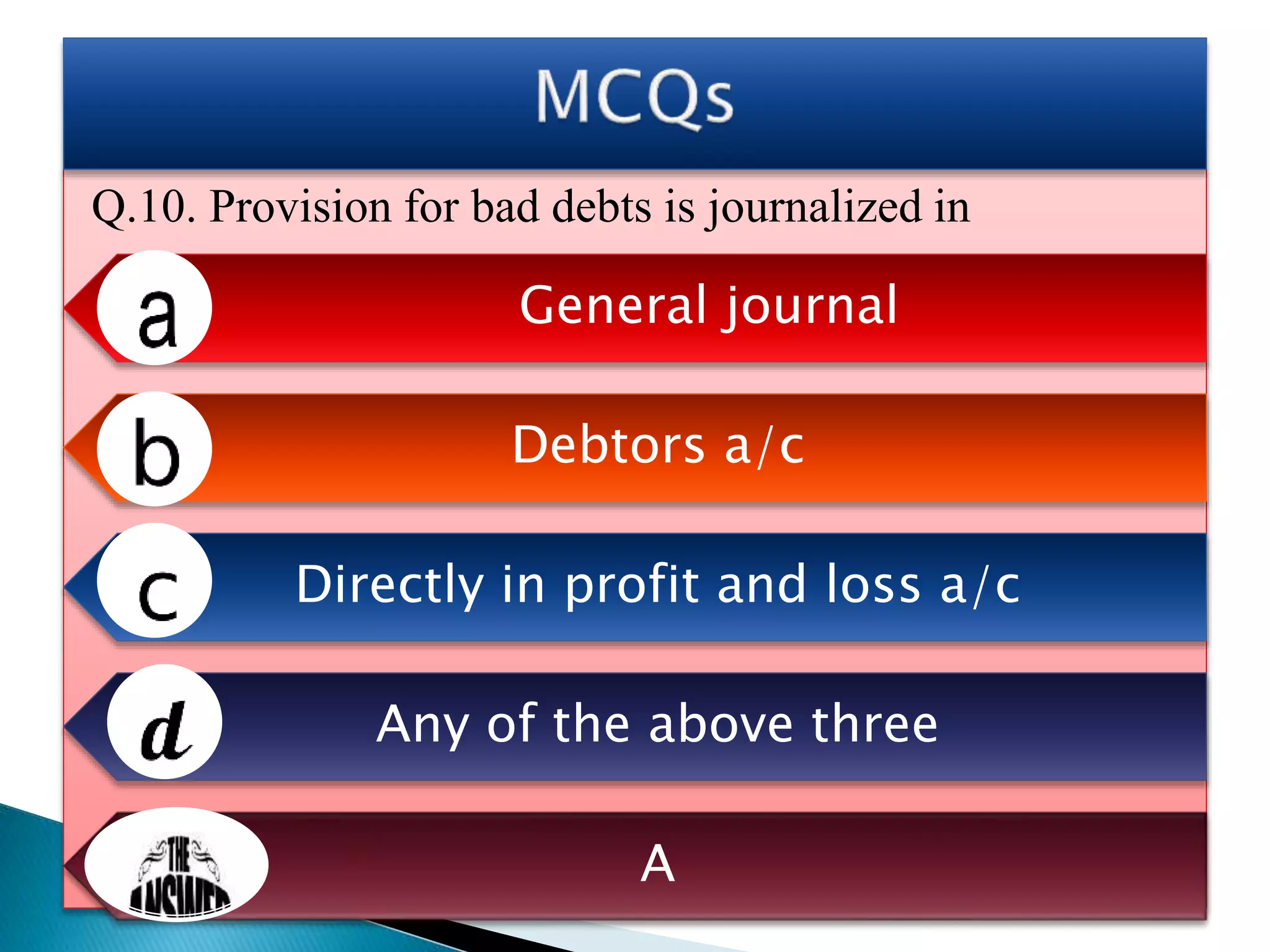
Q.10. Provision for bad debts is journalized in
General journal
Debtors a/c
Directly in profit and loss a/c
Any of the above three
A
Buy Courses
 Visit -> http://www.takshilalearning.com
 Contact -> +91-8800999280
 FB-> www.facebook.com/takshilalearn
 Linkedin->
www.linkedin.com/in/takshilalearningtrainingco
 Youtube->
https://www.youtube.com/c/TakshilaLearning

Accounting Process- Subsidiary Books

  • 1.
  • 2.
    As all thetransactions are recorded in Journal (without any sequence) It is Convenient to maintain some “Subsidiary ( Supporting/Ancillary/Memorandum) books to help the “Journal” for some special/frequent transactions It is part of recording (books of Original/Prime entry), followed by Classification
  • 3.
    Division of WorkTime Saving Expertise, Efficiency Easy accessibility of Information Easy error detection
  • 4.
    Cash Book SaleBook Purchase Book Purchase Return Book Sales Return Book Bill Payable Book Bill Receivable book ( Note : All other entries done in “Journal Proper”)
  • 5.
    A Subsidiary book-Records Cash/Cash Discount/Bank Transactions Also a Principal books(Serves the purpose of Ledger Account) Cash Book is prepared as a Cash A/c (It is both a Subsidiary & Principal book)
  • 6.
    Main Cash BookPetty Cash Book Single Column Triple Column Cash Book Cash Book Double column Cash book
  • 7.
    Shows the Receipts& Payments of only Cash (Hard Cash) Prepared on Cash basis ( Receipts- Dr. Side, Payments- Cr. Side) as a Ordinary Ledger A/C. Starts with Cash opening Balance (Dr. Side) & Ends with Closing Balance (Cr. Side) Always have a Debit Balance
  • 8.
    It Records Cash& Cash discount Transactions Discount (Dr. Side) – Discount allowed Discount (Cr. Side) – Discount Received Discount columns are not balanced , only totaled (Note : Cash Discount : Discount for early recovery/payment of Cash) (Trade Discount- a quantity discount for sale/purchase of bulk quantity) (Never Recorded separately anywhere )
  • 9.
    Date Particulars J.FCash Discount (allowed) Dt Particulars J.F Cash Discnt ( Recd) Total Total
  • 10.
    Columns for Cash,Discount & Bank Entries involving Cash & Bank (called as Contra Entries) “C” is written in L.F. Column If cheque deposited on different date Ist Entry : as cash receipt IInd Entry : as Cash deposit
  • 11.
    2016 Jan.1 Mr. Malhotracommences business with Cash 20,000 “3 He paid into Current A/c 19,000 “4 He received cheque from Rahul & Co. on account 600 “7 He pays in bank Rahul & Co’s cheque 600 “10 He pays Shyam & Co. by cheque and is allowed discount ` 20 330 “12 Kapoor & Co pays into his Bank A/c 475 “15 He receives cheque from Rahul and allows him discount ` 35 450 “20 He receives cash ` 75 and chequè 100 for cash sale “25 He pays into Bank, including cheques received on 15th and 20th 1,000 “27 He pays by cheque for cash purchase 275 “30 He pays sundry expenses in cash 50
  • 12.
    Small Cash expensesare recorded (often incurred in the business, like conveyance, courier,etc.) Imprest System : Every month the closing balance of cash is calculated, & at the beginning of next month, Petty cashier is received net amount(Monthly amount – Costing cash) Prepared in two ways : Analytical Cash book Simple Cash book.
  • 14.
    Started with theCash Received periodically by the Main Cashier Petty expenses are written (both in Total column & specific column) We get the total petty expenses incurred of the period & the total of head wise expense.
  • 15.
    Division of workSaving of time Less Burden Control over small payments Check on the junior Cashier
  • 16.
    Shri Ramanathan maintainsa Columnar Petty Cash Book on the Imprest System. The imprest amount is ` 500. From the following information, show how his Petty Cash Book for the week ended 12th September, 2015: 7/9/2015 8/9/2015 9/9/2015 10/9/2015 11/9/2015 12/9/2015 12/9/2015 Balance in hand Received Cash reimbursement to make up the imprest Stationery Miscellaneous Expenses Repairs Travelling Stationery Miscellaneous Expenses Repairs 134.90 365.10 49.80 20.90 156.70 68.50 71.40 6.30 48.30
  • 17.
    Recording the purchaseof goods on credit only No Cash purchases No Purchase of assets (Cash Book) ( Journal Proper) prepared as an invoice (the name of supplier, description of goods purchased)- Not an A/c Trade discount received (on Bulk Purchases) Deducted from Gross Purchases
  • 18.
    Vat Paid isadded to the Net Purchases (After discount) Separate Column for Vat paid on purchases (Vat Receivable)- Cenvat Credit receivable (Shown as Assets) Separate column for incidental expenses on purchases like Freight Total of respective columns-transferred to their Ledger Accounts (Total of purchases to Purchases Account)
  • 19.
     There canbe eight columns: a. Date b. Particulars c. Ledger Folio d. Invoice No. e. Details f. Amount (Net Purchases) g. VAT Paid h. Expenses
  • 20.
    Present the JournalBook: April 4 April 15 April 28 Purchased from Ajay Enterprises, Delhi 100 Doz. Rexona Hawai Chappal @ ` 120 per Doz. 200 Doz. Palki Leather Chappal@ ` 300 per Doz. Less : trade discount @ 10% Freight charged ` 150. Purchased from Balaji Traders, Delhi 50 Doz. Max Shoes @ ` 400 per Doz. 100 pair Sports Shoes. @ ` 140 per paid. Less : trade discount @ 10%. Freight charged ` 200. Purchased from Tripti Industries, Bahadurgarh 40 pair leather shoes@ ` 400 per pair 100 Doz. Rosy Hawai Chappal@ ` 180 per Doz. Less : trade discount @ 10%. Freight charged ` 100. Purchases are subject to Sales Tax @ 10%.
  • 21.
    Recording the Saleof goods on credit only No Cash Sales No Sale of assets (Cash Book) (Journal Proper) prepared as an invoice (the name of supplier, description of goods Sold)- Not an A/c Trade discount allowed (on Bulk Sales) Deducted from Gross Sales
  • 22.
    Vat Received (fromCustomers) is added to the Net Sales (After discount) Separate Column for Vat received on Sales (Vat Payable)- Shown as Liability (paid to Govt. after claim Cenvat) Total of respective columns-transferred to their Ledger Accounts (Total of Sales to Sales Account)
  • 23.
    Prepare the SalesBook: February 2, 2016 : Sold to South Indian Toys 500 toys @ ` 60 each; Less: Trade Discount @ 5%; Sales tax to be charged @ 10%. February 10, 2016 : Sold to Ria Sisters 100 kg. of wheat @ ` 40 per kg.; Less: 5% Trade Discount; Sales tax charged @ 5% . February 15, 2016 : Sold to Raj Bros. 20 bags of White Cement Powder; @ ` 2,000 per bag; Less: 2% Trade Discount; Sales tax @ 8%. February 27, 2016: Sold to Sen & Co. 10 chests of tea @ ` 500 per chest less 10% Trade Discount; Sales tax is charged @ 5%.
  • 24.
    Records the detailsof goods returned (purchased on credit) to the suppliers(Creditors) “ Returns Outward book” Prepared like a Purchase book Proportionate discount on the goods returned is also to be adjusted. On return, a debit note will be sent to the supplier (along with the goods)
  • 25.
    Records the detailsof goods returned (purchased on credit) by the Customers(Debtors). “ Returns Inward book” Prepared like a Sale book Proportionate discount on the goods returned is also to be adjusted. On return, a Credit note will be sent to the Customer
  • 26.
    If the firmhave a number of Bill receivables (signed by their Debtors) due to be collected. The book contains: Name of the acceptor, date of receipt of the bill, term of the bill, due date, Amount, etc. The total of the amount column of the bills receivable book is debited to bills receivable account
  • 27.
    If the firmhave a number of Bill Payables accepted due to be Paid (to Creditors). The book contains: Name of the Payee, date of acceptance, term of the bill, due date, Amount, etc. The total of the amount column of the bills Payable book is debited to bills receivable account
  • 28.
    For Entries otherfor which there is no special book. Opening Entries Closing Entries Rectification Entries Adjusting Entries Transfer Entries Others
  • 29.
    Other than these7 subsidiary books, there may be any other subsidiary book like Sales on Approval/Return basis book. (if their transaction are frequent & Often)
  • 30.
    Q.1. The primaryrecord of a credit purchase of a fixed asset is made in — Cash book Sales book Purchases book Journal proper D
  • 31.
    Q.2. What isthe order in which the accounting transactions and events are recorded in the books? Journal, Subsidiary books, Ledger, Balance sheet, Profit and loss account Ledger, Journal, Ledger, Balance sheet, Profit and loss account Journal, Ledger, Profit and loss account, Balance sheet Profit and loss account, Ledger, Balance sheet, Journal C
  • 32.
    Q.3. Which ofthe following is a credit transaction? Sold goods Sold goods for cash Sold goods to a customer for cash Sold goods to a customer D
  • 33.
    Q.4. Sales Bookis used to record – All sales of goods All credit sales All credit sales of assets other than goods All credit sales of goods. D
  • 34.
    Q.5. When thegoods are returned to a supplier - An invoice is sent to him A debit note is sent to him A credit note is sent to him A receipt is sent to him. B
  • 35.
    Q.6. Which ofthe following is recorded as Contra Entry – With drew from bank for personal use Cheque received from X lodged into bank on same day Cheque received from Y before ,now lodged into bank A customer directly deposited in our bank account C
  • 36.
    Q.7. Ram isdebtor for Rs. 500 ,received a cheque for Rs. 480 from him in full settlement and deposited into bank on the same day .Its entry in 3-column Cash book is – In Dr. side of cash column and discount column In Dr. side of cash and Cr. Side of discount column In Dr. side of Bank column and discount column In Dr. side of Bank & Cr. Side of discount column C
  • 37.
    Q.8. The periodictotal of purchase day book is posted to Debit side of purchase a/c Debit side of trading a/c Credit side of creditors a/c Credit side of sales a/c A
  • 38.
    Q.9. Which ofthe following a/c has a credit balance? Purchase a/c Sales a/c Goodwill a/c Cash in hand a/c B
  • 39.
    Q.10. Provision forbad debts is journalized in General journal Debtors a/c Directly in profit and loss a/c Any of the above three A
  • 40.
    Buy Courses  Visit-> http://www.takshilalearning.com  Contact -> +91-8800999280  FB-> www.facebook.com/takshilalearn  Linkedin-> www.linkedin.com/in/takshilalearningtrainingco  Youtube-> https://www.youtube.com/c/TakshilaLearning