The Accounting
Process
Is a systematic method for recording, classifying,
summarizing, and reporting financial transactions.
Understanding the Accounting Cycle
1
Analyze Business
Transactions
2
3
4
5
6
7
8
9
Journalize
the Transactions
Post to Ledger
Prepare Financial
Statements
Prepare an Adjusted
Trial Balance
Journalize and Post
Adjusting Entries
Prepare a Trial Balance
Prepare a Post-Closing
Trial Balance
Journalize and Post
Closing Entries
Analyze Business Transactions
1. Which accounts are affected?
2. Are the accounts increasing or decreasing?
3. By how much?
Ex. On September 3 2024, the business received 1,000 peso for
services performed.
 Cash increases by 1,000
 Service Revenue increases by 1,000
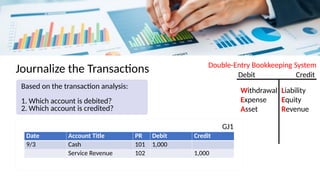
Journalize the Transactions
Based on the transaction analysis:
1. Which account is debited?
2. Which account is credited?
Date Account Title PR Debit Credit
9/3 Cash 101 1,000
Service Revenue 102 1,000
GJ1
Debit Credit
Liability
Equity
Revenue
Withdrawal
Expense
Asset
Double-Entry Bookkeeping System
Post to Ledger
Post the journal entries into the ledger or T-accounts.
Date Account Title PR Debit Credit
9/3 Cash 101 1,000
Service Revenue 102 1,000
Cash 101
Date Account Title PR Debit Credit Balance
9/3 Cash GJ1 1,000 1,000
102
Date Account Title PR Debit Credit Balance
9/3 Service Revenue GJ1 1,000 1,000
Service Revenue
Post to Ledger
Post the journal entries into the ledger or T-accounts.
Cash
1,000
Service Revenue
1,000
Date Account Title PR Debit Credit
9/3 Cash 101 1,000
Service Revenue 102 1,000
9/3
1,000
9/3
1,000
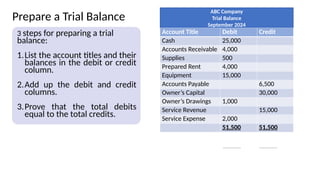
Prepare a Trial Balance
3 steps for preparing a trial
balance:
1.List the account titles and their
balances in the debit or credit
column.
2.Add up the debit and credit
columns.
3.Prove that the total debits
equal to the total credits.
ABC Company
Trial Balance
September 2024
Account Title Debit Credit
Cash 25,000
Accounts Receivable 4,000
Supplies 500
Prepared Rent 4,000
Equipment 15,000
Accounts Payable 6,500
Owner’s Capital 30,000
Owner’s Drawings 1,000
Service Revenue 15,000
Service Expense 2,000
51,500 51,500
Journalize & Post Adjusting Entries
One income statement account AND one
balance sheet account.
Debit an expense OR credit a revenue.
NEVER includes Cash.
Rules for adjusting entries:
Prepare an Adjusted
Trial Balance
3 steps for preparing an adjusted
trial balance:
1.List the account titles and their
adjusted balances in the debit
or credit column.
2.Add up the debit and credit
columns.
3.Prove that the total debits
equal to the total credits.
ABC Company
Adjusted Trial Balance
September 2024
Accounts Debit Credit
Cash 25,000
Accounts Receivable 4,000
Supplies 500
Prepared Rent 4,000
Equipment 15,000
Accounts Payable 6,500
Unearned Service Revenue 2,000
Owner’s Capital 30,000
Owner’s Drawings 1,000
Service Revenue 15,000
Service Expense 2,000
Rent Expense 1,900
Supplies Expense 200
53,100 53,100
Preparing Financial Statements
1 Income Statement
2
3
4 Statement of Cash
Flows
Balance Statement
Owner’s Equity
Statement
Net Income/Loss
Ending Owner’s Capital
Cash Balance
Journalize & Post Closing Entries
Steps for Closing Entries:
Owner’s
Capital
Owner’s
Drawings
Income
Summary
Revenues Expenses
Prepare a Post-Closing
Trial Balance
Preparing a post-closing trial
balance:
1. Only shows permanent
accounts (Assets, Liabilities,
Owner’s Capital).
2. Use updated balance for
Owner’s Capital after
closing entries.
3. Total Debits = Total Credits
ABC Company
Post-Closing Trial Balance
September 2024
Accounts Debit Credit
Cash 35,000
Accounts Receivable 4,850
Supplies 500
Prepaid Rent 4,000
Equipment 15,000
Accumulated Depreciation
Equipment
125
Accounts Payable 8,500
Unearned Service Revenue 8,000
Salaries Payable 1,800
Owner’s Capital 40,925
59,350 59,350
FINANCIAL
STATEMENTS
is a report that shows the financial activities
and performance of a business.
Key Characteristics of
Financial Statements
1 Understandable
.
2 Relevant
3 Reliable
.
Four Basic Financial Statements in Accounting
Income Statement Balance Sheet
Cash Flow Statement Statement of
Changes in Equity
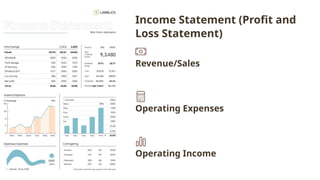
Income Statement (Profit and
Loss Statement)
Revenue/Sales
Operating Expenses
Operating Income
Balance Sheet (Statement of Financial Positio
Assets
Resources owned by
the company that have
economic value.
Liabilities
Financial obligations or
debts owed by the
company to others.
Equity
The residual interest in
the assets after
deducting liabilities.
Cash Flow Statement
Operating Activities
Investing Activities
Financing Activities
Statement of Changes in
Equity
Key Elements
Opening Balance
Additions
Deductions
Closing Balance
Income Statement
also known as the profit and loss (P&L)
statement, is a financial report that
summarizes a company's revenues,
expenses, and profits over a specific period.
What Is An Income
Statement?
It presents a clear picture of a company's
financial health by revealing how much
money they made, how much they spent,
and ultimately, how much profit they
generated.
1 Performance Indicator
2 Decision Making
3 Investor Analysis
Key Components
The income statement is structured in a way
that breaks down the key financial elements,
providing a detailed view of revenue,
expenses, and profitability.
Revenue
.
Expenses
Net Income
Revenue
Represents the total income generated by the company's core business
activities. It encompasses the amount earned from selling goods, providing
services, or other revenue-generating operations.
1. Sales Revenue
Income from selling products.
2. Service Revenue
Income from providing services.
3. Subscription Revenue
Recurring income from
subscriptions.
4. Other Revenue
Income from miscellaneous sources.
Cost Of Goods Sold
This represents the direct costs associated with producing the goods or
services that the company sells. It includes the cost of materials, labor, and
manufacturing overhead.
Raw Materials Cost of materials used in production.
Direct Labor Wages paid to workers directly involved in
production.
Manufacturing Overhead Indirect costs related to production, such as
factory rent, utilities, and maintenance.
Gross Profit
This is the profit generated after deducting
the cost of goods sold from revenue. It
represents the company's ability to generate
profit from its core business operations.
Revenue 100,000
Cost of Goods Sold 60,000
Gross Profit 40,000
Operating Expenses
These are the costs incurred in running the day-to-day operations of the
business, excluding the cost of goods sold. It includes expenses like salaries,
rent, utilities, marketing, and administrative costs.
Salaries & Wages Rent & Utilities Marketing &
Advertising
Administrative Expenses
Net Income
This represents the company's profit after all expenses are deducted from revenue.
It indicates the company's overall profitability and financial health.
1
Revenue
Total income from sales, services, etc.
2 Cost of Goods Sold
Direct costs of producing goods or services.
3
Gross Profit
Profit after deducting cost of goods sold.
4 Operating Expenses
Costs of running the business.
5
Net Income
Profit after all expenses are deducted.
Cash Flow
Statement
What Is a Cash Flow Statement (CFS)?
1 Definition
A CFS tracks the inflow and outflow of
cash, providing insights into a
company's financial health and
operational efficiency.
2 Purpose
The CFS measures how well a company
manages its cash position, meaning how
well the company generates cash to pay its
debt obligations and fund its operating
expenses.
3 Importance
As one of the three main financial
statements, the CFS complements the
balance sheet and the income
statement.
4 Analysis
In this article, we'll show you how the
CFS is structured and how you can use it
when analyzing a company.
How the Cash Flow Statement Is Used
Operational Insights
The cash flow statement
paints a picture as to how
a company's operations
are running, where its
money comes from, and
how money is being spent.
Financial Health
Assessment
Also known as the
statement of cash flows,
the CFS helps its creditors
determine how much cash
is available (referred to as
liquidity) for the company
to fund its operating
expenses and pay down its
debts.
Decision Making
By analyzing the CFS,
investors and creditors can
make informed decisions
about the company's
financial stability and
future prospects.
Structure of the Cash Flow
Statement
Component
1. Cash flow from
operating activities
2. Cash flow from
investing activities
3. Cash flow from
financing activities
4. Disclosure of non-cash activities
Balance Sheet
It summarizes what the company owns (assets),
what it owes (liabilities), and the value of its
shareholders' equity.
Basic Structure of a Balance Sheet
Assets: What the company owns.
Liabilities: What the company owes.
Equity: The residual interest after liabilities are
deducted from assets.
Formula:
Assets = Liabilities + Owners Equity
Assets
Divided into two categories:
•Current Assets (expected to be converted to cash within a year)
Ex: Cash, accounts receivable, inventory.
•Non-Current Assets (long-term investments)
Ex: Property, plant & equipment (PP&E), intangible assets like patents, goodwill.
Liabilities
Divided into two categories:
• Current Liabilities (due within a year):
Ex: Accounts payable, short-term
loans.
• Non-Current Liabilities (long-term
obligations)
Ex: Long-term debt, bonds payable.
Shareholders’ Equity
Common Components:
• Paid-In Capital: Money invested by
shareholders.
• Retained Earnings: Profits that have
been reinvested in the business.
• Treasury Stock: Shares repurchased
by the company.
Example of a Balance Sheet
Present a simplified Balance Sheet:
Assets: $500,000
Liabilities: $300,000
Owners Equity: $200,000
Formula Verification:
Assets = Liabilities + Equity
$500,000 = $300,000 + $200,000
$500,000 = $500,000
Budget Statement
is a crucial financial planning tool used by
organizations to estimate income and
expenses over a specific period.
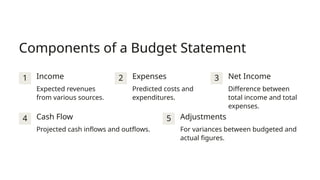
Components of a Budget Statement
1 Income
Expected revenues
from various sources.
2 Expenses
Predicted costs and
expenditures.
3 Net Income
Difference between
total income and total
expenses.
4 Cash Flow
Projected cash inflows and outflows.
5 Adjustments
For variances between budgeted and
actual figures.
Types of Budgets
Operating Budget
Covers day-to-day
expenses and revenues.
Capital Budget
Involves long-term
investments and major
capital expenditures.
Cash Flow Budget
Focuses on cash inflows
and outflows to ensure
liquidity.
Static vs. Flexible Budget
Static is fixed, while flexible adjusts to activity levels.
Preparing a Budget Statement
1 Define Goals
Understand the financial goals and objectives.
2 Gather Data
Collect historical data on income and expenses.
3 Estimate Income
Forecast future revenues based on trends and market conditions.
4 Project Expenses
Estimate future costs, including fixed and variable expenses.
5 Review and Adjust
Regularly compare actual performance with the budget and adjust as needed.

Financial-Management topic and presentation

  • 1.
    The Accounting Process Is asystematic method for recording, classifying, summarizing, and reporting financial transactions.
  • 2.
    Understanding the AccountingCycle 1 Analyze Business Transactions 2 3 4 5 6 7 8 9 Journalize the Transactions Post to Ledger Prepare Financial Statements Prepare an Adjusted Trial Balance Journalize and Post Adjusting Entries Prepare a Trial Balance Prepare a Post-Closing Trial Balance Journalize and Post Closing Entries
  • 3.
    Analyze Business Transactions 1.Which accounts are affected? 2. Are the accounts increasing or decreasing? 3. By how much? Ex. On September 3 2024, the business received 1,000 peso for services performed.  Cash increases by 1,000  Service Revenue increases by 1,000
  • 4.
    Journalize the Transactions Basedon the transaction analysis: 1. Which account is debited? 2. Which account is credited? Date Account Title PR Debit Credit 9/3 Cash 101 1,000 Service Revenue 102 1,000 GJ1 Debit Credit Liability Equity Revenue Withdrawal Expense Asset Double-Entry Bookkeeping System
  • 5.
    Post to Ledger Postthe journal entries into the ledger or T-accounts. Date Account Title PR Debit Credit 9/3 Cash 101 1,000 Service Revenue 102 1,000 Cash 101 Date Account Title PR Debit Credit Balance 9/3 Cash GJ1 1,000 1,000 102 Date Account Title PR Debit Credit Balance 9/3 Service Revenue GJ1 1,000 1,000 Service Revenue
  • 6.
    Post to Ledger Postthe journal entries into the ledger or T-accounts. Cash 1,000 Service Revenue 1,000 Date Account Title PR Debit Credit 9/3 Cash 101 1,000 Service Revenue 102 1,000 9/3 1,000 9/3 1,000
  • 7.
    Prepare a TrialBalance 3 steps for preparing a trial balance: 1.List the account titles and their balances in the debit or credit column. 2.Add up the debit and credit columns. 3.Prove that the total debits equal to the total credits. ABC Company Trial Balance September 2024 Account Title Debit Credit Cash 25,000 Accounts Receivable 4,000 Supplies 500 Prepared Rent 4,000 Equipment 15,000 Accounts Payable 6,500 Owner’s Capital 30,000 Owner’s Drawings 1,000 Service Revenue 15,000 Service Expense 2,000 51,500 51,500
  • 8.
    Journalize & PostAdjusting Entries One income statement account AND one balance sheet account. Debit an expense OR credit a revenue. NEVER includes Cash. Rules for adjusting entries:
  • 9.
    Prepare an Adjusted TrialBalance 3 steps for preparing an adjusted trial balance: 1.List the account titles and their adjusted balances in the debit or credit column. 2.Add up the debit and credit columns. 3.Prove that the total debits equal to the total credits. ABC Company Adjusted Trial Balance September 2024 Accounts Debit Credit Cash 25,000 Accounts Receivable 4,000 Supplies 500 Prepared Rent 4,000 Equipment 15,000 Accounts Payable 6,500 Unearned Service Revenue 2,000 Owner’s Capital 30,000 Owner’s Drawings 1,000 Service Revenue 15,000 Service Expense 2,000 Rent Expense 1,900 Supplies Expense 200 53,100 53,100
  • 10.
    Preparing Financial Statements 1Income Statement 2 3 4 Statement of Cash Flows Balance Statement Owner’s Equity Statement Net Income/Loss Ending Owner’s Capital Cash Balance
  • 11.
    Journalize & PostClosing Entries Steps for Closing Entries: Owner’s Capital Owner’s Drawings Income Summary Revenues Expenses
  • 12.
    Prepare a Post-Closing TrialBalance Preparing a post-closing trial balance: 1. Only shows permanent accounts (Assets, Liabilities, Owner’s Capital). 2. Use updated balance for Owner’s Capital after closing entries. 3. Total Debits = Total Credits ABC Company Post-Closing Trial Balance September 2024 Accounts Debit Credit Cash 35,000 Accounts Receivable 4,850 Supplies 500 Prepaid Rent 4,000 Equipment 15,000 Accumulated Depreciation Equipment 125 Accounts Payable 8,500 Unearned Service Revenue 8,000 Salaries Payable 1,800 Owner’s Capital 40,925 59,350 59,350
  • 13.
    FINANCIAL STATEMENTS is a reportthat shows the financial activities and performance of a business.
  • 14.
    Key Characteristics of FinancialStatements 1 Understandable . 2 Relevant 3 Reliable .
  • 15.
    Four Basic FinancialStatements in Accounting Income Statement Balance Sheet Cash Flow Statement Statement of Changes in Equity
  • 16.
    Income Statement (Profitand Loss Statement) Revenue/Sales Operating Expenses Operating Income
  • 17.
    Balance Sheet (Statementof Financial Positio Assets Resources owned by the company that have economic value. Liabilities Financial obligations or debts owed by the company to others. Equity The residual interest in the assets after deducting liabilities.
  • 18.
    Cash Flow Statement OperatingActivities Investing Activities Financing Activities
  • 19.
    Statement of Changesin Equity Key Elements Opening Balance Additions Deductions Closing Balance
  • 20.
    Income Statement also knownas the profit and loss (P&L) statement, is a financial report that summarizes a company's revenues, expenses, and profits over a specific period.
  • 21.
    What Is AnIncome Statement? It presents a clear picture of a company's financial health by revealing how much money they made, how much they spent, and ultimately, how much profit they generated. 1 Performance Indicator 2 Decision Making 3 Investor Analysis
  • 22.
    Key Components The incomestatement is structured in a way that breaks down the key financial elements, providing a detailed view of revenue, expenses, and profitability. Revenue . Expenses Net Income
  • 23.
    Revenue Represents the totalincome generated by the company's core business activities. It encompasses the amount earned from selling goods, providing services, or other revenue-generating operations. 1. Sales Revenue Income from selling products. 2. Service Revenue Income from providing services. 3. Subscription Revenue Recurring income from subscriptions. 4. Other Revenue Income from miscellaneous sources.
  • 24.
    Cost Of GoodsSold This represents the direct costs associated with producing the goods or services that the company sells. It includes the cost of materials, labor, and manufacturing overhead. Raw Materials Cost of materials used in production. Direct Labor Wages paid to workers directly involved in production. Manufacturing Overhead Indirect costs related to production, such as factory rent, utilities, and maintenance.
  • 25.
    Gross Profit This isthe profit generated after deducting the cost of goods sold from revenue. It represents the company's ability to generate profit from its core business operations. Revenue 100,000 Cost of Goods Sold 60,000 Gross Profit 40,000
  • 26.
    Operating Expenses These arethe costs incurred in running the day-to-day operations of the business, excluding the cost of goods sold. It includes expenses like salaries, rent, utilities, marketing, and administrative costs. Salaries & Wages Rent & Utilities Marketing & Advertising Administrative Expenses
  • 27.
    Net Income This representsthe company's profit after all expenses are deducted from revenue. It indicates the company's overall profitability and financial health. 1 Revenue Total income from sales, services, etc. 2 Cost of Goods Sold Direct costs of producing goods or services. 3 Gross Profit Profit after deducting cost of goods sold. 4 Operating Expenses Costs of running the business. 5 Net Income Profit after all expenses are deducted.
  • 28.
  • 29.
    What Is aCash Flow Statement (CFS)? 1 Definition A CFS tracks the inflow and outflow of cash, providing insights into a company's financial health and operational efficiency. 2 Purpose The CFS measures how well a company manages its cash position, meaning how well the company generates cash to pay its debt obligations and fund its operating expenses. 3 Importance As one of the three main financial statements, the CFS complements the balance sheet and the income statement. 4 Analysis In this article, we'll show you how the CFS is structured and how you can use it when analyzing a company.
  • 31.
    How the CashFlow Statement Is Used Operational Insights The cash flow statement paints a picture as to how a company's operations are running, where its money comes from, and how money is being spent. Financial Health Assessment Also known as the statement of cash flows, the CFS helps its creditors determine how much cash is available (referred to as liquidity) for the company to fund its operating expenses and pay down its debts. Decision Making By analyzing the CFS, investors and creditors can make informed decisions about the company's financial stability and future prospects.
  • 32.
    Structure of theCash Flow Statement Component 1. Cash flow from operating activities 2. Cash flow from investing activities 3. Cash flow from financing activities 4. Disclosure of non-cash activities
  • 33.
    Balance Sheet It summarizeswhat the company owns (assets), what it owes (liabilities), and the value of its shareholders' equity.
  • 34.
    Basic Structure ofa Balance Sheet Assets: What the company owns. Liabilities: What the company owes. Equity: The residual interest after liabilities are deducted from assets. Formula: Assets = Liabilities + Owners Equity
  • 35.
    Assets Divided into twocategories: •Current Assets (expected to be converted to cash within a year) Ex: Cash, accounts receivable, inventory. •Non-Current Assets (long-term investments) Ex: Property, plant & equipment (PP&E), intangible assets like patents, goodwill. Liabilities Divided into two categories: • Current Liabilities (due within a year): Ex: Accounts payable, short-term loans. • Non-Current Liabilities (long-term obligations) Ex: Long-term debt, bonds payable. Shareholders’ Equity Common Components: • Paid-In Capital: Money invested by shareholders. • Retained Earnings: Profits that have been reinvested in the business. • Treasury Stock: Shares repurchased by the company.
  • 36.
    Example of aBalance Sheet Present a simplified Balance Sheet: Assets: $500,000 Liabilities: $300,000 Owners Equity: $200,000 Formula Verification: Assets = Liabilities + Equity $500,000 = $300,000 + $200,000 $500,000 = $500,000
  • 37.
    Budget Statement is acrucial financial planning tool used by organizations to estimate income and expenses over a specific period.
  • 38.
    Components of aBudget Statement 1 Income Expected revenues from various sources. 2 Expenses Predicted costs and expenditures. 3 Net Income Difference between total income and total expenses. 4 Cash Flow Projected cash inflows and outflows. 5 Adjustments For variances between budgeted and actual figures.
  • 39.
    Types of Budgets OperatingBudget Covers day-to-day expenses and revenues. Capital Budget Involves long-term investments and major capital expenditures. Cash Flow Budget Focuses on cash inflows and outflows to ensure liquidity. Static vs. Flexible Budget Static is fixed, while flexible adjusts to activity levels.
  • 40.
    Preparing a BudgetStatement 1 Define Goals Understand the financial goals and objectives. 2 Gather Data Collect historical data on income and expenses. 3 Estimate Income Forecast future revenues based on trends and market conditions. 4 Project Expenses Estimate future costs, including fixed and variable expenses. 5 Review and Adjust Regularly compare actual performance with the budget and adjust as needed.