
Subject:- Financial Accounting 1 
Presented By……. 
Pallabi Goswami MCI14028 
Padum Chetry MCI14026 
Indrani Talukdar MCI14011 
Kamal K. Saharia MCI14027 
Tonmoyee Talukdar MCI14013 
Nandit N.P Gayan MCI14021 
AklantaMadhav Kalita MCI14030 
Jahnu Borah MCI14023 
Tezpur University
Introduction 
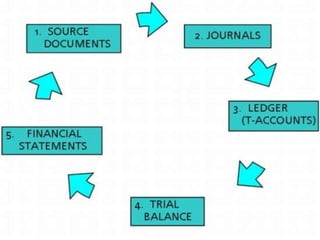
Financial statements are the end products of 
the accounting process, which reveals the 
financial results of the specified period and 
financial position as on particular date. It is 
the basic and formal annual report through 
which a business communicates financial 
information to its various user groups.
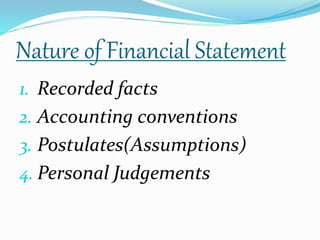
Nature of Financial Statement 
1. Recorded facts 
2. Accounting conventions 
3. Postulates(Assumptions) 
4. Personal Judgements
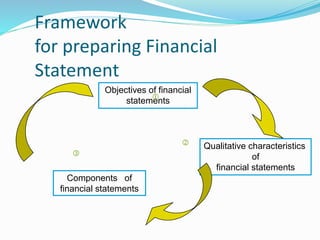
Framework 
for preparing Financial 
Statement 
Qualitative characteristics 
of 
financial statements 
Objectives of financial 
statements 
Components of 
financial statements 
j 
k 
l
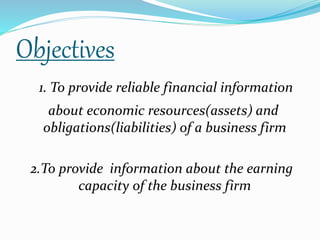
Objectives 
1. To provide reliable financial information 
about economic resources(assets) and 
obligations(liabilities) of a business firm 
2.To provide information about the earning 
capacity of the business firm
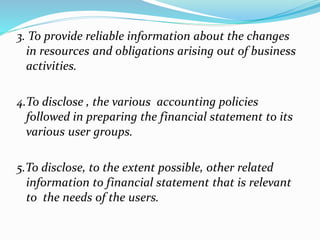
3. To provide reliable information about the changes 
in resources and obligations arising out of business 
activities. 
4.To disclose , the various accounting policies 
followed in preparing the financial statement to its 
various user groups. 
5.To disclose, to the extent possible, other related 
information to financial statement that is relevant 
to the needs of the users.
Characteristics of Ideal financial statement 
1.Relevency 
2.Reliability 
3.Understandibility 
4.Comparability
Importance of financial statement 
1. Importance to management 
2. Importance to Creditors 
3 Importance to Bankers 
4. Importance to Investors 
5. Importance to Government
Limitation of financial statement 
1.Provide only interim reports 
2.Aggregate information 
3.No qualitative information 
4.Personal biasness 
5.Historical cost
Components of Financial Statement 
1. Income Statement 
(a)Manufacturing Account 
(b)Trading account 
(c)Profit and loss account 
2. Statement of Financial Position 
*Balance sheet
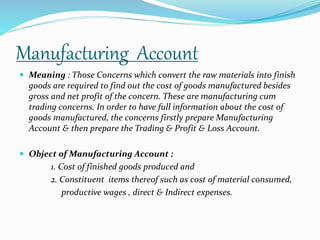
Manufacturing Account 
 Meaning : Those Concerns which convert the raw materials into finish 
goods are required to find out the cost of goods manufactured besides 
gross and net profit of the concern. These are manufacturing cum 
trading concerns. In order to have full information about the cost of 
goods manufactured, the concerns firstly prepare Manufacturing 
Account & then prepare the Trading & Profit & Loss Account. 
 Object of Manufacturing Account : 
1. Cost of finished goods produced and 
2. Constituent items thereof such as cost of material consumed, 
productive wages , direct & Indirect expenses.
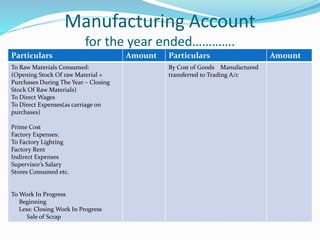
Manufacturing Account 
for the year ended…………. 
Particulars Amount Particulars Amount 
To Raw Materials Consumed: 
(Opening Stock Of raw Material + 
Purchases During The Year – Closing 
Stock Of Raw Materials) 
To Direct Wages 
To Direct Expenses(as carriage on 
purchases) 
Prime Cost 
Factory Expenses: 
To Factory Lighting 
Factory Rent 
Indirect Expenses 
Supervisor’s Salary 
Stores Consumed etc. 
To Work In Progress 
Beginning 
Less: Closing Work In Progress 
Sale of Scrap 
By Cost of Goods Manufactured 
transferred to Trading A/c
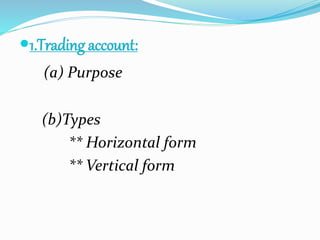
1.Trading account: 
(a) Purpose 
(b)Types 
** Horizontal form 
** Vertical form
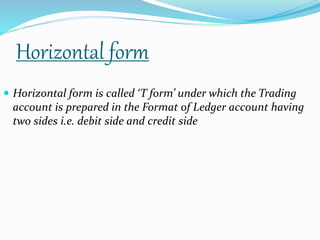
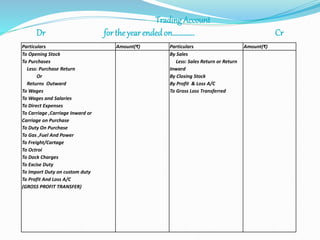
Horizontal form 
 Horizontal form is called ‘T form’ under which the Trading 
account is prepared in the Format of Ledger account having 
two sides i.e. debit side and credit side
Trading Account 
Dr for the year ended on………….. Cr 
Particulars Amount(₹) Particulars Amount(₹) 
To Opening Stock 
To Purchases 
Less: Purchase Return 
Or 
Returns Outward 
To Wages 
To Wages and Salaries 
To Direct Expenses 
To Carriage ,Carriage Inward or 
Carriage on Purchase 
To Duty On Purchase 
To Gas ,Fuel And Power 
To Freight/Cartage 
To Octroi 
To Dock Charges 
To Excise Duty 
To Import Duty on custom duty 
To Profit And Loss A/C 
(GROSS PROFIT TRANSFER) 
By Sales 
Less: Sales Return or Return 
Inward 
By Closing Stock 
By Profit & Loss A/C 
To Gross Loss Transferred
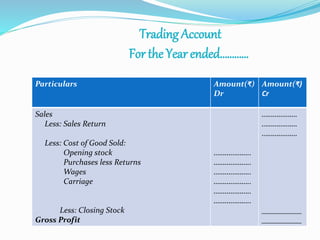
Vertical Form 
 Vertical form is a form under which the trading 
account is prepared in vertical order i.e. in the form of a 
statement. These are shown below
Particulars Amount(₹) 
Dr 
Amount(₹) 
Cr 
Sales 
Less: Sales Return 
Less: Cost of Good Sold: 
Opening stock 
Purchases less Returns 
Wages 
Carriage 
Less: Closing Stock 
Gross Profit 
……………….. 
……………….. 
……………….. 
……………….. 
……………….. 
……………….. 
………………. 
………………. 
………………. 
__________ 
__________ 
Trading Account 
For the Year ended…………
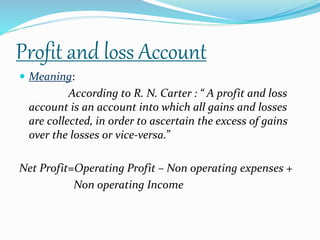
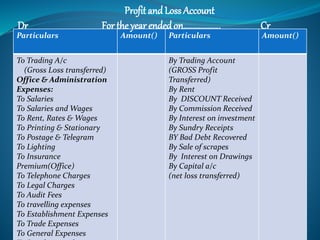
Profit and loss Account 
 Meaning: 
According to R. N. Carter : “ A profit and loss 
account is an account into which all gains and losses 
are collected, in order to ascertain the excess of gains 
over the losses or vice-versa.” 
Net Profit=Operating Profit – Non operating expenses + 
Non operating Income
Profit and Loss Account 
Dr For the year ended on……………….. Cr 
Particulars Amount() Particulars Amount() 
To Trading A/c 
(Gross Loss transferred) 
Office & Administration 
Expenses: 
To Salaries 
To Salaries and Wages 
To Rent, Rates & Wages 
To Printing & Stationary 
To Postage & Telegram 
To Lighting 
To Insurance 
Premium(Office) 
To Telephone Charges 
To Legal Charges 
To Audit Fees 
To travelling expenses 
To Establishment Expenses 
To Trade Expenses 
To General Expenses 
To Royalty on sales 
By Trading Account 
(GROSS Profit 
Transferred) 
By Rent 
By DISCOUNT Received 
By Commission Received 
By Interest on investment 
By Sundry Receipts 
BY Bad Debt Recovered 
By Sale of scrapes 
By Interest on Drawings 
By Capital a/c 
(net loss transferred)
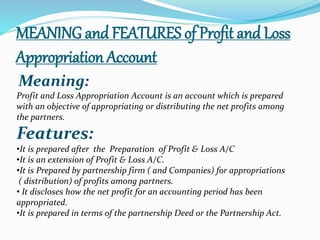
MEANING and FEATURES of Profit and Loss 
Appropriation Account 
Meaning: 
Profit and Loss Appropriation Account is an account which is prepared 
with an objective of appropriating or distributing the net profits among 
the partners. 
Features: 
•It is prepared after the Preparation of Profit & Loss A/C 
•It is an extension of Profit & Loss A/C. 
•It is Prepared by partnership firm ( and Companies) for appropriations 
( distribution) of profits among partners. 
• It discloses how the net profit for an accounting period has been 
appropriated. 
•It is prepared in terms of the partnership Deed or the Partnership Act.
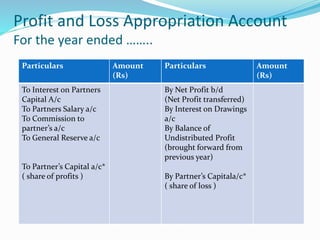
Profit and Loss Appropriation Account 
For the year ended …….. 
Particulars Amount 
(Rs) 
Particulars Amount 
(Rs) 
To Interest on Partners 
Capital A/c 
To Partners Salary a/c 
To Commission to 
partner’s a/c 
To General Reserve a/c 
To Partner’s Capital a/c* 
( share of profits ) 
By Net Profit b/d 
(Net Profit transferred) 
By Interest on Drawings 
a/c 
By Balance of 
Undistributed Profit 
(brought forward from 
previous year) 
By Partner’s Capitala/c* 
( share of loss )
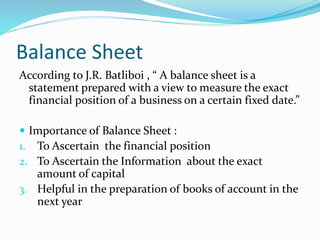
Balance Sheet 
According to J.R. Batliboi , “ A balance sheet is a 
statement prepared with a view to measure the exact 
financial position of a business on a certain fixed date.” 
 Importance of Balance Sheet : 
1. To Ascertain the financial position 
2. To Ascertain the Information about the exact 
amount of capital 
3. Helpful in the preparation of books of account in the 
next year
Characteristics of Balance Sheet 
 The balance sheet is a statement not an account. 
 The word ‘to’ and ‘By’ are not used before the names of 
the accounts shown in the balance sheet. 
 The total of the two sides of the balance sheet must be 
equal. 
 It Shows the financial position of the business 
according to the going concern concept. 
 The balance sheet does not have Debit or Credit Side. 
The two sides of the balance sheet are called “Assets” 
And “Liability”
Marshalling of Assets & Liabilities 
 Marshalling can be made in one of the following two 
methods 
(a)Liquidity; or 
(b)Permanence 
Generally , sole proprietors and partnership firms 
prepare their Balance Sheet in the order of Liquidity.
Formats of Balance Sheet 
 Horizontal Form and 
 Vertical Form
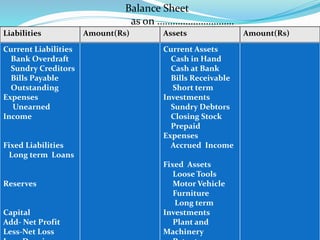
 Horizontal Form:- 
Under this form of presentation of Balance 
Sheet the Assets are shown on the right hand side. And 
the Liabilities are shown on the Left Hand Side . This 
form is also called ‘T’ form. This shown below
Balance Sheet 
as on ………………………… 
Liabilities Amount(Rs) Assets Amount(Rs) 
Current Liabilities 
Bank Overdraft 
Sundry Creditors 
Bills Payable 
Outstanding 
Expenses 
Unearned 
Income 
Fixed Liabilities 
Long term Loans 
Reserves 
Capital 
Add- Net Profit 
Less-Net Loss 
Less-Drawings 
Current Assets 
Cash in Hand 
Cash at Bank 
Bills Receivable 
Short term 
Investments 
Sundry Debtors 
Closing Stock 
Prepaid 
Expenses 
Accrued Income 
Fixed Assets 
Loose Tools 
Motor Vehicle 
Furniture 
Long term 
Investments 
Plant and 
Machinery 
Patent
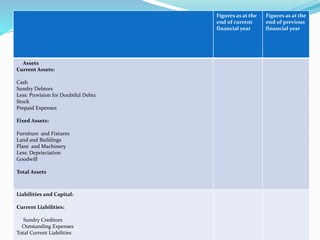
Vertical Form:- 
Under vertical form of preparing a 
balance sheet, the liabilities and assets 
are shown one after another in vertical 
order i.e. in the form of a statement.
Figures as at the 
end of current 
financial year 
Figures as at the 
end of previous 
financial year 
Assets 
Current Assets: 
Cash 
Sundry Debtors 
Less: Provision for Doubtful Debts 
Stock 
Prepaid Expenses 
Fixed Assets: 
Furniture and Fixtures 
Land and Buildings 
Plant and Machinery 
Less: Deprieciation 
Goodwill 
Total Assets 
Liabilities and Capital: 
Current Liabilities: 
Sundry Creditors 
Outstanding Expenses 
Total Current Liabilities
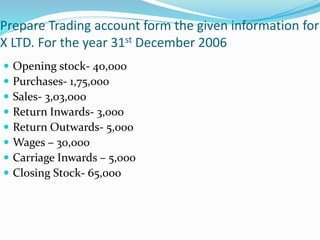
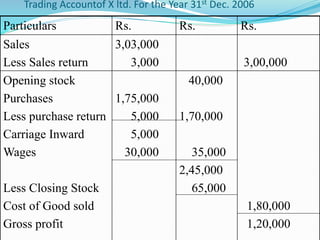
Prepare Trading account form the given information for 
X LTD. For the year 31st December 2006 
 Opening stock- 40,000 
 Purchases- 1,75,000 
 Sales- 3,03,000 
 Return Inwards- 3,000 
 Return Outwards- 5,000 
 Wages – 30,000 
 Carriage Inwards – 5,000 
 Closing Stock- 65,000
Trading Accountof X ltd. For the Year 31st Dec. 2006 
Particulars Rs. Rs. Rs. 
Sales 
3,03,000 
Less Sales return 
3,000 3,00,000 
Opening stock 
Purchases 
Less purchase return 
Carriage Inward 
Wages 
Less Closing Stock 
Cost of Good sold 
Gross profit 
1,75,000 
5,000 
5,000 
30,000 
40,000 
1,70,000 
35,000 
2,45,000 
65,000 
1,80,000 
1,20,000
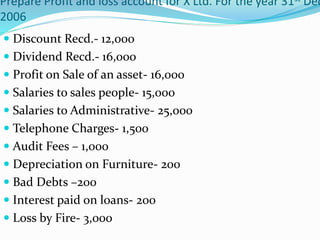
Prepare Profit and loss account for X Ltd. For the year 31st Dec. 
2006 
 Discount Recd.- 12,000 
 Dividend Recd.- 16,000 
 Profit on Sale of an asset- 16,000 
 Salaries to sales people- 15,000 
 Salaries to Administrative- 25,000 
 Telephone Charges- 1,500 
 Audit Fees – 1,000 
 Depreciation on Furniture- 200 
 Bad Debts –200 
 Interest paid on loans- 200 
 Loss by Fire- 3,000
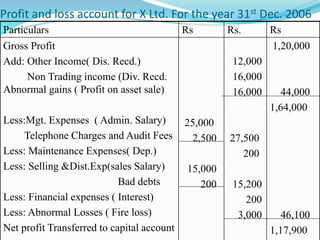
Profit and loss account for X Ltd. For the year 31st Dec. 2006 
Particulars Rs Rs. Rs 
Gross Profit 
Add: Other Income( Dis. Recd.) 
Non Trading income (Div. Recd. 
Abnormal gains ( Profit on asset sale) 
Less:Mgt. Expenses ( Admin. Salary) 
Telephone Charges and Audit Fees 
Less: Maintenance Expenses( Dep.) 
Less: Selling &Dist.Exp(sales Salary) 
Bad debts 
Less: Financial expenses ( Interest) 
Less: Abnormal Losses ( Fire loss) 
Net profit Transferred to capital account 
25,000 
2,500 
15,000 
200 
12,000 
16,000 
16,000 
27,500 
200 
15,200 
200 
3,000 
1,20,000 
44,000 
1,64,000 
46,100 
1,17,900
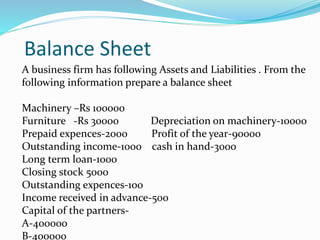
Balance Sheet 
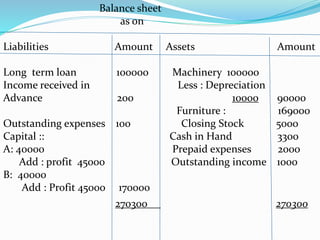
A business firm has following Assets and Liabilities . From the 
following information prepare a balance sheet 
Machinery –Rs 100000 
Furniture -Rs 30000 Depreciation on machinery-10000 
Prepaid expences-2000 Profit of the year-90000 
Outstanding income-1000 cash in hand-3000 
Long term loan-1000 
Closing stock 5000 
Outstanding expences-100 
Income received in advance-500 
Capital of the partners- 
A-400000 
B-400000
Balance sheet 
as on 
Liabilities Amount Assets Amount 
Long term loan 100000 Machinery 100000 
Income received in Less : Depreciation 
Advance 200 10000 90000 
Furniture : 169000 
Outstanding expenses 100 Closing Stock 5000 
Capital :: Cash in Hand 3300 
A: 40000 Prepaid expenses 2000 
Add : profit 45000 Outstanding income 1000 
B: 40000 
Add : Profit 45000 170000 
270300 270300
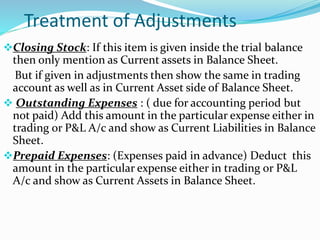
Treatment of Adjustments 
Closing Stock: If this item is given inside the trial balance 
then only mention as Current assets in Balance Sheet. 
But if given in adjustments then show the same in trading 
account as well as in Current Asset side of Balance Sheet. 
 Outstanding Expenses : ( due for accounting period but 
not paid) Add this amount in the particular expense either in 
trading or P&L A/c and show as Current Liabilities in Balance 
Sheet. 
Prepaid Expenses: (Expenses paid in advance) Deduct this 
amount in the particular expense either in trading or P&L 
A/c and show as Current Assets in Balance Sheet.
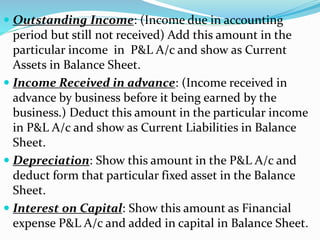
 Outstanding Income: (Income due in accounting 
period but still not received) Add this amount in the 
particular income in P&L A/c and show as Current 
Assets in Balance Sheet. 
 Income Received in advance: (Income received in 
advance by business before it being earned by the 
business.) Deduct this amount in the particular income 
in P&L A/c and show as Current Liabilities in Balance 
Sheet. 
 Depreciation: Show this amount in the P&L A/c and 
deduct form that particular fixed asset in the Balance 
Sheet. 
 Interest on Capital: Show this amount as Financial 
expense P&L A/c and added in capital in Balance Sheet.
THANK YOU 
39

Financial statement

  • 1.
    Subject:- Financial Accounting1 Presented By……. Pallabi Goswami MCI14028 Padum Chetry MCI14026 Indrani Talukdar MCI14011 Kamal K. Saharia MCI14027 Tonmoyee Talukdar MCI14013 Nandit N.P Gayan MCI14021 AklantaMadhav Kalita MCI14030 Jahnu Borah MCI14023 Tezpur University
  • 2.
    Introduction Financial statementsare the end products of the accounting process, which reveals the financial results of the specified period and financial position as on particular date. It is the basic and formal annual report through which a business communicates financial information to its various user groups.
  • 3.
    Nature of FinancialStatement 1. Recorded facts 2. Accounting conventions 3. Postulates(Assumptions) 4. Personal Judgements
  • 5.
    Framework for preparingFinancial Statement Qualitative characteristics of financial statements Objectives of financial statements Components of financial statements j k l
  • 6.
    Objectives 1. Toprovide reliable financial information about economic resources(assets) and obligations(liabilities) of a business firm 2.To provide information about the earning capacity of the business firm
  • 7.
    3. To providereliable information about the changes in resources and obligations arising out of business activities. 4.To disclose , the various accounting policies followed in preparing the financial statement to its various user groups. 5.To disclose, to the extent possible, other related information to financial statement that is relevant to the needs of the users.
  • 8.
    Characteristics of Idealfinancial statement 1.Relevency 2.Reliability 3.Understandibility 4.Comparability
  • 9.
    Importance of financialstatement 1. Importance to management 2. Importance to Creditors 3 Importance to Bankers 4. Importance to Investors 5. Importance to Government
  • 10.
    Limitation of financialstatement 1.Provide only interim reports 2.Aggregate information 3.No qualitative information 4.Personal biasness 5.Historical cost
  • 11.
    Components of FinancialStatement 1. Income Statement (a)Manufacturing Account (b)Trading account (c)Profit and loss account 2. Statement of Financial Position *Balance sheet
  • 12.
    Manufacturing Account Meaning : Those Concerns which convert the raw materials into finish goods are required to find out the cost of goods manufactured besides gross and net profit of the concern. These are manufacturing cum trading concerns. In order to have full information about the cost of goods manufactured, the concerns firstly prepare Manufacturing Account & then prepare the Trading & Profit & Loss Account.  Object of Manufacturing Account : 1. Cost of finished goods produced and 2. Constituent items thereof such as cost of material consumed, productive wages , direct & Indirect expenses.
  • 13.
    Manufacturing Account forthe year ended…………. Particulars Amount Particulars Amount To Raw Materials Consumed: (Opening Stock Of raw Material + Purchases During The Year – Closing Stock Of Raw Materials) To Direct Wages To Direct Expenses(as carriage on purchases) Prime Cost Factory Expenses: To Factory Lighting Factory Rent Indirect Expenses Supervisor’s Salary Stores Consumed etc. To Work In Progress Beginning Less: Closing Work In Progress Sale of Scrap By Cost of Goods Manufactured transferred to Trading A/c
  • 14.
    1.Trading account: (a)Purpose (b)Types ** Horizontal form ** Vertical form
  • 15.
    Horizontal form Horizontal form is called ‘T form’ under which the Trading account is prepared in the Format of Ledger account having two sides i.e. debit side and credit side
  • 16.
    Trading Account Drfor the year ended on………….. Cr Particulars Amount(₹) Particulars Amount(₹) To Opening Stock To Purchases Less: Purchase Return Or Returns Outward To Wages To Wages and Salaries To Direct Expenses To Carriage ,Carriage Inward or Carriage on Purchase To Duty On Purchase To Gas ,Fuel And Power To Freight/Cartage To Octroi To Dock Charges To Excise Duty To Import Duty on custom duty To Profit And Loss A/C (GROSS PROFIT TRANSFER) By Sales Less: Sales Return or Return Inward By Closing Stock By Profit & Loss A/C To Gross Loss Transferred
  • 17.
    Vertical Form Vertical form is a form under which the trading account is prepared in vertical order i.e. in the form of a statement. These are shown below
  • 18.
    Particulars Amount(₹) Dr Amount(₹) Cr Sales Less: Sales Return Less: Cost of Good Sold: Opening stock Purchases less Returns Wages Carriage Less: Closing Stock Gross Profit ……………….. ……………….. ……………….. ……………….. ……………….. ……………….. ………………. ………………. ………………. __________ __________ Trading Account For the Year ended…………
  • 19.
    Profit and lossAccount  Meaning: According to R. N. Carter : “ A profit and loss account is an account into which all gains and losses are collected, in order to ascertain the excess of gains over the losses or vice-versa.” Net Profit=Operating Profit – Non operating expenses + Non operating Income
  • 20.
    Profit and LossAccount Dr For the year ended on……………….. Cr Particulars Amount() Particulars Amount() To Trading A/c (Gross Loss transferred) Office & Administration Expenses: To Salaries To Salaries and Wages To Rent, Rates & Wages To Printing & Stationary To Postage & Telegram To Lighting To Insurance Premium(Office) To Telephone Charges To Legal Charges To Audit Fees To travelling expenses To Establishment Expenses To Trade Expenses To General Expenses To Royalty on sales By Trading Account (GROSS Profit Transferred) By Rent By DISCOUNT Received By Commission Received By Interest on investment By Sundry Receipts BY Bad Debt Recovered By Sale of scrapes By Interest on Drawings By Capital a/c (net loss transferred)
  • 21.
    MEANING and FEATURESof Profit and Loss Appropriation Account Meaning: Profit and Loss Appropriation Account is an account which is prepared with an objective of appropriating or distributing the net profits among the partners. Features: •It is prepared after the Preparation of Profit & Loss A/C •It is an extension of Profit & Loss A/C. •It is Prepared by partnership firm ( and Companies) for appropriations ( distribution) of profits among partners. • It discloses how the net profit for an accounting period has been appropriated. •It is prepared in terms of the partnership Deed or the Partnership Act.
  • 22.
    Profit and LossAppropriation Account For the year ended …….. Particulars Amount (Rs) Particulars Amount (Rs) To Interest on Partners Capital A/c To Partners Salary a/c To Commission to partner’s a/c To General Reserve a/c To Partner’s Capital a/c* ( share of profits ) By Net Profit b/d (Net Profit transferred) By Interest on Drawings a/c By Balance of Undistributed Profit (brought forward from previous year) By Partner’s Capitala/c* ( share of loss )
  • 23.
    Balance Sheet Accordingto J.R. Batliboi , “ A balance sheet is a statement prepared with a view to measure the exact financial position of a business on a certain fixed date.”  Importance of Balance Sheet : 1. To Ascertain the financial position 2. To Ascertain the Information about the exact amount of capital 3. Helpful in the preparation of books of account in the next year
  • 24.
    Characteristics of BalanceSheet  The balance sheet is a statement not an account.  The word ‘to’ and ‘By’ are not used before the names of the accounts shown in the balance sheet.  The total of the two sides of the balance sheet must be equal.  It Shows the financial position of the business according to the going concern concept.  The balance sheet does not have Debit or Credit Side. The two sides of the balance sheet are called “Assets” And “Liability”
  • 25.
    Marshalling of Assets& Liabilities  Marshalling can be made in one of the following two methods (a)Liquidity; or (b)Permanence Generally , sole proprietors and partnership firms prepare their Balance Sheet in the order of Liquidity.
  • 26.
    Formats of BalanceSheet  Horizontal Form and  Vertical Form
  • 27.
     Horizontal Form:- Under this form of presentation of Balance Sheet the Assets are shown on the right hand side. And the Liabilities are shown on the Left Hand Side . This form is also called ‘T’ form. This shown below
  • 28.
    Balance Sheet ason ………………………… Liabilities Amount(Rs) Assets Amount(Rs) Current Liabilities Bank Overdraft Sundry Creditors Bills Payable Outstanding Expenses Unearned Income Fixed Liabilities Long term Loans Reserves Capital Add- Net Profit Less-Net Loss Less-Drawings Current Assets Cash in Hand Cash at Bank Bills Receivable Short term Investments Sundry Debtors Closing Stock Prepaid Expenses Accrued Income Fixed Assets Loose Tools Motor Vehicle Furniture Long term Investments Plant and Machinery Patent
  • 29.
    Vertical Form:- Undervertical form of preparing a balance sheet, the liabilities and assets are shown one after another in vertical order i.e. in the form of a statement.
  • 30.
    Figures as atthe end of current financial year Figures as at the end of previous financial year Assets Current Assets: Cash Sundry Debtors Less: Provision for Doubtful Debts Stock Prepaid Expenses Fixed Assets: Furniture and Fixtures Land and Buildings Plant and Machinery Less: Deprieciation Goodwill Total Assets Liabilities and Capital: Current Liabilities: Sundry Creditors Outstanding Expenses Total Current Liabilities
  • 31.
    Prepare Trading accountform the given information for X LTD. For the year 31st December 2006  Opening stock- 40,000  Purchases- 1,75,000  Sales- 3,03,000  Return Inwards- 3,000  Return Outwards- 5,000  Wages – 30,000  Carriage Inwards – 5,000  Closing Stock- 65,000
  • 32.
    Trading Accountof Xltd. For the Year 31st Dec. 2006 Particulars Rs. Rs. Rs. Sales 3,03,000 Less Sales return 3,000 3,00,000 Opening stock Purchases Less purchase return Carriage Inward Wages Less Closing Stock Cost of Good sold Gross profit 1,75,000 5,000 5,000 30,000 40,000 1,70,000 35,000 2,45,000 65,000 1,80,000 1,20,000
  • 33.
    Prepare Profit andloss account for X Ltd. For the year 31st Dec. 2006  Discount Recd.- 12,000  Dividend Recd.- 16,000  Profit on Sale of an asset- 16,000  Salaries to sales people- 15,000  Salaries to Administrative- 25,000  Telephone Charges- 1,500  Audit Fees – 1,000  Depreciation on Furniture- 200  Bad Debts –200  Interest paid on loans- 200  Loss by Fire- 3,000
  • 34.
    Profit and lossaccount for X Ltd. For the year 31st Dec. 2006 Particulars Rs Rs. Rs Gross Profit Add: Other Income( Dis. Recd.) Non Trading income (Div. Recd. Abnormal gains ( Profit on asset sale) Less:Mgt. Expenses ( Admin. Salary) Telephone Charges and Audit Fees Less: Maintenance Expenses( Dep.) Less: Selling &Dist.Exp(sales Salary) Bad debts Less: Financial expenses ( Interest) Less: Abnormal Losses ( Fire loss) Net profit Transferred to capital account 25,000 2,500 15,000 200 12,000 16,000 16,000 27,500 200 15,200 200 3,000 1,20,000 44,000 1,64,000 46,100 1,17,900
  • 35.
    Balance Sheet Abusiness firm has following Assets and Liabilities . From the following information prepare a balance sheet Machinery –Rs 100000 Furniture -Rs 30000 Depreciation on machinery-10000 Prepaid expences-2000 Profit of the year-90000 Outstanding income-1000 cash in hand-3000 Long term loan-1000 Closing stock 5000 Outstanding expences-100 Income received in advance-500 Capital of the partners- A-400000 B-400000
  • 36.
    Balance sheet ason Liabilities Amount Assets Amount Long term loan 100000 Machinery 100000 Income received in Less : Depreciation Advance 200 10000 90000 Furniture : 169000 Outstanding expenses 100 Closing Stock 5000 Capital :: Cash in Hand 3300 A: 40000 Prepaid expenses 2000 Add : profit 45000 Outstanding income 1000 B: 40000 Add : Profit 45000 170000 270300 270300
  • 37.
    Treatment of Adjustments Closing Stock: If this item is given inside the trial balance then only mention as Current assets in Balance Sheet. But if given in adjustments then show the same in trading account as well as in Current Asset side of Balance Sheet.  Outstanding Expenses : ( due for accounting period but not paid) Add this amount in the particular expense either in trading or P&L A/c and show as Current Liabilities in Balance Sheet. Prepaid Expenses: (Expenses paid in advance) Deduct this amount in the particular expense either in trading or P&L A/c and show as Current Assets in Balance Sheet.
  • 38.
     Outstanding Income:(Income due in accounting period but still not received) Add this amount in the particular income in P&L A/c and show as Current Assets in Balance Sheet.  Income Received in advance: (Income received in advance by business before it being earned by the business.) Deduct this amount in the particular income in P&L A/c and show as Current Liabilities in Balance Sheet.  Depreciation: Show this amount in the P&L A/c and deduct form that particular fixed asset in the Balance Sheet.  Interest on Capital: Show this amount as Financial expense P&L A/c and added in capital in Balance Sheet.
  • 39.