Basic Accounting
Principles
The Financial Statements
Accounting Terms
Account

• A group of items having common
characteristics

Types of Accounts
• Asset
• Income
• Equity

Liability
Expense
Chart of Accounts
Listing of all of the
accounts used by a business
Asset Accounts
Items of Value
Characterized as current
and non-current
Liability Accounts
Claims that others have against
the assets
Have a known:
• Amount
• Date to be paid
• Person to whom payment owed

Also current and non current
Equity Accounts
Claims that the owner has
against the assets
Sometimes called net worth
Difference between value of
assets and liabilities
Income and Expense
Accounts
Types of equity accounts
Simple accounting systems
often only contain these
accounts
Double vs Single Entry
Accounting
 Single – One account entry for each
transaction
 Double – Two account entries for each
transaction
• One debit and one credit

 Hybrid systems

• May not match income with expenses
• May not distinguish cash, check, or
credit
Basic Accounting
Equation
Always maintained in double
entry accounting
Assets will always equal
liabilities plus equity
Transactions
Will be equal and offsetting
Two types:
• Income & Expenses
• Transfers between accounts
Cash and Accrual
Accounting
Refers to the timing of entries
into the accounting system
Cash Based Records
Transactions are recorded when
cash is received or paid out
Accrual Based Records
Transactions are recorded when
they take place
Regardless of whether cash is
involved
Accrual Adjusted
Statements
Cash based records are kept
throughout the year
Non-Cash adjustments are
made to the cash based income
statement at the end of the
year
Account Valuation
Income Accounts
• Value received is recorded

Expense Accounts
• Value paid is recorded

Liability Accounts
• Value is dollar amount owed
Account Valuation
Asset Accounts
• More difficult because they may
not be traded routinely
Asset Valuation
Cost Basis
Market Value Basis
Cost Basis Asset
Valuation
Original cost minus depreciation
Must establish a depreciation
method
Market Basis Asset
Valuation
Recorded as the price they
could bring if sold, less selling
expenses
Based on recent auctions,
appraisals, etc.
Depreciation
 Section II page 29, (FFSTF
Guidelines)
 Allocation of the expense that
reflects the “using up” of capital
assets employed by the business
 Conceptually, this is done over the
useful life of the asset in a
“systematic and rational” manner
Depreciation
 Allocation applied to original cost
minus salvage value
 Accelerated versus straight line
methods

• Example of difference between
management records and tax records

 Can overstate or understate true
income
Financial Reports
Balance Sheet
Income Statement
Statement of Cash Flows
Statement of Owner Equity
Balance Sheet
Represents a financial situation
at a single point in time
Has a date on it
Broken down by:
• Type of Asset or liability
• Time or life of the account type
Balance Sheet
Current Assets

• Cash and other assets that will
be converted into cash during one
operating cycle

Non-Current Assets

• Those not expected to be
converted into cash in one
operating cycle
Balance Sheet
Current Liabilities
• Debts that will come due within
one year from the balance sheet
date

Non-Current Liabilities
• Those debts due more that one
year from the balance sheet date
Balance Sheet
 Intermediate Assets and Liabilities
 Long term Assets and Liabilities
 Can use cost or market valuations
or both
 Supporting Schedules are very
helpful
 Will need a balance sheet for
beginning and ending of accounting
period
Income Statement
 Summary of income and expenses
 Represents a period of time
between two balance sheets
 Explains the change in equity
between two balance sheets
 Can be divided into enterprise
reports
 Can be cash or accrual
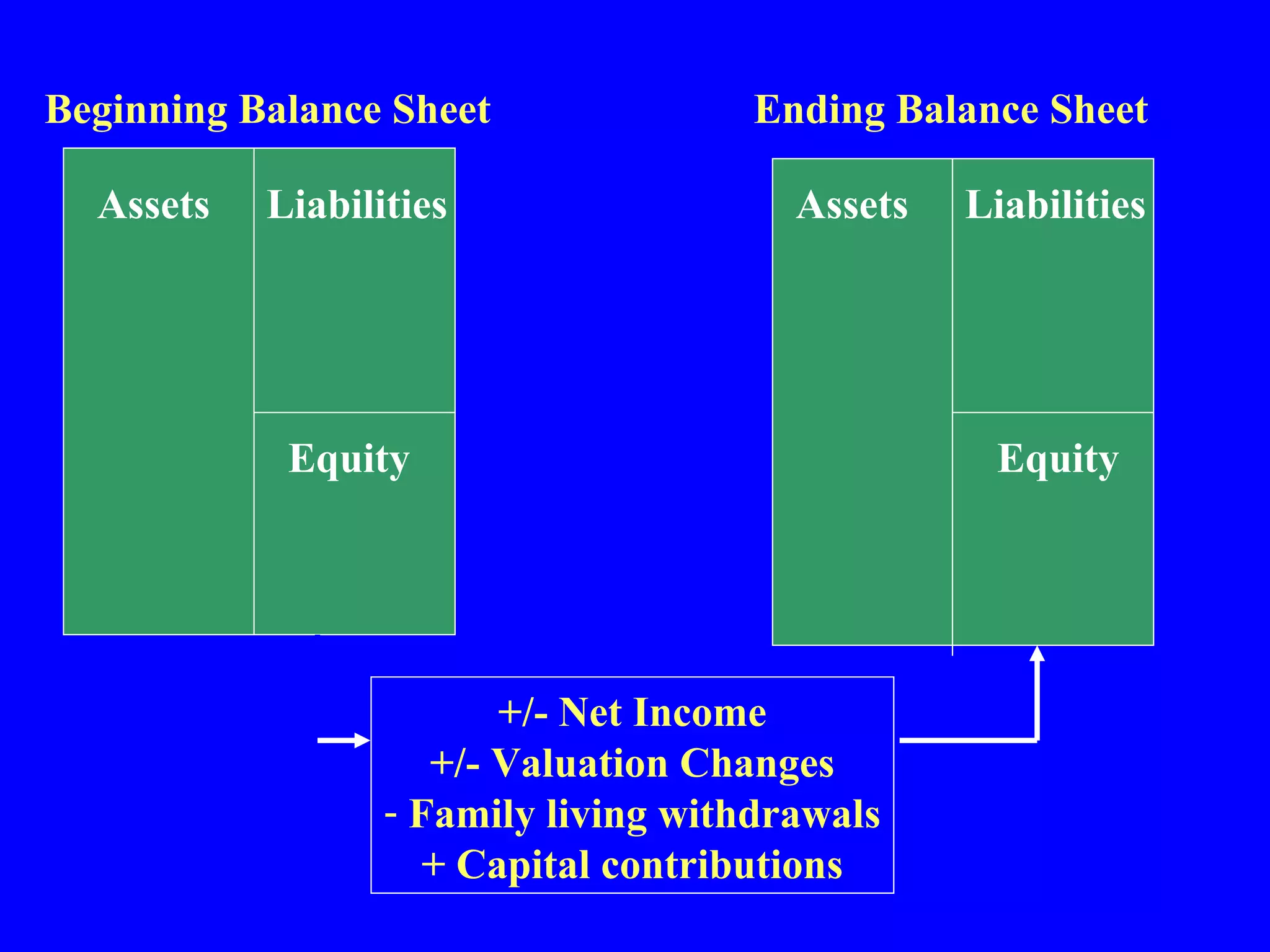
Beginning Balance Sheet
Assets

Liabilities

Ending Balance Sheet
Assets

Equity

+/- Net Income
+/- Valuation Changes
- Family living withdrawals
+ Capital contributions

Liabilities

Equity
Income Statement
Will have more than one profit
line
Definition of Profit
• Financial profit is the net return
to business equity
Accrual Adjusted Income
Statement

 Cash incomes and expenses must be
adjusted by:
• Changes in non-cash assets
• Inventories
• Pre paid expenses
• Receivables

• Changes in non-cash liabilities
• Payables
• Accrued interest
Statement of Cash Flows
 Not the same as a cash flow plan
(Budget)
 Is a historical record of sources
and uses of funds
 Divisions of Statement:
• Cash from operating activities
• Cash from investing activities
• Cash from financing activities
Statement of Owner
Equity

 Explains the change in owners
equity between two balances sheets
 Changes due to :
•
•
•
•
•

Net income
Change in inventory valuation
Family living withdrawals
Capital contributions
Capital distributions
Financial Analysis
All business owners should have
a basic set of financial
statements at their disposal
and they should know how to
analyze and interpret them.
Financial Analysis
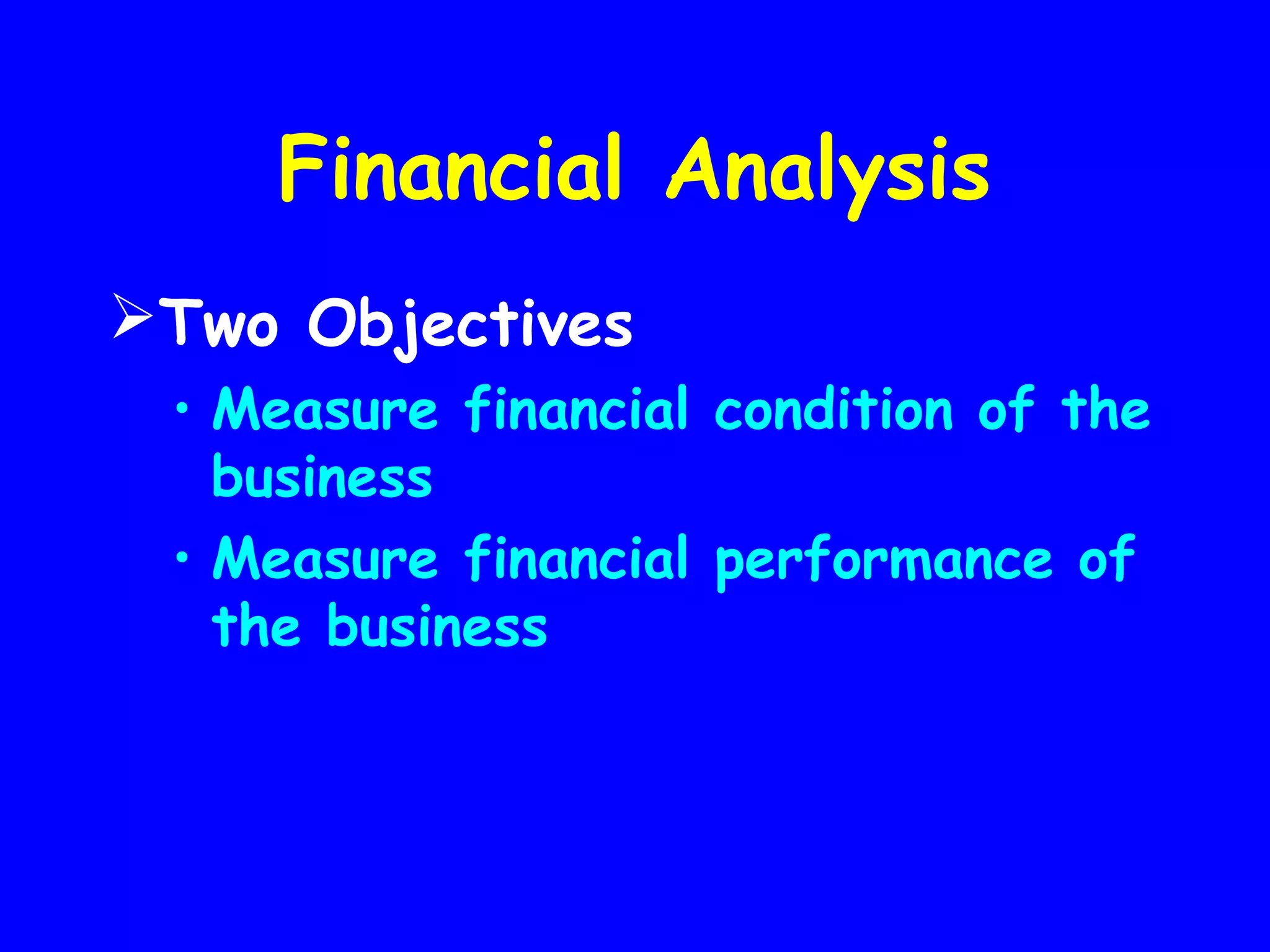
Two Objectives
• Measure financial condition of the
business
• Measure financial performance of
the business
Financial Analysis
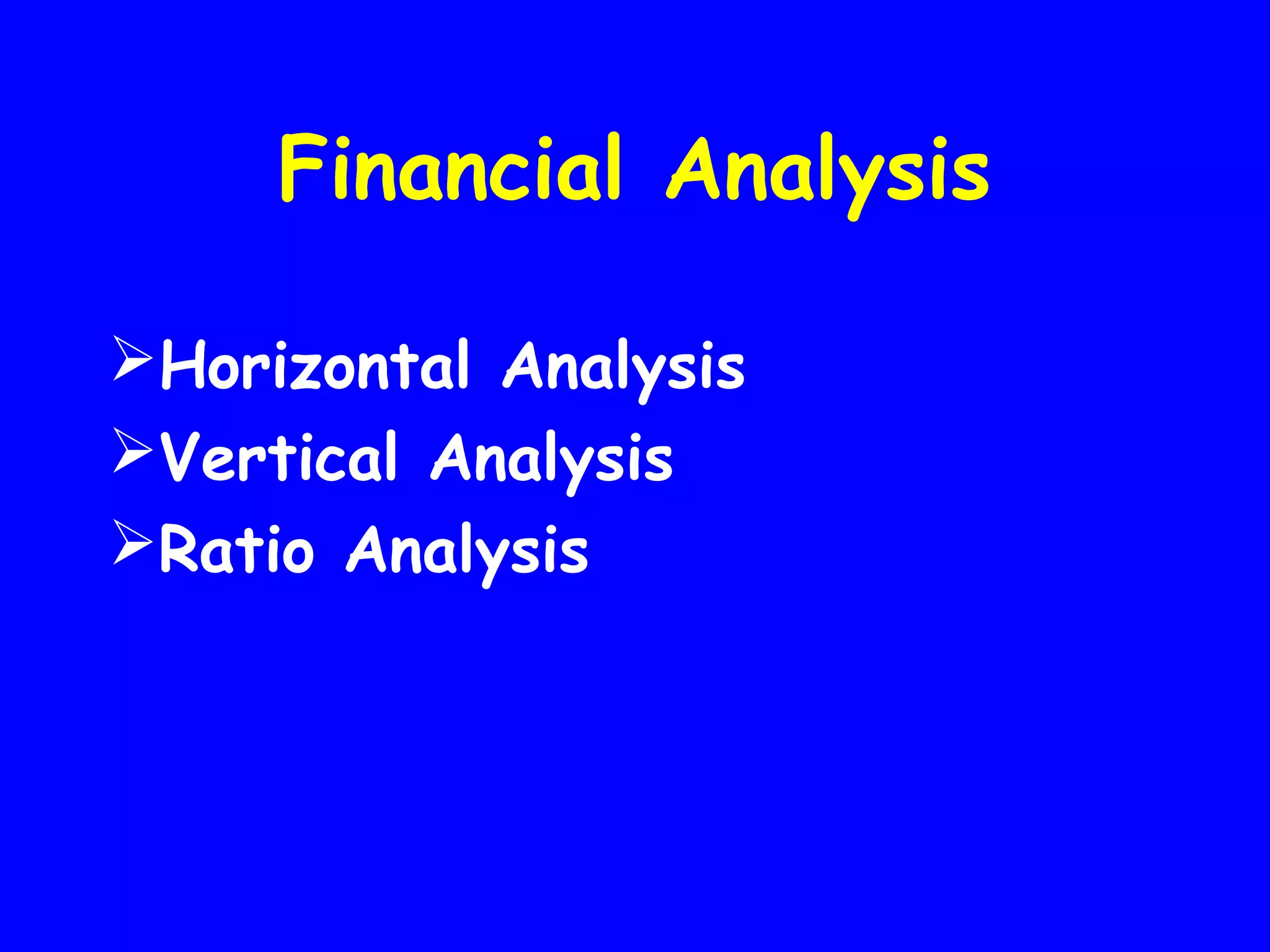
Horizontal Analysis
Vertical Analysis
Ratio Analysis
Horizontal Analysis
Looks at trends in performance
and strength over time
• For example, percent change in
net income from year to year
Vertical Analysis
Looks at within year events
rather than over time
• For example, interest expense as
a percent of total expenses
Ratio Analysis
Allows for consistent
comparison of a single business
over time as well as comparison
between businesses
Converts nominal dollar amounts
to a common basis
Source of data for Ratio
Analysis
Balance Sheet
Income Statement
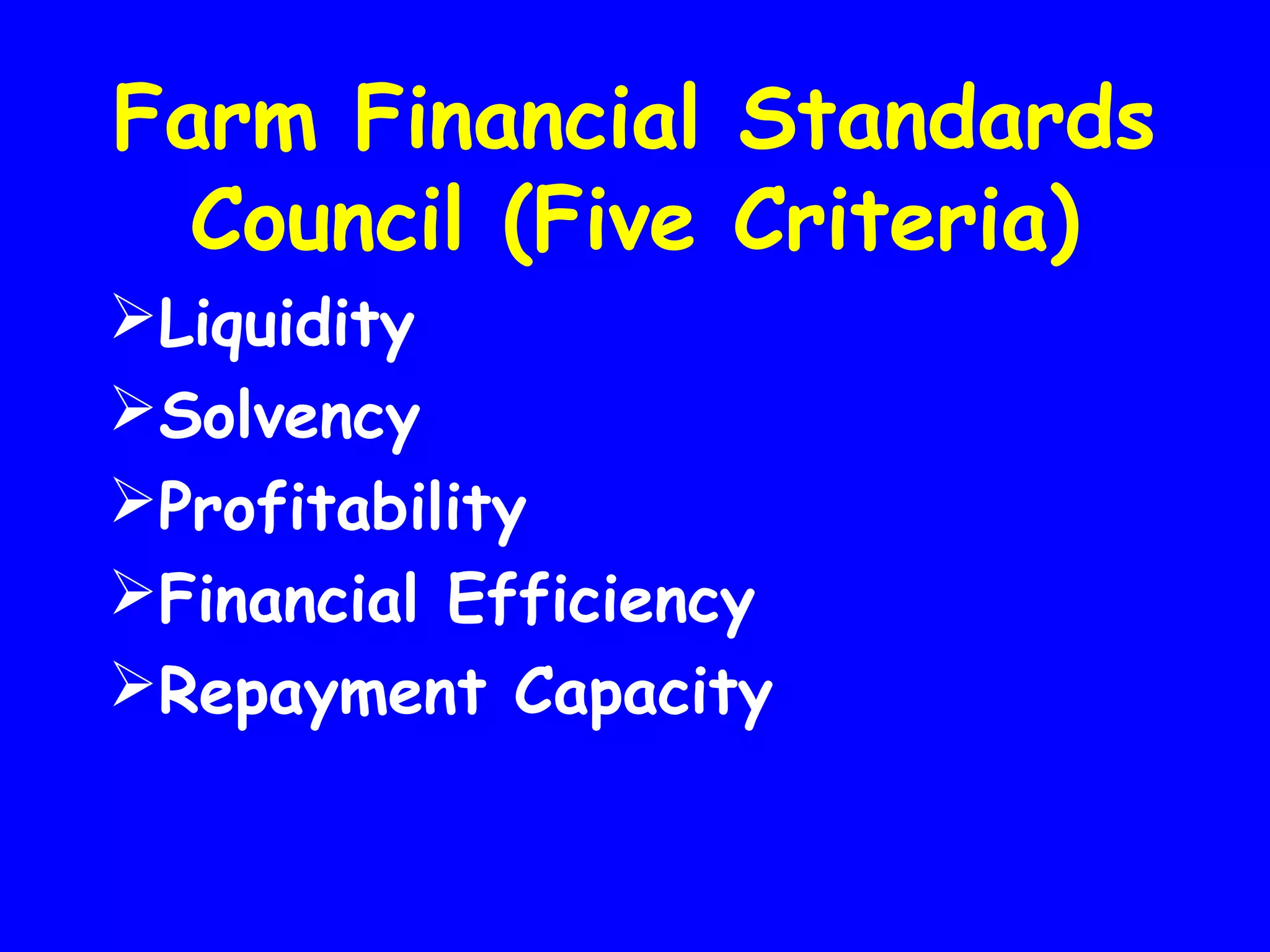
Farm Financial Standards
Council (Five Criteria)
Liquidity
Solvency
Profitability
Financial Efficiency
Repayment Capacity
Ratio Analysis
16 different ratios commonly
used
Each has limitations
Proper interpretation is critical
Liquidity
Ability of a business to pay
current liabilities as they come
due
Liquidity
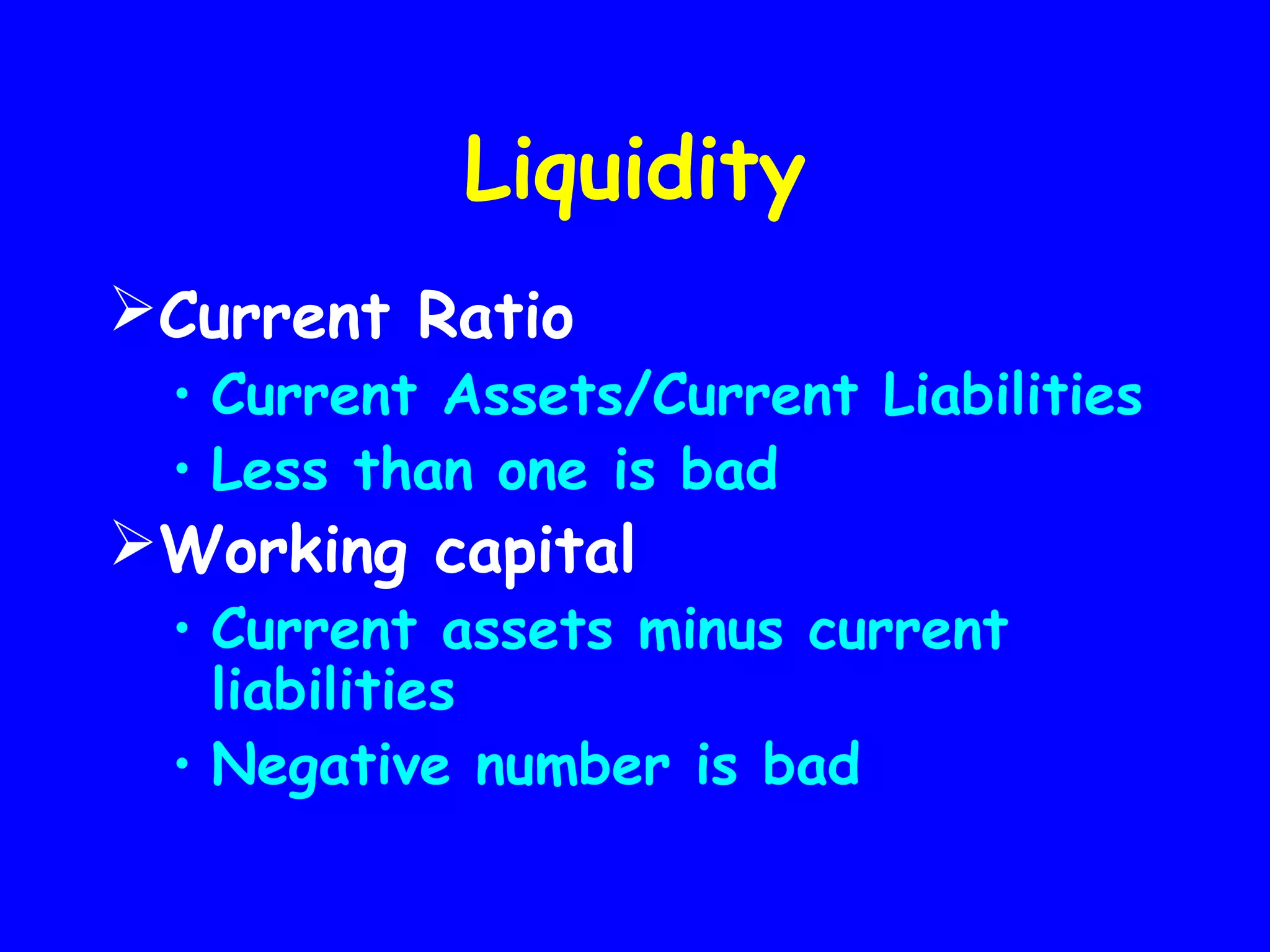
Current Ratio

• Current Assets/Current Liabilities
• Less than one is bad
Working capital

• Current assets minus current
liabilities
• Negative number is bad
Solvency
Ability of the firm to repay all
of its financial obligations
Solvency
 Debt to Asset Ratio

• Total liabilities/total assets
• Greater than one bad

 Equity to Asset Ratio

• Total equity/total assets

 Debt to Equity Ratio
• Leverage ratio
• Less than one better
Profitability
Rate of return on assets
Rate of return on equity
Operating profit margin ratio
Financial Efficiency
Measures the intensity with
which a business uses its assets
to generate gross revenues and
the effectiveness of production
Financial Efficiency
Asset turnover ratio
Operating expense ratio
Depreciation ratio
Interest expense ratio
Net income from operations
ratio
Repayment Capacity
Measures the borrower’s ability
to repay term debts and capital
leases rather than financial
position or performance
Repayment Capacity
Term debt and capital lease
coverage ratio
Capital replacement and term
repayment margin
Cautions
 Measures are only as good as the
data used
 Methods must be consistent
between years and between
operations
• Example – Asset valuation methods

 Measures ask the right questions
but do not provide the answers

Accounting2