SHARES
&
DEBENTURE
PREPARED BY:-
1. Ms. Neha
2. Ms. Sangita
3. Ms. Vaishali
4. Ms. Priya
5. Ms. Deepali
6. Mr.Dhan
Bahadur
1
 Introduction
 Meaning of shares &
share capital
 Types of share &
their advantages &
disadvantages
 Types of Share
Capital
 Authorised Share
Capital
 Issued Capital
 Subscribed Capital
 Called Up Capital
 Paid up Capital
 Issue of Bonus
shares
 Meaning of
debenture & its
types
 Real Life Example
 conclusion
2
CONTENTS
3
INTRODUCTION
Companies (Private and Public) need capital either to increase their
productivity or to increase their market reach or to diversify or to purchase
latest modern equipments.
Companies go in for IPO and if they have already gone for IPO then they
go for FPO.
The only thing they do in either IPO or FPO is to sell the shares or
debentures to investors.
(the term investor here represents retail investors, financial institutions,
government, high net worth individuals, banks etc).
Whether they issue shares or debentures totally depends upon the
concerned company.
4
A share is one unit into which the total share capital is divided. Share
capital of the company can be explained as a fund or sum with which a
company is formed to carry on the business and which is raised by the
issue of shares.
A share is a security which represents a portion of the owner’s capital in a
business. Shareholders are the owners of the business. They share in the
success or failure of the business. This can be measured by the amount of
dividends that they receive and by the price of the share, quoted on the
stock market .
Shares are the marketable instruments issued by the companies in order
to raise the required capital.
MEANING OF SHARES & SHARE CAPITAL
5
 These are very popular investments which are traded
every day in the stock market and the value of the
share at the end of the day decides the value of the
firm.
 In the U.S., shares are referred to as
common stock.
6
The shares which are issued by companies are of two
types:
• Equity Shares
• Preference Shares
TYPES OF SHARES
7
Equity Shares are issued and are traded everyday in the stock
market.
Equity share holders only get dividend after preference
shareholders & debenture holders.
The returns on the equity shares are not at all fixed. It depends on
the amount of profits made by the company.
The board of directors decides on how much of the dividends will
be given to equity share holders. Share holders can accept to it or
reject the offer during the annual general meeting.
Equity shareholders have the right to vote on any resolution
placed before the company.
EQUITY SHARES
8
The Equity share is a common name, some of the types of
equity shares are:
• Blue Chip Shares
• Income Shares
• Growth shares
• Cyclical Shares
• Defensive shares
• Speculative shares
TYPES OF EQUITY SHARES
9
One more classification of shares is given by one of the most
successful and respected investor all around the world Peter
Lynch. According to him the shares can be classified into 6
types:
• Slow Growers
• Fast Growers
• Stalwarts
• Cyclical
• Turn-around
• Asset plays
FURTHER CLASSIFICATION
10
ADVANTAGES
• High Return
• Easily Transferable.
• These can be easily liquidated.
• Right to vote
• Right to choose the board of directors.
• Equity share holders have the right to oppose any of the decisions taken
by the board of directors.
( for e.g. This is what happened when Mr. Ramalinga raju tried to buy
Maytas company)
DISADVANTAGES
• High Risk
• In worst cases less privilege given to equity share holders.
11
These are other type of shares. The preference shares are
market instrument issued by the companies to raise the
capital. Preference shares have the characteristics of both
equity shares and debentures. Fixed rate of dividends are
paid to the preference share holder as in case of debentures,
irrespective of the profits earned company is liable to pay
interest to preference share holders.
PREFRENCE SHARE
12
Preference shares are divided into:
• Cumulative & Non cumulative shares
• Redeemable & Non-redeemable
• Convertible & Non-convertible shares
• Participating and non-participating
TYPES OF PREFERENCE SHARES
13
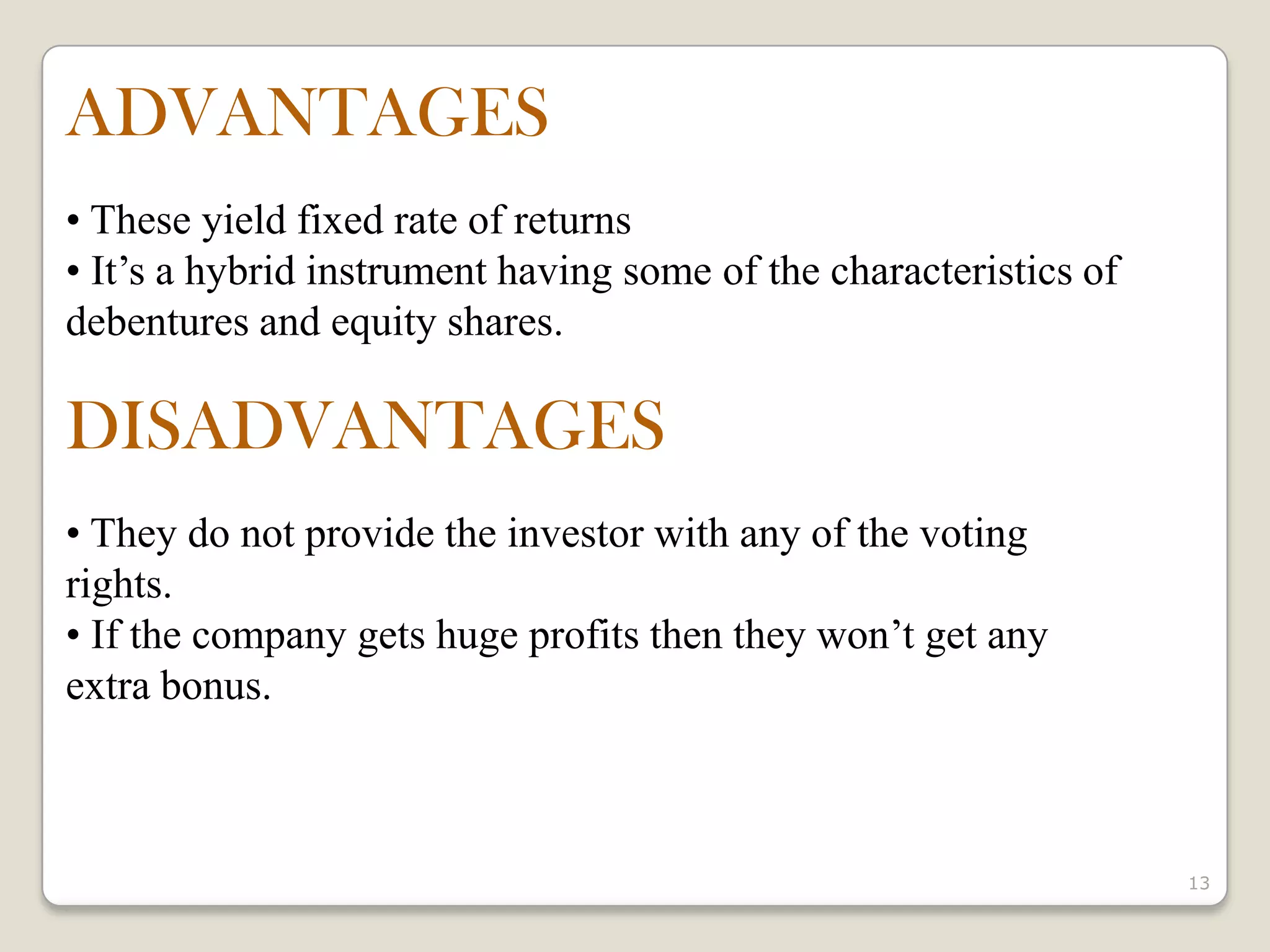
ADVANTAGES
• These yield fixed rate of returns
• It’s a hybrid instrument having some of the characteristics of
debentures and equity shares.
DISADVANTAGES
• They do not provide the investor with any of the voting
rights.
• If the company gets huge profits then they won’t get any
extra bonus.
14
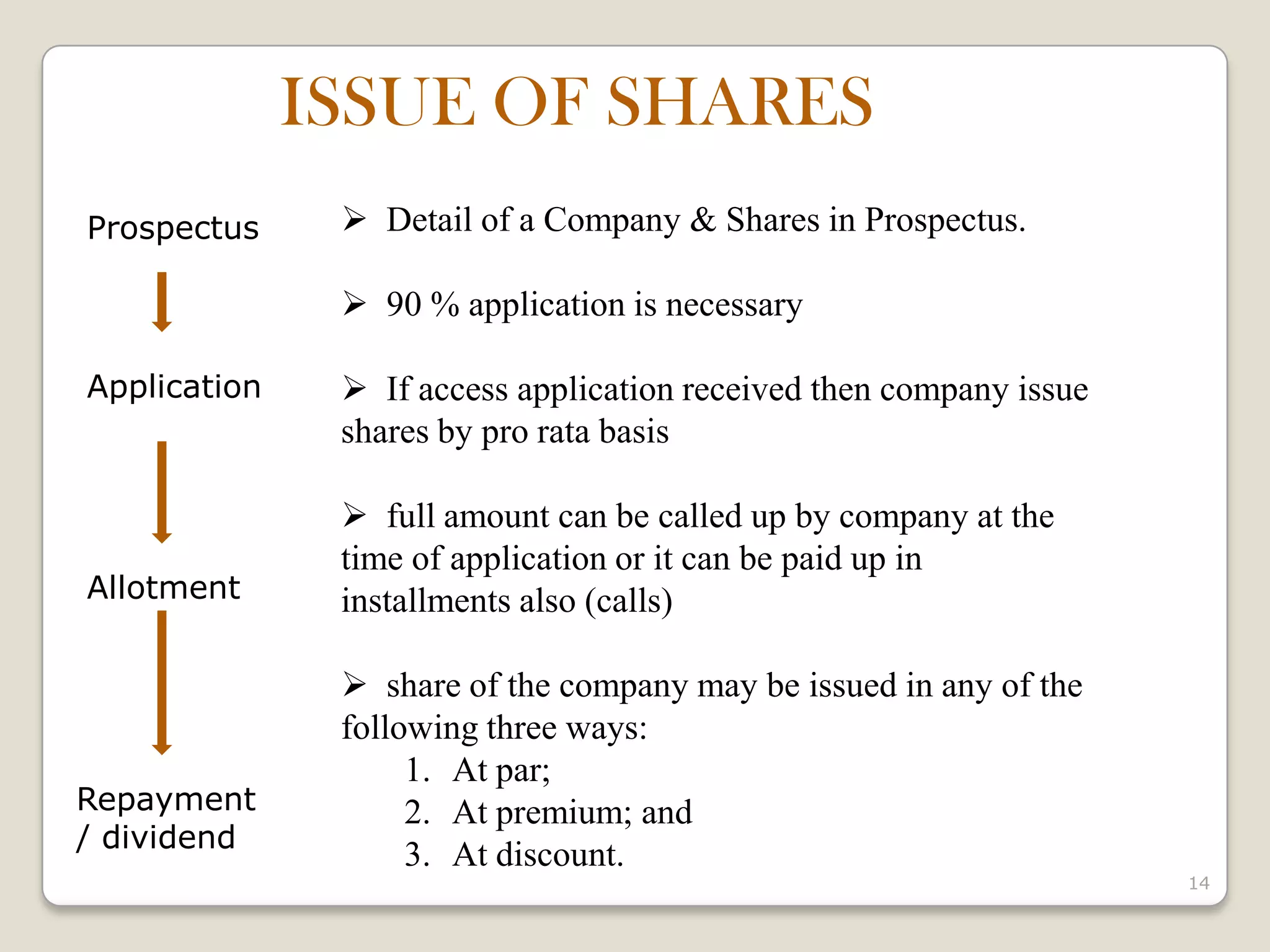
ISSUE OF SHARES
Prospectus
Application
Repayment
/ dividend
Allotment
 Detail of a Company & Shares in Prospectus.
 90 % application is necessary
 If access application received then company issue
shares by pro rata basis
 full amount can be called up by company at the
time of application or it can be paid up in
installments also (calls)
 share of the company may be issued in any of the
following three ways:
1. At par;
2. At premium; and
3. At discount.
15
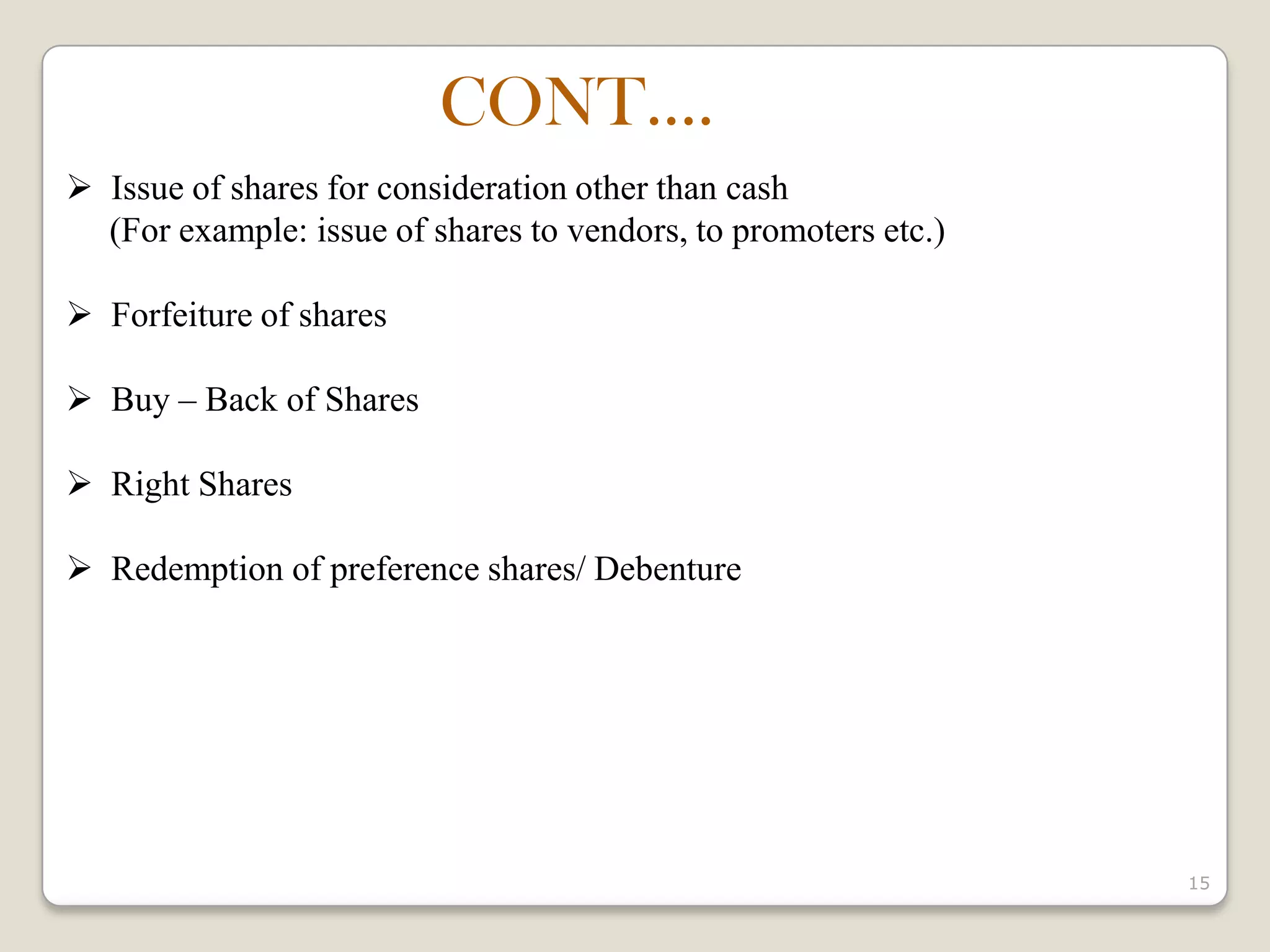
 Issue of shares for consideration other than cash
(For example: issue of shares to vendors, to promoters etc.)
 Forfeiture of shares
 Buy – Back of Shares
 Right Shares
 Redemption of preference shares/ Debenture
CONT….
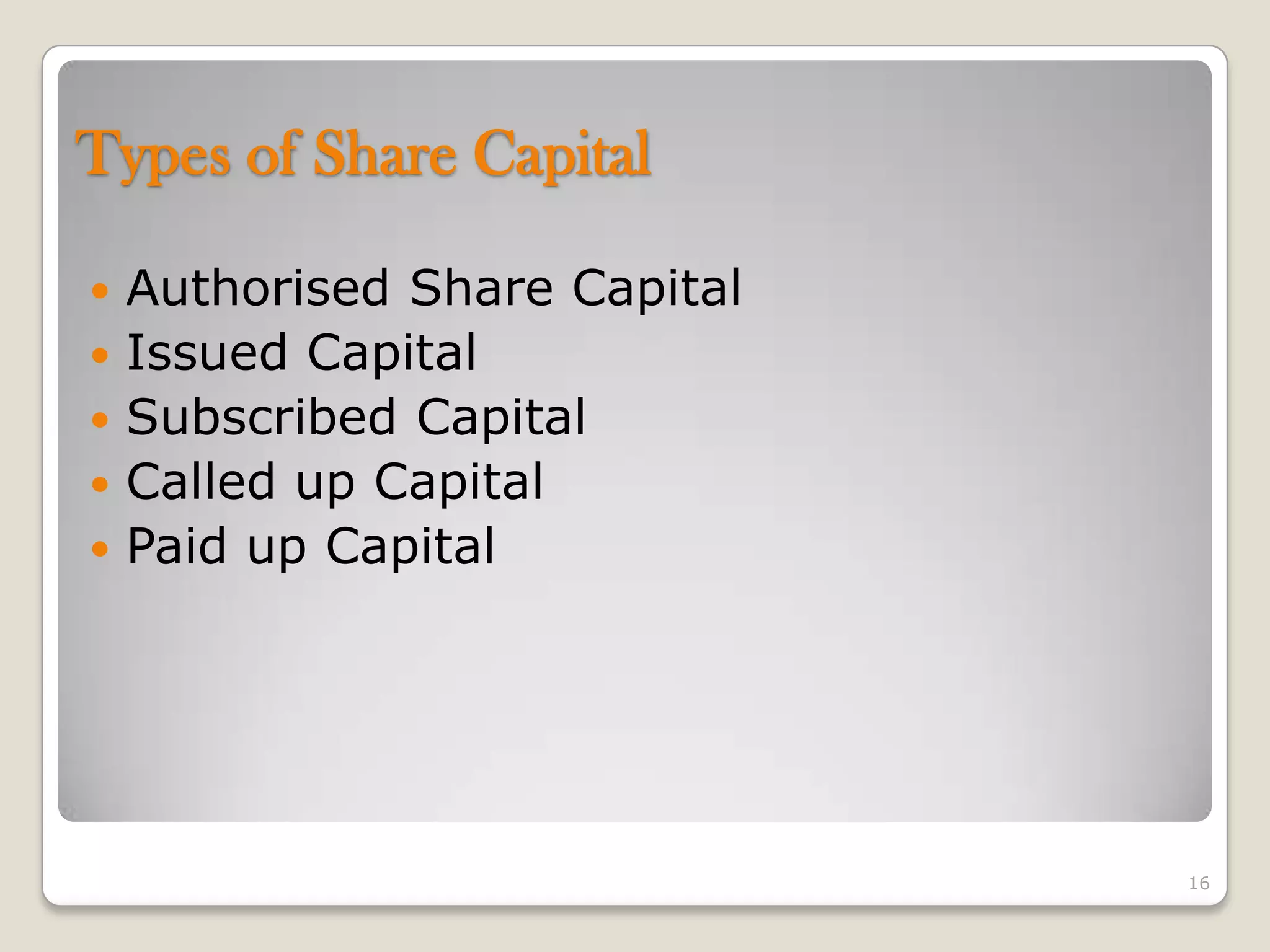
 Authorised Share Capital
 Issued Capital
 Subscribed Capital
 Called up Capital
 Paid up Capital
16
Types of Share Capital
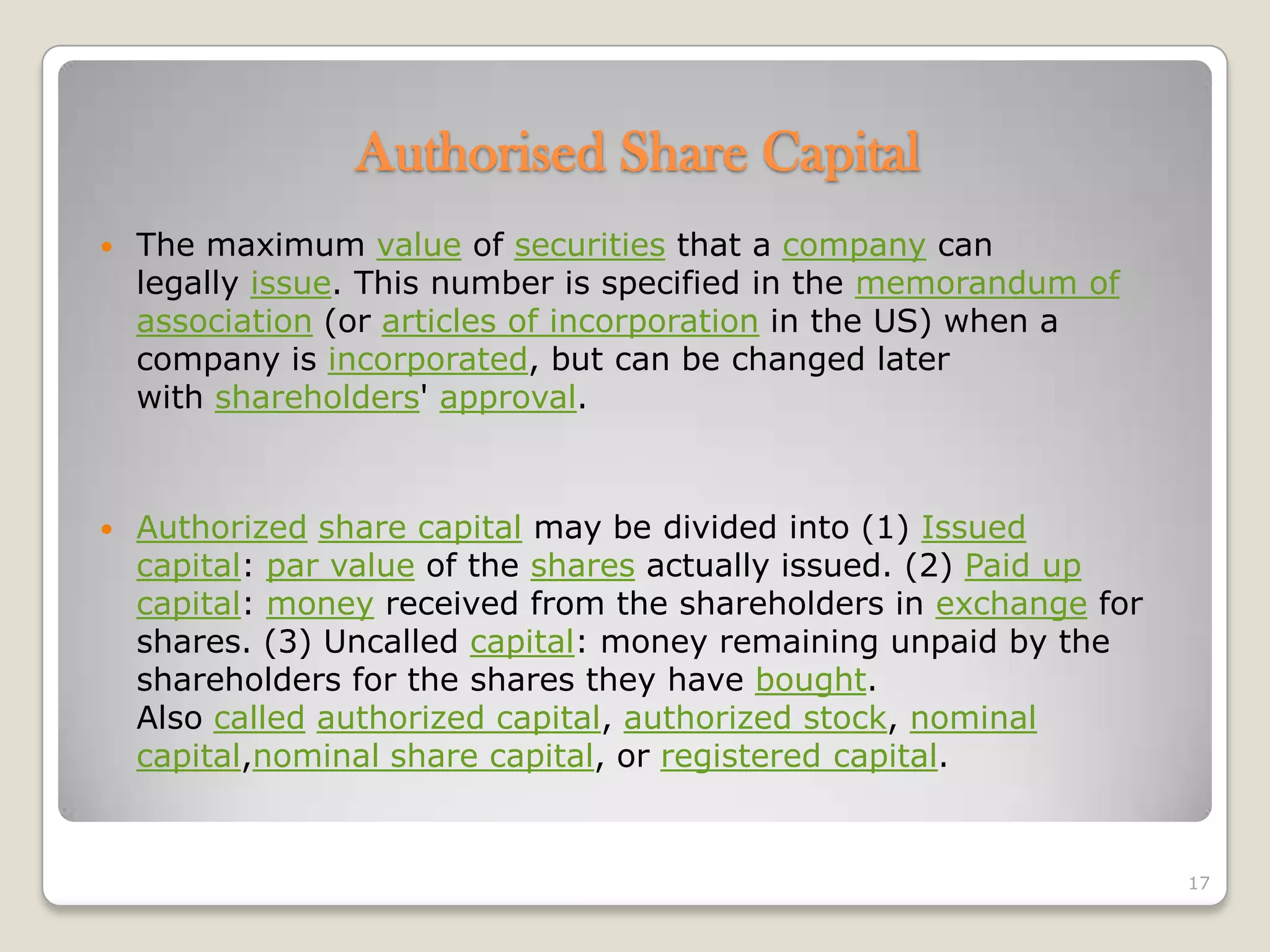
 The maximum value of securities that a company can
legally issue. This number is specified in the memorandum of
association (or articles of incorporation in the US) when a
company is incorporated, but can be changed later
with shareholders' approval.
 Authorized share capital may be divided into (1) Issued
capital: par value of the shares actually issued. (2) Paid up
capital: money received from the shareholders in exchange for
shares. (3) Uncalled capital: money remaining unpaid by the
shareholders for the shares they have bought.
Also called authorized capital, authorized stock, nominal
capital,nominal share capital, or registered capital.
17
Authorised Share Capital
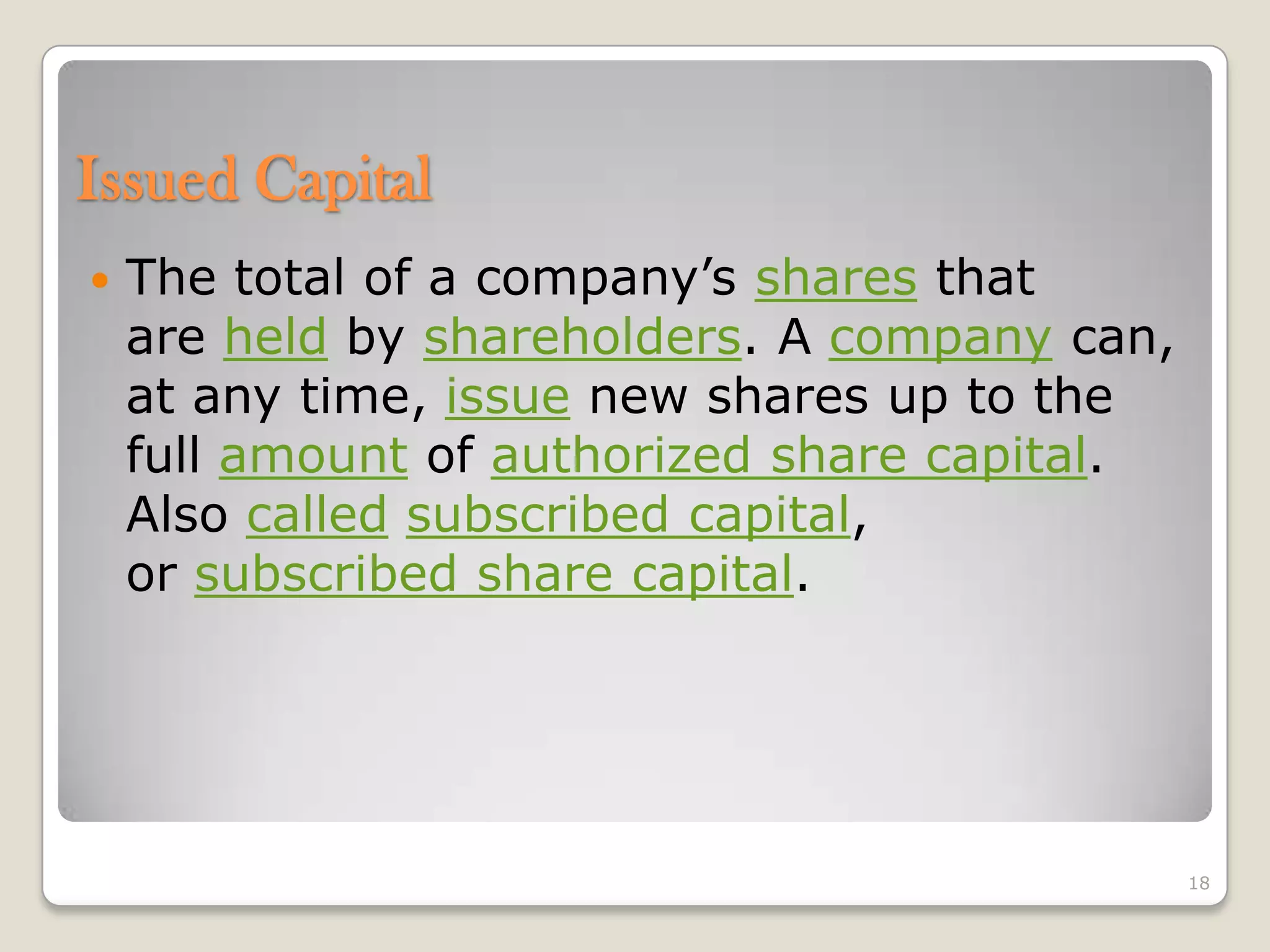
 The total of a company’s shares that
are held by shareholders. A company can,
at any time, issue new shares up to the
full amount of authorized share capital.
Also called subscribed capital,
or subscribed share capital.
18
Issued Capital
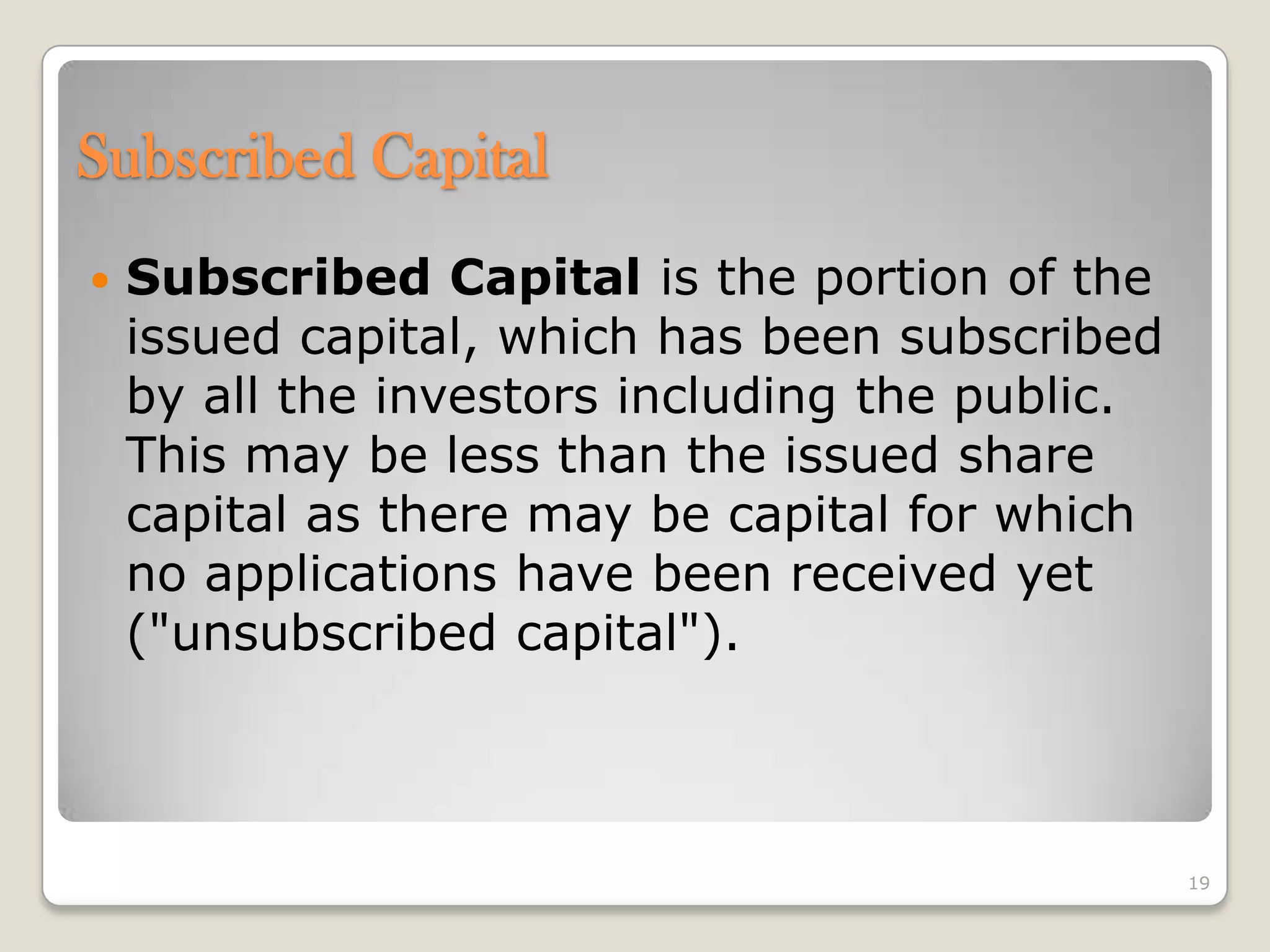
Subscribed Capital
 Subscribed Capital is the portion of the
issued capital, which has been subscribed
by all the investors including the public.
This may be less than the issued share
capital as there may be capital for which
no applications have been received yet
("unsubscribed capital").
19
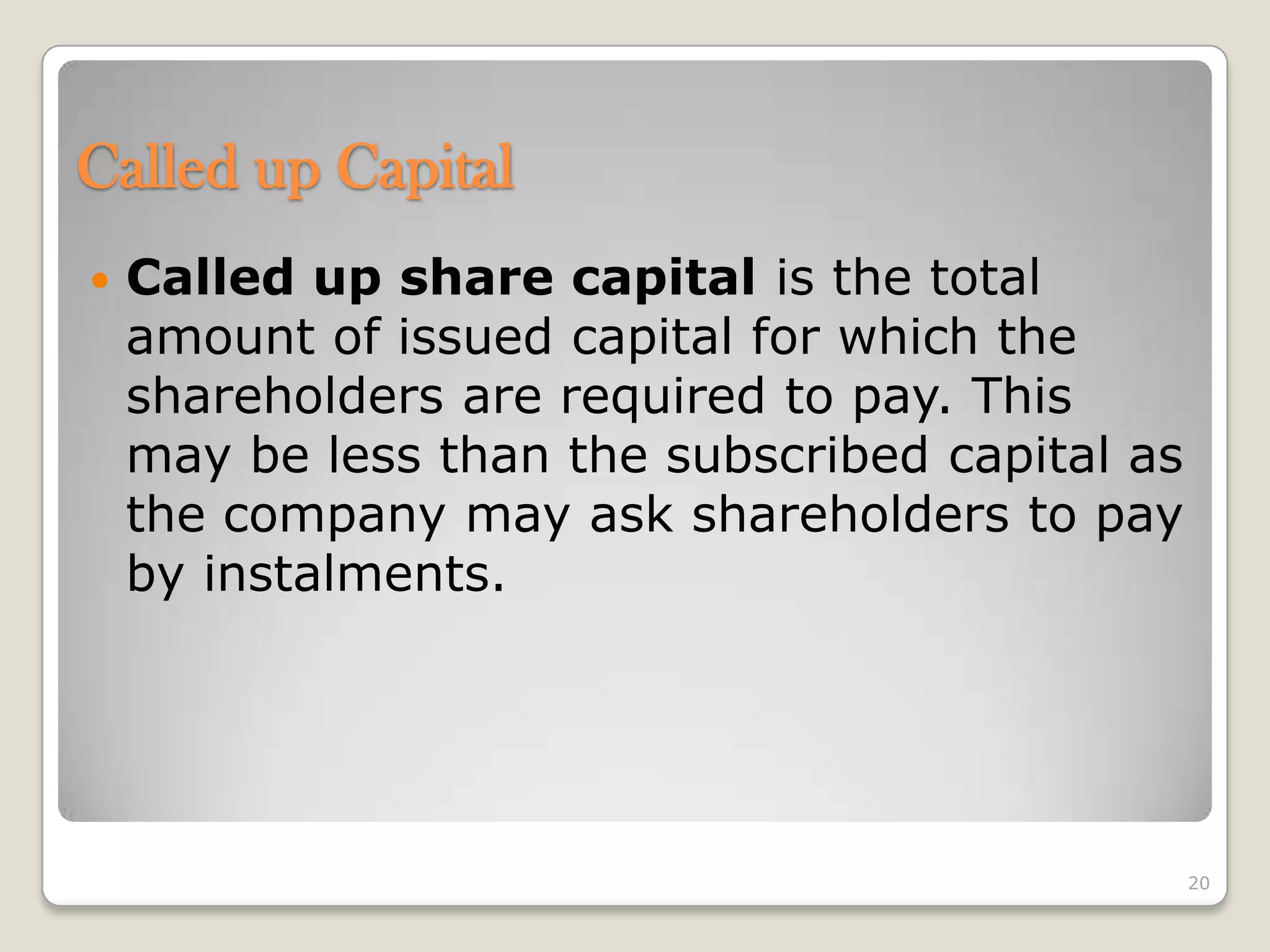
Called up Capital
 Called up share capital is the total
amount of issued capital for which the
shareholders are required to pay. This
may be less than the subscribed capital as
the company may ask shareholders to pay
by instalments.
20
Paid up Capital
 Paid up share capital is the amount of
share capital paid by the shareholders.
This may be less than the called up capital
as payments may be in instalments
("calls-in-arrears") .
21
 Bonus Shares may be issued at par or at
premium
 Before Bonus shares are issued all the
existing shares must be either fully paid
or made fully paid
 Whenever Bonus is declared Share
Capital increases and Reserves decrease
 Declaration of Bonus is known as
Capitalization of reserve
22
Issue of Bonus Shares
 Instrument of debt executed by the company
 A certificate of loan
 Company pays pre specified percentage of
interest
 Part of the company's capital structure
 Debentures are generally secured against the
company’s assets
 Convertible debentures can be either fully or
partly converted into Shares
 Convertible debentures may carry a lower
rate of interest
23
DEBENTURES
24
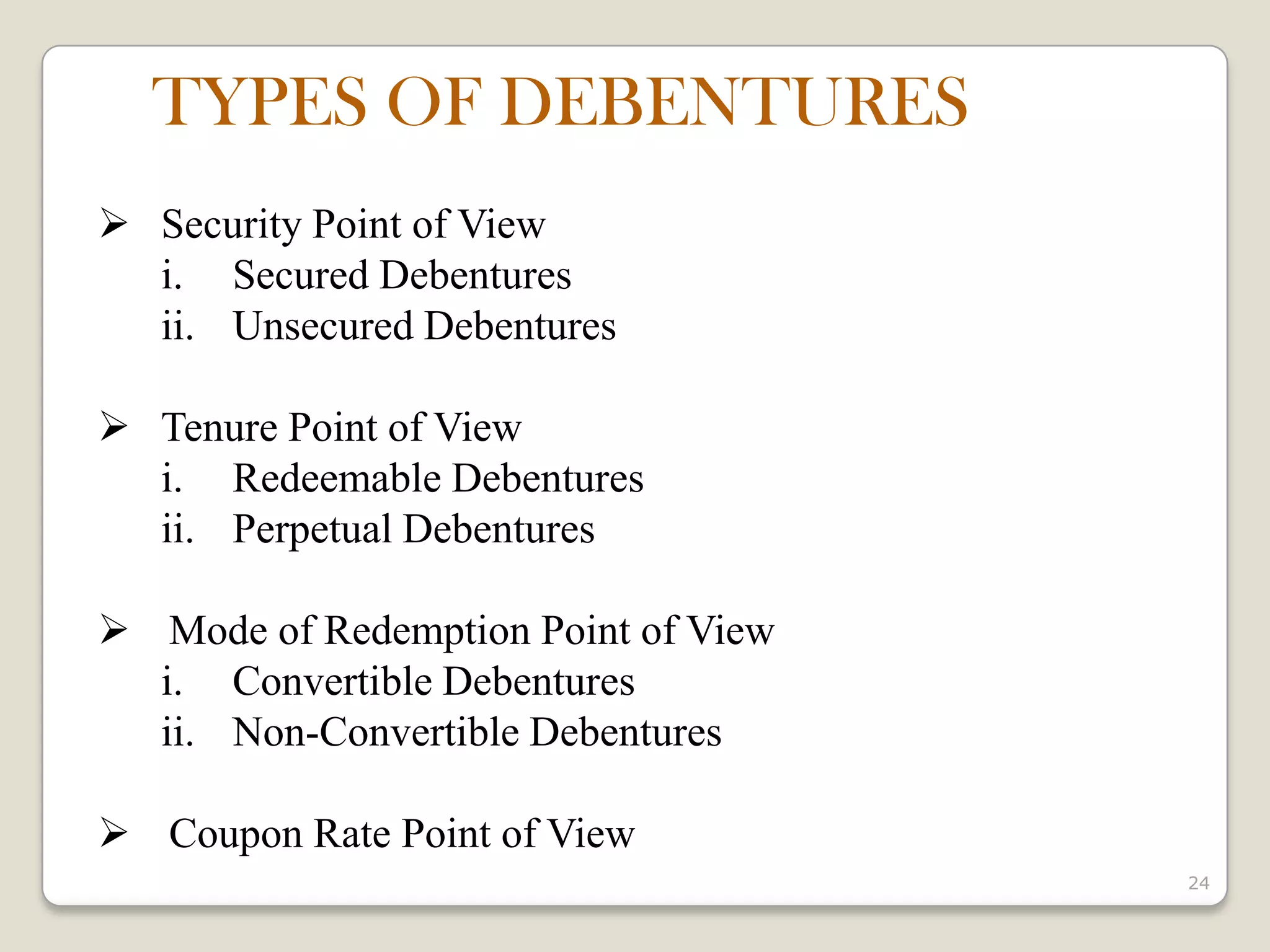
 Security Point of View
i. Secured Debentures
ii. Unsecured Debentures
 Tenure Point of View
i. Redeemable Debentures
ii. Perpetual Debentures
 Mode of Redemption Point of View
i. Convertible Debentures
ii. Non-Convertible Debentures
 Coupon Rate Point of View
TYPES OF DEBENTURES
25
ADVANTAGES
1. Control of company is not surrendered to debenture holders because
they do not have any voting rights.
2. Interest on debenture is an allowable expenditure under income tax
act, hence incidence of tax on the company is decreased.
3. Debenture can be redeemed when company has surplus funds.
DISADVANTAGES
1. Cost of raising capital through debentures is high of high stamps duty.
2. Common people cannot buy debenture as they are of high
denominations.
3. They are not meant for companies earning greater than the rate of
interest which they are paying on the debentures.
26
Today, I sat out on the balcony of my primary residence,
overlooking the river in the forest behind my house reading
through annual reports. A lot of time was spent on precious metals
companies as part of the ongoing series I've been rolling out here
at Investing for Beginners. Several hours, however, was spent
delving into the details of car companies; specifically Ford. I was
impressed by the move to repurchase their own debt at 35 cents
on the dollar in the open market so I thought it would be worth a
closer examination.
As I was reading page 115 of the annual report, I came across a
statement that is routine when studying companies with dual class
structures but I realized that many of you may not know how it
works. Here's the paragraph: "If liquidated, each share of Common
Stock will be entitled to the first $0.50 available for distributions to
holders of Common Stock and Class B Stock, each share of Class B
Stock will be entitled to the next $1.00 so available, each share of
Common Stock will be entitled to the next $0.50 so available and
each share of Common and Class B Stock will be entitled to an
equal amount thereafter."
27
Looking at the most recent quarterly filing with the SEC, you
discover that Ford has 2,802,397,653 shares of regular common
stock and 70,852,076 shares of Class B stock. As you research
further, you discover that the regular shares are entitled to elect
60% of the Board of Directors with the Class B shares entitled to
elect 40%. Based upon the paragraph quoted above, they are
also entitled to different amounts if the company goes into
bankruptcy and there is anything remaining after the debts have
been paid.
Why does this exist? The Ford family owns all 70+ million shares
of the Class B stock. It is a way for them to ensure they keep
control of the company no matter how much stock they have to
issue to avoid bankruptcy. Some argue that dual class structures
are inherently unfair because you are decoupling ownership from
voting power. I'm not sure I agree simply because everyone
accepted those terms when the shares were first issued so you
knew what you were getting into at the outset. The liquidation
provisions, if I'm reading the details correctly, help to ensure that
the Ford family walks away with more than the regular
stockholders who bought their shares on the open market through
a brokerage account in the event of a catastrophic liquidation.
28
Doesn't Anyone Remember Ford's $10 Billion Dividend?
One thing that interest me is that Ford burned through $21 billion in
cash last year as a result of the global economic collapse. Yet, it was
only nine years ago in 2000 that the company restructured and paid
out a $10 billion special dividend. According to an article from that
time - which, keep in mind, this is old - "The Ford family holds all 71
million shares of the company's Class B stock, along with a small
number of the company's 1.1 billion common shares. Under rules
designed to preserve family control and drafted when the company
went public in 1956, the family holds 40 percent of the voting power
at the company as long as it continues to own at least 60.7 million
shares of the Class B stock -- even though the Class B shares make up
only 6 percent of the company's overall equity."The article goes on to
point out, "If the family sells too many shares of its Class B stock,
whether to pay estate taxes, cover personal expenses or simply
participate in a stock buyback, then the family's influence shrinks. If
the family's holdings fall to between 33.7 million and 60.7 million
shares of Class B stock, the family wields only 30 percent of the voting
power. And if the family's holdings fall below 33.7 million shares then
all special voting privileges are lost.
29
When Class B shares are sold outside the family, they revert to
common stock. Under today's plan, each holder of Ford's
common or Class B stock will be given a choice of receiving $20
a share in cash or additional common stock. William C. Ford Jr.,
Ford's chairman and one of Henry Ford's 13 great-grandchildren,
said that the members of the Ford family would take additional
stock for all of their Class B stock. Most if not all family
members will put the additional distribution into the family's
voting trust, he added."
You can accuse the car companies of completely inept
management but you certainly have to give credit to the
members of the Ford family for putting their money where their
mouth is. They are married into the business lock, stock, and
barrel.
30
CONCLUSION
No doubt equity shares have both advantages and
disadvantages but the fact is that equity shares are the most
sought financial instruments for both investment or for
speculation.
31
THANK YOU

Financial accounting project of issue of shares

  • 1.
    SHARES & DEBENTURE PREPARED BY:- 1. Ms.Neha 2. Ms. Sangita 3. Ms. Vaishali 4. Ms. Priya 5. Ms. Deepali 6. Mr.Dhan Bahadur 1
  • 2.
     Introduction  Meaningof shares & share capital  Types of share & their advantages & disadvantages  Types of Share Capital  Authorised Share Capital  Issued Capital  Subscribed Capital  Called Up Capital  Paid up Capital  Issue of Bonus shares  Meaning of debenture & its types  Real Life Example  conclusion 2 CONTENTS
  • 3.
    3 INTRODUCTION Companies (Private andPublic) need capital either to increase their productivity or to increase their market reach or to diversify or to purchase latest modern equipments. Companies go in for IPO and if they have already gone for IPO then they go for FPO. The only thing they do in either IPO or FPO is to sell the shares or debentures to investors. (the term investor here represents retail investors, financial institutions, government, high net worth individuals, banks etc). Whether they issue shares or debentures totally depends upon the concerned company.
  • 4.
    4 A share isone unit into which the total share capital is divided. Share capital of the company can be explained as a fund or sum with which a company is formed to carry on the business and which is raised by the issue of shares. A share is a security which represents a portion of the owner’s capital in a business. Shareholders are the owners of the business. They share in the success or failure of the business. This can be measured by the amount of dividends that they receive and by the price of the share, quoted on the stock market . Shares are the marketable instruments issued by the companies in order to raise the required capital. MEANING OF SHARES & SHARE CAPITAL
  • 5.
    5  These arevery popular investments which are traded every day in the stock market and the value of the share at the end of the day decides the value of the firm.  In the U.S., shares are referred to as common stock.
  • 6.
    6 The shares whichare issued by companies are of two types: • Equity Shares • Preference Shares TYPES OF SHARES
  • 7.
    7 Equity Shares areissued and are traded everyday in the stock market. Equity share holders only get dividend after preference shareholders & debenture holders. The returns on the equity shares are not at all fixed. It depends on the amount of profits made by the company. The board of directors decides on how much of the dividends will be given to equity share holders. Share holders can accept to it or reject the offer during the annual general meeting. Equity shareholders have the right to vote on any resolution placed before the company. EQUITY SHARES
  • 8.
    8 The Equity shareis a common name, some of the types of equity shares are: • Blue Chip Shares • Income Shares • Growth shares • Cyclical Shares • Defensive shares • Speculative shares TYPES OF EQUITY SHARES
  • 9.
    9 One more classificationof shares is given by one of the most successful and respected investor all around the world Peter Lynch. According to him the shares can be classified into 6 types: • Slow Growers • Fast Growers • Stalwarts • Cyclical • Turn-around • Asset plays FURTHER CLASSIFICATION
  • 10.
    10 ADVANTAGES • High Return •Easily Transferable. • These can be easily liquidated. • Right to vote • Right to choose the board of directors. • Equity share holders have the right to oppose any of the decisions taken by the board of directors. ( for e.g. This is what happened when Mr. Ramalinga raju tried to buy Maytas company) DISADVANTAGES • High Risk • In worst cases less privilege given to equity share holders.
  • 11.
    11 These are othertype of shares. The preference shares are market instrument issued by the companies to raise the capital. Preference shares have the characteristics of both equity shares and debentures. Fixed rate of dividends are paid to the preference share holder as in case of debentures, irrespective of the profits earned company is liable to pay interest to preference share holders. PREFRENCE SHARE
  • 12.
    12 Preference shares aredivided into: • Cumulative & Non cumulative shares • Redeemable & Non-redeemable • Convertible & Non-convertible shares • Participating and non-participating TYPES OF PREFERENCE SHARES
  • 13.
    13 ADVANTAGES • These yieldfixed rate of returns • It’s a hybrid instrument having some of the characteristics of debentures and equity shares. DISADVANTAGES • They do not provide the investor with any of the voting rights. • If the company gets huge profits then they won’t get any extra bonus.
  • 14.
    14 ISSUE OF SHARES Prospectus Application Repayment /dividend Allotment  Detail of a Company & Shares in Prospectus.  90 % application is necessary  If access application received then company issue shares by pro rata basis  full amount can be called up by company at the time of application or it can be paid up in installments also (calls)  share of the company may be issued in any of the following three ways: 1. At par; 2. At premium; and 3. At discount.
  • 15.
    15  Issue ofshares for consideration other than cash (For example: issue of shares to vendors, to promoters etc.)  Forfeiture of shares  Buy – Back of Shares  Right Shares  Redemption of preference shares/ Debenture CONT….
  • 16.
     Authorised ShareCapital  Issued Capital  Subscribed Capital  Called up Capital  Paid up Capital 16 Types of Share Capital
  • 17.
     The maximumvalue of securities that a company can legally issue. This number is specified in the memorandum of association (or articles of incorporation in the US) when a company is incorporated, but can be changed later with shareholders' approval.  Authorized share capital may be divided into (1) Issued capital: par value of the shares actually issued. (2) Paid up capital: money received from the shareholders in exchange for shares. (3) Uncalled capital: money remaining unpaid by the shareholders for the shares they have bought. Also called authorized capital, authorized stock, nominal capital,nominal share capital, or registered capital. 17 Authorised Share Capital
  • 18.
     The totalof a company’s shares that are held by shareholders. A company can, at any time, issue new shares up to the full amount of authorized share capital. Also called subscribed capital, or subscribed share capital. 18 Issued Capital
  • 19.
    Subscribed Capital  SubscribedCapital is the portion of the issued capital, which has been subscribed by all the investors including the public. This may be less than the issued share capital as there may be capital for which no applications have been received yet ("unsubscribed capital"). 19
  • 20.
    Called up Capital Called up share capital is the total amount of issued capital for which the shareholders are required to pay. This may be less than the subscribed capital as the company may ask shareholders to pay by instalments. 20
  • 21.
    Paid up Capital Paid up share capital is the amount of share capital paid by the shareholders. This may be less than the called up capital as payments may be in instalments ("calls-in-arrears") . 21
  • 22.
     Bonus Sharesmay be issued at par or at premium  Before Bonus shares are issued all the existing shares must be either fully paid or made fully paid  Whenever Bonus is declared Share Capital increases and Reserves decrease  Declaration of Bonus is known as Capitalization of reserve 22 Issue of Bonus Shares
  • 23.
     Instrument ofdebt executed by the company  A certificate of loan  Company pays pre specified percentage of interest  Part of the company's capital structure  Debentures are generally secured against the company’s assets  Convertible debentures can be either fully or partly converted into Shares  Convertible debentures may carry a lower rate of interest 23 DEBENTURES
  • 24.
    24  Security Pointof View i. Secured Debentures ii. Unsecured Debentures  Tenure Point of View i. Redeemable Debentures ii. Perpetual Debentures  Mode of Redemption Point of View i. Convertible Debentures ii. Non-Convertible Debentures  Coupon Rate Point of View TYPES OF DEBENTURES
  • 25.
    25 ADVANTAGES 1. Control ofcompany is not surrendered to debenture holders because they do not have any voting rights. 2. Interest on debenture is an allowable expenditure under income tax act, hence incidence of tax on the company is decreased. 3. Debenture can be redeemed when company has surplus funds. DISADVANTAGES 1. Cost of raising capital through debentures is high of high stamps duty. 2. Common people cannot buy debenture as they are of high denominations. 3. They are not meant for companies earning greater than the rate of interest which they are paying on the debentures.
  • 26.
    26 Today, I satout on the balcony of my primary residence, overlooking the river in the forest behind my house reading through annual reports. A lot of time was spent on precious metals companies as part of the ongoing series I've been rolling out here at Investing for Beginners. Several hours, however, was spent delving into the details of car companies; specifically Ford. I was impressed by the move to repurchase their own debt at 35 cents on the dollar in the open market so I thought it would be worth a closer examination. As I was reading page 115 of the annual report, I came across a statement that is routine when studying companies with dual class structures but I realized that many of you may not know how it works. Here's the paragraph: "If liquidated, each share of Common Stock will be entitled to the first $0.50 available for distributions to holders of Common Stock and Class B Stock, each share of Class B Stock will be entitled to the next $1.00 so available, each share of Common Stock will be entitled to the next $0.50 so available and each share of Common and Class B Stock will be entitled to an equal amount thereafter."
  • 27.
    27 Looking at themost recent quarterly filing with the SEC, you discover that Ford has 2,802,397,653 shares of regular common stock and 70,852,076 shares of Class B stock. As you research further, you discover that the regular shares are entitled to elect 60% of the Board of Directors with the Class B shares entitled to elect 40%. Based upon the paragraph quoted above, they are also entitled to different amounts if the company goes into bankruptcy and there is anything remaining after the debts have been paid. Why does this exist? The Ford family owns all 70+ million shares of the Class B stock. It is a way for them to ensure they keep control of the company no matter how much stock they have to issue to avoid bankruptcy. Some argue that dual class structures are inherently unfair because you are decoupling ownership from voting power. I'm not sure I agree simply because everyone accepted those terms when the shares were first issued so you knew what you were getting into at the outset. The liquidation provisions, if I'm reading the details correctly, help to ensure that the Ford family walks away with more than the regular stockholders who bought their shares on the open market through a brokerage account in the event of a catastrophic liquidation.
  • 28.
    28 Doesn't Anyone RememberFord's $10 Billion Dividend? One thing that interest me is that Ford burned through $21 billion in cash last year as a result of the global economic collapse. Yet, it was only nine years ago in 2000 that the company restructured and paid out a $10 billion special dividend. According to an article from that time - which, keep in mind, this is old - "The Ford family holds all 71 million shares of the company's Class B stock, along with a small number of the company's 1.1 billion common shares. Under rules designed to preserve family control and drafted when the company went public in 1956, the family holds 40 percent of the voting power at the company as long as it continues to own at least 60.7 million shares of the Class B stock -- even though the Class B shares make up only 6 percent of the company's overall equity."The article goes on to point out, "If the family sells too many shares of its Class B stock, whether to pay estate taxes, cover personal expenses or simply participate in a stock buyback, then the family's influence shrinks. If the family's holdings fall to between 33.7 million and 60.7 million shares of Class B stock, the family wields only 30 percent of the voting power. And if the family's holdings fall below 33.7 million shares then all special voting privileges are lost.
  • 29.
    29 When Class Bshares are sold outside the family, they revert to common stock. Under today's plan, each holder of Ford's common or Class B stock will be given a choice of receiving $20 a share in cash or additional common stock. William C. Ford Jr., Ford's chairman and one of Henry Ford's 13 great-grandchildren, said that the members of the Ford family would take additional stock for all of their Class B stock. Most if not all family members will put the additional distribution into the family's voting trust, he added." You can accuse the car companies of completely inept management but you certainly have to give credit to the members of the Ford family for putting their money where their mouth is. They are married into the business lock, stock, and barrel.
  • 30.
    30 CONCLUSION No doubt equityshares have both advantages and disadvantages but the fact is that equity shares are the most sought financial instruments for both investment or for speculation.
  • 31.