
11EX-013   Bishnu Kumar
11EX-015   Davinder Singh
11EX-040   Prateek Wadhwa
11EX-041   Priyanka Tyagi
• 24 Hour Market because of business overlap
• Trade is done by buying one currency while selling the
  other
• 2 Segments of OTC Market
   o Interbank
   o Merchant
• Securities under the Securities Contracts Act, 1956
  and hence the trading of derivatives is governed by
  the regulatory framework under the SC(R)A.
• A product whose value is derived from the value of
  one or more basic variables called bases
• The underlying asset can be equity, foreign
  exchange, commodity, interest rate or any other asset
• Has a future settlement date
The factors driving the growth of financial derivatives are:
• Increased volatility in asset prices in financial markets
• Increased integration of national financial markets with the
  international financial markets
• Marked improvement in communication facilities and sharp
  decline in their costs,
• Development of more sophisticated risk management tools
• Innovations in the derivatives markets, which optimally
  combine the risks and returns over a large number of
  financial assets, leading to higher returns, reduced risk and
  lower transactions costs as compared to individual financial
  assets.
Unpredicted movements in exchange rates requires investors to
hedge these risks.

  • Forwards: A customized OTC contract between two parties.
  • Futures: Exchange-trade forwards.
  • Options: Option does not buy or sell the underlying directly but
    buys or sells the right without obligation on the underlying.
  • Swaps: Swaps are agreements between two parties to exchange
    cash flows in the future according to a prearranged formula.
     • Interest rate swaps: Swapping of interest related cash flows
       between the parties in the same currency.
     • Currency swaps: Swapping both principal and interest
       between the parties, with the cash flows in one direction
       being in a different currency than those in the opposite
       direction.
A currency future, also known as FX future, is a
standardized contract , traded on an exchange, to buy or
sell one currency for another at a specified date in the
future at a price that is fixed on the purchase date. Both
parties of the futures contract must fulfill their obligations on
the settlement date.
Futures have some distinct advantages over forward contracts:

• Price transparency
• Elimination of Counterparty credit risk.
• Access to all types of market participants. The OTC market is
  restricted to Authorized Dealers (banks which are licensed by
  RBI to deal in FX), individuals and entities with FOREX
  exposures. Retail speculators with no exposure to FX cannot
  trade in OTC market.
• Futures offer low cost of trading as compared to OTC market.
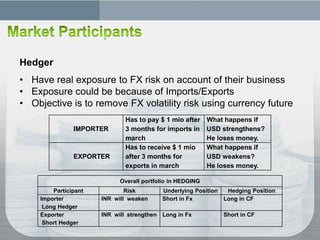
Hedger
• Have real exposure to FX risk on account of their business
• Exposure could be because of Imports/Exports
• Objective is to remove FX volatility risk using currency future
                              Has to pay $ 1 mio after     What happens if
               IMPORTER       3 months for imports in      USD strengthens?
                              march                        He loses money.
                              Has to receive $ 1 mio       What happens if
               EXPORTER       after 3 months for           USD weakens?
                              exports in march             He loses money.

                            Overall portfolio in HEDGING
        Participant           Risk        Underlying Position  Hedging Position
    Importer          INR will weaken     Short in Fx         Long in CF
     Long Hedger
    Exporter          INR will strengthen Long in Fx           Short in CF
     Short Hedger
Speculator
• Also called as Traders
• Does not have real exposure to FX risk
• Takes a view on the market direction hoping to make returns
  by taking the price risk
• Assumes the price risk that hedgers attempt to lay off in the
  markets
Arbitrageurs
• Look for mispricing and execute simultaneous buy and sell to
  capture the mispricing and make profit
• Do not take any view on the market direction
• Neither have exposure to risk and nor they take any risk
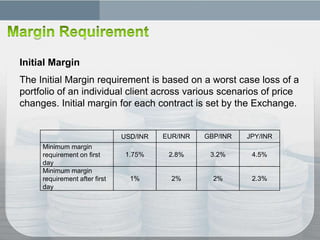
Initial Margin
The Initial Margin requirement is based on a worst case loss of a
portfolio of an individual client across various scenarios of price
changes. Initial margin for each contract is set by the Exchange.


                               USD/INR   EUR/INR   GBP/INR   JPY/INR
     Minimum margin
     requirement on first       1.75%     2.8%      3.2%      4.5%
     day
     Minimum margin
     requirement after first     1%        2%        2%       2.3%
     day
Calendar Spread
When a CF position at one maturity is hedged by an offsetting
position at a different maturity, Rs. 250/‐ Calendar Spread Margin
per Calendar Spread contract is charged.

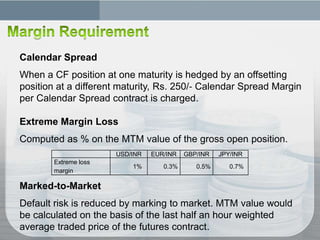
Extreme Margin Loss
Computed as % on the MTM value of the gross open position.
                       USD/INR   EUR/INR   GBP/INR   JPY/INR
        Extreme loss
                           1%       0.3%      0.5%      0.7%
        margin

Marked-to-Market
Default risk is reduced by marking to market. MTM value would
be calculated on the basis of the last half an hour weighted
average traded price of the futures contract.
National Securities Clearing Corporation Limited (NSCCL)
undertakes clearing and settlement of all trades executed on the
currency derivatives segment of the exchange. It also acts as
legal counterparty to all trades on the currency derivatives
segment and guarantees their financial settlement.

    • Mark-to-Market Settlement
    • Final Settlement of Futures
FIM - Currency Futures PPT

FIM - Currency Futures PPT

  • 1.
    11EX-013 Bishnu Kumar 11EX-015 Davinder Singh 11EX-040 Prateek Wadhwa 11EX-041 Priyanka Tyagi
  • 2.
    • 24 HourMarket because of business overlap • Trade is done by buying one currency while selling the other • 2 Segments of OTC Market o Interbank o Merchant
  • 3.
    • Securities underthe Securities Contracts Act, 1956 and hence the trading of derivatives is governed by the regulatory framework under the SC(R)A. • A product whose value is derived from the value of one or more basic variables called bases • The underlying asset can be equity, foreign exchange, commodity, interest rate or any other asset • Has a future settlement date
  • 4.
    The factors drivingthe growth of financial derivatives are: • Increased volatility in asset prices in financial markets • Increased integration of national financial markets with the international financial markets • Marked improvement in communication facilities and sharp decline in their costs, • Development of more sophisticated risk management tools • Innovations in the derivatives markets, which optimally combine the risks and returns over a large number of financial assets, leading to higher returns, reduced risk and lower transactions costs as compared to individual financial assets.
  • 5.
    Unpredicted movements inexchange rates requires investors to hedge these risks. • Forwards: A customized OTC contract between two parties. • Futures: Exchange-trade forwards. • Options: Option does not buy or sell the underlying directly but buys or sells the right without obligation on the underlying. • Swaps: Swaps are agreements between two parties to exchange cash flows in the future according to a prearranged formula. • Interest rate swaps: Swapping of interest related cash flows between the parties in the same currency. • Currency swaps: Swapping both principal and interest between the parties, with the cash flows in one direction being in a different currency than those in the opposite direction.
  • 6.
    A currency future,also known as FX future, is a standardized contract , traded on an exchange, to buy or sell one currency for another at a specified date in the future at a price that is fixed on the purchase date. Both parties of the futures contract must fulfill their obligations on the settlement date.
  • 7.
    Futures have somedistinct advantages over forward contracts: • Price transparency • Elimination of Counterparty credit risk. • Access to all types of market participants. The OTC market is restricted to Authorized Dealers (banks which are licensed by RBI to deal in FX), individuals and entities with FOREX exposures. Retail speculators with no exposure to FX cannot trade in OTC market. • Futures offer low cost of trading as compared to OTC market.
  • 8.
    Hedger • Have realexposure to FX risk on account of their business • Exposure could be because of Imports/Exports • Objective is to remove FX volatility risk using currency future Has to pay $ 1 mio after What happens if IMPORTER 3 months for imports in USD strengthens? march He loses money. Has to receive $ 1 mio What happens if EXPORTER after 3 months for USD weakens? exports in march He loses money. Overall portfolio in HEDGING Participant Risk Underlying Position Hedging Position Importer INR will weaken Short in Fx Long in CF Long Hedger Exporter INR will strengthen Long in Fx Short in CF Short Hedger
  • 9.
    Speculator • Also calledas Traders • Does not have real exposure to FX risk • Takes a view on the market direction hoping to make returns by taking the price risk • Assumes the price risk that hedgers attempt to lay off in the markets
  • 10.
    Arbitrageurs • Look formispricing and execute simultaneous buy and sell to capture the mispricing and make profit • Do not take any view on the market direction • Neither have exposure to risk and nor they take any risk
  • 11.
    Initial Margin The InitialMargin requirement is based on a worst case loss of a portfolio of an individual client across various scenarios of price changes. Initial margin for each contract is set by the Exchange. USD/INR EUR/INR GBP/INR JPY/INR Minimum margin requirement on first 1.75% 2.8% 3.2% 4.5% day Minimum margin requirement after first 1% 2% 2% 2.3% day
  • 12.
    Calendar Spread When aCF position at one maturity is hedged by an offsetting position at a different maturity, Rs. 250/‐ Calendar Spread Margin per Calendar Spread contract is charged. Extreme Margin Loss Computed as % on the MTM value of the gross open position. USD/INR EUR/INR GBP/INR JPY/INR Extreme loss 1% 0.3% 0.5% 0.7% margin Marked-to-Market Default risk is reduced by marking to market. MTM value would be calculated on the basis of the last half an hour weighted average traded price of the futures contract.
  • 13.
    National Securities ClearingCorporation Limited (NSCCL) undertakes clearing and settlement of all trades executed on the currency derivatives segment of the exchange. It also acts as legal counterparty to all trades on the currency derivatives segment and guarantees their financial settlement. • Mark-to-Market Settlement • Final Settlement of Futures