Professor: Gohar Stepanyan
Group: Lida Arshakyan
Anna Mamyan
Marina Sedrakyan
Vahan Poghosyan
Tigran Zohrabyan
International Financial Management
SPECIAL DRAWING
RIGHTS (SDR)
1
• Introduction to SDR
• History of SDR
• Valuation of SDR
• SDR Interest Rate Calculation
• SDR allocations
• Use of SDR
• Qualitative analysis: What is the future of SDR?
Contents
2
• SDRs are used as a unit of account by the IMF and several other international
organizations. A few countries peg their currencies against SDRs, and it is also
used to denominate some private international financial instruments (e.g., the
Warsaw convention, which regulates liability for international carriage of
persons, luggage or goods by air, uses SDRs to value the maximum liability of
the carrier).
Definition of SDR
3
History of SDR Creation
• World War II, elimination of gold standard
• Meeting of the representatives of 44 countries at Bretton Woods in 1944
• Formation of the IMF and World Bank
• Two scenarios for the USA:
 trade deficit policy - overflow the market with reserve currency
 zero deficit strategy - a shortage of USD in the market
• Solution was SDR, no willing to give IMF the right to print money
• In 1969 IMF created an international monetary reserve currency (SDR)
• SDR
 neither a currency, nor a claim on the IMF
 step towards solving the problems of limited resources of gold and dollars
 support the Bretton Woods fixed exchange rate system 4
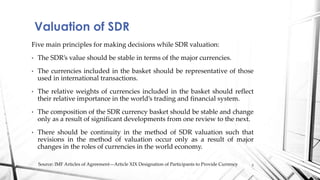
Five main principles for making decisions while SDR valuation:
• The SDR’s value should be stable in terms of the major currencies.
• The currencies included in the basket should be representative of those
used in international transactions.
• The relative weights of currencies included in the basket should reflect
their relative importance in the world’s trading and financial system.
• The composition of the SDR currency basket should be stable and change
only as a result of significant developments from one review to the next.
• There should be continuity in the method of SDR valuation such that
revisions in the method of valuation occur only as a result of major
changes in the roles of currencies in the world economy.
Valuation of SDR
Source: IMF Articles of Agreement—Article XIX Designation of Participants to Provide Currency 5
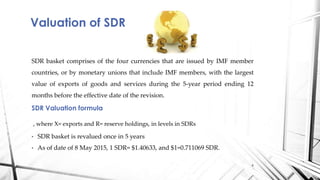
SDR basket comprises of the four currencies that are issued by IMF member
countries, or by monetary unions that include IMF members, with the largest
value of exports of goods and services during the 5-year period ending 12
months before the effective date of the revision.
SDR Valuation formula
, where X= exports and R= reserve holdings, in levels in SDRs
• SDR basket is revalued once in 5 years
• As of date of 8 May 2015, 1 SDR= $1.40633, and $1=0.711069 SDR.
Valuation of SDR
6
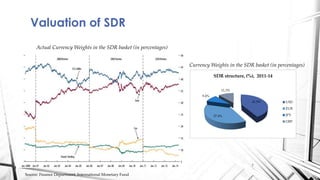
Valuation of SDR
Currency Weights in the SDR basket (in percentages)
41.9%
37.4%
9.4%
11.3%
SDR structure, (%), 2011-14
USD
EUR
JPY
GBP
Actual Currency Weights in the SDR basket (in percentages)
Source: Finance Department, International Monetary Fund
7
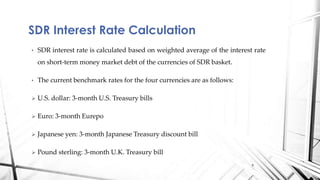
• SDR interest rate is calculated based on weighted average of the interest rate
on short-term money market debt of the currencies of SDR basket.
• The current benchmark rates for the four currencies are as follows:
 U.S. dollar: 3-month U.S. Treasury bills
 Euro: 3-month Eurepo
 Japanese yen: 3-month Japanese Treasury discount bill
 Pound sterling: 3-month U.K. Treasury bill
SDR Interest Rate Calculation
8
SDR Interest Rate Calculation
Interest Rates on the SDR and its financial instrument components (in percentages), 2005- 2014
Source: Finance Department, International Monetary Fund
9
• The basis of SDR allocation by IMF to its members is the proportions of
their IMF quotas,
• This allocation means a costless, unconditional international reserve asset
for the members, and no interest is earned or paid on it,
• Only in case SDR Holdings of a member increase above its allocation,
interest is earned on the excess,
• If fewer SDR is held than allocated, the members pay interest on this
shortfall. Cancellations of SDRs are allowed.
SDR allocations
0%
10%
20%
30%
40%
50%
60%
70%
80%
90%
100%
Category 1
Chart Title
Series 1 Series 2 Series 3
10
The two types of allocations :
• General- based on long-term need to increase existing reserve
as a special one-time allocation
• Special- ensure all members of IMF the relative same amount
of SDRs, since countries join the IMF at different times
Decisions on these allocations are made for periods of up to five
years.
SDR allocations
11
• SDRs are used as a unit of account by the IMF and several other international
organizations. A few countries peg their currencies against SDRs, and it is
also used to denominate some private international financial instruments
• SDRs can be used in transactions with the IMF. For example, it can be used
for the repayment of loans or payment of the reserve asset portion of quota
increases
• In the Euro zone, the Euro is displacing the SDR as a basis to set values of
various currencies, including Latvian Lats.
Use of SDR
12
• SDRs were originally created to replace gold and silver in large
international transactions and provide a cost-free alternative to member
states for building reserves.
• SDRs are credits that nations with balance of trade surpluses can draw
upon from nations with deficits.
• It has also been suggested that having holders of US Dollars convert
those dollars into SDRs would allow diversification away from the dollar
without accelerating the decline of the value of the dollar
Use of SDR
13
• Bosnia and Herzegovina used a substantial portion of its SDR holdings to
help finance its 2009 budget deficit.
• Malawi, facing a foreign exchange shortage, used the 2009 special allocation
of SDRs in November 2009.
• Mauritania, facing a deteriorating fiscal position, used a significant portion
of its 2009 SDR allocations to help close a fiscal financing gap.
• In Moldova, the authorities used most of their SDR allocation for budget
financing in late 2009, helping to clear accumulated expenditure arrears and
reduce reliance on more expensive short-term domestic financing.
• Ukraine used its 2009 SDR allocations to meet external obligations to natural
gas suppliers
• Zimbabwe used a portion of its SDR holdings for budgetary purposes.
SDR allocation examples
14
Qualitative analysis: What is the future of SDR
• Low interest in SDR by the private sector
• Starting from 1970s attempts to increase the attractiveness of SDR as an asset
 allow the SDR holders to use it in such transactions as swap, forward, etc.
 let central banks involve into SDR transactions without the intermediation of IMF
 issue of SDR-denominated liabilities by commercial banks and private corporations
• Changes in the foreign exchange reserves
• Chances that new currencies can join the basket (e.g. Yuan)
 Issues of timing
 Stability of SDR
 Perceptions
 Convertibility
 Condition of freely-used currency
 Provision of updated statistics
15
• USA and its 17% voting rights
• Independent monetary policies
Obstacles for SDR
SDR Pros
• US government’s high debt
• Domestic economic problems in the USA
SDR Cons
• Major transactions in USD
• High costs of shifting
16
• IMF is discussing the scenario of private use of SDR.
• IMF is considering the expansion of SDR denominated
bonds
• Creating the substitution accounts
IMF’s vision of SDR
17
18

Special Drawing Rights

  • 1.
    Professor: Gohar Stepanyan Group:Lida Arshakyan Anna Mamyan Marina Sedrakyan Vahan Poghosyan Tigran Zohrabyan International Financial Management SPECIAL DRAWING RIGHTS (SDR) 1
  • 2.
    • Introduction toSDR • History of SDR • Valuation of SDR • SDR Interest Rate Calculation • SDR allocations • Use of SDR • Qualitative analysis: What is the future of SDR? Contents 2
  • 3.
    • SDRs areused as a unit of account by the IMF and several other international organizations. A few countries peg their currencies against SDRs, and it is also used to denominate some private international financial instruments (e.g., the Warsaw convention, which regulates liability for international carriage of persons, luggage or goods by air, uses SDRs to value the maximum liability of the carrier). Definition of SDR 3
  • 4.
    History of SDRCreation • World War II, elimination of gold standard • Meeting of the representatives of 44 countries at Bretton Woods in 1944 • Formation of the IMF and World Bank • Two scenarios for the USA:  trade deficit policy - overflow the market with reserve currency  zero deficit strategy - a shortage of USD in the market • Solution was SDR, no willing to give IMF the right to print money • In 1969 IMF created an international monetary reserve currency (SDR) • SDR  neither a currency, nor a claim on the IMF  step towards solving the problems of limited resources of gold and dollars  support the Bretton Woods fixed exchange rate system 4
  • 5.
    Five main principlesfor making decisions while SDR valuation: • The SDR’s value should be stable in terms of the major currencies. • The currencies included in the basket should be representative of those used in international transactions. • The relative weights of currencies included in the basket should reflect their relative importance in the world’s trading and financial system. • The composition of the SDR currency basket should be stable and change only as a result of significant developments from one review to the next. • There should be continuity in the method of SDR valuation such that revisions in the method of valuation occur only as a result of major changes in the roles of currencies in the world economy. Valuation of SDR Source: IMF Articles of Agreement—Article XIX Designation of Participants to Provide Currency 5
  • 6.
    SDR basket comprisesof the four currencies that are issued by IMF member countries, or by monetary unions that include IMF members, with the largest value of exports of goods and services during the 5-year period ending 12 months before the effective date of the revision. SDR Valuation formula , where X= exports and R= reserve holdings, in levels in SDRs • SDR basket is revalued once in 5 years • As of date of 8 May 2015, 1 SDR= $1.40633, and $1=0.711069 SDR. Valuation of SDR 6
  • 7.
    Valuation of SDR CurrencyWeights in the SDR basket (in percentages) 41.9% 37.4% 9.4% 11.3% SDR structure, (%), 2011-14 USD EUR JPY GBP Actual Currency Weights in the SDR basket (in percentages) Source: Finance Department, International Monetary Fund 7
  • 8.
    • SDR interestrate is calculated based on weighted average of the interest rate on short-term money market debt of the currencies of SDR basket. • The current benchmark rates for the four currencies are as follows:  U.S. dollar: 3-month U.S. Treasury bills  Euro: 3-month Eurepo  Japanese yen: 3-month Japanese Treasury discount bill  Pound sterling: 3-month U.K. Treasury bill SDR Interest Rate Calculation 8
  • 9.
    SDR Interest RateCalculation Interest Rates on the SDR and its financial instrument components (in percentages), 2005- 2014 Source: Finance Department, International Monetary Fund 9
  • 10.
    • The basisof SDR allocation by IMF to its members is the proportions of their IMF quotas, • This allocation means a costless, unconditional international reserve asset for the members, and no interest is earned or paid on it, • Only in case SDR Holdings of a member increase above its allocation, interest is earned on the excess, • If fewer SDR is held than allocated, the members pay interest on this shortfall. Cancellations of SDRs are allowed. SDR allocations 0% 10% 20% 30% 40% 50% 60% 70% 80% 90% 100% Category 1 Chart Title Series 1 Series 2 Series 3 10
  • 11.
    The two typesof allocations : • General- based on long-term need to increase existing reserve as a special one-time allocation • Special- ensure all members of IMF the relative same amount of SDRs, since countries join the IMF at different times Decisions on these allocations are made for periods of up to five years. SDR allocations 11
  • 12.
    • SDRs areused as a unit of account by the IMF and several other international organizations. A few countries peg their currencies against SDRs, and it is also used to denominate some private international financial instruments • SDRs can be used in transactions with the IMF. For example, it can be used for the repayment of loans or payment of the reserve asset portion of quota increases • In the Euro zone, the Euro is displacing the SDR as a basis to set values of various currencies, including Latvian Lats. Use of SDR 12
  • 13.
    • SDRs wereoriginally created to replace gold and silver in large international transactions and provide a cost-free alternative to member states for building reserves. • SDRs are credits that nations with balance of trade surpluses can draw upon from nations with deficits. • It has also been suggested that having holders of US Dollars convert those dollars into SDRs would allow diversification away from the dollar without accelerating the decline of the value of the dollar Use of SDR 13
  • 14.
    • Bosnia andHerzegovina used a substantial portion of its SDR holdings to help finance its 2009 budget deficit. • Malawi, facing a foreign exchange shortage, used the 2009 special allocation of SDRs in November 2009. • Mauritania, facing a deteriorating fiscal position, used a significant portion of its 2009 SDR allocations to help close a fiscal financing gap. • In Moldova, the authorities used most of their SDR allocation for budget financing in late 2009, helping to clear accumulated expenditure arrears and reduce reliance on more expensive short-term domestic financing. • Ukraine used its 2009 SDR allocations to meet external obligations to natural gas suppliers • Zimbabwe used a portion of its SDR holdings for budgetary purposes. SDR allocation examples 14
  • 15.
    Qualitative analysis: Whatis the future of SDR • Low interest in SDR by the private sector • Starting from 1970s attempts to increase the attractiveness of SDR as an asset  allow the SDR holders to use it in such transactions as swap, forward, etc.  let central banks involve into SDR transactions without the intermediation of IMF  issue of SDR-denominated liabilities by commercial banks and private corporations • Changes in the foreign exchange reserves • Chances that new currencies can join the basket (e.g. Yuan)  Issues of timing  Stability of SDR  Perceptions  Convertibility  Condition of freely-used currency  Provision of updated statistics 15
  • 16.
    • USA andits 17% voting rights • Independent monetary policies Obstacles for SDR SDR Pros • US government’s high debt • Domestic economic problems in the USA SDR Cons • Major transactions in USD • High costs of shifting 16
  • 17.
    • IMF isdiscussing the scenario of private use of SDR. • IMF is considering the expansion of SDR denominated bonds • Creating the substitution accounts IMF’s vision of SDR 17
  • 18.