DERIVATIVES S.CLEMENT
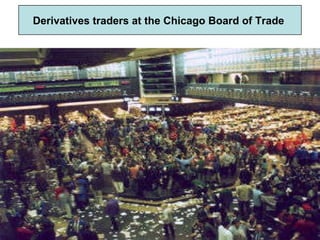
Derivatives traders at the Chicago Board of Trade
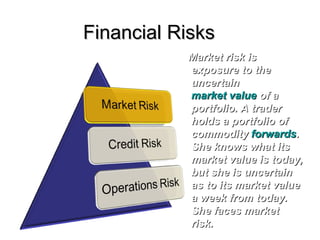
Financial Risks Market risk is exposure to the uncertain  market value   of a portfolio. A trader holds a portfolio of commodity  forwards . She knows what its market value is today, but she is uncertain as to its market value a week from today. She faces market risk.
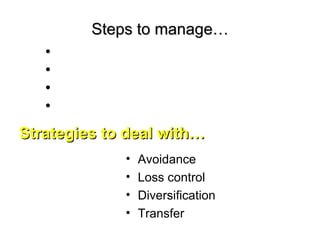
Steps to manage… Avoidance  Loss control Diversification  Transfer  Identification of risk Quantification of risks Framing Risk Appetite Implementation and control  Strategies to deal with…
Hedging “ Establishing a position in the derivatives market  that is  equal  and  opposite  to the risky position in the physical market..”
HEDGING TOOLS Take out finance Securitisation Derivatives
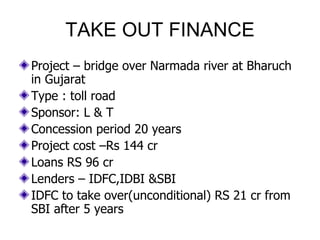
TAKE OUT FINANCE Project – bridge over Narmada river at Bharuch in Gujarat Type : toll road  Sponsor: L & T Concession period 20 years Project cost –Rs 144 cr Loans RS 96 cr Lenders – IDFC,IDBI &SBI IDFC to take over(unconditional) RS 21 cr from SBI after 5 years
DERIVATIVES MEANS Derivative are financial instruments whose value depends upon the value of underlying asset Features are: It has no independent value. Its’ value depends on the value of an asset. Under lying asset could be Int. rates, commodities, stocks, index , currency,etc Pre determined life It is independent of underlying contract It is a hedging tool. Derivative means a forward, future, option or any other hybrid contract of pre determined fixed duration, linked for the purpose of contract fulfillment to the value of a specified real or financial asset or to an index of securities.
Features of derivatives  Bench mark rates  Strike price Contract period View of contracting partiees
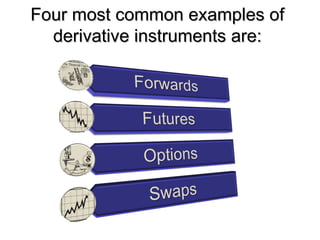
Four most common examples of derivative instruments are:
Genesis It is not new  wine in the new bottle. It is nothing but old wine In new bottle It is 2000 years old . Olive farmers in Greece used forward contract for delivery on a specified date  between seller & buyer Bombay traders used to have FC with farmers in Gujarat & Maharashtra for supplying cotton even in 17 th century
TYPES OF DERIVATIVES Over the counter(OTC) Forward contract Forward rate agreements Swaps Options Credit EXCHANGE RELATED Futures Stock options Commodity futures
OTC  COTRACTS Bilateral contract Customized contract No quotes in the market Settlement by delivery Reversal/ cancellation with counter party E.g.. FC Forex transactions & Commodity Problems- No standardization & counter party risk (OTC) derivatives are contracts that are traded (and privately negotiated) directly between two parties, without going through an exchange or other intermediary. Products such as swaps, forward rate agreements and exotic options are almost always traded in this way.  The OTC derivatives market is huge. According to the Bank for International Settlements, the total outstanding notional amount is USD 516 trillion (as of June 2007)
Exchange Traded Contracts The world's largest derivatives exchanges (by number of transactions) are the Korea Exchange (which lists KOSPI Index Futures & Options),  Eurex (which lists a wide range of European products such as interest rate & index products), and  CME Group (made up of the 2007 merger of the Chicago Mercantile Exchange and the Chicago Board of Trade and the 2008 acquisition of the New York Mercantile Exchange).  According to BIS, the combined turnover in the world's derivatives exchanges totalled USD 344 trillion during Q4 2005.
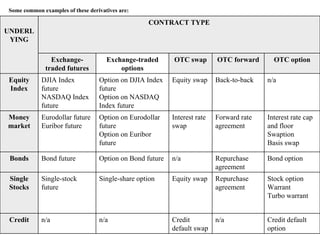
Some common examples of these derivatives are: UNDERLYING CONTRACT TYPE Exchange-traded futures Exchange-traded options OTC swap OTC forward OTC option Equity Index DJIA Index future NASDAQ Index future Option on DJIA Index future Option on NASDAQ Index future Equity swap Back-to-back n/a Money market Eurodollar future Euribor future Option on Eurodollar future Option on Euribor future Interest rate swap Forward rate agreement Interest rate cap and floor Swaption Basis swap Bonds Bond future Option on Bond future n/a Repurchase agreement Bond option Single Stocks Single-stock future Single-share option Equity swap Repurchase agreement Stock option Warrant Turbo warrant Credit n/a n/a Credit default swap n/a Credit default option
FC –commodity (OTC) Kissan co wants to procure 500 kg of tomatoes after 3 months. Prevailing 1 kg @Rs 6.  View of the company– Expected to go up to Rs 8 per kg. View of the farmer- Price @ Rs 5.50. So FC between Company & Farmer.Agreed price  @ Rs 6.50 . Delivery after 3 months. Situation after 3 moths – Price may be same I.e @ Rs 6 or more or less than strike price
Hedging – Case Study •  ABC Ltd having order in hand to supply copper wire worth 500 MT of copper to be delivered 2 months from now •  Case I –  Price of copper is fixed at current spot price •  Case II –  The price of copper would be fixed based on flexibility: –  on any dates at the hands of the buyer after one month of the order or –  On any dates in the delivery month •  What should your hedging strategy be?
Hedging  Hedging Options – evaluation •  Option I •  Buy in the spot market at current price –  Buying in the spot market blocks the working capital –  Increased inventory carrying cost –  Copper available in the spot market priced at last months average price which is higher than landed spot price •  Option II •  Lock in the price on the futures market at one month forward –  This gives flexibility in terms of pricing spot market purchases –  Increases negotiation capacity with the supplier •  Option III •  Leave the position un-hedged and buy copper when actually required for production leaving to vagaries of volatile copper price risk Risk Management
CURRENCY -FORWARD CONTRACTS (OTC) Export transaction –  Export for USD  10,000/- expected date 3months later. Spot rate Rs 46 View – Dollar will depreciate by Re 1. FC (sale by exporter) for  USD 10,000 @ 45.75 for 3 months. Situation I – After 3 months  rate@ 46 Situation II – After 3 months rate @ 45 It is a notional loss but exporter managed price risk.
FORDWARD RATE AGREEMENTS It is a financial contract between two parties to exchange steam of interest payments on notional principal amount on settlement date Features-n Bilateral contract Notional principal amount Exchange of cash flows on settlement date or periodically  reset dates Between the strike price  & market price Object- Hedging to IRR
FC- INT.RATES (FRA) Object- Hedging against INT.RATE RISK ABC co ltd borrowed Rs 50 lacs for 1 year @ 11% (floating) from SBI View – INT.rate will go up FRA with CITI bank for 1 year. Strike price @ 11% Situation- After 1 year  INT @ 13% . CITI will pay 2%(13-11) to ABC who will in turn pay 13% to lender  SBI. Situation II-- If INT at 10% ,ABC will pay 1% to CITI. For ABC -- interest cost stays at  11%
Interest Rate Swaps A swap a transaction is one where two or more parties agree to receive or pay on a notional principal for an agreed period of time Swap may be for interest, currency,Commodity etc
FUTURES(Exchange related) Agreement between two parties at an agreed  price on a specified date . It may relate to commodities, Index, share etc. Feature- Bilateral contract Designated future date at a price agreed today It is traded in the exchange Standardized- Quantity,price,period etc No counter party risk as SE itself counter party Transparent functioning Price discovery
FUTURES (Equity ) E.G. X wants to buy 100 shares of XYZ CO after 3 months @ Rs 250 per share. Hence futures contract Situation I – After 3 moths if the price is Rs 300, then X will get Rs 5000(300-250*100).There is no exchange of shares but only the difference agreed price and market price. Situation II If the price is RS 200, X will pay Rs 5000 (250-200 * 50) In both situations, X is able to manage price risk
Index futures  Futures contract on a stock or financial index. For each index there may be a different multiple for determining the price of the futures contract.  For example, the S&P 500 Index is one of the most widely traded index futures contracts in the U.S. Stock portfolio managers who want to hedge risk over a certain period of time often use S&P 500 futures to do so.  By shorting these contracts, stock portfolio managers can protect themselves from the downside price risk of the broader market.  However, by using this hedging strategy, if perfectly done, the manager's portfolio will not participate in any gains on the index; instead, the portfolio will lock in gains equivalent to the risk-free rate of interest.   Alternatively, stock portfolio managers can use index futures to increase their exposure to movements in a particular index, essentially leveraging their portfolios.
Index Futures  Portfolio value – Re 4,00,000 Beta factor – 1.5 (i.e. if index drops by 10%,porfolio value will drop by 15%). Portfolio value will drop by to Re 3,40,000 (4000 X 10 X 1.5) To hedge the portfolio, index futures to be used by going in for buying contracts on index. Formula – (4000 X1.5) / (4000 X 50 ) = 6,00,000/ 2,00,000 = 3 contracts to sold. Situation A – if index drops by 10% i.e. to 3600, Profit on futures contract = 10% of Re 2.00 lac for 3 contracts will be Re 60,000. Cash market loss will be off set by gain in derivative segment. Long Hedge –for acquiring shares at a  future date. Short Hedge – for selling the shares at a future date.
commodity futures Commitment to make or take delivery of a specific commodity of Specific  quantity&quality At a pre determined price and place In future  with all terms of contracts standardized It is to hedge price risk on account of demand & supply, govt.policy,natural calamities etc Hedging tool for traders/exporters Price discovery
Agri.commodity- Sugar,cotton,coffee, Soya bean, Mustard seed, Mustard oil Crude palm oil , Pepperetc Metallurgical –precious (Gold , Silver etc) & base metals  Energy – crude oil ,gasoline etc Objective – manage price risk. Major  exchanges – National Commodity & Derivatives Exchange (NCDEX)& Multi commodity Exchange of India. Regulator – Forwards  Markets Commission (FMC) commodity futures
How t is useful  for hedging ? An exporter exporting Agro products (E.g. Basmati rice). Price fluctuations between date of receiving the order and execution of order i.e date of exports An importer importing gold for selling in the ratail market or making jewellery for exports. commodity futures
At present , MCX ( Multi commodity Exchange of India) offers futures on 60 commodities.It recently entered in to strategic alliance with Malaysian commodity exchange  for offering futures on Crude Palm Oil(CPO ) CPO traded in Malaysian exchange will be offered by MCX to Indian traders who are importing CPO  form South East Asia. It will help to hedge the price risk. FUTURES commodity
OPTIONS It is a bilateral contract where by the buyer has the right perform or not to perform an obligation. It maybe a call (buy) or a put (sell) option. In short. the buyer has the option  to buy or sell American option – An option exercisable at any time before due date European option- Option exercisable only on due date SEBI issued guidelines for trading in derivative I.e. stock option
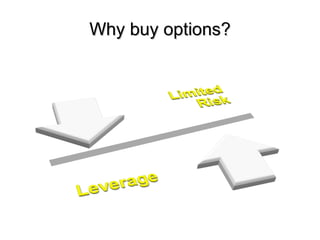
Why buy options?
OPTION – TERMINOLOGIES Call/Put Volatility Strike Price American/European In the money Out of money At the money
Open interest  Open interest  (also known as  open contracts  or  open commitments ) denotes the total number of derivative contracts, like futures and options, that are currently active on a specific underlying security, having specific terms. Open Interest is the total number of outstanding contracts that are held by market participants at the end of the day. It can also be defined as the total number of futures contracts or option contracts that have not yet been exercised (squared off), expired, or fulfilled by delivery
Open Interest  For option traders, open interest is an indication of how intense trading the options in an underlying security may be.  For instance, if open interest increases suddenly from one day to the next, it is likely that new information about the underlying security has been revealed, which may indicate a near-term rise in the underlying security's volatility.  In theory there's nothing which can be said on the future direction of the underlying, because there are as many contracts bought as sold  Increasing open interest means that new money is flowing into the marketplace. The result will be that the present trend ( up, down or sideways) will continue. Declining open interest means that the market is liquidating and implies that the prevailing price trend is coming to an end.  A knowledge of open interest can prove useful toward the end of major market moves.
SWAPTIONS A swaption is a contract by which a party acquires  an option to enter into a swap It is to used to hedge uncertainties in cash flows E.g..A company bids for a tender . It is not sure whether tender will be awarded. So a swaption is entered say for interest on borrowing.
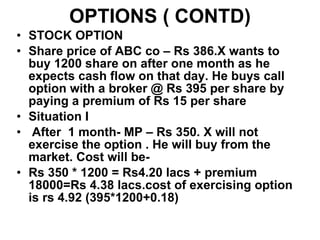
OPTIONS ( CONTD) STOCK OPTION Share price of ABC co – Rs 386.X wants to buy 1200 share on after one month as he expects cash flow on that day. He buys call option with a broker @ Rs 395 per share by paying a premium of Rs 15 per share  Situation I After  1 month- MP – Rs 350. X will not exercise the option . He will buy from the market. Cost will be-  Rs 350 * 1200 = Rs4.20 lacs + premium 18000=Rs 4.38 lacs.cost of exercising option is rs 4.92 (395*1200+0.18)
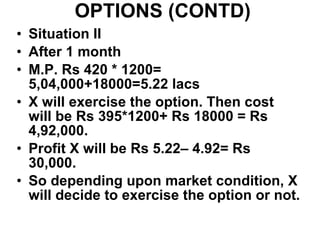
OPTIONS (CONTD) Situation II After 1 month M.P. Rs 420 * 1200= 5,04,000+18000=5.22 lacs X will exercise the option. Then cost will be Rs 395*1200+ Rs 18000 = Rs 4,92,000.  Profit X will be Rs 5.22– 4.92= Rs 30,000. So depending upon market condition, X will decide to exercise the option or not.
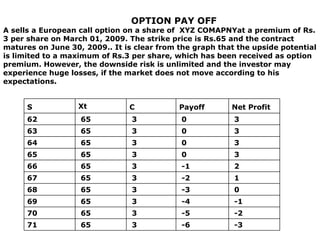
OPTION PAY OFF A sells a European call option on a share of  XYZ COMAPNYat a premium of Rs. 3 per share on March 01, 2009. The strike price is Rs.65 and the contract matures on June 30, 2009.. It is clear from the graph that the upside potential is limited to a maximum of Rs.3 per share, which has been received as option premium. However, the downside risk is unlimited and the investor may experience huge losses, if the market does not move according to his expectations. S   Xt  C   Payoff   Net Profit   62    65    3    0    3 63    65    3    0    3 64    65    3    0    3 65    65    3    0    3 66    65    3    -1    2 67    65    3    -2    1 68    65    3    -3    0 69    65    3    -4    -1 70    65    3    -5    -2 71    65    3    -6    -3
straddles and strangles strangle  is an investment strategy involving the purchase or sale of particular option derivatives that allows the holder to profit based on how much the price of the underlying security moves, with relatively minimal exposure to the  direction  of price movement.  The purchase of particular option derivatives is known as a long strangle, while the sale of the option derivatives is known as a short strangle. It is related to a similar option strategy known as a straddle.
Long strangle The  long strangle  involves going long (buying) both a call option and a put option of the same underlying security.  Like a long straddle, the options expire at the same time, but unlike a straddle, the options have different strike prices. The owner of a long strangle makes a profit if the underlying price moves far enough way from the current price, either above or below.  Thus, an investor may take a long strangle position if he thinks the underlying security is highly volatile, but does not know which direction it is going to move.  This position is a limited risk, since the most a purchaser may lose is the cost of both options. At the same time, there is unlimited profit potential.
Short strangle The  short strangle  is the converse of the long strangle.  The call and put options are written (sold) instead of bought.  The investor loses if the underlying security increases or decreases enough; but if the stock price remains stable then the options expire and the investor gets to keep the premiums
straddle The difference between a straddle and a strangle is the strike price of the options. In a straddle, the options are bought with the same strike price.  In a strangle, the options are bought with different strike prices.
Option strategies  Calls  increase in value as the underlying stock increases in value.  Likewise  puts  increase in value as the underlying stock decreases in value. Buying both a  call  and a  put  means that if the underlying stock moves up the call increases in value and likewise if the underlying stock moves down the put increases in value.  The combined position can increase in value if the stock moves significantly in either direction. (The position loses money if the stock stays at the same price or within a range of the price when the position was established.) This strategy is called a  straddle .  It is one of many options strategies that investors can employ.
straddles and strangles With  Infosys  Results coming in tomorrow, the market is expected to be highly volatile. However with right use of stock options, investors can actually profit from this volatility.  There are  option strategies  like  straddles and strangles  which let investors profit from huge one way movements So in cases where you know the stock prices will move heavily one way, either up or down, but you don’t know which way this huge movement is going to take place, stradles and strangles can be used to make decent profit .
When to use straddle and strangles Straddle  – when there is no clue abouthe direction in the market. Strangle  – when you take a definite view about the direction in the market i.e. up or down.
Regulatory frame work –S/E Securities contracts (regulation) Act 1956 SEBI Act 1992 The forwards Contract (regulations) Act 1952
REGULATORS- INDIA RBI  -  OTC SEBI  - Exchange related ( Stock market) Forward Markets Commission –Commodity Futures
DERIVATIVES IN INDIA 1998 – L.C. GUPTA Committee recommended for introduction of derivatives SEBI will grant approval for clearing corporation and their bye laws Trading members to register with SEBI Margin to be maintained as per SEBI rules BSE & NSE launched Index future in June 2000 /Index  &stock option in July 2001/Stock futures in Nov 2001 Commodity futures already exist for Pepper,Coffee etc
DERIVATIVES IN INDIA – commodity futures Commodities traded – coffee, pepper, cotton,soyabean ,petroleum,rubber,Gold etc Actively traded – cotton, coffee ,cotton& castor oil 23 commodity exchanges- major exchanges at Mumbai(cotton &oil seeds), Bangalore (Coffee),Cochin (pepper), Kolkata (Jute) etc Current Turnover of all 23 exchanges increased to Re 20 lakh crore from 6 lakh crore (2004-05)
Current Issues Three regulators- SEBI for SE , RBI for OTC contacts &  Forward Markets Commission –Commodity Futures Documentation Stamp duty Poor response from GOVT. banks  Accounting standards
Derivatives – a double edged sword Derivatives are often subject to the following criticisms: The use of derivatives can result in large losses due to the use of leverage. Derivatives allow investors to earn large returns from small movements in the underlying asset's price. However, investors could lose large amounts if the price of the underlying moves against them significantly.  There have been several instances of massive losses in derivative markets, including:  The Nick Leesonaffair in 1994.
THANK  YOU

Derivatives

  • 1.
  • 2.
    Derivatives traders atthe Chicago Board of Trade
  • 3.
    Financial Risks Marketrisk is exposure to the uncertain market value of a portfolio. A trader holds a portfolio of commodity forwards . She knows what its market value is today, but she is uncertain as to its market value a week from today. She faces market risk.
  • 4.
    Steps to manage…Avoidance Loss control Diversification Transfer Identification of risk Quantification of risks Framing Risk Appetite Implementation and control Strategies to deal with…
  • 5.
    Hedging “ Establishinga position in the derivatives market that is equal and opposite to the risky position in the physical market..”
  • 6.
    HEDGING TOOLS Takeout finance Securitisation Derivatives
  • 7.
    TAKE OUT FINANCEProject – bridge over Narmada river at Bharuch in Gujarat Type : toll road Sponsor: L & T Concession period 20 years Project cost –Rs 144 cr Loans RS 96 cr Lenders – IDFC,IDBI &SBI IDFC to take over(unconditional) RS 21 cr from SBI after 5 years
  • 8.
    DERIVATIVES MEANS Derivativeare financial instruments whose value depends upon the value of underlying asset Features are: It has no independent value. Its’ value depends on the value of an asset. Under lying asset could be Int. rates, commodities, stocks, index , currency,etc Pre determined life It is independent of underlying contract It is a hedging tool. Derivative means a forward, future, option or any other hybrid contract of pre determined fixed duration, linked for the purpose of contract fulfillment to the value of a specified real or financial asset or to an index of securities.
  • 9.
    Features of derivatives Bench mark rates Strike price Contract period View of contracting partiees
  • 10.
    Four most commonexamples of derivative instruments are:
  • 11.
    Genesis It isnot new wine in the new bottle. It is nothing but old wine In new bottle It is 2000 years old . Olive farmers in Greece used forward contract for delivery on a specified date between seller & buyer Bombay traders used to have FC with farmers in Gujarat & Maharashtra for supplying cotton even in 17 th century
  • 12.
    TYPES OF DERIVATIVESOver the counter(OTC) Forward contract Forward rate agreements Swaps Options Credit EXCHANGE RELATED Futures Stock options Commodity futures
  • 13.
    OTC COTRACTSBilateral contract Customized contract No quotes in the market Settlement by delivery Reversal/ cancellation with counter party E.g.. FC Forex transactions & Commodity Problems- No standardization & counter party risk (OTC) derivatives are contracts that are traded (and privately negotiated) directly between two parties, without going through an exchange or other intermediary. Products such as swaps, forward rate agreements and exotic options are almost always traded in this way. The OTC derivatives market is huge. According to the Bank for International Settlements, the total outstanding notional amount is USD 516 trillion (as of June 2007)
  • 14.
    Exchange Traded ContractsThe world's largest derivatives exchanges (by number of transactions) are the Korea Exchange (which lists KOSPI Index Futures & Options), Eurex (which lists a wide range of European products such as interest rate & index products), and CME Group (made up of the 2007 merger of the Chicago Mercantile Exchange and the Chicago Board of Trade and the 2008 acquisition of the New York Mercantile Exchange). According to BIS, the combined turnover in the world's derivatives exchanges totalled USD 344 trillion during Q4 2005.
  • 15.
    Some common examplesof these derivatives are: UNDERLYING CONTRACT TYPE Exchange-traded futures Exchange-traded options OTC swap OTC forward OTC option Equity Index DJIA Index future NASDAQ Index future Option on DJIA Index future Option on NASDAQ Index future Equity swap Back-to-back n/a Money market Eurodollar future Euribor future Option on Eurodollar future Option on Euribor future Interest rate swap Forward rate agreement Interest rate cap and floor Swaption Basis swap Bonds Bond future Option on Bond future n/a Repurchase agreement Bond option Single Stocks Single-stock future Single-share option Equity swap Repurchase agreement Stock option Warrant Turbo warrant Credit n/a n/a Credit default swap n/a Credit default option
  • 16.
    FC –commodity (OTC)Kissan co wants to procure 500 kg of tomatoes after 3 months. Prevailing 1 kg @Rs 6. View of the company– Expected to go up to Rs 8 per kg. View of the farmer- Price @ Rs 5.50. So FC between Company & Farmer.Agreed price @ Rs 6.50 . Delivery after 3 months. Situation after 3 moths – Price may be same I.e @ Rs 6 or more or less than strike price
  • 17.
    Hedging – CaseStudy • ABC Ltd having order in hand to supply copper wire worth 500 MT of copper to be delivered 2 months from now • Case I – Price of copper is fixed at current spot price • Case II – The price of copper would be fixed based on flexibility: – on any dates at the hands of the buyer after one month of the order or – On any dates in the delivery month • What should your hedging strategy be?
  • 18.
    Hedging HedgingOptions – evaluation • Option I • Buy in the spot market at current price – Buying in the spot market blocks the working capital – Increased inventory carrying cost – Copper available in the spot market priced at last months average price which is higher than landed spot price • Option II • Lock in the price on the futures market at one month forward – This gives flexibility in terms of pricing spot market purchases – Increases negotiation capacity with the supplier • Option III • Leave the position un-hedged and buy copper when actually required for production leaving to vagaries of volatile copper price risk Risk Management
  • 19.
    CURRENCY -FORWARD CONTRACTS(OTC) Export transaction – Export for USD 10,000/- expected date 3months later. Spot rate Rs 46 View – Dollar will depreciate by Re 1. FC (sale by exporter) for USD 10,000 @ 45.75 for 3 months. Situation I – After 3 months rate@ 46 Situation II – After 3 months rate @ 45 It is a notional loss but exporter managed price risk.
  • 20.
    FORDWARD RATE AGREEMENTSIt is a financial contract between two parties to exchange steam of interest payments on notional principal amount on settlement date Features-n Bilateral contract Notional principal amount Exchange of cash flows on settlement date or periodically reset dates Between the strike price & market price Object- Hedging to IRR
  • 21.
    FC- INT.RATES (FRA)Object- Hedging against INT.RATE RISK ABC co ltd borrowed Rs 50 lacs for 1 year @ 11% (floating) from SBI View – INT.rate will go up FRA with CITI bank for 1 year. Strike price @ 11% Situation- After 1 year INT @ 13% . CITI will pay 2%(13-11) to ABC who will in turn pay 13% to lender SBI. Situation II-- If INT at 10% ,ABC will pay 1% to CITI. For ABC -- interest cost stays at 11%
  • 22.
    Interest Rate SwapsA swap a transaction is one where two or more parties agree to receive or pay on a notional principal for an agreed period of time Swap may be for interest, currency,Commodity etc
  • 23.
    FUTURES(Exchange related) Agreementbetween two parties at an agreed price on a specified date . It may relate to commodities, Index, share etc. Feature- Bilateral contract Designated future date at a price agreed today It is traded in the exchange Standardized- Quantity,price,period etc No counter party risk as SE itself counter party Transparent functioning Price discovery
  • 24.
    FUTURES (Equity )E.G. X wants to buy 100 shares of XYZ CO after 3 months @ Rs 250 per share. Hence futures contract Situation I – After 3 moths if the price is Rs 300, then X will get Rs 5000(300-250*100).There is no exchange of shares but only the difference agreed price and market price. Situation II If the price is RS 200, X will pay Rs 5000 (250-200 * 50) In both situations, X is able to manage price risk
  • 25.
    Index futures Futures contract on a stock or financial index. For each index there may be a different multiple for determining the price of the futures contract. For example, the S&P 500 Index is one of the most widely traded index futures contracts in the U.S. Stock portfolio managers who want to hedge risk over a certain period of time often use S&P 500 futures to do so. By shorting these contracts, stock portfolio managers can protect themselves from the downside price risk of the broader market.  However, by using this hedging strategy, if perfectly done, the manager's portfolio will not participate in any gains on the index; instead, the portfolio will lock in gains equivalent to the risk-free rate of interest.  Alternatively, stock portfolio managers can use index futures to increase their exposure to movements in a particular index, essentially leveraging their portfolios.
  • 26.
    Index Futures Portfolio value – Re 4,00,000 Beta factor – 1.5 (i.e. if index drops by 10%,porfolio value will drop by 15%). Portfolio value will drop by to Re 3,40,000 (4000 X 10 X 1.5) To hedge the portfolio, index futures to be used by going in for buying contracts on index. Formula – (4000 X1.5) / (4000 X 50 ) = 6,00,000/ 2,00,000 = 3 contracts to sold. Situation A – if index drops by 10% i.e. to 3600, Profit on futures contract = 10% of Re 2.00 lac for 3 contracts will be Re 60,000. Cash market loss will be off set by gain in derivative segment. Long Hedge –for acquiring shares at a future date. Short Hedge – for selling the shares at a future date.
  • 27.
    commodity futures Commitmentto make or take delivery of a specific commodity of Specific quantity&quality At a pre determined price and place In future with all terms of contracts standardized It is to hedge price risk on account of demand & supply, govt.policy,natural calamities etc Hedging tool for traders/exporters Price discovery
  • 28.
    Agri.commodity- Sugar,cotton,coffee, Soyabean, Mustard seed, Mustard oil Crude palm oil , Pepperetc Metallurgical –precious (Gold , Silver etc) & base metals Energy – crude oil ,gasoline etc Objective – manage price risk. Major exchanges – National Commodity & Derivatives Exchange (NCDEX)& Multi commodity Exchange of India. Regulator – Forwards Markets Commission (FMC) commodity futures
  • 29.
    How t isuseful for hedging ? An exporter exporting Agro products (E.g. Basmati rice). Price fluctuations between date of receiving the order and execution of order i.e date of exports An importer importing gold for selling in the ratail market or making jewellery for exports. commodity futures
  • 30.
    At present ,MCX ( Multi commodity Exchange of India) offers futures on 60 commodities.It recently entered in to strategic alliance with Malaysian commodity exchange for offering futures on Crude Palm Oil(CPO ) CPO traded in Malaysian exchange will be offered by MCX to Indian traders who are importing CPO form South East Asia. It will help to hedge the price risk. FUTURES commodity
  • 31.
    OPTIONS It isa bilateral contract where by the buyer has the right perform or not to perform an obligation. It maybe a call (buy) or a put (sell) option. In short. the buyer has the option to buy or sell American option – An option exercisable at any time before due date European option- Option exercisable only on due date SEBI issued guidelines for trading in derivative I.e. stock option
  • 32.
  • 33.
    OPTION – TERMINOLOGIESCall/Put Volatility Strike Price American/European In the money Out of money At the money
  • 34.
    Open interest Open interest (also known as open contracts or open commitments ) denotes the total number of derivative contracts, like futures and options, that are currently active on a specific underlying security, having specific terms. Open Interest is the total number of outstanding contracts that are held by market participants at the end of the day. It can also be defined as the total number of futures contracts or option contracts that have not yet been exercised (squared off), expired, or fulfilled by delivery
  • 35.
    Open Interest For option traders, open interest is an indication of how intense trading the options in an underlying security may be. For instance, if open interest increases suddenly from one day to the next, it is likely that new information about the underlying security has been revealed, which may indicate a near-term rise in the underlying security's volatility. In theory there's nothing which can be said on the future direction of the underlying, because there are as many contracts bought as sold Increasing open interest means that new money is flowing into the marketplace. The result will be that the present trend ( up, down or sideways) will continue. Declining open interest means that the market is liquidating and implies that the prevailing price trend is coming to an end. A knowledge of open interest can prove useful toward the end of major market moves.
  • 36.
    SWAPTIONS A swaptionis a contract by which a party acquires an option to enter into a swap It is to used to hedge uncertainties in cash flows E.g..A company bids for a tender . It is not sure whether tender will be awarded. So a swaption is entered say for interest on borrowing.
  • 37.
    OPTIONS ( CONTD)STOCK OPTION Share price of ABC co – Rs 386.X wants to buy 1200 share on after one month as he expects cash flow on that day. He buys call option with a broker @ Rs 395 per share by paying a premium of Rs 15 per share Situation I After 1 month- MP – Rs 350. X will not exercise the option . He will buy from the market. Cost will be- Rs 350 * 1200 = Rs4.20 lacs + premium 18000=Rs 4.38 lacs.cost of exercising option is rs 4.92 (395*1200+0.18)
  • 38.
    OPTIONS (CONTD) SituationII After 1 month M.P. Rs 420 * 1200= 5,04,000+18000=5.22 lacs X will exercise the option. Then cost will be Rs 395*1200+ Rs 18000 = Rs 4,92,000. Profit X will be Rs 5.22– 4.92= Rs 30,000. So depending upon market condition, X will decide to exercise the option or not.
  • 39.
    OPTION PAY OFFA sells a European call option on a share of XYZ COMAPNYat a premium of Rs. 3 per share on March 01, 2009. The strike price is Rs.65 and the contract matures on June 30, 2009.. It is clear from the graph that the upside potential is limited to a maximum of Rs.3 per share, which has been received as option premium. However, the downside risk is unlimited and the investor may experience huge losses, if the market does not move according to his expectations. S Xt C Payoff Net Profit 62   65   3   0   3 63   65   3   0   3 64   65   3   0   3 65   65   3   0   3 66   65   3   -1   2 67   65   3   -2   1 68   65   3   -3   0 69   65   3   -4   -1 70   65   3   -5   -2 71   65   3   -6   -3
  • 40.
    straddles and stranglesstrangle is an investment strategy involving the purchase or sale of particular option derivatives that allows the holder to profit based on how much the price of the underlying security moves, with relatively minimal exposure to the direction of price movement. The purchase of particular option derivatives is known as a long strangle, while the sale of the option derivatives is known as a short strangle. It is related to a similar option strategy known as a straddle.
  • 41.
    Long strangle The long strangle involves going long (buying) both a call option and a put option of the same underlying security. Like a long straddle, the options expire at the same time, but unlike a straddle, the options have different strike prices. The owner of a long strangle makes a profit if the underlying price moves far enough way from the current price, either above or below. Thus, an investor may take a long strangle position if he thinks the underlying security is highly volatile, but does not know which direction it is going to move. This position is a limited risk, since the most a purchaser may lose is the cost of both options. At the same time, there is unlimited profit potential.
  • 42.
    Short strangle The short strangle is the converse of the long strangle. The call and put options are written (sold) instead of bought. The investor loses if the underlying security increases or decreases enough; but if the stock price remains stable then the options expire and the investor gets to keep the premiums
  • 43.
    straddle The differencebetween a straddle and a strangle is the strike price of the options. In a straddle, the options are bought with the same strike price. In a strangle, the options are bought with different strike prices.
  • 44.
    Option strategies Calls increase in value as the underlying stock increases in value. Likewise puts increase in value as the underlying stock decreases in value. Buying both a call and a put means that if the underlying stock moves up the call increases in value and likewise if the underlying stock moves down the put increases in value. The combined position can increase in value if the stock moves significantly in either direction. (The position loses money if the stock stays at the same price or within a range of the price when the position was established.) This strategy is called a straddle . It is one of many options strategies that investors can employ.
  • 45.
    straddles and stranglesWith Infosys Results coming in tomorrow, the market is expected to be highly volatile. However with right use of stock options, investors can actually profit from this volatility. There are option strategies like straddles and strangles which let investors profit from huge one way movements So in cases where you know the stock prices will move heavily one way, either up or down, but you don’t know which way this huge movement is going to take place, stradles and strangles can be used to make decent profit .
  • 46.
    When to usestraddle and strangles Straddle – when there is no clue abouthe direction in the market. Strangle – when you take a definite view about the direction in the market i.e. up or down.
  • 47.
    Regulatory frame work–S/E Securities contracts (regulation) Act 1956 SEBI Act 1992 The forwards Contract (regulations) Act 1952
  • 48.
    REGULATORS- INDIA RBI - OTC SEBI - Exchange related ( Stock market) Forward Markets Commission –Commodity Futures
  • 49.
    DERIVATIVES IN INDIA1998 – L.C. GUPTA Committee recommended for introduction of derivatives SEBI will grant approval for clearing corporation and their bye laws Trading members to register with SEBI Margin to be maintained as per SEBI rules BSE & NSE launched Index future in June 2000 /Index &stock option in July 2001/Stock futures in Nov 2001 Commodity futures already exist for Pepper,Coffee etc
  • 50.
    DERIVATIVES IN INDIA– commodity futures Commodities traded – coffee, pepper, cotton,soyabean ,petroleum,rubber,Gold etc Actively traded – cotton, coffee ,cotton& castor oil 23 commodity exchanges- major exchanges at Mumbai(cotton &oil seeds), Bangalore (Coffee),Cochin (pepper), Kolkata (Jute) etc Current Turnover of all 23 exchanges increased to Re 20 lakh crore from 6 lakh crore (2004-05)
  • 51.
    Current Issues Threeregulators- SEBI for SE , RBI for OTC contacts & Forward Markets Commission –Commodity Futures Documentation Stamp duty Poor response from GOVT. banks Accounting standards
  • 52.
    Derivatives – adouble edged sword Derivatives are often subject to the following criticisms: The use of derivatives can result in large losses due to the use of leverage. Derivatives allow investors to earn large returns from small movements in the underlying asset's price. However, investors could lose large amounts if the price of the underlying moves against them significantly. There have been several instances of massive losses in derivative markets, including: The Nick Leesonaffair in 1994.
  • 53.