DERIVATIVE MARKET IN
       INDIA
RISK IS THE BASIS OF BANKING…
TO WIN WITHOUT RISK IS TO TRIUMPH WITHOUT GLORY………


 No                      NO
Risk !!!!                GAIN!!
INTRODUCTION- RISK
    MANAGMENT

   Risk management is a discipline that helps bringing risks
    to manageable extent .
   One risk does not get transformed into undesirable risk.
    PLAYERS:
     Hedgers, Speculators and Arbitrageurs - Market Role
   Hedgers and investors provide the economic substance to
    any financial market. Without them the markets would
    lose their purpose and become mere tools of gambling.
     (E.g. Banks)
   Speculators provide liquidity and depth to the market.
   Arbitrageurs
VARIOUS TYPES OF RISKS IN BANKS

   Solvency Risks- Risk of total financial failure of a
    bank.
   Liquidity Risk- Inability to meet the repayment
    requirements
   Credit Risk- Loss of Bank as a result of default
   Interest Rate Risk- Changes in Interest rate.
   Price Risks- Risk of loss/gain in value of assets &
    liabilities due to volatility in exchange rates.
   Operating Risks- Risks arising from out of failures in
    operations, supporting system, sabotage, fraud etc.
   Market & Foreign exchange Risk.
PROCESS OF RISK MANAGEMENT
         IN BANKS

   Identification of risks
   Quantification of risks
   Policy Formulation
   Strategy Formulation
    Derivatives come in
    play
   Monitoring Risks
HISTORY OF DERIVATIVES AND
       THE MARKET IN INDIA
According to Mr. Asani Sarkar’s research work,
Derivatives market has been in existence in India since
1875
He also mentions that in early 1900s India had the
largest Futures Industry
In 1952, Indian Government banned the options and
futures trading
But, by 2000 various reforms assisted in lifting all
such bans and the derivatives market is booming since
then
Contd..
   The exchange traded derivative market is
    the largest in terms of number of contracts
    made
   In 2004, the daily trading value was 30
    billion USD
   The commodities eligible for futures trading
    was 8 and in 2004 it was increased to 80
DERIVATIVES
   Derivatives are financial contracts whose value/price is dependent
    on the behavior of the price of one or more basic underlying assets
    (often simply known as the underlying). These contracts are
    legally binding agreements, made on the trading screen of stock
    exchanges, to buy or sell an asset in future. The asset can be a
    share, index, interest rate, bond, rupee dollar exchange rate,
    sugar, crude oil, soybean, cotton, coffee and what have you.
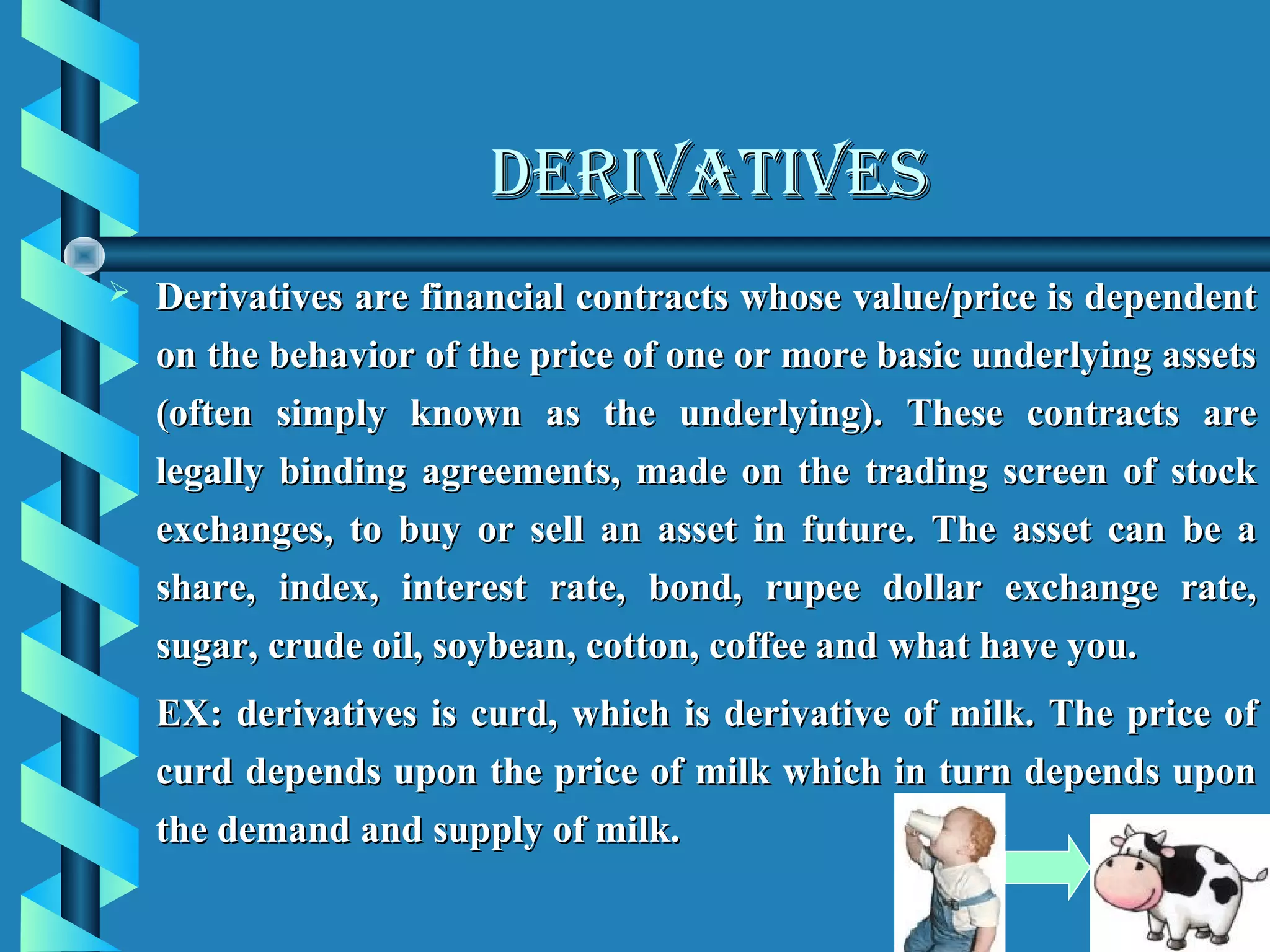
    EX: derivatives is curd, which is derivative of milk. The price of
    curd depends upon the price of milk which in turn depends upon
    the demand and supply of milk.
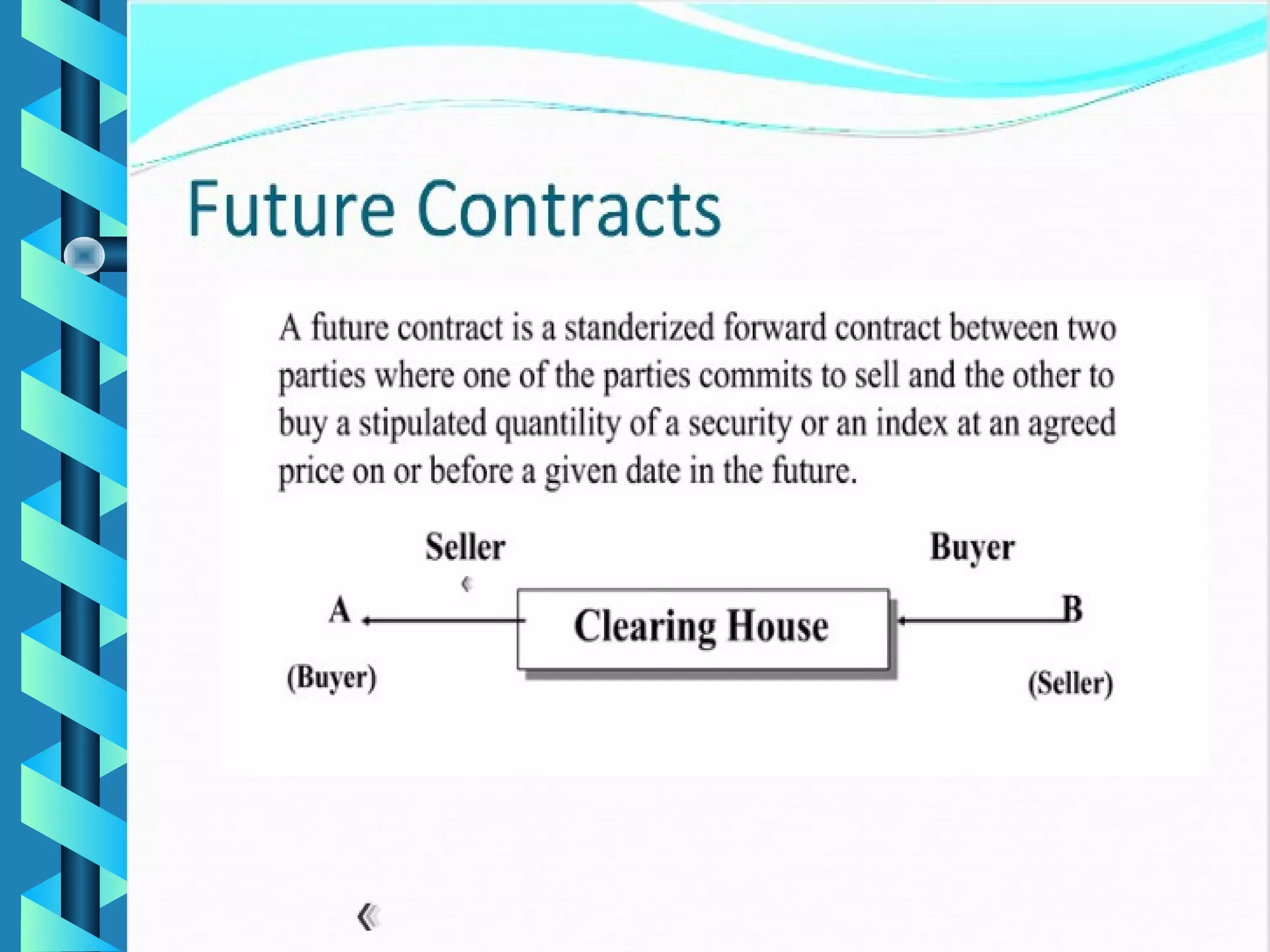
Financial derivatives are financial instruments whose
  prices are derived from the prices of other financial
  instruments which are also know as underlying. It
  relates to equities, loans, bonds, interest rates and
  currencies.

Section 2(ac) of Securities Contract Regulation Act
   (SCRA) 1956 defines Derivative as:
a) “a security derived from a debt instrument, share, loan
   whether secured or unsecured, risk
instrument or contract for differences or any other form of
   security;
b) “a contract which derives its value from the prices, or
   index of prices, of underlying securities”.
MOTIVES OF USING DERIVATIVES


   Spreads trade
   Currency risk management.
   Interest risk Real time trading in the market
    ( Treasury Activities)
ApplicAtions of finAnciAl
       DerivAtives


1. Management of risk:
2. Efficiency in trading:
3. Speculation:
4. Price discover:
5. Price stabilization function:
Derivatives
                        Derivatives


   Commodity
   Commodity                               Financial
                                           Financial


                                           Complex
                                            Complex
                     Basic Instrument
                     Basic Instrument      Instruments
                                            Instruments

                                           Exotic,
                                            Exotic,
                                           Swaptions and
                                            Swaptions and
                                           LEAPS etc.
                                            LEAPS etc.


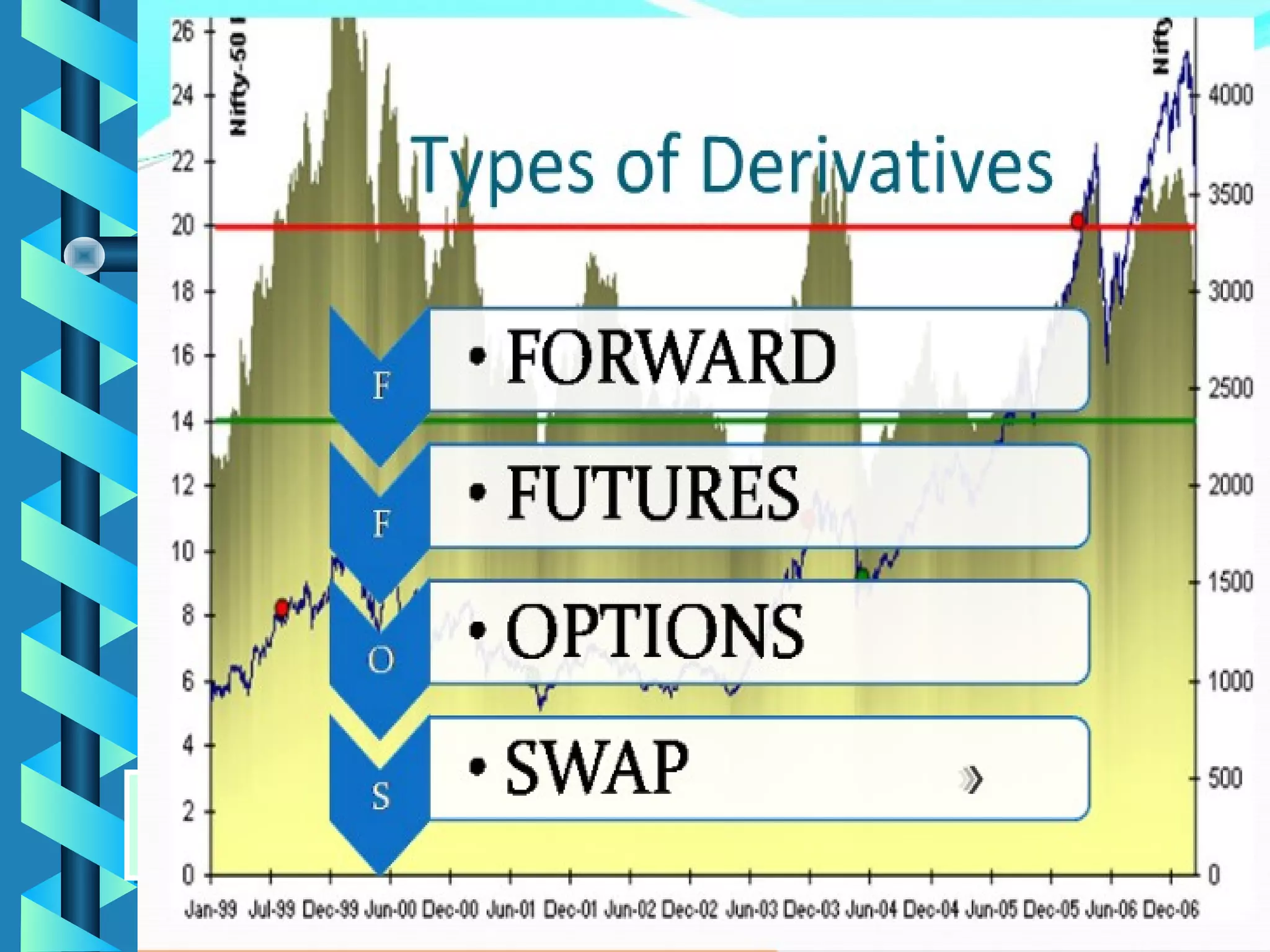
Forward
Forward    Futures
           Futures         Options
                           Options      Swaps
                                        Swaps
strAteGies of risK
MAnAGeMent in BAnKs.

   Hedging the Risk . – Derivatives

    Forwards
    Futures
    Options
    Swaps
    Credit Derivatives (Not available in
     India)
eXAMple

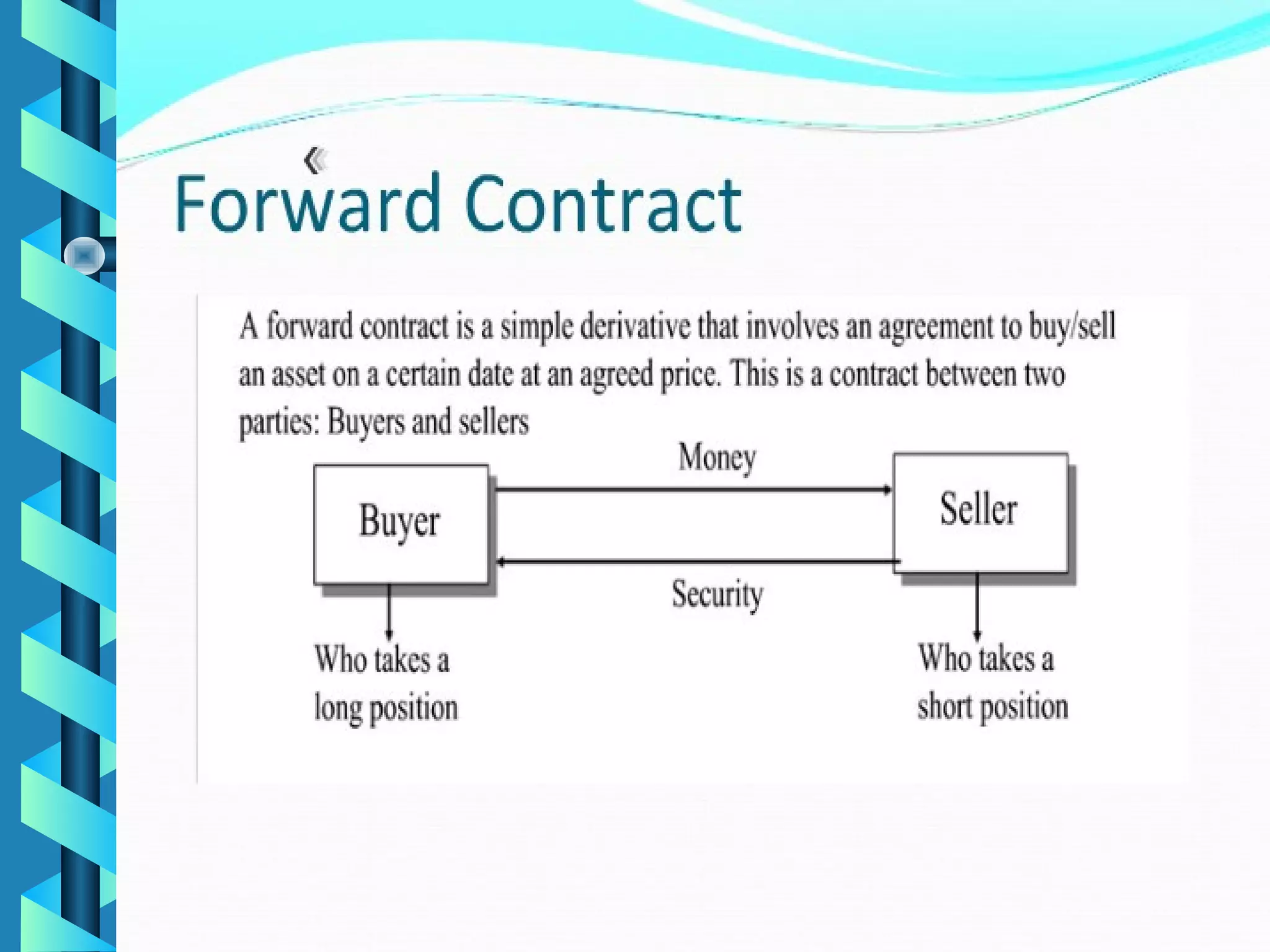
    Jewelry manufacturer Gold buyer agrees to buy gold at
    Rs. 600 (the forward or delivery price) three months
    from now (the delivery date) from gold mining concern
    Gold seller. This is an example of a forward contract.
    No money changes hands between Gold buyer and
    Gold seller at the time the forward contract is created.
    Rather, Gold buyer’s payoff depends on the spot price
    at the time of delivery. Suppose that the spot price
    reaches Rs. 610 at the delivery date. Then Gold buyer
    gains Rs. 10 on his forward position (i.e. the difference
    between the spot and forward prices) by taking
    delivery of the gold at Rs. 600.

.
feAtures of forwArD
               contrAct…

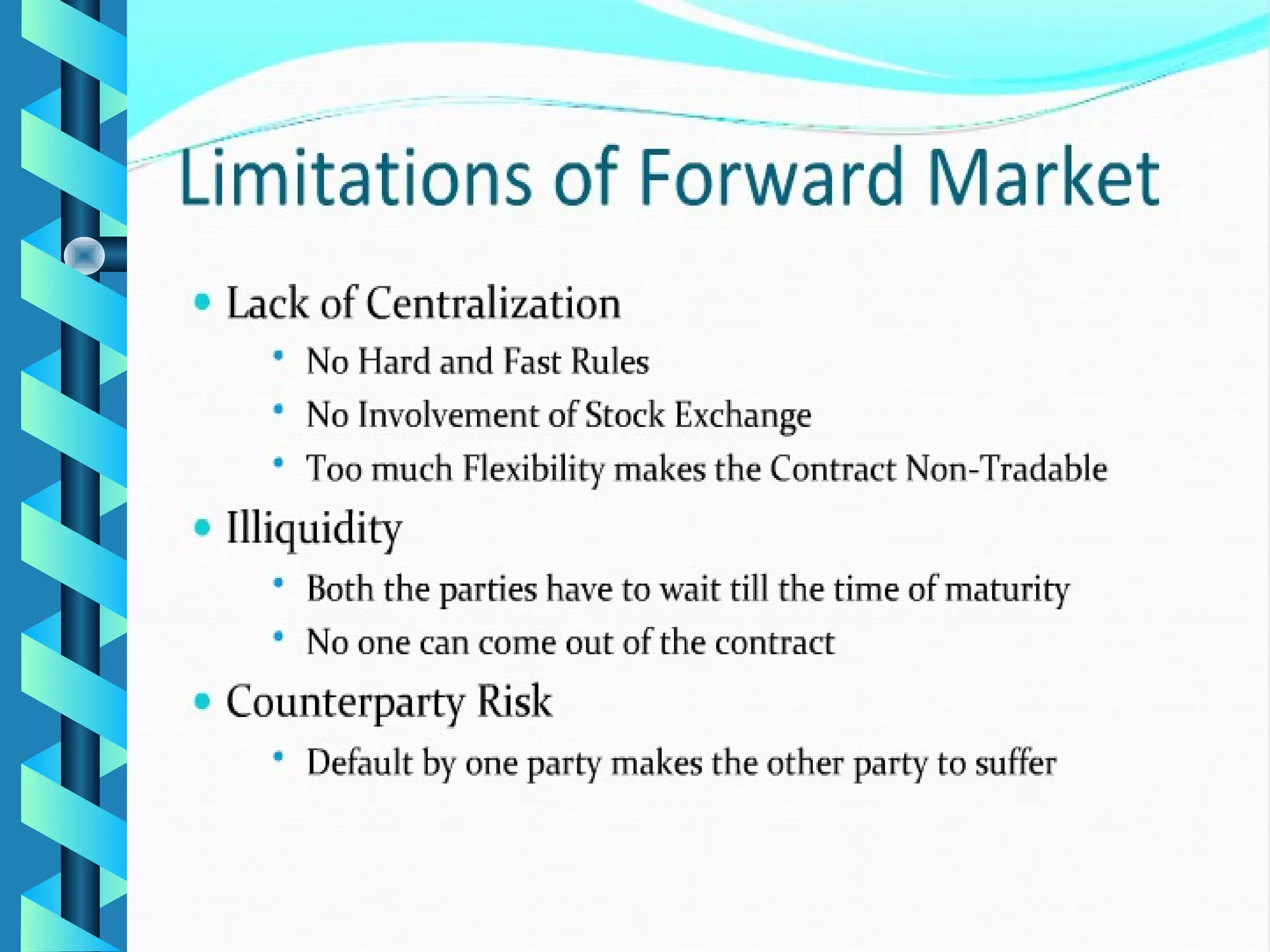
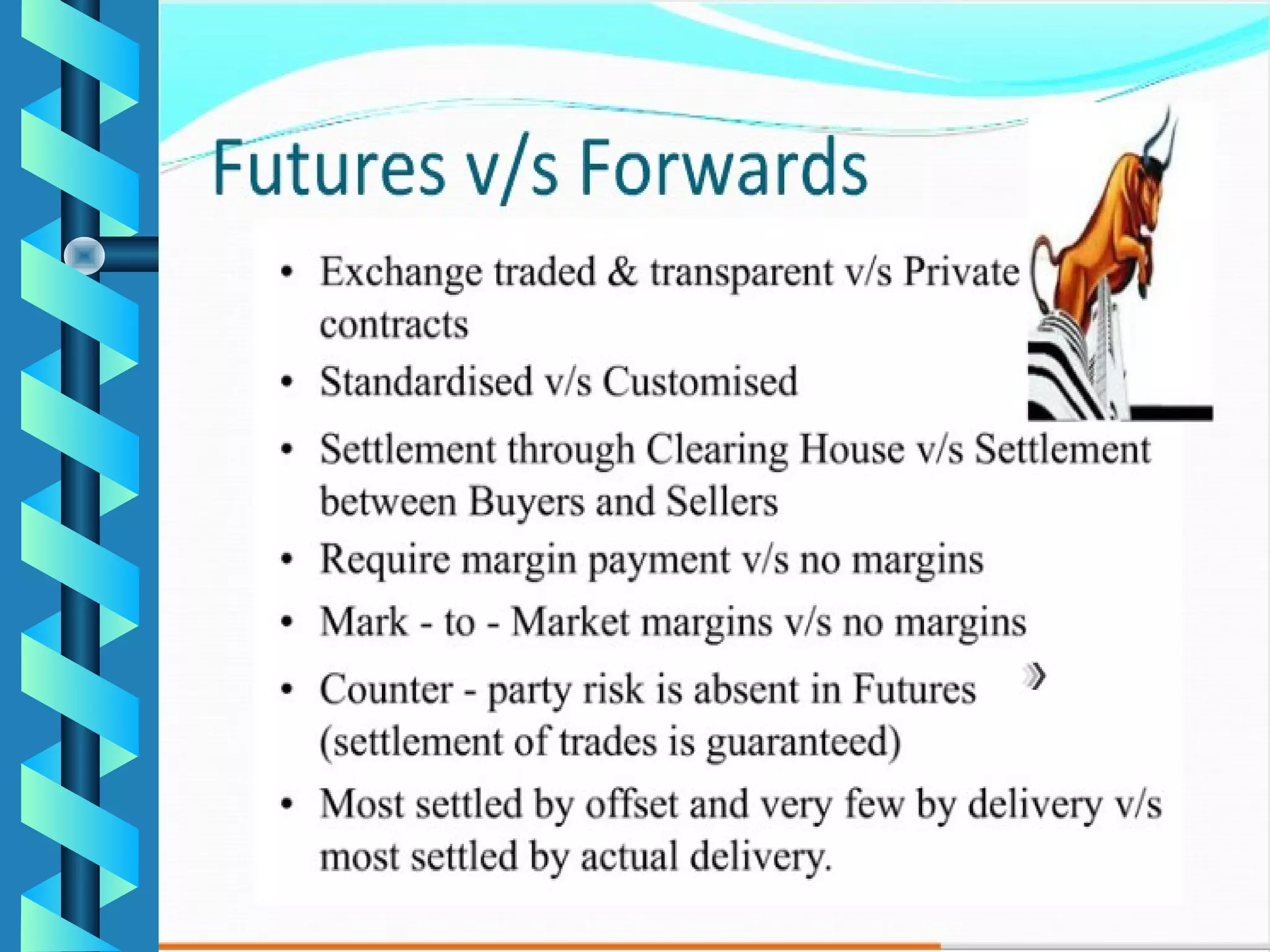
   It is a negotiated contract between two parties and hence
    exposed to counter party risk.
   Each contract is custom designed and hence unique in
    terms of contract size, expiration date, asset type, asset
    quality etc.
   A contract has to be settled in delivery or cash on
    expiration date.
   In case one of the two parties wishes to reverse a contract,
    he has to compulsorily go to the other party. The counter
    party being in a monopoly situation can command the
    price he wants.
the stAnDArD feAture in Any
          futures contrAct
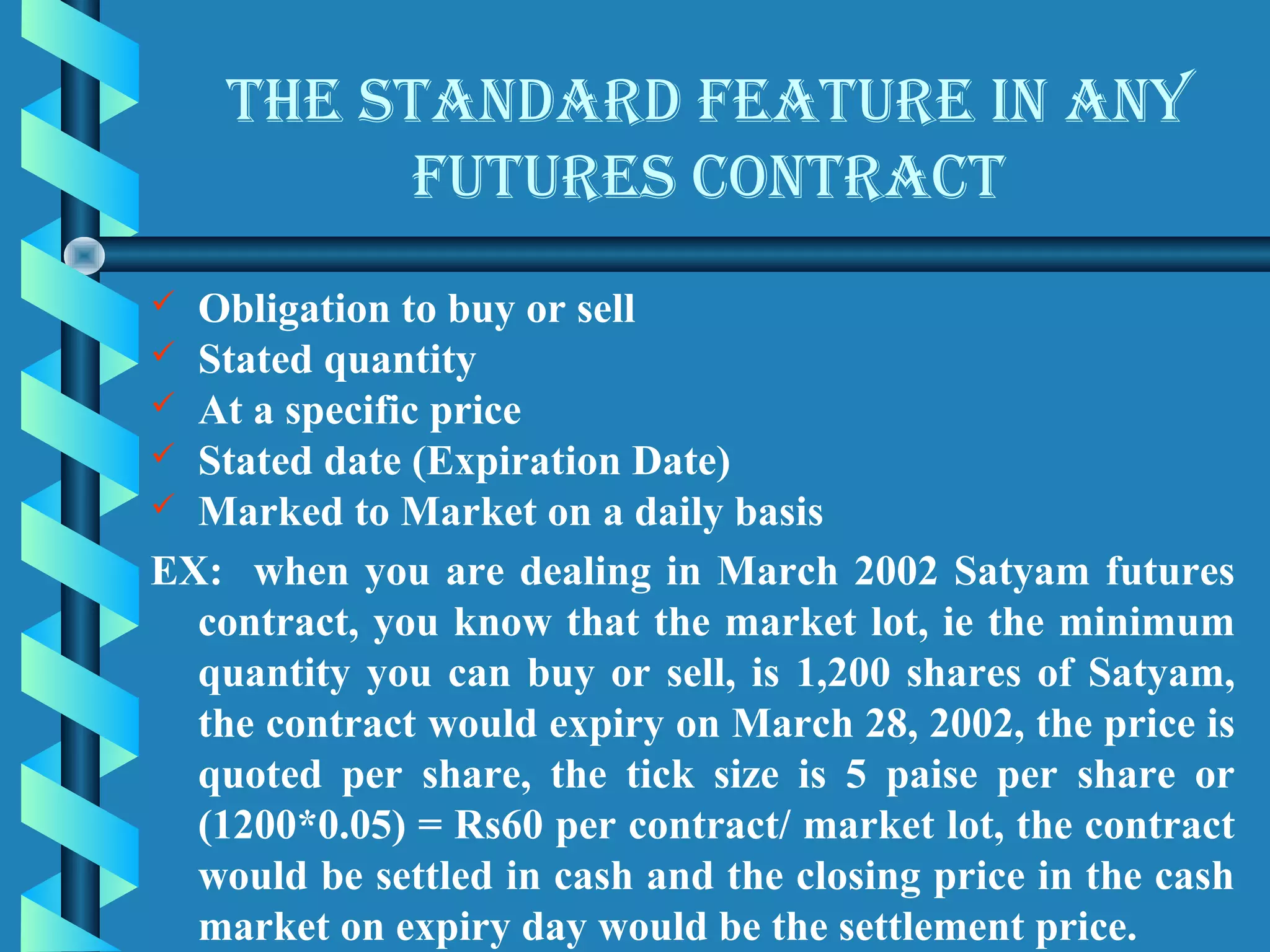
 Obligation to buy or sell
 Stated quantity
 At a specific price
 Stated date (Expiration Date)
 Marked to Market on a daily basis

EX: when you are dealing in March 2002 Satyam futures
  contract, you know that the market lot, ie the minimum
  quantity you can buy or sell, is 1,200 shares of Satyam,
  the contract would expiry on March 28, 2002, the price is
  quoted per share, the tick size is 5 paise per share or
  (1200*0.05) = Rs60 per contract/ market lot, the contract
  would be settled in cash and the closing price in the cash
  market on expiry day would be the settlement price.
Motives BehinD usinG futures

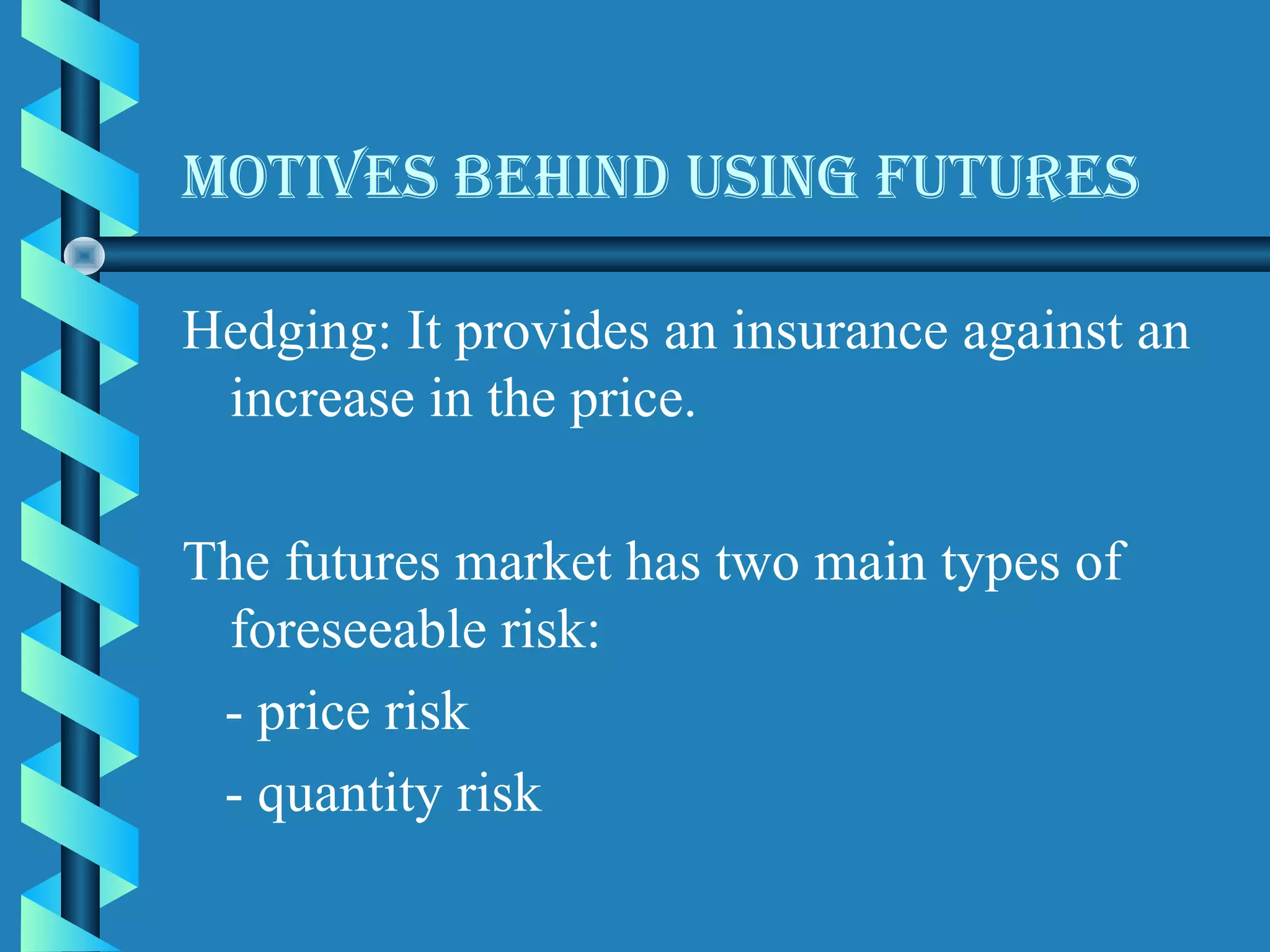
Hedging: It provides an insurance against an
 increase in the price.

The futures market has two main types of
 foreseeable risk:
 - price risk
 - quantity risk
Interest rate Futures

An interest rate futures contract is an
agreement to buy or sell a standard quantity
of specific interest bearing instruments, at a
predetermined future date and a price
agreed upon between parties
OPtIOns
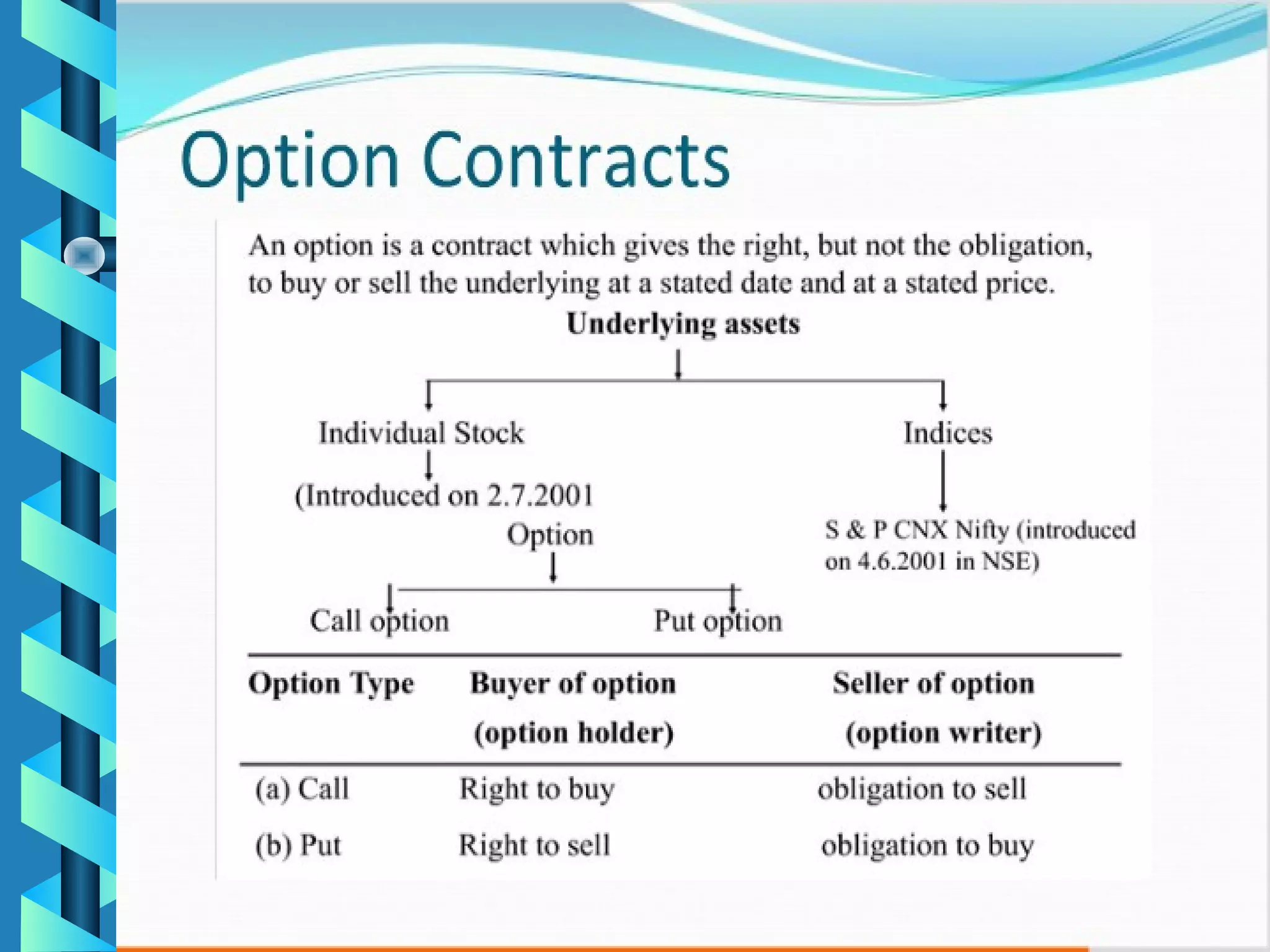
Options contracts grant their purchasers the
right but not the obligation to buy or sell a
specific amount of the underlying at a
particular price within a specified period.
OPtIOns termInOlOgy …

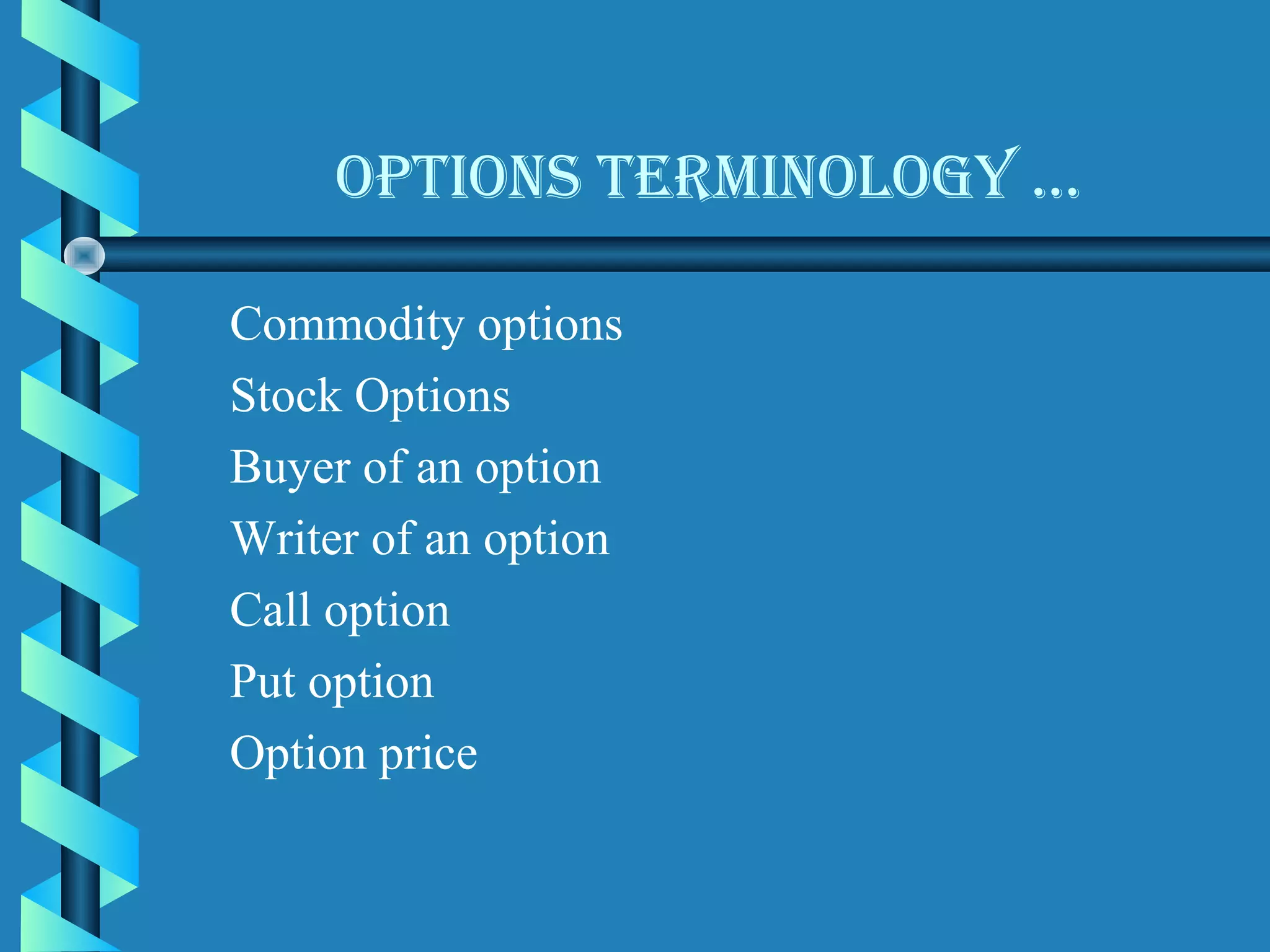
Commodity options
Stock Options
Buyer of an option
Writer of an option
Call option
Put option
Option price
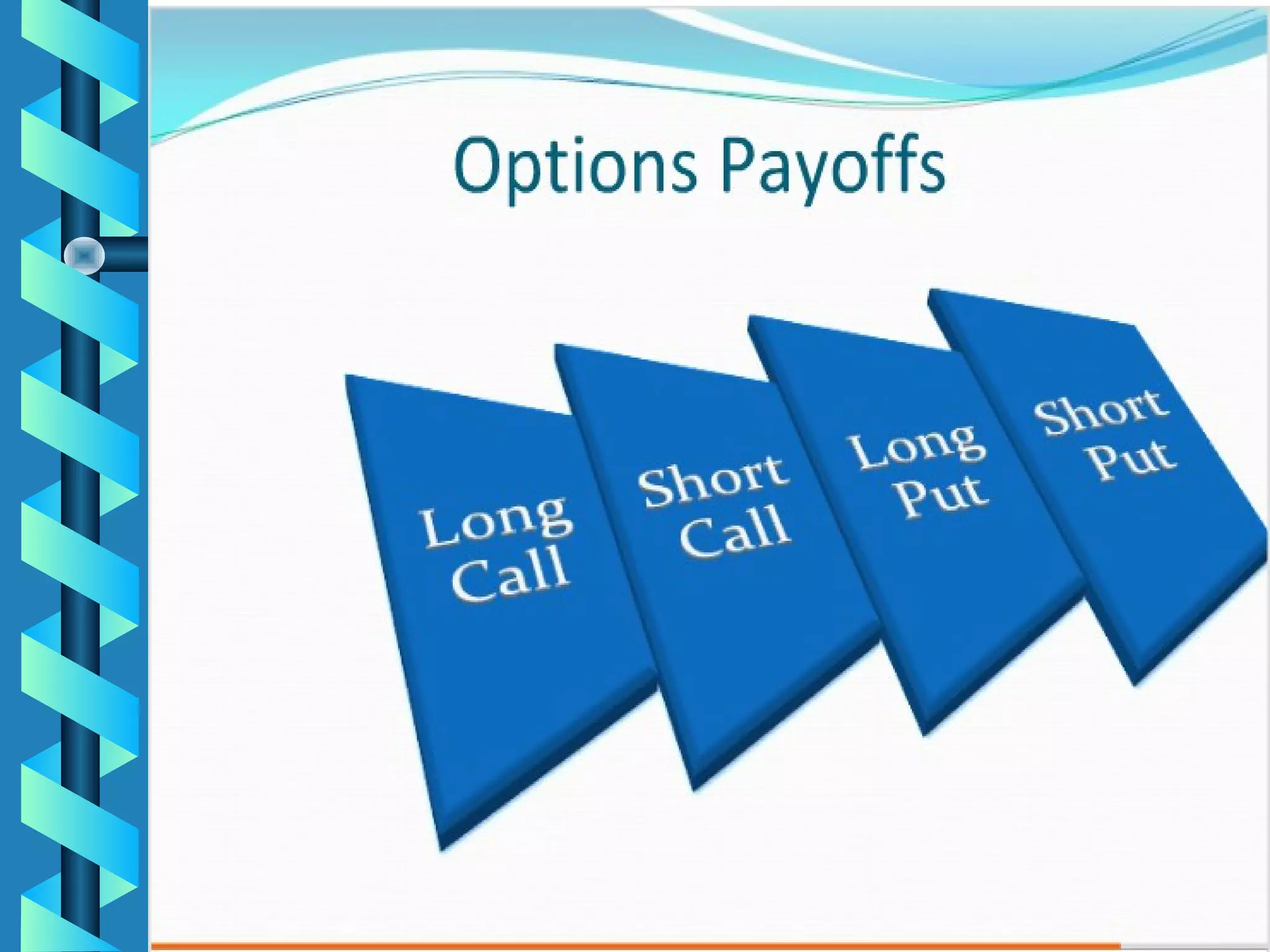
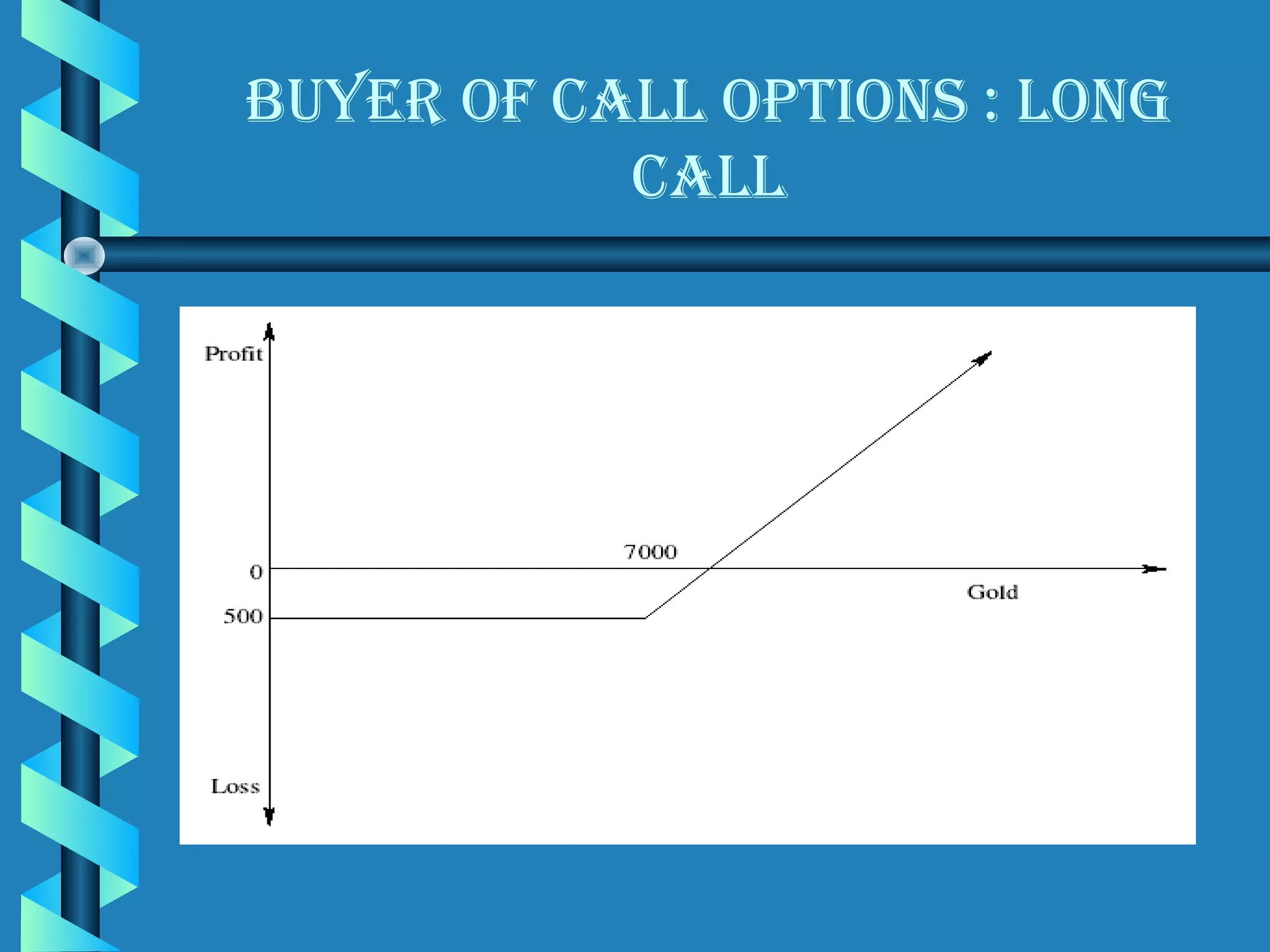
Buyer OF call OPtIOns : lOng
           call
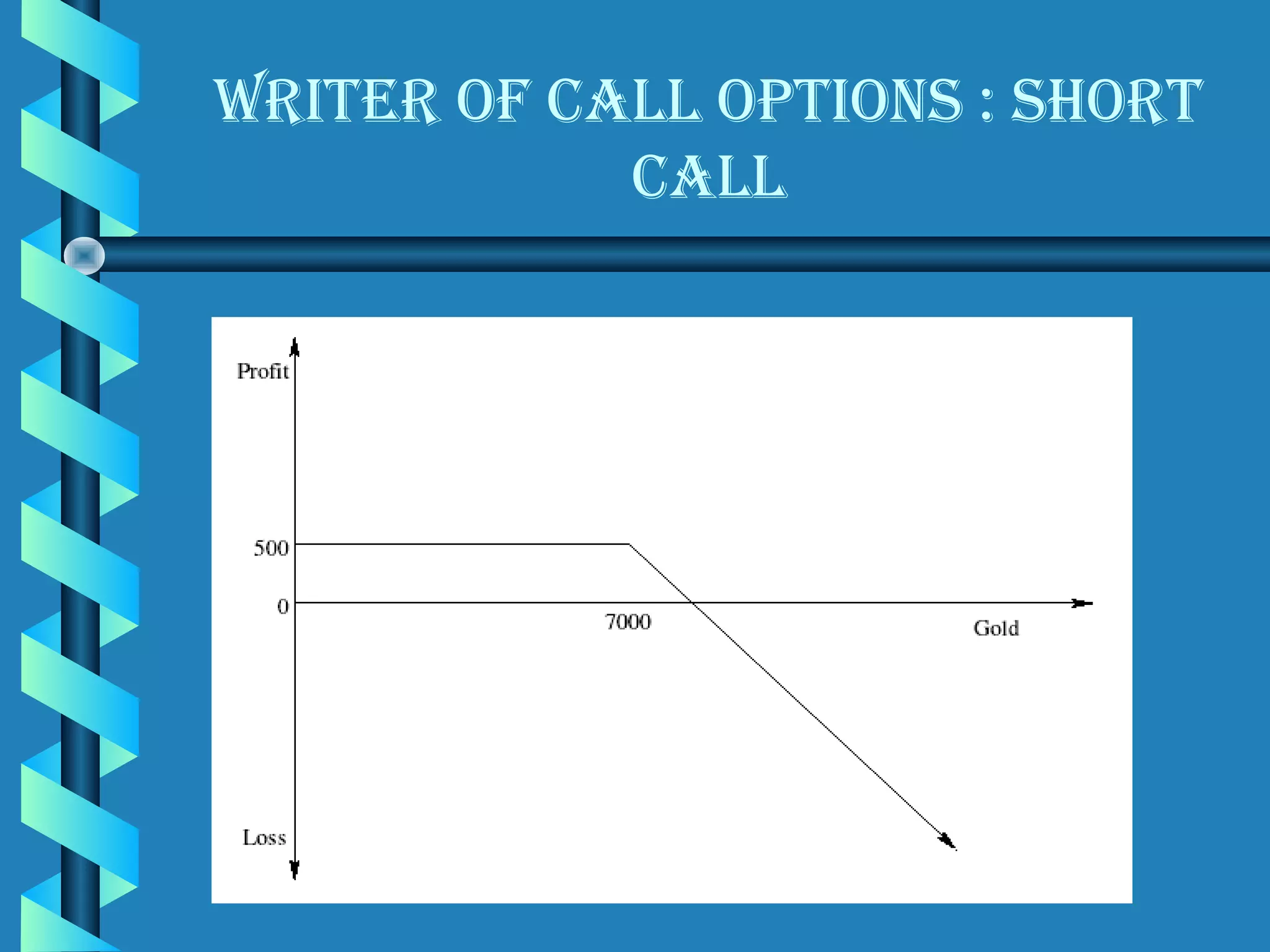
WrIter OF call OPtIOns : shOrt
            call
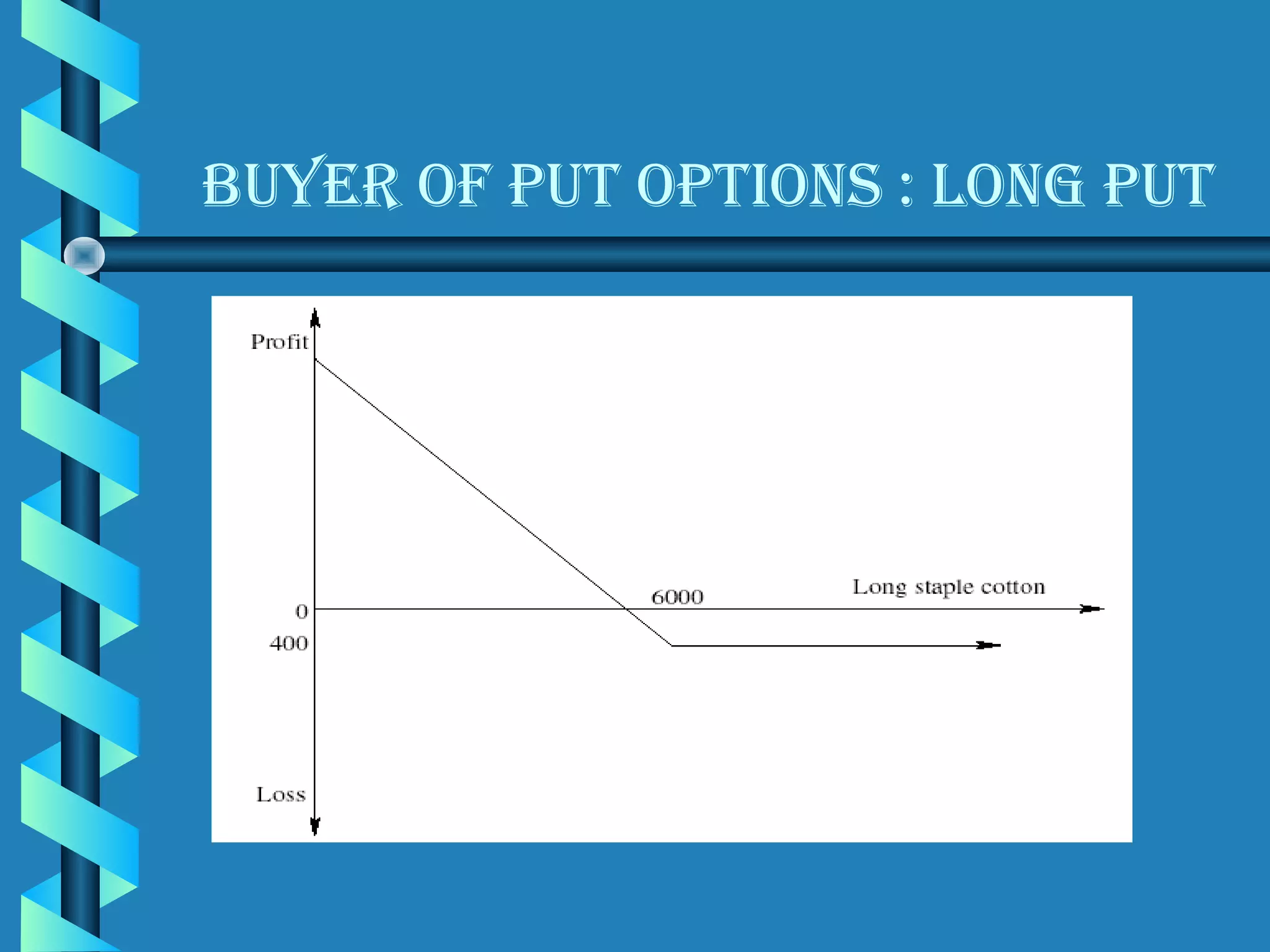
Buyer OF Put OPtIOns : lOng Put
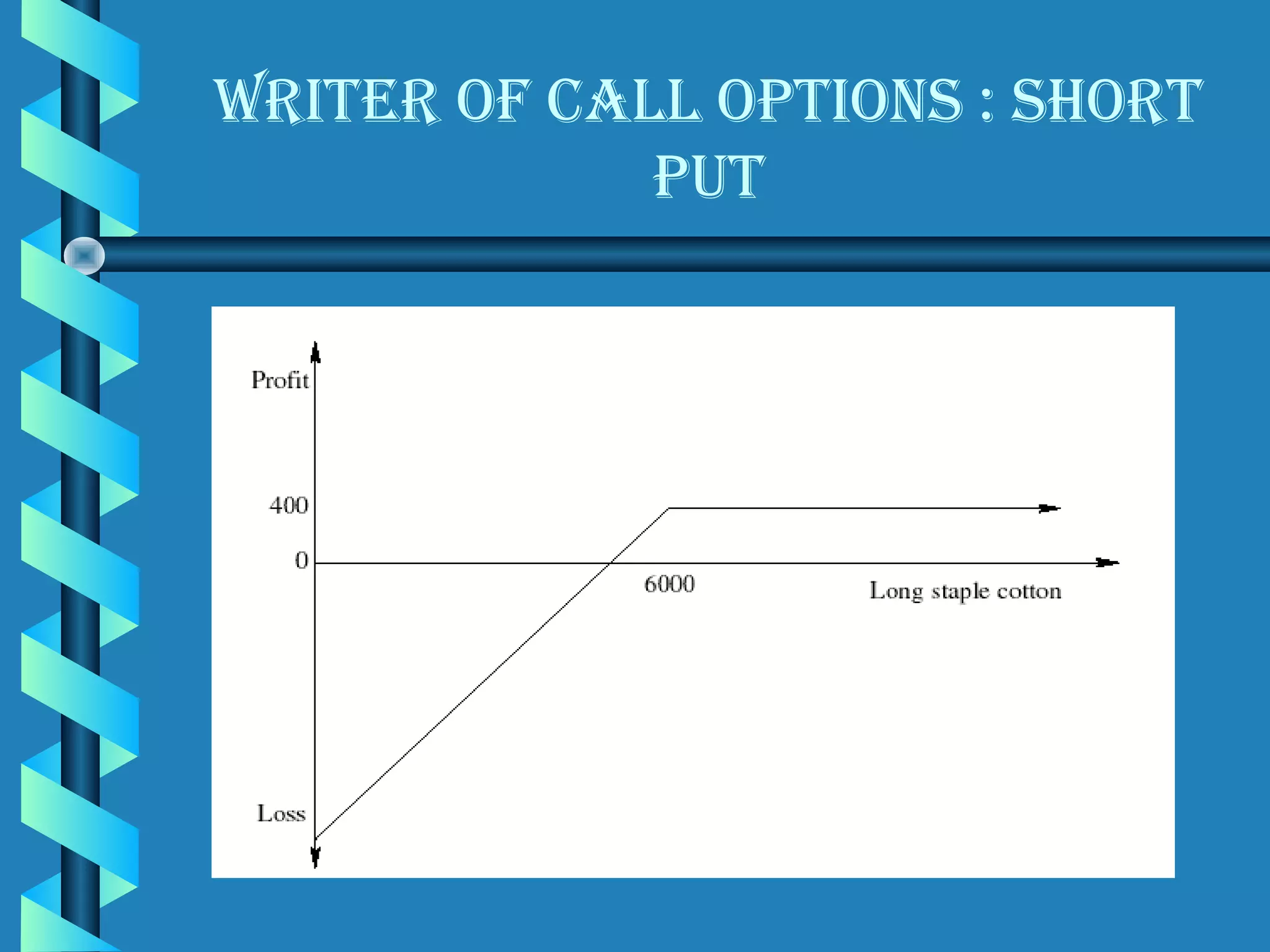
WrIter OF call OPtIOns : shOrt
             Put
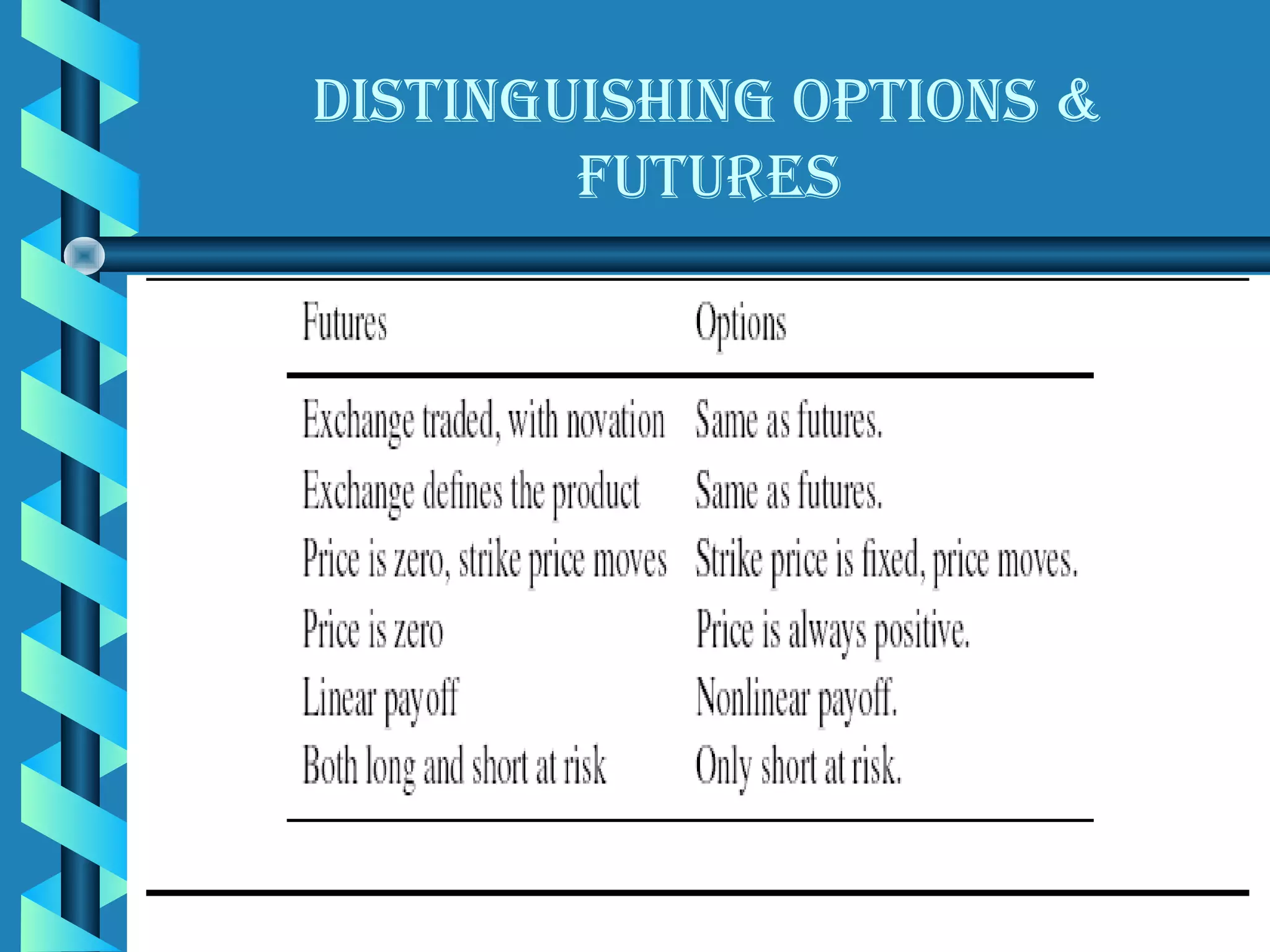
DIstInguIshIng OPtIOns &
        Futures
SWAPS
Swaps are derivatives involving exchange
of cash flows over time, typically between
two parties. One party makes a payment
to the other depending upon whether a
price is above or below a reference price
specified in the swap contract.
ChArACteriStiCS of SWAPS

1. Basically a forward
    It is combination of Forwards. It has all the
    properties of Forward contract.
2. Double coincidence of wants
    It requires that two parties with equal and opposite
    needs must come into contact with each other.
3. Comparative credit advantage
    Borrowers enjoying comparative credit advantage in
    floating rate debts will enter into swap agreement.
Contd..
4. Flexibility
   Lenders have the flexibility to exchange
   floating rates according to the conditions
   prevailing in the market.

5. Necessity of an intermediary
     It requires two counter parties with
   opposite and matching needs. Thus it has
   created the necessity of an intermediary.
Contd..
6. Settlements
      Even though the principal amount is
  mentioned it is not exchanged. Here stream
  of fixed rate is exchanged for floating rate
  interest.
7. Long term agreement
      Forwards are for short term. Long dated
  forward contracts are not preferred because
  they involve more risk.
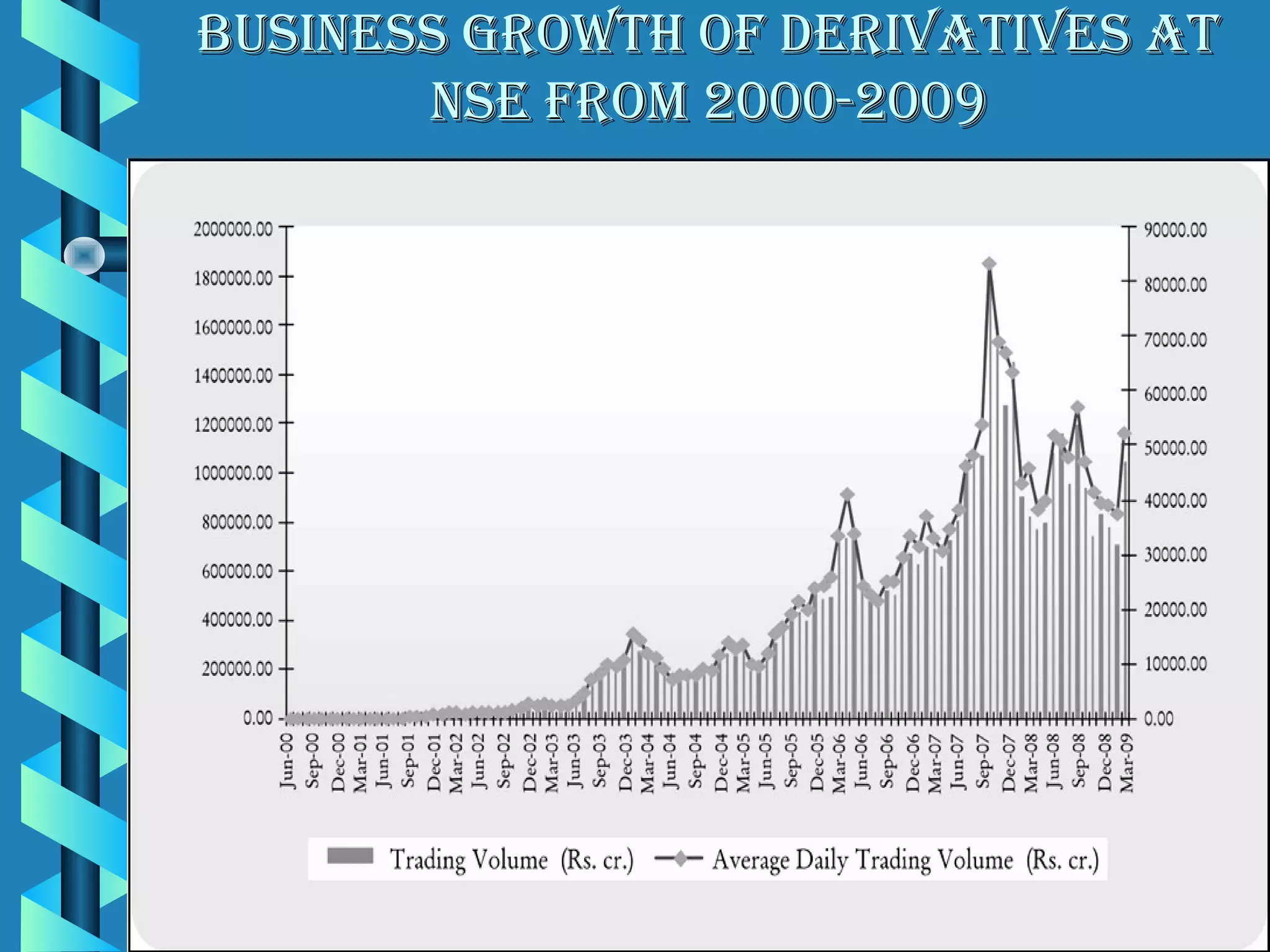
BuSineSS GroWth of DerivAtiveS At
       nSe from 2000-2009
imPortAnCe

   To minimize risk.
   To protect the interest of individual and institutional
    investors.
   Offers high liquidity and flexibility.
   Does not create new risk and minimizes existing
    ones.
   Lowers transaction cost.
   Provides information on market movement.
   Provides wide choice of hedging.
   Convenient, low cost and simple to operate.
Futures and Options

Futures and Options

  • 1.
  • 2.
    RISK IS THEBASIS OF BANKING… TO WIN WITHOUT RISK IS TO TRIUMPH WITHOUT GLORY……… No NO Risk !!!! GAIN!!
  • 3.
    INTRODUCTION- RISK MANAGMENT  Risk management is a discipline that helps bringing risks to manageable extent .  One risk does not get transformed into undesirable risk. PLAYERS: Hedgers, Speculators and Arbitrageurs - Market Role  Hedgers and investors provide the economic substance to any financial market. Without them the markets would lose their purpose and become mere tools of gambling. (E.g. Banks)  Speculators provide liquidity and depth to the market.  Arbitrageurs
  • 4.
    VARIOUS TYPES OFRISKS IN BANKS  Solvency Risks- Risk of total financial failure of a bank.  Liquidity Risk- Inability to meet the repayment requirements  Credit Risk- Loss of Bank as a result of default  Interest Rate Risk- Changes in Interest rate.  Price Risks- Risk of loss/gain in value of assets & liabilities due to volatility in exchange rates.  Operating Risks- Risks arising from out of failures in operations, supporting system, sabotage, fraud etc.  Market & Foreign exchange Risk.
  • 5.
    PROCESS OF RISKMANAGEMENT IN BANKS  Identification of risks  Quantification of risks  Policy Formulation  Strategy Formulation Derivatives come in play  Monitoring Risks
  • 6.
    HISTORY OF DERIVATIVESAND THE MARKET IN INDIA According to Mr. Asani Sarkar’s research work, Derivatives market has been in existence in India since 1875 He also mentions that in early 1900s India had the largest Futures Industry In 1952, Indian Government banned the options and futures trading But, by 2000 various reforms assisted in lifting all such bans and the derivatives market is booming since then
  • 7.
    Contd..  The exchange traded derivative market is the largest in terms of number of contracts made  In 2004, the daily trading value was 30 billion USD  The commodities eligible for futures trading was 8 and in 2004 it was increased to 80
  • 8.
    DERIVATIVES  Derivatives are financial contracts whose value/price is dependent on the behavior of the price of one or more basic underlying assets (often simply known as the underlying). These contracts are legally binding agreements, made on the trading screen of stock exchanges, to buy or sell an asset in future. The asset can be a share, index, interest rate, bond, rupee dollar exchange rate, sugar, crude oil, soybean, cotton, coffee and what have you. EX: derivatives is curd, which is derivative of milk. The price of curd depends upon the price of milk which in turn depends upon the demand and supply of milk.
  • 9.
    Financial derivatives arefinancial instruments whose prices are derived from the prices of other financial instruments which are also know as underlying. It relates to equities, loans, bonds, interest rates and currencies. Section 2(ac) of Securities Contract Regulation Act (SCRA) 1956 defines Derivative as: a) “a security derived from a debt instrument, share, loan whether secured or unsecured, risk instrument or contract for differences or any other form of security; b) “a contract which derives its value from the prices, or index of prices, of underlying securities”.
  • 10.
    MOTIVES OF USINGDERIVATIVES  Spreads trade  Currency risk management.  Interest risk Real time trading in the market ( Treasury Activities)
  • 11.
    ApplicAtions of finAnciAl DerivAtives 1. Management of risk: 2. Efficiency in trading: 3. Speculation: 4. Price discover: 5. Price stabilization function:
  • 12.
    Derivatives Derivatives Commodity Commodity Financial Financial Complex Complex Basic Instrument Basic Instrument Instruments Instruments Exotic, Exotic, Swaptions and Swaptions and LEAPS etc. LEAPS etc. Forward Forward Futures Futures Options Options Swaps Swaps
  • 13.
    strAteGies of risK MAnAGeMentin BAnKs.  Hedging the Risk . – Derivatives Forwards Futures Options Swaps Credit Derivatives (Not available in India)
  • 15.
    eXAMple Jewelry manufacturer Gold buyer agrees to buy gold at Rs. 600 (the forward or delivery price) three months from now (the delivery date) from gold mining concern Gold seller. This is an example of a forward contract. No money changes hands between Gold buyer and Gold seller at the time the forward contract is created. Rather, Gold buyer’s payoff depends on the spot price at the time of delivery. Suppose that the spot price reaches Rs. 610 at the delivery date. Then Gold buyer gains Rs. 10 on his forward position (i.e. the difference between the spot and forward prices) by taking delivery of the gold at Rs. 600. .
  • 16.
    feAtures of forwArD contrAct…  It is a negotiated contract between two parties and hence exposed to counter party risk.  Each contract is custom designed and hence unique in terms of contract size, expiration date, asset type, asset quality etc.  A contract has to be settled in delivery or cash on expiration date.  In case one of the two parties wishes to reverse a contract, he has to compulsorily go to the other party. The counter party being in a monopoly situation can command the price he wants.
  • 19.
    the stAnDArD feAturein Any futures contrAct  Obligation to buy or sell  Stated quantity  At a specific price  Stated date (Expiration Date)  Marked to Market on a daily basis EX: when you are dealing in March 2002 Satyam futures contract, you know that the market lot, ie the minimum quantity you can buy or sell, is 1,200 shares of Satyam, the contract would expiry on March 28, 2002, the price is quoted per share, the tick size is 5 paise per share or (1200*0.05) = Rs60 per contract/ market lot, the contract would be settled in cash and the closing price in the cash market on expiry day would be the settlement price.
  • 20.
    Motives BehinD usinGfutures Hedging: It provides an insurance against an increase in the price. The futures market has two main types of foreseeable risk: - price risk - quantity risk
  • 21.
    Interest rate Futures Aninterest rate futures contract is an agreement to buy or sell a standard quantity of specific interest bearing instruments, at a predetermined future date and a price agreed upon between parties
  • 23.
    OPtIOns Options contracts granttheir purchasers the right but not the obligation to buy or sell a specific amount of the underlying at a particular price within a specified period.
  • 24.
    OPtIOns termInOlOgy … Commodityoptions Stock Options Buyer of an option Writer of an option Call option Put option Option price
  • 26.
    Buyer OF callOPtIOns : lOng call
  • 27.
    WrIter OF callOPtIOns : shOrt call
  • 28.
    Buyer OF PutOPtIOns : lOng Put
  • 29.
    WrIter OF callOPtIOns : shOrt Put
  • 30.
  • 31.
    SWAPS Swaps are derivativesinvolving exchange of cash flows over time, typically between two parties. One party makes a payment to the other depending upon whether a price is above or below a reference price specified in the swap contract.
  • 32.
    ChArACteriStiCS of SWAPS 1.Basically a forward It is combination of Forwards. It has all the properties of Forward contract. 2. Double coincidence of wants It requires that two parties with equal and opposite needs must come into contact with each other. 3. Comparative credit advantage Borrowers enjoying comparative credit advantage in floating rate debts will enter into swap agreement.
  • 33.
    Contd.. 4. Flexibility Lenders have the flexibility to exchange floating rates according to the conditions prevailing in the market. 5. Necessity of an intermediary It requires two counter parties with opposite and matching needs. Thus it has created the necessity of an intermediary.
  • 34.
    Contd.. 6. Settlements Even though the principal amount is mentioned it is not exchanged. Here stream of fixed rate is exchanged for floating rate interest. 7. Long term agreement Forwards are for short term. Long dated forward contracts are not preferred because they involve more risk.
  • 35.
    BuSineSS GroWth ofDerivAtiveS At nSe from 2000-2009
  • 36.
    imPortAnCe  To minimize risk.  To protect the interest of individual and institutional investors.  Offers high liquidity and flexibility.  Does not create new risk and minimizes existing ones.  Lowers transaction cost.  Provides information on market movement.  Provides wide choice of hedging.  Convenient, low cost and simple to operate.