MB305C FINANCIAL
DERIVATIVES
PROF. INDRAJEET KOLE
Syllabus
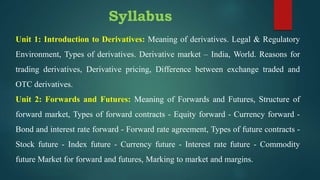
Unit 1: Introduction to Derivatives: Meaning of derivatives. Legal & Regulatory
Environment, Types of derivatives. Derivative market – India, World. Reasons for
trading derivatives, Derivative pricing, Difference between exchange traded and
OTC derivatives.
Unit 2: Forwards and Futures: Meaning of Forwards and Futures, Structure of
forward market, Types of forward contracts - Equity forward - Currency forward -
Bond and interest rate forward - Forward rate agreement, Types of future contracts -
Stock future - Index future - Currency future - Interest rate future - Commodity
future Market for forward and futures, Marking to market and margins.
Syllabus
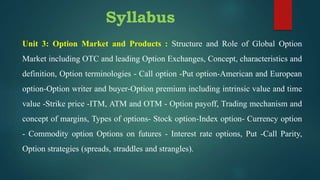
Unit 3: Option Market and Products : Structure and Role of Global Option
Market including OTC and leading Option Exchanges, Concept, characteristics and
definition, Option terminologies - Call option -Put option-American and European
option-Option writer and buyer-Option premium including intrinsic value and time
value -Strike price -ITM, ATM and OTM - Option payoff, Trading mechanism and
concept of margins, Types of options- Stock option-Index option- Currency option
- Commodity option Options on futures - Interest rate options, Put -Call Parity,
Option strategies (spreads, straddles and strangles).
Syllabus
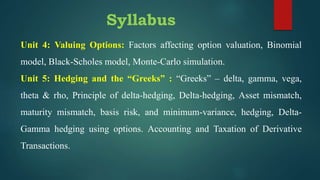
Unit 4: Valuing Options: Factors affecting option valuation, Binomial
model, Black-Scholes model, Monte-Carlo simulation.
Unit 5: Hedging and the “Greeks” : “Greeks” – delta, gamma, vega,
theta & rho, Principle of delta-hedging, Delta-hedging, Asset mismatch,
maturity mismatch, basis risk, and minimum-variance, hedging, Delta-
Gamma hedging using options. Accounting and Taxation of Derivative
Transactions.
What are Derivatives
A derivative is a financial instrument whose value is derived from the
value of another asset, which is known as the underlying.
When the price of the underlying changes, the value of the derivative also
changes.
 A Derivative is not a product. It is a contract that derives its value from
changes in the price of the underlying.
Example : The value of a gold futures contract is derived from the value of
the underlying asset i.e. Gold.
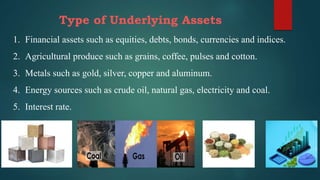
Type of Underlying Assets
1. Financial assets such as equities, debts, bonds, currencies and indices.
2. Agricultural produce such as grains, coffee, pulses and cotton.
3. Metals such as gold, silver, copper and aluminum.
4. Energy sources such as crude oil, natural gas, electricity and coal.
5. Interest rate.
Indian History of Derivatives
 The Bombay Cotton trade association started future Trading in
1875
 In 1952 the government banned cash settlement and Option
Trading
 In 1995 a Prohibition of trading options was lifted
 In 1999, the Securities Contract (Regulation) Act of 1956 was
amended and derivatives could be Declared “securities”
 NSE Started trade in future and option by 2005
Regulatory Framework of Derivative
Trading in India
 Dr. L.C Gupta Committee constituted by SEBI had laid down the regulatory
framework for derivative trading in India.
 Some of the important eligibility conditions are -
1. Derivative trading to take place through an online screen based Trading
System.
2. The Derivatives Exchange/Segment shall have online surveillance capability
to monitor positions, prices, and volumes on a real time basis to deter market
manipulation.
Regulatory Framework of Derivative
Trading in India
3.The Derivatives Exchange/ Segment should have arrangements for dissemination of
information about trades, quantities and quotes on a real time basis through at least two
information vending networks, which are easily accessible to investors across the country.
4.The Derivatives Exchange/Segment should have arbitration and investor grievances redressal
mechanism operative from all the four areas / regions of the country.
5.The Derivatives Exchange/Segment should have satisfactory system of monitoring investor
complaints and preventing irregularities in trading.
6.The Derivative Segment of the Exchange would have a separate Investor Protection Fund.
Regulatory Framework of Derivative
Trading in India
7.The Clearing Corporation/House shall perform full novation, i.e. the Clearing
Corporation/House shall interpose itself between both legs of every trade, becoming
the legal counterparty to both or alternatively should provide an unconditional
guarantee for settlement of all trades.
8.The Clearing Corporation/House shall have the capacity to monitor the overall
position of Members across both derivatives market and the underlying securities
market for those Members who are participating in both.
Regulatory Framework of Derivative
Trading in India
9.The level of initial margin on Index Futures Contracts shall be related to the risk of loss on the
position. The concept of value-at-risk shall be used in calculating required level of initial
margins. The initial margins should be large enough to cover the one-day loss that can be
encountered on the position on 99% of the days.
10.The Clearing Corporation/House shall establish facilities for electronic funds transfer (EFT)
for swift movement of margin payments.
11.In the event of a Member defaulting in meeting its liabilities, the Clearing
Corporation/House shall transfer client positions and assets to another solvent Member or close-
out all open positions.
Regulatory Framework of Derivative
Trading in India
12.The Clearing Corporation/House should have capabilities to segregate initial
margins deposited by Clearing Members for trades on their own account and on
account of his client. The Clearing Corporation/House shall hold the clients’
margin money in trust for the client purposes only and should not allow its
diversion for any other purpose.
13.The Clearing Corporation/House shall have a separate Trade Guarantee Fund
for the trades executed on Derivative Exchange / Segment.
Advantages of Derivatives Trading
1) Low Transaction Cost: Derivatives contracts play a part in reducing
market transaction costs. Since they work as risk management tools. Thus
the cost of transaction in derivative stock trading is lower as compared to
the securities like debentures and shares.
2) Used in Risk Management: the value of a derivative contract has a
direct relation with the price of its underlying asset. Hence derivative are
used to hedge the risk associated with changing price levels of the
underlying assets.
Advantages of Derivatives Trading
3. Market Efficiency: Derivative trading involves the practice of
arbitrage which plays a vital role in ensuring that the market reaches
equilibrium and the prices of the underlying assets are correct.
4. Determines the Price of an Underlying Asset: Derivative contracts
are often used to ascertain the price of an underlying asset.
5. Risk is Transferable: Derivatives allow investors, businesses and
other to transfer the risk to other parties.
Disadvantages of Derivatives Trading
1. Involves High Risk : Derivative contracts are highly volatile as
the value of underlying assets like shares keep fluctuating rapidly.
Thus, traders are exposed to the risk of incurring the huge losses.
2. Counterparty Risk: Derivative contracts like future that are
traded on the exchanges like BSE and NSE are organized and
regulated. But OTC derivative contracts like forwards are not
standardized hence, there’s always a risk of counterparty default.
Disadvantages of Derivatives Trading
3. Speculative in Nature: Derivative contracts are commonly
used as tools for speculation. Due to the high risk associated
with the and their unpredictable fluctuations in value baseless
speculation often lead to huge losses.
 Derivative trading requires in-depth knowledge about the
products and a great deal of expertise.
Traders in Derivatives Market
There are 3 types of traders in the Derivatives Market :
HEDGER : A hedger is someone who faces risk associated with price
movement of an asset and who uses derivatives as means of reducing
risk.
They provide economic balance to the market.
SPECULATOR : A trader who enters the futures market for pursuit of
profits, accepting risk in the endeavor.
They provide liquidity and depth to the market.
Traders in Derivatives Market
ARBITRAGEUR : A person who simultaneously enters into transactions in
two or more markets to take advantage of the discrepancies between prices in
these markets.
 Arbitrage involves making profits from relative mispricing.
 Arbitrageurs also help to make markets liquid, ensure accurate and
uniform pricing, and enhance price stability
 They help in bringing about price uniformity and discovery.
Types of derivatives:
1) OTC (Over the counter)
2) Exchange Traded Derivatives
1. OTC : Over-the-counter (OTC) or off-exchange trading is to trade financial
instruments such as stocks, bonds, commodities or derivatives directly
between two parties without going through an exchange or other intermediary.
• The contract between the two parties are privately negotiated.
• The contract can be tailor-made to the two parties’ liking.
• Over-the-counter markets are uncontrolled, unregulated and have very few
laws.
2. Exchange-traded Derivatives
 Exchange traded derivatives contract (ETD) are those derivatives
instruments that are traded via specialized Derivatives exchange or
other exchanges. A derivatives exchange is a market where
individuals trade standardized contracts that have been defined by
the exchange.
 There is a very visible and transparent market price for the
derivatives.
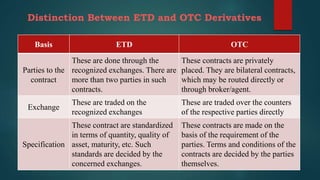
Distinction Between ETD and OTC Derivatives
Basis ETD OTC
Parties to the
contract
These are done through the
recognized exchanges. There are
more than two parties in such
contracts.
These contracts are privately
placed. They are bilateral contracts,
which may be routed directly or
through broker/agent.
Exchange
These are traded on the
recognized exchanges
These are traded over the counters
of the respective parties directly
Specification
These contract are standardized
in terms of quantity, quality of
asset, maturity, etc. Such
standards are decided by the
concerned exchanges.
These contracts are made on the
basis of the requirement of the
parties. Terms and conditions of the
contracts are decided by the parties
themselves.
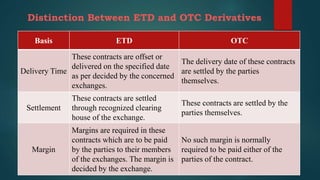
Distinction Between ETD and OTC Derivatives
Basis ETD OTC
Delivery Time
These contracts are offset or
delivered on the specified date
as per decided by the concerned
exchanges.
The delivery date of these contracts
are settled by the parties
themselves.
Settlement
These contracts are settled
through recognized clearing
house of the exchange.
These contracts are settled by the
parties themselves.
Margin
Margins are required in these
contracts which are to be paid
by the parties to their members
of the exchanges. The margin is
decided by the exchange.
No such margin is normally
required to be paid either of the
parties of the contract.
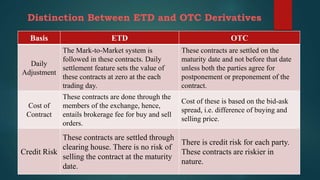
Distinction Between ETD and OTC Derivatives
Basis ETD OTC
Daily
Adjustment
The Mark-to-Market system is
followed in these contracts. Daily
settlement feature sets the value of
these contracts at zero at the each
trading day.
These contracts are settled on the
maturity date and not before that date
unless both the parties agree for
postponement or preponement of the
contract.
Cost of
Contract
These contracts are done through the
members of the exchange, hence,
entails brokerage fee for buy and sell
orders.
Cost of these is based on the bid-ask
spread, i.e. difference of buying and
selling price.
Credit Risk
These contracts are settled through
clearing house. There is no risk of
selling the contract at the maturity
date.
There is credit risk for each party.
These contracts are riskier in
nature.
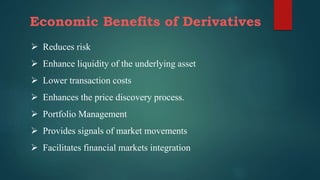
Economic Benefits of Derivatives
 Reduces risk
 Enhance liquidity of the underlying asset
 Lower transaction costs
 Enhances the price discovery process.
 Portfolio Management
 Provides signals of market movements
 Facilitates financial markets integration
What is a Forward?
 A forward is a contract in which one party commits to buy and
the other party commits to sell a specified quantity of an agreed
upon asset for a pre-determined price at a specific date in the
future.
 It is a customized contract, in the sense that the terms of the
contract are agreed upon by the individual parties.
 Hence, it is traded OTC.
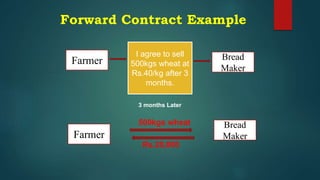
Forward Contract Example
I agree to sell
500kgs wheat at
Rs.40/kg after 3
months.
Farmer Bread
Maker
3 months Later
Farmer
Bread
Maker
500kgs wheat
Rs.20,000
Risks in Forward Contracts
 Credit Risk – Does the other party have the means to
pay?
 Operational Risk – Will the other party make delivery?
Will the other party accept delivery?
 Liquidity Risk – Incase either party wants to opt out of
the contract, how to find another counter party?
Terminology
 Long position - Buyer
 Short position - seller
 Spot price – Price of the asset in the spot market. (market
price)
 Delivery/forward price – Price of the asset at the
delivery date.
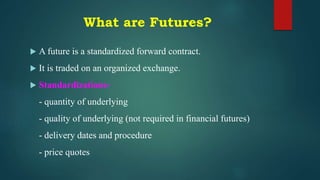
What are Futures?
 A future is a standardized forward contract.
 It is traded on an organized exchange.
 Standardizations-
- quantity of underlying
- quality of underlying (not required in financial futures)
- delivery dates and procedure
- price quotes
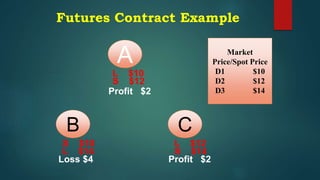
Futures Contract Example
A
B C
L $10
S $12
S $10
L $14
L $12
S $14
Profit $2
Loss $4 Profit $2
Market
Price/Spot Price
D1 $10
D2 $12
D3 $14
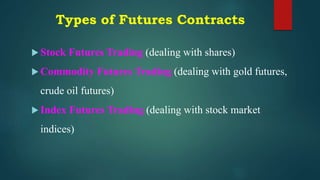
Types of Futures Contracts
 Stock Futures Trading (dealing with shares)
 Commodity Futures Trading (dealing with gold futures,
crude oil futures)
 Index Futures Trading (dealing with stock market
indices)
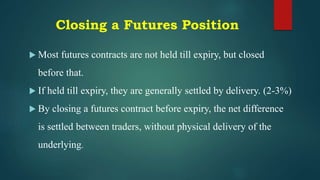
Closing a Futures Position
 Most futures contracts are not held till expiry, but closed
before that.
 If held till expiry, they are generally settled by delivery. (2-3%)
 By closing a futures contract before expiry, the net difference
is settled between traders, without physical delivery of the
underlying.
Terminology
 Contract size – The amount of the asset that has to be delivered under one
contract. All futures are sold in multiples of lots which is decided by the
exchange board.
Eg. If the lot size of Tata steel is 500 shares, then one futures contract is
necessarily 500 shares.
 Contract cycle – The period for which a contract trades.
The futures on the NSE have one (near) month, two (next) months, three
(far) months expiry cycles.
Terminology
 Expiry date – usually last Thursday of every month or
previous day if Thursday is public holiday.
 Strike price – The agreed price of the deal is called the
strike price.
 Cost of carry – Difference between strike price and current
price.
Margins
 A margin is an amount of a money that must be deposited with the
clearing house by both buyers and sellers in a margin account in
order to open a futures contract.
 It ensures performance of the terms of the contract.
 Its aim is to minimize the risk of default by either counterparty.
 Initial Margin - Deposit that a trader must make before trading
any futures. Usually, 10% of the contract size.
Margins
 Maintenance Margin - When margin reaches a minimum maintenance
level, the trader is required to bring the margin back to its initial level.
The maintenance margin is generally about 75% of the initial margin.
 Variation Margin - Additional margin required to bring an account up
to the required level.
 Margin call – If amt in the margin A/C falls below the maintenance
level, a margin call is made to fill the gap.
Marking to Market
 This is the practice of periodically adjusting the margin
account by adding or subtracting funds based on changes
in market value to reflect the investor’s gain or loss.
 This leads to changes in margin amounts daily.
 This ensures that there are o defaults by the parties.
What are Options?
Contracts that give the holder the option to buy/sell
specified quantity of the underlying assets at a particular
price on or before a specified time period.
The word “option” means that the holder has the right
but not the obligation to buy/sell underlying assets.
Types of Options
 Options are of two types – call and put.
 Call option give the buyer the right but not the obligation to buy a
given quantity of the underlying asset, at a given price on or
before a particular date by paying a premium.
 Puts give the buyer the right, but not obligation to sell a given
quantity of the underlying asset at a given price on or before a
particular date by paying a premium.
Types of Options (cont.)
 The other two types are – European style options and American
style options.
 European style options can be exercised only on the maturity date
of the option, also known as the expiry date.
 American style options can be exercised at any time before and on
the expiry date.
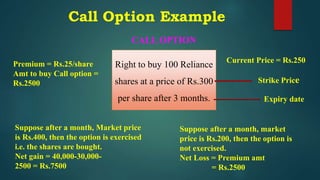
Call Option Example
Right to buy 100 Reliance
shares at a price of Rs.300
per share after 3 months.
CALL OPTION
Strike Price
Premium = Rs.25/share
Amt to buy Call option =
Rs.2500
Current Price = Rs.250
Suppose after a month, Market price
is Rs.400, then the option is exercised
i.e. the shares are bought.
Net gain = 40,000-30,000-
2500 = Rs.7500
Suppose after a month, market
price is Rs.200, then the option is
not exercised.
Net Loss = Premium amt
= Rs.2500
Expiry date
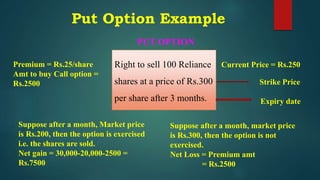
Put Option Example
Right to sell 100 Reliance
shares at a price of Rs.300
per share after 3 months.
PUT OPTION
Strike Price
Premium = Rs.25/share
Amt to buy Call option =
Rs.2500
Current Price = Rs.250
Suppose after a month, Market price
is Rs.200, then the option is exercised
i.e. the shares are sold.
Net gain = 30,000-20,000-2500 =
Rs.7500
Suppose after a month, market price
is Rs.300, then the option is not
exercised.
Net Loss = Premium amt
= Rs.2500
Expiry date
Features of Options
 A fixed maturity date on which they expire. (Expiry date)
 The price at which the option is exercised is called the exercise price or
strike price.
 The person who writes the option and is the seller is referred as the “option
writer”, and who holds the option and is the buyer is called “option holder”.
 The premium is the price paid for the option by the buyer to the seller.
 A clearing house is interposed between the writer and the buyer which
guarantees performance of the contract.
Options Terminology
 Underlying: Specific security or asset.
 Option premium: Price paid.
 Strike price: Pre-decided price.
 Expiration date: Date on which option expires.
 Exercise date: Option is exercised.
 Open interest: Total numbers of option contracts that have not yet
been expired.
Options Terminology (cont.)
 Option holder: One who buys option.
 Option writer: One who sells option.
 Option class: All listed options of a type on a particular instrument.
 Option series: A series that consists of all the options of a given
class with the same expiry date and strike price.
 Put-call ratio: The ratio of puts to the calls traded in the market.
Options Terminology (cont.)
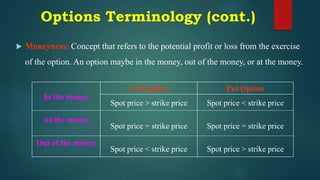
 Moneyness: Concept that refers to the potential profit or loss from the exercise
of the option. An option maybe in the money, out of the money, or at the money.
In the money
At the money
Out of the money
Call Option Put Option
Spot price > strike price
Spot price = strike price
Spot price < strike price
Spot price = strike price
Spot price > strike price
What are SWAPS?
 In a swap, two counter parties agree to enter into a
contractual agreement wherein they agree to exchange cash
flows at periodic intervals.
 Most swaps are traded “Over The Counter”.
 Some are also traded on futures exchange market.
Types of Swaps
There are 2 main types of swaps:
Plain vanilla fixed for floating swaps or simply
interest rate swaps.
Fixed for fixed currency swaps or simply
currency swaps.
What is an Interest Rate Swap?
 A company agrees to pay a pre-determined fixed interest
rate on a notional principal for a fixed number of years.
 In return, it receives interest at a floating rate on the same
notional principal for the same period of time.
 The principal is not exchanged. Hence, it is called a
notional amount.
Floating Interest Rate
 LIBOR – London Interbank Offered Rate
 It is the average interest rate estimated by leading banks in London.
 It is the primary benchmark for short term interest rates around the
world.
 Similarly, we have MIBOR i.e. Mumbai Interbank Offered Rate.
 It is calculated by the NSE as a weighted average of lending rates
of a group of banks.
What is a Currency Swap?
 It is a swap that includes exchange of principal and interest
rates in one currency for the same in another currency.
 It is considered to be a foreign exchange transaction.
 It is not required by law to be shown in the balance sheets.
 The principal may be exchanged either at the beginning or
at the end of the tenure.
What is a Currency Swap?
 However, if it is exchanged at the end of the life of the
swap, the principal value may be very different.
 It is generally used to hedge against exchange rate
fluctuations.

Unit 1-Introduction to Derivatives.pptx

  • 1.
  • 2.
    Syllabus Unit 1: Introductionto Derivatives: Meaning of derivatives. Legal & Regulatory Environment, Types of derivatives. Derivative market – India, World. Reasons for trading derivatives, Derivative pricing, Difference between exchange traded and OTC derivatives. Unit 2: Forwards and Futures: Meaning of Forwards and Futures, Structure of forward market, Types of forward contracts - Equity forward - Currency forward - Bond and interest rate forward - Forward rate agreement, Types of future contracts - Stock future - Index future - Currency future - Interest rate future - Commodity future Market for forward and futures, Marking to market and margins.
  • 3.
    Syllabus Unit 3: OptionMarket and Products : Structure and Role of Global Option Market including OTC and leading Option Exchanges, Concept, characteristics and definition, Option terminologies - Call option -Put option-American and European option-Option writer and buyer-Option premium including intrinsic value and time value -Strike price -ITM, ATM and OTM - Option payoff, Trading mechanism and concept of margins, Types of options- Stock option-Index option- Currency option - Commodity option Options on futures - Interest rate options, Put -Call Parity, Option strategies (spreads, straddles and strangles).
  • 4.
    Syllabus Unit 4: ValuingOptions: Factors affecting option valuation, Binomial model, Black-Scholes model, Monte-Carlo simulation. Unit 5: Hedging and the “Greeks” : “Greeks” – delta, gamma, vega, theta & rho, Principle of delta-hedging, Delta-hedging, Asset mismatch, maturity mismatch, basis risk, and minimum-variance, hedging, Delta- Gamma hedging using options. Accounting and Taxation of Derivative Transactions.
  • 5.
    What are Derivatives Aderivative is a financial instrument whose value is derived from the value of another asset, which is known as the underlying. When the price of the underlying changes, the value of the derivative also changes.  A Derivative is not a product. It is a contract that derives its value from changes in the price of the underlying. Example : The value of a gold futures contract is derived from the value of the underlying asset i.e. Gold.
  • 6.
    Type of UnderlyingAssets 1. Financial assets such as equities, debts, bonds, currencies and indices. 2. Agricultural produce such as grains, coffee, pulses and cotton. 3. Metals such as gold, silver, copper and aluminum. 4. Energy sources such as crude oil, natural gas, electricity and coal. 5. Interest rate.
  • 7.
    Indian History ofDerivatives  The Bombay Cotton trade association started future Trading in 1875  In 1952 the government banned cash settlement and Option Trading  In 1995 a Prohibition of trading options was lifted  In 1999, the Securities Contract (Regulation) Act of 1956 was amended and derivatives could be Declared “securities”  NSE Started trade in future and option by 2005
  • 8.
    Regulatory Framework ofDerivative Trading in India  Dr. L.C Gupta Committee constituted by SEBI had laid down the regulatory framework for derivative trading in India.  Some of the important eligibility conditions are - 1. Derivative trading to take place through an online screen based Trading System. 2. The Derivatives Exchange/Segment shall have online surveillance capability to monitor positions, prices, and volumes on a real time basis to deter market manipulation.
  • 9.
    Regulatory Framework ofDerivative Trading in India 3.The Derivatives Exchange/ Segment should have arrangements for dissemination of information about trades, quantities and quotes on a real time basis through at least two information vending networks, which are easily accessible to investors across the country. 4.The Derivatives Exchange/Segment should have arbitration and investor grievances redressal mechanism operative from all the four areas / regions of the country. 5.The Derivatives Exchange/Segment should have satisfactory system of monitoring investor complaints and preventing irregularities in trading. 6.The Derivative Segment of the Exchange would have a separate Investor Protection Fund.
  • 10.
    Regulatory Framework ofDerivative Trading in India 7.The Clearing Corporation/House shall perform full novation, i.e. the Clearing Corporation/House shall interpose itself between both legs of every trade, becoming the legal counterparty to both or alternatively should provide an unconditional guarantee for settlement of all trades. 8.The Clearing Corporation/House shall have the capacity to monitor the overall position of Members across both derivatives market and the underlying securities market for those Members who are participating in both.
  • 11.
    Regulatory Framework ofDerivative Trading in India 9.The level of initial margin on Index Futures Contracts shall be related to the risk of loss on the position. The concept of value-at-risk shall be used in calculating required level of initial margins. The initial margins should be large enough to cover the one-day loss that can be encountered on the position on 99% of the days. 10.The Clearing Corporation/House shall establish facilities for electronic funds transfer (EFT) for swift movement of margin payments. 11.In the event of a Member defaulting in meeting its liabilities, the Clearing Corporation/House shall transfer client positions and assets to another solvent Member or close- out all open positions.
  • 12.
    Regulatory Framework ofDerivative Trading in India 12.The Clearing Corporation/House should have capabilities to segregate initial margins deposited by Clearing Members for trades on their own account and on account of his client. The Clearing Corporation/House shall hold the clients’ margin money in trust for the client purposes only and should not allow its diversion for any other purpose. 13.The Clearing Corporation/House shall have a separate Trade Guarantee Fund for the trades executed on Derivative Exchange / Segment.
  • 13.
    Advantages of DerivativesTrading 1) Low Transaction Cost: Derivatives contracts play a part in reducing market transaction costs. Since they work as risk management tools. Thus the cost of transaction in derivative stock trading is lower as compared to the securities like debentures and shares. 2) Used in Risk Management: the value of a derivative contract has a direct relation with the price of its underlying asset. Hence derivative are used to hedge the risk associated with changing price levels of the underlying assets.
  • 14.
    Advantages of DerivativesTrading 3. Market Efficiency: Derivative trading involves the practice of arbitrage which plays a vital role in ensuring that the market reaches equilibrium and the prices of the underlying assets are correct. 4. Determines the Price of an Underlying Asset: Derivative contracts are often used to ascertain the price of an underlying asset. 5. Risk is Transferable: Derivatives allow investors, businesses and other to transfer the risk to other parties.
  • 15.
    Disadvantages of DerivativesTrading 1. Involves High Risk : Derivative contracts are highly volatile as the value of underlying assets like shares keep fluctuating rapidly. Thus, traders are exposed to the risk of incurring the huge losses. 2. Counterparty Risk: Derivative contracts like future that are traded on the exchanges like BSE and NSE are organized and regulated. But OTC derivative contracts like forwards are not standardized hence, there’s always a risk of counterparty default.
  • 16.
    Disadvantages of DerivativesTrading 3. Speculative in Nature: Derivative contracts are commonly used as tools for speculation. Due to the high risk associated with the and their unpredictable fluctuations in value baseless speculation often lead to huge losses.  Derivative trading requires in-depth knowledge about the products and a great deal of expertise.
  • 17.
    Traders in DerivativesMarket There are 3 types of traders in the Derivatives Market : HEDGER : A hedger is someone who faces risk associated with price movement of an asset and who uses derivatives as means of reducing risk. They provide economic balance to the market. SPECULATOR : A trader who enters the futures market for pursuit of profits, accepting risk in the endeavor. They provide liquidity and depth to the market.
  • 18.
    Traders in DerivativesMarket ARBITRAGEUR : A person who simultaneously enters into transactions in two or more markets to take advantage of the discrepancies between prices in these markets.  Arbitrage involves making profits from relative mispricing.  Arbitrageurs also help to make markets liquid, ensure accurate and uniform pricing, and enhance price stability  They help in bringing about price uniformity and discovery.
  • 19.
    Types of derivatives: 1)OTC (Over the counter) 2) Exchange Traded Derivatives 1. OTC : Over-the-counter (OTC) or off-exchange trading is to trade financial instruments such as stocks, bonds, commodities or derivatives directly between two parties without going through an exchange or other intermediary. • The contract between the two parties are privately negotiated. • The contract can be tailor-made to the two parties’ liking. • Over-the-counter markets are uncontrolled, unregulated and have very few laws.
  • 20.
    2. Exchange-traded Derivatives Exchange traded derivatives contract (ETD) are those derivatives instruments that are traded via specialized Derivatives exchange or other exchanges. A derivatives exchange is a market where individuals trade standardized contracts that have been defined by the exchange.  There is a very visible and transparent market price for the derivatives.
  • 21.
    Distinction Between ETDand OTC Derivatives Basis ETD OTC Parties to the contract These are done through the recognized exchanges. There are more than two parties in such contracts. These contracts are privately placed. They are bilateral contracts, which may be routed directly or through broker/agent. Exchange These are traded on the recognized exchanges These are traded over the counters of the respective parties directly Specification These contract are standardized in terms of quantity, quality of asset, maturity, etc. Such standards are decided by the concerned exchanges. These contracts are made on the basis of the requirement of the parties. Terms and conditions of the contracts are decided by the parties themselves.
  • 22.
    Distinction Between ETDand OTC Derivatives Basis ETD OTC Delivery Time These contracts are offset or delivered on the specified date as per decided by the concerned exchanges. The delivery date of these contracts are settled by the parties themselves. Settlement These contracts are settled through recognized clearing house of the exchange. These contracts are settled by the parties themselves. Margin Margins are required in these contracts which are to be paid by the parties to their members of the exchanges. The margin is decided by the exchange. No such margin is normally required to be paid either of the parties of the contract.
  • 23.
    Distinction Between ETDand OTC Derivatives Basis ETD OTC Daily Adjustment The Mark-to-Market system is followed in these contracts. Daily settlement feature sets the value of these contracts at zero at the each trading day. These contracts are settled on the maturity date and not before that date unless both the parties agree for postponement or preponement of the contract. Cost of Contract These contracts are done through the members of the exchange, hence, entails brokerage fee for buy and sell orders. Cost of these is based on the bid-ask spread, i.e. difference of buying and selling price. Credit Risk These contracts are settled through clearing house. There is no risk of selling the contract at the maturity date. There is credit risk for each party. These contracts are riskier in nature.
  • 24.
    Economic Benefits ofDerivatives  Reduces risk  Enhance liquidity of the underlying asset  Lower transaction costs  Enhances the price discovery process.  Portfolio Management  Provides signals of market movements  Facilitates financial markets integration
  • 25.
    What is aForward?  A forward is a contract in which one party commits to buy and the other party commits to sell a specified quantity of an agreed upon asset for a pre-determined price at a specific date in the future.  It is a customized contract, in the sense that the terms of the contract are agreed upon by the individual parties.  Hence, it is traded OTC.
  • 26.
    Forward Contract Example Iagree to sell 500kgs wheat at Rs.40/kg after 3 months. Farmer Bread Maker 3 months Later Farmer Bread Maker 500kgs wheat Rs.20,000
  • 27.
    Risks in ForwardContracts  Credit Risk – Does the other party have the means to pay?  Operational Risk – Will the other party make delivery? Will the other party accept delivery?  Liquidity Risk – Incase either party wants to opt out of the contract, how to find another counter party?
  • 28.
    Terminology  Long position- Buyer  Short position - seller  Spot price – Price of the asset in the spot market. (market price)  Delivery/forward price – Price of the asset at the delivery date.
  • 29.
    What are Futures? A future is a standardized forward contract.  It is traded on an organized exchange.  Standardizations- - quantity of underlying - quality of underlying (not required in financial futures) - delivery dates and procedure - price quotes
  • 30.
    Futures Contract Example A BC L $10 S $12 S $10 L $14 L $12 S $14 Profit $2 Loss $4 Profit $2 Market Price/Spot Price D1 $10 D2 $12 D3 $14
  • 31.
    Types of FuturesContracts  Stock Futures Trading (dealing with shares)  Commodity Futures Trading (dealing with gold futures, crude oil futures)  Index Futures Trading (dealing with stock market indices)
  • 32.
    Closing a FuturesPosition  Most futures contracts are not held till expiry, but closed before that.  If held till expiry, they are generally settled by delivery. (2-3%)  By closing a futures contract before expiry, the net difference is settled between traders, without physical delivery of the underlying.
  • 33.
    Terminology  Contract size– The amount of the asset that has to be delivered under one contract. All futures are sold in multiples of lots which is decided by the exchange board. Eg. If the lot size of Tata steel is 500 shares, then one futures contract is necessarily 500 shares.  Contract cycle – The period for which a contract trades. The futures on the NSE have one (near) month, two (next) months, three (far) months expiry cycles.
  • 34.
    Terminology  Expiry date– usually last Thursday of every month or previous day if Thursday is public holiday.  Strike price – The agreed price of the deal is called the strike price.  Cost of carry – Difference between strike price and current price.
  • 35.
    Margins  A marginis an amount of a money that must be deposited with the clearing house by both buyers and sellers in a margin account in order to open a futures contract.  It ensures performance of the terms of the contract.  Its aim is to minimize the risk of default by either counterparty.  Initial Margin - Deposit that a trader must make before trading any futures. Usually, 10% of the contract size.
  • 36.
    Margins  Maintenance Margin- When margin reaches a minimum maintenance level, the trader is required to bring the margin back to its initial level. The maintenance margin is generally about 75% of the initial margin.  Variation Margin - Additional margin required to bring an account up to the required level.  Margin call – If amt in the margin A/C falls below the maintenance level, a margin call is made to fill the gap.
  • 37.
    Marking to Market This is the practice of periodically adjusting the margin account by adding or subtracting funds based on changes in market value to reflect the investor’s gain or loss.  This leads to changes in margin amounts daily.  This ensures that there are o defaults by the parties.
  • 38.
    What are Options? Contractsthat give the holder the option to buy/sell specified quantity of the underlying assets at a particular price on or before a specified time period. The word “option” means that the holder has the right but not the obligation to buy/sell underlying assets.
  • 39.
    Types of Options Options are of two types – call and put.  Call option give the buyer the right but not the obligation to buy a given quantity of the underlying asset, at a given price on or before a particular date by paying a premium.  Puts give the buyer the right, but not obligation to sell a given quantity of the underlying asset at a given price on or before a particular date by paying a premium.
  • 40.
    Types of Options(cont.)  The other two types are – European style options and American style options.  European style options can be exercised only on the maturity date of the option, also known as the expiry date.  American style options can be exercised at any time before and on the expiry date.
  • 41.
    Call Option Example Rightto buy 100 Reliance shares at a price of Rs.300 per share after 3 months. CALL OPTION Strike Price Premium = Rs.25/share Amt to buy Call option = Rs.2500 Current Price = Rs.250 Suppose after a month, Market price is Rs.400, then the option is exercised i.e. the shares are bought. Net gain = 40,000-30,000- 2500 = Rs.7500 Suppose after a month, market price is Rs.200, then the option is not exercised. Net Loss = Premium amt = Rs.2500 Expiry date
  • 42.
    Put Option Example Rightto sell 100 Reliance shares at a price of Rs.300 per share after 3 months. PUT OPTION Strike Price Premium = Rs.25/share Amt to buy Call option = Rs.2500 Current Price = Rs.250 Suppose after a month, Market price is Rs.200, then the option is exercised i.e. the shares are sold. Net gain = 30,000-20,000-2500 = Rs.7500 Suppose after a month, market price is Rs.300, then the option is not exercised. Net Loss = Premium amt = Rs.2500 Expiry date
  • 43.
    Features of Options A fixed maturity date on which they expire. (Expiry date)  The price at which the option is exercised is called the exercise price or strike price.  The person who writes the option and is the seller is referred as the “option writer”, and who holds the option and is the buyer is called “option holder”.  The premium is the price paid for the option by the buyer to the seller.  A clearing house is interposed between the writer and the buyer which guarantees performance of the contract.
  • 44.
    Options Terminology  Underlying:Specific security or asset.  Option premium: Price paid.  Strike price: Pre-decided price.  Expiration date: Date on which option expires.  Exercise date: Option is exercised.  Open interest: Total numbers of option contracts that have not yet been expired.
  • 45.
    Options Terminology (cont.) Option holder: One who buys option.  Option writer: One who sells option.  Option class: All listed options of a type on a particular instrument.  Option series: A series that consists of all the options of a given class with the same expiry date and strike price.  Put-call ratio: The ratio of puts to the calls traded in the market.
  • 46.
    Options Terminology (cont.) Moneyness: Concept that refers to the potential profit or loss from the exercise of the option. An option maybe in the money, out of the money, or at the money. In the money At the money Out of the money Call Option Put Option Spot price > strike price Spot price = strike price Spot price < strike price Spot price < strike price Spot price = strike price Spot price > strike price
  • 47.
    What are SWAPS? In a swap, two counter parties agree to enter into a contractual agreement wherein they agree to exchange cash flows at periodic intervals.  Most swaps are traded “Over The Counter”.  Some are also traded on futures exchange market.
  • 48.
    Types of Swaps Thereare 2 main types of swaps: Plain vanilla fixed for floating swaps or simply interest rate swaps. Fixed for fixed currency swaps or simply currency swaps.
  • 49.
    What is anInterest Rate Swap?  A company agrees to pay a pre-determined fixed interest rate on a notional principal for a fixed number of years.  In return, it receives interest at a floating rate on the same notional principal for the same period of time.  The principal is not exchanged. Hence, it is called a notional amount.
  • 50.
    Floating Interest Rate LIBOR – London Interbank Offered Rate  It is the average interest rate estimated by leading banks in London.  It is the primary benchmark for short term interest rates around the world.  Similarly, we have MIBOR i.e. Mumbai Interbank Offered Rate.  It is calculated by the NSE as a weighted average of lending rates of a group of banks.
  • 51.
    What is aCurrency Swap?  It is a swap that includes exchange of principal and interest rates in one currency for the same in another currency.  It is considered to be a foreign exchange transaction.  It is not required by law to be shown in the balance sheets.  The principal may be exchanged either at the beginning or at the end of the tenure.
  • 52.
    What is aCurrency Swap?  However, if it is exchanged at the end of the life of the swap, the principal value may be very different.  It is generally used to hedge against exchange rate fluctuations.