INTERNATIONAL MONETARY SYSTEM AND
FACTORS RESPONSIBLE FOR THE GROWTH OF
MULTINATIONAL FIRMS
INTERNATIONAL MONETARY SYSTEM
DEFINITION
‘‘ International Monetary System is part of the institutional framework
that binds national economies, such a system permits producers to
specialize in those goods for which they have a comparative advantage,
and serves to seek profitable investment opportunities on a global
basis’’
EVOLUTION OF INTERNATIONAL MONETARY
SYSTEM
• Bimetallism (Before 1875)
• Classic Gold Standard (1875 – 1914)
• Interwar Period (1915 – 1944)
• Bretton Woods Agreement (1945 – 1972)
• Smithsonian Agreement (1971)
• International Monetary System (1973 to present)
CLASSIC GOLD STANDARDS (1875 – 1914)
• Countries had to establish the rate at which its currency could be
converted to the weight of the gold.
• Participants – Germany , France , UK, USA.
• Example : $ 20.67/ounce , Pounds 4.247 / ounce.
• Exchange rate between any two currencies was determined by
their gold content.
• Gold was used as a storage of wealth and as a medium of
exchange.
• Central banks were restricted not to issue more currency than
gold reserves.
ADVANTAGES OF GOLD STANDARD
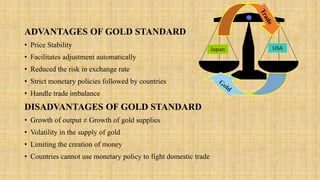
• Price Stability
• Facilitates adjustment automatically
• Reduced the risk in exchange rate
• Strict monetary policies followed by countries
• Handle trade imbalance
DISADVANTAGES OF GOLD STANDARD
• Growth of output ≠ Growth of gold supplies
• Volatility in the supply of gold
• Limiting the creation of money
• Countries cannot use monetary policy to fight domestic trade
Japan USA
DECLINE OF GOLD STANDARD
• Money supply for financing the war activities was not easy.
• Exchange rate parity was greatly disturbed.
• Gold volume could not grow fast enough.
• It was not practical for a country to subordinate their national
currencies to gold.
INTERWAR PERIOD (1915 – 1944)
• Described as a period of de-globalization.
• Countries had abandoned the gold standard, the international trade and
capital flows shrank and started printing money to pay for war related
expenses.
• After the war, with high rates of inflation and a large amount of
outstanding money.
• A return to the old gold standard was attempted.
• The Great depression of 1930s diminished,
Commercial trade
International exchange of currencies
Cross border lending and borrowing
CONDITIONS PRIOR TO BRETTON WOODS
• Prior to WW I , national currencies had fixed exchange rates under the
international gold standards which abandoned after WW I.
• End of the War II to 1925- fluctuating exchange rates that collapsed in
the Great Depression.
• Many countries resorted to protectionism and competitive devaluation.
BRETTON WOODS AGREEMENT (1945-1972)
• Named after the year 1944 meeting of 44 nations at Bretton Woods, New Hampshire
initiated by John Maynard Keynes and Harry Dexter White.
• The goal was exchange rate stability without the gold standard.
• The result was the creation of the IMF and the World Bank.
OBJECTIVE
• Freedom for governments to pursue domestic polices
• Promoting employment
• Stabilize exchange rates
• Provide capital for reconstruction from the war
FEATURES OF BRETTON WOODS SYSTEM
• Key difference was that the dollar was the only currency that was
convertible into gold.
• Exchangeable rates could be readjusted at certain times under certain
conditions.
• Each country was allowed to have a 1% band around which their currency
was allowed to fluctuate around the fixed rate.
• The IMF was created with the specific goal of being the multilateral body
that monitored the implementation of the Bretton Woods agreement.
• Central banks had to exchange domestic currency for dollars upon
request.
• Changes in monetary policy can affect both the output in its country as
well as output in other countries.
• A procedure for mutual international credits.
• The Bretton Woods system was a dollar-based gold exchange standard
and not gold based currency exchange.
• Longest formal mechanism.
DEMISE OF THE BRETTON WOODS SYSTEM
• Lead to problem of lack of international liquidity.
• Countries began holding less in dollars and more keen on holding
gold.
• Any pressure to devalue the dollar would cause problems
throughout the world.
• The trade balance of the USA became highly negative.
• Large amount of US dollars was held outside the USA that it was
more than the total gold holdings of the USA.
• On 15th Aug 1971, President Nixon suspended the system of
convertibility of gold and dollar and decided for floating
exchange rate system.
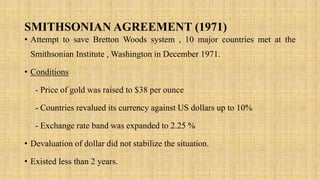
SMITHSONIAN AGREEMENT (1971)
• Attempt to save Bretton Woods system , 10 major countries met at the
Smithsonian Institute , Washington in December 1971.
• Conditions
- Price of gold was raised to $38 per ounce
- Countries revalued its currency against US dollars up to 10%
- Exchange rate band was expanded to 2.25 %
• Devaluation of dollar did not stabilize the situation.
• Existed less than 2 years.
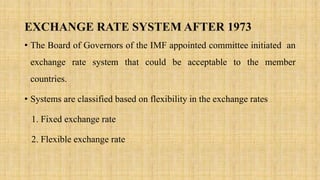
EXCHANGE RATE SYSTEM AFTER 1973
• The Board of Governors of the IMF appointed committee initiated an
exchange rate system that could be acceptable to the member
countries.
• Systems are classified based on flexibility in the exchange rates
1. Fixed exchange rate
2. Flexible exchange rate
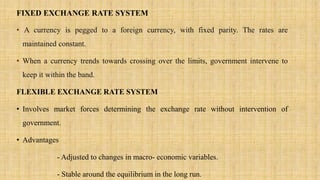
FIXED EXCHANGE RATE SYSTEM
• A currency is pegged to a foreign currency, with fixed parity. The rates are
maintained constant.
• When a currency trends towards crossing over the limits, government intervene to
keep it within the band.
FLEXIBLE EXCHANGE RATE SYSTEM
• Involves market forces determining the exchange rate without intervention of
government.
• Advantages
- Adjusted to changes in macro- economic variables.
- Stable around the equilibrium in the long run.
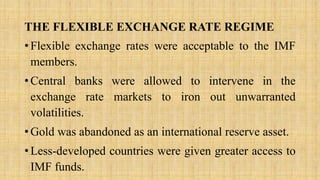
THE FLEXIBLE EXCHANGE RATE REGIME
• Flexible exchange rates were acceptable to the IMF
members.
• Central banks were allowed to intervene in the
exchange rate markets to iron out unwarranted
volatilities.
• Gold was abandoned as an international reserve asset.
• Less-developed countries were given greater access to
IMF funds.
TYPES OF EXCHANGE RATE REGIME
Within the flexible exchange rate regime there are 3 categories,
1.Floating
 Independent floating system
 Managed floating systems
2.Pegging
3.Target Zone Arrangements
1. FLOATING
INDEPENDENT FLOATING SYSTEM
• Independent floating system does not involve intervention
and so termed as ‘clean floating’.
• The purpose of intervention is simply to moderate the
exchange rate and to prevent any undue fluctuation.
• But no attempt is undertaken to achieve/maintain a particular
rate.
MANAGED FLOATING SYSTEMS
• Involves direct or indirect intervention by the monetary authorities of
the country to stabilize the exchange rate.
• Indirect intervention - The monetary authorities stabilize the exchange
rate through changing the interest rates.
• Direct intervention - The monetary authorities purchase and sell
foreign currency in the domestic market.
• Managed floating is also known as ‘dirty floating’.
• No Predetermined Path for the Exchange Rate.
PEGGING
• Periodic adjustment of fixed exchange rate to catch up with market
determined rates.
•Combine the advantages of fixed exchange rate with flexibility of
floating exchange rate.
•It fixes the exchange rate at a given level which is responsive to
changes in market conditions (ie) it is allowed to crawl pegging.
• A Crawling Band allows a periodic adjustment of the exchange rate
band itself.
• The upper and lower limits are decided for exchange rate depending
demand and supply of foreign exchange.
• When exchange rate crosses limits, the monetary policies push the
exchange rate within the target zone.
• If economic indicators are being disturbed, the monetary authorities let
the exchange rate depreciate or appreciate as the case may be.
TARGET – ZONE ARRANGEMENTS
• Target zone arrangement involves member countries having fixed
exchange rate among their currencies. Alternatively, they may use a
common currency.
FIXED VERSUS FLEXIBLE EXCHANGE RATE
REGIMES
• Arguments in favor of flexible exchange rates
Easier external adjustments
National policy autonomy
• Arguments against flexible exchange rates
Exchange rate uncertainty may hamper international trade
No safeguards to prevent crises
INTERNATIONAL MONETARY SYSTEM
• Set of internationally agreed rules, conventions and supporting institutions.
• Facilitate - International trade
- Cross border investment
- Financing capital movement globally
- Determination on exchange rates
• Solves problems relating to
- Liquidity
- Adjustment
- Stability
FEATURES OF IMS
 Flow of international trade
 Investment according to comparative advantage
 Stability in foreign exchange
 Promoting Balance of Payments
 Providing countries with sufficient liquidity
 Plan for avoiding uncertainty
 Allowing member countries to pursue independent monetary and fiscal
policies
IMPLICATIONS FOR MANAGERS
For managers , understanding of International monetary system
is important for
- Currency management
- Business strategy
- Corporate – government relations
CURRENCY MANAGEMENT
• To recognize , the current IMS is a managed float system in
which the government intervention can drive the foreign
exchange market .
• To understand the speculative buying and selling of
currencies can create volatile movements in exchange rates.
BUSINESS STRATEGY
• To recognize that while exchange rate movements are difficult to
predict , it can have a major impact on the competitive position of the
business.
• To contend with this impact , managers need strategic flexibility .
Example : dispersing production to different locations.
CORPORATE GOVERNMENT RELATIONS
• To recognize that businesses can influence government policy
towards the IMS.
• Companies should promote an IMS that facilitates
international growth and development .
REFERENCES
P K Jain, Josette Peyrard, Surendra S Yadav, “International Financial
Management”, Macmillan India Ltd, New Delhi, 2005.
Madhu Vij, “ International Financial Management”, Excel books
publications, New Delhi, 2001.
Vyuptakesh Sharan, “ International Financial Management”, Prentice Hall
of India Pvt Ltd, New Delhi, 2006.
THANK YOU

International Monetary System

  • 1.
    INTERNATIONAL MONETARY SYSTEMAND FACTORS RESPONSIBLE FOR THE GROWTH OF MULTINATIONAL FIRMS
  • 2.
    INTERNATIONAL MONETARY SYSTEM DEFINITION ‘‘International Monetary System is part of the institutional framework that binds national economies, such a system permits producers to specialize in those goods for which they have a comparative advantage, and serves to seek profitable investment opportunities on a global basis’’
  • 3.
    EVOLUTION OF INTERNATIONALMONETARY SYSTEM • Bimetallism (Before 1875) • Classic Gold Standard (1875 – 1914) • Interwar Period (1915 – 1944) • Bretton Woods Agreement (1945 – 1972) • Smithsonian Agreement (1971) • International Monetary System (1973 to present)
  • 4.
    CLASSIC GOLD STANDARDS(1875 – 1914) • Countries had to establish the rate at which its currency could be converted to the weight of the gold. • Participants – Germany , France , UK, USA. • Example : $ 20.67/ounce , Pounds 4.247 / ounce. • Exchange rate between any two currencies was determined by their gold content. • Gold was used as a storage of wealth and as a medium of exchange. • Central banks were restricted not to issue more currency than gold reserves.
  • 5.
    ADVANTAGES OF GOLDSTANDARD • Price Stability • Facilitates adjustment automatically • Reduced the risk in exchange rate • Strict monetary policies followed by countries • Handle trade imbalance DISADVANTAGES OF GOLD STANDARD • Growth of output ≠ Growth of gold supplies • Volatility in the supply of gold • Limiting the creation of money • Countries cannot use monetary policy to fight domestic trade Japan USA
  • 6.
    DECLINE OF GOLDSTANDARD • Money supply for financing the war activities was not easy. • Exchange rate parity was greatly disturbed. • Gold volume could not grow fast enough. • It was not practical for a country to subordinate their national currencies to gold.
  • 7.
    INTERWAR PERIOD (1915– 1944) • Described as a period of de-globalization. • Countries had abandoned the gold standard, the international trade and capital flows shrank and started printing money to pay for war related expenses. • After the war, with high rates of inflation and a large amount of outstanding money. • A return to the old gold standard was attempted.
  • 8.
    • The Greatdepression of 1930s diminished, Commercial trade International exchange of currencies Cross border lending and borrowing
  • 9.
    CONDITIONS PRIOR TOBRETTON WOODS • Prior to WW I , national currencies had fixed exchange rates under the international gold standards which abandoned after WW I. • End of the War II to 1925- fluctuating exchange rates that collapsed in the Great Depression. • Many countries resorted to protectionism and competitive devaluation.
  • 10.
    BRETTON WOODS AGREEMENT(1945-1972) • Named after the year 1944 meeting of 44 nations at Bretton Woods, New Hampshire initiated by John Maynard Keynes and Harry Dexter White. • The goal was exchange rate stability without the gold standard. • The result was the creation of the IMF and the World Bank. OBJECTIVE • Freedom for governments to pursue domestic polices • Promoting employment • Stabilize exchange rates • Provide capital for reconstruction from the war
  • 11.
    FEATURES OF BRETTONWOODS SYSTEM • Key difference was that the dollar was the only currency that was convertible into gold. • Exchangeable rates could be readjusted at certain times under certain conditions. • Each country was allowed to have a 1% band around which their currency was allowed to fluctuate around the fixed rate. • The IMF was created with the specific goal of being the multilateral body that monitored the implementation of the Bretton Woods agreement.
  • 12.
    • Central bankshad to exchange domestic currency for dollars upon request. • Changes in monetary policy can affect both the output in its country as well as output in other countries. • A procedure for mutual international credits. • The Bretton Woods system was a dollar-based gold exchange standard and not gold based currency exchange. • Longest formal mechanism.
  • 13.
    DEMISE OF THEBRETTON WOODS SYSTEM • Lead to problem of lack of international liquidity. • Countries began holding less in dollars and more keen on holding gold. • Any pressure to devalue the dollar would cause problems throughout the world. • The trade balance of the USA became highly negative. • Large amount of US dollars was held outside the USA that it was more than the total gold holdings of the USA. • On 15th Aug 1971, President Nixon suspended the system of convertibility of gold and dollar and decided for floating exchange rate system.
  • 14.
    SMITHSONIAN AGREEMENT (1971) •Attempt to save Bretton Woods system , 10 major countries met at the Smithsonian Institute , Washington in December 1971. • Conditions - Price of gold was raised to $38 per ounce - Countries revalued its currency against US dollars up to 10% - Exchange rate band was expanded to 2.25 % • Devaluation of dollar did not stabilize the situation. • Existed less than 2 years.
  • 15.
    EXCHANGE RATE SYSTEMAFTER 1973 • The Board of Governors of the IMF appointed committee initiated an exchange rate system that could be acceptable to the member countries. • Systems are classified based on flexibility in the exchange rates 1. Fixed exchange rate 2. Flexible exchange rate
  • 16.
    FIXED EXCHANGE RATESYSTEM • A currency is pegged to a foreign currency, with fixed parity. The rates are maintained constant. • When a currency trends towards crossing over the limits, government intervene to keep it within the band. FLEXIBLE EXCHANGE RATE SYSTEM • Involves market forces determining the exchange rate without intervention of government. • Advantages - Adjusted to changes in macro- economic variables. - Stable around the equilibrium in the long run.
  • 17.
    THE FLEXIBLE EXCHANGERATE REGIME • Flexible exchange rates were acceptable to the IMF members. • Central banks were allowed to intervene in the exchange rate markets to iron out unwarranted volatilities. • Gold was abandoned as an international reserve asset. • Less-developed countries were given greater access to IMF funds.
  • 18.
    TYPES OF EXCHANGERATE REGIME Within the flexible exchange rate regime there are 3 categories, 1.Floating  Independent floating system  Managed floating systems 2.Pegging 3.Target Zone Arrangements
  • 19.
    1. FLOATING INDEPENDENT FLOATINGSYSTEM • Independent floating system does not involve intervention and so termed as ‘clean floating’. • The purpose of intervention is simply to moderate the exchange rate and to prevent any undue fluctuation. • But no attempt is undertaken to achieve/maintain a particular rate.
  • 20.
    MANAGED FLOATING SYSTEMS •Involves direct or indirect intervention by the monetary authorities of the country to stabilize the exchange rate. • Indirect intervention - The monetary authorities stabilize the exchange rate through changing the interest rates. • Direct intervention - The monetary authorities purchase and sell foreign currency in the domestic market. • Managed floating is also known as ‘dirty floating’. • No Predetermined Path for the Exchange Rate.
  • 21.
    PEGGING • Periodic adjustmentof fixed exchange rate to catch up with market determined rates. •Combine the advantages of fixed exchange rate with flexibility of floating exchange rate. •It fixes the exchange rate at a given level which is responsive to changes in market conditions (ie) it is allowed to crawl pegging.
  • 22.
    • A CrawlingBand allows a periodic adjustment of the exchange rate band itself. • The upper and lower limits are decided for exchange rate depending demand and supply of foreign exchange. • When exchange rate crosses limits, the monetary policies push the exchange rate within the target zone. • If economic indicators are being disturbed, the monetary authorities let the exchange rate depreciate or appreciate as the case may be.
  • 23.
    TARGET – ZONEARRANGEMENTS • Target zone arrangement involves member countries having fixed exchange rate among their currencies. Alternatively, they may use a common currency.
  • 24.
    FIXED VERSUS FLEXIBLEEXCHANGE RATE REGIMES • Arguments in favor of flexible exchange rates Easier external adjustments National policy autonomy • Arguments against flexible exchange rates Exchange rate uncertainty may hamper international trade No safeguards to prevent crises
  • 25.
    INTERNATIONAL MONETARY SYSTEM •Set of internationally agreed rules, conventions and supporting institutions. • Facilitate - International trade - Cross border investment - Financing capital movement globally - Determination on exchange rates • Solves problems relating to - Liquidity - Adjustment - Stability
  • 26.
    FEATURES OF IMS Flow of international trade  Investment according to comparative advantage  Stability in foreign exchange  Promoting Balance of Payments  Providing countries with sufficient liquidity  Plan for avoiding uncertainty  Allowing member countries to pursue independent monetary and fiscal policies
  • 27.
    IMPLICATIONS FOR MANAGERS Formanagers , understanding of International monetary system is important for - Currency management - Business strategy - Corporate – government relations
  • 28.
    CURRENCY MANAGEMENT • Torecognize , the current IMS is a managed float system in which the government intervention can drive the foreign exchange market . • To understand the speculative buying and selling of currencies can create volatile movements in exchange rates.
  • 29.
    BUSINESS STRATEGY • Torecognize that while exchange rate movements are difficult to predict , it can have a major impact on the competitive position of the business. • To contend with this impact , managers need strategic flexibility . Example : dispersing production to different locations.
  • 30.
    CORPORATE GOVERNMENT RELATIONS •To recognize that businesses can influence government policy towards the IMS. • Companies should promote an IMS that facilitates international growth and development .
  • 31.
    REFERENCES P K Jain,Josette Peyrard, Surendra S Yadav, “International Financial Management”, Macmillan India Ltd, New Delhi, 2005. Madhu Vij, “ International Financial Management”, Excel books publications, New Delhi, 2001. Vyuptakesh Sharan, “ International Financial Management”, Prentice Hall of India Pvt Ltd, New Delhi, 2006.
  • 32.