The Option Investment Strategies Mayank Bhatia Sandri Supardi Gail Yambao
Options Options:  contract giving the buyer right, but not obligation to buy or sell the underlying asset at a certain price on/before the certain date. Two types of Options: Call Option:  Gives the holder right to buy an assets at certain price within the specific period of time. Put Option:  Gives the holder right to sell an assets at certain price within the specific period of time.
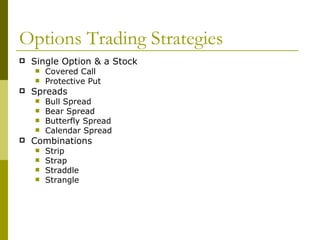
Options Trading Strategies Single Option & a Stock Covered Call Protective Put Spreads Bull Spread Bear Spread Butterfly Spread Calendar Spread Combinations Strip Strap Straddle Strangle
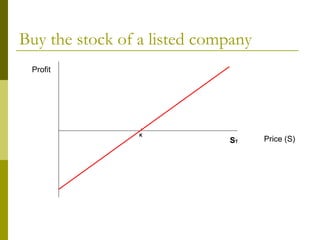
Buy the stock of a listed company Profit Price (S) K S T
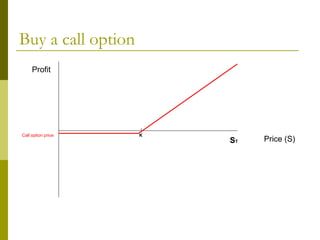
Buy a call option Profit Price (S) K S T Call option price
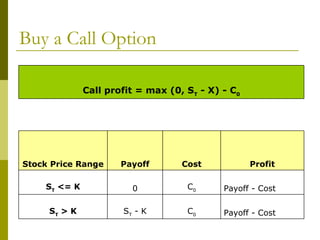
Buy a Call Option Payoff - Cost C 0 S T  - K S T  > K Payoff - Cost C 0 0 S T  <= K Profit Cost Payoff Stock Price Range Call profit = max (0, S T  - X) - C 0
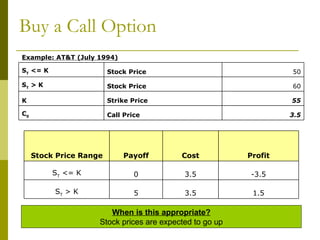
Buy a Call Option When is this appropriate? Stock prices are expected to go up 1.5 3.5 5 S T  > K -3.5 3.5 0 S T  <= K Profit Cost Payoff Stock Price Range 3.5 Call Price C 0 55 Strike Price K 60 Stock Price S T  > K 50 Stock Price S T  <= K Example: AT&T (July 1994)
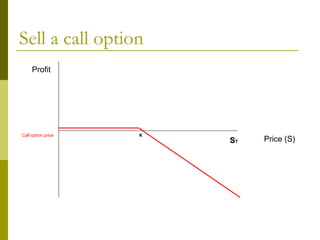
Sell a call option Profit Price (S) K S T Call option price
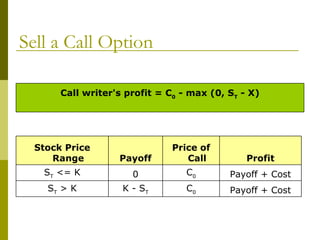
Sell a Call Option Call writer's profit = C 0  - max (0, S T  - X) Payoff + Cost C 0 K - S T S T  > K Payoff + Cost C 0 0 S T  <= K Profit Price of Call Payoff Stock Price Range
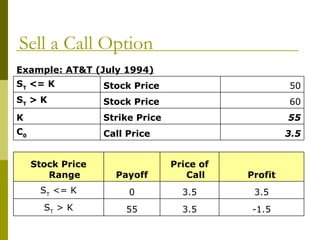
Sell a Call Option 3.5 Call Price C 0 55 Strike Price K 60 Stock Price S T  > K 50 Stock Price S T  <= K Example: AT&T (July 1994) -1.5 3.5 55 S T  > K 3.5 3.5 0 S T  <= K Profit Price of Call Payoff Stock Price Range
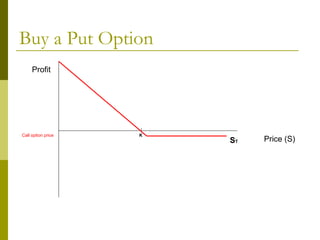
Buy a Put Option Profit Price (S) K S T Call option price
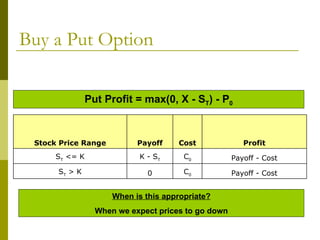
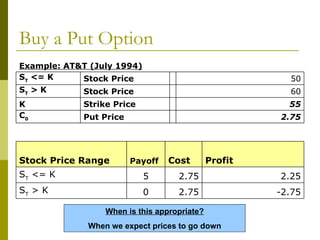
Buy a Put Option Put Profit = max(0, X - S T ) - P 0 When is this appropriate? When we expect prices to go down Payoff - Cost C 0 0 S T  > K Payoff - Cost C 0 K - S T S T  <= K Profit Cost Payoff Stock Price Range
Buy a Put Option When is this appropriate? When we expect prices to go down 2.75   Put Price C 0 55   Strike Price K 60   Stock Price S T  > K 50   Stock Price S T  <= K Example: AT&T (July 1994) -2.75 2.75 0 S T  > K 2.25 2.75 5 S T  <= K Profit Cost Payoff Stock Price Range
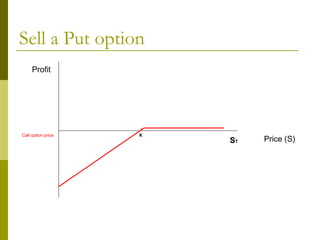
Sell a Put option Profit Price (S) K S T Call option price
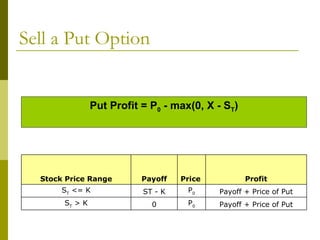
Sell a Put Option Put Profit = P 0  - max(0, X - S T ) Payoff + Price of Put P 0 0 S T  > K Payoff + Price of Put P 0 ST - K S T  <= K Profit Price Payoff Stock Price Range
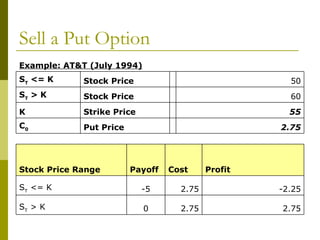
Sell a Put Option 2.75   Put Price C 0 55   Strike Price K 60   Stock Price S T  > K 50   Stock Price S T  <= K Example: AT&T (July 1994) 2.75 2.75 0 S T  > K -2.25 2.75 -5 S T  <= K Profit Cost Payoff Stock Price Range
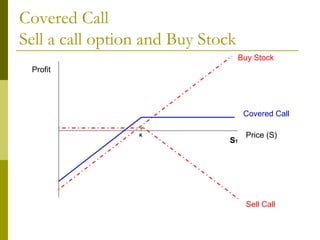
Covered Call  Sell a call option and Buy Stock Profit Price (S) K S T Sell Call Covered Call Buy Stock
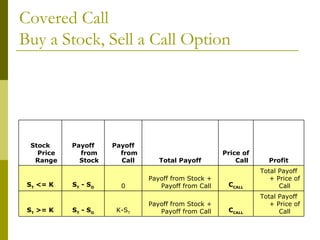
Covered Call  Buy a Stock, Sell a Call Option  Total Payoff + Price of Call C CALL Payoff from Stock + Payoff from Call K-S T S T  - S O S T  >= K Total Payoff + Price of Call C CALL Payoff from Stock + Payoff from Call 0 S T  - S O S T  <= K Profit Price of Call Total Payoff Payoff from Call  Payoff from Stock Stock Price Range
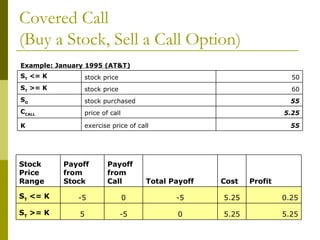
Covered Call  (Buy a Stock, Sell a Call Option)  55 exercise price of call K 5.25 price of call C CALL 55 stock purchased S O 60 stock price S T  >= K 50 stock price S T  <= K Example: January 1995 (AT&T) 5.25 5.25 0 -5 5 S T  >= K 0.25 5.25 -5 0 -5 S T  <= K Profit Cost Total Payoff Payoff from Call  Payoff from Stock Stock Price Range
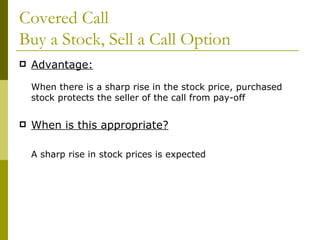
Covered Call  Buy a Stock, Sell a Call Option Advantage: When there is a sharp rise in the stock price, purchased stock protects the seller of the call from pay-off When is this appropriate? A sharp rise in stock prices is expected
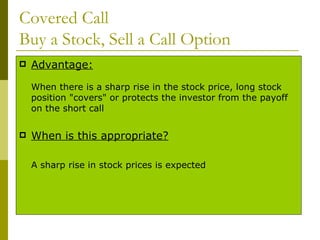
Covered Call  Buy a Stock, Sell a Call Option Advantage: When there is a sharp rise in the stock price, long stock position &quot;covers&quot; or protects the investor from the payoff on the short call When is this appropriate? A sharp rise in stock prices is expected
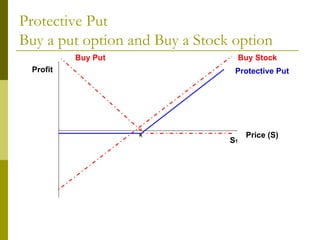
Protective Put Buy a put option and Buy a Stock option Profit Price (S) K S T Buy Put Protective Put Buy Stock
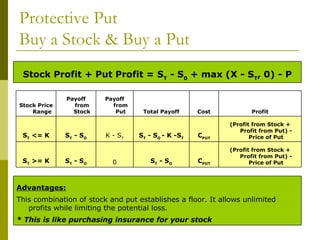
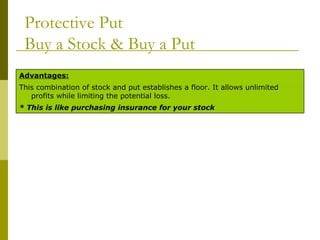
Protective Put  Buy a Stock & Buy a Put Stock Profit + Put Profit = S T  - S 0  + max (X - S T , 0) - P (Profit from Stock + Profit from Put) - Price of Put C PUT S T  - S O 0 S T  - S O S T  >= K (Profit from Stock + Profit from Put) - Price of Put C PUT S T  - S O  - K -S T K - S T S T  - S O S T  <= K Profit Cost Total Payoff Payoff from Put Payoff from Stock Stock Price Range * This is like purchasing insurance for your stock This combination of stock and put establishes a floor. It allows unlimited profits while limiting the potential loss. Advantages:
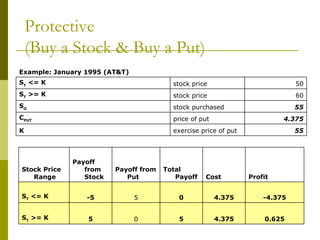
Protective  (Buy a Stock & Buy a Put) 55 exercise price of put K 4.375 price of put C PUT 55 stock purchased S O 60 stock price S T  >= K 50 stock price S T  <= K Example: January 1995 (AT&T) 0.625 4.375 5 0 5 S T  >= K -4.375 4.375 0 5 -5 S T  <= K Profit Cost Total Payoff Payoff from Put Payoff from Stock Stock Price Range
Protective Put Buy a Stock & Buy a Put * This is like purchasing insurance for your stock This combination of stock and put establishes a floor. It allows unlimited profits while limiting the potential loss. Advantages:
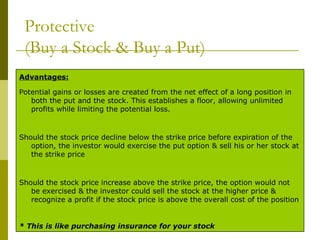
Protective  (Buy a Stock & Buy a Put) * This is like purchasing insurance for your stock   Should the stock price increase above the strike price, the option would not be exercised & the investor could sell the stock at the higher price & recognize a profit if the stock price is above the overall cost of the position   Should the stock price decline below the strike price before expiration of the option, the investor would exercise the put option & sell his or her stock at the strike price   Potential gains or losses are created from the net effect of a long position in both the put and the stock. This establishes a floor, allowing unlimited profits while limiting the potential loss. Advantages:
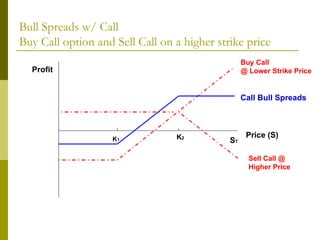
Bull Spreads w/ Call  Buy Call option and Sell Call on a higher strike price Profit Price (S) K 1 S T Sell Call @ Higher Price Call Bull Spreads Buy Call  @ Lower Strike Price K 2
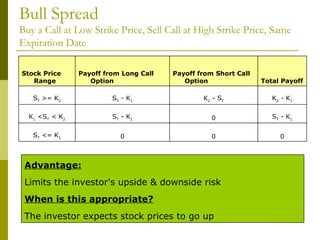
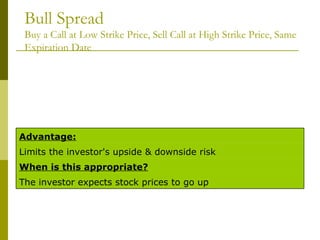
Bull Spread Buy a Call at Low Strike Price, Sell Call at High Strike Price, Same Expiration Date 0 0 0 S T  <= K 1 S T  - K 1 0 S T  - K 1 K 1  <S T  < K 2 K 2  - K 1 K 2  - S T S T  - K 1 S T  >= K 2 Total Payoff Payoff from Short Call Option Payoff from Long Call Option Stock Price Range The investor expects stock prices to go up When is this appropriate? Limits the investor's upside & downside risk Advantage:
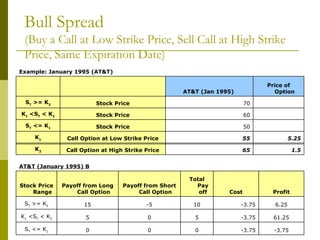
Bull Spread (Buy a Call at Low Strike Price, Sell Call at High Strike Price, Same Expiration Date) 1.5 65 Call Option at High Strike Price K 2 5.25 55 Call Option at Low Strike Price K 1   50 Stock Price S T  <= K 1   60 Stock Price K 1  <S T  < K 2   70 Stock Price S T  >= K 2 Price of Option AT&T (Jan 1995)      Example: January 1995 (AT&T) -3.75 -3.75 0 0 0 S T  <= K 1 61.25 -3.75 5 0 5 K 1  <S T  < K 2 6.25 -3.75 10 -5 15 S T  >= K 2 Profit Cost Total Payoff Payoff from Short Call Option Payoff from Long Call Option Stock Price Range AT&T (January 1995) B
Bull Spread Buy a Call at Low Strike Price, Sell Call at High Strike Price, Same Expiration Date The investor expects stock prices to go up When is this appropriate? Limits the investor's upside & downside risk Advantage:
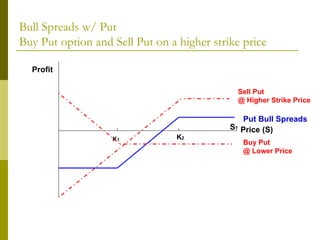
Bull Spreads w/ Put Buy Put option and Sell Put on a higher strike price Profit Price (S) K 1 S T Buy Put  @ Lower Price Put Bull Spreads Sell Put  @ Higher Strike Price K 2
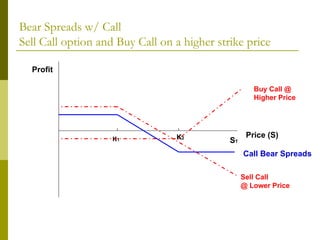
Bear Spreads w/ Call  Sell Call option and Buy Call on a higher strike price Profit Price (S) K 1 S T Buy Call @ Higher Price Call Bear Spreads Sell Call  @ Lower Price K 2
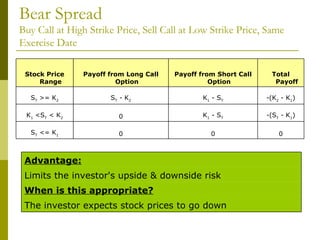
Bear Spread Buy Call at High Strike Price, Sell Call at Low Strike Price, Same Exercise Date 0 0 0 S T  <= K 1 -(S T  - K 1 ) K 1  - S T 0 K 1  <S T  < K 2 -(K 2  - K 1 ) K 1  - S T S T  - K 2 S T  >= K 2 Total Payoff Payoff from Short Call Option Payoff from Long Call Option Stock Price Range The investor expects stock prices to go down When is this appropriate? Limits the investor's upside & downside risk Advantage:
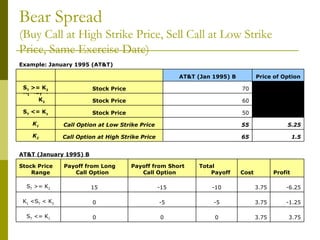
Bear Spread (Buy Call at High Strike Price, Sell Call at Low Strike Price, Same Exercise Date) 1.5 65 Call Option at High Strike Price K 2 5.25 55 Call Option at Low Strike Price K 1   50 Stock Price S T  <= K 1   60 Stock Price K 1  <S T  < K 2   70 Stock Price S T  >= K 2 Price of Option AT&T (Jan 1995) B     Example: January 1995 (AT&T) 3.75 3.75 0 0 0 S T  <= K 1 -1.25 3.75 -5 -5 0 K 1  <S T  < K 2 -6.25 3.75 -10 -15 15 S T  >= K 2 Profit Cost Total Payoff Payoff from Short Call Option Payoff from Long Call Option Stock Price Range AT&T (January 1995) B
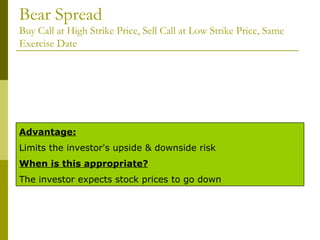
Bear Spread Buy Call at High Strike Price, Sell Call at Low Strike Price, Same Exercise Date The investor expects stock prices to go down When is this appropriate? Limits the investor's upside & downside risk Advantage:
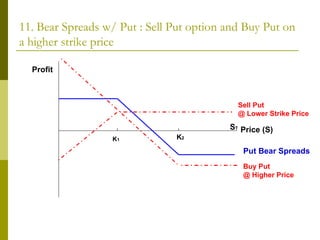
11. Bear Spreads w/ Put : Sell Put option and Buy Put on a higher strike price Profit Price (S) K 1 S T Buy Put  @ Higher Price Put Bear Spreads Sell Put  @ Lower Strike Price K 2
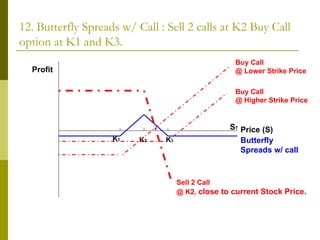
12. Butterfly Spreads w/ Call : Sell 2 calls at K2 Buy Call option at K1 and K3. Profit Price (S) K 1 S T Sell 2 Call  @ K2,  close to current Stock Price.   Butterfly Spreads w/ call Buy Call  @ Higher Strike Price K 3 K 2 Buy Call  @ Lower Strike Price
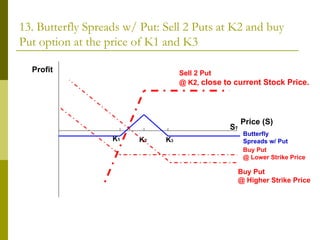
13. Butterfly Spreads w/ Put: Sell 2 Puts at K2 and buy Put option at the price of K1 and K3 Profit Price (S) K 1 S T Sell 2 Put  @ K2,  close to current Stock Price.   Butterfly Spreads w/ Put Buy Put @ Lower Strike Price K 3 K 2 Buy Put @ Higher Strike Price
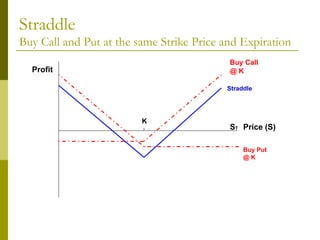
Straddle Buy Call and Put at the same Strike Price and Expiration Profit Price (S) S T Buy Call  @ K Straddle Buy Put @ K K
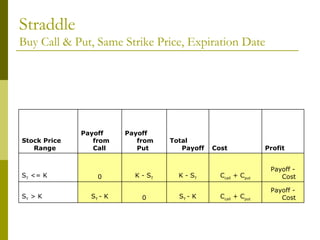
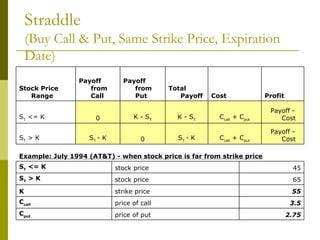
Straddle Buy Call & Put, Same Strike Price, Expiration Date Payoff - Cost C call  + C put S T  - K 0 S T  - K S T  > K Payoff - Cost C call  + C put K - S T K - S T 0 S T  <= K Profit Cost Total Payoff Payoff from Put Payoff from Call Stock Price Range
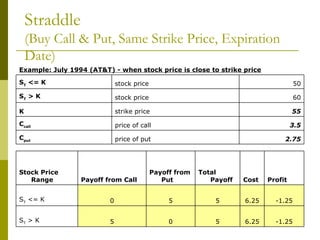
Straddle (Buy Call & Put, Same Strike Price, Expiration Date) 2.75 price of put  C put 3.5 price of call C call 55 strike price K 60 stock price S T  > K 50 stock price S T  <= K Example: July 1994 (AT&T) - when stock price is close to strike price -1.25 6.25 5 0 5 S T  > K -1.25 6.25 5 5 0 S T  <= K Profit Cost Total Payoff Payoff from Put Payoff from Call Stock Price Range
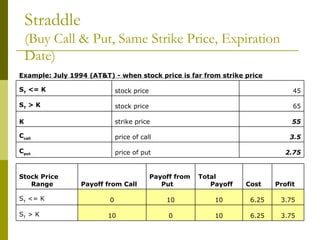
Straddle (Buy Call & Put, Same Strike Price, Expiration Date) Payoff - Cost C call  + C put S T  - K 0 S T  - K S T  > K Payoff - Cost C call  + C put K - S T K - S T 0 S T  <= K Profit Cost Total Payoff Payoff from Put Payoff from Call Stock Price Range 2.75 price of put  C put 3.5 price of call C call 55 strike price K 65 stock price S T  > K 45 stock price S T  <= K Example: July 1994 (AT&T) - when stock price is far from strike price
Straddle (Buy Call & Put, Same Strike Price, Expiration Date) 2.75 price of put  C put 3.5 price of call C call 55 strike price K 65 stock price S T  > K 45 stock price S T  <= K Example: July 1994 (AT&T) - when stock price is far from strike price 3.75 6.25 10 0 10 S T  > K 3.75 6.25 10 10 0 S T  <= K Profit Cost Total Payoff Payoff from Put Payoff from Call Stock Price Range
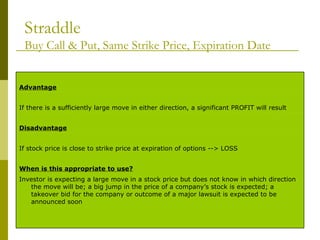
Straddle Buy Call & Put, Same Strike Price, Expiration Date Investor is expecting a large move in a stock price but does not know in which direction the move will be; a big jump in the price of a company’s stock is expected; a takeover bid for the company or outcome of a major lawsuit is expected to be announced soon When is this appropriate to use? If stock price is close to strike price at expiration of options --> LOSS Disadvantage If there is a sufficiently large move in either direction, a significant PROFIT will result Advantage
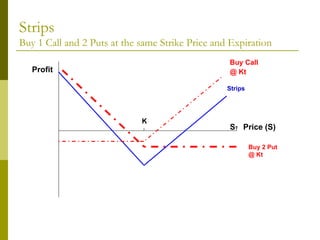
Strips Buy 1 Call and 2 Puts at the same Strike Price and Expiration Profit Price (S) S T Buy Call  @ Kt   Strips Buy 2 Put @ Kt K
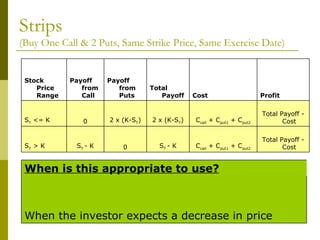
Strips (Buy One Call & 2 Puts, Same Strike Price, Same Exercise Date) Total Payoff - Cost C call  + C put1  + C put2 S T  - K 0 S T  - K S T  > K Total Payoff - Cost C call  + C put1  + C put2 2 x (K-S T ) 2 x (K-S T ) 0 S T  <= K Profit Cost Total Payoff Payoff from Puts Payoff from Call Stock Price Range When the investor expects a decrease in price When is this appropriate to use?
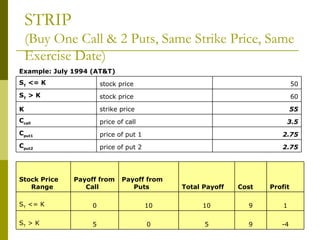
STRIP (Buy One Call & 2 Puts, Same Strike Price, Same Exercise Date) 2.75 price of put 2 C put2 2.75 price of put 1 C put1 3.5 price of call C call 55 strike price K 60 stock price S T  > K 50 stock price S T  <= K Example: July 1994 (AT&T) -4 9 5 0 5 S T  > K 1 9 10 10 0 S T  <= K Profit Cost Total Payoff Payoff from Puts Payoff from Call Stock Price Range
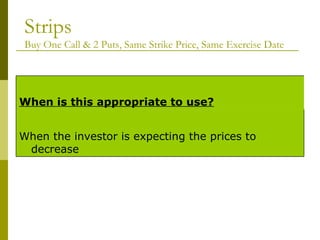
Strips Buy One Call & 2 Puts, Same Strike Price, Same Exercise Date When the investor is expecting the prices to decrease When is this appropriate to use?
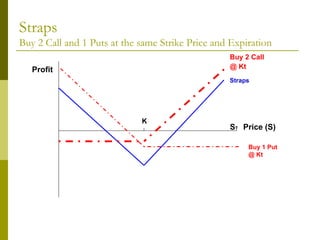
Straps   Buy 2 Call and 1 Puts at the same Strike Price and Expiration Profit Price (S) S T Buy 2 Call  @ Kt   Straps Buy 1 Put @ Kt K
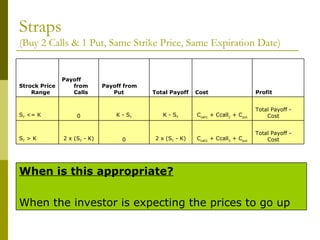
Straps (Buy 2 Calls & 1 Put, Same Strike Price, Same Expiration Date) Total Payoff - Cost C call1  + Ccall 2  + C put 2 x (S T  - K) 0 2 x (S T  - K) S T  > K Total Payoff - Cost C call1  + Ccall 2  + C put K - S T K - S T 0 S T  <= K Profit Cost Total Payoff Payoff from Put Payoff from Calls Strock Price Range When the investor is expecting the prices to go up When is this appropriate?
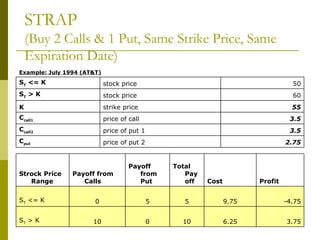
STRAP (Buy 2 Calls & 1 Put, Same Strike Price, Same Expiration Date) 2.75 price of put 2 C put 3.5 price of put 1 C call2 3.5 price of call C call1 55 strike price K 60 stock price S T  > K 50 stock price S T  <= K Example: July 1994 (AT&T) 3.75 6.25 10 0 10 S T  > K -4.75 9.75 5 5 0 S T  <= K Profit Cost Total Payoff Payoff from Put Payoff from Calls Strock Price Range
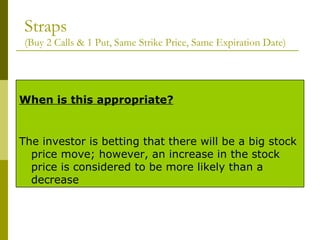
Straps (Buy 2 Calls & 1 Put, Same Strike Price, Same Expiration Date) The investor is betting that there will be a big stock price move; however, an increase in the stock price is considered to be more likely than a decrease When is this appropriate?
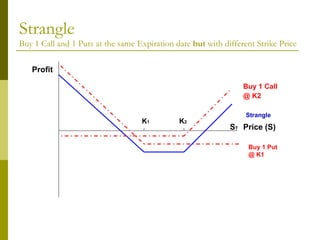
Strangle Buy 1 Call and 1 Puts at the same Expiration date  but  with different Strike Price Profit Price (S) S T Buy 1 Call  @ K2   Strangle Buy 1 Put @ K1 K 1 K 2
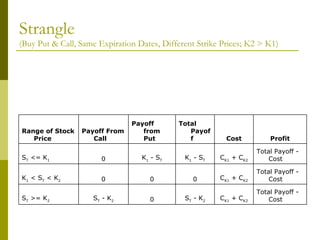
Strangle  (Buy Put & Call, Same Expiration Dates, Different Strike Prices; K2 > K1) Total Payoff - Cost C K1  + C K2 S T  - K 2 0 S T  - K 2 S T  >= K 2 Total Payoff - Cost C K1  + C K2 0 0 0 K 1  < S T  < K 2 Total Payoff - Cost C K1  + C K2 K 1  - S T K 1  - S T 0 S T  <= K 1 Profit Cost Total Payoff Payoff from Put Payoff From Call Range of Stock Price
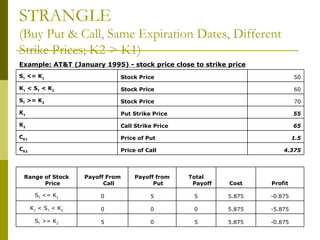
STRANGLE  (Buy Put & Call, Same Expiration Dates, Different Strike Prices; K2 > K1) 4.375 Price of Call C K2 1.5 Price of Put C K1 65 Call Strike Price K 2 55 Put Strike Price K 1 70 Stock Price S T  >= K 2 60 Stock Price K 1  < S T  < K 2 50 Stock Price S T  <= K 1 Example: AT&T (January 1995) - stock price close to strike price -0.875 5.875 5 0 5 S T  >= K 2 -5.875 5.875 0 0 0 K 1  < S T  < K 2 -0.875 5.875 5 5 0 S T  <= K 1 Profit Cost Total Payoff Payoff from Put Payoff From Call Range of Stock Price
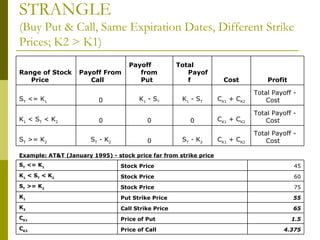
STRANGLE  (Buy Put & Call, Same Expiration Dates, Different Strike Prices; K2 > K1) Total Payoff - Cost C K1  + C K2 S T  - K 2 0 S T  - K 2 S T  >= K 2 Total Payoff - Cost C K1  + C K2 0 0 0 K 1  < S T  < K 2 Total Payoff - Cost C K1  + C K2 K 1  - S T K 1  - S T 0 S T  <= K 1 Profit Cost Total Payoff Payoff from Put Payoff From Call Range of Stock Price 4.375 Price of Call C K2 1.5 Price of Put C K1 65 Call Strike Price K 2 55 Put Strike Price K 1 75 Stock Price S T  >= K 2 60 Stock Price K 1  < S T  < K 2 45 Stock Price S T  <= K 1 Example: AT&T (January 1995) - stock price far from strike price
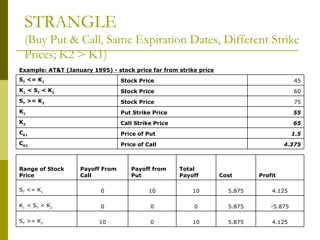
STRANGLE  (Buy Put & Call, Same Expiration Dates, Different Strike Prices; K2 > K1) 4.375 Price of Call C K2 1.5 Price of Put C K1 65 Call Strike Price K 2 55 Put Strike Price K 1 75 Stock Price S T  >= K 2 60 Stock Price K 1  < S T  < K 2 45 Stock Price S T  <= K 1 Example: AT&T (January 1995) - stock price far from strike price 4.125 5.875 10 0 10 S T  >= K 2 -5.875 5.875 0 0 0 K 1  < S T  < K 2 4.125 5.875 10 10 0 S T  <= K 1 Profit Cost Total Payoff Payoff from Put Payoff From Call Range of Stock Price
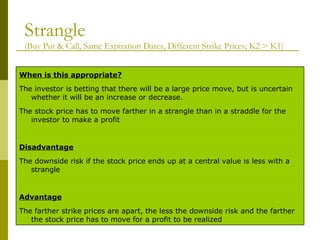
Strangle   (Buy Put & Call, Same Expiration Dates, Different Strike Prices; K2 > K1) The farther strike prices are apart, the less the downside risk and the farther the stock price has to move for a profit to be realized Advantage   The downside risk if the stock price ends up at a central value is less with a strangle Disadvantage   The stock price has to move farther in a strangle than in a straddle for the investor to make a profit The investor is betting that there will be a large price move, but is uncertain whether it will be an increase or decrease. When is this appropriate?

Options Trading Strategies

  • 1.
    The Option InvestmentStrategies Mayank Bhatia Sandri Supardi Gail Yambao
  • 2.
    Options Options: contract giving the buyer right, but not obligation to buy or sell the underlying asset at a certain price on/before the certain date. Two types of Options: Call Option: Gives the holder right to buy an assets at certain price within the specific period of time. Put Option: Gives the holder right to sell an assets at certain price within the specific period of time.
  • 3.
    Options Trading StrategiesSingle Option & a Stock Covered Call Protective Put Spreads Bull Spread Bear Spread Butterfly Spread Calendar Spread Combinations Strip Strap Straddle Strangle
  • 4.
    Buy the stockof a listed company Profit Price (S) K S T
  • 5.
    Buy a calloption Profit Price (S) K S T Call option price
  • 6.
    Buy a CallOption Payoff - Cost C 0 S T - K S T > K Payoff - Cost C 0 0 S T <= K Profit Cost Payoff Stock Price Range Call profit = max (0, S T - X) - C 0
  • 7.
    Buy a CallOption When is this appropriate? Stock prices are expected to go up 1.5 3.5 5 S T > K -3.5 3.5 0 S T <= K Profit Cost Payoff Stock Price Range 3.5 Call Price C 0 55 Strike Price K 60 Stock Price S T > K 50 Stock Price S T <= K Example: AT&T (July 1994)
  • 8.
    Sell a calloption Profit Price (S) K S T Call option price
  • 9.
    Sell a CallOption Call writer's profit = C 0 - max (0, S T - X) Payoff + Cost C 0 K - S T S T > K Payoff + Cost C 0 0 S T <= K Profit Price of Call Payoff Stock Price Range
  • 10.
    Sell a CallOption 3.5 Call Price C 0 55 Strike Price K 60 Stock Price S T > K 50 Stock Price S T <= K Example: AT&T (July 1994) -1.5 3.5 55 S T > K 3.5 3.5 0 S T <= K Profit Price of Call Payoff Stock Price Range
  • 11.
    Buy a PutOption Profit Price (S) K S T Call option price
  • 12.
    Buy a PutOption Put Profit = max(0, X - S T ) - P 0 When is this appropriate? When we expect prices to go down Payoff - Cost C 0 0 S T > K Payoff - Cost C 0 K - S T S T <= K Profit Cost Payoff Stock Price Range
  • 13.
    Buy a PutOption When is this appropriate? When we expect prices to go down 2.75   Put Price C 0 55   Strike Price K 60   Stock Price S T > K 50   Stock Price S T <= K Example: AT&T (July 1994) -2.75 2.75 0 S T > K 2.25 2.75 5 S T <= K Profit Cost Payoff Stock Price Range
  • 14.
    Sell a Putoption Profit Price (S) K S T Call option price
  • 15.
    Sell a PutOption Put Profit = P 0 - max(0, X - S T ) Payoff + Price of Put P 0 0 S T > K Payoff + Price of Put P 0 ST - K S T <= K Profit Price Payoff Stock Price Range
  • 16.
    Sell a PutOption 2.75   Put Price C 0 55   Strike Price K 60   Stock Price S T > K 50   Stock Price S T <= K Example: AT&T (July 1994) 2.75 2.75 0 S T > K -2.25 2.75 -5 S T <= K Profit Cost Payoff Stock Price Range
  • 17.
    Covered Call Sell a call option and Buy Stock Profit Price (S) K S T Sell Call Covered Call Buy Stock
  • 18.
    Covered Call Buy a Stock, Sell a Call Option Total Payoff + Price of Call C CALL Payoff from Stock + Payoff from Call K-S T S T - S O S T >= K Total Payoff + Price of Call C CALL Payoff from Stock + Payoff from Call 0 S T - S O S T <= K Profit Price of Call Total Payoff Payoff from Call Payoff from Stock Stock Price Range
  • 19.
    Covered Call (Buy a Stock, Sell a Call Option) 55 exercise price of call K 5.25 price of call C CALL 55 stock purchased S O 60 stock price S T >= K 50 stock price S T <= K Example: January 1995 (AT&T) 5.25 5.25 0 -5 5 S T >= K 0.25 5.25 -5 0 -5 S T <= K Profit Cost Total Payoff Payoff from Call Payoff from Stock Stock Price Range
  • 20.
    Covered Call Buy a Stock, Sell a Call Option Advantage: When there is a sharp rise in the stock price, purchased stock protects the seller of the call from pay-off When is this appropriate? A sharp rise in stock prices is expected
  • 21.
    Covered Call Buy a Stock, Sell a Call Option Advantage: When there is a sharp rise in the stock price, long stock position &quot;covers&quot; or protects the investor from the payoff on the short call When is this appropriate? A sharp rise in stock prices is expected
  • 22.
    Protective Put Buya put option and Buy a Stock option Profit Price (S) K S T Buy Put Protective Put Buy Stock
  • 23.
    Protective Put Buy a Stock & Buy a Put Stock Profit + Put Profit = S T - S 0 + max (X - S T , 0) - P (Profit from Stock + Profit from Put) - Price of Put C PUT S T - S O 0 S T - S O S T >= K (Profit from Stock + Profit from Put) - Price of Put C PUT S T - S O - K -S T K - S T S T - S O S T <= K Profit Cost Total Payoff Payoff from Put Payoff from Stock Stock Price Range * This is like purchasing insurance for your stock This combination of stock and put establishes a floor. It allows unlimited profits while limiting the potential loss. Advantages:
  • 24.
    Protective (Buya Stock & Buy a Put) 55 exercise price of put K 4.375 price of put C PUT 55 stock purchased S O 60 stock price S T >= K 50 stock price S T <= K Example: January 1995 (AT&T) 0.625 4.375 5 0 5 S T >= K -4.375 4.375 0 5 -5 S T <= K Profit Cost Total Payoff Payoff from Put Payoff from Stock Stock Price Range
  • 25.
    Protective Put Buya Stock & Buy a Put * This is like purchasing insurance for your stock This combination of stock and put establishes a floor. It allows unlimited profits while limiting the potential loss. Advantages:
  • 26.
    Protective (Buya Stock & Buy a Put) * This is like purchasing insurance for your stock   Should the stock price increase above the strike price, the option would not be exercised & the investor could sell the stock at the higher price & recognize a profit if the stock price is above the overall cost of the position   Should the stock price decline below the strike price before expiration of the option, the investor would exercise the put option & sell his or her stock at the strike price   Potential gains or losses are created from the net effect of a long position in both the put and the stock. This establishes a floor, allowing unlimited profits while limiting the potential loss. Advantages:
  • 27.
    Bull Spreads w/Call Buy Call option and Sell Call on a higher strike price Profit Price (S) K 1 S T Sell Call @ Higher Price Call Bull Spreads Buy Call @ Lower Strike Price K 2
  • 28.
    Bull Spread Buya Call at Low Strike Price, Sell Call at High Strike Price, Same Expiration Date 0 0 0 S T <= K 1 S T - K 1 0 S T - K 1 K 1 <S T < K 2 K 2 - K 1 K 2 - S T S T - K 1 S T >= K 2 Total Payoff Payoff from Short Call Option Payoff from Long Call Option Stock Price Range The investor expects stock prices to go up When is this appropriate? Limits the investor's upside & downside risk Advantage:
  • 29.
    Bull Spread (Buya Call at Low Strike Price, Sell Call at High Strike Price, Same Expiration Date) 1.5 65 Call Option at High Strike Price K 2 5.25 55 Call Option at Low Strike Price K 1   50 Stock Price S T <= K 1   60 Stock Price K 1 <S T < K 2   70 Stock Price S T >= K 2 Price of Option AT&T (Jan 1995)     Example: January 1995 (AT&T) -3.75 -3.75 0 0 0 S T <= K 1 61.25 -3.75 5 0 5 K 1 <S T < K 2 6.25 -3.75 10 -5 15 S T >= K 2 Profit Cost Total Payoff Payoff from Short Call Option Payoff from Long Call Option Stock Price Range AT&T (January 1995) B
  • 30.
    Bull Spread Buya Call at Low Strike Price, Sell Call at High Strike Price, Same Expiration Date The investor expects stock prices to go up When is this appropriate? Limits the investor's upside & downside risk Advantage:
  • 31.
    Bull Spreads w/Put Buy Put option and Sell Put on a higher strike price Profit Price (S) K 1 S T Buy Put @ Lower Price Put Bull Spreads Sell Put @ Higher Strike Price K 2
  • 32.
    Bear Spreads w/Call Sell Call option and Buy Call on a higher strike price Profit Price (S) K 1 S T Buy Call @ Higher Price Call Bear Spreads Sell Call @ Lower Price K 2
  • 33.
    Bear Spread BuyCall at High Strike Price, Sell Call at Low Strike Price, Same Exercise Date 0 0 0 S T <= K 1 -(S T - K 1 ) K 1 - S T 0 K 1 <S T < K 2 -(K 2 - K 1 ) K 1 - S T S T - K 2 S T >= K 2 Total Payoff Payoff from Short Call Option Payoff from Long Call Option Stock Price Range The investor expects stock prices to go down When is this appropriate? Limits the investor's upside & downside risk Advantage:
  • 34.
    Bear Spread (BuyCall at High Strike Price, Sell Call at Low Strike Price, Same Exercise Date) 1.5 65 Call Option at High Strike Price K 2 5.25 55 Call Option at Low Strike Price K 1   50 Stock Price S T <= K 1   60 Stock Price K 1 <S T < K 2   70 Stock Price S T >= K 2 Price of Option AT&T (Jan 1995) B     Example: January 1995 (AT&T) 3.75 3.75 0 0 0 S T <= K 1 -1.25 3.75 -5 -5 0 K 1 <S T < K 2 -6.25 3.75 -10 -15 15 S T >= K 2 Profit Cost Total Payoff Payoff from Short Call Option Payoff from Long Call Option Stock Price Range AT&T (January 1995) B
  • 35.
    Bear Spread BuyCall at High Strike Price, Sell Call at Low Strike Price, Same Exercise Date The investor expects stock prices to go down When is this appropriate? Limits the investor's upside & downside risk Advantage:
  • 36.
    11. Bear Spreadsw/ Put : Sell Put option and Buy Put on a higher strike price Profit Price (S) K 1 S T Buy Put @ Higher Price Put Bear Spreads Sell Put @ Lower Strike Price K 2
  • 37.
    12. Butterfly Spreadsw/ Call : Sell 2 calls at K2 Buy Call option at K1 and K3. Profit Price (S) K 1 S T Sell 2 Call @ K2, close to current Stock Price. Butterfly Spreads w/ call Buy Call @ Higher Strike Price K 3 K 2 Buy Call @ Lower Strike Price
  • 38.
    13. Butterfly Spreadsw/ Put: Sell 2 Puts at K2 and buy Put option at the price of K1 and K3 Profit Price (S) K 1 S T Sell 2 Put @ K2, close to current Stock Price. Butterfly Spreads w/ Put Buy Put @ Lower Strike Price K 3 K 2 Buy Put @ Higher Strike Price
  • 39.
    Straddle Buy Calland Put at the same Strike Price and Expiration Profit Price (S) S T Buy Call @ K Straddle Buy Put @ K K
  • 40.
    Straddle Buy Call& Put, Same Strike Price, Expiration Date Payoff - Cost C call + C put S T - K 0 S T - K S T > K Payoff - Cost C call + C put K - S T K - S T 0 S T <= K Profit Cost Total Payoff Payoff from Put Payoff from Call Stock Price Range
  • 41.
    Straddle (Buy Call& Put, Same Strike Price, Expiration Date) 2.75 price of put C put 3.5 price of call C call 55 strike price K 60 stock price S T > K 50 stock price S T <= K Example: July 1994 (AT&T) - when stock price is close to strike price -1.25 6.25 5 0 5 S T > K -1.25 6.25 5 5 0 S T <= K Profit Cost Total Payoff Payoff from Put Payoff from Call Stock Price Range
  • 42.
    Straddle (Buy Call& Put, Same Strike Price, Expiration Date) Payoff - Cost C call + C put S T - K 0 S T - K S T > K Payoff - Cost C call + C put K - S T K - S T 0 S T <= K Profit Cost Total Payoff Payoff from Put Payoff from Call Stock Price Range 2.75 price of put C put 3.5 price of call C call 55 strike price K 65 stock price S T > K 45 stock price S T <= K Example: July 1994 (AT&T) - when stock price is far from strike price
  • 43.
    Straddle (Buy Call& Put, Same Strike Price, Expiration Date) 2.75 price of put C put 3.5 price of call C call 55 strike price K 65 stock price S T > K 45 stock price S T <= K Example: July 1994 (AT&T) - when stock price is far from strike price 3.75 6.25 10 0 10 S T > K 3.75 6.25 10 10 0 S T <= K Profit Cost Total Payoff Payoff from Put Payoff from Call Stock Price Range
  • 44.
    Straddle Buy Call& Put, Same Strike Price, Expiration Date Investor is expecting a large move in a stock price but does not know in which direction the move will be; a big jump in the price of a company’s stock is expected; a takeover bid for the company or outcome of a major lawsuit is expected to be announced soon When is this appropriate to use? If stock price is close to strike price at expiration of options --> LOSS Disadvantage If there is a sufficiently large move in either direction, a significant PROFIT will result Advantage
  • 45.
    Strips Buy 1Call and 2 Puts at the same Strike Price and Expiration Profit Price (S) S T Buy Call @ Kt Strips Buy 2 Put @ Kt K
  • 46.
    Strips (Buy OneCall & 2 Puts, Same Strike Price, Same Exercise Date) Total Payoff - Cost C call + C put1 + C put2 S T - K 0 S T - K S T > K Total Payoff - Cost C call + C put1 + C put2 2 x (K-S T ) 2 x (K-S T ) 0 S T <= K Profit Cost Total Payoff Payoff from Puts Payoff from Call Stock Price Range When the investor expects a decrease in price When is this appropriate to use?
  • 47.
    STRIP (Buy OneCall & 2 Puts, Same Strike Price, Same Exercise Date) 2.75 price of put 2 C put2 2.75 price of put 1 C put1 3.5 price of call C call 55 strike price K 60 stock price S T > K 50 stock price S T <= K Example: July 1994 (AT&T) -4 9 5 0 5 S T > K 1 9 10 10 0 S T <= K Profit Cost Total Payoff Payoff from Puts Payoff from Call Stock Price Range
  • 48.
    Strips Buy OneCall & 2 Puts, Same Strike Price, Same Exercise Date When the investor is expecting the prices to decrease When is this appropriate to use?
  • 49.
    Straps Buy 2 Call and 1 Puts at the same Strike Price and Expiration Profit Price (S) S T Buy 2 Call @ Kt Straps Buy 1 Put @ Kt K
  • 50.
    Straps (Buy 2Calls & 1 Put, Same Strike Price, Same Expiration Date) Total Payoff - Cost C call1 + Ccall 2 + C put 2 x (S T - K) 0 2 x (S T - K) S T > K Total Payoff - Cost C call1 + Ccall 2 + C put K - S T K - S T 0 S T <= K Profit Cost Total Payoff Payoff from Put Payoff from Calls Strock Price Range When the investor is expecting the prices to go up When is this appropriate?
  • 51.
    STRAP (Buy 2Calls & 1 Put, Same Strike Price, Same Expiration Date) 2.75 price of put 2 C put 3.5 price of put 1 C call2 3.5 price of call C call1 55 strike price K 60 stock price S T > K 50 stock price S T <= K Example: July 1994 (AT&T) 3.75 6.25 10 0 10 S T > K -4.75 9.75 5 5 0 S T <= K Profit Cost Total Payoff Payoff from Put Payoff from Calls Strock Price Range
  • 52.
    Straps (Buy 2Calls & 1 Put, Same Strike Price, Same Expiration Date) The investor is betting that there will be a big stock price move; however, an increase in the stock price is considered to be more likely than a decrease When is this appropriate?
  • 53.
    Strangle Buy 1Call and 1 Puts at the same Expiration date but with different Strike Price Profit Price (S) S T Buy 1 Call @ K2 Strangle Buy 1 Put @ K1 K 1 K 2
  • 54.
    Strangle (BuyPut & Call, Same Expiration Dates, Different Strike Prices; K2 > K1) Total Payoff - Cost C K1 + C K2 S T - K 2 0 S T - K 2 S T >= K 2 Total Payoff - Cost C K1 + C K2 0 0 0 K 1 < S T < K 2 Total Payoff - Cost C K1 + C K2 K 1 - S T K 1 - S T 0 S T <= K 1 Profit Cost Total Payoff Payoff from Put Payoff From Call Range of Stock Price
  • 55.
    STRANGLE (BuyPut & Call, Same Expiration Dates, Different Strike Prices; K2 > K1) 4.375 Price of Call C K2 1.5 Price of Put C K1 65 Call Strike Price K 2 55 Put Strike Price K 1 70 Stock Price S T >= K 2 60 Stock Price K 1 < S T < K 2 50 Stock Price S T <= K 1 Example: AT&T (January 1995) - stock price close to strike price -0.875 5.875 5 0 5 S T >= K 2 -5.875 5.875 0 0 0 K 1 < S T < K 2 -0.875 5.875 5 5 0 S T <= K 1 Profit Cost Total Payoff Payoff from Put Payoff From Call Range of Stock Price
  • 56.
    STRANGLE (BuyPut & Call, Same Expiration Dates, Different Strike Prices; K2 > K1) Total Payoff - Cost C K1 + C K2 S T - K 2 0 S T - K 2 S T >= K 2 Total Payoff - Cost C K1 + C K2 0 0 0 K 1 < S T < K 2 Total Payoff - Cost C K1 + C K2 K 1 - S T K 1 - S T 0 S T <= K 1 Profit Cost Total Payoff Payoff from Put Payoff From Call Range of Stock Price 4.375 Price of Call C K2 1.5 Price of Put C K1 65 Call Strike Price K 2 55 Put Strike Price K 1 75 Stock Price S T >= K 2 60 Stock Price K 1 < S T < K 2 45 Stock Price S T <= K 1 Example: AT&T (January 1995) - stock price far from strike price
  • 57.
    STRANGLE (BuyPut & Call, Same Expiration Dates, Different Strike Prices; K2 > K1) 4.375 Price of Call C K2 1.5 Price of Put C K1 65 Call Strike Price K 2 55 Put Strike Price K 1 75 Stock Price S T >= K 2 60 Stock Price K 1 < S T < K 2 45 Stock Price S T <= K 1 Example: AT&T (January 1995) - stock price far from strike price 4.125 5.875 10 0 10 S T >= K 2 -5.875 5.875 0 0 0 K 1 < S T < K 2 4.125 5.875 10 10 0 S T <= K 1 Profit Cost Total Payoff Payoff from Put Payoff From Call Range of Stock Price
  • 58.
    Strangle (Buy Put & Call, Same Expiration Dates, Different Strike Prices; K2 > K1) The farther strike prices are apart, the less the downside risk and the farther the stock price has to move for a profit to be realized Advantage   The downside risk if the stock price ends up at a central value is less with a strangle Disadvantage   The stock price has to move farther in a strangle than in a straddle for the investor to make a profit The investor is betting that there will be a large price move, but is uncertain whether it will be an increase or decrease. When is this appropriate?