GROUP NAME:

THE TRIO
GROUP MEMBERS:
NEELAM
FATIMA
BENISH
INTRODUCTION TO
DERIVATIVES
Derivatives are the financial instruments which
derive their value from the value of the underlying
asset.
HISTORY:
 Derivatives markets can be traced back to middle ages. They
were developed to meet the needs of farmers and merchants.
First future exchange was established in Japan in 16th century.
The Chicago Board of Trade was established in 1848.The
international Monetary market was established in 1972 for
future trading in foreign currencies
Players in the derivatives market?
 Hedgers
 Speculators
 Arbitrageurs
HEDGER
 A hedger is someone who faces risk associated with
price movement of an asset and who uses derivatives
as means of reducing risk.
 Definitions
 long
position:
or owned

an

asset

which

is

purchased

 short position: an asset which must be delivered to a third party as a
future date, or an asset which is borrowed and sold, but must be
replaced in the future

 Hedging risk involves engaging in a financial transaction that
offsets a long position by taking an additional short position,
or offsets a short position by taking an additional long
position.
SPECULATOR
 Speculators use derivatives to bet on the future
direction of the markets. Their objective is to
gain when the prices move as per their
expectation.
 3 types based on duration
i. SCALPERS – hold for very short time (in
minutes)
ii. DAY TRADERS- one trading day
iii.POSITION TRADERS- long period (week,
month, a year).
ARBITRAGERS

 Arbitrageurs try to make risk-less profit by
simultaneously entering in to transactions in two or
more market.
 Arbitrageurs assist in proper price discovery and
correct price abnormalities.
NEXT PRESENTER
FATIMA
TYPES OF FINANCIAL DERIVATIVE
Forward

Futures
Options
FORWARD CONTRACT

A forward is an agreement between two counterparties - a
buyer and seller. The buyer agrees to buy an underlying asset
from the other party (the seller). The delivery of the asset
occurs at a later time, but the price is determined at the time of
purchase.
FUTURES CONTRACT
A futures contract is an agreement that requires a
party to the agreement either to buy or sell something
at a designated future date at a predetermined price.

Futures contracts are categorized as either
commodity futures
or
financial
futures.
Commodity futures involve traditional agricultural
commodities (such as grain and livestock), imported
foodstuffs (such as coffee, cocoa, and sugar), and
industrial commodities.
WHO DO YOU USE FUTURES
CONTRACTS MARKETS?

Hedgers

Speculators
MECHANICS OF FUTURES TRADING
A futures contract is a firm legal agreement between a
buyer and an established exchange or its
clearinghouse in which the buyer agrees to take
delivery of something at a specified price at the end
of a designated period of time.
The price at which the parties agree to transact in the
future is called the futures price.
The designated date at which the parties must transact
is called the settlement date.
LIQUIDATING A POSITION

Most financial futures contracts have settlement dates
in the months of March, June, September, or
December.
The contract with the closest settlement date is called
the nearby futures contract.
The contract farthest away in time from the
settlement is called the most distant futures contract.
Choices of liquidation
A party to a futures contract has two choices on
liquidation of the position.
First, the position can be liquidated prior to the
settlement date.
The alternative is to wait until the settlement date.
DAILY PRICE LIMITS

The exchange has the right to impose a limit on the
daily price movement of a futures contract from the
previous session's closing price.
RISK AND RETURN CHARACTERISTICS OF
FUTURES CONTRACTS
Long futures: An investor whose opening position is the
purchase of a futures contract

Short futures: An investor whose opening position is the
sale of a futures contract.

The long will realize a profit if the futures price increases.

The short will realize a profit if the futures price decreases
NEXT PRESENTER
BENISH
OPTIONS
Option is basically an instrument that is traded at the derivative
segment in stock market. Option is a contract between the buyer
and seller to buy or sell a one or more lot of underlying asset at a
fixed price on or before the expiry date of the contract.
TYPES OF OPTIONS
There are mainly two types of option contact
that you can buy or sell at the stock market.
 Call Option
 Put Option
CALL OPTION
“ A call gives the holder the right to buy an asset at a certain
price within a specific period of time or certain date of time.”
 Certain price
 Certain date
PUT OPTION

“A put gives the holder the right to sell an asset at a certain
price within a specific period of time”.
OPTION PREMIUM
The premium is the price at which the contract trades. The
premium is the price of the option and is paid by the buyer to the
writer, or seller, of the option.

Option

premium

=

intrinsic

value

+

time

value
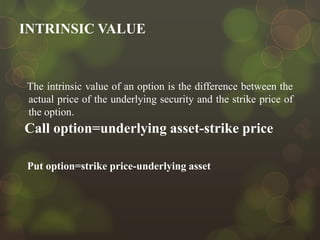
INTRINSIC VALUE

The intrinsic value of an option is the difference between the
actual price of the underlying security and the strike price of
the option.

Call option=underlying asset-strike price
Put option=strike price-underlying asset
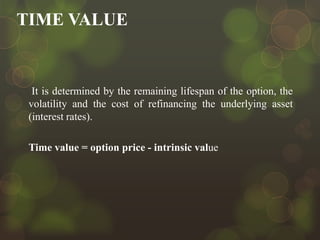
TIME VALUE

It is determined by the remaining lifespan of the option, the
volatility and the cost of refinancing the underlying asset
(interest rates).
Time value = option price - intrinsic value
OPTIONS CONTRACTS
PRELIMINARIES

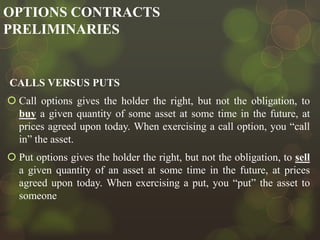
CALLS VERSUS PUTS
 Call options gives the holder the right, but not the obligation, to
buy a given quantity of some asset at some time in the future, at
prices agreed upon today. When exercising a call option, you “call
in” the asset.
 Put options gives the holder the right, but not the obligation, to sell
a given quantity of an asset at some time in the future, at prices
agreed upon today. When exercising a put, you “put” the asset to
someone
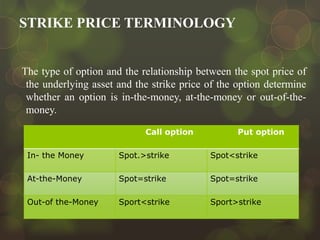
STRIKE PRICE TERMINOLOGY

The type of option and the relationship between the spot price of
the underlying asset and the strike price of the option determine
whether an option is in-the-money, at-the-money or out-of-themoney.
Call option

Put option

In- the Money

Spot.>strike

Spot<strike

At-the-Money

Spot=strike

Spot=strike

Out-of the-Money

Sport<strike

Sport>strike
TRADING & PARTICIPANTS OF OPTIONS
Trading of option
Options are traded both on exchanges and in the over-the-counter
market.
Participant of options
There are four types of participants in options markets.
 Buyers of calls
 Seller of calls
 Buyer of puts
 Seller of puts
DERIVATIVES MARKET IN PAKISTAN
Derivatives Market in Pakistan

Commodity futures contracts have recently been
introduced from the platform of National Commodity
Exchange Limited Karachi. Currently they only trade
in Gold futures and plan to expand the contracts on
agricultural commodities and interest rates.
SBP took initiative in 2004 by granting Authorized
Derivative Dealers (ADD) license to five commercial
banks.
Need & Scope of Derivatives in Pakistan

Volatile financial markets due to:
1. Political Uncertainty

2. Monetary Policy
3. Fiscal Policy
4. Foreign Investment
5. War On Terror
THANK YOU ALL OF YOU

Introduction to derivatives

  • 2.
    GROUP NAME: THE TRIO GROUPMEMBERS: NEELAM FATIMA BENISH
  • 3.
    INTRODUCTION TO DERIVATIVES Derivatives arethe financial instruments which derive their value from the value of the underlying asset.
  • 4.
    HISTORY:  Derivatives marketscan be traced back to middle ages. They were developed to meet the needs of farmers and merchants. First future exchange was established in Japan in 16th century. The Chicago Board of Trade was established in 1848.The international Monetary market was established in 1972 for future trading in foreign currencies
  • 5.
    Players in thederivatives market?  Hedgers  Speculators  Arbitrageurs
  • 6.
    HEDGER  A hedgeris someone who faces risk associated with price movement of an asset and who uses derivatives as means of reducing risk.
  • 7.
     Definitions  long position: orowned an asset which is purchased  short position: an asset which must be delivered to a third party as a future date, or an asset which is borrowed and sold, but must be replaced in the future  Hedging risk involves engaging in a financial transaction that offsets a long position by taking an additional short position, or offsets a short position by taking an additional long position.
  • 8.
    SPECULATOR  Speculators usederivatives to bet on the future direction of the markets. Their objective is to gain when the prices move as per their expectation.  3 types based on duration i. SCALPERS – hold for very short time (in minutes) ii. DAY TRADERS- one trading day iii.POSITION TRADERS- long period (week, month, a year).
  • 9.
    ARBITRAGERS  Arbitrageurs tryto make risk-less profit by simultaneously entering in to transactions in two or more market.  Arbitrageurs assist in proper price discovery and correct price abnormalities.
  • 10.
  • 11.
    TYPES OF FINANCIALDERIVATIVE Forward Futures Options
  • 12.
    FORWARD CONTRACT A forwardis an agreement between two counterparties - a buyer and seller. The buyer agrees to buy an underlying asset from the other party (the seller). The delivery of the asset occurs at a later time, but the price is determined at the time of purchase.
  • 13.
    FUTURES CONTRACT A futurescontract is an agreement that requires a party to the agreement either to buy or sell something at a designated future date at a predetermined price. Futures contracts are categorized as either commodity futures or financial futures. Commodity futures involve traditional agricultural commodities (such as grain and livestock), imported foodstuffs (such as coffee, cocoa, and sugar), and industrial commodities.
  • 14.
    WHO DO YOUUSE FUTURES CONTRACTS MARKETS? Hedgers Speculators
  • 15.
    MECHANICS OF FUTURESTRADING A futures contract is a firm legal agreement between a buyer and an established exchange or its clearinghouse in which the buyer agrees to take delivery of something at a specified price at the end of a designated period of time. The price at which the parties agree to transact in the future is called the futures price. The designated date at which the parties must transact is called the settlement date.
  • 16.
    LIQUIDATING A POSITION Mostfinancial futures contracts have settlement dates in the months of March, June, September, or December. The contract with the closest settlement date is called the nearby futures contract. The contract farthest away in time from the settlement is called the most distant futures contract.
  • 17.
    Choices of liquidation Aparty to a futures contract has two choices on liquidation of the position. First, the position can be liquidated prior to the settlement date. The alternative is to wait until the settlement date.
  • 18.
    DAILY PRICE LIMITS Theexchange has the right to impose a limit on the daily price movement of a futures contract from the previous session's closing price.
  • 19.
    RISK AND RETURNCHARACTERISTICS OF FUTURES CONTRACTS Long futures: An investor whose opening position is the purchase of a futures contract Short futures: An investor whose opening position is the sale of a futures contract. The long will realize a profit if the futures price increases. The short will realize a profit if the futures price decreases
  • 20.
  • 21.
    OPTIONS Option is basicallyan instrument that is traded at the derivative segment in stock market. Option is a contract between the buyer and seller to buy or sell a one or more lot of underlying asset at a fixed price on or before the expiry date of the contract.
  • 22.
    TYPES OF OPTIONS Thereare mainly two types of option contact that you can buy or sell at the stock market.  Call Option  Put Option
  • 23.
    CALL OPTION “ Acall gives the holder the right to buy an asset at a certain price within a specific period of time or certain date of time.”  Certain price  Certain date
  • 24.
    PUT OPTION “A putgives the holder the right to sell an asset at a certain price within a specific period of time”.
  • 25.
    OPTION PREMIUM The premiumis the price at which the contract trades. The premium is the price of the option and is paid by the buyer to the writer, or seller, of the option. Option premium = intrinsic value + time value
  • 26.
    INTRINSIC VALUE The intrinsicvalue of an option is the difference between the actual price of the underlying security and the strike price of the option. Call option=underlying asset-strike price Put option=strike price-underlying asset
  • 27.
    TIME VALUE It isdetermined by the remaining lifespan of the option, the volatility and the cost of refinancing the underlying asset (interest rates). Time value = option price - intrinsic value
  • 28.
    OPTIONS CONTRACTS PRELIMINARIES CALLS VERSUSPUTS  Call options gives the holder the right, but not the obligation, to buy a given quantity of some asset at some time in the future, at prices agreed upon today. When exercising a call option, you “call in” the asset.  Put options gives the holder the right, but not the obligation, to sell a given quantity of an asset at some time in the future, at prices agreed upon today. When exercising a put, you “put” the asset to someone
  • 29.
    STRIKE PRICE TERMINOLOGY Thetype of option and the relationship between the spot price of the underlying asset and the strike price of the option determine whether an option is in-the-money, at-the-money or out-of-themoney. Call option Put option In- the Money Spot.>strike Spot<strike At-the-Money Spot=strike Spot=strike Out-of the-Money Sport<strike Sport>strike
  • 30.
    TRADING & PARTICIPANTSOF OPTIONS Trading of option Options are traded both on exchanges and in the over-the-counter market. Participant of options There are four types of participants in options markets.  Buyers of calls  Seller of calls  Buyer of puts  Seller of puts
  • 31.
  • 32.
    Derivatives Market inPakistan Commodity futures contracts have recently been introduced from the platform of National Commodity Exchange Limited Karachi. Currently they only trade in Gold futures and plan to expand the contracts on agricultural commodities and interest rates. SBP took initiative in 2004 by granting Authorized Derivative Dealers (ADD) license to five commercial banks.
  • 33.
    Need & Scopeof Derivatives in Pakistan Volatile financial markets due to: 1. Political Uncertainty 2. Monetary Policy 3. Fiscal Policy 4. Foreign Investment 5. War On Terror
  • 34.