Currency Derivatives
ADITYA TRADING SOLUTIONS
Presence through more than 200 locations-Pan India
Present across more than 150 Cities & Towns
Total group employees 100 plus
Client Interfaces through the Retail, Wealth and Institutional
spectrums
Among the largest Retail brokerage branch network, going
beyond Tier-I and Tier-II cities in India
What are Currency Derivatives?
 FUTURES: An agreement between two partiesto buy or sell astandard quantity of currency at a
certain timein futureat apredetermined priceon thefloor of an organized futuresexchange.
FutureContractsarespecial typesof forward/OTC contractsin thesensethat futuresarestandardized
exchangetraded contracts.
 OPTIONS: An option isacontract between abuyer and aseller that givesthebuyer of theoption the
right, but not theobligation, to buy or sell aspecified asset (underlying) on or beforetheOptions
expiration time, at an agreed price(thestrikeprice).
 A call option givesthebuyer of theoption theright to buy theunderlying asset by acertain datefor a
certain price.
 A put option givesthebuyer of theoption theright to sell theunderlying asset by acertain datefor a
certain price.
If thebuyer of option choosesto exercisehisright, theseller isobliged to sell or buy theasset at an
agreed price.
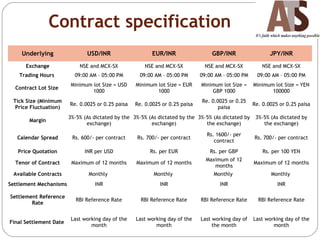
Contract specification
Underlying USD/INR EUR/INR GBP/INR JPY/INR
Exchange NSE and MCX-SX NSE and MCX-SX NSE and MCX-SX NSE and MCX-SX
Trading Hours 09:00 AM – 05:00 PM 09:00 AM – 05:00 PM 09:00 AM – 05:00 PM 09:00 AM – 05:00 PM
Contract Lot Size
Minimum lot Size = USD
1000
Minimum lot Size = EUR
1000
Minimum lot Size =
GBP 1000
Minimum lot Size = YEN
100000
Tick Size (Minimum
Price Fluctuation)
Re. 0.0025 or 0.25 paisa Re. 0.0025 or 0.25 paisa
Re. 0.0025 or 0.25
paisa
Re. 0.0025 or 0.25 paisa
Margin
3%-5% (As dictated by the
exchange)
3%-5% (As dictated by the
exchange)
3%-5% (As dictated by
the exchange)
3%-5% (As dictated by
the exchange)
Calendar Spread Rs. 600/- per contract Rs. 700/- per contract
Rs. 1600/- per
contract
Rs. 700/- per contract
Price Quotation INR per USD Rs. per EUR Rs. per GBP Rs. per 100 YEN
Tenor of Contract Maximum of 12 months Maximum of 12 months
Maximum of 12
months
Maximum of 12 months
Available Contracts Monthly Monthly Monthly Monthly
Settlement Mechanisms INR INR INR INR
Settlement Reference
Rate
RBI Reference Rate RBI Reference Rate RBI Reference Rate RBI Reference Rate
Final Settlement Date
Last working day of the
month
Last working day of the
month
Last working day of
the month
Last working day of the
month
Practical use of Currency Derivatives
 Hedge
A transaction in which an end user (Exporter/ Importer) seeks to protect a position or anticipated
position in the spot market by using an opposite position in derivatives is a Hedge Transaction.
 Speculation
Buying or selling of a contract by taking view on the market, with a motive of profit from
anticipated price movement.
 Arbitrage
Arbitrage means earning risk-free profits by simultaneously buying and selling identical or
similar instruments in different markets.
Portfolio in Hedging
Participant Risk Underlying Position Hedging Position
Importer
Currency of Import
will strengthen
Buyer of Currency of Import
Long in Currency of
Import
Exporter
Currency of Export
will weaken
Seller of Currency of Export
Short in Currency of
Export
RANGE FORWARDS:
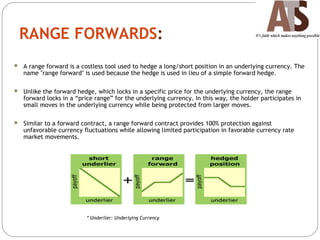
 A range forward is a costless tool used to hedge a long/short position in an underlying currency. The
name "range forward" is used because the hedge is used in lieu of a simple forward hedge.
 Unlike the forward hedge, which locks in a specific price for the underlying currency, the range
forward locks in a “price range” for the underlying currency. In this way, the holder participates in
small moves in the underlying currency while being protected from larger moves.
 Similar to a forward contract, a range forward contract provides 100% protection against
unfavorable currency fluctuations while allowing limited participation in favorable currency rate
market movements.
* Underlier: Underlying Currency
Characteristics of Range
Forwards
Advantages of Range Forwards:
Usually structured with no upfront premium
Provides full protection (a floor) against adverse currency movements
Allows participation in favorable currency moves up to a pre-determined level (a cap)
Considerations for when to use a range forward contract:
Floor is less attractive than the forward rate
Participation in favorable market movement is limited
Who can benefit from using a range forward contract?
Importers looking to reduce the cost of foreign payables
Exporters looking to increase the value of foreign currency receivables
Companies that need to protect their budget at a defined rate, while benefiting from favorable
currency moves
Companies that need to accommodate different views on currency direction yet still meet hedging
requirements
Companies that want to take advantage of positive currency fluctuations but do not want to pay a
premium upfront
* Floor: Base Price of the Range Selected
* Cap: Upward Price of the Range Selected
Example of Range Forwards
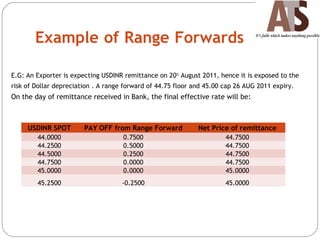
E.G: An Exporter is expecting USDINR remittance on 20th
August 2011, hence it is exposed to the
risk of Dollar depreciation . A range forward of 44.75 floor and 45.00 cap 26 AUG 2011 expiry.
On the day of remittance received in Bank, the final effective rate will be:
USDINR SPOT PAY OFF from Range Forward Net Price of remittance
44.0000 0.7500 44.7500
44.2500 0.5000 44.7500
44.5000 0.2500 44.7500
44.7500 0.0000 44.7500
45.0000 0.0000 45.0000
45.2500 -0.2500 45.0000
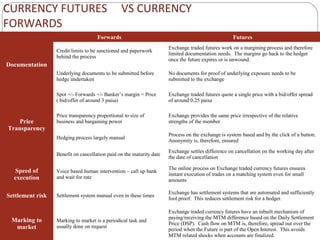
  Forwards Futures
Documentation
Credit limits to be sanctioned and paperwork 
behind the process
Exchange traded futures work on a margining process and therefore 
limited documentation needs.  The margins go back to the hedger 
once the future expires or is unwound.
Underlying documents to be submitted before 
hedge undertaken
No documents for proof of underlying exposure needs to be 
submitted to the exchange
Price
Transparency
Spot +/- Forwards +/- Banker’s margin = Price 
( bid/offer of around 3 paisa) 
Exchange traded futures quote a single price with a bid/offer spread 
of around 0.25 paisa
Price transparency proportional to size of 
business and bargaining power
Exchange provides the same price irrespective of the relative 
strengths of the member
Hedging process largely manual
Process on the exchange is system based and by the click of a button. 
Anonymity is, therefore, ensured
Benefit on cancellation paid on the maturity date
Exchange settles difference on cancellation on the working day after 
the date of cancellation
Speed of
execution
Voice based human intervention – call up bank 
and wait for rate
The online process on Exchange traded currency futures ensures 
instant execution of trades on a matching system even for small 
amounts
Settlement risk Settlement system manual even in these times
Exchange has settlement systems that are automated and sufficiently 
fool proof.  This reduces settlement risk for a hedger.
Marking to
market
Marking to market is a periodical task and 
usually done on request
Exchange traded currency futures have an inbuilt mechanism of 
paying/receiving the MTM difference based on the Daily Settlement 
Price (DSP).  Cash flow on MTM is, therefore, spread out over the 
period when the Future is part of the Open Interest.  This avoids 
MTM related shocks when accounts are finalized.
CURRENCY FUTURES VS CURRENCY
FORWARDS
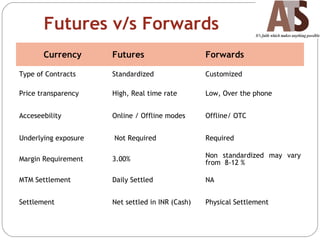
Futures v/s Forwards
Currency Futures Forwards
Type of Contracts Standardized Customized
Price transparency High, Real time rate Low, Over the phone
Acceseebility Online / Offline modes Offline/ OTC
Underlying exposure Not Required Required
Margin Requirement 3.00%
Non standardized may vary
from 8-12 %
MTM Settlement Daily Settled NA
Settlement Net settled in INR (Cash) Physical Settlement
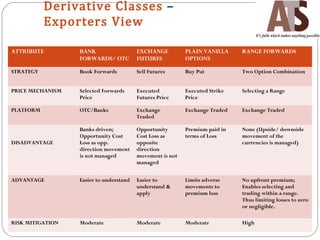
Derivative Classes –
Exporters View
ATTRIBUTE BANK
FORWARDS/ OTC
EXCHANGE
FUTURES
PLAIN VANILLA
OPTIONS
RANGE FORWARDS
STRATEGY Book Forwards Sell Futures Buy Put Two Option Combination
PRICE MECHANISM Selected Forwards
Price
Executed
Futures Price
Executed Strike
Price
Selecting a Range
PLATFORM OTC/Banks Exchange
Traded
Exchange Traded Exchange Traded
DISADVANTAGE
Banks driven;
Opportunity Cost
Loss as opp.
direction movement
is not managed
Opportunity
Cost Loss as
opposite
direction
movement is not
managed
Premium paid in
terms of Loss
None (Upside/ downside
movement of the
currencies is managed)
ADVANTAGE Easier to understand Easier to
understand &
apply
Limits adverse
movements to
premium loss
No upfront premium;
Enables selecting and
trading within a range.
Thus limiting losses to zero
or negligible.
RISK MITIGATION Moderate Moderate Moderate High
Facts about OTC/OPTIONS:
 Annex to A.P (DIR Series) Circular No.32 dated December 28, 2010 don’t allow companies below Rs 200 Cr net
worth to enter into any option products in OTC .
2. Companies having access to options cannot write/sell options OR cannot be net receiver of premiums Example :
An exporter cannot sell CALL OR Importer cannot sell PUT option with the BANK
3. Derivatives like Interest rate & Currency swaps may have interest payments to be received /paid at some
intervals and if those need to be hedged , RBI doesn’t permit the same .
4. Proceeds (profits booked) before maturity of Forwards/Cancellation are only passed to the clients on the
expiry of contract.
5. There is mandate for submitting the underline documents to Bank against all the foreign exchange contracts
within 15 days of booking.
6. Requirement of underlying while dealing with bank involves too much of process, human involvement,
compliance and reporting which impacts to cost.
7. In the event of non-submission of underline documents within 15 days, the contract may be cancelled, and the
exchange gains are not passed on. If it is repeated on more than three occasions in a financial year, booking may
be allowed only against production of the underlying documents at the time of booking the contract
* Sources : RBI Annex to A.P (DIR Series) Circular No.32 dated December 28, 2010]
Taxation
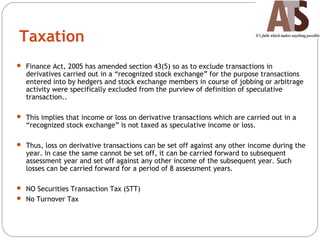
 Finance Act, 2005 has amended section 43(5) so as to exclude transactions in
derivatives carried out in a “recognized stock exchange” for the purpose transactions
entered into by hedgers and stock exchange members in course of jobbing or arbitrage
activity were specifically excluded from the purview of definition of speculative
transaction..
 This implies that income or loss on derivative transactions which are carried out in a
“recognized stock exchange” is not taxed as speculative income or loss.
 Thus, loss on derivative transactions can be set off against any other income during the
year. In case the same cannot be set off, it can be carried forward to subsequent
assessment year and set off against any other income of the subsequent year. Such
losses can be carried forward for a period of 8 assessment years.
 NO Securities Transaction Tax (STT)
 No Turnover Tax
Crosses
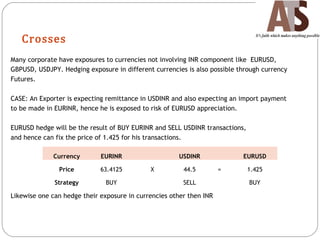
Many corporate have exposures to currencies not involving INR component like EURUSD,
GBPUSD, USDJPY. Hedging exposure in different currencies is also possible through currency
Futures.
CASE: An Exporter is expecting remittance in USDINR and also expecting an import payment
to be made in EURINR, hence he is exposed to risk of EURUSD appreciation.
EURUSD hedge will be the result of BUY EURINR and SELL USDINR transactions,
and hence can fix the price of 1.425 for his transactions.
Likewise one can hedge their exposure in currencies other then INR
Currency EURINR USDINR EURUSD
Price 63.4125 X 44.5 = 1.425
Strategy BUY SELL BUY
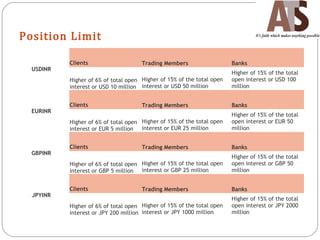
Position Limit
USDINR
Clients Trading Members Banks
Higher of 6% of total open
interest or USD 10 million
Higher of 15% of the total open
interest or USD 50 million
Higher of 15% of the total
open interest or USD 100
million
EURINR
Clients Trading Members Banks
Higher of 6% of total open
interest or EUR 5 million
Higher of 15% of the total open
interest or EUR 25 million
Higher of 15% of the total
open interest or EUR 50
million
GBPINR
Clients Trading Members Banks
Higher of 6% of total open
interest or GBP 5 million
Higher of 15% of the total open
interest or GBP 25 million
Higher of 15% of the total
open interest or GBP 50
million
JPYINR
Clients Trading Members Banks
Higher of 6% of total open
interest or JPY 200 million
Higher of 15% of the total open
interest or JPY 1000 million
Higher of 15% of the total
open interest or JPY 2000
million
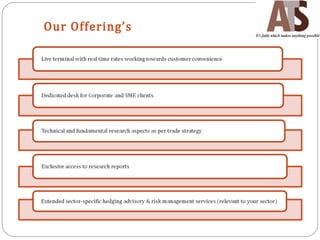
Our Offering’s
Let’s Begin!!!
websites:websites: email:email:
www. adityatrading.in bijo@adityatrading.com , contact:9176599355
Member :
NSE, MCX-SX
Address:
CORPORATE OFFICE
ADITYA TRADING
SOLUTIONS PVT LTD.
No.15, 22nd Cross Street,
Indra Nagar, Adyar,
Chennai -20
Ph : 044-60010222

Currency corporates

  • 1.
  • 2.
    ADITYA TRADING SOLUTIONS Presencethrough more than 200 locations-Pan India Present across more than 150 Cities & Towns Total group employees 100 plus Client Interfaces through the Retail, Wealth and Institutional spectrums Among the largest Retail brokerage branch network, going beyond Tier-I and Tier-II cities in India
  • 3.
    What are CurrencyDerivatives?  FUTURES: An agreement between two partiesto buy or sell astandard quantity of currency at a certain timein futureat apredetermined priceon thefloor of an organized futuresexchange. FutureContractsarespecial typesof forward/OTC contractsin thesensethat futuresarestandardized exchangetraded contracts.  OPTIONS: An option isacontract between abuyer and aseller that givesthebuyer of theoption the right, but not theobligation, to buy or sell aspecified asset (underlying) on or beforetheOptions expiration time, at an agreed price(thestrikeprice).  A call option givesthebuyer of theoption theright to buy theunderlying asset by acertain datefor a certain price.  A put option givesthebuyer of theoption theright to sell theunderlying asset by acertain datefor a certain price. If thebuyer of option choosesto exercisehisright, theseller isobliged to sell or buy theasset at an agreed price.
  • 4.
    Contract specification Underlying USD/INREUR/INR GBP/INR JPY/INR Exchange NSE and MCX-SX NSE and MCX-SX NSE and MCX-SX NSE and MCX-SX Trading Hours 09:00 AM – 05:00 PM 09:00 AM – 05:00 PM 09:00 AM – 05:00 PM 09:00 AM – 05:00 PM Contract Lot Size Minimum lot Size = USD 1000 Minimum lot Size = EUR 1000 Minimum lot Size = GBP 1000 Minimum lot Size = YEN 100000 Tick Size (Minimum Price Fluctuation) Re. 0.0025 or 0.25 paisa Re. 0.0025 or 0.25 paisa Re. 0.0025 or 0.25 paisa Re. 0.0025 or 0.25 paisa Margin 3%-5% (As dictated by the exchange) 3%-5% (As dictated by the exchange) 3%-5% (As dictated by the exchange) 3%-5% (As dictated by the exchange) Calendar Spread Rs. 600/- per contract Rs. 700/- per contract Rs. 1600/- per contract Rs. 700/- per contract Price Quotation INR per USD Rs. per EUR Rs. per GBP Rs. per 100 YEN Tenor of Contract Maximum of 12 months Maximum of 12 months Maximum of 12 months Maximum of 12 months Available Contracts Monthly Monthly Monthly Monthly Settlement Mechanisms INR INR INR INR Settlement Reference Rate RBI Reference Rate RBI Reference Rate RBI Reference Rate RBI Reference Rate Final Settlement Date Last working day of the month Last working day of the month Last working day of the month Last working day of the month
  • 5.
    Practical use ofCurrency Derivatives  Hedge A transaction in which an end user (Exporter/ Importer) seeks to protect a position or anticipated position in the spot market by using an opposite position in derivatives is a Hedge Transaction.  Speculation Buying or selling of a contract by taking view on the market, with a motive of profit from anticipated price movement.  Arbitrage Arbitrage means earning risk-free profits by simultaneously buying and selling identical or similar instruments in different markets.
  • 6.
    Portfolio in Hedging ParticipantRisk Underlying Position Hedging Position Importer Currency of Import will strengthen Buyer of Currency of Import Long in Currency of Import Exporter Currency of Export will weaken Seller of Currency of Export Short in Currency of Export
  • 7.
    RANGE FORWARDS:  Arange forward is a costless tool used to hedge a long/short position in an underlying currency. The name "range forward" is used because the hedge is used in lieu of a simple forward hedge.  Unlike the forward hedge, which locks in a specific price for the underlying currency, the range forward locks in a “price range” for the underlying currency. In this way, the holder participates in small moves in the underlying currency while being protected from larger moves.  Similar to a forward contract, a range forward contract provides 100% protection against unfavorable currency fluctuations while allowing limited participation in favorable currency rate market movements. * Underlier: Underlying Currency
  • 8.
    Characteristics of Range Forwards Advantagesof Range Forwards: Usually structured with no upfront premium Provides full protection (a floor) against adverse currency movements Allows participation in favorable currency moves up to a pre-determined level (a cap) Considerations for when to use a range forward contract: Floor is less attractive than the forward rate Participation in favorable market movement is limited Who can benefit from using a range forward contract? Importers looking to reduce the cost of foreign payables Exporters looking to increase the value of foreign currency receivables Companies that need to protect their budget at a defined rate, while benefiting from favorable currency moves Companies that need to accommodate different views on currency direction yet still meet hedging requirements Companies that want to take advantage of positive currency fluctuations but do not want to pay a premium upfront * Floor: Base Price of the Range Selected * Cap: Upward Price of the Range Selected
  • 9.
    Example of RangeForwards E.G: An Exporter is expecting USDINR remittance on 20th August 2011, hence it is exposed to the risk of Dollar depreciation . A range forward of 44.75 floor and 45.00 cap 26 AUG 2011 expiry. On the day of remittance received in Bank, the final effective rate will be: USDINR SPOT PAY OFF from Range Forward Net Price of remittance 44.0000 0.7500 44.7500 44.2500 0.5000 44.7500 44.5000 0.2500 44.7500 44.7500 0.0000 44.7500 45.0000 0.0000 45.0000 45.2500 -0.2500 45.0000
  • 10.
      Forwards Futures Documentation Credit limits to be sanctioned and paperwork  behind the process Exchange traded futures work on a margining process and therefore  limited documentation needs.  The margins go back to the hedger  once the future expires or is unwound. Underlying documents to be submitted before  hedge undertaken No documents for proof of underlying exposure needs to be  submitted to the exchange Price Transparency Spot +/- Forwards +/- Banker’s margin = Price  ( bid/offer of around 3 paisa)  Exchange traded futures quote a single price with a bid/offer spread  of around 0.25 paisa Price transparency proportional to size of  business and bargaining power Exchange provides the same price irrespective of the relative  strengths of the member Hedging process largely manual Process on the exchange is system based and by the click of a button.  Anonymity is, therefore, ensured Benefit on cancellation paid on the maturity date Exchange settles difference on cancellation on the working day after  the date of cancellation Speedof execution Voice based human intervention – call up bank  and wait for rate The online process on Exchange traded currency futures ensures  instant execution of trades on a matching system even for small  amounts Settlement risk Settlement system manual even in these times Exchange has settlement systems that are automated and sufficiently  fool proof.  This reduces settlement risk for a hedger. Marking to market Marking to market is a periodical task and  usually done on request Exchange traded currency futures have an inbuilt mechanism of  paying/receiving the MTM difference based on the Daily Settlement  Price (DSP).  Cash flow on MTM is, therefore, spread out over the  period when the Future is part of the Open Interest.  This avoids  MTM related shocks when accounts are finalized. CURRENCY FUTURES VS CURRENCY FORWARDS
  • 11.
    Futures v/s Forwards CurrencyFutures Forwards Type of Contracts Standardized Customized Price transparency High, Real time rate Low, Over the phone Acceseebility Online / Offline modes Offline/ OTC Underlying exposure Not Required Required Margin Requirement 3.00% Non standardized may vary from 8-12 % MTM Settlement Daily Settled NA Settlement Net settled in INR (Cash) Physical Settlement
  • 12.
    Derivative Classes – ExportersView ATTRIBUTE BANK FORWARDS/ OTC EXCHANGE FUTURES PLAIN VANILLA OPTIONS RANGE FORWARDS STRATEGY Book Forwards Sell Futures Buy Put Two Option Combination PRICE MECHANISM Selected Forwards Price Executed Futures Price Executed Strike Price Selecting a Range PLATFORM OTC/Banks Exchange Traded Exchange Traded Exchange Traded DISADVANTAGE Banks driven; Opportunity Cost Loss as opp. direction movement is not managed Opportunity Cost Loss as opposite direction movement is not managed Premium paid in terms of Loss None (Upside/ downside movement of the currencies is managed) ADVANTAGE Easier to understand Easier to understand & apply Limits adverse movements to premium loss No upfront premium; Enables selecting and trading within a range. Thus limiting losses to zero or negligible. RISK MITIGATION Moderate Moderate Moderate High
  • 13.
    Facts about OTC/OPTIONS: Annex to A.P (DIR Series) Circular No.32 dated December 28, 2010 don’t allow companies below Rs 200 Cr net worth to enter into any option products in OTC . 2. Companies having access to options cannot write/sell options OR cannot be net receiver of premiums Example : An exporter cannot sell CALL OR Importer cannot sell PUT option with the BANK 3. Derivatives like Interest rate & Currency swaps may have interest payments to be received /paid at some intervals and if those need to be hedged , RBI doesn’t permit the same . 4. Proceeds (profits booked) before maturity of Forwards/Cancellation are only passed to the clients on the expiry of contract. 5. There is mandate for submitting the underline documents to Bank against all the foreign exchange contracts within 15 days of booking. 6. Requirement of underlying while dealing with bank involves too much of process, human involvement, compliance and reporting which impacts to cost. 7. In the event of non-submission of underline documents within 15 days, the contract may be cancelled, and the exchange gains are not passed on. If it is repeated on more than three occasions in a financial year, booking may be allowed only against production of the underlying documents at the time of booking the contract * Sources : RBI Annex to A.P (DIR Series) Circular No.32 dated December 28, 2010]
  • 14.
    Taxation  Finance Act,2005 has amended section 43(5) so as to exclude transactions in derivatives carried out in a “recognized stock exchange” for the purpose transactions entered into by hedgers and stock exchange members in course of jobbing or arbitrage activity were specifically excluded from the purview of definition of speculative transaction..  This implies that income or loss on derivative transactions which are carried out in a “recognized stock exchange” is not taxed as speculative income or loss.  Thus, loss on derivative transactions can be set off against any other income during the year. In case the same cannot be set off, it can be carried forward to subsequent assessment year and set off against any other income of the subsequent year. Such losses can be carried forward for a period of 8 assessment years.  NO Securities Transaction Tax (STT)  No Turnover Tax
  • 15.
    Crosses Many corporate haveexposures to currencies not involving INR component like EURUSD, GBPUSD, USDJPY. Hedging exposure in different currencies is also possible through currency Futures. CASE: An Exporter is expecting remittance in USDINR and also expecting an import payment to be made in EURINR, hence he is exposed to risk of EURUSD appreciation. EURUSD hedge will be the result of BUY EURINR and SELL USDINR transactions, and hence can fix the price of 1.425 for his transactions. Likewise one can hedge their exposure in currencies other then INR Currency EURINR USDINR EURUSD Price 63.4125 X 44.5 = 1.425 Strategy BUY SELL BUY
  • 16.
    Position Limit USDINR Clients TradingMembers Banks Higher of 6% of total open interest or USD 10 million Higher of 15% of the total open interest or USD 50 million Higher of 15% of the total open interest or USD 100 million EURINR Clients Trading Members Banks Higher of 6% of total open interest or EUR 5 million Higher of 15% of the total open interest or EUR 25 million Higher of 15% of the total open interest or EUR 50 million GBPINR Clients Trading Members Banks Higher of 6% of total open interest or GBP 5 million Higher of 15% of the total open interest or GBP 25 million Higher of 15% of the total open interest or GBP 50 million JPYINR Clients Trading Members Banks Higher of 6% of total open interest or JPY 200 million Higher of 15% of the total open interest or JPY 1000 million Higher of 15% of the total open interest or JPY 2000 million
  • 17.
  • 18.
    Let’s Begin!!! websites:websites: email:email: www.adityatrading.in bijo@adityatrading.com , contact:9176599355 Member : NSE, MCX-SX Address: CORPORATE OFFICE ADITYA TRADING SOLUTIONS PVT LTD. No.15, 22nd Cross Street, Indra Nagar, Adyar, Chennai -20 Ph : 044-60010222