Currency Derivatives
5Chapter
A5 - 2
Chapter Objectives
• To explain how forward contracts
are used for hedging based on anticipated
exchange rate movements; and
• To explain how currency futures contracts
and currency options contracts are used
for hedging or speculation based on
anticipated exchange rate movements.
A5 - 3
Forward Market
• The forward market facilitates the trading
of forward contracts on currencies.
• A forward contract is an agreement
between a corporation and a commercial
bank to exchange a specified amount of a
currency at a specified exchange rate
(called the forward rate) on a specified
date in the future.
A5 - 4
Forward Market
• When MNCs anticipate future need or
future receipt of a foreign currency, they
can set up forward contracts to lock in the
exchange rate.
• Forward contracts are often valued at $1
million or more, and are not normally used
by consumers or small firms.
A5 - 5
• As with the case of spot rates, there is a
bid/ask spread on forward rates.
• Forward rates may also contain a premium
or discount.
¤ If the forward rate exceeds the existing
spot rate, it contains a premium.
¤ If the forward rate is less than the existing
spot rate, it contains a discount.
Forward Market
A5 - 6
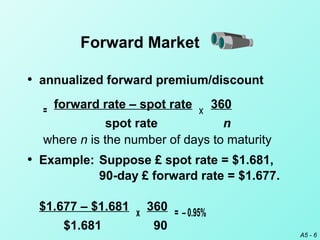
• annualized forward premium/discount
=
forward rate – spot rate ×
360
spot rate n
where n is the number of days to maturity
• Example: Suppose £ spot rate = $1.681,
90-day £ forward rate = $1.677.
$1.677 – $1.681 x
360 = – 0.95%
$1.681 90
Forward Market
A5 - 7
• The forward premium/discount reflects the
difference between the home interest rate
and the foreign interest rate, so as to
prevent arbitrage.
Forward Market
A5 - 8
Currency Futures Market
• Currency futures contracts specify a
standard volume of a particular currency to
be exchanged on a specific settlement
date, typically the third Wednesdays in
March, June, September, and December.
• They are used by MNCs to hedge their
currency positions, and by speculators
who hope to capitalize on their
expectations of exchange rate movements.
A5 - 9
Currency Futures Market
• The contracts can be traded by firms or
individuals through brokers on the trading
floor of an exchange (e.g. Chicago
Mercantile Exchange), on automated
trading systems (e.g. GLOBEX), or over-
the-counter.
• Participants in the currency futures
market need to establish and maintain a
margin when they take a position.
A5 - 10
Forward Markets Futures Markets
Contract size Customized. Standardized.
Delivery date Customized. Standardized.
Participants Banks, brokers, Banks, brokers,
MNCs. Public MNCs. Qualified
speculation not public speculation
encouraged. encouraged.
Security Compensating Small security
deposit bank balances or deposit required.
credit lines needed.
Currency Futures Market
A5 - 11
Clearing Handled by Handled by
operation individual banks exchange
& brokers. clearinghouse.
Daily settlements
to market prices.
Marketplace Worldwide Central exchange
telephone floor with global
network. communications.
Currency Futures Market
Forward Markets Futures Markets
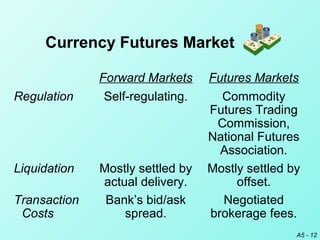
A5 - 12
Regulation Self-regulating. Commodity
Futures Trading
Commission,
National Futures
Association.
Liquidation Mostly settled by Mostly settled by
actual delivery. offset.
Transaction Bank’s bid/ask Negotiated
Costs spread. brokerage fees.
Currency Futures Market
Forward Markets Futures Markets
A5 - 13
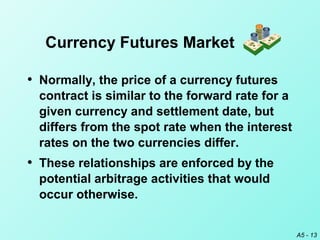
• Normally, the price of a currency futures
contract is similar to the forward rate for a
given currency and settlement date, but
differs from the spot rate when the interest
rates on the two currencies differ.
• These relationships are enforced by the
potential arbitrage activities that would
occur otherwise.
Currency Futures Market
A5 - 14
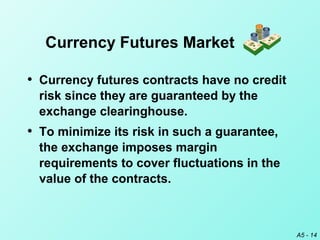
• Currency futures contracts have no credit
risk since they are guaranteed by the
exchange clearinghouse.
• To minimize its risk in such a guarantee,
the exchange imposes margin
requirements to cover fluctuations in the
value of the contracts.
Currency Futures Market
A5 - 15
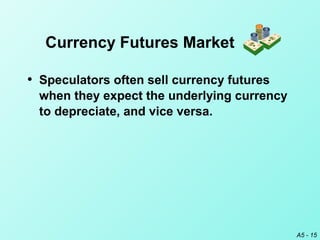
• Speculators often sell currency futures
when they expect the underlying currency
to depreciate, and vice versa.
Currency Futures Market
A5 - 16
• Currency futures may be purchased by
MNCs to hedge foreign currency payables,
or sold to hedge receivables.
Currency Futures Market
A5 - 17
• Holders of futures contracts can close out
their positions by selling similar futures
contracts. Sellers may also close out their
positions by purchasing similar contracts.
Currency Futures Market
A5 - 18
• Most currency futures contracts are
closed out before their settlement dates.
• Brokers who fulfill orders to buy or sell
futures contracts earn a transaction or
brokerage fee in the form of the bid/ask
spread.
Currency Futures Market
A5 - 19
Currency Options Market
• A currency option is another type of
contract that can be purchased or sold by
speculators and firms.
• The standard options that are traded on an
exchange through brokers are guaranteed,
but require margin maintenance.
• U.S. option exchanges (e.g. Chicago
Board Options Exchange) are regulated by
the Securities and Exchange Commission.
A5 - 20
• In addition to the exchanges, there is an
over-the-counter market where
commercial banks and brokerage firms
offer customized currency options.
• There are no credit guarantees for these
OTC options, so some form of collateral
may be required.
• Currency options are classified as either
calls or puts.
Currency Options Market
A5 - 21
• A currency call option grants the holder
the right to buy a specific currency at a
specific price (called the exercise or strike
price) within a specific period of time.
• A call option is
¤ in the money if spot rate > strike price,
¤ at the money if spot rate = strike price,
¤ out of the money
if spot rate < strike price.
Currency Call Options
A5 - 22
• Option owners can sell or exercise their
options. They can also choose to let their
options expire. At most, they will lose the
premiums they paid for their options.
• Call option premiums will be higher when:
¤ (spot price – strike price) is larger;
¤ the time to expiration date is longer; and
¤ the variability of the currency is greater.
Currency Call Options
A5 - 23
• Firms with open positions in foreign
currencies may use currency call options
to cover those positions.
• They may purchase currency call options
¤ to hedge future payables;
¤ to hedge potential expenses when bidding
on projects; and
¤ to hedge potential costs when attempting
to acquire other firms.
Currency Call Options
A5 - 24
• Speculators who expect a foreign
currency to appreciate can purchase call
options on that currency.
¤ Profit = selling price – buying (strike) price
– option premium
• They may also sell (write) call options on a
currency that they expect to depreciate.
¤ Profit = option premium – buying price
+ selling (strike) price
Currency Call Options
A5 - 25
• The purchaser of a call option will break
even when
selling price = buying (strike) price
+ option premium
• The seller (writer) of a call option will
break even when
buying price = selling (strike) price
+ option premium
Currency Call Options
A5 - 26
• A currency put option grants the holder
the right to sell a specific currency at a
specific price (the strike price) within a
specific period of time.
• A put option is
¤ in the money if spot rate < strike price,
¤ at the money if spot rate = strike price,
¤ out of the money
if spot rate > strike price.
Currency Put Options
A5 - 27
• Put option premiums will be higher when:
¤ (strike price – spot rate) is larger;
¤ the time to expiration date is longer; and
¤ the variability of the currency is greater.
• Corporations with open foreign currency
positions may use currency put options to
cover their positions.
¤ For example, firms may purchase put
options to hedge future receivables.
Currency Put Options
A5 - 28
• Speculators who expect a foreign
currency to depreciate can purchase put
options on that currency.
¤ Profit = selling (strike) price – buying price
– option premium
• They may also sell (write) put options on a
currency that they expect to appreciate.
¤ Profit = option premium + selling price
– buying (strike) price
Currency Put Options
A5 - 29
• One possible speculative strategy for
volatile currencies is to purchase both a
put option and a call option at the same
exercise price. This is called a straddle.
• By purchasing both options, the
speculator may gain if the currency moves
substantially in either direction, or if it
moves in one direction followed by the
other.
Currency Put Options
A5 - 30
Conditional Currency Options
• A currency option may be structured such
that the premium is conditioned on the
actual currency movement over the period
of concern.
• Suppose a conditional put option on £ has
an exercise price of $1.70, and a trigger of
$1.74. The premium will have to be paid
only if the £’s value exceeds the trigger
value.
A5 - 31
Conditional Currency Options
• Similarly, a conditional call option on £
may specify an exercise price of $1.70,
and a trigger of $1.67. The premium will
have to be paid only if the £’s value falls
below the trigger value.
• In both cases, the payment of the premium
is avoided conditionally at the cost of a
higher premium.
A5 - 32
• Forward Market
¤ How MNCs Use Forward Contracts
¤ Non-Deliverable Forward Contracts
Chapter Review
A5 - 33
Chapter Review
• Currency Futures Market
¤ Contract Specifications
¤ Comparison of Currency Futures and
Forward Contracts
¤ Pricing Currency Futures
¤ Credit Risk of Currency Futures Contracts
¤ Speculation with Currency Futures
¤ How Firms Use Currency Futures
¤ Closing Out A Futures Position
¤ Transaction Costs of Currency Futures
A5 - 34
Chapter Review
• Currency Options Market
• Currency Call Options
¤ Factors Affecting Currency Call Option
Premiums
¤ How Firms Use Currency Call Options
¤ Speculating with Currency Call Options
A5 - 35
Chapter Review
• Currency Put Options
¤ Factors Affecting Currency Put Option
Premiums
¤ Hedging with Currency Put Options
¤ Speculating with Currency Put Options

Currency derivatives

  • 1.
  • 2.
    A5 - 2 ChapterObjectives • To explain how forward contracts are used for hedging based on anticipated exchange rate movements; and • To explain how currency futures contracts and currency options contracts are used for hedging or speculation based on anticipated exchange rate movements.
  • 3.
    A5 - 3 ForwardMarket • The forward market facilitates the trading of forward contracts on currencies. • A forward contract is an agreement between a corporation and a commercial bank to exchange a specified amount of a currency at a specified exchange rate (called the forward rate) on a specified date in the future.
  • 4.
    A5 - 4 ForwardMarket • When MNCs anticipate future need or future receipt of a foreign currency, they can set up forward contracts to lock in the exchange rate. • Forward contracts are often valued at $1 million or more, and are not normally used by consumers or small firms.
  • 5.
    A5 - 5 •As with the case of spot rates, there is a bid/ask spread on forward rates. • Forward rates may also contain a premium or discount. ¤ If the forward rate exceeds the existing spot rate, it contains a premium. ¤ If the forward rate is less than the existing spot rate, it contains a discount. Forward Market
  • 6.
    A5 - 6 •annualized forward premium/discount = forward rate – spot rate × 360 spot rate n where n is the number of days to maturity • Example: Suppose £ spot rate = $1.681, 90-day £ forward rate = $1.677. $1.677 – $1.681 x 360 = – 0.95% $1.681 90 Forward Market
  • 7.
    A5 - 7 •The forward premium/discount reflects the difference between the home interest rate and the foreign interest rate, so as to prevent arbitrage. Forward Market
  • 8.
    A5 - 8 CurrencyFutures Market • Currency futures contracts specify a standard volume of a particular currency to be exchanged on a specific settlement date, typically the third Wednesdays in March, June, September, and December. • They are used by MNCs to hedge their currency positions, and by speculators who hope to capitalize on their expectations of exchange rate movements.
  • 9.
    A5 - 9 CurrencyFutures Market • The contracts can be traded by firms or individuals through brokers on the trading floor of an exchange (e.g. Chicago Mercantile Exchange), on automated trading systems (e.g. GLOBEX), or over- the-counter. • Participants in the currency futures market need to establish and maintain a margin when they take a position.
  • 10.
    A5 - 10 ForwardMarkets Futures Markets Contract size Customized. Standardized. Delivery date Customized. Standardized. Participants Banks, brokers, Banks, brokers, MNCs. Public MNCs. Qualified speculation not public speculation encouraged. encouraged. Security Compensating Small security deposit bank balances or deposit required. credit lines needed. Currency Futures Market
  • 11.
    A5 - 11 ClearingHandled by Handled by operation individual banks exchange & brokers. clearinghouse. Daily settlements to market prices. Marketplace Worldwide Central exchange telephone floor with global network. communications. Currency Futures Market Forward Markets Futures Markets
  • 12.
    A5 - 12 RegulationSelf-regulating. Commodity Futures Trading Commission, National Futures Association. Liquidation Mostly settled by Mostly settled by actual delivery. offset. Transaction Bank’s bid/ask Negotiated Costs spread. brokerage fees. Currency Futures Market Forward Markets Futures Markets
  • 13.
    A5 - 13 •Normally, the price of a currency futures contract is similar to the forward rate for a given currency and settlement date, but differs from the spot rate when the interest rates on the two currencies differ. • These relationships are enforced by the potential arbitrage activities that would occur otherwise. Currency Futures Market
  • 14.
    A5 - 14 •Currency futures contracts have no credit risk since they are guaranteed by the exchange clearinghouse. • To minimize its risk in such a guarantee, the exchange imposes margin requirements to cover fluctuations in the value of the contracts. Currency Futures Market
  • 15.
    A5 - 15 •Speculators often sell currency futures when they expect the underlying currency to depreciate, and vice versa. Currency Futures Market
  • 16.
    A5 - 16 •Currency futures may be purchased by MNCs to hedge foreign currency payables, or sold to hedge receivables. Currency Futures Market
  • 17.
    A5 - 17 •Holders of futures contracts can close out their positions by selling similar futures contracts. Sellers may also close out their positions by purchasing similar contracts. Currency Futures Market
  • 18.
    A5 - 18 •Most currency futures contracts are closed out before their settlement dates. • Brokers who fulfill orders to buy or sell futures contracts earn a transaction or brokerage fee in the form of the bid/ask spread. Currency Futures Market
  • 19.
    A5 - 19 CurrencyOptions Market • A currency option is another type of contract that can be purchased or sold by speculators and firms. • The standard options that are traded on an exchange through brokers are guaranteed, but require margin maintenance. • U.S. option exchanges (e.g. Chicago Board Options Exchange) are regulated by the Securities and Exchange Commission.
  • 20.
    A5 - 20 •In addition to the exchanges, there is an over-the-counter market where commercial banks and brokerage firms offer customized currency options. • There are no credit guarantees for these OTC options, so some form of collateral may be required. • Currency options are classified as either calls or puts. Currency Options Market
  • 21.
    A5 - 21 •A currency call option grants the holder the right to buy a specific currency at a specific price (called the exercise or strike price) within a specific period of time. • A call option is ¤ in the money if spot rate > strike price, ¤ at the money if spot rate = strike price, ¤ out of the money if spot rate < strike price. Currency Call Options
  • 22.
    A5 - 22 •Option owners can sell or exercise their options. They can also choose to let their options expire. At most, they will lose the premiums they paid for their options. • Call option premiums will be higher when: ¤ (spot price – strike price) is larger; ¤ the time to expiration date is longer; and ¤ the variability of the currency is greater. Currency Call Options
  • 23.
    A5 - 23 •Firms with open positions in foreign currencies may use currency call options to cover those positions. • They may purchase currency call options ¤ to hedge future payables; ¤ to hedge potential expenses when bidding on projects; and ¤ to hedge potential costs when attempting to acquire other firms. Currency Call Options
  • 24.
    A5 - 24 •Speculators who expect a foreign currency to appreciate can purchase call options on that currency. ¤ Profit = selling price – buying (strike) price – option premium • They may also sell (write) call options on a currency that they expect to depreciate. ¤ Profit = option premium – buying price + selling (strike) price Currency Call Options
  • 25.
    A5 - 25 •The purchaser of a call option will break even when selling price = buying (strike) price + option premium • The seller (writer) of a call option will break even when buying price = selling (strike) price + option premium Currency Call Options
  • 26.
    A5 - 26 •A currency put option grants the holder the right to sell a specific currency at a specific price (the strike price) within a specific period of time. • A put option is ¤ in the money if spot rate < strike price, ¤ at the money if spot rate = strike price, ¤ out of the money if spot rate > strike price. Currency Put Options
  • 27.
    A5 - 27 •Put option premiums will be higher when: ¤ (strike price – spot rate) is larger; ¤ the time to expiration date is longer; and ¤ the variability of the currency is greater. • Corporations with open foreign currency positions may use currency put options to cover their positions. ¤ For example, firms may purchase put options to hedge future receivables. Currency Put Options
  • 28.
    A5 - 28 •Speculators who expect a foreign currency to depreciate can purchase put options on that currency. ¤ Profit = selling (strike) price – buying price – option premium • They may also sell (write) put options on a currency that they expect to appreciate. ¤ Profit = option premium + selling price – buying (strike) price Currency Put Options
  • 29.
    A5 - 29 •One possible speculative strategy for volatile currencies is to purchase both a put option and a call option at the same exercise price. This is called a straddle. • By purchasing both options, the speculator may gain if the currency moves substantially in either direction, or if it moves in one direction followed by the other. Currency Put Options
  • 30.
    A5 - 30 ConditionalCurrency Options • A currency option may be structured such that the premium is conditioned on the actual currency movement over the period of concern. • Suppose a conditional put option on £ has an exercise price of $1.70, and a trigger of $1.74. The premium will have to be paid only if the £’s value exceeds the trigger value.
  • 31.
    A5 - 31 ConditionalCurrency Options • Similarly, a conditional call option on £ may specify an exercise price of $1.70, and a trigger of $1.67. The premium will have to be paid only if the £’s value falls below the trigger value. • In both cases, the payment of the premium is avoided conditionally at the cost of a higher premium.
  • 32.
    A5 - 32 •Forward Market ¤ How MNCs Use Forward Contracts ¤ Non-Deliverable Forward Contracts Chapter Review
  • 33.
    A5 - 33 ChapterReview • Currency Futures Market ¤ Contract Specifications ¤ Comparison of Currency Futures and Forward Contracts ¤ Pricing Currency Futures ¤ Credit Risk of Currency Futures Contracts ¤ Speculation with Currency Futures ¤ How Firms Use Currency Futures ¤ Closing Out A Futures Position ¤ Transaction Costs of Currency Futures
  • 34.
    A5 - 34 ChapterReview • Currency Options Market • Currency Call Options ¤ Factors Affecting Currency Call Option Premiums ¤ How Firms Use Currency Call Options ¤ Speculating with Currency Call Options
  • 35.
    A5 - 35 ChapterReview • Currency Put Options ¤ Factors Affecting Currency Put Option Premiums ¤ Hedging with Currency Put Options ¤ Speculating with Currency Put Options

Editor's Notes

  • #2 Currency derivative is a contracts whose price is partially derived from the currency it represents. i-e the difference in purchasing and selling price is cost of contract.
  • #5 MNC’s usually need foreign currencies to meet their import bills and sell currencies which they get by exporting.