FINANCIAL DERIVATIVES


            Prepared by
      K.Logasakthi MBA (Ph.D)
          Assist.. Professor
     VSA School of Management,
               Salem.
OBJECTIVES OF THE LEARING
Derivatives - (Meaning)

Derivatives: derivatives are instruments which
  include
 a) Security derived from a debt instrument
  share, loan, risk instrument or contract for
  differences of any other form of security and ,
b) a contract that derives its value from the
  price/index of prices of underlying securities.
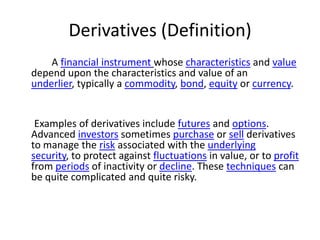
Derivatives (Definition)
    A financial instrument whose characteristics and value
depend upon the characteristics and value of an
underlier, typically a commodity, bond, equity or currency.


 Examples of derivatives include futures and options.
Advanced investors sometimes purchase or sell derivatives
to manage the risk associated with the underlying
security, to protect against fluctuations in value, or to profit
from periods of inactivity or decline. These techniques can
be quite complicated and quite risky.
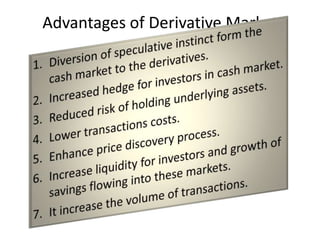
Advantages of Derivative Market
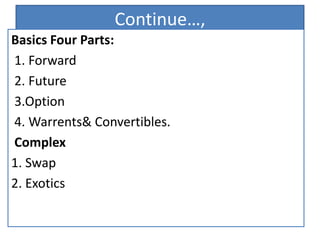
Continue…,
Basics Four Parts:
1. Forward
2. Future
3.Option
4. Warrents& Convertibles.
Complex
1. Swap
2. Exotics
Forward contract
The salient features of forward contracts
              are as follows:
• They are bilateral contracts and hence, exposed to
  counterparty risk.
• Each contract is customer designed, and hence is
  unique in terms of contract sixe, expiration date and
  the asset type and quality.
• The contract price is generally not available in public
  domain.
• On the expiration date, the contract has to be
  settled by delivery of the asset and
• If party wishes to reverse the contract.
Limitations of Forward contract

1. Forward markets are afflicted by several
   problems:
2. Lack of centralization of trading,
3. Liquidity and Counterparty risk.
• The basic problem in the first two is that they
  have too much flexibility and generality.
• Counterparty risk arises from the possibility of
  default by any one party to the transaction.
  When one of the two sides to the transaction
  declares bankruptcy, the other suffers
FUTURE CONTRACT
Future contract

                Future contract is an agreement
  between two parties to buy or sell an asset at a
  certain time in the future, at a certain price. But
  unlike forward contract, futures contract are
  standardized and stock ex-changed traded.
Continue.,,….,,
The standardized items in a futures contract are:
1. Quantity of the underlying,
2. Quality of the underlying,
3. The date/month of delivery,
4. The units of price quotation and minimum
   price change and
5. Location of settlement.
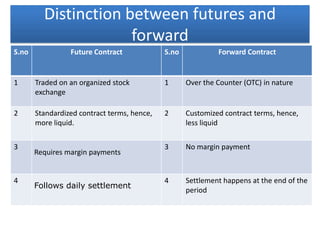
Distinction between futures and
                      forward
S.no             Future Contract             S.no            Forward Contract


1      Traded on an organized stock          1      Over the Counter (OTC) in nature
       exchange

2      Standardized contract terms, hence,   2      Customized contract terms, hence,
       more liquid.                                 less liquid


3                                            3      No margin payment
       Requires margin payments


4                                            4      Settlement happens at the end of the
       Follows daily settlement
                                                    period
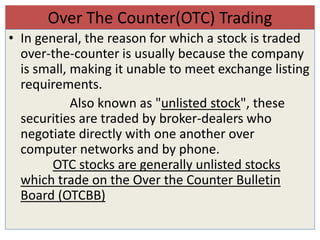
Over The Counter(OTC) Trading
• In general, the reason for which a stock is traded
  over-the-counter is usually because the company
  is small, making it unable to meet exchange listing
  requirements.
            Also known as "unlisted stock", these
  securities are traded by broker-dealers who
  negotiate directly with one another over
  computer networks and by phone.
        OTC stocks are generally unlisted stocks
  which trade on the Over the Counter Bulletin
  Board (OTCBB)
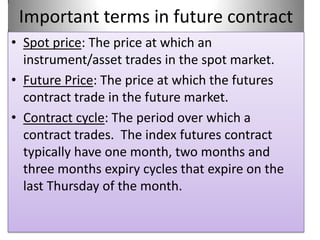
Important terms in future contract
• Spot price: The price at which an
  instrument/asset trades in the spot market.
• Future Price: The price at which the futures
  contract trade in the future market.
• Contract cycle: The period over which a
  contract trades. The index futures contract
  typically have one month, two months and
  three months expiry cycles that expire on the
  last Thursday of the month.
Continue…,,,,
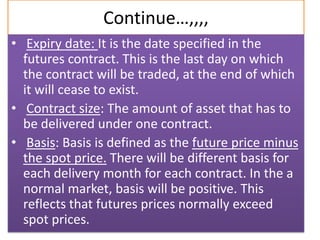
• Expiry date: It is the date specified in the
  futures contract. This is the last day on which
  the contract will be traded, at the end of which
  it will cease to exist.
• Contract size: The amount of asset that has to
  be delivered under one contract.
• Basis: Basis is defined as the future price minus
  the spot price. There will be different basis for
  each delivery month for each contract. In the a
  normal market, basis will be positive. This
  reflects that futures prices normally exceed
  spot prices.
Continue…,
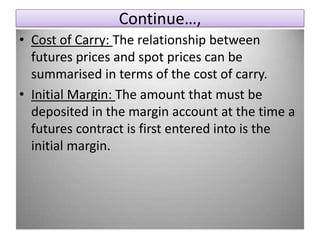
• Cost of Carry: The relationship between
  futures prices and spot prices can be
  summarised in terms of the cost of carry.
• Initial Margin: The amount that must be
  deposited in the margin account at the time a
  futures contract is first entered into is the
  initial margin.
Pay off for Futures
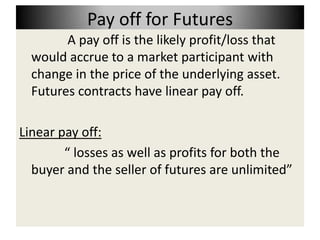
        A pay off is the likely profit/loss that
  would accrue to a market participant with
  change in the price of the underlying asset.
  Futures contracts have linear pay off.

Linear pay off:
        “ losses as well as profits for both the
  buyer and the seller of futures are unlimited”
Pay off for Buyer of Futures: (Long
                  Future)
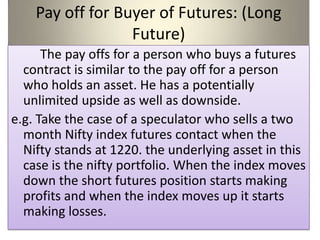
      The pay offs for a person who buys a futures
  contract is similar to the pay off for a person
  who holds an asset. He has a potentially
  unlimited upside as well as downside.
e.g. Take the case of a speculator who sells a two
  month Nifty index futures contact when the
  Nifty stands at 1220. the underlying asset in this
  case is the nifty portfolio. When the index moves
  down the short futures position starts making
  profits and when the index moves up it starts
  making losses.
Pay off for Seller Futures (short future)
• The pay off for a person who sells a futures
  contract is similar to the pay off for a person
  who shorts an asset. he has potentially
  unlimited upside as well as downside.
OPTIONS
Meaning of options:
       An option is the right, but not the
obligation to buy or sell something on a
specified date at a specified price. In the
securities market, an option is a contract
between two parties to buy or sell specified
number of shares at a later date for an agreed
price.
Continue…,,
    There are three parties involved in the option
  trading, the option seller, buyer and the broker.

1. The option seller or writer is a person who grants
   someone else the option to buy or sell. He
   receives premium on its price.
2. The option buyer pays a price to the option
   writer to induce him to write the option.
3. The securities broker acts as an agent to find the
   option buyer and the seller, and receives a
   commission or fee for it.
Options
 An option to buy anything is known as a CALL
while an option to sell a thing is called a PUT.
Options trade in an organized market but,
large percentage of it is traded over the
counter (i.e. privately).
       Note that this is just an option. That
means it is a right and not an obligation.
  Strike price: Price specified in the options
contract is known as the strike price or
exercise price.
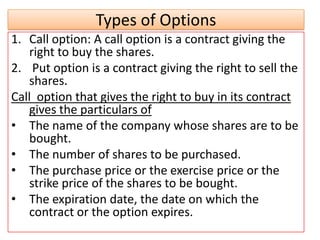
Types of Options
1. Call option: A call option is a contract giving the
   right to buy the shares.
2. Put option is a contract giving the right to sell the
   shares.
Call option that gives the right to buy in its contract
   gives the particulars of
• The name of the company whose shares are to be
   bought.
• The number of shares to be purchased.
• The purchase price or the exercise price or the
   strike price of the shares to be bought.
• The expiration date, the date on which the
   contract or the option expires.
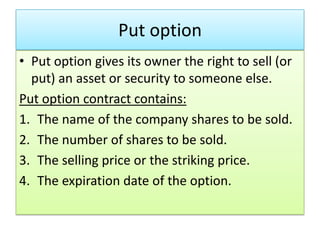
Put option
• Put option gives its owner the right to sell (or
  put) an asset or security to someone else.
Put option contract contains:
1. The name of the company shares to be sold.
2. The number of shares to be sold.
3. The selling price or the striking price.
4. The expiration date of the option.
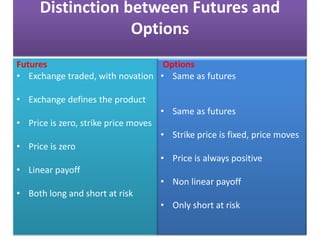
Distinction between Futures and
                   Options
Futures                           Options
• Exchange traded, with novation • Same as futures

• Exchange defines the product
                                      • Same as futures
• Price is zero, strike price moves
                                      • Strike price is fixed, price moves
• Price is zero
                                      • Price is always positive
• Linear payoff
                                      • Non linear payoff
• Both long and short at risk
                                      • Only short at risk
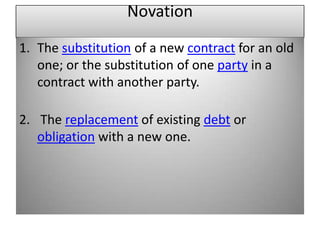
Novation

1. The substitution of a new contract for an old
   one; or the substitution of one party in a
   contract with another party.

2. The replacement of existing debt or
   obligation with a new one.
SWAPS (Meaning)
• Swaps: Swaps are private agreements
  between two parties to exchange cash flows in
  the future according to a prearranged
  formula. They can be regarded as portfolios of
  forward contracts.
Commonly two kind of swaps
• Interest rate swaps: These entail swapping
  only the interest related cash flows between
  the parties in the same currency.
• Currency swaps: These entail swapping both
  principal and interest between the
  parties, with the cash flows in one direction
  being in a different currency than those in the
  opposite direction.
Types Of Swaps
There are four types of swaps.
(1).Interest Rate Swaps.
(2).Currency Swaps.
(3).Commodity Swaps.
(4).Equity Swaps.
UNIT-II
FUTURES
    Future contract is an agreement between
two parties to buy or sell an asset at a certain
time in the future, at a certain price. But unlike
forward contract, futures contract are
standardized and stock ex-changed traded.
Continue…,
Future is a financial contract which derives its
  value from the underlying asset.
For example:
      Sugar cane or wheat or cotton farmers
  may wish to have contracts to sell their
  harvest at a future date to eliminate the risk
  of change in price by that date.
     There are commodity futures and financial
  futures.
Continue….,,
• In the financial futures, there are foreign
  currencies, interest rate and market index
  futures.
• Market index futures directly related with the
  stock market.
Continue…,,
The standardized items in a futures contract are:
1. Quantity of the underlying,
2. Quality of the underlying,
3. The date/month of delivery,
4. The units of price quotation and minimum
   price change and
5. Location of settlement.
Continue…..,
• Futures markets are designed to solve the
   problems of trading, liquidity and
   counterparty risk. Basically, futures markets
   resemble the forward market
Three distinct features of the futures markets
   are:
 - standardized contracts
 - centralized trading
- Settlement through clearing houses to avoid
   counterparty risk.

Financial derivatives ppt

  • 1.
    FINANCIAL DERIVATIVES Prepared by K.Logasakthi MBA (Ph.D) Assist.. Professor VSA School of Management, Salem.
  • 2.
  • 3.
    Derivatives - (Meaning) Derivatives:derivatives are instruments which include a) Security derived from a debt instrument share, loan, risk instrument or contract for differences of any other form of security and , b) a contract that derives its value from the price/index of prices of underlying securities.
  • 4.
    Derivatives (Definition) A financial instrument whose characteristics and value depend upon the characteristics and value of an underlier, typically a commodity, bond, equity or currency. Examples of derivatives include futures and options. Advanced investors sometimes purchase or sell derivatives to manage the risk associated with the underlying security, to protect against fluctuations in value, or to profit from periods of inactivity or decline. These techniques can be quite complicated and quite risky.
  • 5.
  • 7.
    Continue…, Basics Four Parts: 1.Forward 2. Future 3.Option 4. Warrents& Convertibles. Complex 1. Swap 2. Exotics
  • 8.
  • 9.
    The salient featuresof forward contracts are as follows: • They are bilateral contracts and hence, exposed to counterparty risk. • Each contract is customer designed, and hence is unique in terms of contract sixe, expiration date and the asset type and quality. • The contract price is generally not available in public domain. • On the expiration date, the contract has to be settled by delivery of the asset and • If party wishes to reverse the contract.
  • 10.
    Limitations of Forwardcontract 1. Forward markets are afflicted by several problems: 2. Lack of centralization of trading, 3. Liquidity and Counterparty risk. • The basic problem in the first two is that they have too much flexibility and generality. • Counterparty risk arises from the possibility of default by any one party to the transaction. When one of the two sides to the transaction declares bankruptcy, the other suffers
  • 11.
    FUTURE CONTRACT Future contract Future contract is an agreement between two parties to buy or sell an asset at a certain time in the future, at a certain price. But unlike forward contract, futures contract are standardized and stock ex-changed traded.
  • 12.
    Continue.,,….,, The standardized itemsin a futures contract are: 1. Quantity of the underlying, 2. Quality of the underlying, 3. The date/month of delivery, 4. The units of price quotation and minimum price change and 5. Location of settlement.
  • 13.
    Distinction between futuresand forward S.no Future Contract S.no Forward Contract 1 Traded on an organized stock 1 Over the Counter (OTC) in nature exchange 2 Standardized contract terms, hence, 2 Customized contract terms, hence, more liquid. less liquid 3 3 No margin payment Requires margin payments 4 4 Settlement happens at the end of the Follows daily settlement period
  • 14.
    Over The Counter(OTC)Trading • In general, the reason for which a stock is traded over-the-counter is usually because the company is small, making it unable to meet exchange listing requirements. Also known as "unlisted stock", these securities are traded by broker-dealers who negotiate directly with one another over computer networks and by phone. OTC stocks are generally unlisted stocks which trade on the Over the Counter Bulletin Board (OTCBB)
  • 15.
    Important terms infuture contract • Spot price: The price at which an instrument/asset trades in the spot market. • Future Price: The price at which the futures contract trade in the future market. • Contract cycle: The period over which a contract trades. The index futures contract typically have one month, two months and three months expiry cycles that expire on the last Thursday of the month.
  • 16.
    Continue…,,,, • Expiry date:It is the date specified in the futures contract. This is the last day on which the contract will be traded, at the end of which it will cease to exist. • Contract size: The amount of asset that has to be delivered under one contract. • Basis: Basis is defined as the future price minus the spot price. There will be different basis for each delivery month for each contract. In the a normal market, basis will be positive. This reflects that futures prices normally exceed spot prices.
  • 17.
    Continue…, • Cost ofCarry: The relationship between futures prices and spot prices can be summarised in terms of the cost of carry. • Initial Margin: The amount that must be deposited in the margin account at the time a futures contract is first entered into is the initial margin.
  • 18.
    Pay off forFutures A pay off is the likely profit/loss that would accrue to a market participant with change in the price of the underlying asset. Futures contracts have linear pay off. Linear pay off: “ losses as well as profits for both the buyer and the seller of futures are unlimited”
  • 19.
    Pay off forBuyer of Futures: (Long Future) The pay offs for a person who buys a futures contract is similar to the pay off for a person who holds an asset. He has a potentially unlimited upside as well as downside. e.g. Take the case of a speculator who sells a two month Nifty index futures contact when the Nifty stands at 1220. the underlying asset in this case is the nifty portfolio. When the index moves down the short futures position starts making profits and when the index moves up it starts making losses.
  • 20.
    Pay off forSeller Futures (short future) • The pay off for a person who sells a futures contract is similar to the pay off for a person who shorts an asset. he has potentially unlimited upside as well as downside.
  • 21.
    OPTIONS Meaning of options: An option is the right, but not the obligation to buy or sell something on a specified date at a specified price. In the securities market, an option is a contract between two parties to buy or sell specified number of shares at a later date for an agreed price.
  • 22.
    Continue…,, There are three parties involved in the option trading, the option seller, buyer and the broker. 1. The option seller or writer is a person who grants someone else the option to buy or sell. He receives premium on its price. 2. The option buyer pays a price to the option writer to induce him to write the option. 3. The securities broker acts as an agent to find the option buyer and the seller, and receives a commission or fee for it.
  • 23.
    Options An optionto buy anything is known as a CALL while an option to sell a thing is called a PUT. Options trade in an organized market but, large percentage of it is traded over the counter (i.e. privately). Note that this is just an option. That means it is a right and not an obligation. Strike price: Price specified in the options contract is known as the strike price or exercise price.
  • 24.
    Types of Options 1.Call option: A call option is a contract giving the right to buy the shares. 2. Put option is a contract giving the right to sell the shares. Call option that gives the right to buy in its contract gives the particulars of • The name of the company whose shares are to be bought. • The number of shares to be purchased. • The purchase price or the exercise price or the strike price of the shares to be bought. • The expiration date, the date on which the contract or the option expires.
  • 25.
    Put option • Putoption gives its owner the right to sell (or put) an asset or security to someone else. Put option contract contains: 1. The name of the company shares to be sold. 2. The number of shares to be sold. 3. The selling price or the striking price. 4. The expiration date of the option.
  • 26.
    Distinction between Futuresand Options Futures Options • Exchange traded, with novation • Same as futures • Exchange defines the product • Same as futures • Price is zero, strike price moves • Strike price is fixed, price moves • Price is zero • Price is always positive • Linear payoff • Non linear payoff • Both long and short at risk • Only short at risk
  • 27.
    Novation 1. The substitutionof a new contract for an old one; or the substitution of one party in a contract with another party. 2. The replacement of existing debt or obligation with a new one.
  • 29.
    SWAPS (Meaning) • Swaps:Swaps are private agreements between two parties to exchange cash flows in the future according to a prearranged formula. They can be regarded as portfolios of forward contracts.
  • 30.
    Commonly two kindof swaps • Interest rate swaps: These entail swapping only the interest related cash flows between the parties in the same currency. • Currency swaps: These entail swapping both principal and interest between the parties, with the cash flows in one direction being in a different currency than those in the opposite direction.
  • 31.
    Types Of Swaps Thereare four types of swaps. (1).Interest Rate Swaps. (2).Currency Swaps. (3).Commodity Swaps. (4).Equity Swaps.
  • 32.
  • 33.
    FUTURES Future contract is an agreement between two parties to buy or sell an asset at a certain time in the future, at a certain price. But unlike forward contract, futures contract are standardized and stock ex-changed traded.
  • 34.
    Continue…, Future is afinancial contract which derives its value from the underlying asset. For example: Sugar cane or wheat or cotton farmers may wish to have contracts to sell their harvest at a future date to eliminate the risk of change in price by that date. There are commodity futures and financial futures.
  • 35.
    Continue….,, • In thefinancial futures, there are foreign currencies, interest rate and market index futures. • Market index futures directly related with the stock market.
  • 36.
    Continue…,, The standardized itemsin a futures contract are: 1. Quantity of the underlying, 2. Quality of the underlying, 3. The date/month of delivery, 4. The units of price quotation and minimum price change and 5. Location of settlement.
  • 37.
    Continue….., • Futures marketsare designed to solve the problems of trading, liquidity and counterparty risk. Basically, futures markets resemble the forward market Three distinct features of the futures markets are: - standardized contracts - centralized trading - Settlement through clearing houses to avoid counterparty risk.