
• Types of Bonds
• International Bonds
• Bond Yields
• YTM
• Risk Analysis in Bonds
• Bond Value Theorem
• Bond Immunization
Strategies
2
3
• Bond is a negotiable certificate, evidencing indebtedness.
• It is typically a long term, fixed income instrument that represents a
loan made by an investor to a borrower.
• The terms Bond and Debentures are used interchangeably, but in
India;
• BONDS are generally the debt securities issued by the Govt or
Public Sector enterprises.
• DEBENTURES are the debt securities issued by the Private sector.
4
• 1. Maturity Period
• Upto 5 Years – Short Term
• 5 – 15 Years – Medium Term
• More than 15 Years – Long Term
• Coupon Rate
• Redemption Value
• Inverse relation with the Market interest rate
Manu Antony Chachirayil 9567320002
5
• Zero Coupon
• Deep Discount
• Convertible
• Callable & Putable
• Floating Rate
• Perpetual
• Extendable
• Index Linked
• Junk Bonds
• Strips
6
• A stripped bond is a bond that has had its main components broken
up into a zero-coupon bond and a series of coupons.
• Bond stripping is done through specialized agencies
• It helps the investors in minimizing the risk
7
• A debt Instrument which is issued in a country by a non-
domestic entity
• In an Indian perspective, a bond issued by another country
or a foreign corporation here would be an International
Bond.
• Types are;
1. Euro Bonds &
2. Foreign Bonds
8
• Default Risk
• Interest Rate Risk
• 1. Reinvestment Risk
• 2. Price Risk
9
• Income Predictability
• Safety
• Diversification
• Choice
10
• It is the Process of determining the fair price of a bond.
• The different valuation methods are;
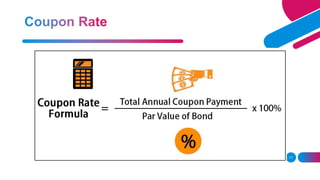
• 1. Coupon Rate
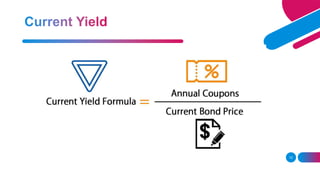
• 2. Current Yield
• 3. Spot Interest Rate
• 4. Yield to Maturity
• 5. Yield to Call
11
12
13
• Calculated for Zero Coupon Bonds
• For such Bonds, there will only be one cash outflow and
one cash inflow.
• Spot Interest rate is the return received from a zero coupon
bond expressed in an annualized basis.
• In other words, SIR is the annual rate of return of a Bond,
which has only one cash inflow.
14
• MP =
• MP = Market Price
• TV = Terminal Value (Value realized at the maturity)
• K = Spot Interest Rate
• n = Number of years to maturity
TV
(1 + K)n
15
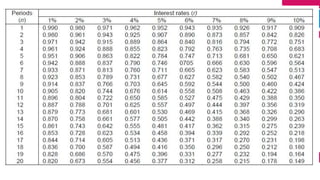
• Most widely used measure to calculate Bond Returns.
• It is the compounded rate of return an Investor is expected
to receive from a Bond purchased at the current market
price and held to maturity.
• YTM is the discount rate, which equates the PV of all cash
inflows to the Cash out flow.
• In other words, it is the IRR of holding a Bond till maturity.
16
• 1. There should not be any default
• 2. The investor has to hold the Bond till maturity
• 3. All the coupon payments should be re-invested
immediately at the same interest rate.
17
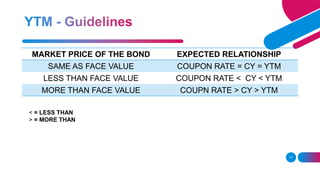
MARKET PRICE OF THE BOND EXPECTED RELATIONSHIP
SAME AS FACE VALUE COUPON RATE = CY = YTM
LESS THAN FACE VALUE COUPON RATE ˂ CY ˂ YTM
MORE THAN FACE VALUE COUPN RATE ˃ CY ˃ YTM
˂ = LESS THAN
˃ = MORE THAN
18
• Annuity : Refers to the series regular payments (Coupon)
that the Investor receives at the end of each year
throughout the maturity period.
• Terminal Value/ Redemption Value: The value at which the
issuer buy back the debenture. This is a form of cash
inflow which happens only once.
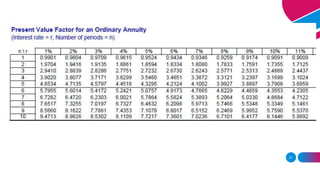
• Present Value Factor (PVF): The factor value which finds
the PV of TV/RV
• Present Value Factor for Annuity (PVFA): The factor value
which finds the PV of Annuities
19
20
21
22
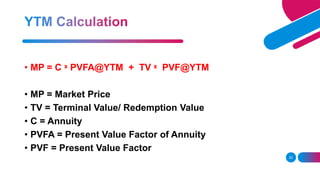
• MP = C ˣ PVFA@YTM + TV ˣ PVF@YTM
• MP = Market Price
• TV = Terminal Value/ Redemption Value
• C = Annuity
• PVFA = Present Value Factor of Annuity
• PVF = Present Value Factor
23
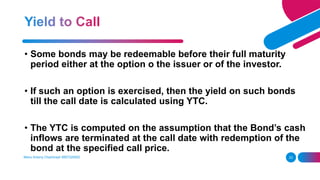
• Some bonds may be redeemable before their full maturity
period either at the option o the issuer or of the investor.
• If such an option is exercised, then the yield on such bonds
till the call date is calculated using YTC.
• The YTC is computed on the assumption that the Bond’s cash
inflows are terminated at the call date with redemption of the
bond at the specified call price.
Manu Antony Chachirayil 9567320002
24
• If you are provided with the YTM at the first instance, you
can use it to calculate the Value of the bond.
• Then you have to compare the calculated Bond value with
the existing market price.
• If the existing MP is higher, then the Bond is Overpriced
and the market will correct it soon by price reduction.
• If the existing MP is lower than the calculated Bond value,
the price of the bond is expected to increase.
25
• Bonds are sensitive to the changes in the Market Interest
rate.
• The relationship between Bond prices and changes in the
market interest rate have been stated by Burton G Malkiel
in the form of five general principles.
• They explain the Bond Pricing behaviour in an environment
of changing interest rates.
26
• 1. Bond prices will move inversely to market interest
changes
27
• 2. Bond price variability is directly related to the term to
maturity; which means, for a given change in the level of
market interest rates, changes in bond prices are greater
for long term maturities.
28
• 3. A Bond’s sensitivity to changes in market interest rate
increases at a diminishing rate as the time remaining until
its maturity increases.
29
• 4. The price changes resulting from equal absolute
increases in market interest rates are not symmetrical. i.e,
for any given maturity a decrease in market interest rate
causes a price rise that is larger than the price decline that
results from an equal increase in the market interest rate.
30
• 5. Bond price volatility is related to the coupon rate, which
implies that the percentage change in a bond’s price due to
a change in the market interest rate will be smaller if its
coupon rate is higher.
31
• “Bond immunization is an investment strategy used to
minimize the interest rate risk of bond investments by
adjusting the portfolio duration to match the investor's
investment time horizon.”
32
• Immunization locks in a fixed rate of return during the
amount of time an investor plans to keep the bond without
cashing it in.
• While immunising a Bond, we are actually creating a
portfolio with interest rate risk and Price risk, which offsets
each other.
33
• Duration measures the time structure of a bond and the
Bond’s interest rate risk.
• The time structure of a bond is expressed in two different
ways;
• 1. The Common way; the number of years that an
investor has to wait until the bond matures and the
principal money is paid back. (Asset time to
maturity/Years to maturity)
• 2. Measuring the average time until all investment
coupons and the principal is recovered
34
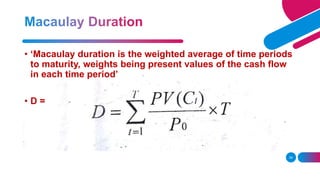
• ‘Macaulay duration is the weighted average of time periods
to maturity, weights being present values of the cash flow
in each time period’
• D =
35
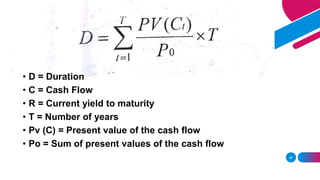
• D = Duration
• C = Cash Flow
• R = Current yield to maturity
• T = Number of years
• Pv (C) = Present value of the cash flow
• Po = Sum of present values of the cash flow
36
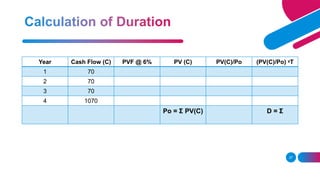
Year Cash Flow (C) PVF @ 6% PV (C) PV(C)/Po (PV(C)/Po) ˣT
1 70 0.943 66.01 0.0638 0.0638
2 70 0.890 62.30 0.0602 0.1204
3 70 0.8396 58.77 0.0568 0.1704
4 1070 0.7921 847.55 0.8191 3.2764
Po = Σ PV(C)
= 1034.63
D = 3.6310
37
Year Cash Flow (C) PVF @ 6% PV (C) PV(C)/Po (PV(C)/Po) ˣT
1 70
2 70
3 70
4 1070
Po = Σ PV(C) D = Σ
38
• Larger the Coupon Rate, lower the Duration.
• Longer the term to maturity, longer will be the duration.
• Higher the YTM, lower will be the duration.
• For a zero couponed bond, the bonds term to maturity and
the Duration are the same. (The zero coupon bond makes
only one balloon payment at redemption)
MC
39
Manu Antony 9567320002
cmanuantony@gmail.com

Bond investment analysis

  • 2.
    • Types ofBonds • International Bonds • Bond Yields • YTM • Risk Analysis in Bonds • Bond Value Theorem • Bond Immunization Strategies 2
  • 3.
    3 • Bond isa negotiable certificate, evidencing indebtedness. • It is typically a long term, fixed income instrument that represents a loan made by an investor to a borrower. • The terms Bond and Debentures are used interchangeably, but in India; • BONDS are generally the debt securities issued by the Govt or Public Sector enterprises. • DEBENTURES are the debt securities issued by the Private sector.
  • 4.
    4 • 1. MaturityPeriod • Upto 5 Years – Short Term • 5 – 15 Years – Medium Term • More than 15 Years – Long Term • Coupon Rate • Redemption Value • Inverse relation with the Market interest rate Manu Antony Chachirayil 9567320002
  • 5.
    5 • Zero Coupon •Deep Discount • Convertible • Callable & Putable • Floating Rate • Perpetual • Extendable • Index Linked • Junk Bonds • Strips
  • 6.
    6 • A strippedbond is a bond that has had its main components broken up into a zero-coupon bond and a series of coupons. • Bond stripping is done through specialized agencies • It helps the investors in minimizing the risk
  • 7.
    7 • A debtInstrument which is issued in a country by a non- domestic entity • In an Indian perspective, a bond issued by another country or a foreign corporation here would be an International Bond. • Types are; 1. Euro Bonds & 2. Foreign Bonds
  • 8.
    8 • Default Risk •Interest Rate Risk • 1. Reinvestment Risk • 2. Price Risk
  • 9.
    9 • Income Predictability •Safety • Diversification • Choice
  • 10.
    10 • It isthe Process of determining the fair price of a bond. • The different valuation methods are; • 1. Coupon Rate • 2. Current Yield • 3. Spot Interest Rate • 4. Yield to Maturity • 5. Yield to Call
  • 11.
  • 12.
  • 13.
    13 • Calculated forZero Coupon Bonds • For such Bonds, there will only be one cash outflow and one cash inflow. • Spot Interest rate is the return received from a zero coupon bond expressed in an annualized basis. • In other words, SIR is the annual rate of return of a Bond, which has only one cash inflow.
  • 14.
    14 • MP = •MP = Market Price • TV = Terminal Value (Value realized at the maturity) • K = Spot Interest Rate • n = Number of years to maturity TV (1 + K)n
  • 15.
    15 • Most widelyused measure to calculate Bond Returns. • It is the compounded rate of return an Investor is expected to receive from a Bond purchased at the current market price and held to maturity. • YTM is the discount rate, which equates the PV of all cash inflows to the Cash out flow. • In other words, it is the IRR of holding a Bond till maturity.
  • 16.
    16 • 1. Thereshould not be any default • 2. The investor has to hold the Bond till maturity • 3. All the coupon payments should be re-invested immediately at the same interest rate.
  • 17.
    17 MARKET PRICE OFTHE BOND EXPECTED RELATIONSHIP SAME AS FACE VALUE COUPON RATE = CY = YTM LESS THAN FACE VALUE COUPON RATE ˂ CY ˂ YTM MORE THAN FACE VALUE COUPN RATE ˃ CY ˃ YTM ˂ = LESS THAN ˃ = MORE THAN
  • 18.
    18 • Annuity :Refers to the series regular payments (Coupon) that the Investor receives at the end of each year throughout the maturity period. • Terminal Value/ Redemption Value: The value at which the issuer buy back the debenture. This is a form of cash inflow which happens only once. • Present Value Factor (PVF): The factor value which finds the PV of TV/RV • Present Value Factor for Annuity (PVFA): The factor value which finds the PV of Annuities
  • 19.
  • 20.
  • 21.
  • 22.
    22 • MP =C ˣ PVFA@YTM + TV ˣ PVF@YTM • MP = Market Price • TV = Terminal Value/ Redemption Value • C = Annuity • PVFA = Present Value Factor of Annuity • PVF = Present Value Factor
  • 23.
    23 • Some bondsmay be redeemable before their full maturity period either at the option o the issuer or of the investor. • If such an option is exercised, then the yield on such bonds till the call date is calculated using YTC. • The YTC is computed on the assumption that the Bond’s cash inflows are terminated at the call date with redemption of the bond at the specified call price. Manu Antony Chachirayil 9567320002
  • 24.
    24 • If youare provided with the YTM at the first instance, you can use it to calculate the Value of the bond. • Then you have to compare the calculated Bond value with the existing market price. • If the existing MP is higher, then the Bond is Overpriced and the market will correct it soon by price reduction. • If the existing MP is lower than the calculated Bond value, the price of the bond is expected to increase.
  • 25.
    25 • Bonds aresensitive to the changes in the Market Interest rate. • The relationship between Bond prices and changes in the market interest rate have been stated by Burton G Malkiel in the form of five general principles. • They explain the Bond Pricing behaviour in an environment of changing interest rates.
  • 26.
    26 • 1. Bondprices will move inversely to market interest changes
  • 27.
    27 • 2. Bondprice variability is directly related to the term to maturity; which means, for a given change in the level of market interest rates, changes in bond prices are greater for long term maturities.
  • 28.
    28 • 3. ABond’s sensitivity to changes in market interest rate increases at a diminishing rate as the time remaining until its maturity increases.
  • 29.
    29 • 4. Theprice changes resulting from equal absolute increases in market interest rates are not symmetrical. i.e, for any given maturity a decrease in market interest rate causes a price rise that is larger than the price decline that results from an equal increase in the market interest rate.
  • 30.
    30 • 5. Bondprice volatility is related to the coupon rate, which implies that the percentage change in a bond’s price due to a change in the market interest rate will be smaller if its coupon rate is higher.
  • 31.
    31 • “Bond immunizationis an investment strategy used to minimize the interest rate risk of bond investments by adjusting the portfolio duration to match the investor's investment time horizon.”
  • 32.
    32 • Immunization locksin a fixed rate of return during the amount of time an investor plans to keep the bond without cashing it in. • While immunising a Bond, we are actually creating a portfolio with interest rate risk and Price risk, which offsets each other.
  • 33.
    33 • Duration measuresthe time structure of a bond and the Bond’s interest rate risk. • The time structure of a bond is expressed in two different ways; • 1. The Common way; the number of years that an investor has to wait until the bond matures and the principal money is paid back. (Asset time to maturity/Years to maturity) • 2. Measuring the average time until all investment coupons and the principal is recovered
  • 34.
    34 • ‘Macaulay durationis the weighted average of time periods to maturity, weights being present values of the cash flow in each time period’ • D =
  • 35.
    35 • D =Duration • C = Cash Flow • R = Current yield to maturity • T = Number of years • Pv (C) = Present value of the cash flow • Po = Sum of present values of the cash flow
  • 36.
    36 Year Cash Flow(C) PVF @ 6% PV (C) PV(C)/Po (PV(C)/Po) ˣT 1 70 0.943 66.01 0.0638 0.0638 2 70 0.890 62.30 0.0602 0.1204 3 70 0.8396 58.77 0.0568 0.1704 4 1070 0.7921 847.55 0.8191 3.2764 Po = Σ PV(C) = 1034.63 D = 3.6310
  • 37.
    37 Year Cash Flow(C) PVF @ 6% PV (C) PV(C)/Po (PV(C)/Po) ˣT 1 70 2 70 3 70 4 1070 Po = Σ PV(C) D = Σ
  • 38.
    38 • Larger theCoupon Rate, lower the Duration. • Longer the term to maturity, longer will be the duration. • Higher the YTM, lower will be the duration. • For a zero couponed bond, the bonds term to maturity and the Duration are the same. (The zero coupon bond makes only one balloon payment at redemption)
  • 39.