Financial Derivatives
         for
 Risk Management
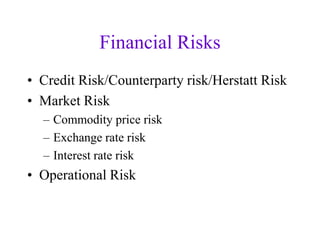
Financial Risks
• Credit Risk/Counterparty risk/Herstatt Risk
• Market Risk
  – Commodity price risk
  – Exchange rate risk
  – Interest rate risk
• Operational Risk
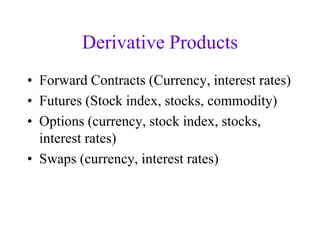
Derivative Products
• Forward Contracts (Currency, interest rates)
• Futures (Stock index, stocks, commodity)
• Options (currency, stock index, stocks,
  interest rates)
• Swaps (currency, interest rates)
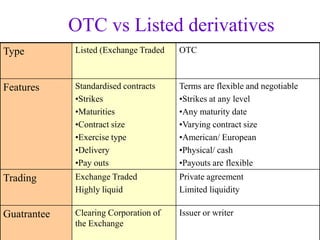
OTC vs Listed derivatives
Type         Listed (Exchange Traded   OTC


Features     Standardised contracts    Terms are flexible and negotiable
             •Strikes                  •Strikes at any level
             •Maturities               •Any maturity date
             •Contract size            •Varying contract size
             •Exercise type            •American/ European
             •Delivery                 •Physical/ cash
             •Pay outs                 •Payouts are flexible
Trading      Exchange Traded           Private agreement
             Highly liquid             Limited liquidity

Guatrantee   Clearing Corporation of   Issuer or writer
             the Exchange
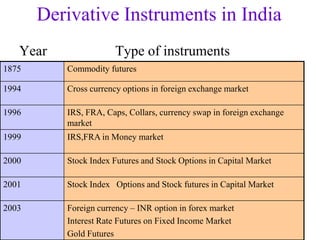
Derivative Instruments in India
   Year               Type of instruments
1875      Commodity futures

1994      Cross currency options in foreign exchange market

1996      IRS, FRA, Caps, Collars, currency swap in foreign exchange
          market
1999      IRS,FRA in Money market

2000      Stock Index Futures and Stock Options in Capital Market

2001      Stock Index Options and Stock futures in Capital Market

2003      Foreign currency – INR option in forex market
          Interest Rate Futures on Fixed Income Market
          Gold Futures
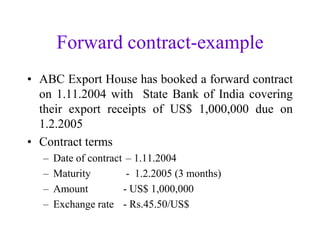
Forward contract-example
• ABC Export House has booked a forward contract
  on 1.11.2004 with State Bank of India covering
  their export receipts of US$ 1,000,000 due on
  1.2.2005
• Contract terms
  –   Date of contract – 1.11.2004
  –   Maturity         - 1.2.2005 (3 months)
  –   Amount          - US$ 1,000,000
  –   Exchange rate - Rs.45.50/US$
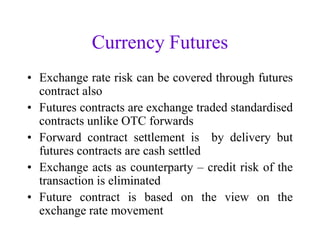
Currency Futures
• Exchange rate risk can be covered through futures
  contract also
• Futures contracts are exchange traded standardised
  contracts unlike OTC forwards
• Forward contract settlement is by delivery but
  futures contracts are cash settled
• Exchange acts as counterparty – credit risk of the
  transaction is eliminated
• Future contract is based on the view on the
  exchange rate movement
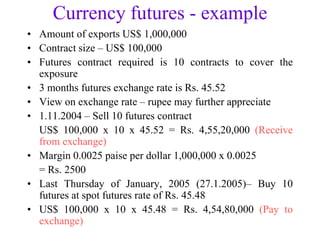
Currency futures - example
• Amount of exports US$ 1,000,000
• Contract size – US$ 100,000
• Futures contract required is 10 contracts to cover the
  exposure
• 3 months futures exchange rate is Rs. 45.52
• View on exchange rate – rupee may further appreciate
• 1.11.2004 – Sell 10 futures contract
  US$ 100,000 x 10 x 45.52 = Rs. 4,55,20,000 (Receive
  from exchange)
• Margin 0.0025 paise per dollar 1,000,000 x 0.0025
  = Rs. 2500
• Last Thursday of January, 2005 (27.1.2005)– Buy 10
  futures at spot futures rate of Rs. 45.48
• US$ 100,000 x 10 x 45.48 = Rs. 4,54,80,000 (Pay to
  exchange)
Currency Futures in India
• Currency futures in India is yet to be introduced
• Full fledged currency futures exchange is required
  to be set up
• Thin volume of forex transactions on forward
  basis unlike international markets
• Forward contract is very popular in Indian market
• Popular international currency futures exchange
  are, CBOT, LIFFEE, PLDX, SIMEX etc.
Call and Put Option
• Customer can buy option for purchase of foreign
  currency or sale of foreign currency with a bank
  for a forward period
• Call option – to buy foreign currency
• Put option - to sell foreign currency
• Customer (Option buyer)– Buy call option or buy
  put option (Long call or long put)
• Bank (Option writer) – Sell call option or sell put
  option (shot call or short put)
Exercise Style
• European Option = Option exercised on maturity
  of the contract
• American Option = Option exercise any time
  before the maturity of the contract
• In India all currency options are OTC and
  European style option
• Cross currency option was introduced in January,
  1994
• Foreign currency-Rupee option was introduced in
  July, 2003
Hedging through option
• ABC Export House with export receivables of
  US$ 1,000,000 due on 1.2.2005 want to hedge
  through option
• Option contract terms(Short put for customer)
  –   Amount US$ 1,000,000
  –   Spot rate US$ 1=Rs.45.48
  –   Option rate    =Rs.45.50
  –   Option premium 1 paise per US dollar
  –   Exercise = European – 1.2.2005
Hedge or not to hedge
• ABC Export House with export receivables
  of US$ 1,000,000 due on 1.2.2005
• There are three possible choices
  – Do nothing (keep the position open)
  – Book forward contract to mature on 1.2.2005
  – Buy USD put option at Rs.45.50 with premium
    of Re.0.01
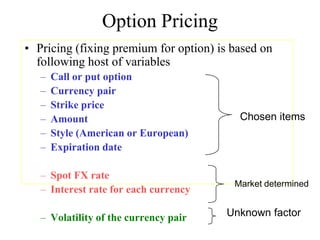
Option Pricing
• Pricing (fixing premium for option) is based on
  following host of variables
   –   Call or put option
   –   Currency pair
   –   Strike price
   –   Amount                             Chosen items
   –   Style (American or European)
   –   Expiration date

   – Spot FX rate
                                         Market determined
   – Interest rate for each currency

   – Volatility of the currency pair   Unknown factor
Guidelines to banks for writing
             options
• Banks need to obtain one time approval from
  Reserve Bank
• Continuous profitability for at least 3 years
• Minimum CRAR of 9%
• Net NPA at reasonable level (not more than 5% of
  net advances)
• Minimum Net worth not less than Rs. 200 crore
• Banks can offer plain vanilla European option
• Option premium to be quoted in Rupees or as a
  percentage of the Rupee/FC notional
Option valuation
• The delta of an option is produced as a by product
  of the pricing formula (Black Sholes Model) and
  represents the mathematical calculation of the
  options likelihood of exercise on maturity. The
  delta of an option can have a value between 0 and
  1 but is usually expressed in percentage terms
• Market makers are allowed to hedge the delta of
  their option portfolio b accessing the spot markets
IRS/FRA guidelines
• Interest Rate Swap/Forward Rate Agreement
  introduced in July, 1999(MPD.BC.187.01.279/ 1999-
  2000 dated July 7, 1999)
• Banks/PDs/FIs can undertake plain vanilla FRAs/IRS
  – swaps having implicit option futures such as
  caps/floors/collars are not permitted
• Benchmark rate should evolve on its own in the
  market- any domestic money market or debt market
  rate may be used as benchmark which has acceptance
  among users
• No restriction on minimum and maximum notional
  amount/tenor of the contract. However, IRS are
  booked for a maximum period of 1 year only
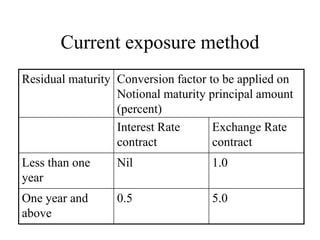
Current exposure method
Residual maturity Conversion factor to be applied on
                  Notional maturity principal amount
                  (percent)
                  Interest Rate      Exchange Rate
                  contract           contract
Less than one     Nil               1.0
year
One year and      0.5               5.0
above
IRS – Benchmark rate
• R-MIBOR – Reuter-Mumbai Interbank
  Offered Rate (weighted average of traded
  call money rates sourced from 25 banks,
  PDs and FIs)
• N-MIBOR- NSE Mumbai Interbank
  Offered Rate which is the rate issued by the
  NSE
• Interest rate is reset periodically
Interest Rate Swaps- Benchmark
                rates
• MITOR -      Mumbai Interbank Tom Rate
  – FIMMDA-Reuters implied Rupee rates based cash/Tom
  – It is based on cash/TOM dollar-rupee premium
• OIS – FIMMDA-Reuters Overnight Indexed
  Swaps
  – It is an average (after taking out 2 highest and 2 lowest)
    quoted by 17 market participants.
• MIFOR – Mumbai Interbank Forward Offered
  Rate
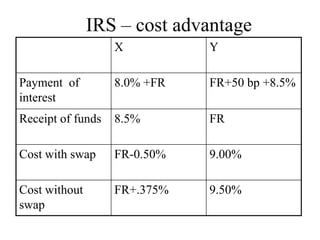
IRS – cost advantage
                   X          Y

Payment of         8.0% +FR   FR+50 bp +8.5%
interest
Receipt of funds   8.5%       FR

Cost with swap     FR-0.50%   9.00%

Cost without       FR+.375%   9.50%
swap
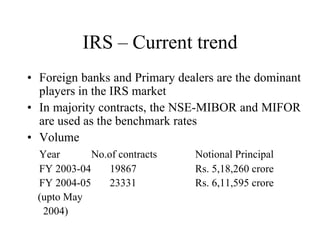
IRS – Current trend
• Foreign banks and Primary dealers are the dominant
  players in the IRS market
• In majority contracts, the NSE-MIBOR and MIFOR
  are used as the benchmark rates
• Volume
  Year       No.of contracts   Notional Principal
  FY 2003-04     19867         Rs. 5,18,260 crore
  FY 2004-05     23331         Rs. 6,11,595 crore
  (upto May
   2004)
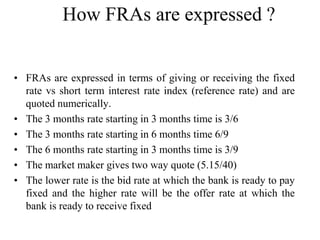
How FRAs are expressed ?


• FRAs are expressed in terms of giving or receiving the fixed
  rate vs short term interest rate index (reference rate) and are
  quoted numerically.
• The 3 months rate starting in 3 months time is 3/6
• The 3 months rate starting in 6 months time 6/9
• The 6 months rate starting in 3 months time is 3/9
• The market maker gives two way quote (5.15/40)
• The lower rate is the bid rate at which the bank is ready to pay
  fixed and the higher rate will be the offer rate at which the
  bank is ready to receive fixed
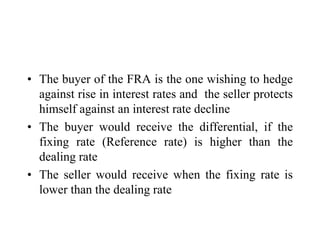
• The buyer of the FRA is the one wishing to hedge
  against rise in interest rates and the seller protects
  himself against an interest rate decline
• The buyer would receive the differential, if the
  fixing rate (Reference rate) is higher than the
  dealing rate
• The seller would receive when the fixing rate is
  lower than the dealing rate
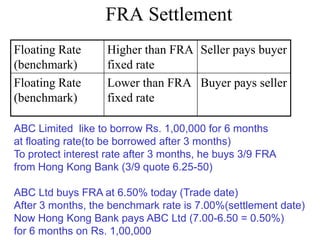
FRA Settlement
Floating Rate      Higher than FRA Seller pays buyer
(benchmark)        fixed rate
Floating Rate      Lower than FRA Buyer pays seller
(benchmark)        fixed rate

ABC Limited like to borrow Rs. 1,00,000 for 6 months
at floating rate(to be borrowed after 3 months)
To protect interest rate after 3 months, he buys 3/9 FRA
from Hong Kong Bank (3/9 quote 6.25-50)

ABC Ltd buys FRA at 6.50% today (Trade date)
After 3 months, the benchmark rate is 7.00%(settlement date)
Now Hong Kong Bank pays ABC Ltd (7.00-6.50 = 0.50%)
for 6 months on Rs. 1,00,000
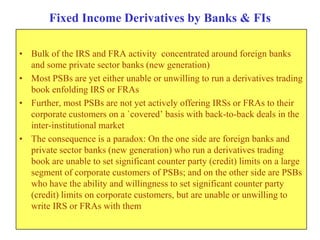
Fixed Income Derivatives by Banks & FIs

• Bulk of the IRS and FRA activity concentrated around foreign banks
  and some private sector banks (new generation)
• Most PSBs are yet either unable or unwilling to run a derivatives trading
  book enfolding IRS or FRAs
• Further, most PSBs are not yet actively offering IRSs or FRAs to their
  corporate customers on a `covered‟ basis with back-to-back deals in the
  inter-institutional market
• The consequence is a paradox: On the one side are foreign banks and
  private sector banks (new generation) who run a derivatives trading
  book are unable to set significant counter party (credit) limits on a large
  segment of corporate customers of PSBs; and on the other side are PSBs
  who have the ability and willingness to set significant counter party
  (credit) limits on corporate customers, but are unable or unwilling to
  write IRS or FRAs with them
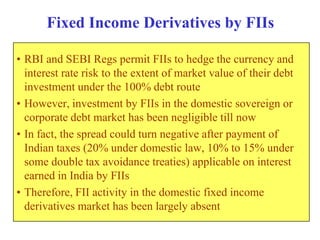
Fixed Income Derivatives by FIIs

• RBI and SEBI Regs permit FIIs to hedge the currency and
  interest rate risk to the extent of market value of their debt
  investment under the 100% debt route
• However, investment by FIIs in the domestic sovereign or
  corporate debt market has been negligible till now
• In fact, the spread could turn negative after payment of
  Indian taxes (20% under domestic law, 10% to 15% under
  some double tax avoidance treaties) applicable on interest
  earned in India by FIIs
• Therefore, FII activity in the domestic fixed income
  derivatives market has been largely absent

Flevy.com - Financial Derivatives - Forwards/Futures/Options

  • 1.
    Financial Derivatives for Risk Management
  • 2.
    Financial Risks • CreditRisk/Counterparty risk/Herstatt Risk • Market Risk – Commodity price risk – Exchange rate risk – Interest rate risk • Operational Risk
  • 3.
    Derivative Products • ForwardContracts (Currency, interest rates) • Futures (Stock index, stocks, commodity) • Options (currency, stock index, stocks, interest rates) • Swaps (currency, interest rates)
  • 4.
    OTC vs Listedderivatives Type Listed (Exchange Traded OTC Features Standardised contracts Terms are flexible and negotiable •Strikes •Strikes at any level •Maturities •Any maturity date •Contract size •Varying contract size •Exercise type •American/ European •Delivery •Physical/ cash •Pay outs •Payouts are flexible Trading Exchange Traded Private agreement Highly liquid Limited liquidity Guatrantee Clearing Corporation of Issuer or writer the Exchange
  • 5.
    Derivative Instruments inIndia Year Type of instruments 1875 Commodity futures 1994 Cross currency options in foreign exchange market 1996 IRS, FRA, Caps, Collars, currency swap in foreign exchange market 1999 IRS,FRA in Money market 2000 Stock Index Futures and Stock Options in Capital Market 2001 Stock Index Options and Stock futures in Capital Market 2003 Foreign currency – INR option in forex market Interest Rate Futures on Fixed Income Market Gold Futures
  • 6.
    Forward contract-example • ABCExport House has booked a forward contract on 1.11.2004 with State Bank of India covering their export receipts of US$ 1,000,000 due on 1.2.2005 • Contract terms – Date of contract – 1.11.2004 – Maturity - 1.2.2005 (3 months) – Amount - US$ 1,000,000 – Exchange rate - Rs.45.50/US$
  • 7.
    Currency Futures • Exchangerate risk can be covered through futures contract also • Futures contracts are exchange traded standardised contracts unlike OTC forwards • Forward contract settlement is by delivery but futures contracts are cash settled • Exchange acts as counterparty – credit risk of the transaction is eliminated • Future contract is based on the view on the exchange rate movement
  • 8.
    Currency futures -example • Amount of exports US$ 1,000,000 • Contract size – US$ 100,000 • Futures contract required is 10 contracts to cover the exposure • 3 months futures exchange rate is Rs. 45.52 • View on exchange rate – rupee may further appreciate • 1.11.2004 – Sell 10 futures contract US$ 100,000 x 10 x 45.52 = Rs. 4,55,20,000 (Receive from exchange) • Margin 0.0025 paise per dollar 1,000,000 x 0.0025 = Rs. 2500 • Last Thursday of January, 2005 (27.1.2005)– Buy 10 futures at spot futures rate of Rs. 45.48 • US$ 100,000 x 10 x 45.48 = Rs. 4,54,80,000 (Pay to exchange)
  • 9.
    Currency Futures inIndia • Currency futures in India is yet to be introduced • Full fledged currency futures exchange is required to be set up • Thin volume of forex transactions on forward basis unlike international markets • Forward contract is very popular in Indian market • Popular international currency futures exchange are, CBOT, LIFFEE, PLDX, SIMEX etc.
  • 10.
    Call and PutOption • Customer can buy option for purchase of foreign currency or sale of foreign currency with a bank for a forward period • Call option – to buy foreign currency • Put option - to sell foreign currency • Customer (Option buyer)– Buy call option or buy put option (Long call or long put) • Bank (Option writer) – Sell call option or sell put option (shot call or short put)
  • 11.
    Exercise Style • EuropeanOption = Option exercised on maturity of the contract • American Option = Option exercise any time before the maturity of the contract • In India all currency options are OTC and European style option • Cross currency option was introduced in January, 1994 • Foreign currency-Rupee option was introduced in July, 2003
  • 12.
    Hedging through option •ABC Export House with export receivables of US$ 1,000,000 due on 1.2.2005 want to hedge through option • Option contract terms(Short put for customer) – Amount US$ 1,000,000 – Spot rate US$ 1=Rs.45.48 – Option rate =Rs.45.50 – Option premium 1 paise per US dollar – Exercise = European – 1.2.2005
  • 13.
    Hedge or notto hedge • ABC Export House with export receivables of US$ 1,000,000 due on 1.2.2005 • There are three possible choices – Do nothing (keep the position open) – Book forward contract to mature on 1.2.2005 – Buy USD put option at Rs.45.50 with premium of Re.0.01
  • 14.
    Option Pricing • Pricing(fixing premium for option) is based on following host of variables – Call or put option – Currency pair – Strike price – Amount Chosen items – Style (American or European) – Expiration date – Spot FX rate Market determined – Interest rate for each currency – Volatility of the currency pair Unknown factor
  • 15.
    Guidelines to banksfor writing options • Banks need to obtain one time approval from Reserve Bank • Continuous profitability for at least 3 years • Minimum CRAR of 9% • Net NPA at reasonable level (not more than 5% of net advances) • Minimum Net worth not less than Rs. 200 crore • Banks can offer plain vanilla European option • Option premium to be quoted in Rupees or as a percentage of the Rupee/FC notional
  • 16.
    Option valuation • Thedelta of an option is produced as a by product of the pricing formula (Black Sholes Model) and represents the mathematical calculation of the options likelihood of exercise on maturity. The delta of an option can have a value between 0 and 1 but is usually expressed in percentage terms • Market makers are allowed to hedge the delta of their option portfolio b accessing the spot markets
  • 17.
    IRS/FRA guidelines • InterestRate Swap/Forward Rate Agreement introduced in July, 1999(MPD.BC.187.01.279/ 1999- 2000 dated July 7, 1999) • Banks/PDs/FIs can undertake plain vanilla FRAs/IRS – swaps having implicit option futures such as caps/floors/collars are not permitted • Benchmark rate should evolve on its own in the market- any domestic money market or debt market rate may be used as benchmark which has acceptance among users • No restriction on minimum and maximum notional amount/tenor of the contract. However, IRS are booked for a maximum period of 1 year only
  • 18.
    Current exposure method Residualmaturity Conversion factor to be applied on Notional maturity principal amount (percent) Interest Rate Exchange Rate contract contract Less than one Nil 1.0 year One year and 0.5 5.0 above
  • 19.
    IRS – Benchmarkrate • R-MIBOR – Reuter-Mumbai Interbank Offered Rate (weighted average of traded call money rates sourced from 25 banks, PDs and FIs) • N-MIBOR- NSE Mumbai Interbank Offered Rate which is the rate issued by the NSE • Interest rate is reset periodically
  • 20.
    Interest Rate Swaps-Benchmark rates • MITOR - Mumbai Interbank Tom Rate – FIMMDA-Reuters implied Rupee rates based cash/Tom – It is based on cash/TOM dollar-rupee premium • OIS – FIMMDA-Reuters Overnight Indexed Swaps – It is an average (after taking out 2 highest and 2 lowest) quoted by 17 market participants. • MIFOR – Mumbai Interbank Forward Offered Rate
  • 21.
    IRS – costadvantage X Y Payment of 8.0% +FR FR+50 bp +8.5% interest Receipt of funds 8.5% FR Cost with swap FR-0.50% 9.00% Cost without FR+.375% 9.50% swap
  • 22.
    IRS – Currenttrend • Foreign banks and Primary dealers are the dominant players in the IRS market • In majority contracts, the NSE-MIBOR and MIFOR are used as the benchmark rates • Volume Year No.of contracts Notional Principal FY 2003-04 19867 Rs. 5,18,260 crore FY 2004-05 23331 Rs. 6,11,595 crore (upto May 2004)
  • 23.
    How FRAs areexpressed ? • FRAs are expressed in terms of giving or receiving the fixed rate vs short term interest rate index (reference rate) and are quoted numerically. • The 3 months rate starting in 3 months time is 3/6 • The 3 months rate starting in 6 months time 6/9 • The 6 months rate starting in 3 months time is 3/9 • The market maker gives two way quote (5.15/40) • The lower rate is the bid rate at which the bank is ready to pay fixed and the higher rate will be the offer rate at which the bank is ready to receive fixed
  • 24.
    • The buyerof the FRA is the one wishing to hedge against rise in interest rates and the seller protects himself against an interest rate decline • The buyer would receive the differential, if the fixing rate (Reference rate) is higher than the dealing rate • The seller would receive when the fixing rate is lower than the dealing rate
  • 25.
    FRA Settlement Floating Rate Higher than FRA Seller pays buyer (benchmark) fixed rate Floating Rate Lower than FRA Buyer pays seller (benchmark) fixed rate ABC Limited like to borrow Rs. 1,00,000 for 6 months at floating rate(to be borrowed after 3 months) To protect interest rate after 3 months, he buys 3/9 FRA from Hong Kong Bank (3/9 quote 6.25-50) ABC Ltd buys FRA at 6.50% today (Trade date) After 3 months, the benchmark rate is 7.00%(settlement date) Now Hong Kong Bank pays ABC Ltd (7.00-6.50 = 0.50%) for 6 months on Rs. 1,00,000
  • 26.
    Fixed Income Derivativesby Banks & FIs • Bulk of the IRS and FRA activity concentrated around foreign banks and some private sector banks (new generation) • Most PSBs are yet either unable or unwilling to run a derivatives trading book enfolding IRS or FRAs • Further, most PSBs are not yet actively offering IRSs or FRAs to their corporate customers on a `covered‟ basis with back-to-back deals in the inter-institutional market • The consequence is a paradox: On the one side are foreign banks and private sector banks (new generation) who run a derivatives trading book are unable to set significant counter party (credit) limits on a large segment of corporate customers of PSBs; and on the other side are PSBs who have the ability and willingness to set significant counter party (credit) limits on corporate customers, but are unable or unwilling to write IRS or FRAs with them
  • 27.
    Fixed Income Derivativesby FIIs • RBI and SEBI Regs permit FIIs to hedge the currency and interest rate risk to the extent of market value of their debt investment under the 100% debt route • However, investment by FIIs in the domestic sovereign or corporate debt market has been negligible till now • In fact, the spread could turn negative after payment of Indian taxes (20% under domestic law, 10% to 15% under some double tax avoidance treaties) applicable on interest earned in India by FIIs • Therefore, FII activity in the domestic fixed income derivatives market has been largely absent