ADAPTIVE FILTER
     A Brief Discussion of
The Problem and The Solutions


 Sivaranjan Goswami, B. Tech. 7th sem.
  Electronics and Communication Engineering
Don Bosco College of Engineering and Technology
     Air Port Road, Azara, Guwahati 781017
           Contact: sivgos@gmail.com
INTRODUCTION
• In many practical scenario it is observed that
  we are required to filter a signal whose exact
  frequency response is not known.
• A solution to such problem is an adaptive
  filter.
• An adaptive filter is one which can
  automatically design itself and can detect
  system variation in time.

                 ADAPTIVE FILTER - the problem and the
                                                         2
                               solutions
Defining an Adaptive Filter
An adaptive filter is defined by four aspects:

1. The signals being processed by the filter
2. The structure that defines how the output signal
   of the filter is computed from its input signal
3. The parameters within this structure that can be
   iteratively changed to alter the filter’s input-
   output relationship
4. The adaptive algorithm that describes how the
   parameters are adjusted from one time instant to
   the next
                  ADAPTIVE FILTER - the problem and the
                                                          3
                                solutions
Block Diagram of Adaptive Filtering
             Problem


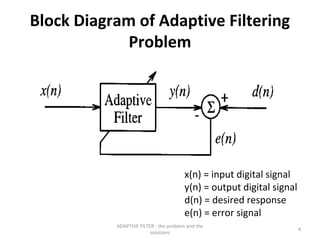
                                        x(n) = input digital signal
                                        y(n) = output digital signal
                                        d(n) = desired response
                                        e(n) = error signal
           ADAPTIVE FILTER - the problem and the
                                                                       4
                         solutions
Adaptive Filtering Problem
• The error signal e(n) is calculated from the
  desired response as shown in block diagram.
• The error signal is fed into a procedure which
  alters or adapts the parameters of the filter from
  time n to time (n +1) in a well-defined manner.
• Thus as time increases the output signal or actual
  response y(n) is hoped to become better and
  better match to the desired response d(n).

                  ADAPTIVE FILTER - the problem and the
                                                          5
                                solutions
Adaptive Filter Structure
• An adaptive filter is usually a linear one which
  can be represented as:


Where,
X(n)=[x(n),x(n-1),….,x(n-L+1)] is the input vector
W(n)=[w0(n),w1(n),….,wL-1(n)]T is the parameter or co-efficient vector

                         ADAPTIVE FILTER - the problem and the
                                                                         6
                                       solutions
Practical Adaptive Filtering Problem 1
• So far we are focusing on the desired
  response d(n). However, it is quite obvious
  that in many practical situations d(n) is not
  available.
• To solve this problem d(n) must be estimated
  from whatever signal is available to the input.
• The fact that such schemes even work is a
  tribute both to the ingenuity of the
  developers of the algorithms and to the
  technological maturity of the adaptive filtering
  field.         ADAPTIVE FILTER - the problem and the
                               solutions
                                                         7
Practical Adaptive Filtering Problem 2
• It should also be recognized that the
  relationship between x(n) and d(n) can vary
  with time.
• In this situation the adaptive filter must
  continuously change its parameter values to
  adapt the change.
• This behavior is commonly referred to as
  tracking.

                ADAPTIVE FILTER - the problem and the
                                                        8
                              solutions
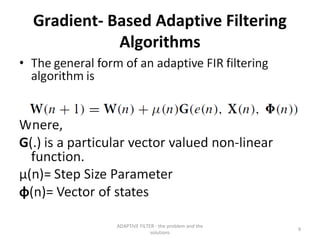
Gradient- Based Adaptive Filtering
           Algorithms


           ADAPTIVE FILTER - the problem and the
                                                   9
                         solutions
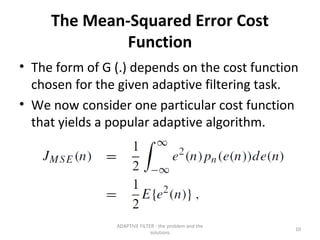
The Mean-Squared Error Cost
             Function
• The form of G (.) depends on the cost function
  chosen for the given adaptive filtering task.
• We now consider one particular cost function
  that yields a popular adaptive algorithm.


                ADAPTIVE FILTER - the problem and the
                                                        10
                              solutions
The MSE Cost Function (contd.)
• The MSE Adaptive filter is useful for adaptive
  FIR Filter because:
  – JMSE(n) has a well-defined minimum with respect to
    the parameters in W(n)
  – The parameters at this minimum minimizes the
    power of the error signal e(n), indicating that y(n)
    has approached d(n).
  – JMSE(n) is a smooth function of each parameter of
    W(n), and differentiable w. r. t. each of these
    parameters.
                  ADAPTIVE FILTER - the problem and the
                                                          11
                                solutions
The Wiener Solution
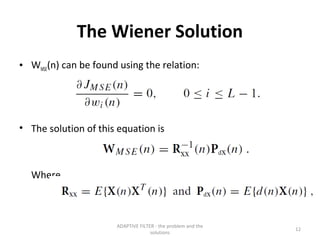
• WMSE(n) can be found using the relation:


• The solution of this equation is


  Where,


                      ADAPTIVE FILTER - the problem and the
                                                              12
                                    solutions
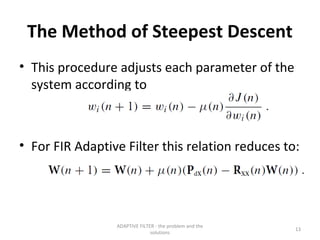
The Method of Steepest Descent
• This procedure adjusts each parameter of the
  system according to


• For FIR Adaptive Filter this relation reduces to:


                 ADAPTIVE FILTER - the problem and the
                                                         13
                               solutions
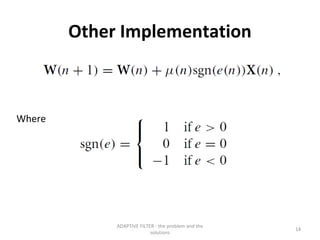
Other Implementation


Where


             ADAPTIVE FILTER - the problem and the
                                                     14
                           solutions
DISCUSSION
• There are various other methods also for
  implementation of Adaptive Filter.
• The hardware or software implementations supporting
  floating point arithmetic are less severe compared to
  those supporting fixed point arithmetic.
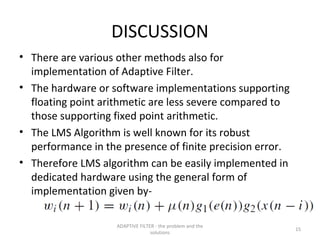
• The LMS Algorithm is well known for its robust
  performance in the presence of finite precision error.
• Therefore LMS algorithm can be easily implemented in
  dedicated hardware using the general form of
  implementation given by-

                    ADAPTIVE FILTER - the problem and the
                                                            15
                                  solutions
Reference
Chapter 18 “Introduction to Adaptive Filters” of
Douglas, S.C. “Digital Signal Processing Handbook”
Ed. Vijay K. Madisetti and Douglas B. Williams
Boca Raton: CRC Press LLC, 1999

Available at
http://www.dsp-book.narod.ru/DSPMW/18.PDF


                      ADAPTIVE FILTER - the problem and the
                                                              16
                                    solutions
THANK YOU

  ADAPTIVE FILTER - the problem and the
                                          17
                solutions

Adaptive filter

  • 1.
    ADAPTIVE FILTER A Brief Discussion of The Problem and The Solutions Sivaranjan Goswami, B. Tech. 7th sem. Electronics and Communication Engineering Don Bosco College of Engineering and Technology Air Port Road, Azara, Guwahati 781017 Contact: sivgos@gmail.com
  • 2.
    INTRODUCTION • In manypractical scenario it is observed that we are required to filter a signal whose exact frequency response is not known. • A solution to such problem is an adaptive filter. • An adaptive filter is one which can automatically design itself and can detect system variation in time. ADAPTIVE FILTER - the problem and the 2 solutions
  • 3.
    Defining an AdaptiveFilter An adaptive filter is defined by four aspects: 1. The signals being processed by the filter 2. The structure that defines how the output signal of the filter is computed from its input signal 3. The parameters within this structure that can be iteratively changed to alter the filter’s input- output relationship 4. The adaptive algorithm that describes how the parameters are adjusted from one time instant to the next ADAPTIVE FILTER - the problem and the 3 solutions
  • 4.
    Block Diagram ofAdaptive Filtering Problem x(n) = input digital signal y(n) = output digital signal d(n) = desired response e(n) = error signal ADAPTIVE FILTER - the problem and the 4 solutions
  • 5.
    Adaptive Filtering Problem •The error signal e(n) is calculated from the desired response as shown in block diagram. • The error signal is fed into a procedure which alters or adapts the parameters of the filter from time n to time (n +1) in a well-defined manner. • Thus as time increases the output signal or actual response y(n) is hoped to become better and better match to the desired response d(n). ADAPTIVE FILTER - the problem and the 5 solutions
  • 6.
    Adaptive Filter Structure •An adaptive filter is usually a linear one which can be represented as: Where, X(n)=[x(n),x(n-1),….,x(n-L+1)] is the input vector W(n)=[w0(n),w1(n),….,wL-1(n)]T is the parameter or co-efficient vector ADAPTIVE FILTER - the problem and the 6 solutions
  • 7.
    Practical Adaptive FilteringProblem 1 • So far we are focusing on the desired response d(n). However, it is quite obvious that in many practical situations d(n) is not available. • To solve this problem d(n) must be estimated from whatever signal is available to the input. • The fact that such schemes even work is a tribute both to the ingenuity of the developers of the algorithms and to the technological maturity of the adaptive filtering field. ADAPTIVE FILTER - the problem and the solutions 7
  • 8.
    Practical Adaptive FilteringProblem 2 • It should also be recognized that the relationship between x(n) and d(n) can vary with time. • In this situation the adaptive filter must continuously change its parameter values to adapt the change. • This behavior is commonly referred to as tracking. ADAPTIVE FILTER - the problem and the 8 solutions
  • 9.
    Gradient- Based AdaptiveFiltering Algorithms ADAPTIVE FILTER - the problem and the 9 solutions
  • 10.
    The Mean-Squared ErrorCost Function • The form of G (.) depends on the cost function chosen for the given adaptive filtering task. • We now consider one particular cost function that yields a popular adaptive algorithm. ADAPTIVE FILTER - the problem and the 10 solutions
  • 11.
    The MSE CostFunction (contd.) • The MSE Adaptive filter is useful for adaptive FIR Filter because: – JMSE(n) has a well-defined minimum with respect to the parameters in W(n) – The parameters at this minimum minimizes the power of the error signal e(n), indicating that y(n) has approached d(n). – JMSE(n) is a smooth function of each parameter of W(n), and differentiable w. r. t. each of these parameters. ADAPTIVE FILTER - the problem and the 11 solutions
  • 12.
    The Wiener Solution •WMSE(n) can be found using the relation: • The solution of this equation is Where, ADAPTIVE FILTER - the problem and the 12 solutions
  • 13.
    The Method ofSteepest Descent • This procedure adjusts each parameter of the system according to • For FIR Adaptive Filter this relation reduces to: ADAPTIVE FILTER - the problem and the 13 solutions
  • 14.
    Other Implementation Where ADAPTIVE FILTER - the problem and the 14 solutions
  • 15.
    DISCUSSION • There arevarious other methods also for implementation of Adaptive Filter. • The hardware or software implementations supporting floating point arithmetic are less severe compared to those supporting fixed point arithmetic. • The LMS Algorithm is well known for its robust performance in the presence of finite precision error. • Therefore LMS algorithm can be easily implemented in dedicated hardware using the general form of implementation given by- ADAPTIVE FILTER - the problem and the 15 solutions
  • 16.
    Reference Chapter 18 “Introductionto Adaptive Filters” of Douglas, S.C. “Digital Signal Processing Handbook” Ed. Vijay K. Madisetti and Douglas B. Williams Boca Raton: CRC Press LLC, 1999 Available at http://www.dsp-book.narod.ru/DSPMW/18.PDF ADAPTIVE FILTER - the problem and the 16 solutions
  • 17.
    THANK YOU ADAPTIVE FILTER - the problem and the 17 solutions