Submitted by:
Chandan
M.E Scholar, Electrical Engineering
Department, NITTTR, Chandigarh
 The causal IIR digital filters we are concerned
with in this course are characterized by a real
rational transfer function of or, equivalently
by a constant coefficient difference equation
 From the difference equation representation, it
can be seen that the realization of the causal IIR
digital filters requires some form of feedback
1−
z
 An N-th order IIR digital transfer function is
characterized by 2N+1 unique coefficients, and in
general, requires 2N+1 multipliers and 2N two-
input adders for implementation
 Direct form IIR filters: Filter structures in
which the multiplier coefficients are precisely the
coefficients of the transfer function
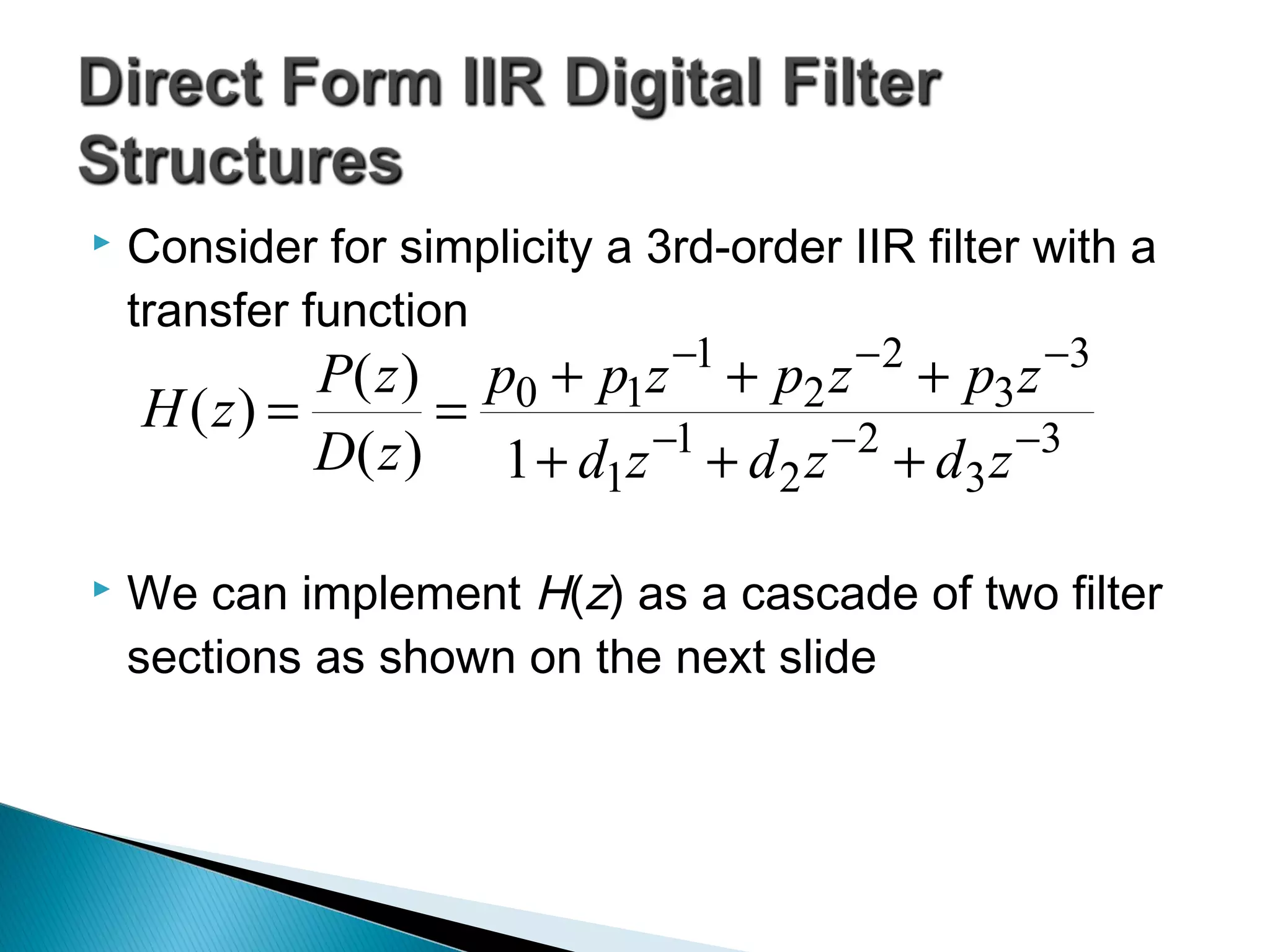
 Consider for simplicity a 3rd-order IIR filter with a
transfer function
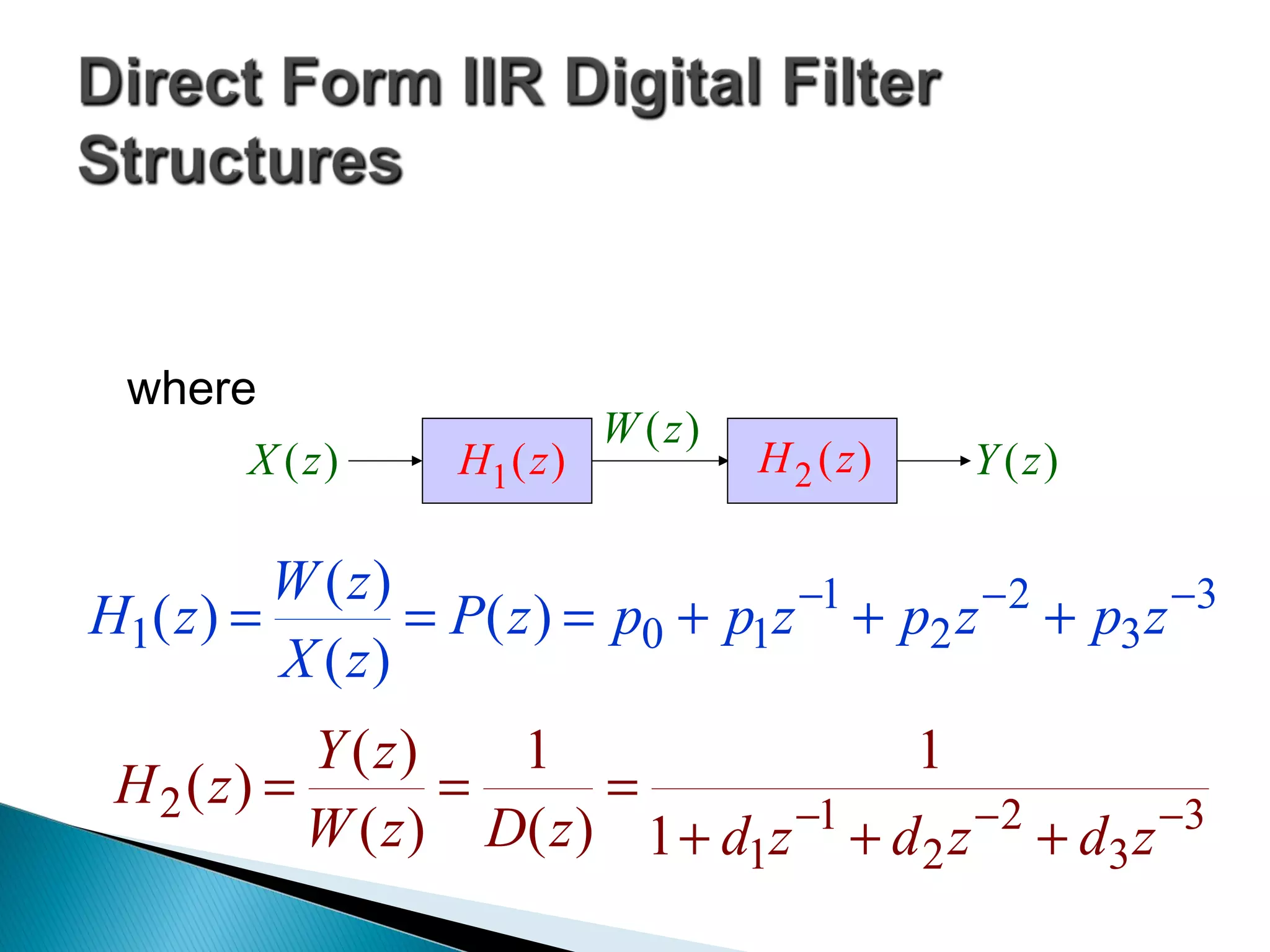
 We can implement H(z) as a cascade of two filter
sections as shown on the next slide
3
3
2
2
1
1
3
3
2
2
1
10
1 −−−
−−−
+++
+++
==
zdzdzd
zpzpzpp
zD
zP
zH
)(
)(
)(
where
3
3
2
2
1
101
−−−
+++=== zpzpzppzP
zX
zW
zH )(
)(
)(
)(
)(zH1 )(zH2
)(zW
)(zX )(zY
3
3
2
2
1
1
2
1
11
−−−
+++
===
zdzdzdzDzW
zY
zH
)()(
)(
)(
 The filter section can be seen to be an
FIR filter and can be realized as shown below
]3[]2[]1[][][ 3210 −+−+−+= nxpnxpnxpnxpnw
)(zH1
 The time-domain representation of is
given by
Realization of follows
from the above
equation and is
shown on the right
)(zH2
][][][][][ 321 321 −−−−−−= nydnydnydnwny
)(zH2
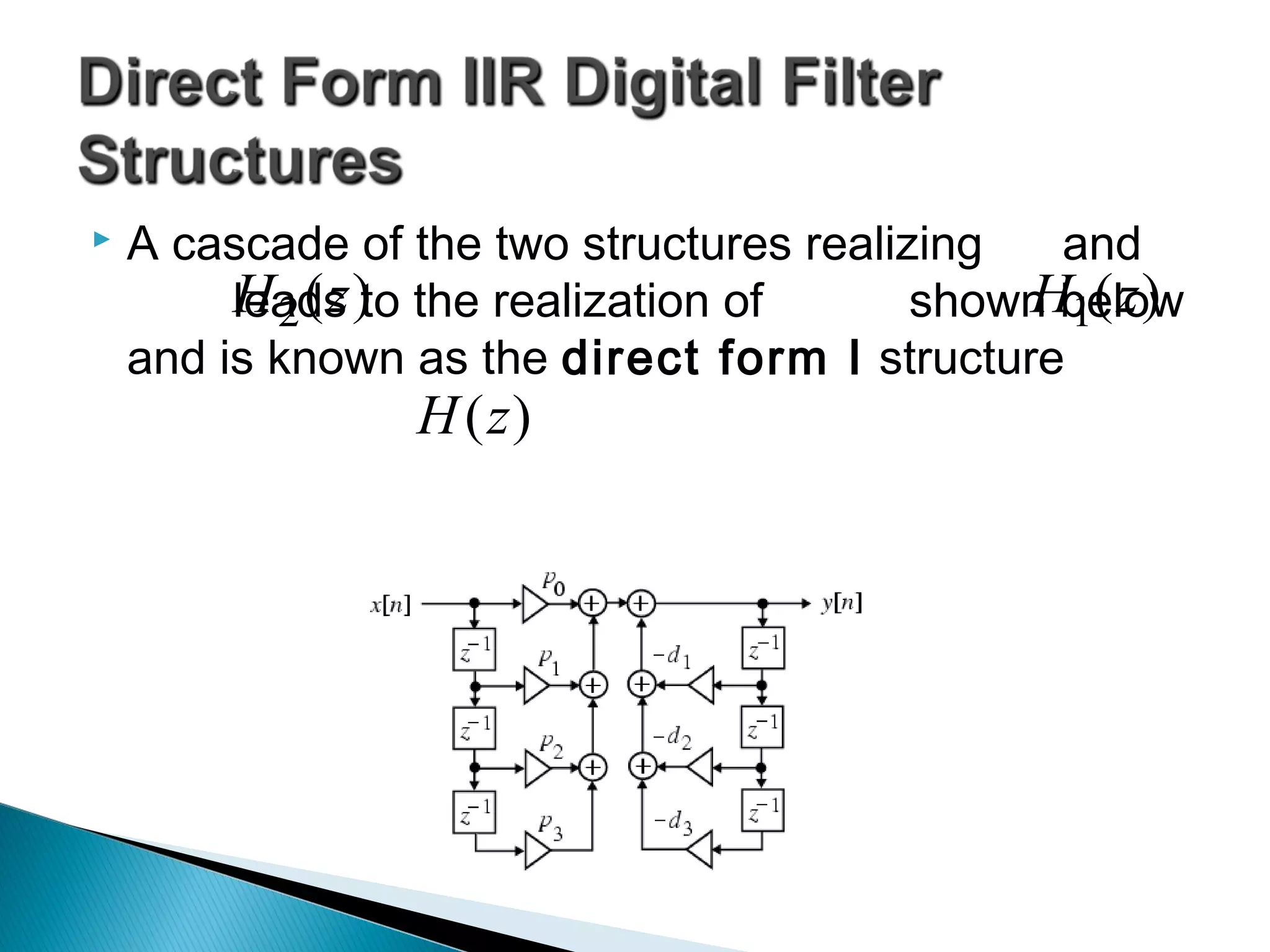
 A cascade of the two structures realizing and
leads to the realization of shown below
and is known as the direct form I structure
)(zH2 )(zH1
)(zH
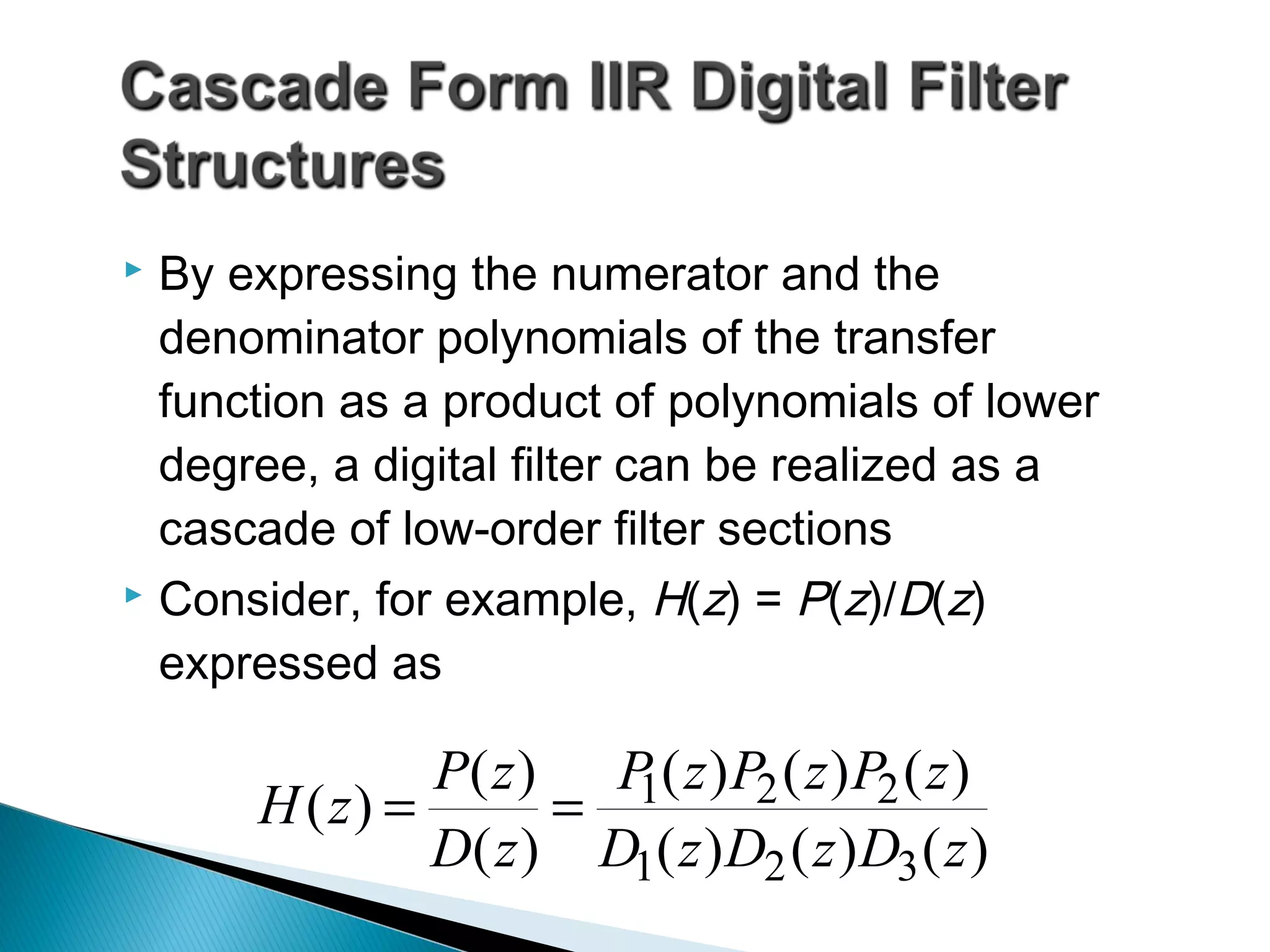
 By expressing the numerator and the
denominator polynomials of the transfer
function as a product of polynomials of lower
degree, a digital filter can be realized as a
cascade of low-order filter sections
 Consider, for example, H(z) = P(z)/D(z)
expressed as
)()()(
)()()(
)(
)(
)(
zDzDzD
zPzPzP
zD
zP
zH
321
221==
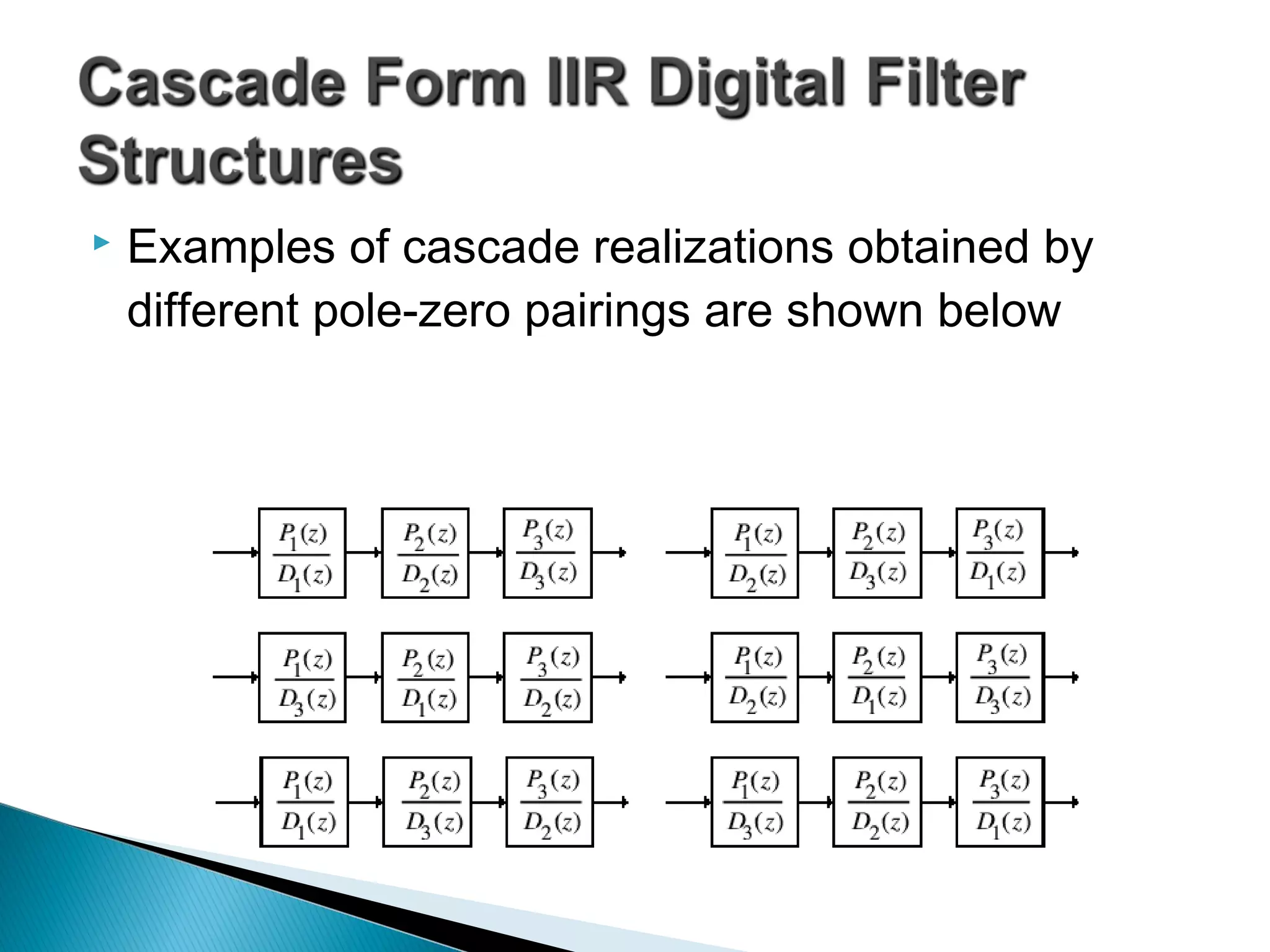
 Examples of cascade realizations obtained by
different pole-zero pairings are shown below
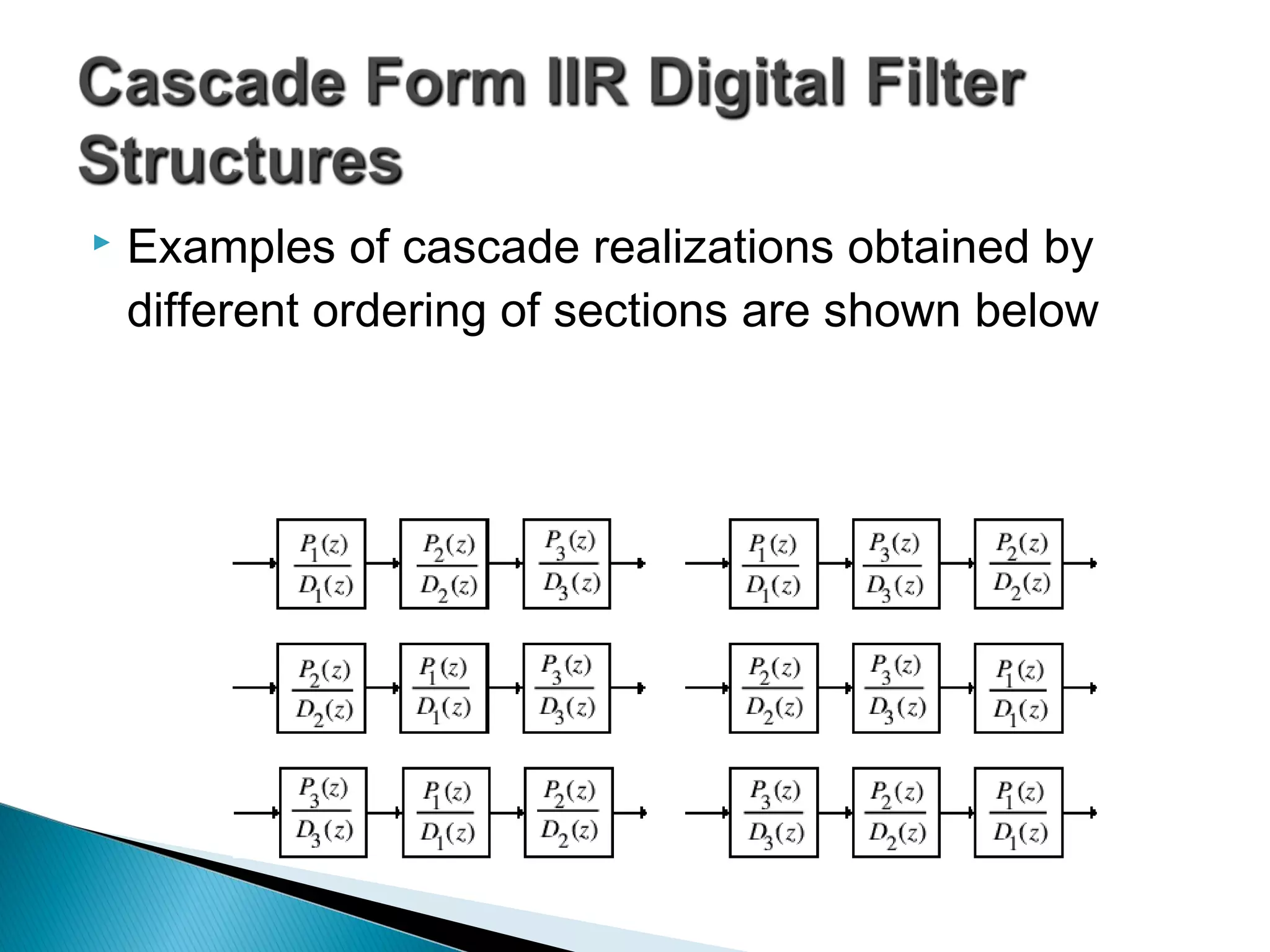
 Examples of cascade realizations obtained by
different ordering of sections are shown below
 There are altogether a total of 36 different
cascade realizations of
based on pole-zero-pairings and ordering
 Due to finite wordlength effects, each such
cascade realization behaves differently from
others
)()()(
)()()(
)(
zDzDzD
zPzPzP
zH
321
221
=
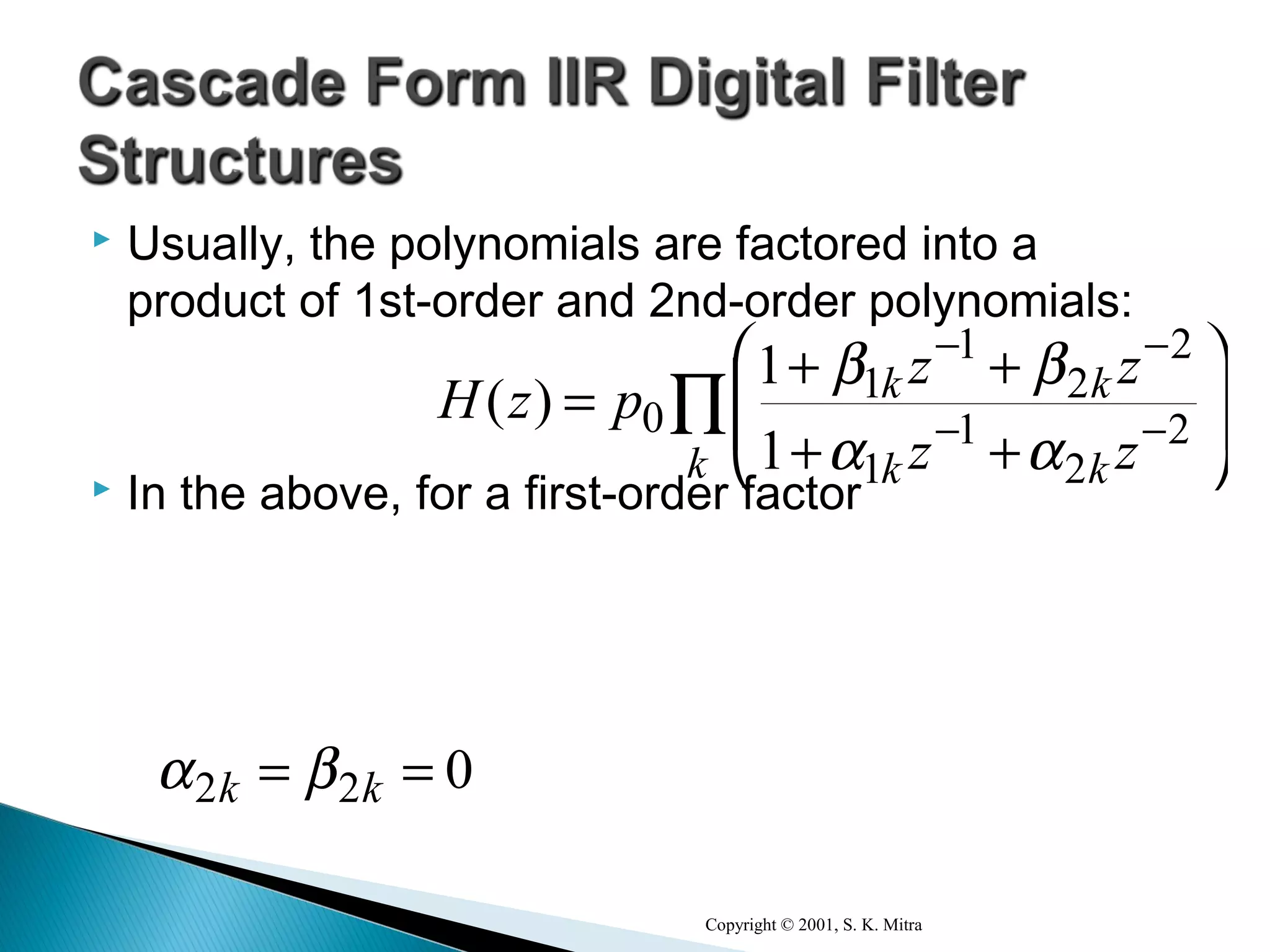
 Usually, the polynomials are factored into a
product of 1st-order and 2nd-order polynomials:
 In the above, for a first-order factor
Copyright © 2001, S. K. Mitra
∏ 







++
++
= −−
−−
k kk
kk
zz
zz
pzH 2
2
1
1
2
2
1
1
0
1
1
αα
ββ
)(
022 == kk βα
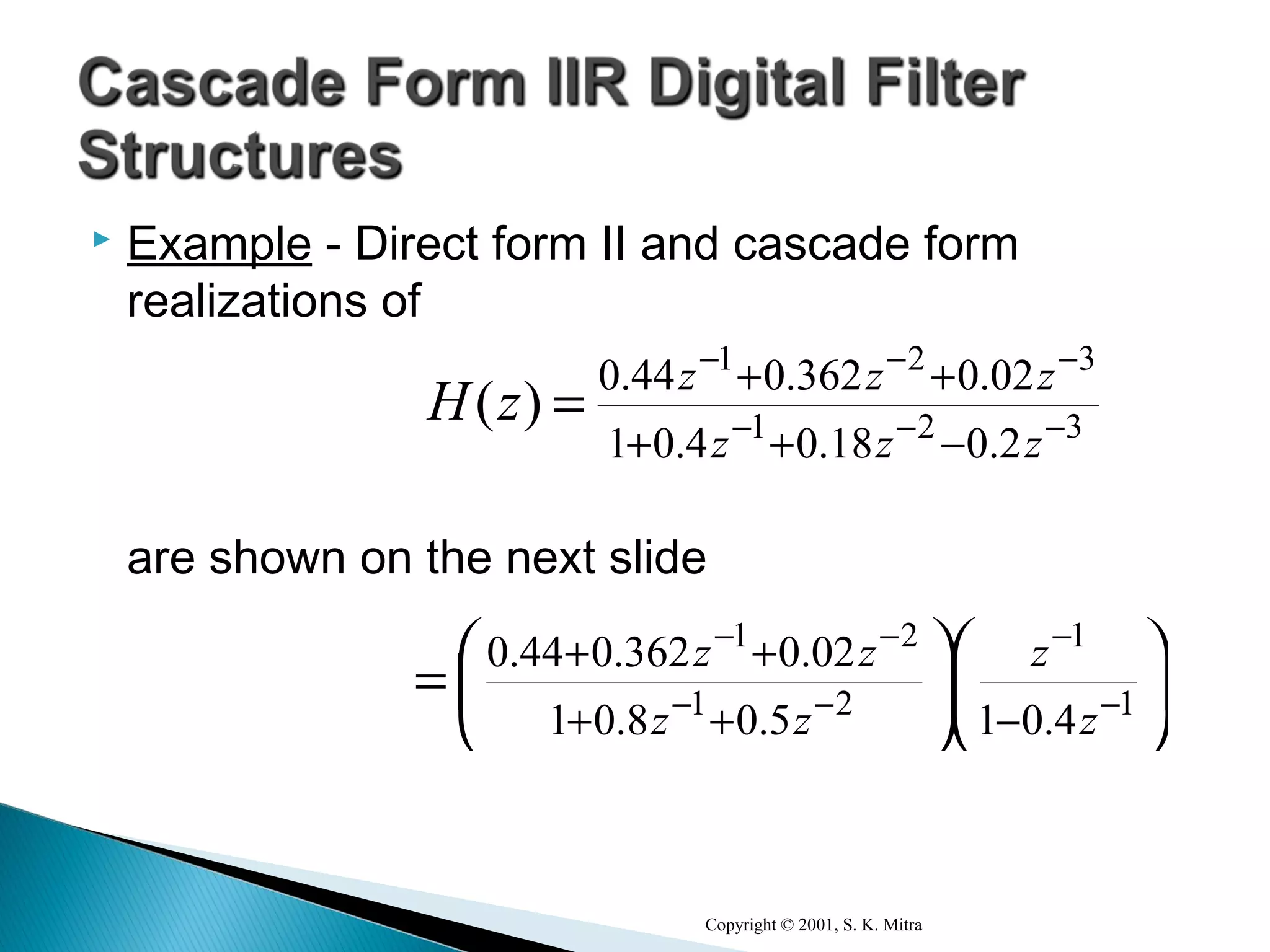
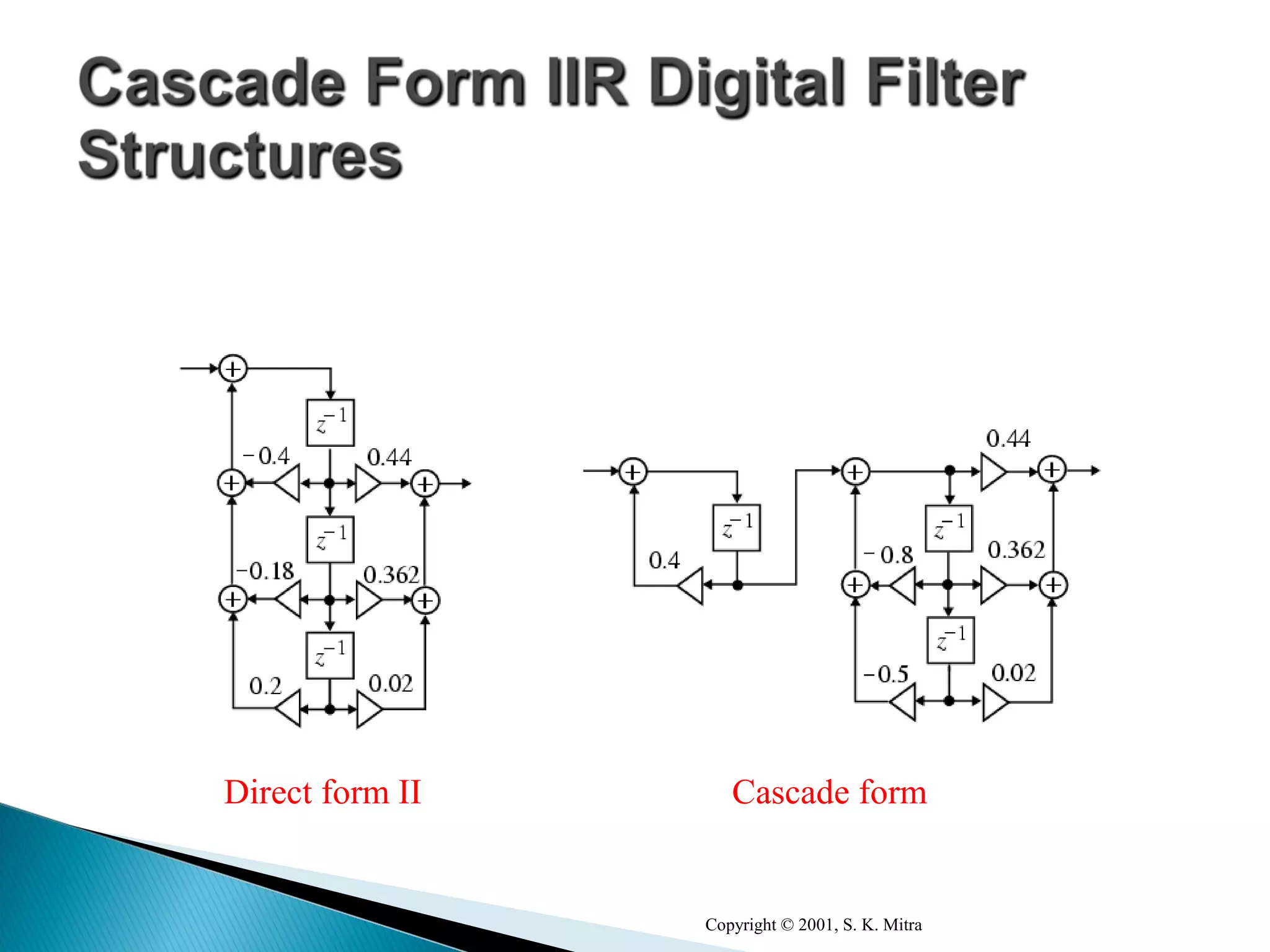
 Example - Direct form II and cascade form
realizations of
are shown on the next slide
Copyright © 2001, S. K. Mitra
321
321
20180401
0203620440
−−−
−−−
−++
++
=
zzz
zzz
zH
...
...
)(











= −
−
−−
−−
−++
++
1
1
21
21
40150801
0203620440
z
z
zz
zz
...
...
Copyright © 2001, S. K. Mitra
Direct form II Cascade form
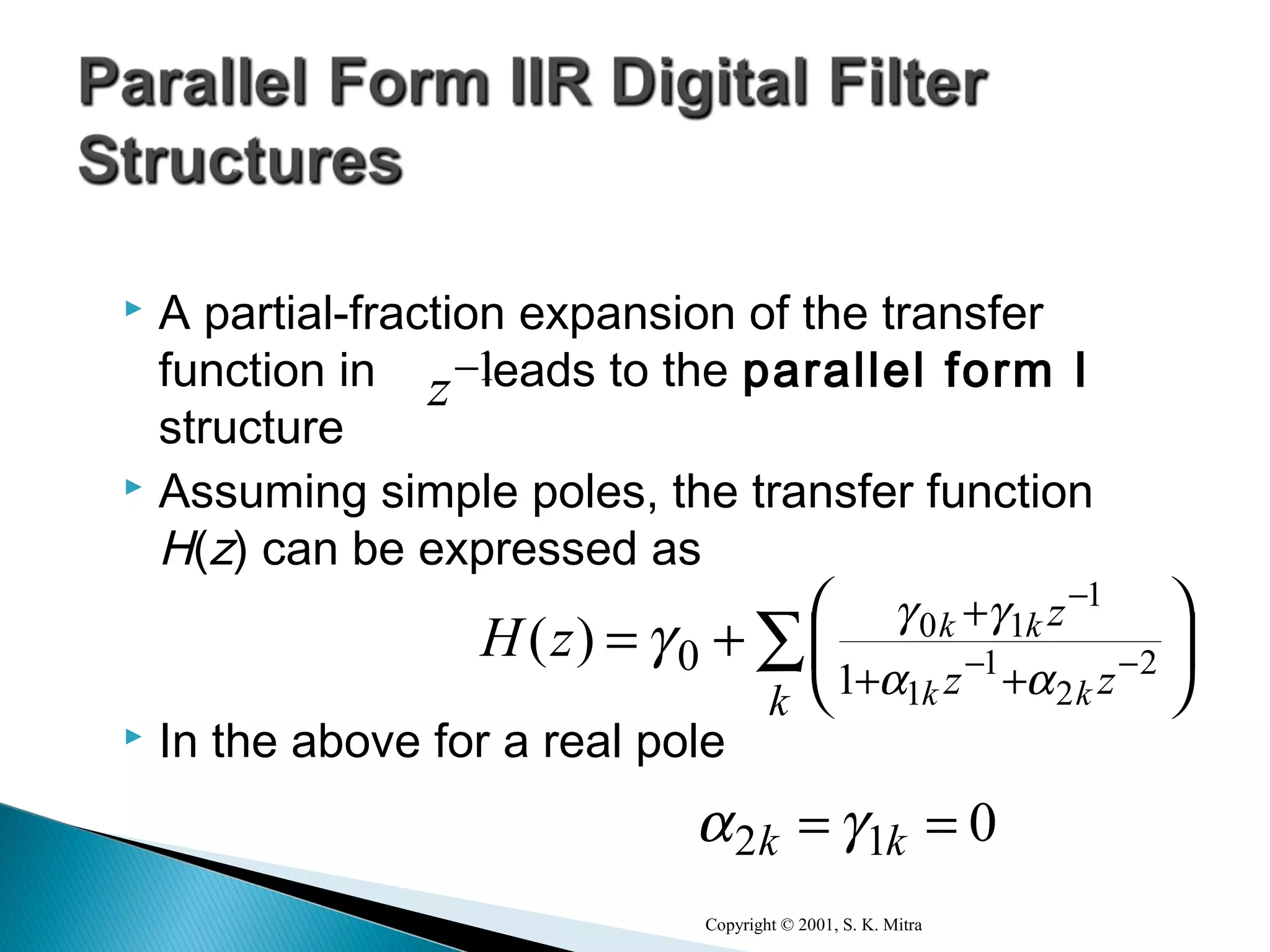
 A partial-fraction expansion of the transfer
function in leads to the parallel form I
structure
 Assuming simple poles, the transfer function
H(z) can be expressed as
 In the above for a real pole
Copyright © 2001, S. K. Mitra
∑ 




+= −−
−
++
+
k zz
z
kk
kk
zH 2
2
1
1
1
10
1
0
αα
γγ
γ)(
012 == kk γα
1−
z
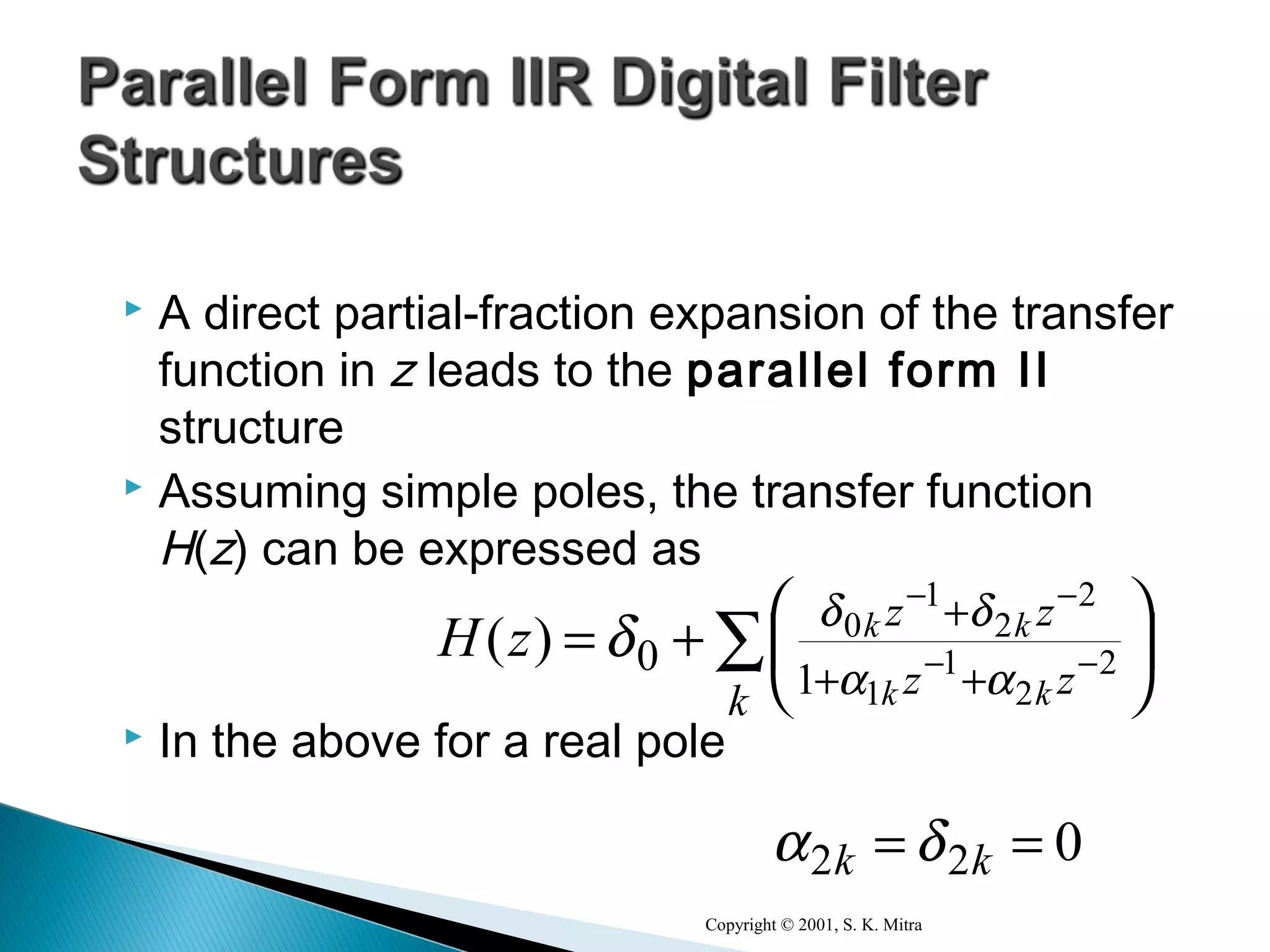
 A direct partial-fraction expansion of the transfer
function in z leads to the parallel form II
structure
 Assuming simple poles, the transfer function
H(z) can be expressed as
 In the above for a real pole
Copyright © 2001, S. K. Mitra
∑ 




+= −−
−−
++
+
k zz
zz
kk
kk
zH 2
2
1
1
2
2
1
0
1
0
αα
δδ
δ)(
022 == kk δα
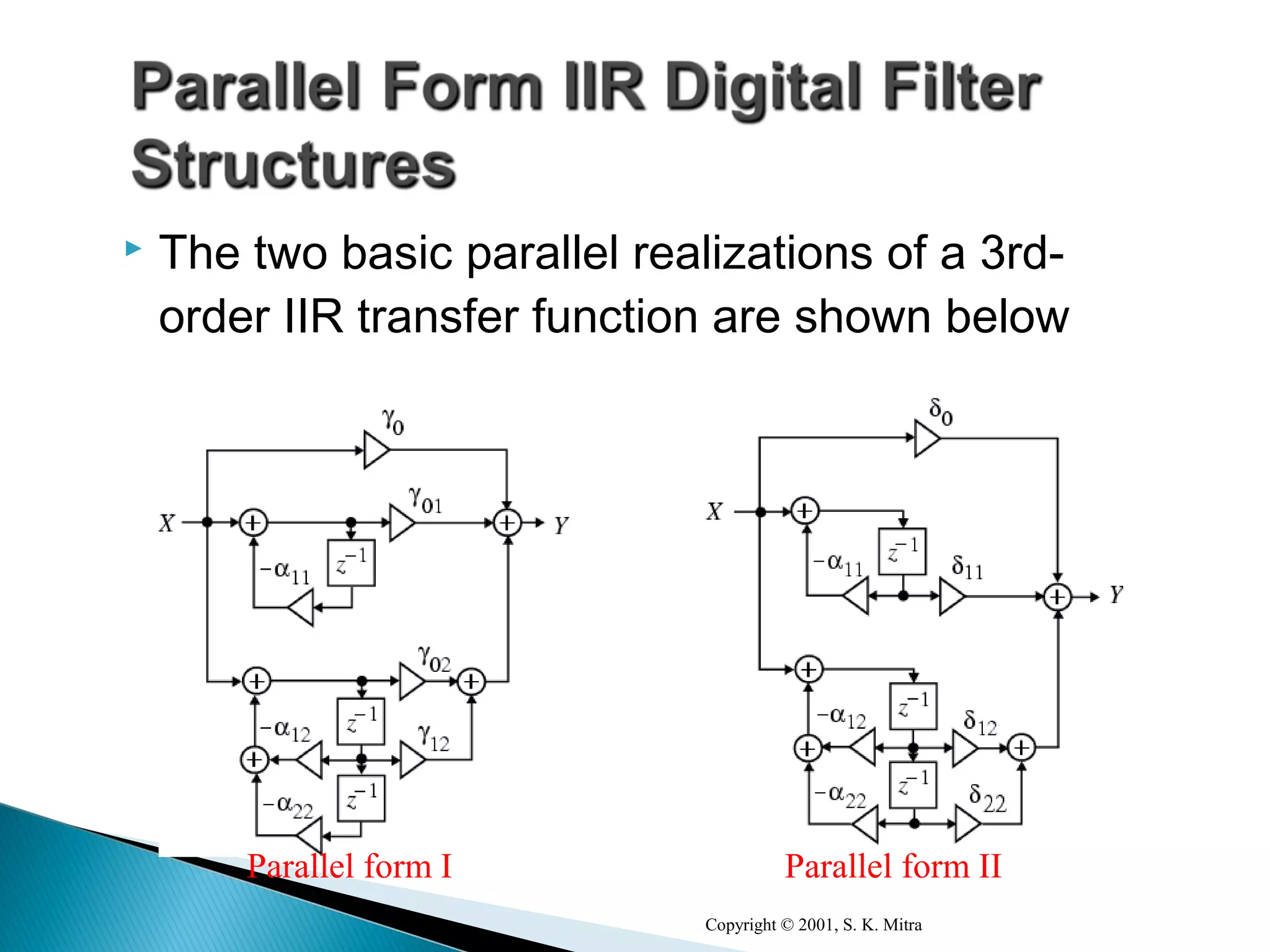
 The two basic parallel realizations of a 3rd-
order IIR transfer function are shown below
Copyright © 2001, S. K. Mitra
Parallel form I Parallel form II
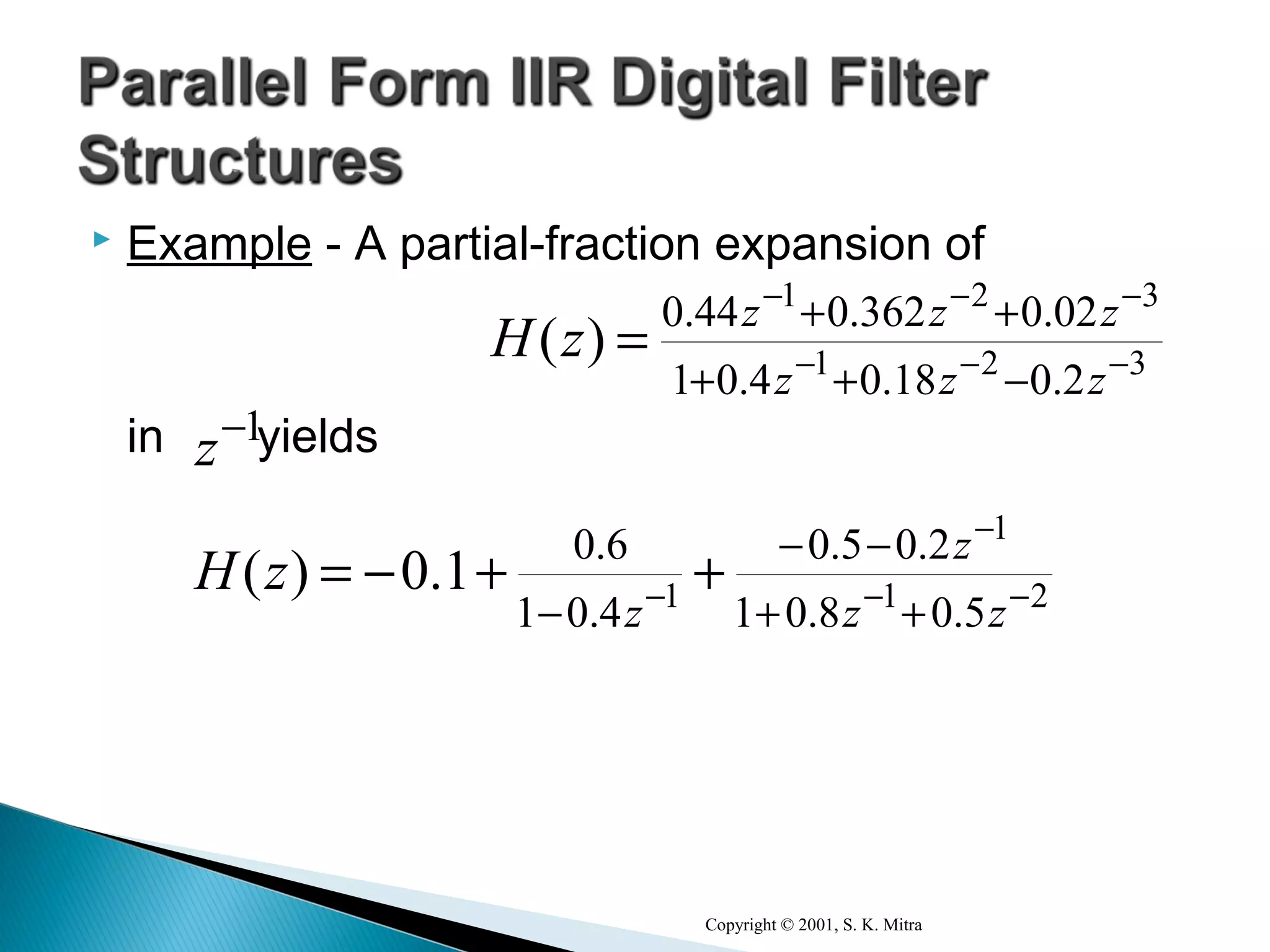
 Example - A partial-fraction expansion of
in yields
Copyright © 2001, S. K. Mitra
321
321
20180401
0203620440
−−−
−−−
−++
++
=
zzz
zzz
zH
...
...
)(
21
1
1
50801
2050
401
60
10 −−
−
−
++
−−
−
++−=
zz
z
z
zH
..
..
.
.
.)(
1−
z
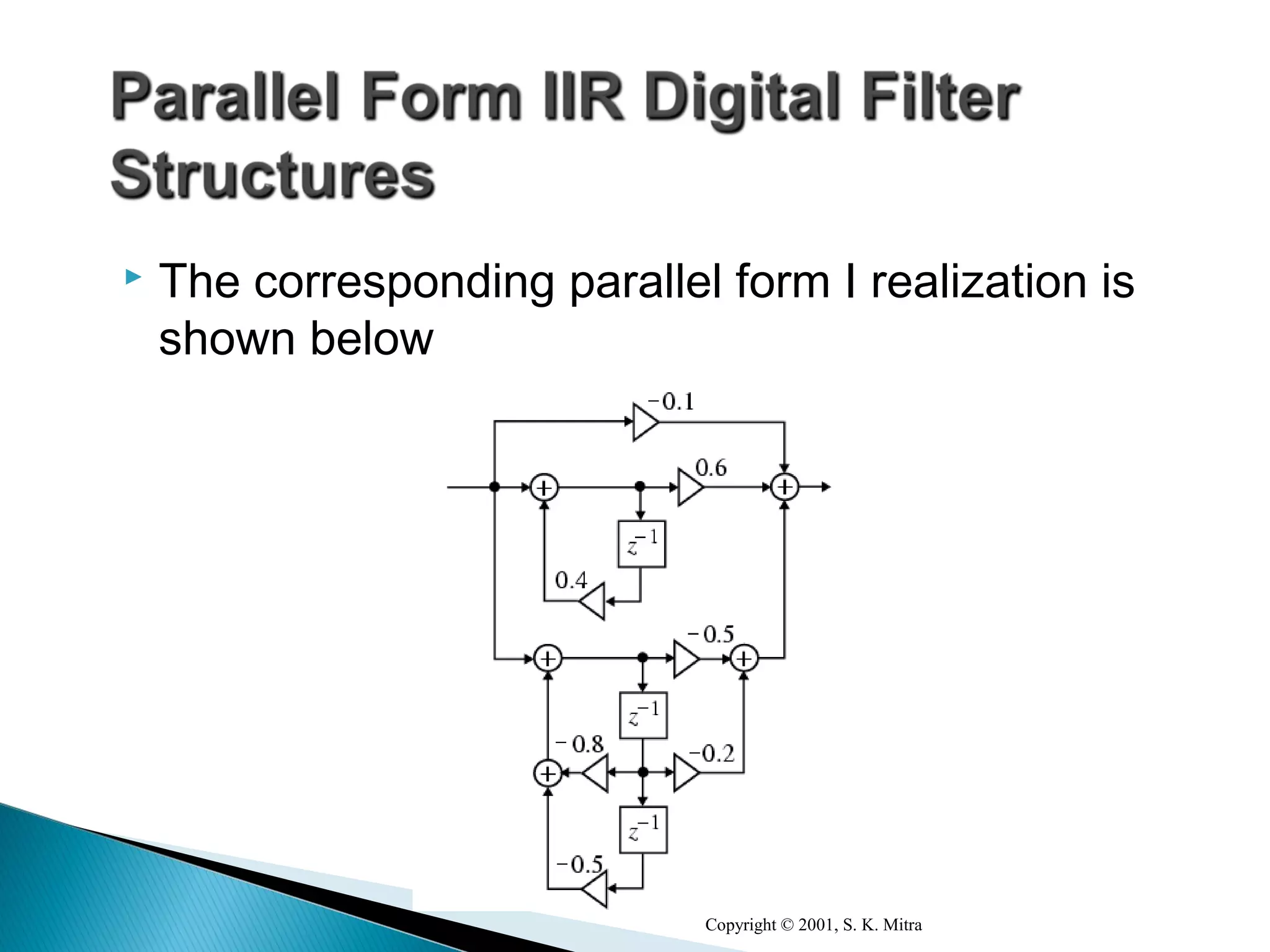
 The corresponding parallel form I realization is
shown below
Copyright © 2001, S. K. Mitra
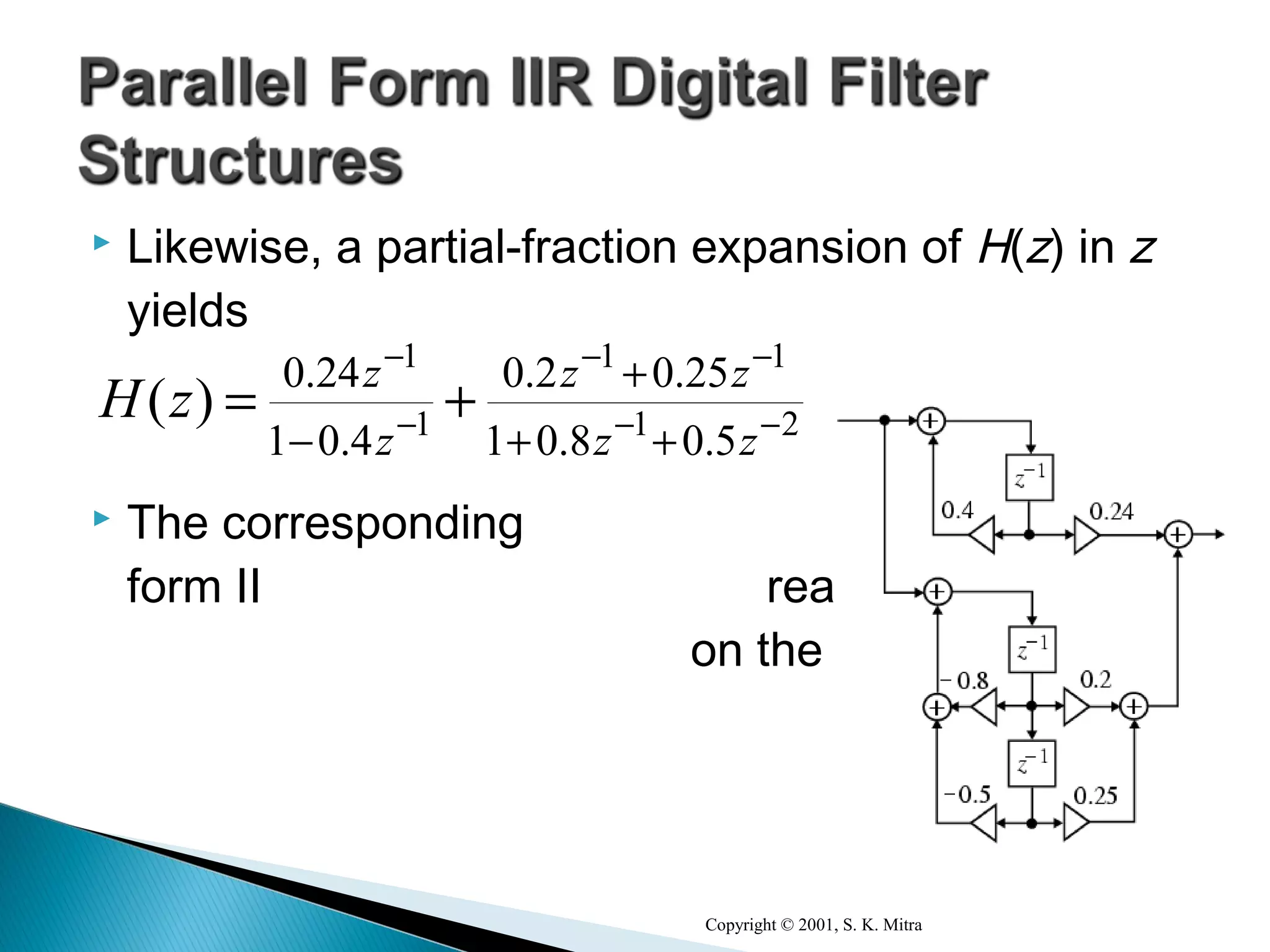
 Likewise, a partial-fraction expansion of H(z) in z
yields
 The corresponding parallel
form II realization is shown
on the right
Copyright © 2001, S. K. Mitra
21
11
1
1
50801
25020
401
240
−−
−−
−
−
++
+
−
+=
zz
zz
z
z
zH
..
..
.
.
)(
Structures for FIR systems

Structures for FIR systems

  • 1.
    Submitted by: Chandan M.E Scholar,Electrical Engineering Department, NITTTR, Chandigarh
  • 2.
     The causalIIR digital filters we are concerned with in this course are characterized by a real rational transfer function of or, equivalently by a constant coefficient difference equation  From the difference equation representation, it can be seen that the realization of the causal IIR digital filters requires some form of feedback 1− z
  • 3.
     An N-thorder IIR digital transfer function is characterized by 2N+1 unique coefficients, and in general, requires 2N+1 multipliers and 2N two- input adders for implementation  Direct form IIR filters: Filter structures in which the multiplier coefficients are precisely the coefficients of the transfer function
  • 4.
     Consider forsimplicity a 3rd-order IIR filter with a transfer function  We can implement H(z) as a cascade of two filter sections as shown on the next slide 3 3 2 2 1 1 3 3 2 2 1 10 1 −−− −−− +++ +++ == zdzdzd zpzpzpp zD zP zH )( )( )(
  • 5.
    where 3 3 2 2 1 101 −−− +++=== zpzpzppzP zX zW zH )( )( )( )( )(zH1)(zH2 )(zW )(zX )(zY 3 3 2 2 1 1 2 1 11 −−− +++ === zdzdzdzDzW zY zH )()( )( )(
  • 6.
     The filtersection can be seen to be an FIR filter and can be realized as shown below ]3[]2[]1[][][ 3210 −+−+−+= nxpnxpnxpnxpnw )(zH1
  • 7.
     The time-domainrepresentation of is given by Realization of follows from the above equation and is shown on the right )(zH2 ][][][][][ 321 321 −−−−−−= nydnydnydnwny )(zH2
  • 8.
     A cascadeof the two structures realizing and leads to the realization of shown below and is known as the direct form I structure )(zH2 )(zH1 )(zH
  • 9.
     By expressingthe numerator and the denominator polynomials of the transfer function as a product of polynomials of lower degree, a digital filter can be realized as a cascade of low-order filter sections  Consider, for example, H(z) = P(z)/D(z) expressed as )()()( )()()( )( )( )( zDzDzD zPzPzP zD zP zH 321 221==
  • 10.
     Examples ofcascade realizations obtained by different pole-zero pairings are shown below
  • 11.
     Examples ofcascade realizations obtained by different ordering of sections are shown below
  • 12.
     There arealtogether a total of 36 different cascade realizations of based on pole-zero-pairings and ordering  Due to finite wordlength effects, each such cascade realization behaves differently from others )()()( )()()( )( zDzDzD zPzPzP zH 321 221 =
  • 13.
     Usually, thepolynomials are factored into a product of 1st-order and 2nd-order polynomials:  In the above, for a first-order factor Copyright © 2001, S. K. Mitra ∏         ++ ++ = −− −− k kk kk zz zz pzH 2 2 1 1 2 2 1 1 0 1 1 αα ββ )( 022 == kk βα
  • 14.
     Example -Direct form II and cascade form realizations of are shown on the next slide Copyright © 2001, S. K. Mitra 321 321 20180401 0203620440 −−− −−− −++ ++ = zzz zzz zH ... ... )(            = − − −− −− −++ ++ 1 1 21 21 40150801 0203620440 z z zz zz ... ...
  • 15.
    Copyright © 2001,S. K. Mitra Direct form II Cascade form
  • 16.
     A partial-fractionexpansion of the transfer function in leads to the parallel form I structure  Assuming simple poles, the transfer function H(z) can be expressed as  In the above for a real pole Copyright © 2001, S. K. Mitra ∑      += −− − ++ + k zz z kk kk zH 2 2 1 1 1 10 1 0 αα γγ γ)( 012 == kk γα 1− z
  • 17.
     A directpartial-fraction expansion of the transfer function in z leads to the parallel form II structure  Assuming simple poles, the transfer function H(z) can be expressed as  In the above for a real pole Copyright © 2001, S. K. Mitra ∑      += −− −− ++ + k zz zz kk kk zH 2 2 1 1 2 2 1 0 1 0 αα δδ δ)( 022 == kk δα
  • 18.
     The twobasic parallel realizations of a 3rd- order IIR transfer function are shown below Copyright © 2001, S. K. Mitra Parallel form I Parallel form II
  • 19.
     Example -A partial-fraction expansion of in yields Copyright © 2001, S. K. Mitra 321 321 20180401 0203620440 −−− −−− −++ ++ = zzz zzz zH ... ... )( 21 1 1 50801 2050 401 60 10 −− − − ++ −− − ++−= zz z z zH .. .. . . .)( 1− z
  • 20.
     The correspondingparallel form I realization is shown below Copyright © 2001, S. K. Mitra
  • 21.
     Likewise, apartial-fraction expansion of H(z) in z yields  The corresponding parallel form II realization is shown on the right Copyright © 2001, S. K. Mitra 21 11 1 1 50801 25020 401 240 −− −− − − ++ + − += zz zz z z zH .. .. . . )(