Chapter-4: Adaptive Signal Processing
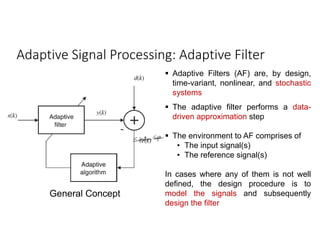
Adaptive Signal Processing: Adaptive Filter
General Concept
 Adaptive Filters (AF) are, by design,
time-variant, nonlinear, and stochastic
systems
 The adaptive filter performs a data-
driven approximation step
 The environment to AF comprises of
• The input signal(s)
• The reference signal(s)
In cases where any of them is not well
defined, the design procedure is to
model the signals and subsequently
design the filter
Adaptive Signal Processing: Adaptive Algorithm
General Concept
 The basic objective of the
adaptive/learning Algorithm is
• To set adaptive filter coefficients
(parameters) to minimize a
meaningful objective function
involving the input, the reference
signal, and adaptive filter output
signals
 The meaningful objective function
should be –
• Non-negative:
, , ≥ 0,
∀ ( ), ( ), ( ) ;
• Optimal: [ ( ), ( ), ( )] = 0.
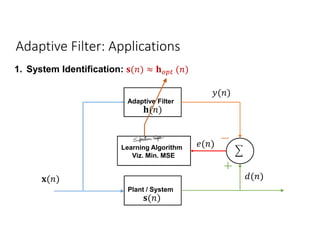
Adaptive Filter: Applications
1. System Identification: ( ) ≈ ( )
Plant / System
Adaptive Filter
Learning Algorithm
Viz. Min. MSE
( )
( )
( )
( )
( )
( )
Adaptive Filter: Applications
2. Inverse Model: ( ) ≈ ( )
( )
Learning Algorithm
Viz. Min. MSE
( )
( )
( )
Adaptive Filter
( )
Plant / System
( )
Delay
( )
Adaptive Filter: Applications
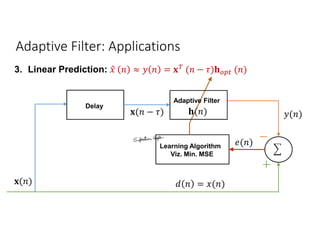
3. Linear Prediction: ≈ = ( − ) ( )
( )
Learning Algorithm
Viz. Min. MSE
( )
= ( )
( )
Adaptive Filter
( )
Delay
( − )
Adaptive Filter: Applications
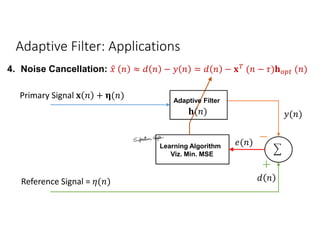
4. Noise Cancellation: ≈ − = − ( − ) ( )
Primary Signal + ( )
Learning Algorithm
Viz. Min. MSE
( )
( )
Adaptive Filter
( )
Reference Signal = ( )
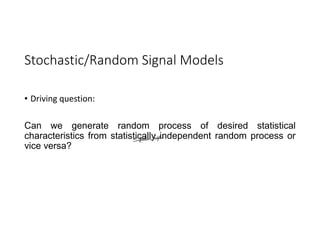
Stochastic/Random Signal Models
• Driving question:
Can we generate random process of desired statistical
characteristics from statistically independent random process or
vice versa?
Stochastic Models
• General or Auto-regressive Moving Average (ARMA) Model
, [ ]
[ ] [ ]
= [ − ] − [ − ]
Stochastic Models
• Moving Average (MA) Model
ℎ
[ ] [ ]
= ℎ [ − ]
Stochastic Models
• Auto-regressive (AR) Model
ℎ[ ]
[ ] [ ]
= − ℎ − + [ ]
Stochastic Models: Computation
• Given the desired auto-correlation sequence for = 0, 1, 2, … ,
determine the ℎ( ) and the input process variance
ℎ − = [ ]
Yule-Walker Eq.: ∑ ℎ∗
− = 0 for > 0
∑ ℎ∗
− = for = 0
Stochastic Models: Computation
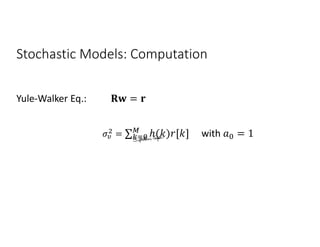
Yule-Walker Eq.: =
= ∑ ℎ( ) with = 1
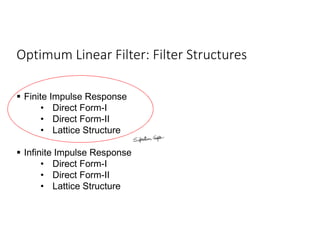
Optimum Linear Filter: Filter Structures
 Finite Impulse Response
• Direct Form-I
• Direct Form-II
• Lattice Structure
 Infinite Impulse Response
• Direct Form-I
• Direct Form-II
• Lattice Structure
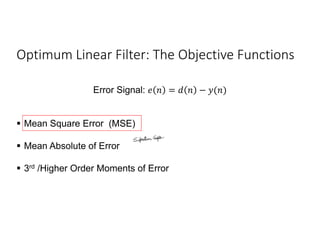
Optimum Linear Filter: The Objective Functions
Error Signal: = − ( )
 Mean Square Error (MSE)
 Mean Absolute of Error
 3rd /Higher Order Moments of Error
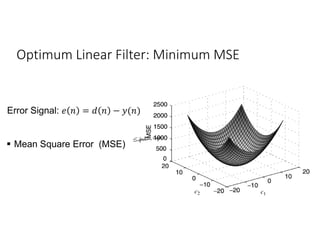
Optimum Linear Filter: Minimum MSE
Error Signal: = − ( )
 Mean Square Error (MSE)
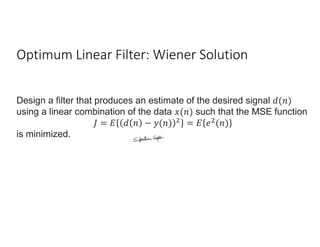
Optimum Linear Filter: Wiener Solution
Design a filter that produces an estimate of the desired signal ( )
using a linear combination of the data ( ) such that the MSE function
= − ( ) = ( )
is minimized.
Wiener Solutions
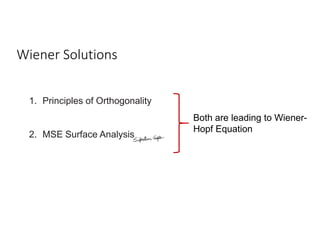
1. Principles of Orthogonality
2. MSE Surface Analysis
Both are leading to Wiener-
Hopf Equation
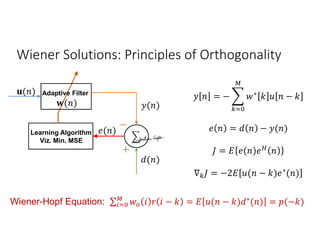
Wiener Solutions: Principles of Orthogonality
Learning Algorithm
Viz. Min. MSE
( )
( )
( )
Adaptive Filter
( )
( )
= − ∗
−
= − ( )
= ( )
∇ = −2 ( − ) ∗
( )
Wiener-Hopf Equation: ∑ − = ( − ) ∗
( ) = (− )
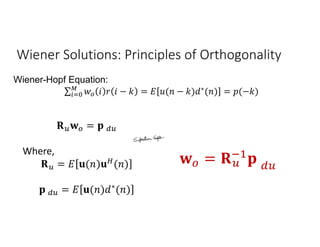
Wiener Solutions: Principles of Orthogonality
Wiener-Hopf Equation:
∑ − = ( − ) ∗
( ) = (− )
=
Where,
= ( ) ( )
= ( ) ∗
( )
=
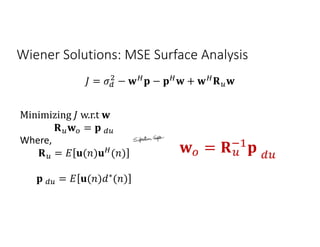
Wiener Solutions: MSE Surface Analysis
= − − +
Minimizing w.r.t
=
Where,
= ( ) ( )
= ( ) ∗
( )
=
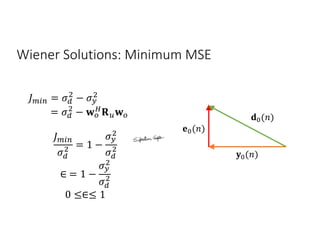
Wiener Solutions: Minimum MSE
= −
= −
( )
( )
( )
= 1 −
∈ = 1 −
0 ≤∈≤ 1
Wiener Solutions: Examples
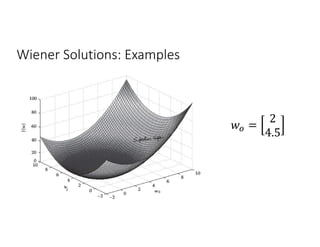
Consider the sample autocorrelation coefficients ( (0) = 1.0, (1) = 0) from given
data ( ), which, in addition to noise, contain the desired signal. Furthermore,
assume the variance of the desired signal = 24.40 and the cross-correlation
vector be = [2 4.5] . It is desired to find the surface defined by the mean-
square function ( ).
Wiener Solutions: Examples
=
2
4.5
Wiener Solutions: Examples
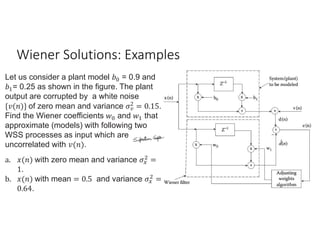
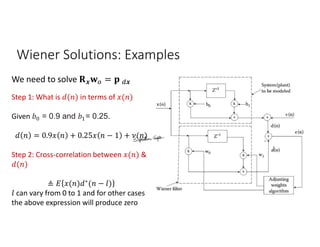
Let us consider a plant model = 0.9 and
= 0.25 as shown in the figure. The plant
output are corrupted by a white noise
{ ( )} of zero mean and variance 2
= 0.15.
Find the Wiener coefficients and that
approximate (models) with following two
WSS processes as input which are
uncorrelated with ( ).
a. ( ) with zero mean and variance =
1.
b. ( ) with mean = 0.5 and variance =
0.64.
Wiener Solutions: Examples
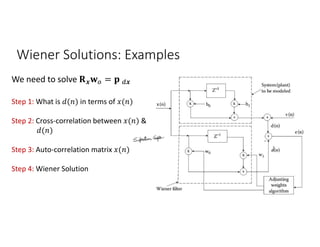
We need to solve =
Step 1: What is ( ) in terms of ( )
Step 2: Cross-correlation between ( ) &
( )
Step 3: Auto-correlation matrix ( )
Step 4: Wiener Solution
Wiener Solutions: Examples
We need to solve =
Step 1: What is ( ) in terms of ( )
Given = 0.9 and = 0.25.
= 0.9 + 0.25 − 1 + ( )
Step 2: Cross-correlation between ( ) &
( )
≜ ( ) ∗( − )
can vary from 0 to 1 and for other cases
the above expression will produce zero
Wiener Solutions: Examples
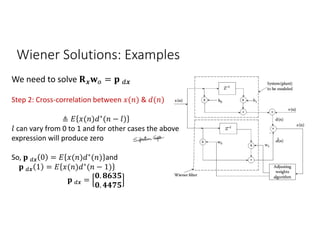
We need to solve =
Step 2: Cross-correlation between ( ) & ( )
≜ ( ) ∗
( − )
can vary from 0 to 1 and for other cases the above
expression will produce zero
So, 0 = ( ) ∗
( ) and
1 = ( ) ∗
( − 1)
=
.
.
Wiener Solutions: Examples
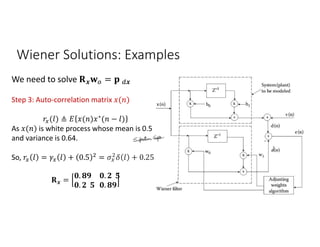
We need to solve =
Step 3: Auto-correlation matrix ( )
( ) ≜ ( ) ∗
( − )
As ( ) is white process whose mean is 0.5
and variance is 0.64.
So, = + 0.5 = + 0.25
=
. .
. .
Wiener Solutions: Examples
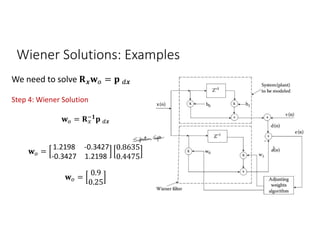
We need to solve =
Step 4: Wiener Solution
=
=
1.2198 -0.3427
-0.3427 1.2198
0.8635
0.4475
=
0.9
0.25
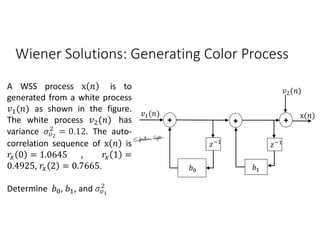
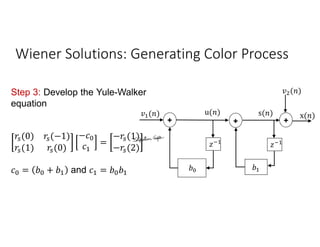
Wiener Solutions: Generating Color Process
₊ ₊
+ ₊
( )
( )
x( )
+ +
A WSS process x is to
generated from a white process
( ) as shown in the figure.
The white process ( ) has
variance = 0.12. The auto-
correlation sequence of x is
0 = 1.0645 , 1 =
0.4925, 2 = 0.7665.
Determine , , and
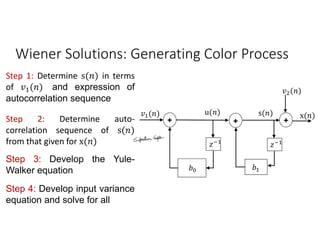
Wiener Solutions: Generating Color Process
₊ ₊
+ ₊
( )
( )
x( )
+ +
Step 1: Determine s( ) in terms
of ( ) and expression of
autocorrelation sequence
Step 2: Determine auto-
correlation sequence of s( )
from that given for x( )
Step 3: Develop the Yule-
Walker equation
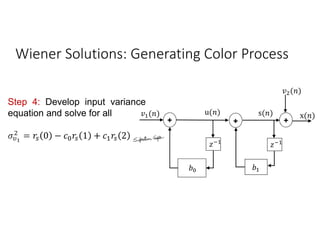
Step 4: Develop input variance
equation and solve for all
s( )
u( )
Wiener Solutions: Generating Color Process
₊ ₊
+ ₊
( )
( )
x( )
+ +
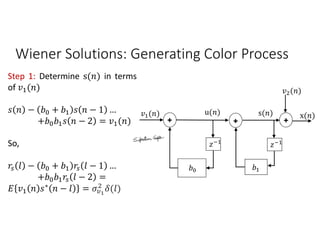
Step 1: Determine s( ) in terms
of ( )
− + − 1 …
+ − 2 = ( )
So,
− + − 1 …
+ − 2 =
∗
− = ( )
s( )
u( )
Wiener Solutions: Generating Color Process
₊ ₊
+ ₊
( )
( )
x( )
+ +
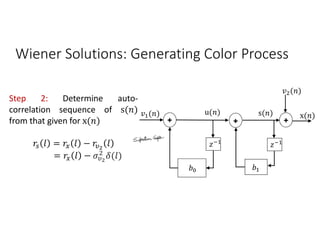
Step 2: Determine auto-
correlation sequence of s( )
from that given for x( )
= −
= − ( )
s( )
u( )
Wiener Solutions: Generating Color Process
₊ ₊
+ ₊
( )
( )
x( )
+ +
Step 3: Develop the Yule-Walker
equation
(0) (−1)
(1) (0)
−
=
− (1)
− (2)
= + and =
s( )
u( )
Wiener Solutions: Generating Color Process
₊ ₊
+ ₊
( )
( )
x( )
+ +
Step 4: Develop input variance
equation and solve for all
= 0 − 1 + 2
s( )
u( )
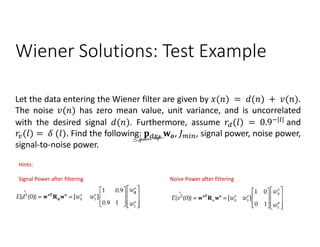
Wiener Solutions: Test Example
Let the data entering the Wiener filter are given by ( ) = ( ) + ( ).
The noise ( ) has zero mean value, unit variance, and is uncorrelated
with the desired signal ( ). Furthermore, assume ( ) = 0.9 and
( ) = ( ). Find the following: , , , signal power, noise power,
signal-to-noise power.
Hints:
Signal Power after filtering Noise Power after filtering
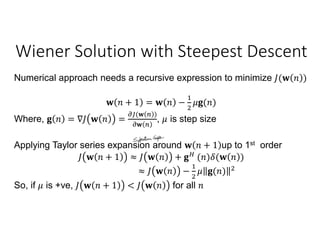
Wiener Solution with Steepest Descent
Numerical approach needs a recursive expression to minimize ( )
+ 1 = − ( )
Where, = ∇ =
( )
, is step size
Applying Taylor series expansion around + 1 up to 1st order
+ 1 ≈ + ( ) ( )
≈ − ( )
So, if is +ve, + 1 < for all
Wiener Solution with Steepest Descent
Learning
Algorithm
( )
( )
( )
Adaptive
Filter
( )
( )
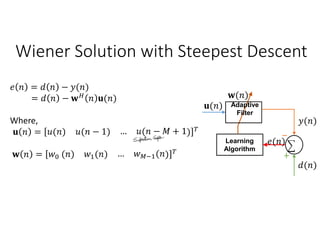
= − ( )
= − ( )
Where,
= ( ) ( − 1) … ( − + 1)
= ( ) ( ) … ( )
Wiener Solution with Steepest Descent
Learning
Algorithm
( )
( )
( )
Adaptive
Filter
( )
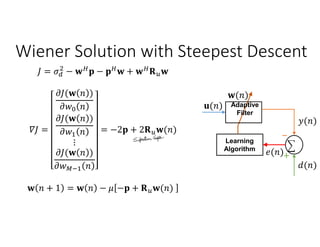
( )
= − − +
=
( )
( )
⋮
( )
= −2 + 2 ( )
+ 1 = − − + ( )
Wiener Solution with Steepest Descent
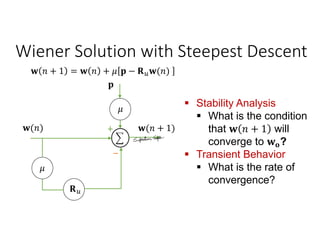
+ 1 = + − ( )
( ) ( + 1)
 Stability Analysis
 What is the condition
that + 1 will
converge to ?
 Transient Behavior
 What is the rate of
convergence?
Minimum MSE Surface
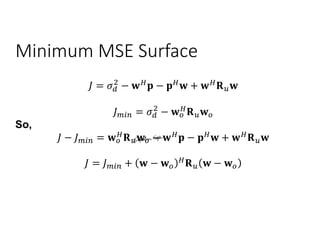
= − − +
= −
So,
− = − − +
= + − −
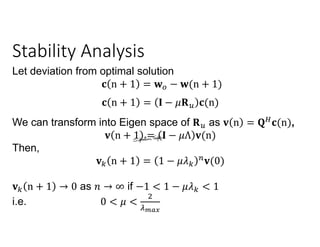
Stability Analysis
Let deviation from optimal solution
n + 1 = − (n + 1)
n + 1 = − (n)
We can transform into Eigen space of as n = (n),
n + 1 = − Λ (n)
Then,
n + 1 = 1 − (0)
n + 1 → 0 as → ∞ if −1 < 1 − < 1
i.e. 0 < <
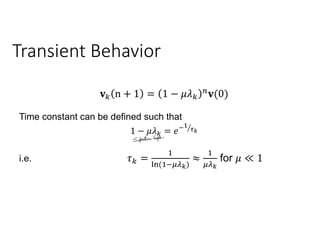
Transient Behavior
n + 1 = 1 − (0)
Time constant can be defined such that
1 − =
i.e. =
( )
≈ for ≪ 1

Lecture Notes on Adaptive Signal Processing-1.pdf

  • 1.
  • 2.
    Adaptive Signal Processing:Adaptive Filter General Concept  Adaptive Filters (AF) are, by design, time-variant, nonlinear, and stochastic systems  The adaptive filter performs a data- driven approximation step  The environment to AF comprises of • The input signal(s) • The reference signal(s) In cases where any of them is not well defined, the design procedure is to model the signals and subsequently design the filter
  • 3.
    Adaptive Signal Processing:Adaptive Algorithm General Concept  The basic objective of the adaptive/learning Algorithm is • To set adaptive filter coefficients (parameters) to minimize a meaningful objective function involving the input, the reference signal, and adaptive filter output signals  The meaningful objective function should be – • Non-negative: , , ≥ 0, ∀ ( ), ( ), ( ) ; • Optimal: [ ( ), ( ), ( )] = 0.
  • 4.
    Adaptive Filter: Applications 1.System Identification: ( ) ≈ ( ) Plant / System Adaptive Filter Learning Algorithm Viz. Min. MSE ( ) ( ) ( ) ( ) ( ) ( )
  • 5.
    Adaptive Filter: Applications 2.Inverse Model: ( ) ≈ ( ) ( ) Learning Algorithm Viz. Min. MSE ( ) ( ) ( ) Adaptive Filter ( ) Plant / System ( ) Delay ( )
  • 6.
    Adaptive Filter: Applications 3.Linear Prediction: ≈ = ( − ) ( ) ( ) Learning Algorithm Viz. Min. MSE ( ) = ( ) ( ) Adaptive Filter ( ) Delay ( − )
  • 7.
    Adaptive Filter: Applications 4.Noise Cancellation: ≈ − = − ( − ) ( ) Primary Signal + ( ) Learning Algorithm Viz. Min. MSE ( ) ( ) Adaptive Filter ( ) Reference Signal = ( )
  • 8.
    Stochastic/Random Signal Models •Driving question: Can we generate random process of desired statistical characteristics from statistically independent random process or vice versa?
  • 9.
    Stochastic Models • Generalor Auto-regressive Moving Average (ARMA) Model , [ ] [ ] [ ] = [ − ] − [ − ]
  • 10.
    Stochastic Models • MovingAverage (MA) Model ℎ [ ] [ ] = ℎ [ − ]
  • 11.
    Stochastic Models • Auto-regressive(AR) Model ℎ[ ] [ ] [ ] = − ℎ − + [ ]
  • 12.
    Stochastic Models: Computation •Given the desired auto-correlation sequence for = 0, 1, 2, … , determine the ℎ( ) and the input process variance ℎ − = [ ] Yule-Walker Eq.: ∑ ℎ∗ − = 0 for > 0 ∑ ℎ∗ − = for = 0
  • 13.
    Stochastic Models: Computation Yule-WalkerEq.: = = ∑ ℎ( ) with = 1
  • 14.
    Optimum Linear Filter:Filter Structures  Finite Impulse Response • Direct Form-I • Direct Form-II • Lattice Structure  Infinite Impulse Response • Direct Form-I • Direct Form-II • Lattice Structure
  • 15.
    Optimum Linear Filter:The Objective Functions Error Signal: = − ( )  Mean Square Error (MSE)  Mean Absolute of Error  3rd /Higher Order Moments of Error
  • 16.
    Optimum Linear Filter:Minimum MSE Error Signal: = − ( )  Mean Square Error (MSE)
  • 17.
    Optimum Linear Filter:Wiener Solution Design a filter that produces an estimate of the desired signal ( ) using a linear combination of the data ( ) such that the MSE function = − ( ) = ( ) is minimized.
  • 18.
    Wiener Solutions 1. Principlesof Orthogonality 2. MSE Surface Analysis Both are leading to Wiener- Hopf Equation
  • 19.
    Wiener Solutions: Principlesof Orthogonality Learning Algorithm Viz. Min. MSE ( ) ( ) ( ) Adaptive Filter ( ) ( ) = − ∗ − = − ( ) = ( ) ∇ = −2 ( − ) ∗ ( ) Wiener-Hopf Equation: ∑ − = ( − ) ∗ ( ) = (− )
  • 20.
    Wiener Solutions: Principlesof Orthogonality Wiener-Hopf Equation: ∑ − = ( − ) ∗ ( ) = (− ) = Where, = ( ) ( ) = ( ) ∗ ( ) =
  • 21.
    Wiener Solutions: MSESurface Analysis = − − + Minimizing w.r.t = Where, = ( ) ( ) = ( ) ∗ ( ) =
  • 22.
    Wiener Solutions: MinimumMSE = − = − ( ) ( ) ( ) = 1 − ∈ = 1 − 0 ≤∈≤ 1
  • 23.
    Wiener Solutions: Examples Considerthe sample autocorrelation coefficients ( (0) = 1.0, (1) = 0) from given data ( ), which, in addition to noise, contain the desired signal. Furthermore, assume the variance of the desired signal = 24.40 and the cross-correlation vector be = [2 4.5] . It is desired to find the surface defined by the mean- square function ( ).
  • 24.
  • 25.
    Wiener Solutions: Examples Letus consider a plant model = 0.9 and = 0.25 as shown in the figure. The plant output are corrupted by a white noise { ( )} of zero mean and variance 2 = 0.15. Find the Wiener coefficients and that approximate (models) with following two WSS processes as input which are uncorrelated with ( ). a. ( ) with zero mean and variance = 1. b. ( ) with mean = 0.5 and variance = 0.64.
  • 26.
    Wiener Solutions: Examples Weneed to solve = Step 1: What is ( ) in terms of ( ) Step 2: Cross-correlation between ( ) & ( ) Step 3: Auto-correlation matrix ( ) Step 4: Wiener Solution
  • 27.
    Wiener Solutions: Examples Weneed to solve = Step 1: What is ( ) in terms of ( ) Given = 0.9 and = 0.25. = 0.9 + 0.25 − 1 + ( ) Step 2: Cross-correlation between ( ) & ( ) ≜ ( ) ∗( − ) can vary from 0 to 1 and for other cases the above expression will produce zero
  • 28.
    Wiener Solutions: Examples Weneed to solve = Step 2: Cross-correlation between ( ) & ( ) ≜ ( ) ∗ ( − ) can vary from 0 to 1 and for other cases the above expression will produce zero So, 0 = ( ) ∗ ( ) and 1 = ( ) ∗ ( − 1) = . .
  • 29.
    Wiener Solutions: Examples Weneed to solve = Step 3: Auto-correlation matrix ( ) ( ) ≜ ( ) ∗ ( − ) As ( ) is white process whose mean is 0.5 and variance is 0.64. So, = + 0.5 = + 0.25 = . . . .
  • 30.
    Wiener Solutions: Examples Weneed to solve = Step 4: Wiener Solution = = 1.2198 -0.3427 -0.3427 1.2198 0.8635 0.4475 = 0.9 0.25
  • 31.
    Wiener Solutions: GeneratingColor Process ₊ ₊ + ₊ ( ) ( ) x( ) + + A WSS process x is to generated from a white process ( ) as shown in the figure. The white process ( ) has variance = 0.12. The auto- correlation sequence of x is 0 = 1.0645 , 1 = 0.4925, 2 = 0.7665. Determine , , and
  • 32.
    Wiener Solutions: GeneratingColor Process ₊ ₊ + ₊ ( ) ( ) x( ) + + Step 1: Determine s( ) in terms of ( ) and expression of autocorrelation sequence Step 2: Determine auto- correlation sequence of s( ) from that given for x( ) Step 3: Develop the Yule- Walker equation Step 4: Develop input variance equation and solve for all s( ) u( )
  • 33.
    Wiener Solutions: GeneratingColor Process ₊ ₊ + ₊ ( ) ( ) x( ) + + Step 1: Determine s( ) in terms of ( ) − + − 1 … + − 2 = ( ) So, − + − 1 … + − 2 = ∗ − = ( ) s( ) u( )
  • 34.
    Wiener Solutions: GeneratingColor Process ₊ ₊ + ₊ ( ) ( ) x( ) + + Step 2: Determine auto- correlation sequence of s( ) from that given for x( ) = − = − ( ) s( ) u( )
  • 35.
    Wiener Solutions: GeneratingColor Process ₊ ₊ + ₊ ( ) ( ) x( ) + + Step 3: Develop the Yule-Walker equation (0) (−1) (1) (0) − = − (1) − (2) = + and = s( ) u( )
  • 36.
    Wiener Solutions: GeneratingColor Process ₊ ₊ + ₊ ( ) ( ) x( ) + + Step 4: Develop input variance equation and solve for all = 0 − 1 + 2 s( ) u( )
  • 37.
    Wiener Solutions: TestExample Let the data entering the Wiener filter are given by ( ) = ( ) + ( ). The noise ( ) has zero mean value, unit variance, and is uncorrelated with the desired signal ( ). Furthermore, assume ( ) = 0.9 and ( ) = ( ). Find the following: , , , signal power, noise power, signal-to-noise power. Hints: Signal Power after filtering Noise Power after filtering
  • 38.
    Wiener Solution withSteepest Descent Numerical approach needs a recursive expression to minimize ( ) + 1 = − ( ) Where, = ∇ = ( ) , is step size Applying Taylor series expansion around + 1 up to 1st order + 1 ≈ + ( ) ( ) ≈ − ( ) So, if is +ve, + 1 < for all
  • 39.
    Wiener Solution withSteepest Descent Learning Algorithm ( ) ( ) ( ) Adaptive Filter ( ) ( ) = − ( ) = − ( ) Where, = ( ) ( − 1) … ( − + 1) = ( ) ( ) … ( )
  • 40.
    Wiener Solution withSteepest Descent Learning Algorithm ( ) ( ) ( ) Adaptive Filter ( ) ( ) = − − + = ( ) ( ) ⋮ ( ) = −2 + 2 ( ) + 1 = − − + ( )
  • 41.
    Wiener Solution withSteepest Descent + 1 = + − ( ) ( ) ( + 1)  Stability Analysis  What is the condition that + 1 will converge to ?  Transient Behavior  What is the rate of convergence?
  • 42.
    Minimum MSE Surface =− − + = − So, − = − − + = + − −
  • 43.
    Stability Analysis Let deviationfrom optimal solution n + 1 = − (n + 1) n + 1 = − (n) We can transform into Eigen space of as n = (n), n + 1 = − Λ (n) Then, n + 1 = 1 − (0) n + 1 → 0 as → ∞ if −1 < 1 − < 1 i.e. 0 < <
  • 44.
    Transient Behavior n +1 = 1 − (0) Time constant can be defined such that 1 − = i.e. = ( ) ≈ for ≪ 1