Direct Sequence Spread-Direct Sequence Spread-
SpectrumSpectrum
What is spread spectrum?What is spread spectrum?
 Methods by which energy generated in aMethods by which energy generated in a
particular bandwidth is deliberatelyparticular bandwidth is deliberately
spread in the frequency domain, resultingspread in the frequency domain, resulting
in a signal with a wider bandwidth.in a signal with a wider bandwidth.
 used for a variety of reasons, includingused for a variety of reasons, including
the establishment of securethe establishment of secure
communications, increasing resistance tocommunications, increasing resistance to
natural interference and jamming, and tonatural interference and jamming, and to
prevent detection.prevent detection.
Why do we need this?Why do we need this?
 In some situations it is required that aIn some situations it is required that a
communication signal be difficult tocommunication signal be difficult to
detect, and difficult to demodulate evendetect, and difficult to demodulate even
when detected. Here the word ‘detect’ iswhen detected. Here the word ‘detect’ is
used in the sense of ‘to discover theused in the sense of ‘to discover the
presence of’.presence of’.
 In other situations a signal is required thatIn other situations a signal is required that
is difficult to interfere with, or ‘jam’.is difficult to interfere with, or ‘jam’.
Commercial useCommercial use
 Initial commercial use of spread spectrumInitial commercial use of spread spectrum
began in the 1980s in the US with threebegan in the 1980s in the US with three
systems: Equatorial Communications System'ssystems: Equatorial Communications System's
very small aperture (VSAT) satellite terminalvery small aperture (VSAT) satellite terminal
system for newspaper newswire services, Delsystem for newspaper newswire services, Del
Norte Technology's radio navigation systemNorte Technology's radio navigation system
for navigation of aircraft for crop dusting andfor navigation of aircraft for crop dusting and
similar applications, and Qualcomm'ssimilar applications, and Qualcomm's
OmniTRACS system for communications toOmniTRACS system for communications to
truckstrucks
Spread-spectrum telecommunicationsSpread-spectrum telecommunications
 a technique in which a (telecommunication)a technique in which a (telecommunication)
signal is transmitted on a bandwidthsignal is transmitted on a bandwidth
considerably larger than the frequency contentconsiderably larger than the frequency content
of the original information.of the original information.
 a signal structuring technique that employsa signal structuring technique that employs
direct sequence, frequency hopping or a hybriddirect sequence, frequency hopping or a hybrid
of these, which can be used for multiple accessof these, which can be used for multiple access
and/or multiple functions.and/or multiple functions.
 This technique decreases the potentialThis technique decreases the potential
interference to other receivers while achievinginterference to other receivers while achieving
privacy.privacy.
Forms of spread spectrumForms of spread spectrum
 Frequency-hopping spread spectrum(FHSS)Frequency-hopping spread spectrum(FHSS)
 direct-sequence spread spectrum (DSSS)direct-sequence spread spectrum (DSSS)
 time-hopping spread spectrum (THSS)time-hopping spread spectrum (THSS)
 chirp spread spectrum (CSS)chirp spread spectrum (CSS)
and combinations of these techniquesand combinations of these techniques
 Each of these techniques employs pseudorandomEach of these techniques employs pseudorandom
number sequences — created using pseudorandomnumber sequences — created using pseudorandom
number generators .number generators .
What is pseudorandom number sequences ?What is pseudorandom number sequences ?
>is a sequence of numbers that has been computed>is a sequence of numbers that has been computed
by some defined arithmetic process but is effectivelyby some defined arithmetic process but is effectively
a random number sequence for the purpose fora random number sequence for the purpose for
which it is required.which it is required.
To determineTo determine andand control the spreading pattern of thecontrol the spreading pattern of the
signal across the allotted bandwidthsignal across the allotted bandwidth
Direct Sequence SpreadDirect Sequence Spread
Spectrum (DSSS)Spectrum (DSSS)
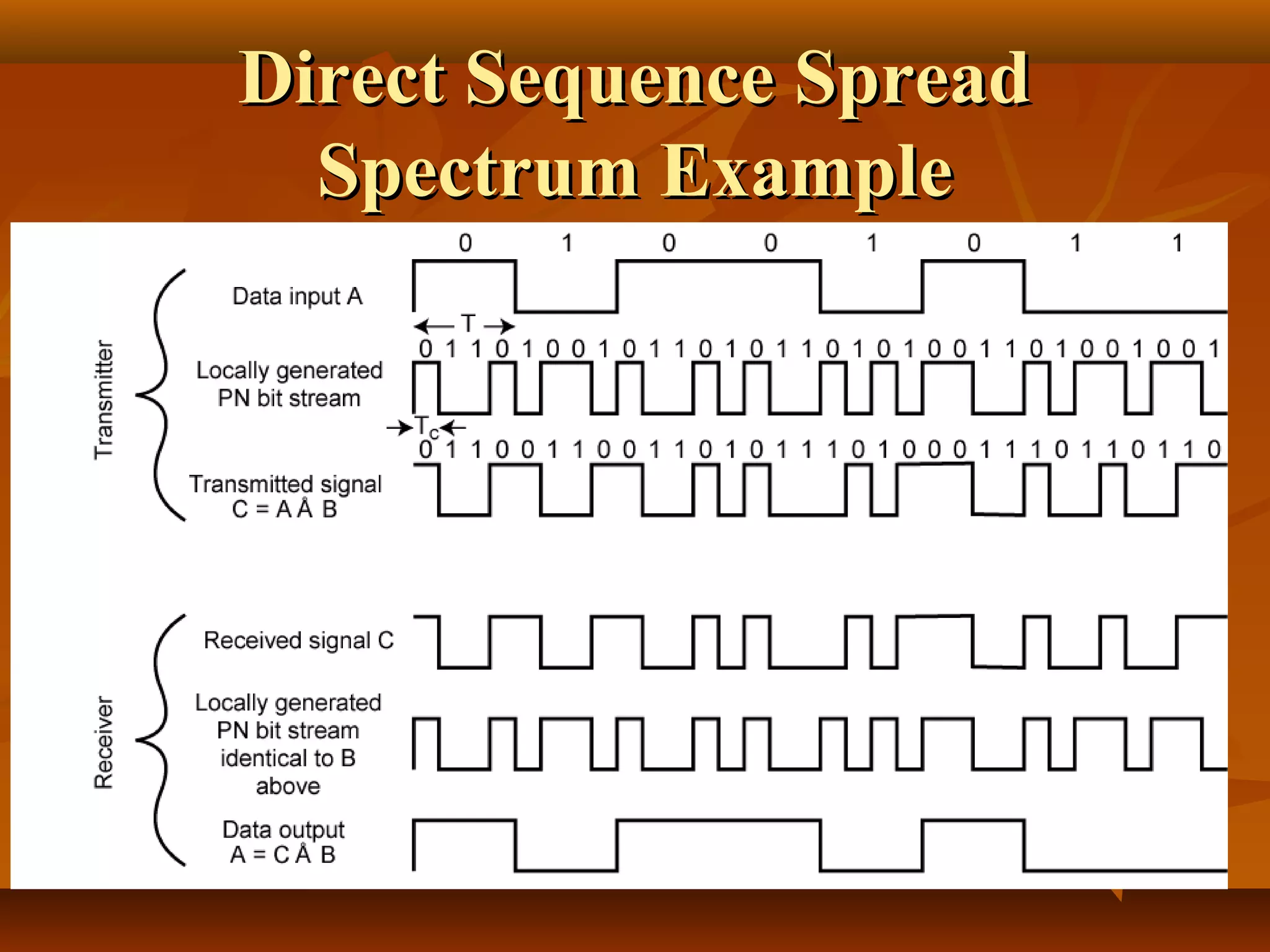
 Each bit represented by multiple bits using spreading codeEach bit represented by multiple bits using spreading code
 Spreading code spreads signal across wider frequency bandSpreading code spreads signal across wider frequency band
 In proportion to number of bits usedIn proportion to number of bits used
 10 bit spreading code spreads signal across 10 times bandwidth of 1 bit10 bit spreading code spreads signal across 10 times bandwidth of 1 bit
codecode
 One method:One method:
 Combine input with spreading code using XORCombine input with spreading code using XOR
 Input bit 1 inverts spreading code bitInput bit 1 inverts spreading code bit
 Input zero bit doesn’t alter spreading code bitInput zero bit doesn’t alter spreading code bit
 Data rate equal to original spreading codeData rate equal to original spreading code
 Performance similar to FHSSPerformance similar to FHSS
DS ModulationDS Modulation
Direct Sequence SpreadDirect Sequence Spread
Spectrum ExampleSpectrum Example
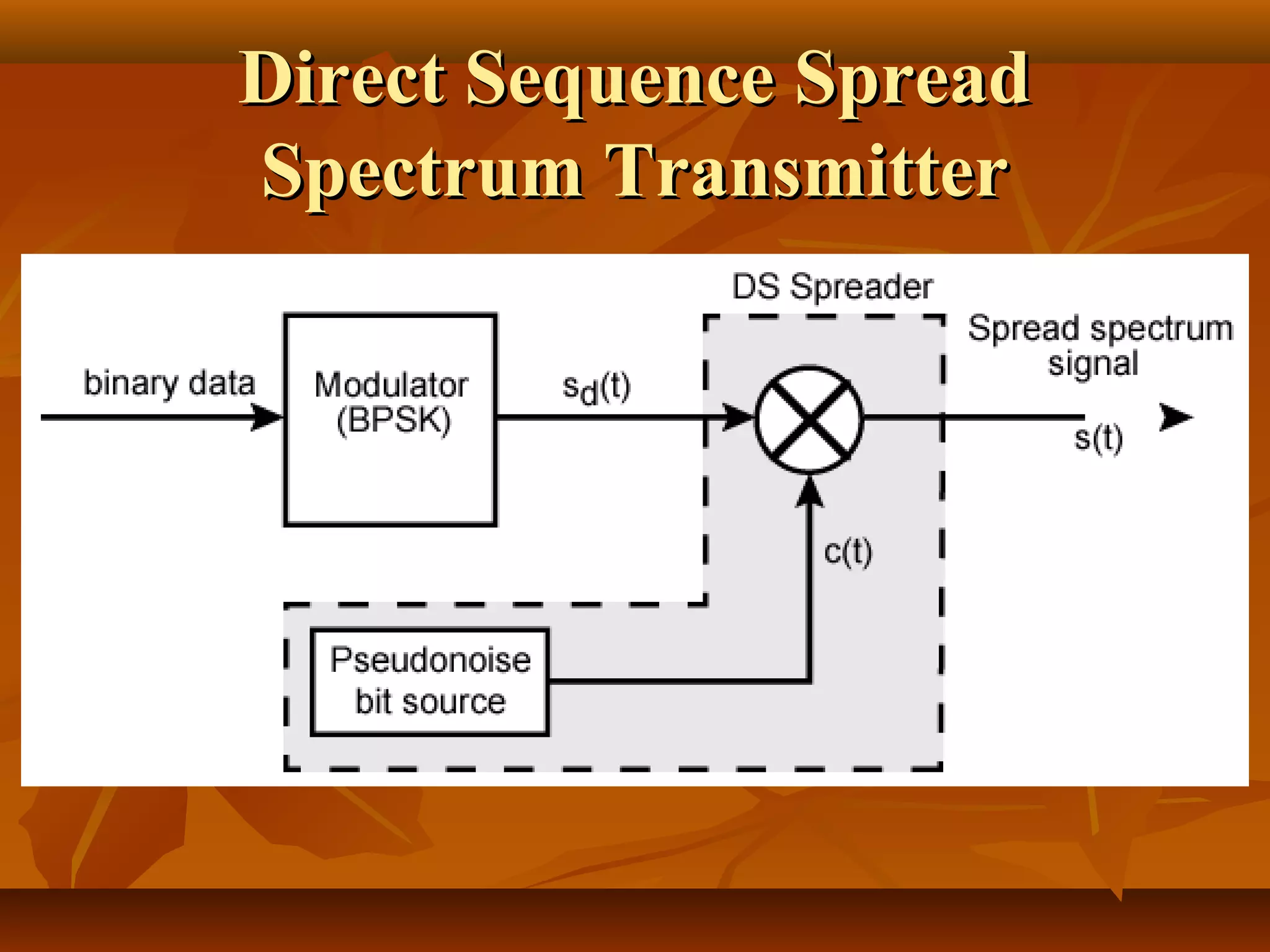
Direct Sequence SpreadDirect Sequence Spread
Spectrum TransmitterSpectrum Transmitter
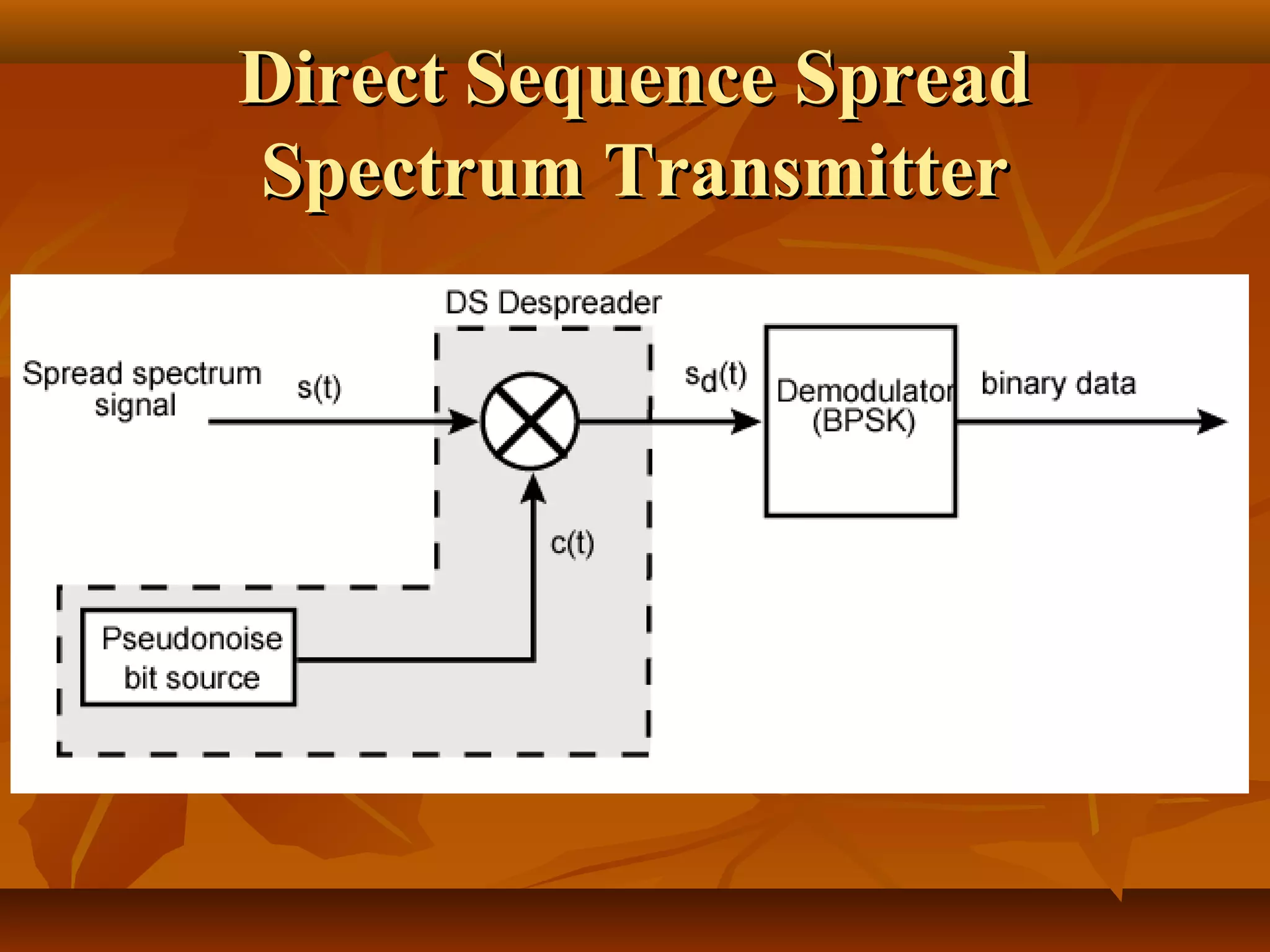
Direct Sequence SpreadDirect Sequence Spread
Spectrum TransmitterSpectrum Transmitter
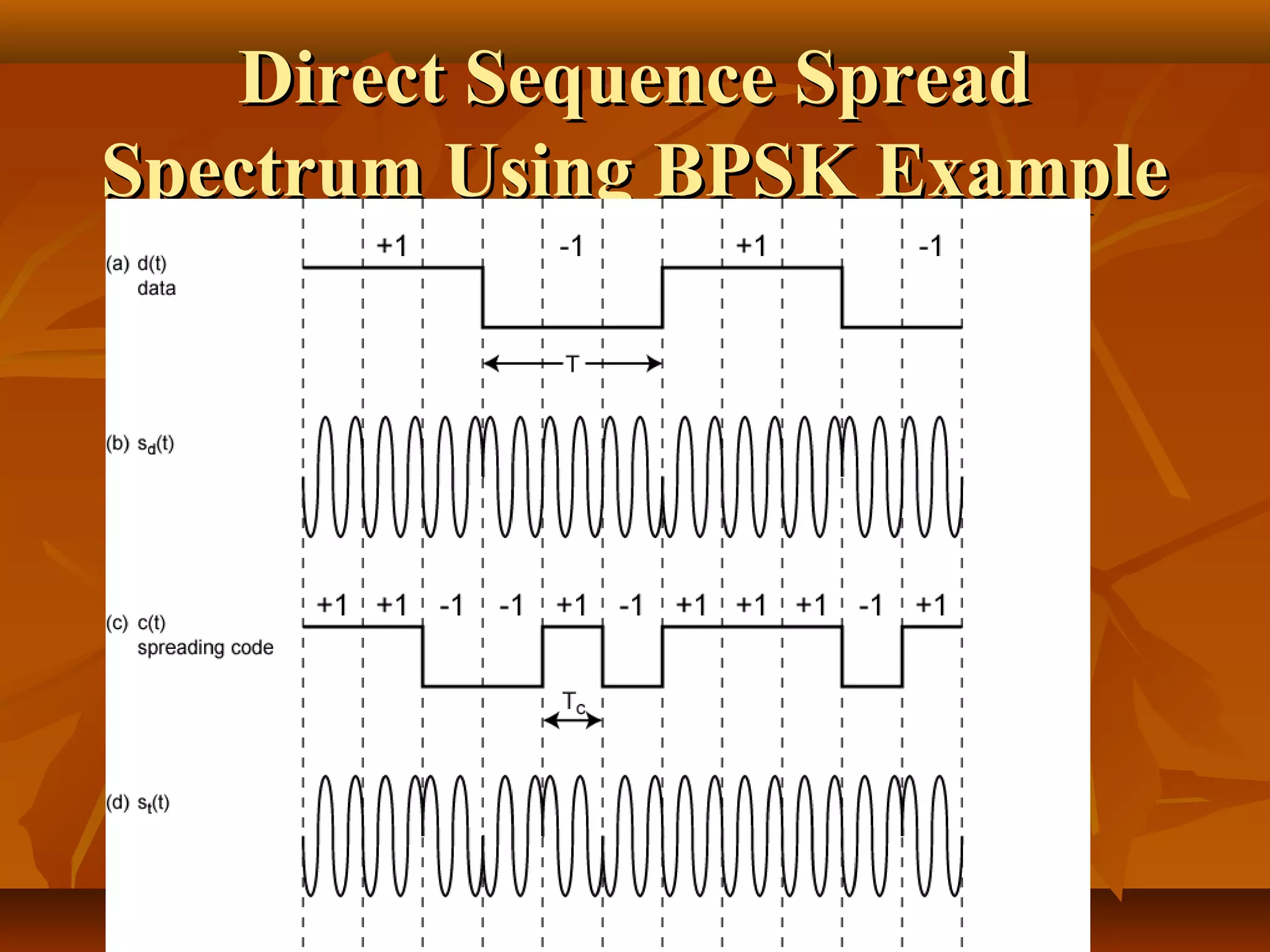
Direct Sequence SpreadDirect Sequence Spread
Spectrum Using BPSK ExampleSpectrum Using BPSK Example
UsesUses
 The United States GPS, RussianThe United States GPS, Russian GlonassGlonass, and, and
European Galileo satellite navigation systems.European Galileo satellite navigation systems.
 Digital cellular phones.Digital cellular phones.
 Cordless phones operating in the 2.4 and 5.8Cordless phones operating in the 2.4 and 5.8
GHz bands.GHz bands.
 WLAN (802.11a , 802.11b and 802.11g)WLAN (802.11a , 802.11b and 802.11g)
 Automatic meter readingAutomatic meter reading
 Military CommunicationMilitary Communication
 BluetoothBluetooth
 Radio-Controled model Automatic VehiclesRadio-Controled model Automatic Vehicles
BenefitsBenefits
 Resistance to intended or unintendedResistance to intended or unintended
jamming.jamming.
 Sharing of a single channel amongSharing of a single channel among
multiple users.multiple users.
 Determination of relative timing betweenDetermination of relative timing between
transmitter and receiver.transmitter and receiver.
DisadvantagesDisadvantages
 Increased Bandwidth (Frequency usage,Increased Bandwidth (Frequency usage,
Wideband reciver)Wideband reciver)
 Need for good PN Sequence generator andNeed for good PN Sequence generator and
hence complex circuityhence complex circuity

4rth lec dsss

  • 1.
    Direct Sequence Spread-DirectSequence Spread- SpectrumSpectrum
  • 2.
    What is spreadspectrum?What is spread spectrum?  Methods by which energy generated in aMethods by which energy generated in a particular bandwidth is deliberatelyparticular bandwidth is deliberately spread in the frequency domain, resultingspread in the frequency domain, resulting in a signal with a wider bandwidth.in a signal with a wider bandwidth.  used for a variety of reasons, includingused for a variety of reasons, including the establishment of securethe establishment of secure communications, increasing resistance tocommunications, increasing resistance to natural interference and jamming, and tonatural interference and jamming, and to prevent detection.prevent detection.
  • 3.
    Why do weneed this?Why do we need this?  In some situations it is required that aIn some situations it is required that a communication signal be difficult tocommunication signal be difficult to detect, and difficult to demodulate evendetect, and difficult to demodulate even when detected. Here the word ‘detect’ iswhen detected. Here the word ‘detect’ is used in the sense of ‘to discover theused in the sense of ‘to discover the presence of’.presence of’.  In other situations a signal is required thatIn other situations a signal is required that is difficult to interfere with, or ‘jam’.is difficult to interfere with, or ‘jam’.
  • 4.
    Commercial useCommercial use Initial commercial use of spread spectrumInitial commercial use of spread spectrum began in the 1980s in the US with threebegan in the 1980s in the US with three systems: Equatorial Communications System'ssystems: Equatorial Communications System's very small aperture (VSAT) satellite terminalvery small aperture (VSAT) satellite terminal system for newspaper newswire services, Delsystem for newspaper newswire services, Del Norte Technology's radio navigation systemNorte Technology's radio navigation system for navigation of aircraft for crop dusting andfor navigation of aircraft for crop dusting and similar applications, and Qualcomm'ssimilar applications, and Qualcomm's OmniTRACS system for communications toOmniTRACS system for communications to truckstrucks
  • 5.
    Spread-spectrum telecommunicationsSpread-spectrum telecommunications a technique in which a (telecommunication)a technique in which a (telecommunication) signal is transmitted on a bandwidthsignal is transmitted on a bandwidth considerably larger than the frequency contentconsiderably larger than the frequency content of the original information.of the original information.  a signal structuring technique that employsa signal structuring technique that employs direct sequence, frequency hopping or a hybriddirect sequence, frequency hopping or a hybrid of these, which can be used for multiple accessof these, which can be used for multiple access and/or multiple functions.and/or multiple functions.  This technique decreases the potentialThis technique decreases the potential interference to other receivers while achievinginterference to other receivers while achieving privacy.privacy.
  • 6.
    Forms of spreadspectrumForms of spread spectrum  Frequency-hopping spread spectrum(FHSS)Frequency-hopping spread spectrum(FHSS)  direct-sequence spread spectrum (DSSS)direct-sequence spread spectrum (DSSS)  time-hopping spread spectrum (THSS)time-hopping spread spectrum (THSS)  chirp spread spectrum (CSS)chirp spread spectrum (CSS) and combinations of these techniquesand combinations of these techniques
  • 7.
     Each ofthese techniques employs pseudorandomEach of these techniques employs pseudorandom number sequences — created using pseudorandomnumber sequences — created using pseudorandom number generators .number generators . What is pseudorandom number sequences ?What is pseudorandom number sequences ? >is a sequence of numbers that has been computed>is a sequence of numbers that has been computed by some defined arithmetic process but is effectivelyby some defined arithmetic process but is effectively a random number sequence for the purpose fora random number sequence for the purpose for which it is required.which it is required. To determineTo determine andand control the spreading pattern of thecontrol the spreading pattern of the signal across the allotted bandwidthsignal across the allotted bandwidth
  • 8.
    Direct Sequence SpreadDirectSequence Spread Spectrum (DSSS)Spectrum (DSSS)  Each bit represented by multiple bits using spreading codeEach bit represented by multiple bits using spreading code  Spreading code spreads signal across wider frequency bandSpreading code spreads signal across wider frequency band  In proportion to number of bits usedIn proportion to number of bits used  10 bit spreading code spreads signal across 10 times bandwidth of 1 bit10 bit spreading code spreads signal across 10 times bandwidth of 1 bit codecode  One method:One method:  Combine input with spreading code using XORCombine input with spreading code using XOR  Input bit 1 inverts spreading code bitInput bit 1 inverts spreading code bit  Input zero bit doesn’t alter spreading code bitInput zero bit doesn’t alter spreading code bit  Data rate equal to original spreading codeData rate equal to original spreading code  Performance similar to FHSSPerformance similar to FHSS
  • 9.
  • 10.
    Direct Sequence SpreadDirectSequence Spread Spectrum ExampleSpectrum Example
  • 11.
    Direct Sequence SpreadDirectSequence Spread Spectrum TransmitterSpectrum Transmitter
  • 12.
    Direct Sequence SpreadDirectSequence Spread Spectrum TransmitterSpectrum Transmitter
  • 13.
    Direct Sequence SpreadDirectSequence Spread Spectrum Using BPSK ExampleSpectrum Using BPSK Example
  • 14.
    UsesUses  The UnitedStates GPS, RussianThe United States GPS, Russian GlonassGlonass, and, and European Galileo satellite navigation systems.European Galileo satellite navigation systems.  Digital cellular phones.Digital cellular phones.  Cordless phones operating in the 2.4 and 5.8Cordless phones operating in the 2.4 and 5.8 GHz bands.GHz bands.  WLAN (802.11a , 802.11b and 802.11g)WLAN (802.11a , 802.11b and 802.11g)  Automatic meter readingAutomatic meter reading  Military CommunicationMilitary Communication  BluetoothBluetooth  Radio-Controled model Automatic VehiclesRadio-Controled model Automatic Vehicles
  • 15.
    BenefitsBenefits  Resistance tointended or unintendedResistance to intended or unintended jamming.jamming.  Sharing of a single channel amongSharing of a single channel among multiple users.multiple users.  Determination of relative timing betweenDetermination of relative timing between transmitter and receiver.transmitter and receiver.
  • 16.
    DisadvantagesDisadvantages  Increased Bandwidth(Frequency usage,Increased Bandwidth (Frequency usage, Wideband reciver)Wideband reciver)  Need for good PN Sequence generator andNeed for good PN Sequence generator and hence complex circuityhence complex circuity