MIRZA UMAR (1443)(SLIDE NO 7& 8)
MIAN AZEEM (1441)(SLIDE 3 )
UMAIR BHATTI (1431)(SLIDE NO 9 & 10)
GHULAM RASOOL(1404)(SLIDE NO 14,15,16))
HAMZA BAJWA(1433)(SLIDE NO 11 ,12& 13)
QASIM ALI(1425)(SLIDE 4 )
RANA ASAD ALI(1407)(SLIDE NO 20,21)
WASEEM ASLAM(1408)(SLIDE NO 17)
AREEBA RIAZ(1439)(SLIDE NO 6 & 7)
ABDUL REHMAN(1423)(SLIDE 19)
MUHAMMAD USMAN(1434)(SLIDE 18)
Introduction to OFDM
 The first OFDM scheme presented in 1966
 Development of OFDM over years
Frequency Division Multiplexing
(FDM)
 •Frequency Division Multiplexing(FDM) has
been used for a long time to carry more than
one signal over a telephone line.
 •FDM divides the channel bandwidth into sub
channels and transmits multiple relatively
low rate signals by carrying each signal on a
separate carrier frequency.
 •To ensure that the signal of one sub channel
did not overlap with the signal from an
adjacent one , some guard-band was left
between the different sub channels.
what is OFDM?
 Orthogonal frequency-division
multiplexing (OFDM) is a method of
encoding digital data on multiple carrier
frequencies. OFDM has developed into a
popular scheme for wideband digital
communication, used in applications such as
digital television and audio
broadcasting, DSL Internet access, wireless
networks, powerline networks, and 4Gmobile
communications.
Other definitions of OFDM
• a method of encoding digital data on multiple carrier
frequencies
oWikipedia
• an FDM modulation technique for transmitting large amounts
of digital data over a radio wave
oWebopedia
• a method of digital modulation in which a signal is split into
several narrowband channels at different frequencies.
o SearchNetworking
• A digital transmission technique that uses a large number of
carriers spaced apart at slightly different frequencies
 o PC Magazine Encyclopedia
How does it work
 •In order to solve the bandwidth efficiency problem ,
orthogonal frequency division multiplexing was
proposed , where the different carriers are
orthogonal to each other. With OFDM , it is possible
to have over lapping sub channels in the frequency
domain , thus increasing the transmission rate.
 •This carrier spacing provides optimal spectral
efficiency.Today , OFDM has grown to be the most
popular communication system in high-speed
communications.
 •OFDM is becoming the chosen modulation
technique for wireless communications . OFDM can
provide large data rates with sufficient robustness to
radio channel impairments.
OFDM is a special case of FDM
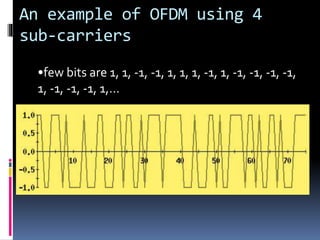
An example of OFDM using 4
sub-carriers
•few bits are 1, 1, -1, -1, 1, 1, 1, -1, 1, -1, -1, -1, -1,
1, -1, -1, -1, 1,…
Types of OFDM
 C-OFDM
 MIMO-OFDM
 V-OFDM
 W-OFDM
 Flash-OFDM
What is C-OFDM
 C-OFDM stands for Coded orthogonal
frequency-division multiplexing. It differs
from OFDM because in COFDM, forward
error correction is applied to the signal before
transmission.This is done to overcome errors.
COFDM and OFDM are sometimes used as
synonyms
C-OFDM(coded Orthogonal frequency-
division multiplexing )
 Coded OFDM
 Digital Audio
Broadcasting (DAB)
 DigitalVideo
Broadcasting (DVB-T)
 COFDM offers real
benefit in the
presence of isolated
narrow-band
interfering signals
Multiple Input, Multiple Output
OFDM (MIMO-OFDM)
 Developed by IospanWireless
 Uses multiple antennas to transmit
and receive radio signals
 Spatial (occupational) multiplexing
V-OFDM(Vector Orthogonal
frequency-division multiplexing
 Developed by CISCO
 Increases subscriber coverage
 Lowers the cost of provisioning and
deploying infrastructure
 Employs both frequency and spatial
diversity (variety)
 Creates a robust (strong) processing technique
for
multi-path fading and narrow band
interference
W-OFDM(Wideband OFDM)
 Invented byWi-LAN
 Large spacing between carriers
Advantages:
 - Optimal performance against Multi-path
-Less sensitive to carrier offset
 -Optimal power efficiency of the transmitter
amplifier
 More immune(safe) against
fading(‫)دھندالہٹ‬
Flash-OFDM (Fast-hopped OFDM)
 Wide-band spread-spectrum
technology
Avoids the compromises(agreement)
inherent(‫)آبادی‬ in other mobile data systems
 Capability to work around interfering(‫)مداخلت‬
signals
Differences Differences from other
multiplexing techniques
OFDM versus WDM
 -more flexible
 -higher bandwidth efficiency
Characteristics of OFDM
 • Can easily adapt to severe channel conditions without
complex time-domain
 equalization.
 • Robust against narrow-band co-channel interference.
 • Robust against intersymbol interference (ISI) and fading
caused by multipath propagation(‫.)تبلیغ‬
 • High spectral efficiency as compared to conventional
modulation schemes, spread spectrum, etc.
 • Efficient implementation using Fast FourierTransform
(FFT).
 • Low sensitivity to time synchronization errors.
 •Tuned sub-channel receiver filters are not required (unlike
conventional FDM).
 • Facilitates single frequency networks (SFNs); i.e.,
transmitter macrodiversity.
OFDM DISADVANTAGES
H IGH PAPR(peak to average power ratio)
 A number of independently modulated sub-carriers result in HIGH
PAPR
 Non-linear power amplifier, efficient, but cannot be used
 Causing performance degradation due to high distortion & out of
band radiations
 High PAPR also increases complexity of ADC & DAC
FREQUENCY OFFSET
 Sub-carriers are very close and overlapping
 Even a small frequency offset will result in ISI
 intersymbol interference (ISI) is a form of distortion of a signal in
which one symbol interferes with subsequent symbols.
 Causes of frequency offset:
 Frequency mismatch in local oscillators of transmitter & receiver
Doppler shift
 Phase noise caused in the channel
5th lec   ofdm

5th lec ofdm

  • 2.
    MIRZA UMAR (1443)(SLIDENO 7& 8) MIAN AZEEM (1441)(SLIDE 3 ) UMAIR BHATTI (1431)(SLIDE NO 9 & 10) GHULAM RASOOL(1404)(SLIDE NO 14,15,16)) HAMZA BAJWA(1433)(SLIDE NO 11 ,12& 13) QASIM ALI(1425)(SLIDE 4 ) RANA ASAD ALI(1407)(SLIDE NO 20,21) WASEEM ASLAM(1408)(SLIDE NO 17) AREEBA RIAZ(1439)(SLIDE NO 6 & 7) ABDUL REHMAN(1423)(SLIDE 19) MUHAMMAD USMAN(1434)(SLIDE 18) Introduction to OFDM
  • 3.
     The firstOFDM scheme presented in 1966  Development of OFDM over years
  • 4.
    Frequency Division Multiplexing (FDM) •Frequency Division Multiplexing(FDM) has been used for a long time to carry more than one signal over a telephone line.  •FDM divides the channel bandwidth into sub channels and transmits multiple relatively low rate signals by carrying each signal on a separate carrier frequency.  •To ensure that the signal of one sub channel did not overlap with the signal from an adjacent one , some guard-band was left between the different sub channels.
  • 5.
    what is OFDM? Orthogonal frequency-division multiplexing (OFDM) is a method of encoding digital data on multiple carrier frequencies. OFDM has developed into a popular scheme for wideband digital communication, used in applications such as digital television and audio broadcasting, DSL Internet access, wireless networks, powerline networks, and 4Gmobile communications.
  • 6.
    Other definitions ofOFDM • a method of encoding digital data on multiple carrier frequencies oWikipedia • an FDM modulation technique for transmitting large amounts of digital data over a radio wave oWebopedia • a method of digital modulation in which a signal is split into several narrowband channels at different frequencies. o SearchNetworking • A digital transmission technique that uses a large number of carriers spaced apart at slightly different frequencies  o PC Magazine Encyclopedia
  • 7.
    How does itwork  •In order to solve the bandwidth efficiency problem , orthogonal frequency division multiplexing was proposed , where the different carriers are orthogonal to each other. With OFDM , it is possible to have over lapping sub channels in the frequency domain , thus increasing the transmission rate.  •This carrier spacing provides optimal spectral efficiency.Today , OFDM has grown to be the most popular communication system in high-speed communications.  •OFDM is becoming the chosen modulation technique for wireless communications . OFDM can provide large data rates with sufficient robustness to radio channel impairments.
  • 9.
    OFDM is aspecial case of FDM
  • 10.
    An example ofOFDM using 4 sub-carriers •few bits are 1, 1, -1, -1, 1, 1, 1, -1, 1, -1, -1, -1, -1, 1, -1, -1, -1, 1,…
  • 11.
    Types of OFDM C-OFDM  MIMO-OFDM  V-OFDM  W-OFDM  Flash-OFDM
  • 12.
    What is C-OFDM C-OFDM stands for Coded orthogonal frequency-division multiplexing. It differs from OFDM because in COFDM, forward error correction is applied to the signal before transmission.This is done to overcome errors. COFDM and OFDM are sometimes used as synonyms
  • 13.
    C-OFDM(coded Orthogonal frequency- divisionmultiplexing )  Coded OFDM  Digital Audio Broadcasting (DAB)  DigitalVideo Broadcasting (DVB-T)  COFDM offers real benefit in the presence of isolated narrow-band interfering signals
  • 14.
    Multiple Input, MultipleOutput OFDM (MIMO-OFDM)  Developed by IospanWireless  Uses multiple antennas to transmit and receive radio signals  Spatial (occupational) multiplexing
  • 15.
    V-OFDM(Vector Orthogonal frequency-division multiplexing Developed by CISCO  Increases subscriber coverage  Lowers the cost of provisioning and deploying infrastructure  Employs both frequency and spatial diversity (variety)  Creates a robust (strong) processing technique for multi-path fading and narrow band interference
  • 17.
    W-OFDM(Wideband OFDM)  InventedbyWi-LAN  Large spacing between carriers Advantages:  - Optimal performance against Multi-path -Less sensitive to carrier offset  -Optimal power efficiency of the transmitter amplifier  More immune(safe) against fading(‫)دھندالہٹ‬
  • 18.
    Flash-OFDM (Fast-hopped OFDM) Wide-band spread-spectrum technology Avoids the compromises(agreement) inherent(‫)آبادی‬ in other mobile data systems  Capability to work around interfering(‫)مداخلت‬ signals
  • 19.
    Differences Differences fromother multiplexing techniques OFDM versus WDM  -more flexible  -higher bandwidth efficiency
  • 20.
    Characteristics of OFDM • Can easily adapt to severe channel conditions without complex time-domain  equalization.  • Robust against narrow-band co-channel interference.  • Robust against intersymbol interference (ISI) and fading caused by multipath propagation(‫.)تبلیغ‬  • High spectral efficiency as compared to conventional modulation schemes, spread spectrum, etc.  • Efficient implementation using Fast FourierTransform (FFT).  • Low sensitivity to time synchronization errors.  •Tuned sub-channel receiver filters are not required (unlike conventional FDM).  • Facilitates single frequency networks (SFNs); i.e., transmitter macrodiversity.
  • 21.
    OFDM DISADVANTAGES H IGHPAPR(peak to average power ratio)  A number of independently modulated sub-carriers result in HIGH PAPR  Non-linear power amplifier, efficient, but cannot be used  Causing performance degradation due to high distortion & out of band radiations  High PAPR also increases complexity of ADC & DAC FREQUENCY OFFSET  Sub-carriers are very close and overlapping  Even a small frequency offset will result in ISI  intersymbol interference (ISI) is a form of distortion of a signal in which one symbol interferes with subsequent symbols.  Causes of frequency offset:  Frequency mismatch in local oscillators of transmitter & receiver Doppler shift  Phase noise caused in the channel