Raffia Siddique
National University of Sciences and
Technology sector H-12 Islamabad
raffiasiddique_93@hotmail.com
Fermentation is the process which requires fermenter
or a bioreactor, the basic thing which enable the
scientist help in their biotechnological research, to see
their desired products being produced. The complete
bioreactor design from inside and outside is being
elaborated along with different types of fermenters
which help in different type of fermentation processes.
The
bioreactor
parts,
its
assembly, disassembly, cleaning autoclaving. The
performance of bioreactors and different problems
which arise during the functioning of bioreactors are
being discussed. Method of sampling are also
unscrambled, hence a complete package on design of
bioreactor and fermenter
Bioreactor
•

A bioreactor can be defined as
an apparatus, such as a large
fermentation chamber, for
growing organisms such as
bacteria or yeast that are
used in the biotechnological
manufacture of substances
such
as
pharmaceuticals, antibodies, or
vaccines,
or
for
the
bioconversion of organic waste.

Fermenter
•

However a fermenter can be
defined as an apparatus that
maintains optimal conditions
for
the
growth
of
microorganisms, used in largescale fermentation and in the
commercial
production
of
antibiotics and hormones
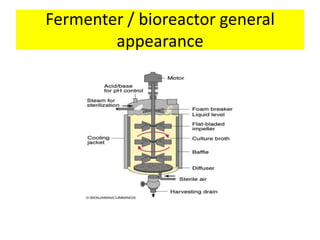
Fermenter / bioreactor general
appearance
1. round bottom , top
plate
2. Seal
3. Sample pipe
4. Port fittings of various
sizes
5. special inoculation port
6. gas sparger
7. A drive motor
8. Drive shaft
9. Impellers
10. Baffles
11. Air Filter
12. Dissolved oxygen
electrode
13. pH electrode
14. Antifoam probe
15. Cooling Valve
16. Heater pad
17. Pt-100 temperature
sensor
18. Cold finger
19. Reagent bottles
20.Sample device
21. controller base unit
Peripheral parts and
accessories
Common Measurement And
Control Systems
Bioreactor/ Fermenter
Designs
1. Stirred Tank
2. Air lift reactors
3. Bubble Column
4. Packed bed reactors
5. Trickle bed reactors
6. Fluidized bed reactor
Stirred tank reactor
• Mixing method:
Mechanical agitation
• High input required
• Baffles are constructed
within the built-in.
• Applications include
production of
antibiotics and
free/immobilized
enzymes
• Draw back is that high
shear forces may break
the cells
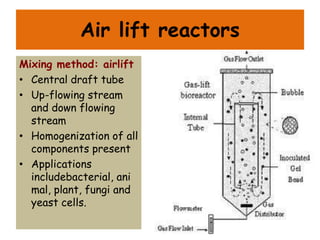
Air lift reactors
Mixing method: airlift
• Central draft tube
• Up-flowing stream
and down flowing
stream
• Homogenization of all
components present
• Applications
includebacterial, ani
mal, plant, fungi and
yeast cells.
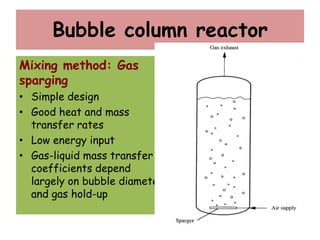
Bubble column reactor
Mixing method: Gas
sparging
• Simple design
• Good heat and mass
transfer rates
• Low energy input
• Gas-liquid mass transfer
coefficients depend
largely on bubble diameter
and gas hold-up
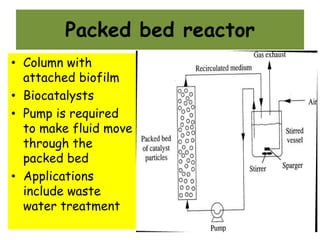
Packed bed reactor
• Column with
attached biofilm
• Biocatalysts
• Pump is required
to make fluid move
through the
packed bed
• Applications
include waste
water treatment
Fluidized bed reactor
• When the packed
beds are operated
in up-flow
mode, the bed
expands at high
liquid flow rates
due to upward
motion of the
particles.
• Energy is required
• Waste water
treatment
Trickle bed reactors
• Liquid is sprayed onto
the top of the packing
and trickles down
through the bed in small
rivulets.
• In the process, the
gaseous pollutants on
the surface of the
carriers is adsorbed and
immediately biologically
mineralized (degraded)
by the microorganisms.
References
•

”Bioreactor”. Def. The Free Dictionary by Farlex.from
http://www.thefreedictionary.com/bioreactor

• Bioreactor. An Encyclopedia
Britannica.From http://www.merriamwebster.com/dictionary/bioreactor
• ”fermentor”.Def. The Free Dictionary
by Farlex.from
http://www.thefreedictionary.com/fer
menter
• ”fermentation” . Def. The Free
Dictionary by Farlex.from
http://www.thefreedictionary.com/fer
mentation
Thank you

Fermentation and bio-reactor design

  • 1.
    Raffia Siddique National Universityof Sciences and Technology sector H-12 Islamabad raffiasiddique_93@hotmail.com
  • 2.
    Fermentation is theprocess which requires fermenter or a bioreactor, the basic thing which enable the scientist help in their biotechnological research, to see their desired products being produced. The complete bioreactor design from inside and outside is being elaborated along with different types of fermenters which help in different type of fermentation processes. The bioreactor parts, its assembly, disassembly, cleaning autoclaving. The performance of bioreactors and different problems which arise during the functioning of bioreactors are being discussed. Method of sampling are also unscrambled, hence a complete package on design of bioreactor and fermenter
  • 3.
    Bioreactor • A bioreactor canbe defined as an apparatus, such as a large fermentation chamber, for growing organisms such as bacteria or yeast that are used in the biotechnological manufacture of substances such as pharmaceuticals, antibodies, or vaccines, or for the bioconversion of organic waste. Fermenter • However a fermenter can be defined as an apparatus that maintains optimal conditions for the growth of microorganisms, used in largescale fermentation and in the commercial production of antibiotics and hormones
  • 6.
    Fermenter / bioreactorgeneral appearance
  • 7.
    1. round bottom, top plate 2. Seal 3. Sample pipe 4. Port fittings of various sizes 5. special inoculation port 6. gas sparger 7. A drive motor 8. Drive shaft 9. Impellers 10. Baffles 11. Air Filter
  • 8.
    12. Dissolved oxygen electrode 13.pH electrode 14. Antifoam probe 15. Cooling Valve 16. Heater pad 17. Pt-100 temperature sensor 18. Cold finger 19. Reagent bottles 20.Sample device 21. controller base unit
  • 9.
  • 10.
  • 11.
    Bioreactor/ Fermenter Designs 1. StirredTank 2. Air lift reactors 3. Bubble Column 4. Packed bed reactors 5. Trickle bed reactors 6. Fluidized bed reactor
  • 12.
    Stirred tank reactor •Mixing method: Mechanical agitation • High input required • Baffles are constructed within the built-in. • Applications include production of antibiotics and free/immobilized enzymes • Draw back is that high shear forces may break the cells
  • 13.
    Air lift reactors Mixingmethod: airlift • Central draft tube • Up-flowing stream and down flowing stream • Homogenization of all components present • Applications includebacterial, ani mal, plant, fungi and yeast cells.
  • 14.
    Bubble column reactor Mixingmethod: Gas sparging • Simple design • Good heat and mass transfer rates • Low energy input • Gas-liquid mass transfer coefficients depend largely on bubble diameter and gas hold-up
  • 15.
    Packed bed reactor •Column with attached biofilm • Biocatalysts • Pump is required to make fluid move through the packed bed • Applications include waste water treatment
  • 16.
    Fluidized bed reactor •When the packed beds are operated in up-flow mode, the bed expands at high liquid flow rates due to upward motion of the particles. • Energy is required • Waste water treatment
  • 17.
    Trickle bed reactors •Liquid is sprayed onto the top of the packing and trickles down through the bed in small rivulets. • In the process, the gaseous pollutants on the surface of the carriers is adsorbed and immediately biologically mineralized (degraded) by the microorganisms.
  • 18.
    References • ”Bioreactor”. Def. TheFree Dictionary by Farlex.from http://www.thefreedictionary.com/bioreactor • Bioreactor. An Encyclopedia Britannica.From http://www.merriamwebster.com/dictionary/bioreactor • ”fermentor”.Def. The Free Dictionary by Farlex.from http://www.thefreedictionary.com/fer menter • ”fermentation” . Def. The Free Dictionary by Farlex.from http://www.thefreedictionary.com/fer mentation
  • 19.