Immobilized Enzyme Reactors
– Batch & continuous
Presented by – Abhishek Giri
M.Sc. (Part – II), SEM – IV,P-V
R.K.Talreja College UNR-03
Topics to be Covered
 Introduction
 Types of Reactors
 Batch reactors
 Continuous reactors
 Advantages
 Disadvantages
 Applications
 References
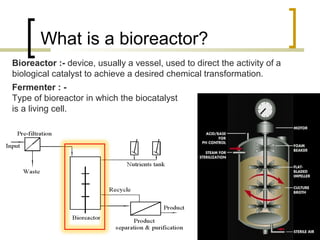
What is a bioreactor?
Bioreactor :- device, usually a vessel, used to direct the activity of a
biological catalyst to achieve a desired chemical transformation.
Fermenter : -
Type of bioreactor in which the biocatalyst
is a living cell.
Introduction
 Immobilization of enzymes refers to the technique of
confining/anchoring the enzymes in or on a inert support for
their stability & functional reuse.
 GOOSE WITH A GOLDEN EGG
 Retains structural conformation necessary for catalysis.
 Techniques for immobilization of enzymes are – adsorption,
entrapment, microencapsulation, covalent binding, & cross-
linking.
 Immobilized enzymes are broadly of two types - batch reactors
& continuous reactors.
 Choice of reactor depends on the cost of a predetermined
product.
Types of an Enzyme Reactor
 6 TYPES
 Stirred tank batch reactor.
 Continuous flow stirred tank reactor.
 Batch membrane reactor.
 Continuous flow ultra filtration membrane reactor.
 Packed bed reactor.
 Fluidized bed reactor.
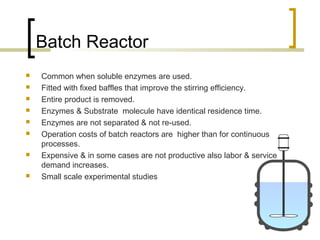
Batch Reactor
 Common when soluble enzymes are used.
 Fitted with fixed baffles that improve the stirring efficiency.
 Entire product is removed.
 Enzymes & Substrate molecule have identical residence time.
 Enzymes are not separated & not re-used.
 Operation costs of batch reactors are higher than for continuous
processes.
 Expensive & in some cases are not productive also labor & service
demand increases.
 Small scale experimental studies
Batch reactor – Stirred tank [STR]
 Simplest form..
 Good mixing, ease of temperature & pH
control.
 Loss of some enzyme activity may occur.
 Modified form – Basket Reactor.
 Basket reactor – enzymes are retained
over the impeller blades or baffles of the
tank reactor.
 Both have a well mixed flow pattern.
 High shear forces may damage cells.
 Requires high energy input.
 Application :- free & immobilized enzyme
reactions..
 Recovery of products produced by
enzymes like lipase, glucose isomerase &
B-galactosidase.
Batch reactor – Plug flow [PFR]
 Alternative to flow pattern type of
reactors.
 Flow rate controlled by a plug system.
 Plug flow – Packed bed or Fluidized
bed
 Used when inadequate product
formation in flow type reactors.
 Advantage – external mass transfer
effects can be reduced by the
operational high fluid velocities.
 Application :- used for obtaining
kinetic data on the reaction systems.
Batch reactor – Packed-bed [PBR]
 Modified form, Widely used.
 When equipped with external
heating & cooling coils is also
called as PFR
 Substrate stream flows at same
velocity, parallel to reactor with
no back-mixing.
 3 substrate flow possibilities –
downward flow method, upward,
& recycling method.
 Packed-bed reactors are used
with immobilized or particulate
biocatalysts.
 Medium can be fed either at the
top or bottom & forms a
continuous liquid phase.
Batch reactor – Fluidised-bed [FBR]
 Intermediate between CSTRs & PBRs.
 Consist of a bed of immobilized
enzymes which is fluidized by rapid
upwards flow of the substrate or in
combination with a gas or Secondary
liquid stream.
 Fluidization requires large power input.
 Heating & cooling coils are located
outwards.
 Baffles are used to decrease stirring
efficiency.
 Useful if the reaction involves the
utilization or release of gaseous
material.
 Disadvantage – difficulty in scaling-up
these reactors.
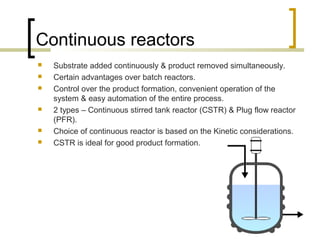
Continuous reactors
 Substrate added continuously & product removed simultaneously.
 Certain advantages over batch reactors.
 Control over the product formation, convenient operation of the
system & easy automation of the entire process.
 2 types – Continuous stirred tank reactor (CSTR) & Plug flow reactor
(PFR).
 Choice of continuous reactor is based on the Kinetic considerations.
 CSTR is ideal for good product formation.
Continuous reactor – CSTR
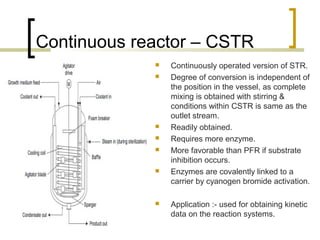
 Continuously operated version of STR.
 Degree of conversion is independent of
the position in the vessel, as complete
mixing is obtained with stirring &
conditions within CSTR is same as the
outlet stream.
 Readily obtained.
 Requires more enzyme.
 More favorable than PFR if substrate
inhibition occurs.
 Enzymes are covalently linked to a
carrier by cyanogen bromide activation.
 Application :- used for obtaining kinetic
data on the reaction systems.
Continuous reactor – PFR
 Degree of conversion is dependent on
the length of the reactor as no mixing
device exist & the conditions within
the reactor are never uniform.
 Difficult to obtain.
 Requires less enzyme to obtain the
same degree of conversion as in
CSTR.
 Application :- used for obtaining
kinetic data on the reaction systems.
Diagrams of various important enzyme reactor
types.
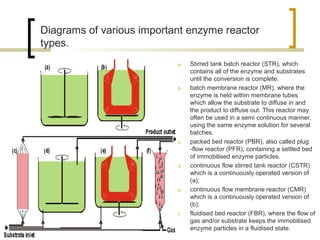
a. Stirred tank batch reactor (STR), which
contains all of the enzyme and substrates
until the conversion is complete.
b. batch membrane reactor (MR), where the
enzyme is held within membrane tubes
which allow the substrate to diffuse in and
the product to diffuse out. This reactor may
often be used in a semi continuous manner,
using the same enzyme solution for several
batches.
c. packed bed reactor (PBR), also called plug
-flow reactor (PFR), containing a settled bed
of immobilised enzyme particles.
d. continuous flow stirred tank reactor (CSTR)
which is a continuously operated version of
(a);
e. continuous flow membrane reactor (CMR)
which is a continuously operated version of
(b);
f. fluidised bed reactor (FBR), where the flow of
gas and/or substrate keeps the immobilised
enzyme particles in a fluidised state.
Reactor Comparison
 Batch
 High operating costs
 Batch-to-batch variations
 PFR
 Difficult to control pH and Temperature
 CSTR
 Simple pH, Temperature control
 Simple catalyst charging and replacement
Choice of reactor
 Form & characteristics of immobilized enzyme preparation.
 Operational requirements.
 Ex – Penicillin acylase (pH control), the CSTR or BSTR is more
suitable than PFR reactors.
 due to possible disintegration of support through mechanical
shearing, only durable preparation of immobilized enzymes should
be used in CSTR.
 With Small immobilized enzymes particles, problems such as high
pressure drop & plugging arise in PFR reactors. Hence, FPR
should be used..
 Reactant characteristics can also influence the choice of reactor.
 Insoluble substrate and product & highly viscous fluids are
preferably processed in FBR or CSTR, where no plugging occurs.
Advantages of immobilized enzymes
 High Stability.
 Reusable.
 Products are enzyme free.
 Ideal for multi-enzyme reaction systems.
 Controls of enzyme function is easy.
 Suitable for industrial & medical use.
 Minimize effluent disposal problems..
Disadvantages
 Possible loss of biological activity of an enzyme during immobilization
or while it is in use
 Immobilization is expensive technique requires sophisticated
equipment
Examples of Immobilized enzymes
 Immobilized glucosidase & glucose isomerase are used in production
of fructose from starch.
 Immobilized L-Aminoacylase which resolves a mixture of D- and L-
amino acids.
 Immobilization of Microbial cells.
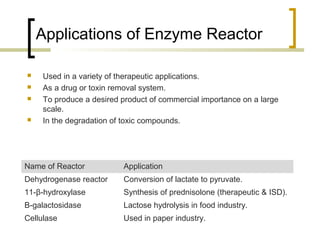
Applications of Enzyme Reactor
 Used in a variety of therapeutic applications.
 As a drug or toxin removal system.
 To produce a desired product of commercial importance on a large
scale.
 In the degradation of toxic compounds.
Name of Reactor Application
Dehydrogenase reactor Conversion of lactate to pyruvate.
11-β-hydroxylase Synthesis of prednisolone (therapeutic & ISD).
Β-galactosidase Lactose hydrolysis in food industry.
Cellulase Used in paper industry.
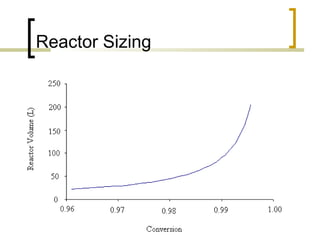
Reactor Sizing
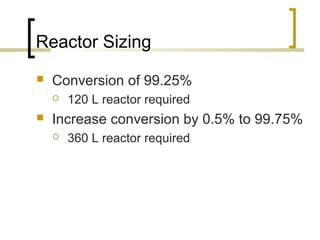
Reactor Sizing
 Conversion of 99.25%
 120 L reactor required
 Increase conversion by 0.5% to 99.75%
 360 L reactor required
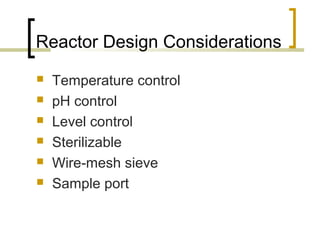
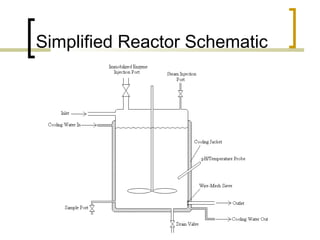
Reactor Design Considerations
 Temperature control
 pH control
 Level control
 Sterilizable
 Wire-mesh sieve
 Sample port
Simplified Reactor Schematic
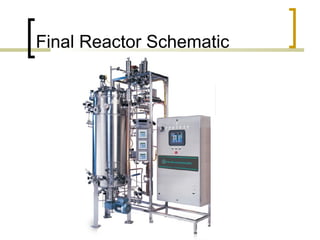
Final Reactor Schematic
• U. Satyanarayan, Biotechnology, 2007
Reprint, Uppala Author Publisher Interlink.
• Colin Rateledge and Bjorn Kristiansen,
Basic Biotechnology, 2nd Edition,
Cambridge Univ. Press
• T. Devasena, Enzymology,2010, Oxford
University press.
References - BOOKS
• www1.lsbu.ac.uk/water/enztech/reactors.htm
• en.wikipedia.org/wiki/Batch_reactor
• en.wikipedia.org/wiki/continuous_reactor
• en.wikipedia.org/wiki/Immobilized_enzyme
References – Web-links
Thank You

immobilized Enzyme reactors- batch and continuous types.

  • 1.
    Immobilized Enzyme Reactors –Batch & continuous Presented by – Abhishek Giri M.Sc. (Part – II), SEM – IV,P-V R.K.Talreja College UNR-03
  • 2.
    Topics to beCovered  Introduction  Types of Reactors  Batch reactors  Continuous reactors  Advantages  Disadvantages  Applications  References
  • 3.
    What is abioreactor? Bioreactor :- device, usually a vessel, used to direct the activity of a biological catalyst to achieve a desired chemical transformation. Fermenter : - Type of bioreactor in which the biocatalyst is a living cell.
  • 4.
    Introduction  Immobilization ofenzymes refers to the technique of confining/anchoring the enzymes in or on a inert support for their stability & functional reuse.  GOOSE WITH A GOLDEN EGG  Retains structural conformation necessary for catalysis.  Techniques for immobilization of enzymes are – adsorption, entrapment, microencapsulation, covalent binding, & cross- linking.  Immobilized enzymes are broadly of two types - batch reactors & continuous reactors.  Choice of reactor depends on the cost of a predetermined product.
  • 5.
    Types of anEnzyme Reactor  6 TYPES  Stirred tank batch reactor.  Continuous flow stirred tank reactor.  Batch membrane reactor.  Continuous flow ultra filtration membrane reactor.  Packed bed reactor.  Fluidized bed reactor.
  • 6.
    Batch Reactor  Commonwhen soluble enzymes are used.  Fitted with fixed baffles that improve the stirring efficiency.  Entire product is removed.  Enzymes & Substrate molecule have identical residence time.  Enzymes are not separated & not re-used.  Operation costs of batch reactors are higher than for continuous processes.  Expensive & in some cases are not productive also labor & service demand increases.  Small scale experimental studies
  • 7.
    Batch reactor –Stirred tank [STR]  Simplest form..  Good mixing, ease of temperature & pH control.  Loss of some enzyme activity may occur.  Modified form – Basket Reactor.  Basket reactor – enzymes are retained over the impeller blades or baffles of the tank reactor.  Both have a well mixed flow pattern.  High shear forces may damage cells.  Requires high energy input.  Application :- free & immobilized enzyme reactions..  Recovery of products produced by enzymes like lipase, glucose isomerase & B-galactosidase.
  • 8.
    Batch reactor –Plug flow [PFR]  Alternative to flow pattern type of reactors.  Flow rate controlled by a plug system.  Plug flow – Packed bed or Fluidized bed  Used when inadequate product formation in flow type reactors.  Advantage – external mass transfer effects can be reduced by the operational high fluid velocities.  Application :- used for obtaining kinetic data on the reaction systems.
  • 9.
    Batch reactor –Packed-bed [PBR]  Modified form, Widely used.  When equipped with external heating & cooling coils is also called as PFR  Substrate stream flows at same velocity, parallel to reactor with no back-mixing.  3 substrate flow possibilities – downward flow method, upward, & recycling method.  Packed-bed reactors are used with immobilized or particulate biocatalysts.  Medium can be fed either at the top or bottom & forms a continuous liquid phase.
  • 10.
    Batch reactor –Fluidised-bed [FBR]  Intermediate between CSTRs & PBRs.  Consist of a bed of immobilized enzymes which is fluidized by rapid upwards flow of the substrate or in combination with a gas or Secondary liquid stream.  Fluidization requires large power input.  Heating & cooling coils are located outwards.  Baffles are used to decrease stirring efficiency.  Useful if the reaction involves the utilization or release of gaseous material.  Disadvantage – difficulty in scaling-up these reactors.
  • 11.
    Continuous reactors  Substrateadded continuously & product removed simultaneously.  Certain advantages over batch reactors.  Control over the product formation, convenient operation of the system & easy automation of the entire process.  2 types – Continuous stirred tank reactor (CSTR) & Plug flow reactor (PFR).  Choice of continuous reactor is based on the Kinetic considerations.  CSTR is ideal for good product formation.
  • 12.
    Continuous reactor –CSTR  Continuously operated version of STR.  Degree of conversion is independent of the position in the vessel, as complete mixing is obtained with stirring & conditions within CSTR is same as the outlet stream.  Readily obtained.  Requires more enzyme.  More favorable than PFR if substrate inhibition occurs.  Enzymes are covalently linked to a carrier by cyanogen bromide activation.  Application :- used for obtaining kinetic data on the reaction systems.
  • 13.
    Continuous reactor –PFR  Degree of conversion is dependent on the length of the reactor as no mixing device exist & the conditions within the reactor are never uniform.  Difficult to obtain.  Requires less enzyme to obtain the same degree of conversion as in CSTR.  Application :- used for obtaining kinetic data on the reaction systems.
  • 14.
    Diagrams of variousimportant enzyme reactor types. a. Stirred tank batch reactor (STR), which contains all of the enzyme and substrates until the conversion is complete. b. batch membrane reactor (MR), where the enzyme is held within membrane tubes which allow the substrate to diffuse in and the product to diffuse out. This reactor may often be used in a semi continuous manner, using the same enzyme solution for several batches. c. packed bed reactor (PBR), also called plug -flow reactor (PFR), containing a settled bed of immobilised enzyme particles. d. continuous flow stirred tank reactor (CSTR) which is a continuously operated version of (a); e. continuous flow membrane reactor (CMR) which is a continuously operated version of (b); f. fluidised bed reactor (FBR), where the flow of gas and/or substrate keeps the immobilised enzyme particles in a fluidised state.
  • 15.
    Reactor Comparison  Batch High operating costs  Batch-to-batch variations  PFR  Difficult to control pH and Temperature  CSTR  Simple pH, Temperature control  Simple catalyst charging and replacement
  • 16.
    Choice of reactor Form & characteristics of immobilized enzyme preparation.  Operational requirements.  Ex – Penicillin acylase (pH control), the CSTR or BSTR is more suitable than PFR reactors.  due to possible disintegration of support through mechanical shearing, only durable preparation of immobilized enzymes should be used in CSTR.  With Small immobilized enzymes particles, problems such as high pressure drop & plugging arise in PFR reactors. Hence, FPR should be used..  Reactant characteristics can also influence the choice of reactor.  Insoluble substrate and product & highly viscous fluids are preferably processed in FBR or CSTR, where no plugging occurs.
  • 17.
    Advantages of immobilizedenzymes  High Stability.  Reusable.  Products are enzyme free.  Ideal for multi-enzyme reaction systems.  Controls of enzyme function is easy.  Suitable for industrial & medical use.  Minimize effluent disposal problems..
  • 18.
    Disadvantages  Possible lossof biological activity of an enzyme during immobilization or while it is in use  Immobilization is expensive technique requires sophisticated equipment
  • 19.
    Examples of Immobilizedenzymes  Immobilized glucosidase & glucose isomerase are used in production of fructose from starch.  Immobilized L-Aminoacylase which resolves a mixture of D- and L- amino acids.  Immobilization of Microbial cells.
  • 20.
    Applications of EnzymeReactor  Used in a variety of therapeutic applications.  As a drug or toxin removal system.  To produce a desired product of commercial importance on a large scale.  In the degradation of toxic compounds. Name of Reactor Application Dehydrogenase reactor Conversion of lactate to pyruvate. 11-β-hydroxylase Synthesis of prednisolone (therapeutic & ISD). Β-galactosidase Lactose hydrolysis in food industry. Cellulase Used in paper industry.
  • 21.
  • 22.
    Reactor Sizing  Conversionof 99.25%  120 L reactor required  Increase conversion by 0.5% to 99.75%  360 L reactor required
  • 23.
    Reactor Design Considerations Temperature control  pH control  Level control  Sterilizable  Wire-mesh sieve  Sample port
  • 24.
  • 25.
  • 26.
    • U. Satyanarayan,Biotechnology, 2007 Reprint, Uppala Author Publisher Interlink. • Colin Rateledge and Bjorn Kristiansen, Basic Biotechnology, 2nd Edition, Cambridge Univ. Press • T. Devasena, Enzymology,2010, Oxford University press. References - BOOKS
  • 27.
    • www1.lsbu.ac.uk/water/enztech/reactors.htm • en.wikipedia.org/wiki/Batch_reactor •en.wikipedia.org/wiki/continuous_reactor • en.wikipedia.org/wiki/Immobilized_enzyme References – Web-links
  • 28.