Fermentation
inmedicinalbiotechnology
Medicinal biotechnology
By Sumit kumar khandai
Sem-2(part-1)
DPSNP
•Fermentationisaprocesstraditionallyknownfortheanaerobicconversionofsugar
tocarbondioxideandalcoholbyyeast,nowreferstoanindustrialprocessof
manufacturingawidevarietyofmetabolitesandbiomaterialsbyusing
microorganismsormammaliancellsinacontrolledcultureenvironment.
•Knownfortheproductionofvariousmedicallyimportantproductssuchas
antibiotics,solvent,andnewgenerationfermentationproductslikeanantiviraldrug,
therapeuticrecombinantproteinsDNA,andmonoclonalantibodies.
INTRODUCTION
INDUSTRIAL FERMENTATION
 It is built on traditional principles but incorporates the most recent
advancements in biotechnology and engineering in order to maximize
yield at a reduced cost.
Types of fermentation:
1- Batch
2- Continuous
3- Fed-batch
Batch fermentation-
• Growing a microorganism in the presence of a fixed amount of substrate
and nutrient, added at the beginning of the fermentation process.
• Cell growth occurs through typical growth cycles of microorganisms:
The lag phase, exponential phase, early stationary phase, and stationary
phase of the growth.
Disadvantage – low productivity, long turnaround times, required for
cleaning and sterilization of the bioreactors.
Continuous fermentation-
• It operates fermentation at a specific growth rate of the organism by
controlling substrate input and product output rate.
Advantage - high productivity
Disadvantage - it is more prone to contamination and product recovery
could be expensive because of the higher dilution of the product.
• Here the substrate is added at an intermittent rate with the withdrawal
of the product at the same rate.
Fed batchformation:
It is the combination of batch and continuous fermentation and the
technique is most widely used for industrial purposes.
• Fed batch fermentation allows the removal of the by-product at
stages when the by-product might be harmful to the bacteria, and
this is done at intermittent levels.
• Fed batch system is divided into two types
SSF(solid state fermentation)
SmF(Sub merged fermentation)
SSF-
• Substrates used are solid compounds such as bran, paper pulp, wheat bran,
rice, rice straw, fruit, etc
• They are utilized very slowly by bacteria or fungi at a steady rate leading to
the controlled release of nutrients.
SMF-
• Uses free-flowing liquid, such as molasses and both, and is suitable for
bacteria that require high water activity.
• In this process, the products of interest are secreted into the fermentation
broth and purification of the product is easier.
• It requires a constant supply of the substrate.
• This technique is mostly used to extract secondary metabolites that need to
be used in liquid form.
Stages of fermentation
Biotech companies use two terms to define the stages of production-
1-Upstream- involves growing microorganisms in the fermenter in the
product fermentation.
2-Downstream- Involves product recovery and purification, product
concentration, and preparing products for commercialization.
Bioreactor
• A bioreactor is a type of fermentation vessel that is used for the
production of various chemicals and biological reactions.
• It is a closed container with adequate arrangement for aeration,
agitation, temperature and pH control, and drain or overflow
vent to remove the waste biomass of cultured microorganisms
along with their products.
A bioreactor should provide for the following:
1.Agitation (for mixing of cells and medium),
2.Aeration (aerobic fermentors); for O2 supply,
3.Regulation of factors like temperature, pH, pressure, aeration,
nutrient feeding, and liquid leveled.
4.Sterilization and maintenance of sterility, and
5.Withdrawal of cells/medium
Bioreactor Design
• The design and mode of operation of a bioreactor are based on
the production of an organism, optimum conditions required for
desired product formation, product value, and its scale of
production.
• A good bioreactor design will help to improve productivity and
provide higher quality products at lower prices.
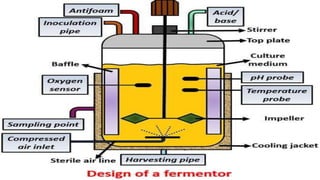
• A bioreactor is a device that consists of various features such
as an agitator system, an oxygen delivery system, a foam
control system, and a variety of other systems such as
temperature & pH control system, sampling ports, cleaning, and
sterilization system, and lines for charging & emptying the
reactor.
• The material used for the construction of a bioreactor must have
the following important properties:
• It should not be corrosive.
• It should not add any toxic substances to the fermentation media.
• It should tolerate the steam sterilization process.
• It should be able to tolerate high pressure and resist pH changes.
• The sizes of the bioreactor vary widely depending on the
application.
• Some bioreactors are designed for small-scale fermenters and
some for large-scale industrial applications from the microbial
cell (few mm3) to shake flask (100-1000 ml) to the laboratory-
scale fermenter (1 – 50 L) to pilot level (0.3 – 10 m3) to plant
scale (2 – 500 m3) for large volume).
Bioreactor Principle
• The bioreactor is the heart of any biochemical process as it
provides an environment for microorganisms to obtain optimal
growth and produce metabolites for the biotransformation and
bioconversion of substrates into desirable products.
• The reactors can be engineered or manufactured based on the
growth requirements of the organisms used.
• Reactors are machines that can be made to transform
biological-based materials into desirable products.
• They can be used for the production of various enzymes and
other bio-catalysis processes.
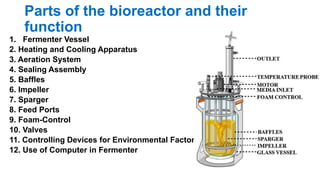
Parts of the bioreactor and their
function
1. Fermenter Vessel
2. Heating and Cooling Apparatus
3. Aeration System
4. Sealing Assembly
5. Baffles
6. Impeller
7. Sparger
8. Feed Ports
9. Foam-Control
10. Valves
11. Controlling Devices for Environmental Factors
12. Use of Computer in Fermenter
Types of bioreactor
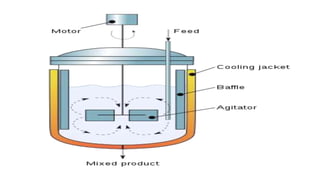
1. Continuous stirred tank fermentor-
• A continuous stirred tank bioreactor is made up of a cylindrical vessel
with a central shaft controlled by a motor that supports one or more
agitators (impellers).
• The sparger, in combination with impellers (agitators), allows for
improved gas distribution throughout the vessel.
• A stirred tank bioreactor can be operated continuously in the
fermentor, temperature control is effortless, construction is
cheap, easy to operate, resulting in low labor cost,
and it is easy to clean.
• It is the most common type of bioreactor used in the industry.
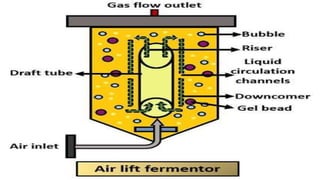
2. Airlift fermentor
• The airlift reactor is generally used for gas-liquid or gas-liquid-solid contact
devices.
• It is also known as a tower reactor.
• A bioreactor using an airlift system divides the fluid volume into two zones
to improve circulation, oxygen transfer, and equalize forces in the reactor.
• In a two-zone system, only one zone is sparged with gas.
• The zone where the gas is sparged is the riser; the zone in which it is not
sparged is the downcomer.
• Airlift bioreactors are used for aerobic bioprocessing technology so that
they can provide a controlled liquid flow in a recycling system using pumps.
• This equipment has several advantages such as its simplicity of design
because it doesn’t contain any moving parts or agitators, its easy
sterilization, its low energy requirements, and its low cost.
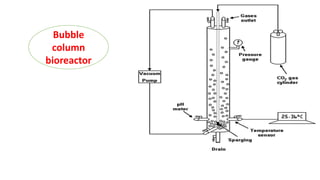
3. Bubble column fermentor
• The bubble column fermentor consists of a cylindrical vessel equipped with
a gas sparger that pushes gas bubbles into a liquid phase or a liquid-solid
suspension.
• The base of the column air or gas is introduced via perforated pipes or
plates, or metal micro porous sparger.
• The rheological properties of the fluid and the gas flow rate have a
significant influence on the mixing of O2 and other performance factors.
• To improve mass transfer and modify the basic design of the vessel, internal
devices such as horizontal perforated plates, vertical baffles, and
corrugated sheet packings placed are in the vessel.
• These reactors are simple in construction, easy maintenance, and have a
low operating cost
• Bubble column reactors are used in biochemical processes such as
fermentation and biological wastewater treatment. It is also used in many
chemical, petrochemical, and biochemical industries.
Bubble
column
bioreactor
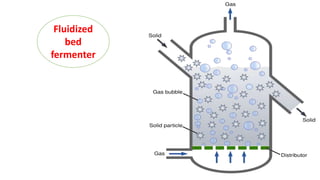
4. Fluidized-bed fermentor
• Fluid bed bioreactors constitute packed beds with smaller particles.
• This prevents problems such as clogging, high liquid pressure drop,
channeling, and bed compaction associated with packed bed reactors.
• Catalyst is laid on the bottom of the reactor and the reactants are pumped
into the reactor through a distributor pump to make the bed fluidized.
• In these reactors, the cells are immobilized small particles which move with
the fluid as a result, mass transfer, oxygen transfer, and nutrition to the cells
are enhanced.
• The bioreactors can be used for reactions involving fluid-suspended
biocatalysts, such as immobilized enzymes, immobilized cells, and
microbial flocs.
• Its main advantages include its ability to maintain even temperatures, easy
replacement and regeneration of the catalyst, continuity, and automaticity of
operation, and reduced contact time between gas and solid, compared to
other catalytic reactors.
Fluidized
bed
fermenter
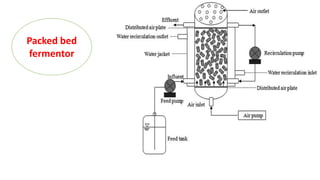
5. Packed bed fermentor
• A packed bed fermentor is a bed of solid particles, having biocatalyst
on or within, the matrix of solids.
• It can either be run in the submerged mode (with or without aeration)
or the trickle flow mode.
• Frequently used in chemical processing processes such as
absorption, distillation, stripping, separation process, and catalytic
reactions, packed bed reactors are also called fixed bed reactors.
• In packed-bed bioreactors, the air is introduced through a sieve that
supports the substrate.
• This reactor has many benefits, like a high conversion rate for the
catalyst, ease of operation, low construction and operation costs,
increased contact between reactant and catalyst, and the ability to
work in high temperatures and pressures.
Packed bed
fermentor
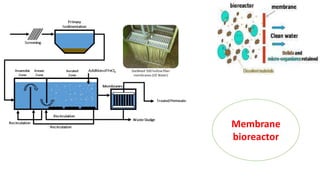
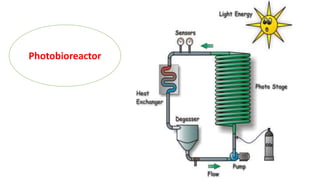
6. Photobioreactor
• A photobioreactor is a specialized unit for fermentation that is either
illuminated by direct sunlight or artificially illuminated.
• They are made up of glass or more commonly transparent plastic
and the tubes or flat panels consist of the light receiving systems.
• In this bioreactor, centrifugal pumps or airlift pumps can be used to
circulate the medium through solar receivers.
• Photo-bioreactors are usually operated in a continuous mode at a
temperature in the range of 25–40 °C.
• Photobioreactors are used for the photosynthetic culture of
microalgae and cyanobacteria to produce products such as
astaxanthin and β-carotene.
Photobioreactor
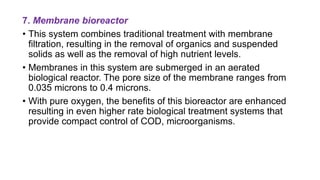
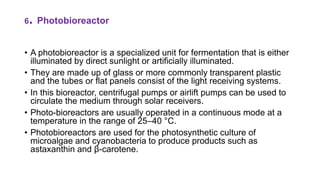
7. Membrane bioreactor
• This system combines traditional treatment with membrane
filtration, resulting in the removal of organics and suspended
solids as well as the removal of high nutrient levels.
• Membranes in this system are submerged in an aerated
biological reactor. The pore size of the membrane ranges from
0.035 microns to 0.4 microns.
• With pure oxygen, the benefits of this bioreactor are enhanced
resulting in even higher rate biological treatment systems that
provide compact control of COD, microorganisms.
Membrane
bioreactor
Thanks

Fermentation in medicinal biotechnology

  • 1.
  • 2.
  • 3.
    INDUSTRIAL FERMENTATION  Itis built on traditional principles but incorporates the most recent advancements in biotechnology and engineering in order to maximize yield at a reduced cost. Types of fermentation: 1- Batch 2- Continuous 3- Fed-batch
  • 4.
    Batch fermentation- • Growinga microorganism in the presence of a fixed amount of substrate and nutrient, added at the beginning of the fermentation process. • Cell growth occurs through typical growth cycles of microorganisms: The lag phase, exponential phase, early stationary phase, and stationary phase of the growth. Disadvantage – low productivity, long turnaround times, required for cleaning and sterilization of the bioreactors.
  • 5.
    Continuous fermentation- • Itoperates fermentation at a specific growth rate of the organism by controlling substrate input and product output rate. Advantage - high productivity Disadvantage - it is more prone to contamination and product recovery could be expensive because of the higher dilution of the product. • Here the substrate is added at an intermittent rate with the withdrawal of the product at the same rate.
  • 6.
    Fed batchformation: It isthe combination of batch and continuous fermentation and the technique is most widely used for industrial purposes. • Fed batch fermentation allows the removal of the by-product at stages when the by-product might be harmful to the bacteria, and this is done at intermittent levels. • Fed batch system is divided into two types SSF(solid state fermentation) SmF(Sub merged fermentation)
  • 7.
    SSF- • Substrates usedare solid compounds such as bran, paper pulp, wheat bran, rice, rice straw, fruit, etc • They are utilized very slowly by bacteria or fungi at a steady rate leading to the controlled release of nutrients. SMF- • Uses free-flowing liquid, such as molasses and both, and is suitable for bacteria that require high water activity. • In this process, the products of interest are secreted into the fermentation broth and purification of the product is easier. • It requires a constant supply of the substrate. • This technique is mostly used to extract secondary metabolites that need to be used in liquid form.
  • 8.
    Stages of fermentation Biotechcompanies use two terms to define the stages of production- 1-Upstream- involves growing microorganisms in the fermenter in the product fermentation. 2-Downstream- Involves product recovery and purification, product concentration, and preparing products for commercialization.
  • 9.
    Bioreactor • A bioreactoris a type of fermentation vessel that is used for the production of various chemicals and biological reactions. • It is a closed container with adequate arrangement for aeration, agitation, temperature and pH control, and drain or overflow vent to remove the waste biomass of cultured microorganisms along with their products.
  • 10.
    A bioreactor shouldprovide for the following: 1.Agitation (for mixing of cells and medium), 2.Aeration (aerobic fermentors); for O2 supply, 3.Regulation of factors like temperature, pH, pressure, aeration, nutrient feeding, and liquid leveled. 4.Sterilization and maintenance of sterility, and 5.Withdrawal of cells/medium
  • 11.
    Bioreactor Design • Thedesign and mode of operation of a bioreactor are based on the production of an organism, optimum conditions required for desired product formation, product value, and its scale of production. • A good bioreactor design will help to improve productivity and provide higher quality products at lower prices. • A bioreactor is a device that consists of various features such as an agitator system, an oxygen delivery system, a foam control system, and a variety of other systems such as temperature & pH control system, sampling ports, cleaning, and sterilization system, and lines for charging & emptying the reactor.
  • 12.
    • The materialused for the construction of a bioreactor must have the following important properties: • It should not be corrosive. • It should not add any toxic substances to the fermentation media. • It should tolerate the steam sterilization process. • It should be able to tolerate high pressure and resist pH changes. • The sizes of the bioreactor vary widely depending on the application. • Some bioreactors are designed for small-scale fermenters and some for large-scale industrial applications from the microbial cell (few mm3) to shake flask (100-1000 ml) to the laboratory- scale fermenter (1 – 50 L) to pilot level (0.3 – 10 m3) to plant scale (2 – 500 m3) for large volume).
  • 13.
    Bioreactor Principle • Thebioreactor is the heart of any biochemical process as it provides an environment for microorganisms to obtain optimal growth and produce metabolites for the biotransformation and bioconversion of substrates into desirable products. • The reactors can be engineered or manufactured based on the growth requirements of the organisms used. • Reactors are machines that can be made to transform biological-based materials into desirable products. • They can be used for the production of various enzymes and other bio-catalysis processes.
  • 14.
    Parts of thebioreactor and their function 1. Fermenter Vessel 2. Heating and Cooling Apparatus 3. Aeration System 4. Sealing Assembly 5. Baffles 6. Impeller 7. Sparger 8. Feed Ports 9. Foam-Control 10. Valves 11. Controlling Devices for Environmental Factors 12. Use of Computer in Fermenter
  • 16.
    Types of bioreactor 1.Continuous stirred tank fermentor- • A continuous stirred tank bioreactor is made up of a cylindrical vessel with a central shaft controlled by a motor that supports one or more agitators (impellers). • The sparger, in combination with impellers (agitators), allows for improved gas distribution throughout the vessel. • A stirred tank bioreactor can be operated continuously in the fermentor, temperature control is effortless, construction is cheap, easy to operate, resulting in low labor cost, and it is easy to clean. • It is the most common type of bioreactor used in the industry.
  • 18.
    2. Airlift fermentor •The airlift reactor is generally used for gas-liquid or gas-liquid-solid contact devices. • It is also known as a tower reactor. • A bioreactor using an airlift system divides the fluid volume into two zones to improve circulation, oxygen transfer, and equalize forces in the reactor. • In a two-zone system, only one zone is sparged with gas. • The zone where the gas is sparged is the riser; the zone in which it is not sparged is the downcomer. • Airlift bioreactors are used for aerobic bioprocessing technology so that they can provide a controlled liquid flow in a recycling system using pumps. • This equipment has several advantages such as its simplicity of design because it doesn’t contain any moving parts or agitators, its easy sterilization, its low energy requirements, and its low cost.
  • 20.
    3. Bubble columnfermentor • The bubble column fermentor consists of a cylindrical vessel equipped with a gas sparger that pushes gas bubbles into a liquid phase or a liquid-solid suspension. • The base of the column air or gas is introduced via perforated pipes or plates, or metal micro porous sparger. • The rheological properties of the fluid and the gas flow rate have a significant influence on the mixing of O2 and other performance factors. • To improve mass transfer and modify the basic design of the vessel, internal devices such as horizontal perforated plates, vertical baffles, and corrugated sheet packings placed are in the vessel. • These reactors are simple in construction, easy maintenance, and have a low operating cost • Bubble column reactors are used in biochemical processes such as fermentation and biological wastewater treatment. It is also used in many chemical, petrochemical, and biochemical industries.
  • 21.
  • 22.
    4. Fluidized-bed fermentor •Fluid bed bioreactors constitute packed beds with smaller particles. • This prevents problems such as clogging, high liquid pressure drop, channeling, and bed compaction associated with packed bed reactors. • Catalyst is laid on the bottom of the reactor and the reactants are pumped into the reactor through a distributor pump to make the bed fluidized. • In these reactors, the cells are immobilized small particles which move with the fluid as a result, mass transfer, oxygen transfer, and nutrition to the cells are enhanced. • The bioreactors can be used for reactions involving fluid-suspended biocatalysts, such as immobilized enzymes, immobilized cells, and microbial flocs. • Its main advantages include its ability to maintain even temperatures, easy replacement and regeneration of the catalyst, continuity, and automaticity of operation, and reduced contact time between gas and solid, compared to other catalytic reactors.
  • 23.
  • 24.
    5. Packed bedfermentor • A packed bed fermentor is a bed of solid particles, having biocatalyst on or within, the matrix of solids. • It can either be run in the submerged mode (with or without aeration) or the trickle flow mode. • Frequently used in chemical processing processes such as absorption, distillation, stripping, separation process, and catalytic reactions, packed bed reactors are also called fixed bed reactors. • In packed-bed bioreactors, the air is introduced through a sieve that supports the substrate. • This reactor has many benefits, like a high conversion rate for the catalyst, ease of operation, low construction and operation costs, increased contact between reactant and catalyst, and the ability to work in high temperatures and pressures.
  • 25.
  • 26.
    6. Photobioreactor • Aphotobioreactor is a specialized unit for fermentation that is either illuminated by direct sunlight or artificially illuminated. • They are made up of glass or more commonly transparent plastic and the tubes or flat panels consist of the light receiving systems. • In this bioreactor, centrifugal pumps or airlift pumps can be used to circulate the medium through solar receivers. • Photo-bioreactors are usually operated in a continuous mode at a temperature in the range of 25–40 °C. • Photobioreactors are used for the photosynthetic culture of microalgae and cyanobacteria to produce products such as astaxanthin and β-carotene.
  • 27.
  • 28.
    7. Membrane bioreactor •This system combines traditional treatment with membrane filtration, resulting in the removal of organics and suspended solids as well as the removal of high nutrient levels. • Membranes in this system are submerged in an aerated biological reactor. The pore size of the membrane ranges from 0.035 microns to 0.4 microns. • With pure oxygen, the benefits of this bioreactor are enhanced resulting in even higher rate biological treatment systems that provide compact control of COD, microorganisms.
  • 29.
  • 30.