
ANIMAL AND PLANT CELL
REACTORS
Presented by,
Erin Davis
REACTORS FOR ANIMAL CELL
Requirements for a bioreactor for animal cell culture
1) well-controlled environment
(Temperature , pH, DO, nutrients, and wastes)
2) supply of nutrients
3) gentle mixing
(avoid shear damage to cells)
4) gentle aeration
(add oxygen slowly to the culture medium, but avoid the
formation of large bubbles which can damage cells on
contact).
5) removal of wastes
o Small volume reactors
T flasks, shaker flasks ( 5 - 25 mL)
o Intermediate scale
Small, highly controlled bioreactors (1 - 5 L)
o Production scale
Large reactors (20 - 1,000 L)
Scale-up
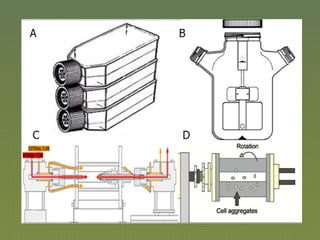
A. Static flasks & roller bottle
B. Spinner flasks
C. Rotary perfusion bioreactor
D. Rotating wall bioreactor
E. Compression bioreactor
Bioreactor for Animal Cell Cultures
Tissue flasks
Easy to use for small
scale
Roller bottles
Good control of gas phase
Labour intensive
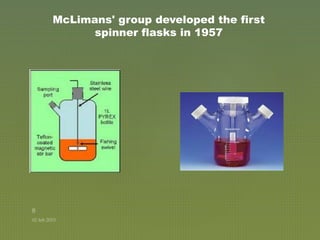
McLimans' group developed the first
spinner flasks in 1957
Spinner flask
Used in tissue engineering
bioprocessing, in particular for cartilage
grown in static medium, even if it is still
too thin for clinical use. Mimic a
traditional stirred tank reactor
Rotating wall bioreactor
The wall of the vessel rotates, providing
an upward hydrodynamic drag force that
balances with the downward gravitational
force, resulting in the scaffold remaining
suspended in the media. As tissue grows
in the bioreactor, the rotational speed
must be increased
Advantages
 Easy
 Visible
 Cheap
 Depyrogenation
feasible
Disadvantages
 Poor aeration
 Impeller jams
 Requires cleaning siliconizing
& sterilization
 High space requirements in
incubator
Spinner Flasks
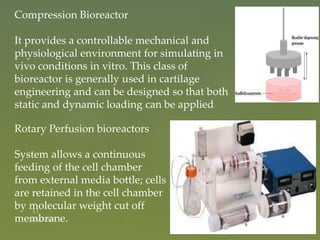
Compression Bioreactor
It provides a controllable mechanical and
physiological environment for simulating in
vivo conditions in vitro. This class of
bioreactor is generally used in cartilage
engineering and can be designed so that both
static and dynamic loading can be applied
Rotary Perfusion bioreactors
System allows a continuous
feeding of the cell chamber
from external media bottle; cells
are retained in the cell chamber
by molecular weight cut off
membrane.
Growth of animal cells in a suspension
Celline bioreactor
• The is a disposable, two compartment cultivation device
suitable for many cell culture applications.
• Example: The production of monoclonal
antibodies on a laboratory scale.
• Efficient cell cultivation is dependent on an optimal supply of
oxygen and nutrients.
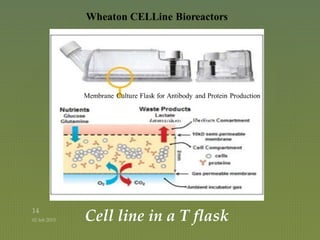
• The two compartment bioreactor is designed by dividing the
bioreactor into a medium compartment and a cell
compartment.
• A semipermeable membrane between the compartments
allows small molecules to diffuse from one compartment to
the other
• Higher molecular weight molecules secreted by the
proliferating cells are retained within the cell compartment.
• The celline is perfectly suited for a wide range of applications
involving suspension cell culture, like monoclonal antibody
production or long term continuous culture maintenance.
Cell line in a T flask
Wheaton CELLine Bioreactors
Micro carrier culture
• Micro carrier cell culture is typically carried out in
spinner flasks , although other vessels such as rotating wall
microgravity bioreactors or fluidized bed bioreactors can also
support micro carrier -based cultures.
• Micro carrier culture introduces new possibilities and for the
first time makes possible the practical high yield culture of
anchorage-dependent cells.
• In micro carrier culture cells grow as monolayers on the
surface of small spheres.
• By using micro carriers in simple suspension culture
systems it is possible to achieve yields of several million
cells per millilitre.
Advantages of micro carrier technology
In the vaccine industry include
a. Ease of scale-up
b. Ability to precisely control cell growth conditions in
sophisticated, computer-controlled bioreactors
c. An overall reduction in the floor space and
incubator volume required for a given-sized
manufacturing operation
d. Drastic reduction in technician labour.
REACTORS FOR PLANT CELL
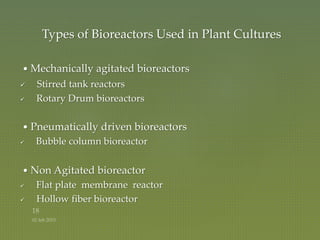
Types of Bioreactors Used in Plant Cultures
• Mechanically agitated bioreactors
 Stirred tank reactors
 Rotary Drum bioreactors
• Pneumatically driven bioreactors
 Bubble column bioreactor
• Non Agitated bioreactor
 Flat plate membrane reactor
 Hollow fiber bioreactor
Advantages
 Versatility
 Multi-gas and pH control
 Increased Capacity
Disadvantages
 Costly
 Size (footprint)/ Weight
 Preparation - siliconizing, cleaning, sterilization, depyrogenation
 Maintenance - Chiller, parts, o-rings
Stirred Tank Bioreactor
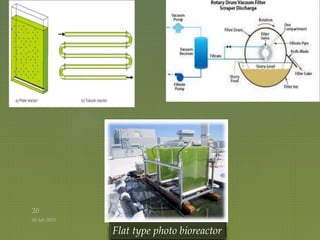
Flat type photo bioreactor
Rotary Drum reactor
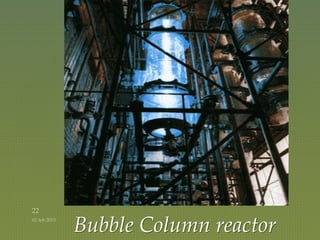
Bubble Column reactor
 Fibers are made of a porous material
 Intraluminal (Cells inside fibers )
 Extra luminal (Cells outside fibers)
 Permits movement of small molecules (O2 ,glucose) , but
not cells
 High cell densities
 Good oxygenation
 Difficult to remove cells
Hollow Fiber Bioreactor
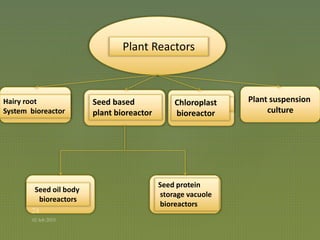
Plant suspension
culture
Plant Reactors
Hairy root
System bioreactor
Seed based
plant bioreactor
Seed oil body
bioreactors
Seed protein
storage vacuole
bioreactors
Chloroplast
bioreactor
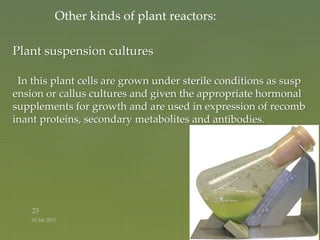
Plant suspension cultures
In this plant cells are grown under sterile conditions as susp
ension or callus cultures and given the appropriate hormonal
supplements for growth and are used in expression of recomb
inant proteins, secondary metabolites and antibodies.
Other kinds of plant reactors:
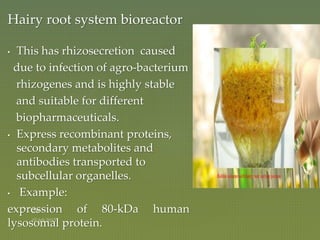
Hairy root system bioreactor
• This has rhizosecretion caused
due to infection of agro-bacterium
rhizogenes and is highly stable
and suitable for different
biopharmaceuticals.
• Express recombinant proteins,
secondary metabolites and
antibodies transported to
subcellular organelles.
• Example:
expression of 80-kDa human
lysosomal protein.
 The nuclear chromosomes of chloroplasts are inserted with
the foreign genes that are responsible for required product.
 Insulin, interferons and other proteins can be prepared.
 Example
High yield in the expression of human serum
albumin protein in chloroplast
Chloroplast bioreactor
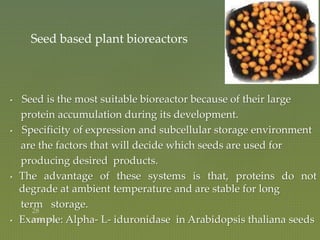
• Seed is the most suitable bioreactor because of their large
protein accumulation during its development.
• Specificity of expression and subcellular storage environment
are the factors that will decide which seeds are used for
producing desired products.
• The advantage of these systems is that, proteins do not
degrade at ambient temperature and are stable for long
term storage.
• Example: Alpha- L- iduronidase in Arabidopsis thaliana seeds
Seed based plant bioreactors
There are two types of seed based plant bioreactors
Seed protein storage vacuole bioreactors
• The protein storage vacuoles in seeds contain some dominant
sub compartments like matrix, globoid and crystalloids
which are best for storing recombinant protein.
• Matrix is suitable for soluble storage proteins, globoids
for hydrolytic enzymes and crystalloids for some intrinsic
protein sequences.
 Seed oil body bioreactors
• This bioreactor can store a large amount of
macromolecules.
• It has oleosin proteins which are ideal carriers of
heterologous proteins encircling the seed oil body.
• This also provides recognition signal for lipase binding
during oil mobilization in seedlings.
 Vaccine antigens:
Antigens like Insulin, rotavirus enterotoxin,
anthrax lethal factor, HIV antigen, foot and mouth
disease virus antigen, heat stable toxin have been
produced in plants.
Therapeutic products:
 The first successful production of a functional antibody,
namely a mouse immunoglobulin in plants, was
reported in 1989.
 In 1992, C.J. Amtzen and co workers expressed
hepatitis B surface antigen in tobacco to produce
immunologically active ingredients via genetic engineering
of plants
Products
Nutritional components:
Carotene , Lycopene ,Flavonoid , Nutraceuticals , Fatty acidβ ,
Vitamins , Minerals , Carbohydrates .
Biodegradable plastics:
Poly hydroxy alkanoates : biodegradable polymers which
occur naturally in plants. Plant was engineered to produce
PHAs or PHBs in the various plant cell compartments.
Thank You

An overview of the animal & plant cell reactors used in laboratories

  • 1.
    ANIMAL AND PLANTCELL REACTORS Presented by, Erin Davis
  • 2.
  • 3.
    Requirements for abioreactor for animal cell culture 1) well-controlled environment (Temperature , pH, DO, nutrients, and wastes) 2) supply of nutrients 3) gentle mixing (avoid shear damage to cells) 4) gentle aeration (add oxygen slowly to the culture medium, but avoid the formation of large bubbles which can damage cells on contact). 5) removal of wastes
  • 4.
    o Small volumereactors T flasks, shaker flasks ( 5 - 25 mL) o Intermediate scale Small, highly controlled bioreactors (1 - 5 L) o Production scale Large reactors (20 - 1,000 L) Scale-up
  • 5.
    A. Static flasks& roller bottle B. Spinner flasks C. Rotary perfusion bioreactor D. Rotating wall bioreactor E. Compression bioreactor Bioreactor for Animal Cell Cultures
  • 7.
    Tissue flasks Easy touse for small scale Roller bottles Good control of gas phase Labour intensive
  • 8.
    McLimans' group developedthe first spinner flasks in 1957
  • 9.
    Spinner flask Used intissue engineering bioprocessing, in particular for cartilage grown in static medium, even if it is still too thin for clinical use. Mimic a traditional stirred tank reactor Rotating wall bioreactor The wall of the vessel rotates, providing an upward hydrodynamic drag force that balances with the downward gravitational force, resulting in the scaffold remaining suspended in the media. As tissue grows in the bioreactor, the rotational speed must be increased
  • 10.
    Advantages  Easy  Visible Cheap  Depyrogenation feasible Disadvantages  Poor aeration  Impeller jams  Requires cleaning siliconizing & sterilization  High space requirements in incubator Spinner Flasks
  • 11.
    Compression Bioreactor It providesa controllable mechanical and physiological environment for simulating in vivo conditions in vitro. This class of bioreactor is generally used in cartilage engineering and can be designed so that both static and dynamic loading can be applied Rotary Perfusion bioreactors System allows a continuous feeding of the cell chamber from external media bottle; cells are retained in the cell chamber by molecular weight cut off membrane.
  • 12.
    Growth of animalcells in a suspension Celline bioreactor • The is a disposable, two compartment cultivation device suitable for many cell culture applications. • Example: The production of monoclonal antibodies on a laboratory scale. • Efficient cell cultivation is dependent on an optimal supply of oxygen and nutrients.
  • 13.
    • The twocompartment bioreactor is designed by dividing the bioreactor into a medium compartment and a cell compartment. • A semipermeable membrane between the compartments allows small molecules to diffuse from one compartment to the other • Higher molecular weight molecules secreted by the proliferating cells are retained within the cell compartment. • The celline is perfectly suited for a wide range of applications involving suspension cell culture, like monoclonal antibody production or long term continuous culture maintenance.
  • 14.
    Cell line ina T flask Wheaton CELLine Bioreactors
  • 15.
    Micro carrier culture •Micro carrier cell culture is typically carried out in spinner flasks , although other vessels such as rotating wall microgravity bioreactors or fluidized bed bioreactors can also support micro carrier -based cultures. • Micro carrier culture introduces new possibilities and for the first time makes possible the practical high yield culture of anchorage-dependent cells. • In micro carrier culture cells grow as monolayers on the surface of small spheres. • By using micro carriers in simple suspension culture systems it is possible to achieve yields of several million cells per millilitre.
  • 16.
    Advantages of microcarrier technology In the vaccine industry include a. Ease of scale-up b. Ability to precisely control cell growth conditions in sophisticated, computer-controlled bioreactors c. An overall reduction in the floor space and incubator volume required for a given-sized manufacturing operation d. Drastic reduction in technician labour.
  • 17.
  • 18.
    Types of BioreactorsUsed in Plant Cultures • Mechanically agitated bioreactors  Stirred tank reactors  Rotary Drum bioreactors • Pneumatically driven bioreactors  Bubble column bioreactor • Non Agitated bioreactor  Flat plate membrane reactor  Hollow fiber bioreactor
  • 19.
    Advantages  Versatility  Multi-gasand pH control  Increased Capacity Disadvantages  Costly  Size (footprint)/ Weight  Preparation - siliconizing, cleaning, sterilization, depyrogenation  Maintenance - Chiller, parts, o-rings Stirred Tank Bioreactor
  • 20.
    Flat type photobioreactor
  • 21.
  • 22.
  • 23.
     Fibers aremade of a porous material  Intraluminal (Cells inside fibers )  Extra luminal (Cells outside fibers)  Permits movement of small molecules (O2 ,glucose) , but not cells  High cell densities  Good oxygenation  Difficult to remove cells Hollow Fiber Bioreactor
  • 24.
    Plant suspension culture Plant Reactors Hairyroot System bioreactor Seed based plant bioreactor Seed oil body bioreactors Seed protein storage vacuole bioreactors Chloroplast bioreactor
  • 25.
    Plant suspension cultures Inthis plant cells are grown under sterile conditions as susp ension or callus cultures and given the appropriate hormonal supplements for growth and are used in expression of recomb inant proteins, secondary metabolites and antibodies. Other kinds of plant reactors:
  • 26.
    Hairy root systembioreactor • This has rhizosecretion caused due to infection of agro-bacterium rhizogenes and is highly stable and suitable for different biopharmaceuticals. • Express recombinant proteins, secondary metabolites and antibodies transported to subcellular organelles. • Example: expression of 80-kDa human lysosomal protein.
  • 27.
     The nuclearchromosomes of chloroplasts are inserted with the foreign genes that are responsible for required product.  Insulin, interferons and other proteins can be prepared.  Example High yield in the expression of human serum albumin protein in chloroplast Chloroplast bioreactor
  • 28.
    • Seed isthe most suitable bioreactor because of their large protein accumulation during its development. • Specificity of expression and subcellular storage environment are the factors that will decide which seeds are used for producing desired products. • The advantage of these systems is that, proteins do not degrade at ambient temperature and are stable for long term storage. • Example: Alpha- L- iduronidase in Arabidopsis thaliana seeds Seed based plant bioreactors
  • 29.
    There are twotypes of seed based plant bioreactors Seed protein storage vacuole bioreactors • The protein storage vacuoles in seeds contain some dominant sub compartments like matrix, globoid and crystalloids which are best for storing recombinant protein. • Matrix is suitable for soluble storage proteins, globoids for hydrolytic enzymes and crystalloids for some intrinsic protein sequences.
  • 30.
     Seed oilbody bioreactors • This bioreactor can store a large amount of macromolecules. • It has oleosin proteins which are ideal carriers of heterologous proteins encircling the seed oil body. • This also provides recognition signal for lipase binding during oil mobilization in seedlings.
  • 31.
     Vaccine antigens: Antigenslike Insulin, rotavirus enterotoxin, anthrax lethal factor, HIV antigen, foot and mouth disease virus antigen, heat stable toxin have been produced in plants. Therapeutic products:  The first successful production of a functional antibody, namely a mouse immunoglobulin in plants, was reported in 1989.  In 1992, C.J. Amtzen and co workers expressed hepatitis B surface antigen in tobacco to produce immunologically active ingredients via genetic engineering of plants Products
  • 32.
    Nutritional components: Carotene ,Lycopene ,Flavonoid , Nutraceuticals , Fatty acidβ , Vitamins , Minerals , Carbohydrates . Biodegradable plastics: Poly hydroxy alkanoates : biodegradable polymers which occur naturally in plants. Plant was engineered to produce PHAs or PHBs in the various plant cell compartments.
  • 33.