
نام استاد: 
جناب آقاي دكتر كرمانشاه 
نام دانشجويان: 
سيد محمد نيك سرشت 
مينو ميرحسيني
FEDEX 
 Inception: 1973 
 Federal express corporation (Fedex) 
 Transformation: 
 from an express delivery company 
 to a global logistics and supply-chain 
management company
RESOURCES OR MARKET? 
 Investing heavily in IT systems 
 Best taking advantage of Internet (from 1994) 
 Investing in systems infrastructure 
 Integrating systems to provide services 
throughout its customers’ supply-chains 
 Spending US $88 million on acquisition of 
Caliber systems, Inc. and building a powerful 
technical architecture. 
 Spending US $100 million on reorganization
THE EXPRESS TRANSPORTATION AND 
LOGISTICS INDUSTRY 
 Start in 1973 
 The main competitor: UPS (1907) 
 Sources of competition: focus on customer 
segmentation, pricing and quality of service 
 Three main trends: 
 The globalization of business 
 Advances in IT 
 Changing market demand for more value added 
services
ADVANCES IN IT 
 Promoted the globalization of commerce 
 Redefined logistics 
 Redesigned warehouses 
 Controlled the storage and movement of 
parts and finished goods
COMPETITION 
 Its next-day delivery service revolutionised the 
distribution industry 
 Reliable over night delivery of time sensitive 
documents 
 Applying IT: 
 First transportation company to launch a website 
 More than 100000 PCs loaded with FedEx software 
 The core corporate strategy: to use IT to help 
costumers take advantage of international markets 
 $10 billion company spending $1 billion annually on IT 
and IT workforce of 5000
EXTERNAL FACTORS 
 Government deregulation of Airline industry 
 Deregulation of trucking industry 
 Trade deregulation in Asia Pacific 
 Technological breakthroughs 
 Rising inflation and global competition
Building the virtual 
information infrastructure 
 COSMOS (customer, operations, 
service, master on-line system): Even 
as early as 1979, a centralized 
computer system kept track of all 
packages handled by the company. 
 Placing bar-code on each parcel at the 
point of pickup and scanning the bar-code 
at each stage of the delivery 
cycle. 
 POWERSHIP program: aimed at 
improving efficiency and control. (a 
technological system in 1984. additional services to 
the customer including storing of frequently used 
addresses, label printing, on-line package pick-up 
requests, package tracking, …)
FedEx took 
advantage of new 
technologies 
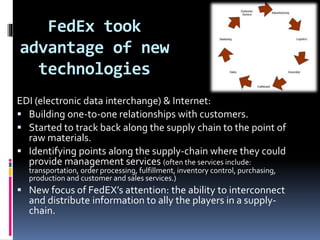
EDI (electronic data interchange) & Internet: 
 Building one-to-one relationships with customers. 
 Started to track back along the supply chain to the point of 
raw materials. 
 Identifying points along the supply-chain where they could 
provide management services (often the services include: 
transportation, order processing, fulfillment, inventory control, purchasing, 
production and customer and sales services.) 
 New focus of FedEX’s attention: the ability to interconnect 
and distribute information to ally the players in a supply-chain.
FedEx took advantage of new 
technologies 
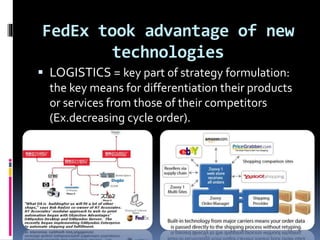
 LOGISTICS = key part of strategy formulation: 
the key means for differentiation their products 
or services from those of their competitors 
(Ex.decreasing cycle order).
FedEx took advantage of new 
technologies 
 FedEx’s role in providing integrated logistics systems 
formed the basis of many partnership arrangements. 
 Helping them to redefine sources and procurement 
strategies so as to link in with other parties in the supply-chain, 
such as raw materials suppliers, customers were 
outsourcing their supply their supply chain management 
functions to FedEx, functions that were seen as 
peripheral to the core of their business. 
 By improving, tightening and synchronizing the various 
parts to the supply-chain, customers saw the benefits of 
squeezing time and inventory out of the system.
Ex. Dell Computers 
 Pioneered the direct selling model in the 
computer industry and succeeded because it was 
able to keep inventory very low (make to order 
vs. make to stock). 
 FedEx provided the system to track and monitor 
the assembly of each PC on order. 
 FedEx was a key partner for Dell, allowing 
customized, built-to-order products to be 
delivered within days of a customer placing an 
order, a huge advantage in an industry whose 
components become obsolete at the rate of two 
per cent per month (IT vs. Inventory).
FedEx took advantage of new 
technologies 
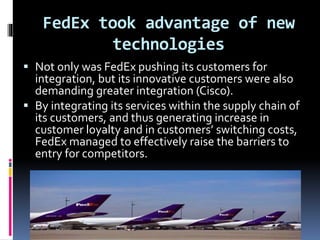
 Not only was FedEx pushing its customers for 
integration, but its innovative customers were also 
demanding greater integration (Cisco). 
 By integrating its services within the supply chain of 
its customers, and thus generating increase in 
customer loyalty and in customers’ switching costs, 
FedEx managed to effectively raise the barriers to 
entry for competitors.
FedEx took advantage of new 
technologies 
 The internet refined the COSMOS system. 
Whenever new information was entered into the 
system by FedEx or by customers through the 
internet, all related files and databases were 
automatically updated. (COSMOS system 
handled 54 million transactions per day in 1999) 
 In 1998 FedEx decided to overhaul its internal IT 
infrastructure under project GRID (global 
resources for information distribution): replacing 
60000 terminals and some PCs with over 75000 
network systems.
Other progresses 
 At the beginning of 1999, FedEx launched 
an enhancement to its package-tracking 
service. Customers could query and receive 
package status information for up to 25 
shipments simultaneously, and forward 
this information on to up to three e-mail 
recipients. 
 In 1999, FedEx signed an agreement with 
Netscape to adopt Netscape software as 
the primary technology for accessing its 
corporate intranet sites. FedEx’s intranet 
included more than 60 Websites, created 
for its end users and in some cases by its 
end users.
Other progresses 
 As well as the data centre in Memphis, FedEx 
operated other centers in Colorado Springs, 
Orlando, Dallas-Fort Worth, Singapore, 
Brussels and Miami. 
 Users in France, Japan, Italy, Germany, 
Netherland and Portuguese and Spanish-speaking 
countries could access this 
information on-line in their native languages 
through www.fedex.com.
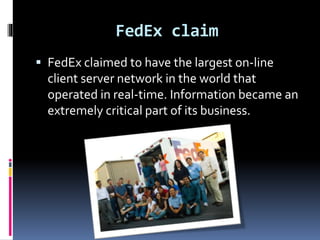
FedEx claim 
 FedEx claimed to have the largest on-line 
client server network in the world that 
operated in real-time. Information became an 
extremely critical part of its business.
BRANDING AND BUSINESS STRUCTURE 
UP UNTIL 19TH JANUARY 2000 
In the first 21 years of business: “Federal Express 
Corporation” 
Its customers came to recognize it as FedEx in short. 
Hence in 1994, it seemed natural that the company 
should change its brand name to “FedEx”.
Branding and business structure 
up until 19th January 2000 
 The Parts Bank 
 Business Logistics Services (BLS): a division of FedEx 
Corporation in 1988 
 FedEx Logistics: 1994 
 FedEx Logistics and Electronic Commerce(FLEC): 
1996
Branding and business structure up 
until 19th January 2000 
 Acquisition of Caliber Systems Inc.: in 1998 
 five separate subsidiary companies: 
 Federal Express 
 RPS 
 Roberts Express 
 Viking Freight 
 FDX Logistics
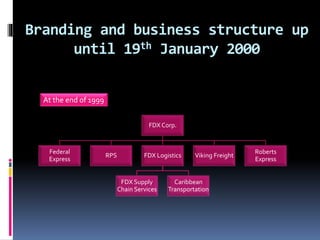
Branding and business structure up 
until 19th January 2000 
FDX Corp. 
Federal 
Express 
RPS FDX Logistics 
FDX Supply 
Chain Services 
Viking Freight 
Caribbean 
Transportation 
Roberts 
Express 
At the end of 1999
Branding and business structure up 
until 19th January 2000 
 The holding company: FDX Corporation 
 The FedEx brand lived on with no advertising 
or promotion of FDX. 
 Five different subsidiary companies with 
completely unrelated names and logos under 
the FDX banner 
 The challenge for FedEx was how to bring the 
companies closer together to create those 
synergies?
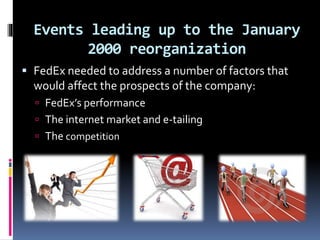
Events leading up to the January 
2000 reorganization 
 FedEx needed to address a number of factors that 
would affect the prospects of the company: 
 FedEx’s performance 
 The internet market and e-tailing 
 The competition
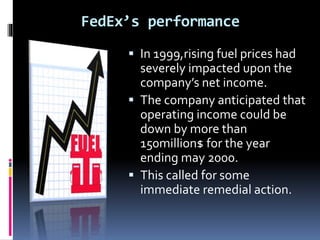
FedEx’s performance 
 In 1999,rising fuel prices had 
severely impacted upon the 
company’s net income. 
 The company anticipated that 
operating income could be 
down by more than 
150million$ for the year 
ending may 2000. 
 This called for some 
immediate remedial action.
The internet market and e-tailing 
 The internet changed the basis for competition 
for most business. Its low cost and diversity of 
applications made it appealing and accessible. 
 The impact of the internet on FedEx was: 
1- it opened up opportunities in logistics management 
for FedEx as businesses were using the internet to 
reengineer their supply-chains. 
2-the express transportation needs associated with the 
growth in e-tailing presented enormous opportunities 
for company.
The competition 
 The industry was loaded with companies that 
provided a myriad of transportation services 
to a wide range of business. 
 Although FedEx pioneered the web based 
package tracking system, such systems 
became the industry norm rather than a 
competitive advantage.
The competition 
 UPS: 
UPS outsourced software developing. 
The company shipped more than 55% of goods 
ordered over the internet and offered over the full 
range of logistics solutions to its customers.
The competition 
 DHL: 
Investing 1.25 billion $ in handling systems, 
automation, facilities and computer technology. 
An increase in worldwide turnover of 18% to 
5.26billion$.
The competition 
 TNT: 
In 1998, TNT launched a web collection facility on the 
internet. Later launched the world’s first global Price 
Checker service on its website. 
In 1999, TNT launched Customized Service 
environment.
The competition 
 While FedEx had pioneered many logistics 
solution that had helped it to achieve 
economies of scale faster than its 
competitors, the advantages were quickly 
eroding as newer technologies became even 
more powerful and less expensive.
The January 2000 announcement 
Three major strategic initiative: 
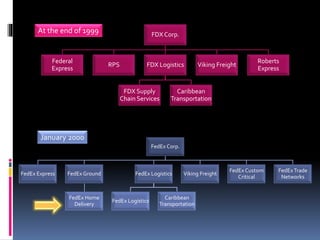
1. A new brand strategy: 
‘FedEx Corporation’ 
 Federal Express  FedEx Express 
 RPS  FedEx Ground 
 Roberts Express  FedEx Custom 
Critical 
 Caliber Logistics  FedEx Logistics 
 Viking Freight
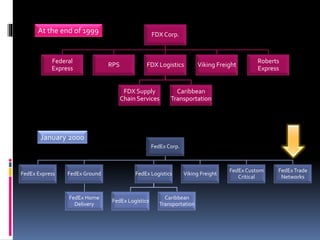
FDX Corp. 
Federal 
Express 
RPS FDX Logistics 
FDX Supply 
Chain Services 
Viking Freight 
Caribbean 
Transportation 
Roberts 
Express 
FedEx Corp. 
FedEx Express FedEx Ground 
FedEx Home 
Delivery 
FedEx Logistics 
FedEx Logistics 
Viking Freight 
Caribbean 
Transportation 
FedEx Custom 
Critical 
FedEx Trade 
Networks 
At the end of 1999 
January 2000
The January 2000 announcement 
2. Major reorganization: 
• Sixth subsidiary (FedEx Corporate Services Corp.): pool 
together the marketing, sales, customer services, 
information technology and electronic commerce 
resources of the Group and combine invoicing function 
for all the companies
The January 2000 announcement 
 Merging of the two logistics operations (Caliber 
Logistics and FLEC) into FedEx Logistics 
 ‘Carrier-agnostic’: FedEx Logistics would use FedEx 
transportation where it fitted, in terms of cost, 
geographic coverage, customer preference and the 
kind of goods being transported 
 Bring together the IT expertise 
and the know-how of the 
logistics business
The January 2000 announcement 
3. Introduction of a new low-cost residential 
delivery service, FedEx Home Delivery, to be 
launched in the US
FDX Corp. 
Federal 
Express 
RPS FDX Logistics 
FDX Supply 
Chain Services 
Viking Freight 
Caribbean 
Transportation 
Roberts 
Express 
FedEx Corp. 
FedEx Express FedEx Ground 
FedEx Home 
Delivery 
FedEx Logistics 
FedEx Logistics 
Viking Freight 
Caribbean 
Transportation 
FedEx Custom 
Critical 
FedEx Trade 
Networks 
At the end of 1999 
January 2000
The January 2000 announcement 
 The Company anticipated having to spend 
US$100 million on these changes over three 
years 
 The competitive advantage of the company 
in the future: collective synergy of solutions
 1. Describe the context of FedEx’s strategy between 
1973 and 2000. What were the circumstances that 
FedEx encountered? 
 2. Describe FedEx’s strategy context between 1973 
and 2000. What were the main characteristics? 
 3. Describe FedEx’s strategy process between 1973 
and 2000. How did FedEx’s strategy come about? 
 4. What are the 5 main strategy issues for FedEx in 
2000? Why? 
 5. Which strategy perspective does FedEx have on 
each of these issues? Did it change over time? What 
is your perspective on each issue?
Fed ex new

Fed ex new

  • 1.
    نام استاد: جنابآقاي دكتر كرمانشاه نام دانشجويان: سيد محمد نيك سرشت مينو ميرحسيني
  • 2.
    FEDEX  Inception:1973  Federal express corporation (Fedex)  Transformation:  from an express delivery company  to a global logistics and supply-chain management company
  • 3.
    RESOURCES OR MARKET?  Investing heavily in IT systems  Best taking advantage of Internet (from 1994)  Investing in systems infrastructure  Integrating systems to provide services throughout its customers’ supply-chains  Spending US $88 million on acquisition of Caliber systems, Inc. and building a powerful technical architecture.  Spending US $100 million on reorganization
  • 4.
    THE EXPRESS TRANSPORTATIONAND LOGISTICS INDUSTRY  Start in 1973  The main competitor: UPS (1907)  Sources of competition: focus on customer segmentation, pricing and quality of service  Three main trends:  The globalization of business  Advances in IT  Changing market demand for more value added services
  • 5.
    ADVANCES IN IT  Promoted the globalization of commerce  Redefined logistics  Redesigned warehouses  Controlled the storage and movement of parts and finished goods
  • 6.
    COMPETITION  Itsnext-day delivery service revolutionised the distribution industry  Reliable over night delivery of time sensitive documents  Applying IT:  First transportation company to launch a website  More than 100000 PCs loaded with FedEx software  The core corporate strategy: to use IT to help costumers take advantage of international markets  $10 billion company spending $1 billion annually on IT and IT workforce of 5000
  • 7.
    EXTERNAL FACTORS Government deregulation of Airline industry  Deregulation of trucking industry  Trade deregulation in Asia Pacific  Technological breakthroughs  Rising inflation and global competition
  • 8.
    Building the virtual information infrastructure  COSMOS (customer, operations, service, master on-line system): Even as early as 1979, a centralized computer system kept track of all packages handled by the company.  Placing bar-code on each parcel at the point of pickup and scanning the bar-code at each stage of the delivery cycle.  POWERSHIP program: aimed at improving efficiency and control. (a technological system in 1984. additional services to the customer including storing of frequently used addresses, label printing, on-line package pick-up requests, package tracking, …)
  • 9.
    FedEx took advantageof new technologies EDI (electronic data interchange) & Internet:  Building one-to-one relationships with customers.  Started to track back along the supply chain to the point of raw materials.  Identifying points along the supply-chain where they could provide management services (often the services include: transportation, order processing, fulfillment, inventory control, purchasing, production and customer and sales services.)  New focus of FedEX’s attention: the ability to interconnect and distribute information to ally the players in a supply-chain.
  • 10.
    FedEx took advantageof new technologies  LOGISTICS = key part of strategy formulation: the key means for differentiation their products or services from those of their competitors (Ex.decreasing cycle order).
  • 11.
    FedEx took advantageof new technologies  FedEx’s role in providing integrated logistics systems formed the basis of many partnership arrangements.  Helping them to redefine sources and procurement strategies so as to link in with other parties in the supply-chain, such as raw materials suppliers, customers were outsourcing their supply their supply chain management functions to FedEx, functions that were seen as peripheral to the core of their business.  By improving, tightening and synchronizing the various parts to the supply-chain, customers saw the benefits of squeezing time and inventory out of the system.
  • 12.
    Ex. Dell Computers  Pioneered the direct selling model in the computer industry and succeeded because it was able to keep inventory very low (make to order vs. make to stock).  FedEx provided the system to track and monitor the assembly of each PC on order.  FedEx was a key partner for Dell, allowing customized, built-to-order products to be delivered within days of a customer placing an order, a huge advantage in an industry whose components become obsolete at the rate of two per cent per month (IT vs. Inventory).
  • 13.
    FedEx took advantageof new technologies  Not only was FedEx pushing its customers for integration, but its innovative customers were also demanding greater integration (Cisco).  By integrating its services within the supply chain of its customers, and thus generating increase in customer loyalty and in customers’ switching costs, FedEx managed to effectively raise the barriers to entry for competitors.
  • 14.
    FedEx took advantageof new technologies  The internet refined the COSMOS system. Whenever new information was entered into the system by FedEx or by customers through the internet, all related files and databases were automatically updated. (COSMOS system handled 54 million transactions per day in 1999)  In 1998 FedEx decided to overhaul its internal IT infrastructure under project GRID (global resources for information distribution): replacing 60000 terminals and some PCs with over 75000 network systems.
  • 15.
    Other progresses At the beginning of 1999, FedEx launched an enhancement to its package-tracking service. Customers could query and receive package status information for up to 25 shipments simultaneously, and forward this information on to up to three e-mail recipients.  In 1999, FedEx signed an agreement with Netscape to adopt Netscape software as the primary technology for accessing its corporate intranet sites. FedEx’s intranet included more than 60 Websites, created for its end users and in some cases by its end users.
  • 16.
    Other progresses As well as the data centre in Memphis, FedEx operated other centers in Colorado Springs, Orlando, Dallas-Fort Worth, Singapore, Brussels and Miami.  Users in France, Japan, Italy, Germany, Netherland and Portuguese and Spanish-speaking countries could access this information on-line in their native languages through www.fedex.com.
  • 17.
    FedEx claim FedEx claimed to have the largest on-line client server network in the world that operated in real-time. Information became an extremely critical part of its business.
  • 18.
    BRANDING AND BUSINESSSTRUCTURE UP UNTIL 19TH JANUARY 2000 In the first 21 years of business: “Federal Express Corporation” Its customers came to recognize it as FedEx in short. Hence in 1994, it seemed natural that the company should change its brand name to “FedEx”.
  • 19.
    Branding and businessstructure up until 19th January 2000  The Parts Bank  Business Logistics Services (BLS): a division of FedEx Corporation in 1988  FedEx Logistics: 1994  FedEx Logistics and Electronic Commerce(FLEC): 1996
  • 20.
    Branding and businessstructure up until 19th January 2000  Acquisition of Caliber Systems Inc.: in 1998  five separate subsidiary companies:  Federal Express  RPS  Roberts Express  Viking Freight  FDX Logistics
  • 21.
    Branding and businessstructure up until 19th January 2000 FDX Corp. Federal Express RPS FDX Logistics FDX Supply Chain Services Viking Freight Caribbean Transportation Roberts Express At the end of 1999
  • 22.
    Branding and businessstructure up until 19th January 2000  The holding company: FDX Corporation  The FedEx brand lived on with no advertising or promotion of FDX.  Five different subsidiary companies with completely unrelated names and logos under the FDX banner  The challenge for FedEx was how to bring the companies closer together to create those synergies?
  • 23.
    Events leading upto the January 2000 reorganization  FedEx needed to address a number of factors that would affect the prospects of the company:  FedEx’s performance  The internet market and e-tailing  The competition
  • 24.
    FedEx’s performance In 1999,rising fuel prices had severely impacted upon the company’s net income.  The company anticipated that operating income could be down by more than 150million$ for the year ending may 2000.  This called for some immediate remedial action.
  • 25.
    The internet marketand e-tailing  The internet changed the basis for competition for most business. Its low cost and diversity of applications made it appealing and accessible.  The impact of the internet on FedEx was: 1- it opened up opportunities in logistics management for FedEx as businesses were using the internet to reengineer their supply-chains. 2-the express transportation needs associated with the growth in e-tailing presented enormous opportunities for company.
  • 26.
    The competition The industry was loaded with companies that provided a myriad of transportation services to a wide range of business.  Although FedEx pioneered the web based package tracking system, such systems became the industry norm rather than a competitive advantage.
  • 27.
    The competition UPS: UPS outsourced software developing. The company shipped more than 55% of goods ordered over the internet and offered over the full range of logistics solutions to its customers.
  • 28.
    The competition DHL: Investing 1.25 billion $ in handling systems, automation, facilities and computer technology. An increase in worldwide turnover of 18% to 5.26billion$.
  • 29.
    The competition TNT: In 1998, TNT launched a web collection facility on the internet. Later launched the world’s first global Price Checker service on its website. In 1999, TNT launched Customized Service environment.
  • 30.
    The competition While FedEx had pioneered many logistics solution that had helped it to achieve economies of scale faster than its competitors, the advantages were quickly eroding as newer technologies became even more powerful and less expensive.
  • 31.
    The January 2000announcement Three major strategic initiative: 1. A new brand strategy: ‘FedEx Corporation’  Federal Express  FedEx Express  RPS  FedEx Ground  Roberts Express  FedEx Custom Critical  Caliber Logistics  FedEx Logistics  Viking Freight
  • 32.
    FDX Corp. Federal Express RPS FDX Logistics FDX Supply Chain Services Viking Freight Caribbean Transportation Roberts Express FedEx Corp. FedEx Express FedEx Ground FedEx Home Delivery FedEx Logistics FedEx Logistics Viking Freight Caribbean Transportation FedEx Custom Critical FedEx Trade Networks At the end of 1999 January 2000
  • 33.
    The January 2000announcement 2. Major reorganization: • Sixth subsidiary (FedEx Corporate Services Corp.): pool together the marketing, sales, customer services, information technology and electronic commerce resources of the Group and combine invoicing function for all the companies
  • 34.
    The January 2000announcement  Merging of the two logistics operations (Caliber Logistics and FLEC) into FedEx Logistics  ‘Carrier-agnostic’: FedEx Logistics would use FedEx transportation where it fitted, in terms of cost, geographic coverage, customer preference and the kind of goods being transported  Bring together the IT expertise and the know-how of the logistics business
  • 35.
    The January 2000announcement 3. Introduction of a new low-cost residential delivery service, FedEx Home Delivery, to be launched in the US
  • 36.
    FDX Corp. Federal Express RPS FDX Logistics FDX Supply Chain Services Viking Freight Caribbean Transportation Roberts Express FedEx Corp. FedEx Express FedEx Ground FedEx Home Delivery FedEx Logistics FedEx Logistics Viking Freight Caribbean Transportation FedEx Custom Critical FedEx Trade Networks At the end of 1999 January 2000
  • 37.
    The January 2000announcement  The Company anticipated having to spend US$100 million on these changes over three years  The competitive advantage of the company in the future: collective synergy of solutions
  • 38.
     1. Describethe context of FedEx’s strategy between 1973 and 2000. What were the circumstances that FedEx encountered?  2. Describe FedEx’s strategy context between 1973 and 2000. What were the main characteristics?  3. Describe FedEx’s strategy process between 1973 and 2000. How did FedEx’s strategy come about?  4. What are the 5 main strategy issues for FedEx in 2000? Why?  5. Which strategy perspective does FedEx have on each of these issues? Did it change over time? What is your perspective on each issue?