THE BATTLE FOR VALUE:
FEDEX CORP. VS. THE UNITED
PARCEL SERVICE, INC.
R. Purwendi Darminto
Dian Atika
Made Sedana Yoga
Ershad Haekal
Magdalena
Taufan Anggi Brata
Agnesia Kharisma
Canggih Sakina Hans
Video FEDEX
Video UPS
The Battle for Value: FedEx vs. UPS
 FedEx will produce superior financial returns
for shareowners by providing high value-
added supply chain, transportation, business,
and related information services through
focused operating companies competing
collectively, and managed collaboratively,
under the respected FedEx brand.
 FedEx Mission Statement
The Battle for Value: FedEx vs. UPS
 We serve the evolving distribution, logistics,
and commerce needs of our customer
worldwide, offering excellence and value in all
we do. We sustain a financially strong
company, with broad employee ownership,
that provides a long-term competitive return to
our shareowners.
 UPS Mission Statement
The Battle for Value: FedEx vs. UPS
 FedEx History
 Business model conceived by Fred Smith in an undergraduate
term paper.
 Invests $4 million of his own capital and raises and addition
$91 million.
 Launches in 1971
 By 2003
 50,000 Delivery Trucks
 625 Cargo Planes
 217,000 Employees
 Handles 2 billion packages
 $22.5 Billion with 37% margins
The Battle for Value: FedEx vs.
UPS
 UPS History
 Started in 1907 by 19 year-old Jim Casey then called American
Messenger Company.
 Became Unite Parcel Service of America in 1929 and began shipping
packages on commercial airliners.
 By 2003
• 88,000 Ground Trucks
• 583 Planes
• 360,000 Employees
• $2.9 Billion in profits on
$33.4 Billion
FedEx UPS
Ground Vehicles 50,000 88,000
Aircraft 625 583
Employees 216,500 360,000
Packages Shipped Daily 5.4 million 13 million
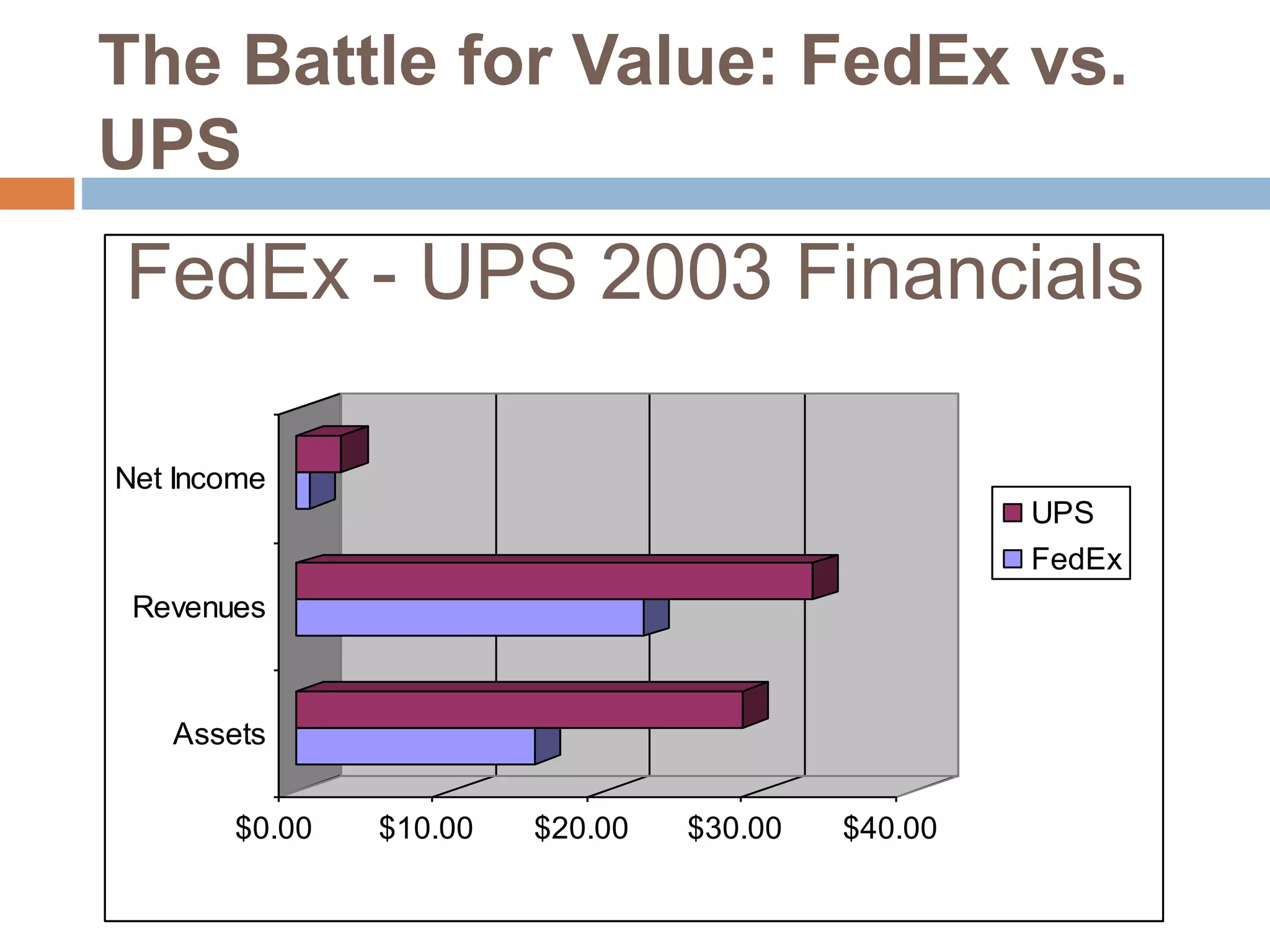
Assets $15.4 billion $28.9 billion
Revenues $22.5 billion $33.4 billion
Net Income $830 million $2.9 billion
Head-to-Head
The Battle for Value, 2005: FedEx vs.
UPS
$0.00 $10.00 $20.00 $30.00 $40.00
Assets
Revenues
Net Income
UPS
FedEx
FedEx - UPS 2003 Financials
The Battle for Value: FedEx vs.
UPS
The Battle for Value: FedEx vs.
UPS
Significant Dimensions of Competition
1) Customer Focus
• Listening carefully to the customer’s need
• Providing customized solution
• Committing to service relationships
2) Price Competition
• Both of firms had settled into a predictable pattern of
regular price increases.
3) Operational Re-engineering
• In order to have a reduction of unit costs, business-process
re-engineering was implemented to squeeze unnecessary
steps and costs out of service.
The Battle for Value: FedEx vs.
UPS
Significant Dimensions of Competition
4) Information Technology
• FedEx use COSMOS (Customer ,Operations, Service, Master On-
line System)
• UPS relied on DIADs ( Delivery Information Acquisition Devices)
5) Service Expansion
• FedEx
armed with volume discounts and superb quality
• UPS
made a customer interfaces by installing 11,500 drop-off boxes
6) Logistic Services
Providing total inventory control of customers, including purchase orders,
receipt of goods, order entry and warehousing, inventory accounting,
shipping, and account receivable.
• The European Market
– In 1992, FedEx sold operations to DHL after
sustaining an estimated $1 Billion in losses since
1984.
– FedEx continues to deliver throughout Europe,
however, leveraging local partners.
– UPS enters the European market place in 1988.
– Acquires 10 local providers.
– Announces $1 Billion of investments in that market
– Targets to grow European business to 1/3 of total
operations.
The Battle for Value: FedEx vs.
UPS
• The Breaking Into China
– Economist suggest China will be the worlds largest
economy by 2039.
– Chinese air cargo is growing at a steady rate of 30%.
– Import/Export shipping market is estimated at $1
Billion.
– Intra-China Shipping estimated at $800 Million.
– In 2004, the US and China strike an new
transportation accord.
• Five times the number of in/outbound flights
• Permitted to establish hubs
• Access to all airports
The Battle for Value: FedEx vs. UPS
2005
• The Breaking Into China (cont.)
– FedEx and UPS already serving China
– FedEx maintained a larger presence in China
• Direct flights to Beijing, Shenzhen, and Shanghai
• 11 weekly flights, twice as many as UPS
• Served 220 Chinese cities.
• FedEx volumes grew by more that 50% between 2003 and
2004
– UPS was active in China since 1988
• Direct flights to Beijing and Shanghai
• 6 weekly 747 flights
• Served 200 Chinese cities
• UPS reported 60% growth in shipments
since 2001.
The Battle for Value: FedEx vs. UPS
2005
Timeline of Competitive Developments
1982 2003
1982
Offers 10:30 AM delivery
1982
Establishes next-day air service
1984
Acquires Gelco International,
launches Asia-Pacific operations
1986
handheld barcode scanner
1985
European hub in Brussels
1987
Warehouse services to IBM
1988
UPS's first air fleet
1989
Acquires Tiger International
1990
Malcolm Balbridge Award
1990
Offers 10:30 AM guarantee
for next-day air
1991
Saturday delivery,
Electronic sign. tracking
1992
2-day delivery
1992
Expands delivery
to 200 countries
1994
Website for package tracking
1994
Website for
package tracking
1995
Guaranteed 8 A.M.
overnight delivery
1995
Acquires air-routes serving China,
Establishes Latin America Div.
1999
UPS IPO
1999
Creates new hub at
CDG Airport in Paris
2000
Acquires all-cargo air service
in Latin America
2001
Acquires Mail Boxes Etc.,
begins direct flights to China
1985
Intercontinental air service
between US and Europe
2000
B2C home-delivery service
2001
Carries USPS packages,
Acquires American
Freightway Corp.
2002
Home delivery to
cover 100% of U.S.
2002
Guaranteed
next-day delivery
2003
Acquires Kinko's,
establishes
Chinese headquarters
2003
Contracts with
Yangtze River Express,
Reduces
ground-delivery time
2003
Return on Assets
The higher the return the better the profit performance for
the company
Formula:
Net Income / (Fixed Assets + Net Working Capital)
UPS gain higher ROA in the recent years
ROA
2003
Return on equity
measures the rate of return on the ownership interest of the common
stock owners.It measures a firm's efficiency at generating profits
from every unit of shareholders' equity. ROE shows how well a
company uses investment funds to generate earnings growth
ROE at 15%-20% considered as good.
UPS gain better ROE in the recent years
ROE
WACC
A company’s assets are financed by either debt or equity, as an
increase in WACC notes a decrease in valuation and a higher risk.
Formula
WACC = [Kd(1-t) x D/(D+E)] + [Ke x E/(D+E)]
UPS gain lower WACC in the recent years
WACC
Economic Value Added:
A measure of a company's financial performance based on the residual wealth
calculated by deducting cost of capital from its operating profit (adjusted for taxes on a
cash basis). (Also referred to as "economic profit".)
Formula
EVA = Net Operating Profit After Taxes (NOPAT) - (Capital * Cost of Capital)
UPS gain higher EVA in recent year
EVA (Annual)
Market Value Added:
The higher the MVA, the better. A high MVA indicates the company has created
substantial wealth for the shareholders. A negative MVA means that the value of
management's actions and investments are less than the value of the capital contributed
to the company by the capital market (or that wealth and value have been destroyed)
Formula: MVA = company’s market value – invested capital
UPS gain higher MVA in recent year so UPS management can create value to the
company more than Fedex
MVA
2003
Net Profit margin
a measure of profitability. A low profit margin indicates a low
margin of safety: higher risk that a decline in sales will erase
profits and result in a net loss, or a negative margin. Profit
margin is an indicator of a company's pricing strategies and
how well it controls costs
Formulas
Net Profit Margin = Net Profit / Revenue
UPS have higher net profit margin so better cost controlling
Net profit Margin
The price of stock of UPS higher than FedEx.
The value of the company also reflect in the price of stock which come from the
performance of the company,.
Stock Price,Dec 31
Dividend Per Share
Dividends are a form of profit distribution to the shareholder. Having
a growing dividend per share can be a sign that the company's
management believes that the growth can be sustained.
Formula
Dividend Per Share = Dividend / No. of Shares
Dividend per share of UPS higher than FedEx with growing rate.
Dividends per share
FedEx 20.25% 87.73% 46.93% 88.04% 157.06% 214.72% 438.04% 248.47% 292.64% 429.57% 528.02%
UPS 12.16% 27.03% 41.89% 58.11% 66.22% 116.22% 646.95% 535.14% 489.19% 581.95% 705.95%
Standard&Poor's 500Index 7.06% 5.41% 41.36% 70.01% 122.72% 182.12% 237.21% 203.02% 163.50% 101.93% 155.20%
Both FedEx and UPS have annual return higher than Standard and Poor’s 500
index but UPS have higher annual return compare to FedEx in recent years.
Annual Return
Company of Excellence
Due to given financial data, UPS tend to have better performance than
FedEx in these following instruments.
 Return on Assets
 Return on Equity
 WACC
 Economic Value Added
 Market Value Added
 Net Profit Margin
All these 6 ratios analysis show the
effectiveness of management in create
the value to the company which will be
shown on Stock Price, Dividend per share
and Annual Return. Dividend depend on
Revenue which show the performance
of company,

The Battle for Value: FedEx vs UPS

  • 1.
    THE BATTLE FORVALUE: FEDEX CORP. VS. THE UNITED PARCEL SERVICE, INC. R. Purwendi Darminto Dian Atika Made Sedana Yoga Ershad Haekal Magdalena Taufan Anggi Brata Agnesia Kharisma Canggih Sakina Hans
  • 2.
  • 3.
  • 4.
    The Battle forValue: FedEx vs. UPS  FedEx will produce superior financial returns for shareowners by providing high value- added supply chain, transportation, business, and related information services through focused operating companies competing collectively, and managed collaboratively, under the respected FedEx brand.  FedEx Mission Statement
  • 5.
    The Battle forValue: FedEx vs. UPS  We serve the evolving distribution, logistics, and commerce needs of our customer worldwide, offering excellence and value in all we do. We sustain a financially strong company, with broad employee ownership, that provides a long-term competitive return to our shareowners.  UPS Mission Statement
  • 6.
    The Battle forValue: FedEx vs. UPS  FedEx History  Business model conceived by Fred Smith in an undergraduate term paper.  Invests $4 million of his own capital and raises and addition $91 million.  Launches in 1971  By 2003  50,000 Delivery Trucks  625 Cargo Planes  217,000 Employees  Handles 2 billion packages  $22.5 Billion with 37% margins
  • 7.
    The Battle forValue: FedEx vs. UPS  UPS History  Started in 1907 by 19 year-old Jim Casey then called American Messenger Company.  Became Unite Parcel Service of America in 1929 and began shipping packages on commercial airliners.  By 2003 • 88,000 Ground Trucks • 583 Planes • 360,000 Employees • $2.9 Billion in profits on $33.4 Billion
  • 8.
    FedEx UPS Ground Vehicles50,000 88,000 Aircraft 625 583 Employees 216,500 360,000 Packages Shipped Daily 5.4 million 13 million Assets $15.4 billion $28.9 billion Revenues $22.5 billion $33.4 billion Net Income $830 million $2.9 billion Head-to-Head The Battle for Value, 2005: FedEx vs. UPS
  • 9.
    $0.00 $10.00 $20.00$30.00 $40.00 Assets Revenues Net Income UPS FedEx FedEx - UPS 2003 Financials The Battle for Value: FedEx vs. UPS
  • 10.
    The Battle forValue: FedEx vs. UPS Significant Dimensions of Competition 1) Customer Focus • Listening carefully to the customer’s need • Providing customized solution • Committing to service relationships 2) Price Competition • Both of firms had settled into a predictable pattern of regular price increases. 3) Operational Re-engineering • In order to have a reduction of unit costs, business-process re-engineering was implemented to squeeze unnecessary steps and costs out of service.
  • 11.
    The Battle forValue: FedEx vs. UPS Significant Dimensions of Competition 4) Information Technology • FedEx use COSMOS (Customer ,Operations, Service, Master On- line System) • UPS relied on DIADs ( Delivery Information Acquisition Devices) 5) Service Expansion • FedEx armed with volume discounts and superb quality • UPS made a customer interfaces by installing 11,500 drop-off boxes 6) Logistic Services Providing total inventory control of customers, including purchase orders, receipt of goods, order entry and warehousing, inventory accounting, shipping, and account receivable.
  • 12.
    • The EuropeanMarket – In 1992, FedEx sold operations to DHL after sustaining an estimated $1 Billion in losses since 1984. – FedEx continues to deliver throughout Europe, however, leveraging local partners. – UPS enters the European market place in 1988. – Acquires 10 local providers. – Announces $1 Billion of investments in that market – Targets to grow European business to 1/3 of total operations. The Battle for Value: FedEx vs. UPS
  • 13.
    • The BreakingInto China – Economist suggest China will be the worlds largest economy by 2039. – Chinese air cargo is growing at a steady rate of 30%. – Import/Export shipping market is estimated at $1 Billion. – Intra-China Shipping estimated at $800 Million. – In 2004, the US and China strike an new transportation accord. • Five times the number of in/outbound flights • Permitted to establish hubs • Access to all airports The Battle for Value: FedEx vs. UPS 2005
  • 14.
    • The BreakingInto China (cont.) – FedEx and UPS already serving China – FedEx maintained a larger presence in China • Direct flights to Beijing, Shenzhen, and Shanghai • 11 weekly flights, twice as many as UPS • Served 220 Chinese cities. • FedEx volumes grew by more that 50% between 2003 and 2004 – UPS was active in China since 1988 • Direct flights to Beijing and Shanghai • 6 weekly 747 flights • Served 200 Chinese cities • UPS reported 60% growth in shipments since 2001. The Battle for Value: FedEx vs. UPS 2005
  • 15.
    Timeline of CompetitiveDevelopments 1982 2003 1982 Offers 10:30 AM delivery 1982 Establishes next-day air service 1984 Acquires Gelco International, launches Asia-Pacific operations 1986 handheld barcode scanner 1985 European hub in Brussels 1987 Warehouse services to IBM 1988 UPS's first air fleet 1989 Acquires Tiger International 1990 Malcolm Balbridge Award 1990 Offers 10:30 AM guarantee for next-day air 1991 Saturday delivery, Electronic sign. tracking 1992 2-day delivery 1992 Expands delivery to 200 countries 1994 Website for package tracking 1994 Website for package tracking 1995 Guaranteed 8 A.M. overnight delivery 1995 Acquires air-routes serving China, Establishes Latin America Div. 1999 UPS IPO 1999 Creates new hub at CDG Airport in Paris 2000 Acquires all-cargo air service in Latin America 2001 Acquires Mail Boxes Etc., begins direct flights to China 1985 Intercontinental air service between US and Europe 2000 B2C home-delivery service 2001 Carries USPS packages, Acquires American Freightway Corp. 2002 Home delivery to cover 100% of U.S. 2002 Guaranteed next-day delivery 2003 Acquires Kinko's, establishes Chinese headquarters 2003 Contracts with Yangtze River Express, Reduces ground-delivery time
  • 16.
    2003 Return on Assets Thehigher the return the better the profit performance for the company Formula: Net Income / (Fixed Assets + Net Working Capital) UPS gain higher ROA in the recent years ROA
  • 17.
    2003 Return on equity measuresthe rate of return on the ownership interest of the common stock owners.It measures a firm's efficiency at generating profits from every unit of shareholders' equity. ROE shows how well a company uses investment funds to generate earnings growth ROE at 15%-20% considered as good. UPS gain better ROE in the recent years ROE
  • 18.
    WACC A company’s assetsare financed by either debt or equity, as an increase in WACC notes a decrease in valuation and a higher risk. Formula WACC = [Kd(1-t) x D/(D+E)] + [Ke x E/(D+E)] UPS gain lower WACC in the recent years WACC
  • 19.
    Economic Value Added: Ameasure of a company's financial performance based on the residual wealth calculated by deducting cost of capital from its operating profit (adjusted for taxes on a cash basis). (Also referred to as "economic profit".) Formula EVA = Net Operating Profit After Taxes (NOPAT) - (Capital * Cost of Capital) UPS gain higher EVA in recent year EVA (Annual)
  • 20.
    Market Value Added: Thehigher the MVA, the better. A high MVA indicates the company has created substantial wealth for the shareholders. A negative MVA means that the value of management's actions and investments are less than the value of the capital contributed to the company by the capital market (or that wealth and value have been destroyed) Formula: MVA = company’s market value – invested capital UPS gain higher MVA in recent year so UPS management can create value to the company more than Fedex MVA
  • 21.
    2003 Net Profit margin ameasure of profitability. A low profit margin indicates a low margin of safety: higher risk that a decline in sales will erase profits and result in a net loss, or a negative margin. Profit margin is an indicator of a company's pricing strategies and how well it controls costs Formulas Net Profit Margin = Net Profit / Revenue UPS have higher net profit margin so better cost controlling Net profit Margin
  • 22.
    The price ofstock of UPS higher than FedEx. The value of the company also reflect in the price of stock which come from the performance of the company,. Stock Price,Dec 31
  • 23.
    Dividend Per Share Dividendsare a form of profit distribution to the shareholder. Having a growing dividend per share can be a sign that the company's management believes that the growth can be sustained. Formula Dividend Per Share = Dividend / No. of Shares Dividend per share of UPS higher than FedEx with growing rate. Dividends per share
  • 24.
    FedEx 20.25% 87.73%46.93% 88.04% 157.06% 214.72% 438.04% 248.47% 292.64% 429.57% 528.02% UPS 12.16% 27.03% 41.89% 58.11% 66.22% 116.22% 646.95% 535.14% 489.19% 581.95% 705.95% Standard&Poor's 500Index 7.06% 5.41% 41.36% 70.01% 122.72% 182.12% 237.21% 203.02% 163.50% 101.93% 155.20% Both FedEx and UPS have annual return higher than Standard and Poor’s 500 index but UPS have higher annual return compare to FedEx in recent years. Annual Return
  • 25.
    Company of Excellence Dueto given financial data, UPS tend to have better performance than FedEx in these following instruments.  Return on Assets  Return on Equity  WACC  Economic Value Added  Market Value Added  Net Profit Margin All these 6 ratios analysis show the effectiveness of management in create the value to the company which will be shown on Stock Price, Dividend per share and Annual Return. Dividend depend on Revenue which show the performance of company,