CASE STUDY
ANALYSIS
20121072 Sandra Obiora
20121543 Dilara Rasulova
20121789 Mwangala Mulamata
ABOUT UPS
• ‘UPS’ stands for United Parcel Service.
• Founded 1907 after James Casey and Claude Ryan recognized the
need for private messenger and delivery services.
• By 1930, UPS extended its services to the East coast of the US.
• By 1953 UPS resumed its air operations.
• By 1993 UPS saw delivery increase at 11.5 million packages a day.
• Between 2010 and current day, UPS has acquired more than 40
companies, and is a leader in freight, retail shipping, finance and
trade services.
2
SUMMARY OF CASE STUDY
• Its aim is “best service and lowest
rates”.
• Has over 400 000 employees.
• Delivers 15.6 packages/ day.
• FedEX and other air borne express
count as main competition.
• UPS spends over $1 b/ year to
maintain high level customer
service.
• Uses DIAD, Automated package
tracking, functional websites, traffic
trackers, Web based post sales post
technologies among others.
• Now leverages its logistics expertise
for other companies.
• Also focus on medical supplies,
aerospace, high tech equipment
deliveries.
• Runs quality inspections on all parts.
3
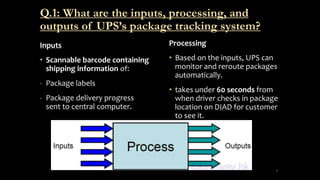
Q.1: What are the inputs, processing, and
outputs of UPS’s package tracking system?
Inputs
• Scannable barcode containing
shipping information of:
- Package labels
- Package delivery progress
sent to central computer.
Processing
• Based on the inputs, UPS can
monitor and reroute packages
automatically.
• takes under 60 seconds from
when driver checks in package
location on DIAD for customer
to see it.
4
Q 1: Continued
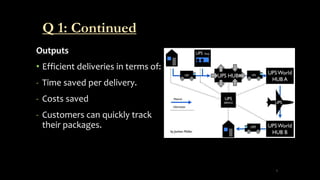
Outputs
• Efficient deliveries in terms of:
- Time saved per delivery.
- Costs saved
- Customers can quickly track
their packages.
5
2: What technologies are used by UPS? How
are these related to UPS’s business strategy?
UPS’s technologies include
• DIAD (Delivery Info.
Acquisition Device).
• Software for creating efficient
delivery routes.
• Label scanner, download, and
print software.
• Automated package tracking
system.
• UPS mobile app for smart
phones.
• Cisco system with tools for
UPS customers to make
shipment tracking and cost
calculations.
• Web based post sales order
management system.
6
2: What technologies are used by UPS? How
are these related to UPS’s business strategy?
According to UPS’s official website:
The UPS vision is guided by four transformative strategies:
• Deploying technology-enabled operations.
• Providing unique and industry-specific customer solutions.
• Expanding our global network.
• Serving the needs of end consumers around the world.
"Corporate Profile." UPS Investor Relations, n.d. Web. <http://www.investors.ups.com/phoenix.zhtml?c=62900&p=irol-
homeprofile>.
7
3: What Strategic business objectives do
UPS’s information Systems address?
UPS’s overall strategic aim is
to:
- Deliver the ‘Best service, at
the lowest rates.’
• Strategic business objectives
normally involve:
- Saving cost
- To improve service quality.
- And Increasing level of
output.
• UPS info. Systems address
these issues:
• Saving cost by using the
Special software:
- Saves 28 million miles/ year.
- Save 3 million of fuel/ year.
8
How much UPS really saves
• With Gas in US. Being $2.74/ Gallon.
If they save 3 000 000 gallons, they
actually save
$2.74 x 3 000 000 gallons
= $8, 220, 000/ Year.
• For Turkey it will be:
$6.67 x 3 000 000 = $20, 010, 000/ year
And when converted is
57, 978, 099 Turkish Lira
9
4: What would happen if UPS’s information
systems were not available?
If UPS’s info systems were
unavailable, the following will
occur:
• All round costs will increase.
• Customer loyalty will decrease
due to inefficient deliveries.
• Their company image will get
ruined.
• UPS offices will be jam-packed
with impatient customers.
• They will lose customers to their
competition.
• Decreased productivity of staff
and employees. (e.g. traffic
situations.)
• Will be overpowered by
competitors and other
airborne express such as
FedEX, DHL who are starting to
employ innovation and
different information
technologies.
10
Conclusion
• UPS’s strategic aim "best service and lowest rates”.
• Its information Technologies have a direct relationship to its
efficiency.
• We understand efficiency to be the least input for the most output
level.
• A lot of cost is saved through its fast information technology
system.
• Its usage improves their company image.
• And the speed improves customer loyalty.
11
Bibliography
• N.p., n.d. Web. <http://www.ups.com/content/corp/about/history/>.
• "Corporate Profile." UPS Investor Relations, n.d. Web.
<http://www.investors.ups.com/phoenix.zhtml?c=62900&p=irol-homeprofile>.
12
ANY QUESTIONS OR CONTRIBUTIONS?
13
THANK YOU FOR LISTENING 
14

UPS case study analysis

  • 1.
    CASE STUDY ANALYSIS 20121072 SandraObiora 20121543 Dilara Rasulova 20121789 Mwangala Mulamata
  • 2.
    ABOUT UPS • ‘UPS’stands for United Parcel Service. • Founded 1907 after James Casey and Claude Ryan recognized the need for private messenger and delivery services. • By 1930, UPS extended its services to the East coast of the US. • By 1953 UPS resumed its air operations. • By 1993 UPS saw delivery increase at 11.5 million packages a day. • Between 2010 and current day, UPS has acquired more than 40 companies, and is a leader in freight, retail shipping, finance and trade services. 2
  • 3.
    SUMMARY OF CASESTUDY • Its aim is “best service and lowest rates”. • Has over 400 000 employees. • Delivers 15.6 packages/ day. • FedEX and other air borne express count as main competition. • UPS spends over $1 b/ year to maintain high level customer service. • Uses DIAD, Automated package tracking, functional websites, traffic trackers, Web based post sales post technologies among others. • Now leverages its logistics expertise for other companies. • Also focus on medical supplies, aerospace, high tech equipment deliveries. • Runs quality inspections on all parts. 3
  • 4.
    Q.1: What arethe inputs, processing, and outputs of UPS’s package tracking system? Inputs • Scannable barcode containing shipping information of: - Package labels - Package delivery progress sent to central computer. Processing • Based on the inputs, UPS can monitor and reroute packages automatically. • takes under 60 seconds from when driver checks in package location on DIAD for customer to see it. 4
  • 5.
    Q 1: Continued Outputs •Efficient deliveries in terms of: - Time saved per delivery. - Costs saved - Customers can quickly track their packages. 5
  • 6.
    2: What technologiesare used by UPS? How are these related to UPS’s business strategy? UPS’s technologies include • DIAD (Delivery Info. Acquisition Device). • Software for creating efficient delivery routes. • Label scanner, download, and print software. • Automated package tracking system. • UPS mobile app for smart phones. • Cisco system with tools for UPS customers to make shipment tracking and cost calculations. • Web based post sales order management system. 6
  • 7.
    2: What technologiesare used by UPS? How are these related to UPS’s business strategy? According to UPS’s official website: The UPS vision is guided by four transformative strategies: • Deploying technology-enabled operations. • Providing unique and industry-specific customer solutions. • Expanding our global network. • Serving the needs of end consumers around the world. "Corporate Profile." UPS Investor Relations, n.d. Web. <http://www.investors.ups.com/phoenix.zhtml?c=62900&p=irol- homeprofile>. 7
  • 8.
    3: What Strategicbusiness objectives do UPS’s information Systems address? UPS’s overall strategic aim is to: - Deliver the ‘Best service, at the lowest rates.’ • Strategic business objectives normally involve: - Saving cost - To improve service quality. - And Increasing level of output. • UPS info. Systems address these issues: • Saving cost by using the Special software: - Saves 28 million miles/ year. - Save 3 million of fuel/ year. 8
  • 9.
    How much UPSreally saves • With Gas in US. Being $2.74/ Gallon. If they save 3 000 000 gallons, they actually save $2.74 x 3 000 000 gallons = $8, 220, 000/ Year. • For Turkey it will be: $6.67 x 3 000 000 = $20, 010, 000/ year And when converted is 57, 978, 099 Turkish Lira 9
  • 10.
    4: What wouldhappen if UPS’s information systems were not available? If UPS’s info systems were unavailable, the following will occur: • All round costs will increase. • Customer loyalty will decrease due to inefficient deliveries. • Their company image will get ruined. • UPS offices will be jam-packed with impatient customers. • They will lose customers to their competition. • Decreased productivity of staff and employees. (e.g. traffic situations.) • Will be overpowered by competitors and other airborne express such as FedEX, DHL who are starting to employ innovation and different information technologies. 10
  • 11.
    Conclusion • UPS’s strategicaim "best service and lowest rates”. • Its information Technologies have a direct relationship to its efficiency. • We understand efficiency to be the least input for the most output level. • A lot of cost is saved through its fast information technology system. • Its usage improves their company image. • And the speed improves customer loyalty. 11
  • 12.
    Bibliography • N.p., n.d.Web. <http://www.ups.com/content/corp/about/history/>. • "Corporate Profile." UPS Investor Relations, n.d. Web. <http://www.investors.ups.com/phoenix.zhtml?c=62900&p=irol-homeprofile>. 12
  • 13.
    ANY QUESTIONS ORCONTRIBUTIONS? 13
  • 14.
    THANK YOU FORLISTENING  14