Federal ExpressFederal Express
Amanjit Kaur
Melanie Kwan
Lalaine Lagsob
Phoebe Lee
Jennifer Low
BackgroundBackground
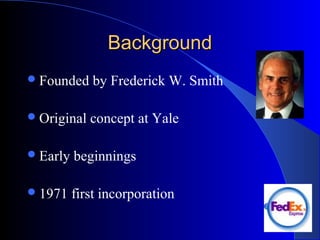
Founded by Frederick W. Smith
Original concept at Yale
Early beginnings
1971 first incorporation
Yesterday and TodayYesterday and Today
April 17, 1973 – First day of Operations
– 186 packages
– 25 cities
Today
– 210 countries
 Global network
– Asia-Pacific
– Canada
– Europe, Middle East, Africa
– Latin America-Caribbean
FedEx CorporationFedEx Corporation
Subsidiaries
– FedEx Express
– FedEx Ground
– FedEx Freight
– FedEx Custom Critical
– FedEx Trade Networks
– FedEx Services
FedEx CorporationFedEx Corporation
1998 – Original name of FDX corporation
January 2000 – Change name to FedEx
Corporation
MilestonesMilestones
1975 – First showed profits
1977 –Deregulation for air cargo allowed
use of larger aircraft
1984 – Services to Europe and Asia began
GoalGoal
Operate independently and compete
collectively
Current StatisticsCurrent Statistics
2003 Revenue of $22.5 billion
44,000+ Location
185,000+ Employees
SuppliersSuppliers
Supply chain management
CompetitionCompetition
United Parcel Service: Net Income
DHL
United States Postal Service
CustomersCustomers
Small businesses
Shoppers
Meeting customers’ expectations through IT
Use of IT/ISUse of IT/IS
FedEx Insight
FedEx Wireless Solutions
FedEx Global Solutions
Smart Tags from FedEx
Bargaining Power of SuppliersBargaining Power of Suppliers
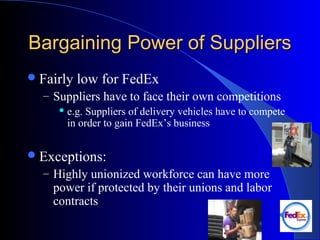
Fairly low for FedEx
– Suppliers have to face their own competitions
 e.g. Suppliers of delivery vehicles have to compete
in order to gain FedEx’s business
Exceptions:
– Highly unionized workforce can have more
power if protected by their unions and labor
contracts
Threat of New EntrantsThreat of New Entrants
Large capital investments are required for
entering this industry
– Air fleets, warehouses, distribution centers,
labor force
Customers are difficult to attract because of
switching costs
– Online tracking, online sales, and shipping
system
Bargaining Power of BuyersBargaining Power of Buyers
Can vary greatly between new and existing
customers
– New customers initially have power
 Shop around for low prices; demand a certain level
of service
Existing customers have decreased power
– High switching costs made them unwilling to
change
Threat of SubstitutesThreat of Substitutes
Currently low, but subject to change
E-mail
– Less likely to be used to transmit sensetive info
Regular mail (e.g. US Postal Service)
– Still have issues with security, speed, and
reliability
Competition Between FedExCompetition Between FedEx
and its Rivalsand its Rivals
Is extremely intense
• New business strategy
 e.g.) UPS who is specialized in ground shipping has
came up with UPS Overnight
 e.g.) FedEx who’s main focus is in the business
segment is planning to enter the residential market
None of the companies have a clear
domination over one another
OpportunitiesOpportunities
Top Employer
Strong Commitment
IT as culture
Key StrategiesKey Strategies
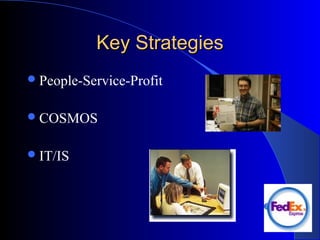
People-Service-Profit
COSMOS
IT/IS
Company StrengthsCompany Strengths
Transportation & Logistics
 World-class logistic services
 Business Logistics Services Division
Company WeaknessesCompany Weaknesses
Web-based interface
 -Design/layout of software
 -Lack of a single systems/data transfer standard
 -Difficulties filling out online air bills
Company StrengthsCompany Strengths
Virtual Merchandising
Gives business opportunity to outsource a lot more of its logistics
operations irrespective of size or nature of its business.
Electronic Commerce
Electronic order taking and customer interaction drove costs down.
Integrated Supply Chain Solution
Allowed firms to concentrate on their core business, be it in
manufacturing or service excellence

Fed ex MBA