2012


       Marketing Management
        Case Study:


                vs.


                      Group Members:
                         Mohammad Mahdi Mesbahi GM04701

                                  Mina Ali Ab Bar GM04665

                                   Wong Cing Yee GM04616

                                   Atousa Jafarian GM04704

                            Azhan Bin Mohd Husain GM04423

                                  Somayeh Rezaei GM04675
INTRODUCTION
• Started by Frederick Smith in 1971
• First Investment
• 1980’s:
   – FedEx reached its maturing stage.
   – First US company to reach $1 billion in
    revenues.
• FedEx handles 3.3 million packages
• History of FedEx Express
• Frederick W. Smith incorporated Federal Express in June 1971.
• Officially began operations on April 17th, 1973, delivering 186 packages to 25
  cities.
• Rapid growth in the industry began in 1977 following air cargo deregulation.
• In 1984, the company expanded to global coverage with services in Europe and
  Asia.
• Founded in 1907 in Seattle,
   Washington by Jim Casey.
• Headquartered in Atlantic, Georgia.
• UPS’s early fleet of delivery included a Model T and a few motor
   cycles.
• Has a fleet of 15,000+ trucks & over 500 planes, and serves every
   company in Fortune Magazine’s list of the 1,000 largest
   companies in US.
• Service to and from more than 200 countries & territories.
• 423,300 employees worldwide (9th largest global employer)
•   In spring 2000 – FDX was under attack from UPS

•   UPS handled three times as many packages as the FedEx

•   UPS practically owned the business of moving packages
    economically by ground and delivering them to any address
    in the country

•   Kelly , the company’s president : “ The consumer will have a
    access to goods anywhere in the world “
SCENARIO
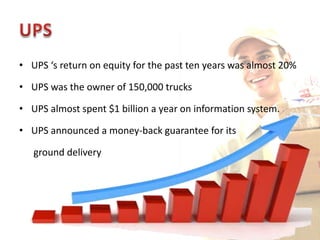
• UPS ‘s return on equity for the past ten years was almost 20%

• UPS was the owner of 150,000 trucks

• UPS almost spent $1 billion a year on information system.

• UPS announced a money-back guarantee for its

   ground delivery
• UPS had been gaining on FedEx in its core business by buying
  the airplanes in the early 1980s.

• UPS sales reps seemed more aggressive than ever in taking
  business away from FedEx.
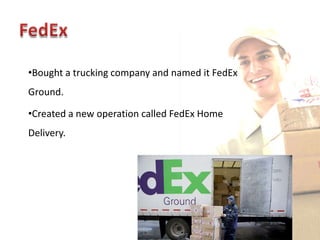
•Bought a trucking company and named it FedEx
Ground.

•Created a new operation called FedEx Home
Delivery.
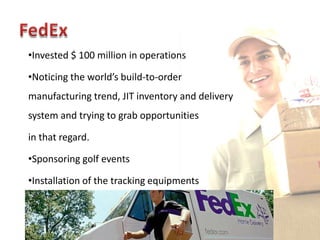
•Invested $ 100 million in operations

•Noticing the world’s build-to-order
manufacturing trend, JIT inventory and delivery
system and trying to grab opportunities

in that regard.

•Sponsoring golf events

•Installation of the tracking equipments
LOGICAL
QUESTIONS
Industry Environment

Porter’s Five Forces

SWOT analysis

Marketing Strategy
INDUSTRY
ENVIRONMENT
classified as being in the mature stage

of the industry life cycle

few competitors in this industry

this industry is very dynamic
PORTER’S
FIVE FACTORS
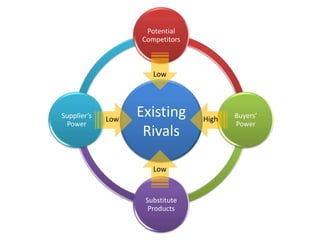
Potential
                    Competitors


                       Low


Supplier’s   Low
                   Existing       High   Buyers’
 Power                                   Power
                    Rivals

                       Low


                    Substitute
                     Products
SWOT
ANALYSIS
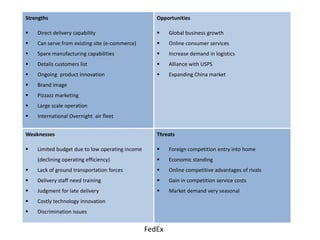
Strengths                                           Opportunities

   Direct delivery capability                          Global business growth
   Can serve from existing site (e-commerce)           Online consumer services
   Spare manufacturing capabilities                    Increase demand in logistics
   Details customers list                              Alliance with USPS
   Ongoing product innovation                          Expanding China market
   Brand image
   Pizzazz marketing
   Large scale operation
   International Overnight air fleet


Weaknesses                                          Threats

   Limited budget due to low operating income          Foreign competition entry into home
    (declining operating efficiency)                    Economic standing
   Lack of ground transportation forces                Online competitive advantages of rivals
   Delivery staff need training                        Gain in competition service costs
   Judgment for late delivery                          Market demand very seasonal
   Costly technology innovation
   Discrimination issues


                                                 FedEx
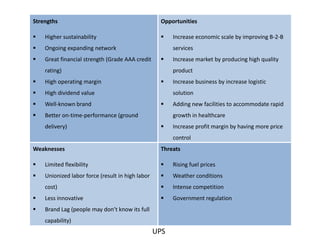
Strengths                                          Opportunities

   Higher sustainability                              Increase economic scale by improving B-2-B
   Ongoing expanding network                           services
   Great financial strength (Grade AAA credit         Increase market by producing high quality
    rating)                                             product
   High operating margin                              Increase business by increase logistic
   High dividend value                                 solution
   Well-known brand                                   Adding new facilities to accommodate rapid
   Better on-time-performance (ground                  growth in healthcare
    delivery)                                          Increase profit margin by having more price
                                                        control
Weaknesses                                         Threats

   Limited flexibility                                Rising fuel prices
   Unionized labor force (result in high labor        Weather conditions
    cost)                                              Intense competition
   Less innovative                                    Government regulation
   Brand Lag (people may don’t know its full
    capability)
                                                  UPS
RECOMMENDATION
• Improve services reliability by
  implementing “text message before
  send”

• Implementing mobile application to
  improve the accessibility – “FedEx always
  with you”

• Expansion of Money-back Guarantee
  (currently applicable at U.S. and to
  Canada only)
• Expanding its market in China as the
  demand growing
• Globalized its business to all uncovered
  area (25 countries) such as North Korea,
  Central African Republic
• Expanding its business by providing
  alternative ocean shipping which is less
  costly
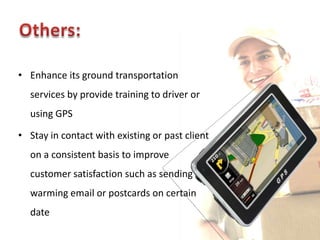
• Enhance its ground transportation
  services by provide training to driver or
  using GPS

• Stay in contact with existing or past client
  on a consistent basis to improve
  customer satisfaction such as sending a
  warming email or postcards on certain
  date
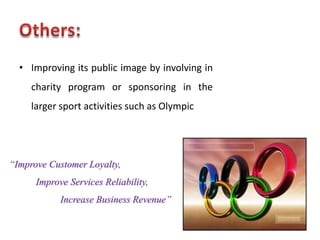
• Improving its public image by involving in
     charity program or sponsoring in the
     larger sport activities such as Olympic


“Improve Customer Loyalty,
      Improve Services Reliability,
            Increase Business Revenue”
CONCLUSION
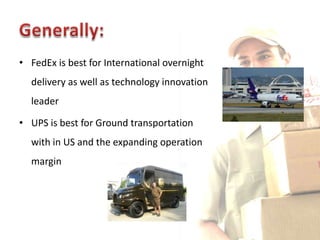
• FedEx is best for International overnight
  delivery as well as technology innovation
  leader

• UPS is best for Ground transportation
  with in US and the expanding operation
  margin
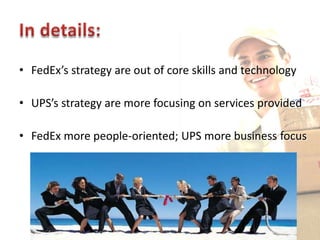
• FedEx’s strategy are out of core skills and technology

• UPS’s strategy are more focusing on services provided

• FedEx more people-oriented; UPS more business focus
FedEx is better than UPS?


 different people

 different perception
left to right   or   right to left ?
Present like Professionals


                     Created by:

                               Mahdi Mesbahi
                     mahdi.mesbahi@gmail.com

Marketing case fedex ups

  • 1.
    2012 Marketing Management Case Study: vs. Group Members: Mohammad Mahdi Mesbahi GM04701 Mina Ali Ab Bar GM04665 Wong Cing Yee GM04616 Atousa Jafarian GM04704 Azhan Bin Mohd Husain GM04423 Somayeh Rezaei GM04675
  • 2.
  • 3.
    • Started byFrederick Smith in 1971 • First Investment • 1980’s: – FedEx reached its maturing stage. – First US company to reach $1 billion in revenues. • FedEx handles 3.3 million packages • History of FedEx Express • Frederick W. Smith incorporated Federal Express in June 1971. • Officially began operations on April 17th, 1973, delivering 186 packages to 25 cities. • Rapid growth in the industry began in 1977 following air cargo deregulation. • In 1984, the company expanded to global coverage with services in Europe and Asia.
  • 4.
    • Founded in1907 in Seattle, Washington by Jim Casey. • Headquartered in Atlantic, Georgia. • UPS’s early fleet of delivery included a Model T and a few motor cycles. • Has a fleet of 15,000+ trucks & over 500 planes, and serves every company in Fortune Magazine’s list of the 1,000 largest companies in US. • Service to and from more than 200 countries & territories. • 423,300 employees worldwide (9th largest global employer)
  • 5.
    In spring 2000 – FDX was under attack from UPS • UPS handled three times as many packages as the FedEx • UPS practically owned the business of moving packages economically by ground and delivering them to any address in the country • Kelly , the company’s president : “ The consumer will have a access to goods anywhere in the world “
  • 6.
  • 7.
    • UPS ‘sreturn on equity for the past ten years was almost 20% • UPS was the owner of 150,000 trucks • UPS almost spent $1 billion a year on information system. • UPS announced a money-back guarantee for its ground delivery
  • 8.
    • UPS hadbeen gaining on FedEx in its core business by buying the airplanes in the early 1980s. • UPS sales reps seemed more aggressive than ever in taking business away from FedEx.
  • 9.
    •Bought a truckingcompany and named it FedEx Ground. •Created a new operation called FedEx Home Delivery.
  • 10.
    •Invested $ 100million in operations •Noticing the world’s build-to-order manufacturing trend, JIT inventory and delivery system and trying to grab opportunities in that regard. •Sponsoring golf events •Installation of the tracking equipments
  • 11.
  • 12.
    Industry Environment Porter’s FiveForces SWOT analysis Marketing Strategy
  • 13.
  • 14.
    classified as beingin the mature stage of the industry life cycle few competitors in this industry this industry is very dynamic
  • 15.
  • 16.
    Potential Competitors Low Supplier’s Low Existing High Buyers’ Power Power Rivals Low Substitute Products
  • 17.
  • 18.
    Strengths Opportunities  Direct delivery capability  Global business growth  Can serve from existing site (e-commerce)  Online consumer services  Spare manufacturing capabilities  Increase demand in logistics  Details customers list  Alliance with USPS  Ongoing product innovation  Expanding China market  Brand image  Pizzazz marketing  Large scale operation  International Overnight air fleet Weaknesses Threats  Limited budget due to low operating income  Foreign competition entry into home (declining operating efficiency)  Economic standing  Lack of ground transportation forces  Online competitive advantages of rivals  Delivery staff need training  Gain in competition service costs  Judgment for late delivery  Market demand very seasonal  Costly technology innovation  Discrimination issues FedEx
  • 19.
    Strengths Opportunities  Higher sustainability  Increase economic scale by improving B-2-B  Ongoing expanding network services  Great financial strength (Grade AAA credit  Increase market by producing high quality rating) product  High operating margin  Increase business by increase logistic  High dividend value solution  Well-known brand  Adding new facilities to accommodate rapid  Better on-time-performance (ground growth in healthcare delivery)  Increase profit margin by having more price control Weaknesses Threats  Limited flexibility  Rising fuel prices  Unionized labor force (result in high labor  Weather conditions cost)  Intense competition  Less innovative  Government regulation  Brand Lag (people may don’t know its full capability) UPS
  • 20.
  • 21.
    • Improve servicesreliability by implementing “text message before send” • Implementing mobile application to improve the accessibility – “FedEx always with you” • Expansion of Money-back Guarantee (currently applicable at U.S. and to Canada only)
  • 22.
    • Expanding itsmarket in China as the demand growing • Globalized its business to all uncovered area (25 countries) such as North Korea, Central African Republic • Expanding its business by providing alternative ocean shipping which is less costly
  • 23.
    • Enhance itsground transportation services by provide training to driver or using GPS • Stay in contact with existing or past client on a consistent basis to improve customer satisfaction such as sending a warming email or postcards on certain date
  • 24.
    • Improving itspublic image by involving in charity program or sponsoring in the larger sport activities such as Olympic “Improve Customer Loyalty, Improve Services Reliability, Increase Business Revenue”
  • 25.
  • 26.
    • FedEx isbest for International overnight delivery as well as technology innovation leader • UPS is best for Ground transportation with in US and the expanding operation margin
  • 27.
    • FedEx’s strategyare out of core skills and technology • UPS’s strategy are more focusing on services provided • FedEx more people-oriented; UPS more business focus
  • 28.
    FedEx is betterthan UPS? different people different perception
  • 29.
    left to right or right to left ?
  • 30.
    Present like Professionals Created by: Mahdi Mesbahi mahdi.mesbahi@gmail.com