FEDERAL EXPRESS
Describe how the company progressively
changed and extended its business model
through the use of IT?

Presented By: Mukesh Kulal
Team Members: Mukesh, Lalit, Sylvie, Bhumika
Agenda
•
•
•
•
•
•
•
•
•
•

What is Fedex?
Hub and Spoke Model
Implementation Strategy
Progressive Change in Fedex
Company Growth
Overseas Expansion
IT Implementation
How has IT helped in Business Expansion?
Flow of Virtual Order(example)
Conclusion
What is Fedex?(1)
• Provides customers with a broad portfolio of
transportation, e-commerce and business
services
• Founded by Frederick W. Smith in 1971
• Headquarters located in Memphis, Tenn.
• Daily Volume of more than 7.5 million shipments
• Workforce of more than 275,000 team members
worldwide
• Revenue of $35.5 billion for year 2009
What is Fedex?(2)
•

FedEx maintains 10 companies, which all provide different services
within the FedEx network. They are :
– FedEx Corp.,
– Express,
– Trade Networks,
– Ground,
– Freight and National LTL,
– Custom Critical,
– Services,
– Customer Information Services,
– Supply Chain Services,
– FedEx Kinko's Office and Print Services.
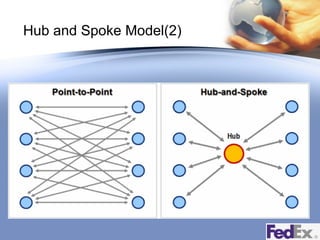
Hub and Spoke Model(1)
• Conceived by Fred Smith and FedEx Express
• Widely adopted by major carriers
• Generates Economies of Scale and Economies
of Flow
• Massive economic impact upon the air cargo and
passenger airline industries
Hub and Spoke Model(2)
Advantages
• All packages can be
sorted at the hub, rather
than multiple locations
• Leads to full utilization of
resources.
• Spokes are simple, and
new ones can be created
easily.

Disadvantages
• Disruption at the hub can
create delays throughout
the system
• Overall operating
efficiency is also limited
by the capacity of the hub
• Day-to-day operations
may be relatively
inflexible
Implementation Strategy
• Two strategies for change:
– Big Bang
– Progressive
Progressive Change in Fedex
• Company Growth
• Overseas Expansion
• IT Implementation
Company Growth
• Fedex became the premier carrier of high priority
goods and standard setter for the industry
• Fedex played a leading role in lobbying for air
cargo deregulation in mid 1970’s.
• Fedex had the world’s largest all-cargo fleet by
the mid 2000’s
Overseas Expansion
• International acquisitions and intercontinental
operations began in 1984 with service to Europe
and Asia.
• Initiated direct scheduled cargo service to Japan.
• Obtained authority to serve China through a 1995
acquisition from Evergreen International Airlines
• By 2004, FedEx was delivering to more than 210
countries and handling about 3.3 million
packages and documents every business day.
IT Implementation
• Web based customer services started in 1995,
which allowed customers to track their shipments
via reference number.
• Developed a comprehensive set of web based
automated shipping solutions for global
customers.
• Launched Home Services designed for the
booming business to consumer e-tailers in 2000
How has IT helped in Business
Expansion?(1)
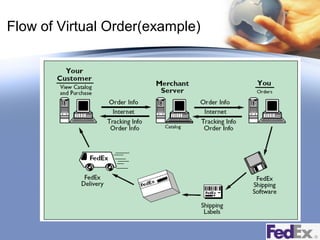
• Virtual Order
– Helped business to get online by providing software to
setup an online catalogue that resides on a secure
Fedex server.

• Fedex Insight
– Enables customers of any size to view the status of
their inbound, outbound and third party shipments

• Fedex e-business tools
– Allows companies to connect their existing
environment to Fedex Information Systems
How has IT helped in Business
Expansion?(1)
• Other third party partnerships
– Orbit Commerce: provide Internet Commerce Services
– Cisco: running End to end Internet Based Network
– AT&T: create wireless internet site for package
tracking and delivery
– E-tailers like eToys, Pro-Flowers, Value America and
LL Bean
– SAP: develop and market the first “one-stop solution”
suite of supply chain services.
Flow of Virtual Order(example)
Conclusion
• Hub and Spoke model is still considered the best
in the logistics industry
• Due to implementation of IT in Fedex internal
processes were optimized and automated.
• Customer Satisfaction was increased because of
the implementation of new tools.
• Fedex has always been an pioneer of technology
and a trend setter in its industry.
• Internet – a serious threat
References
 SRI International (2001) GLOBAL IMPACT OF FEDEX ON THE NEW
ECONOMY [Online]
http://images.fedex.com/us/about/download/economy/sri_exec_summary.pdf
[Accessed 09 November 2009]
 FedEx [no date] FedEx InSight [Online]
http://images.fedex.com/downloads/ebusiness/automation/INS-ENG.pdf?
link=4 [Accessed 05 November 2009]
 ACM Portal (1998) WISs at Federal Express [Online]
http://delivery.acm.org/10.1145/280000/278500/p117-senn.pdf?
key1=278500&key2=6889897521&coll=GUIDE&dl=GUIDE&CFID=62480799
&CFTOKE N=44498399 [Accessed 04 November 2009]

Fedex Strategy

  • 1.
    FEDERAL EXPRESS Describe howthe company progressively changed and extended its business model through the use of IT? Presented By: Mukesh Kulal Team Members: Mukesh, Lalit, Sylvie, Bhumika
  • 2.
    Agenda • • • • • • • • • • What is Fedex? Huband Spoke Model Implementation Strategy Progressive Change in Fedex Company Growth Overseas Expansion IT Implementation How has IT helped in Business Expansion? Flow of Virtual Order(example) Conclusion
  • 3.
    What is Fedex?(1) •Provides customers with a broad portfolio of transportation, e-commerce and business services • Founded by Frederick W. Smith in 1971 • Headquarters located in Memphis, Tenn. • Daily Volume of more than 7.5 million shipments • Workforce of more than 275,000 team members worldwide • Revenue of $35.5 billion for year 2009
  • 4.
    What is Fedex?(2) • FedExmaintains 10 companies, which all provide different services within the FedEx network. They are : – FedEx Corp., – Express, – Trade Networks, – Ground, – Freight and National LTL, – Custom Critical, – Services, – Customer Information Services, – Supply Chain Services, – FedEx Kinko's Office and Print Services.
  • 5.
    Hub and SpokeModel(1) • Conceived by Fred Smith and FedEx Express • Widely adopted by major carriers • Generates Economies of Scale and Economies of Flow • Massive economic impact upon the air cargo and passenger airline industries
  • 6.
    Hub and SpokeModel(2)
  • 7.
    Hub and SpokeModel(2) Advantages • All packages can be sorted at the hub, rather than multiple locations • Leads to full utilization of resources. • Spokes are simple, and new ones can be created easily. Disadvantages • Disruption at the hub can create delays throughout the system • Overall operating efficiency is also limited by the capacity of the hub • Day-to-day operations may be relatively inflexible
  • 8.
    Implementation Strategy • Twostrategies for change: – Big Bang – Progressive
  • 9.
    Progressive Change inFedex • Company Growth • Overseas Expansion • IT Implementation
  • 10.
    Company Growth • Fedexbecame the premier carrier of high priority goods and standard setter for the industry • Fedex played a leading role in lobbying for air cargo deregulation in mid 1970’s. • Fedex had the world’s largest all-cargo fleet by the mid 2000’s
  • 11.
    Overseas Expansion • Internationalacquisitions and intercontinental operations began in 1984 with service to Europe and Asia. • Initiated direct scheduled cargo service to Japan. • Obtained authority to serve China through a 1995 acquisition from Evergreen International Airlines • By 2004, FedEx was delivering to more than 210 countries and handling about 3.3 million packages and documents every business day.
  • 12.
    IT Implementation • Webbased customer services started in 1995, which allowed customers to track their shipments via reference number. • Developed a comprehensive set of web based automated shipping solutions for global customers. • Launched Home Services designed for the booming business to consumer e-tailers in 2000
  • 13.
    How has IThelped in Business Expansion?(1) • Virtual Order – Helped business to get online by providing software to setup an online catalogue that resides on a secure Fedex server. • Fedex Insight – Enables customers of any size to view the status of their inbound, outbound and third party shipments • Fedex e-business tools – Allows companies to connect their existing environment to Fedex Information Systems
  • 14.
    How has IThelped in Business Expansion?(1) • Other third party partnerships – Orbit Commerce: provide Internet Commerce Services – Cisco: running End to end Internet Based Network – AT&T: create wireless internet site for package tracking and delivery – E-tailers like eToys, Pro-Flowers, Value America and LL Bean – SAP: develop and market the first “one-stop solution” suite of supply chain services.
  • 15.
    Flow of VirtualOrder(example)
  • 16.
    Conclusion • Hub andSpoke model is still considered the best in the logistics industry • Due to implementation of IT in Fedex internal processes were optimized and automated. • Customer Satisfaction was increased because of the implementation of new tools. • Fedex has always been an pioneer of technology and a trend setter in its industry. • Internet – a serious threat
  • 17.
    References  SRI International(2001) GLOBAL IMPACT OF FEDEX ON THE NEW ECONOMY [Online] http://images.fedex.com/us/about/download/economy/sri_exec_summary.pdf [Accessed 09 November 2009]  FedEx [no date] FedEx InSight [Online] http://images.fedex.com/downloads/ebusiness/automation/INS-ENG.pdf? link=4 [Accessed 05 November 2009]  ACM Portal (1998) WISs at Federal Express [Online] http://delivery.acm.org/10.1145/280000/278500/p117-senn.pdf? key1=278500&key2=6889897521&coll=GUIDE&dl=GUIDE&CFID=62480799 &CFTOKE N=44498399 [Accessed 04 November 2009]

Editor's Notes

  • #2 Good Afternoon Friends, I am here to present about the question “Describe how the company progressively changed and extended its business model through the use of IT” on the case study Federal Express. My Team Members are 1st me , Lalit, Sylvie and Bhumika.
  • #3 And todays agenda is
  • #4 Provides customers with a broad portfolio of transportation, e-commerce and business services Founded by Frederick W. Smith in 1971 Headquarters located in Memphis, Tenn. Daily Volume of more than 7.5 million shipments Workforce of more than 275,000 team members worldwide Revenue of $35.5 billion for year 2009
  • #5 FedEx maintains 10 companies, which all provide different services within the FedEx network. They are : FedEx Corp., Express, Trade Networks, Ground, Freight and National LTL, Custom Critical, Services, Customer Information Services, Supply Chain Services, FedEx Kinko's Office and Print Services.
  • #6 Creating a New Logistics Framework – The Hub-and-Spoke Model: The hub-and-spoke system conceived by Fred Smith and FedEx Express has revolutionized the transportation/logistics industry and has been widely adopted by major carriers. Hub-and-spoke networks generate economies of scale and economies of flow, both of which have yielded greater industry efficiency and growth. The hub-and-spoke logistics system has had a massive economic impact upon the air cargo and passenger airline industries.
  • #7 Under this system, flows of smaller, arriving flights are precisely timed to connect seamlessly with larger, transfer-forward, departing flights. Flights depart from different airports – the spokes of the network – and arrive at the hub at approximately the same time. This system maximizes the number of attainable connections for incoming cargo or passengers. Cargo or passengers fly in from various regions, are consolidated at the hub and then undergo a reversed process to reach their final destination. Source: http://www.people.hofstra.edu/geotrans/eng/ch1en/conc1en/hubnetwork.html Hubs, as a network structure, allow a greater flexibility within the transport system, through a concentration of flows. he main advantages of hubs are: Economies of scale on connections by offering a high frequency of services. For instance, instead of one service per day between any two pairs in a point-to-point network, four services per day could be possible. Economies of scale at the hubs, enabling the potential development of an efficient distribution system since the hubs handle larger quantities of traffic. Economies of scope in the use of shared transshipment facilities. This can take several dimensions such as lower costs for the users as well as higher quality infrastructures. Many transportation services have adapted to include a hub-and-spoke structure. The most common examples involve air passenger and freight services which have developed such a structure at the global, national and regional levels, such as those used by UPS, FedEx and DHL.
  • #8 Advantages: all packages can be sorted at the hub, rather than sorted in multiple locations Leads to full utilization of resources Spokes are simple, and new ones can be created easily. Disadvantages: additional transshipment as less point-to-point services are offered, which for some connections may involve delays and potential congestion as the hub becomes the major point of transshipment. Any disruption at the hub, such as bad weather or a security problem, can create delays throughout the system. The overall operating efficiency is also limited by the capacity of the hub. Many airlines consciously choose different cities for hubs, so that two major airlines are not regarding the same airport as a hub. The airline must also schedule flights very carefully to ensure that all of the spokes are getting the service they need, and to keep passengers content.
  • #14 FedEx InSight is a leading edge, web-based application that enables customers of any size to view the status of their inbound, outbound and third party shipments without the need to enter tracking numbers. http://images.fedex.com/downloads/ebusiness/automation/INS-ENG.pdf?link=4 http://delivery.acm.org/10.1145/280000/278500/p117-senn.pdf?key1=278500&key2=6889897521&coll=GUIDE&dl=GUIDE&CFID=62480799&CFTOKEN=44498399
  • #15 Led by FedEx, the transportation/logistics industry has shifted from providing “outside” transportation services to becoming fully integrated in customers’ supply chain systems. FedEx has been a pioneer in assisting companies with supply chain management. In 1999, FedEx and SAP announced an alliance to develop and market the first “one-stop solution” suite of supply chain services, including supply chain planning, management and order execution. The suite of services allows customers to outsource all or part of their supply chain functions to a single provider. FedEx customers can tap into an entire network of supply chain management solutions through the Internet.The solutions allow customers to streamline processes, reduce costs, improve cycle time and increase revenue by leveraging state-of-the-art, Internet-based technology
  • #16 For consumers who are doing “last-minute” shopping or have urgent needs, the possibility of a next-day delivery opens up new shopping options in addition to browsing at local stores. The reliability of FedEx also makes consumers much more comfortable in considering the use of service providers, such as a travel agency out of the area, as they can rely on having their tickets delivered to their homes or offices by FedEx. FedEx InSight is a leading edge, web-based application that enables customers of any size to view the status of their inbound, outbound and third party shipments without the need to enter tracking numbers. http://images.fedex.com/downloads/ebusiness/automation/INS-ENG.pdf?link=4 http://delivery.acm.org/10.1145/280000/278500/p117-senn.pdf?key1=278500&key2=6889897521&coll=GUIDE&dl=GUIDE&CFID=62480799&CFTOKEN=44498399