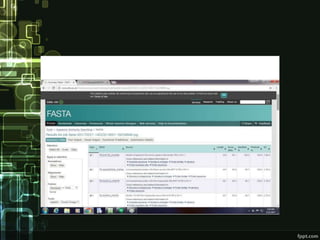
FASTA
P.Venkatasubramanian,
1st M.Sc Botany.
Bioinformatics
Research , development,
application of computational tools
and approaches for expanding
the use of biological , including
those to acquire, store, organize,
analyze such data.
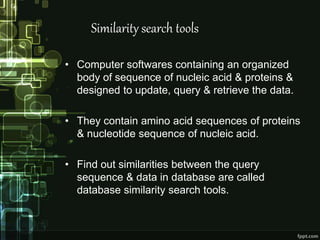
Similarity search tools
• Computer softwares containing an organized
body of sequence of nucleic acid & proteins &
designed to update, query & retrieve the data.
• They contain amino acid sequences of proteins
& nucleotide sequence of nucleic acid.
• Find out similarities between the query
sequence & data in database are called
database similarity search tools.
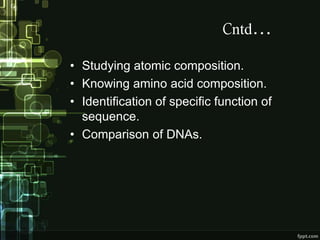
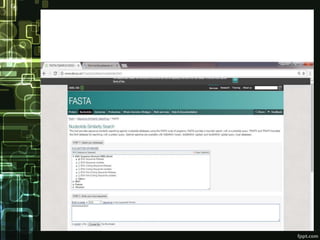
FASTA
• FASTA package was 1st described as
by Lipman & Pearson in 1985.
• FASTA is a DNA & protein sequence
alignment software.
• FASTA is a fast HOMOLOGY search
tool.
• Similar to BLAST , but this tool will
speed up sequence comparison when
compared with BLAST.
• Hence it is called FASTA.
Cntd…
• FAST-P stands for protein , compare the
amino acid sequence of proteins &
FAST-N stands for nucleotide alignment ,
compare the nucleotide sequence of
DNA.
• It is Bioinformatic tool.
• It is biological database.
• It compare the amino acid sequence of
different proteins or the nucleotide
sequence of different DNA.
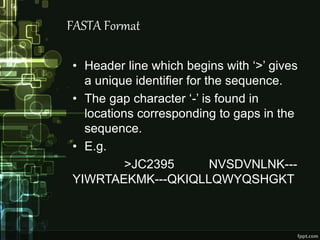
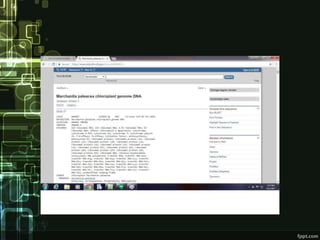
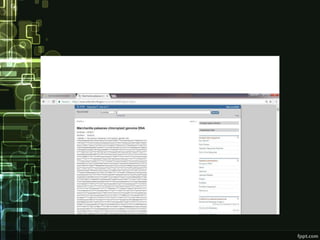
FASTA Format
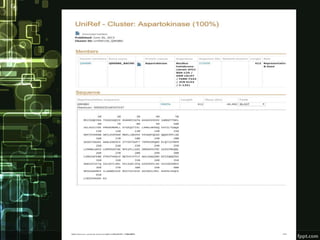
• Header line which begins with ‘>’ gives
a unique identifier for the sequence.
• The gap character ‘-’ is found in
locations corresponding to gaps in the
sequence.
• E.g.
>JC2395 NVSDVNLNK---
YIWRTAEKMK---QKIQLLQWYQSHGKT
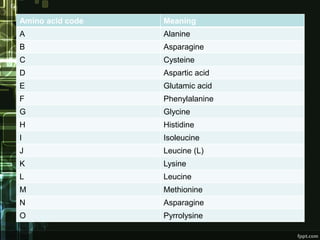
Amino acid code Meaning
A Alanine
B Asparagine
C Cysteine
D Aspartic acid
E Glutamic acid
F Phenylalanine
G Glycine
H Histidine
I Isoleucine
J Leucine (L)
K Lysine
L Leucine
M Methionine
N Asparagine
O Pyrrolysine
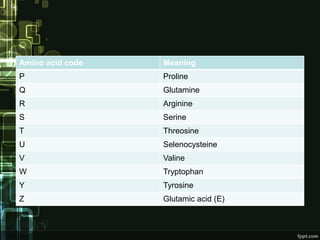
Amino acid code Meaning
P Proline
Q Glutamine
R Arginine
S Serine
T Threosine
U Selenocysteine
V Valine
W Tryptophan
Y Tyrosine
Z Glutamic acid (E)
FASTA Programs
• FASTA - compares a query protein sequence to
a protein library or DNA sequence to a DNA
library.
• TFASTA – compares a query sequence to a DNA
library, after the DNA sequence has been
translated in all 6 reading frames.
• FASTS – compares a set of ordered peptide
fragments, obtained from mass-spectrometry
analysis of a protein against a protein database.
• FASTX & Y – compares a query DNA sequence
to a protein sequence database , translating the
DNA sequence in all 6 reading frames.
salient features of fasta
• FASTA find out patches of sequence
SIMILARITY between the query and
database.
• FASTA may contain GAPS.
• FASTA is RAPID.
• FASTA is working on the basis of
FASTA algorithm developed by Fredi
and Barton.
Cntd…
• Programs can be run locally or by
sending query sequence to the FASTA
Email serer.
• Program achieve a high level of
sensitivity for similarity search at high
speed.
• FASTA is not guaranteed to find best
alignment between the query and
database.
uses of fasta
• Identification of species.
• Establishing phylogeny.
• DNA mapping.
• Understanding biochemical
functions of protein.
• Studying evolution of species.
• Identification of mutations.
• Calculating molecular weight.
Cntd…
• Studying atomic composition.
• Knowing amino acid composition.
• Identification of specific function of
sequence.
• Comparison of DNAs.
THANKYOU

Fasta

  • 1.
  • 2.
    Bioinformatics Research , development, applicationof computational tools and approaches for expanding the use of biological , including those to acquire, store, organize, analyze such data.
  • 3.
    Similarity search tools •Computer softwares containing an organized body of sequence of nucleic acid & proteins & designed to update, query & retrieve the data. • They contain amino acid sequences of proteins & nucleotide sequence of nucleic acid. • Find out similarities between the query sequence & data in database are called database similarity search tools.
  • 4.
    FASTA • FASTA packagewas 1st described as by Lipman & Pearson in 1985. • FASTA is a DNA & protein sequence alignment software. • FASTA is a fast HOMOLOGY search tool. • Similar to BLAST , but this tool will speed up sequence comparison when compared with BLAST. • Hence it is called FASTA.
  • 5.
    Cntd… • FAST-P standsfor protein , compare the amino acid sequence of proteins & FAST-N stands for nucleotide alignment , compare the nucleotide sequence of DNA. • It is Bioinformatic tool. • It is biological database. • It compare the amino acid sequence of different proteins or the nucleotide sequence of different DNA.
  • 6.
    FASTA Format • Headerline which begins with ‘>’ gives a unique identifier for the sequence. • The gap character ‘-’ is found in locations corresponding to gaps in the sequence. • E.g. >JC2395 NVSDVNLNK--- YIWRTAEKMK---QKIQLLQWYQSHGKT
  • 7.
    Amino acid codeMeaning A Alanine B Asparagine C Cysteine D Aspartic acid E Glutamic acid F Phenylalanine G Glycine H Histidine I Isoleucine J Leucine (L) K Lysine L Leucine M Methionine N Asparagine O Pyrrolysine
  • 8.
    Amino acid codeMeaning P Proline Q Glutamine R Arginine S Serine T Threosine U Selenocysteine V Valine W Tryptophan Y Tyrosine Z Glutamic acid (E)
  • 9.
    FASTA Programs • FASTA- compares a query protein sequence to a protein library or DNA sequence to a DNA library. • TFASTA – compares a query sequence to a DNA library, after the DNA sequence has been translated in all 6 reading frames. • FASTS – compares a set of ordered peptide fragments, obtained from mass-spectrometry analysis of a protein against a protein database. • FASTX & Y – compares a query DNA sequence to a protein sequence database , translating the DNA sequence in all 6 reading frames.
  • 10.
    salient features offasta • FASTA find out patches of sequence SIMILARITY between the query and database. • FASTA may contain GAPS. • FASTA is RAPID. • FASTA is working on the basis of FASTA algorithm developed by Fredi and Barton.
  • 11.
    Cntd… • Programs canbe run locally or by sending query sequence to the FASTA Email serer. • Program achieve a high level of sensitivity for similarity search at high speed. • FASTA is not guaranteed to find best alignment between the query and database.
  • 12.
    uses of fasta •Identification of species. • Establishing phylogeny. • DNA mapping. • Understanding biochemical functions of protein. • Studying evolution of species. • Identification of mutations. • Calculating molecular weight.
  • 13.
    Cntd… • Studying atomiccomposition. • Knowing amino acid composition. • Identification of specific function of sequence. • Comparison of DNAs.
  • 23.