
Nuttachat Wisittipanit, Phd.
School of Science
Mae Fah Luang University
BLAST
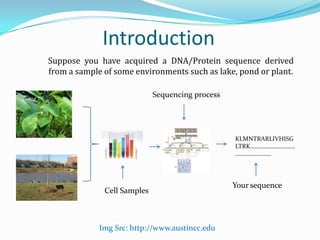
Suppose you have acquired a DNA/Protein sequence derived
from a sample of some environments such as lake, pond or plant.
Introduction
KLMNTRARLIVHISG
LTRK…………………………
……………………
Img Src: http://www.austincc.edu
Sequencing process
Cell Samples
Your sequence
Introduction
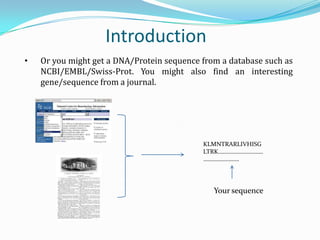
• Or you might get a DNA/Protein sequence from a database such as
NCBI/EMBL/Swiss-Prot. You might also find an interesting
gene/sequence from a journal.
KLMNTRARLIVHISG
LTRK…………………………
……………………
Your sequence
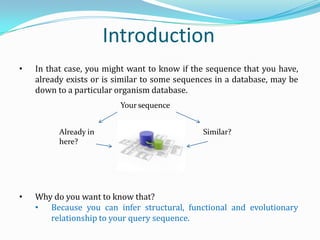
• In that case, you might want to know if the sequence that you have,
already exists or is similar to some sequences in a database, may be
down to a particular organism database.
• Why do you want to know that?
• Because you can infer structural, functional and evolutionary
relationship to your query sequence.
Introduction
Already in
here?
Similar?
Your sequence
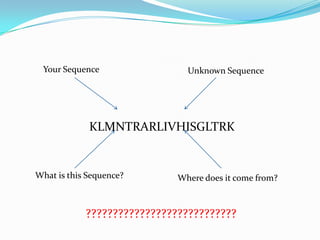
????????????????????????????
Your Sequence Unknown Sequence
What is this Sequence? Where does it come from?
KLMNTRARLIVHISGLTRK
Introducing BLAST (Basic Local
Alignment Search Tool)
 BLAST tool is used to compare a query sequence with a
library or database of sequences.
 It uses a heuristic search algorithm based on statistical
methods. The algorithm was invented by Stephen
Altschul and his co-workers in 1990.
 BLAST programs were designed for fast database
searching.
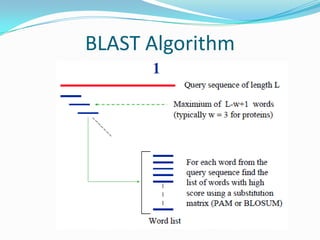
BLAST Algorithm
BLAST Algorithm
BLAST Algorithm
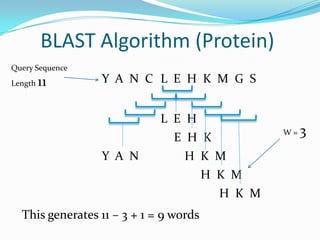
BLAST Algorithm (Protein)
L E H K M G S
Query Sequence
Length 11
L E H
E H K
H K M
This generates 11 – 3 + 1 = 9 words
H K M
H K M
Y A N C
Y A N
W = 3
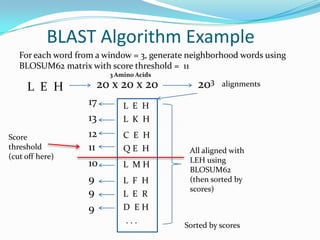
BLAST Algorithm Example
L E H
For each word from a window = 3, generate neighborhood words using
BLOSUM62 matrix with score threshold = 11
L M H
D E H
L E H
C E H
L K H
Q E H
L F H
L E R
. . .
All aligned with
LEH using
BLOSUM62
(then sorted by
scores)
17
13
12
10
9
11
9
9
Score
threshold
(cut off here)
20320 x 20 x 20 alignments
Sorted by scores
3 Amino Acids
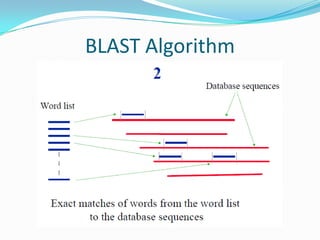
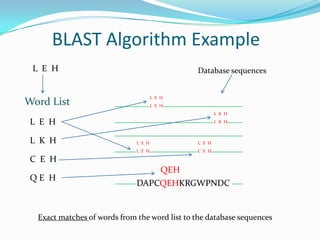
BLAST Algorithm Example
L E H
C E H
L K H
Q E H
Word List
DAPCQEHKRGWPNDC
L E H Database sequences
L E H
L E H
L E H
L E H
L K H
L K H
C E H
C E H
QEH
Exact matches of words from the word list to the database sequences
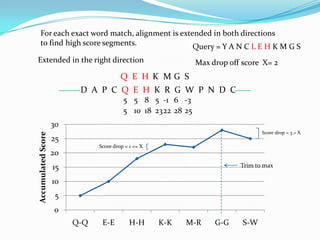
Q E H
D A P C Q E H K R G W P N D C
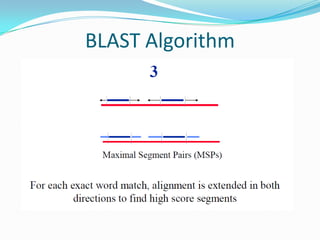
For each exact word match, alignment is extended in both directions
to find high score segments.
Extended in the right direction Max drop off score X= 2
0
5
10
15
20
25
30
Q-Q E-E H-H K-K M-R G-G S-W
AccumulatedScore
5 5 8
Score drop = 3 > X
Score drop = 1 <= X
Trim to max
Query = Y A N C L E H K M G S
K
5
235 10 18
M
-1
22
G
6
28
S
-3
25
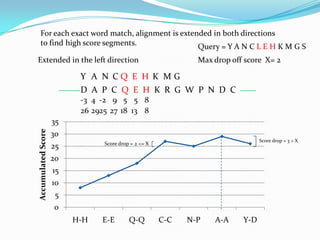
Q E H
D A P C Q E H K R G W P N D C
For each exact word match, alignment is extended in both directions
to find high score segments.
Extended in the left direction
K M G
Max drop off score X= 2
0
5
10
15
20
25
30
35
H-H E-E Q-Q C-C N-P A-A Y-D
AccumulatedScore
5 5 8
Score drop = 3 > X
Score drop = 2 <= X
Query = Y A N C L E H K M G S
18 13 8
C
9
27
N
-2
25
A
4
29
Y
-3
26
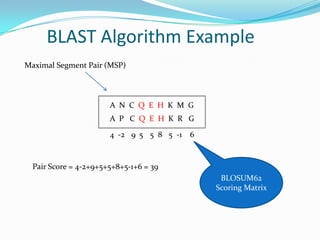
BLAST Algorithm Example
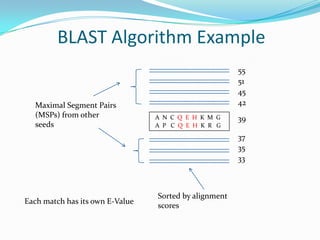
A P C Q E H K R G
5 -1 65 5 894 -2
Maximal Segment Pair (MSP)
Pair Score = 4-2+9+5+5+8+5-1+6 = 39
A N C Q E H K M G
BLOSUM62
Scoring Matrix
A P C Q E H K R G
A N C Q E H K M G 39
Maximal Segment Pairs
(MSPs) from other
seeds
Sorted by alignment
scores
42
45
35
37
51
55
33
BLAST Algorithm Example
Each match has its own E-Value
 E-Value: The number of MSPs with similar score or
higher that one can EXPECT to see by chance alone
when searching a database of a particular size.
BLAST Algorithm
Expect Value (E-Value)
 For example: if the E-Value is equal to 10 for a
particular MSP with score S, one can say that
actually…about 10 MSPs with score >= S can just
happen by chance alone (for any query sequence).
 So most likely that our MSP is not a significant match
at all.
BLAST Algorithm
Expect Value (E-Value)
 If E-Value if very small e.x. 10-4 (very high score S), one
can say that it is almost impossible that there would be
any MSP with score >= S.
 Thus, our MSP is a pretty significant match
(homologous).
BLAST Algorithm
Expect Value (E-Value)
 First: Calculate bit score
 S = Score of the alignment (Raw Score)
 , values depend on the scoring scheme and
sequence composition of a database.
[log value is natural logarithm (log base e)]
BLAST Algorithm
E-Value Calculation
 The lower the E-Value, the better.
 E-Value can be used to limit the number of hits in the
result page.
BLAST Algorithm
Expect Value (E-Value)
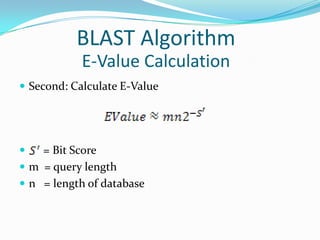
 Second: Calculate E-Value
 = Bit Score
 m = query length
 n = length of database
BLAST Algorithm
E-Value Calculation
• E-values of 10-4 and lower indicate a significant
homology.
• E-values between 10-4 and 10-2 should be checked
(similar domains, maybe non-homologous).
• E-values between 10-2 and 1 do not indicate a good
homology
BLAST Algorithm
E-Value Interpretation
Gapped BLAST
 The Gapped BLAST algorithm allows gaps to be
introduced into the alignments. That means similar
regions are not broken into several segments.
 This method reflects biological relationships much
better.
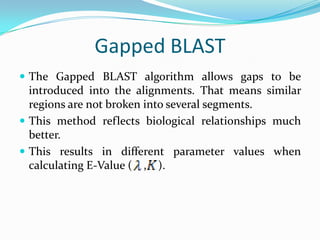
 This results in different parameter values when
calculating E-Value ( , ).
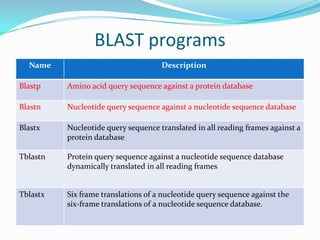
BLAST programs
Name Description
Blastp Amino acid query sequence against a protein database
Blastn Nucleotide query sequence against a nucleotide sequence database
Blastx Nucleotide query sequence translated in all reading frames against a
protein database
Tblastn Protein query sequence against a nucleotide sequence database
dynamically translated in all reading frames
Tblastx Six frame translations of a nucleotide query sequence against the
six-frame translations of a nucleotide sequence database.
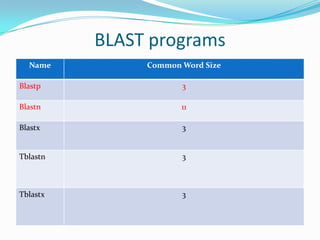
BLAST programs
Name Common Word Size
Blastp 3
Blastn 11
Blastx 3
Tblastn 3
Tblastx 3
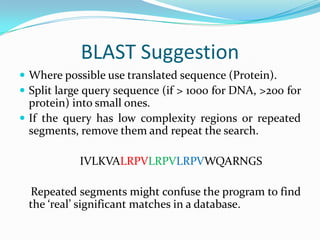
BLAST Suggestion
 Where possible use translated sequence (Protein).
 Split large query sequence (if > 1000 for DNA, >200 for
protein) into small ones.
 If the query has low complexity regions or repeated
segments, remove them and repeat the search.
IVLKVALRPVLRPVLRPVWQARNGS
Repeated segments might confuse the program to find
the ‘real’ significant matches in a database.
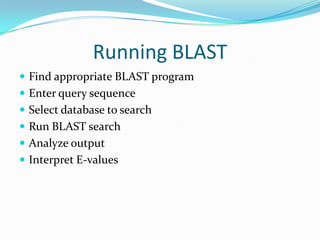
Running BLAST
 Find appropriate BLAST program
 Enter query sequence
 Select database to search
 Run BLAST search
 Analyze output
 Interpret E-values
Documenting BLAST
 Program (Blastp, Blastn,..)
 Name of database
 Word size
 E-Value threshold
 Substitution matrix
 Gap penalty
 BLAST results: Sequence Name, Bit Score, Raw
Score, E-Value, Identities, Positives, Gaps
BLAST
 http://blast.ncbi.nlm.nih.gov/
Homework 4A
 Determine the common proteins in Domestic Cat
[Felis catus], Tiger [Panthera tigris] and Snow Leopard
[Uncia uncia] using this initiating sequence
>gi|145558804
MSMVYINMFLAFIMSLMGLLMYRSHLMSSLLCLEGMMLSLFIMMTVAILNNHFTLASMTPII
LLVFAACEAALGLSLLVMVSNTYGTDYVQNLNLLQC
 Report for each protein match: Protein
name, accession number, bit score, raw score, E-
Value, Identities, Positives and Gaps.
Homework 4B
 H5N1 is the subtype of the Influenza A Virus which is a
bird-adapted strain. This subtype can cause “avian
influenza” or “bird flu” which is fatal to human.
 Use DNA sequence with GenBank Accession number
JX120150.1 as a seed sequence to search for other TWO
matching sequences, each belonging to a different
Influenza A virus subtypes (HXNX). [Use Blastn]
 Report for each subtype match: Subtype
name, Organism origin, Sequence name, accession
number, bit score, raw score, E-
Value, Identities, Positives and Gaps
Homework 4C
 Suppose you have acquired an unknown protein
sequence
FLWLWPYLSYIEAVPIRKVQDDTKTLIKTIVTRINDISHTQAVSSKQRVAGLDFIP
GLHPVLSLSRMDQTLAIYQQILTSLHSRNVVQISNDLENLRDLLHLLASSKS
 (1) Use BLAST program to find out which species this sequence most likely
belongs to.
 (2) Report both scientific and common name for the species.
 (3) This sequence matches to a certain protein of that species, Report E-Value,
protein accession number [GenBank], Protein name, Length, Full sequence
and Function.
Homework 4D
 Calculate E-Value for an MSP with
 Raw Score : 83
 Query Length : 103
 Length of database : 48,109,873
 : 0.316
 : 0.135
Send me email with subject
“HW3_BINF_lastname_id” by 28 June before 5pm.
Late submission will NOT be accepted.

Blast 2013 1

  • 1.
    Nuttachat Wisittipanit, Phd. Schoolof Science Mae Fah Luang University
  • 2.
  • 3.
    Suppose you haveacquired a DNA/Protein sequence derived from a sample of some environments such as lake, pond or plant. Introduction KLMNTRARLIVHISG LTRK………………………… …………………… Img Src: http://www.austincc.edu Sequencing process Cell Samples Your sequence
  • 4.
    Introduction • Or youmight get a DNA/Protein sequence from a database such as NCBI/EMBL/Swiss-Prot. You might also find an interesting gene/sequence from a journal. KLMNTRARLIVHISG LTRK………………………… …………………… Your sequence
  • 5.
    • In thatcase, you might want to know if the sequence that you have, already exists or is similar to some sequences in a database, may be down to a particular organism database. • Why do you want to know that? • Because you can infer structural, functional and evolutionary relationship to your query sequence. Introduction Already in here? Similar? Your sequence
  • 6.
    ???????????????????????????? Your Sequence UnknownSequence What is this Sequence? Where does it come from? KLMNTRARLIVHISGLTRK
  • 7.
    Introducing BLAST (BasicLocal Alignment Search Tool)  BLAST tool is used to compare a query sequence with a library or database of sequences.  It uses a heuristic search algorithm based on statistical methods. The algorithm was invented by Stephen Altschul and his co-workers in 1990.  BLAST programs were designed for fast database searching.
  • 8.
  • 9.
  • 10.
  • 11.
    BLAST Algorithm (Protein) LE H K M G S Query Sequence Length 11 L E H E H K H K M This generates 11 – 3 + 1 = 9 words H K M H K M Y A N C Y A N W = 3
  • 12.
    BLAST Algorithm Example LE H For each word from a window = 3, generate neighborhood words using BLOSUM62 matrix with score threshold = 11 L M H D E H L E H C E H L K H Q E H L F H L E R . . . All aligned with LEH using BLOSUM62 (then sorted by scores) 17 13 12 10 9 11 9 9 Score threshold (cut off here) 20320 x 20 x 20 alignments Sorted by scores 3 Amino Acids
  • 13.
    BLAST Algorithm Example LE H C E H L K H Q E H Word List DAPCQEHKRGWPNDC L E H Database sequences L E H L E H L E H L E H L K H L K H C E H C E H QEH Exact matches of words from the word list to the database sequences
  • 14.
    Q E H DA P C Q E H K R G W P N D C For each exact word match, alignment is extended in both directions to find high score segments. Extended in the right direction Max drop off score X= 2 0 5 10 15 20 25 30 Q-Q E-E H-H K-K M-R G-G S-W AccumulatedScore 5 5 8 Score drop = 3 > X Score drop = 1 <= X Trim to max Query = Y A N C L E H K M G S K 5 235 10 18 M -1 22 G 6 28 S -3 25
  • 15.
    Q E H DA P C Q E H K R G W P N D C For each exact word match, alignment is extended in both directions to find high score segments. Extended in the left direction K M G Max drop off score X= 2 0 5 10 15 20 25 30 35 H-H E-E Q-Q C-C N-P A-A Y-D AccumulatedScore 5 5 8 Score drop = 3 > X Score drop = 2 <= X Query = Y A N C L E H K M G S 18 13 8 C 9 27 N -2 25 A 4 29 Y -3 26
  • 16.
    BLAST Algorithm Example AP C Q E H K R G 5 -1 65 5 894 -2 Maximal Segment Pair (MSP) Pair Score = 4-2+9+5+5+8+5-1+6 = 39 A N C Q E H K M G BLOSUM62 Scoring Matrix
  • 17.
    A P CQ E H K R G A N C Q E H K M G 39 Maximal Segment Pairs (MSPs) from other seeds Sorted by alignment scores 42 45 35 37 51 55 33 BLAST Algorithm Example Each match has its own E-Value
  • 18.
     E-Value: Thenumber of MSPs with similar score or higher that one can EXPECT to see by chance alone when searching a database of a particular size. BLAST Algorithm Expect Value (E-Value)
  • 19.
     For example:if the E-Value is equal to 10 for a particular MSP with score S, one can say that actually…about 10 MSPs with score >= S can just happen by chance alone (for any query sequence).  So most likely that our MSP is not a significant match at all. BLAST Algorithm Expect Value (E-Value)
  • 20.
     If E-Valueif very small e.x. 10-4 (very high score S), one can say that it is almost impossible that there would be any MSP with score >= S.  Thus, our MSP is a pretty significant match (homologous). BLAST Algorithm Expect Value (E-Value)
  • 21.
     First: Calculatebit score  S = Score of the alignment (Raw Score)  , values depend on the scoring scheme and sequence composition of a database. [log value is natural logarithm (log base e)] BLAST Algorithm E-Value Calculation
  • 22.
     The lowerthe E-Value, the better.  E-Value can be used to limit the number of hits in the result page. BLAST Algorithm Expect Value (E-Value)
  • 23.
     Second: CalculateE-Value  = Bit Score  m = query length  n = length of database BLAST Algorithm E-Value Calculation
  • 24.
    • E-values of10-4 and lower indicate a significant homology. • E-values between 10-4 and 10-2 should be checked (similar domains, maybe non-homologous). • E-values between 10-2 and 1 do not indicate a good homology BLAST Algorithm E-Value Interpretation
  • 25.
    Gapped BLAST  TheGapped BLAST algorithm allows gaps to be introduced into the alignments. That means similar regions are not broken into several segments.  This method reflects biological relationships much better.  This results in different parameter values when calculating E-Value ( , ).
  • 26.
    BLAST programs Name Description BlastpAmino acid query sequence against a protein database Blastn Nucleotide query sequence against a nucleotide sequence database Blastx Nucleotide query sequence translated in all reading frames against a protein database Tblastn Protein query sequence against a nucleotide sequence database dynamically translated in all reading frames Tblastx Six frame translations of a nucleotide query sequence against the six-frame translations of a nucleotide sequence database.
  • 27.
    BLAST programs Name CommonWord Size Blastp 3 Blastn 11 Blastx 3 Tblastn 3 Tblastx 3
  • 28.
    BLAST Suggestion  Wherepossible use translated sequence (Protein).  Split large query sequence (if > 1000 for DNA, >200 for protein) into small ones.  If the query has low complexity regions or repeated segments, remove them and repeat the search. IVLKVALRPVLRPVLRPVWQARNGS Repeated segments might confuse the program to find the ‘real’ significant matches in a database.
  • 29.
    Running BLAST  Findappropriate BLAST program  Enter query sequence  Select database to search  Run BLAST search  Analyze output  Interpret E-values
  • 30.
    Documenting BLAST  Program(Blastp, Blastn,..)  Name of database  Word size  E-Value threshold  Substitution matrix  Gap penalty  BLAST results: Sequence Name, Bit Score, Raw Score, E-Value, Identities, Positives, Gaps
  • 31.
  • 32.
    Homework 4A  Determinethe common proteins in Domestic Cat [Felis catus], Tiger [Panthera tigris] and Snow Leopard [Uncia uncia] using this initiating sequence >gi|145558804 MSMVYINMFLAFIMSLMGLLMYRSHLMSSLLCLEGMMLSLFIMMTVAILNNHFTLASMTPII LLVFAACEAALGLSLLVMVSNTYGTDYVQNLNLLQC  Report for each protein match: Protein name, accession number, bit score, raw score, E- Value, Identities, Positives and Gaps.
  • 33.
    Homework 4B  H5N1is the subtype of the Influenza A Virus which is a bird-adapted strain. This subtype can cause “avian influenza” or “bird flu” which is fatal to human.  Use DNA sequence with GenBank Accession number JX120150.1 as a seed sequence to search for other TWO matching sequences, each belonging to a different Influenza A virus subtypes (HXNX). [Use Blastn]  Report for each subtype match: Subtype name, Organism origin, Sequence name, accession number, bit score, raw score, E- Value, Identities, Positives and Gaps
  • 34.
    Homework 4C  Supposeyou have acquired an unknown protein sequence FLWLWPYLSYIEAVPIRKVQDDTKTLIKTIVTRINDISHTQAVSSKQRVAGLDFIP GLHPVLSLSRMDQTLAIYQQILTSLHSRNVVQISNDLENLRDLLHLLASSKS  (1) Use BLAST program to find out which species this sequence most likely belongs to.  (2) Report both scientific and common name for the species.  (3) This sequence matches to a certain protein of that species, Report E-Value, protein accession number [GenBank], Protein name, Length, Full sequence and Function.
  • 35.
    Homework 4D  CalculateE-Value for an MSP with  Raw Score : 83  Query Length : 103  Length of database : 48,109,873  : 0.316  : 0.135
  • 36.
    Send me emailwith subject “HW3_BINF_lastname_id” by 28 June before 5pm. Late submission will NOT be accepted.