Download to read offline
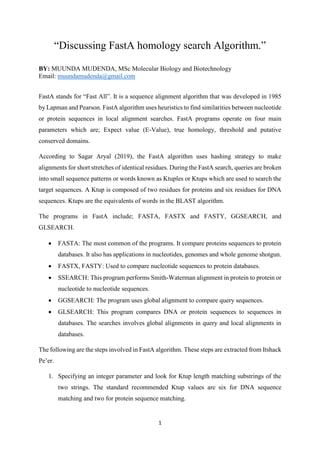
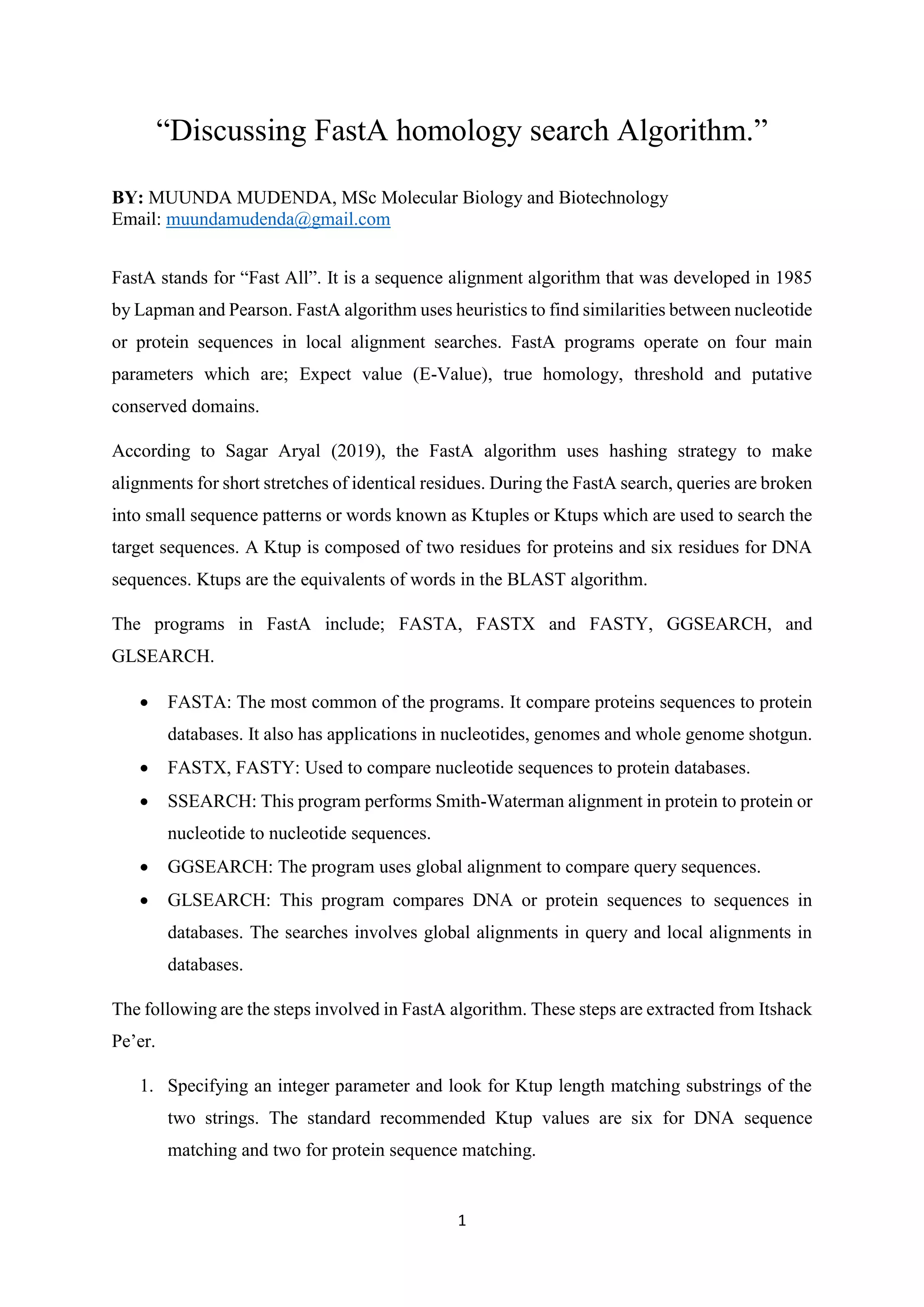


The FastA algorithm is a sequence alignment method developed in 1985 that uses heuristics to find similarities between nucleotide or protein sequences through local alignment searches. It works by breaking queries into short sequence patterns called k-tuples that are used to search target sequences. The main FastA programs are FASTA, FASTX, FASTY, GGSEARCH, and GLSEARCH. The FastA algorithm proceeds in six steps: 1) specifying a k-tup length, 2) finding the best diagonal runs of hot spots, 3) evaluating runs using a substitution matrix, 4) constructing a directed graph, 5) computing an alternative local alignment score, and 6) aligning the query against highest ranking results.


