Failure Mode and Effect Analysis
Dr. Shailendra.V.L.
Director of Patient Safety
Objectives
What is FMEA?
History of FMEA
Why is an FMEA important?
Benefits of FMEA
Limitations of FMEA
How to conduct an FMEA?
Failure Mode and Effect Analysis
FMEA is:
a process that identifies all the possible
types of failures that could happen to a
service and potential consequences of
those failures
FMEA
 A structured approach to:
 Identifying the ways in which a process can fail
 Estimating risk associated with specific causes
 Prioritizing the actions that should be taken to
reduce risk
 Evaluating design validation plan (design FMEA)
or current control plan (process FMEA)
History of FMEA
 First used in the 1960’s in the Aerospace
industry during the Apollo missions to check
the space hardware
 In 1974, US Navy developed MIL-STD-1629
regarding the use of FMEA
 In the late 1970’s, the automotive industry
was driven by liability costs to use FMEA
 Later, the automotive industry saw the
advantages of using this tool to reduce risks
related to poor quality
What Is A Failure Mode?
A Failure Mode is:
Things that could go wrong
The way in which the steps and / or the
process could fail to perform its intended
function
Failure modes may be the result of upstream
operations or may cause downstream
operations to fail
Why should we use FMEA
 Methodology that facilitates process improvement
 Improve internal and external customer
satisfaction
 Focuses on prevention
 FMEA may be a customer requirement
 Identifies and eliminates concerns early in the
development of a process or design
 FMEA may be required by an applicable
Quality Management System Standard (CBAHI)
The Reasons for FMEA
 Get it right the first time
 Indentifies any inadequacies in the development
of the process
 Continuous improvement
 Preventive approach
 Team building
 Required procedure from regulatory bodies
FMEA Terms
 Failure mode - the way in which something
might fail
 Effects analysis – studying the consequences
of the various failure modes to determine
their severity to the customer
Process FMEA
 Indentify potential failures related to process
failure modes
 Assess the potential customer effects of the
failures
 Identify the potential causes on which to focus on
 Develop a ranked list of potential failure modes
 Document the results
FMEA Procedure
11
1. For each process input (start with high value inputs),
determine the ways in which the input can go wrong
(failure mode)
2. For each failure mode, determine effects
 Select a severity level for each effect
3. Identify potential causes of each failure mode
 Select an occurrence level for each cause
4. List current controls for each cause
 Select a detection level for each cause
Process Steps
FMEA Procedure (Cont.)
12
5. Calculate the Risk Priority Number (RPN)
6. Develop recommended actions, assign responsible
persons, and take actions
 Give priority to high RPNs
 MUST look at severities rated as 10
7. Assign the predicted severity, occurrence, and
detection levels and compare RPNs
Process Steps
FMEA: A Team Tool
13
A team approach is necessary.
Team should be led by the Process Owner
who is the technical person, or other similar
individual familiar with FMEA.
The following should be considered for team
members:
– process leaders
– process employees
– QM professional
Team Input
Required
Risk Assessment Factors
Severity (S): A number from 1 to 10, depending on the
severity of the potential failure mode’s effect
1 = no effect
10 = maximum severity
Probability of occurrence (O): A number from 1 to 10,
depending on the likelihood of the failure mode’s
occurrence
1 = very unlikely to occur
10 = almost certain to occur
Risk Assessment Factors
Probability of detection (D): A number from 1 to 10,
depending on how unlikely it is that the fault will be
detected by the system responsible (process control)
1 = nearly certain detention
10 = impossible to detect
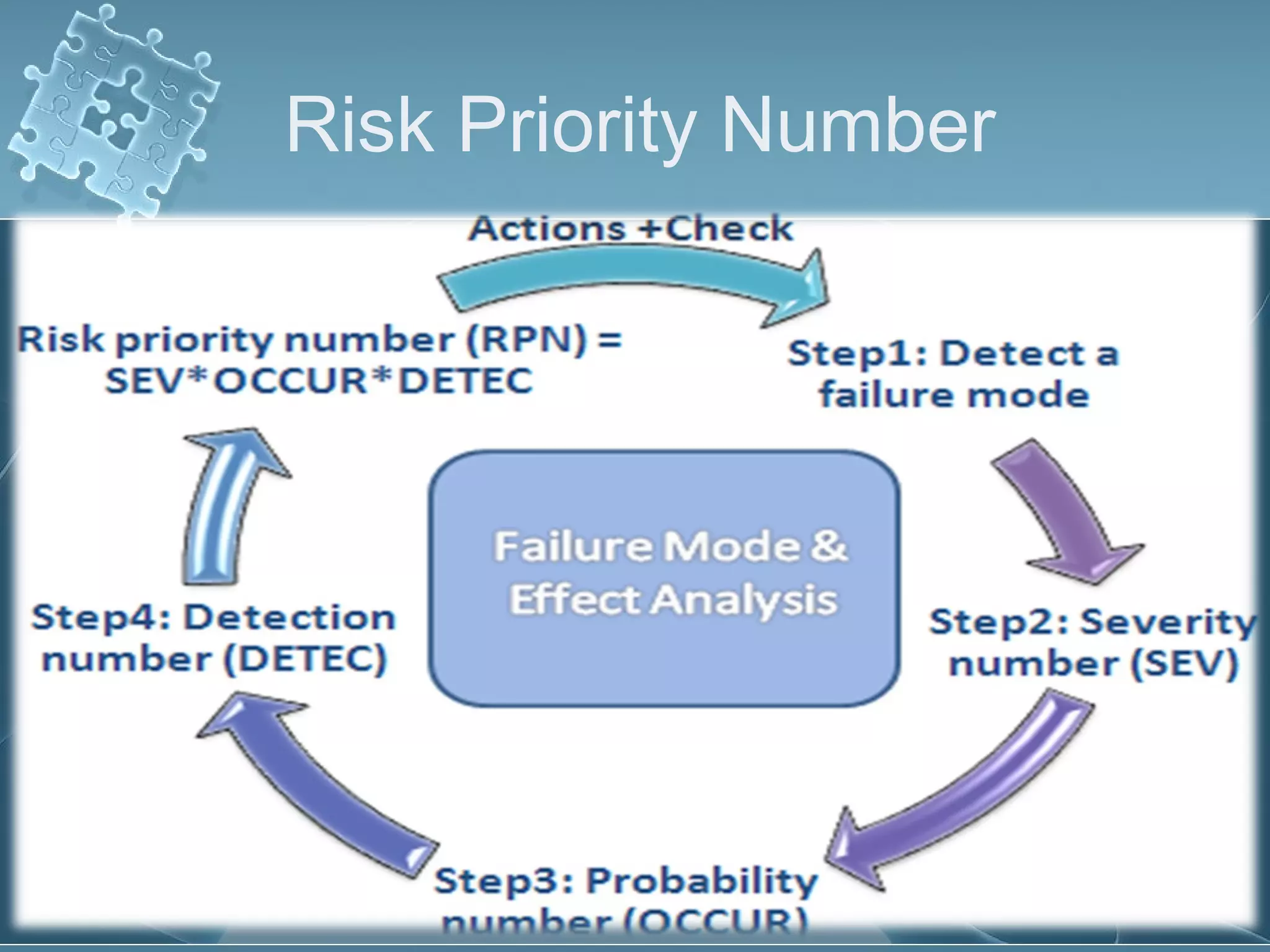
Risk Priority Number (RPN): The failure mode’s risk is
found by the formula RPN = S x O x D. RPN =
Severity x Probability of Occurrence x Probability of
Detection. RPN will be a number between 1
(virtually no risk) and 1000 (extreme risk)
Risk Priority Number
Risk Priority Number (RPN)
17
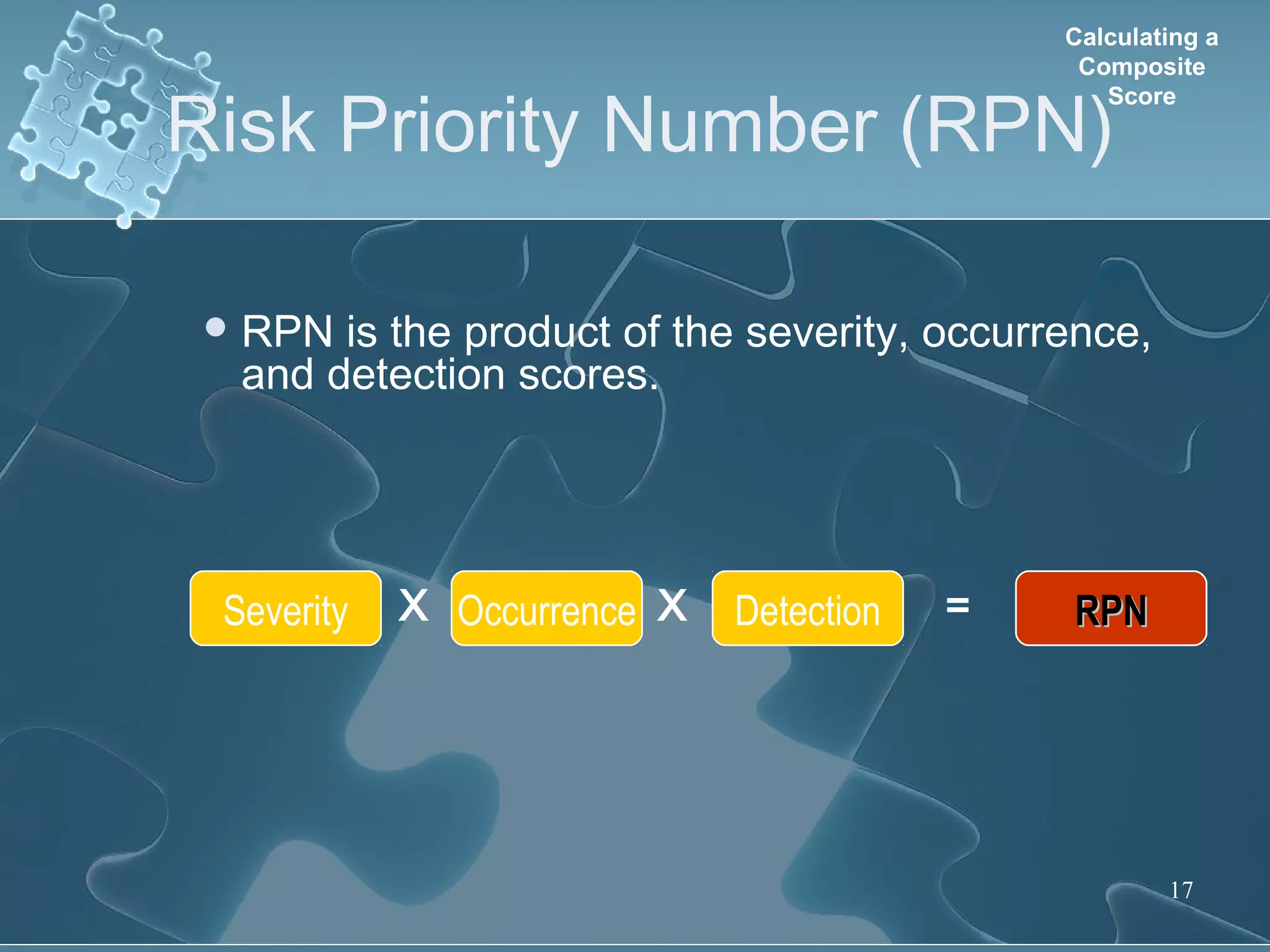
RPN is the product of the severity, occurrence,
and detection scores.
Severity Occurrence Detection RPNRPNX X =
Calculating a
Composite
Score
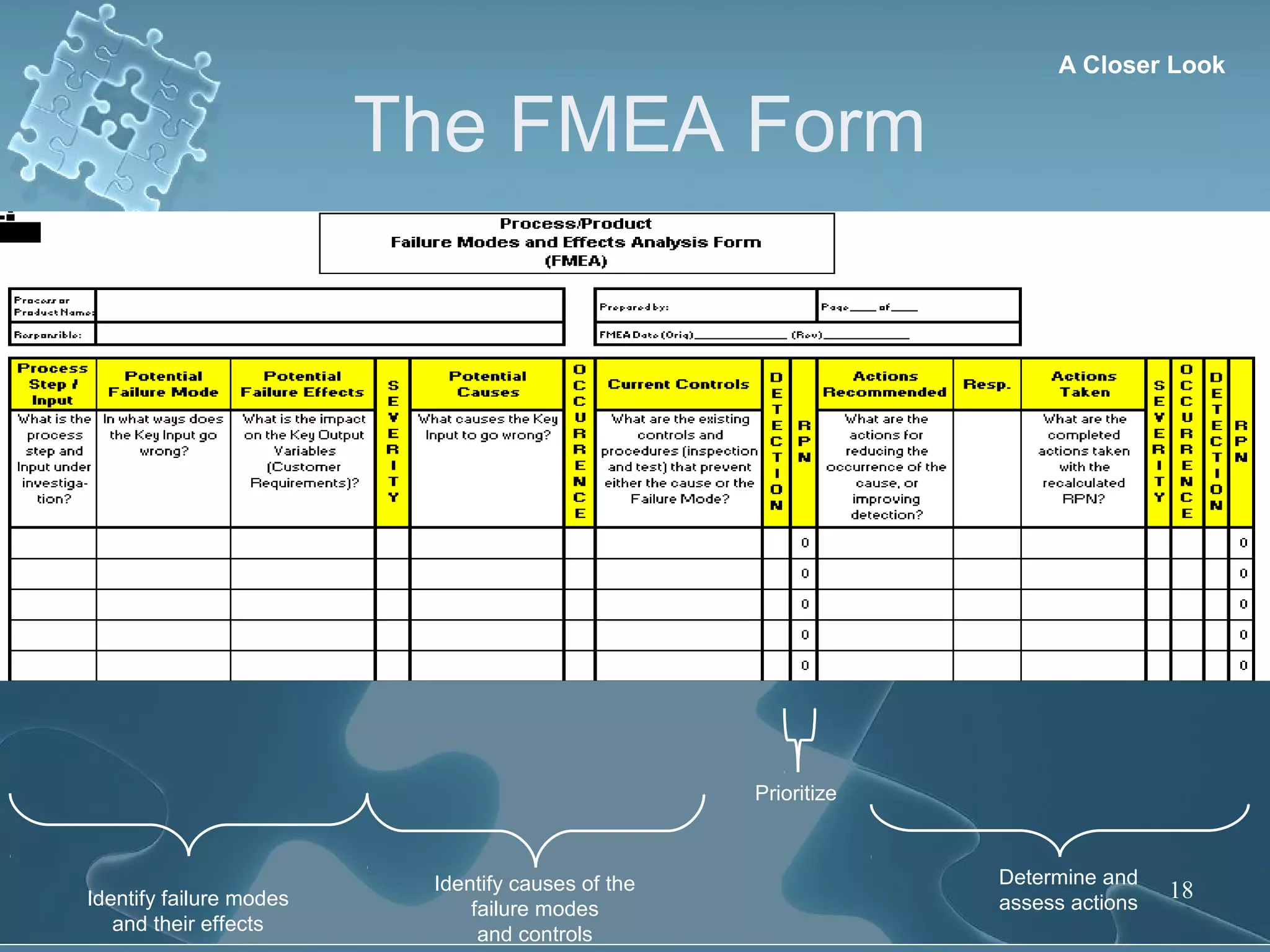
The FMEA Form
18Identify failure modes
and their effects
Identify causes of the
failure modes
and controls
Prioritize
Determine and
assess actions
A Closer Look
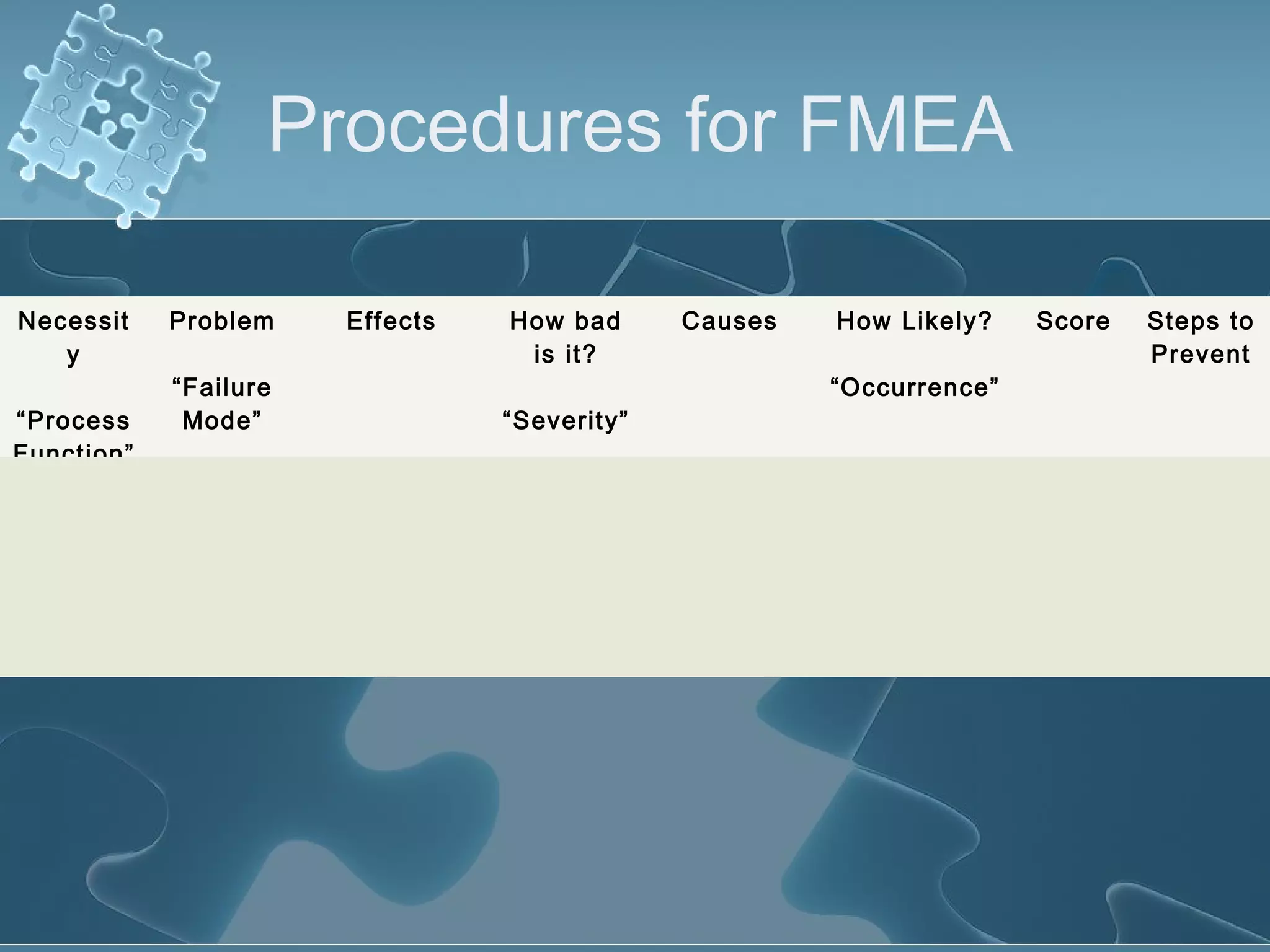
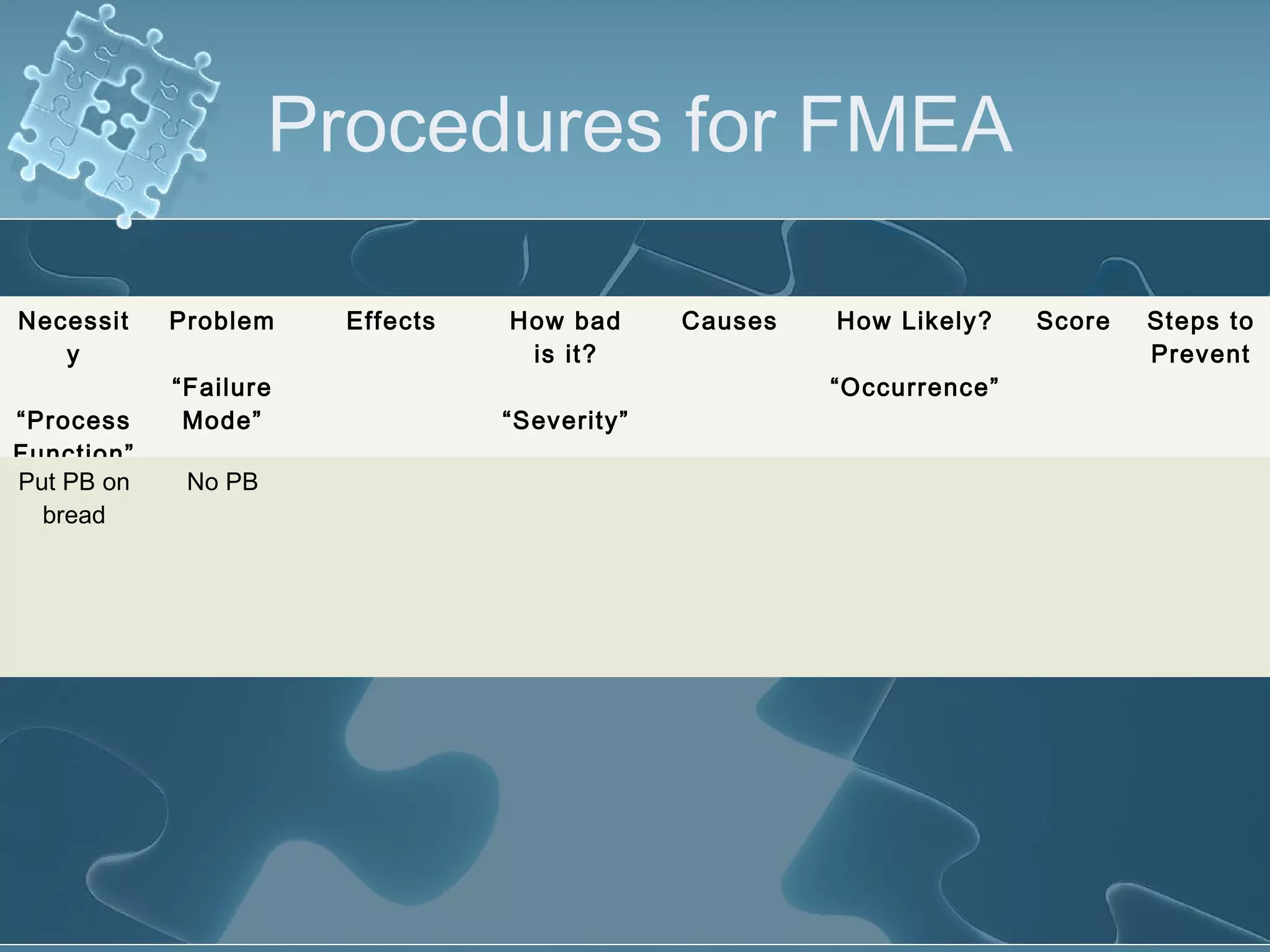
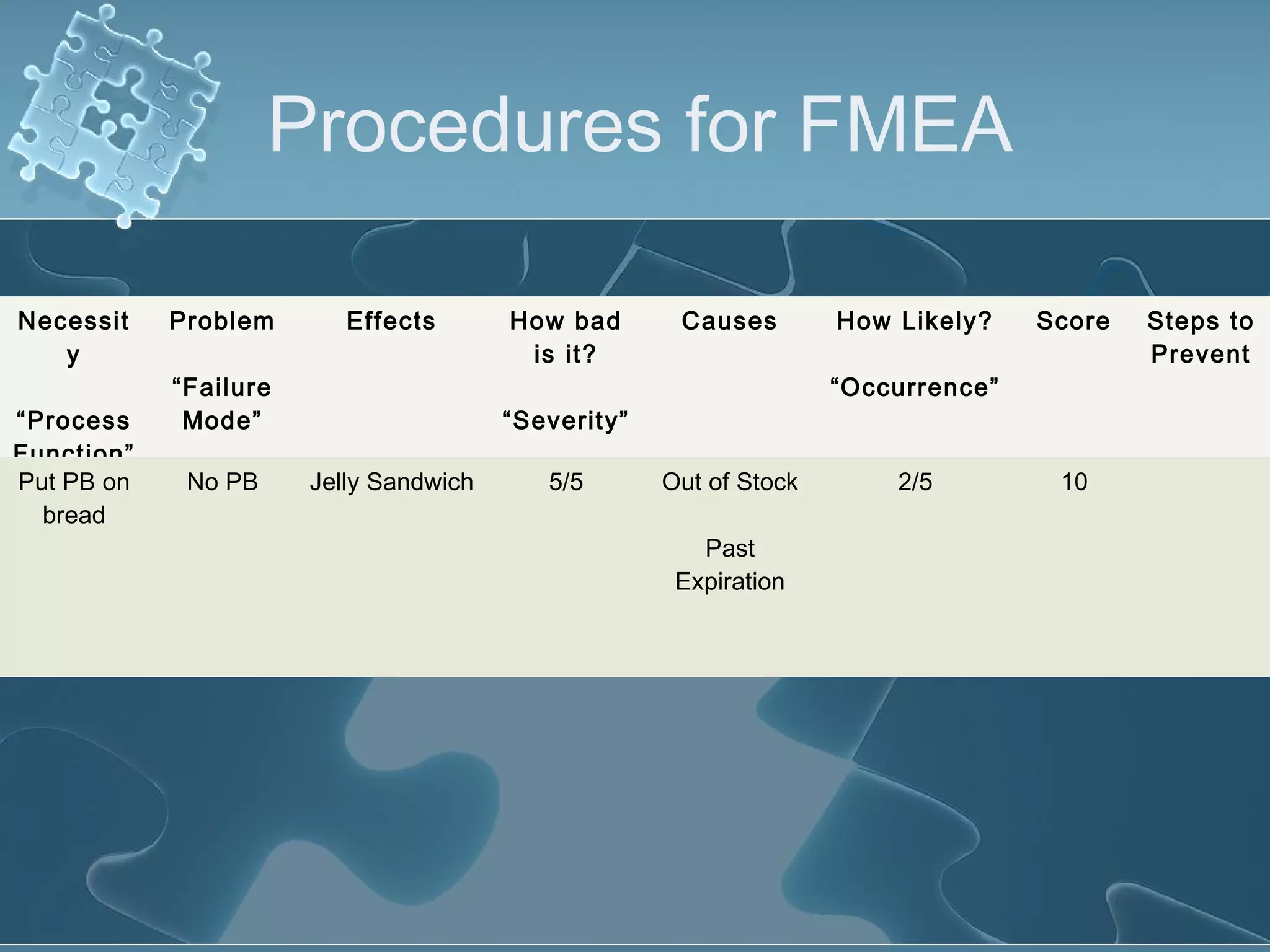
Procedures for FMEA
Necessit
y
“Process
Function”
Problem
“Failure
Mode”
Effects How bad
is it?
“Severity”
Causes How Likely?
“Occurrence”
Score Steps to
Prevent
Procedures for FMEA
Necessit
y
“Process
Function”
Problem
“Failure
Mode”
Effects How bad
is it?
“Severity”
Causes How Likely?
“Occurrence”
Score Steps to
Prevent
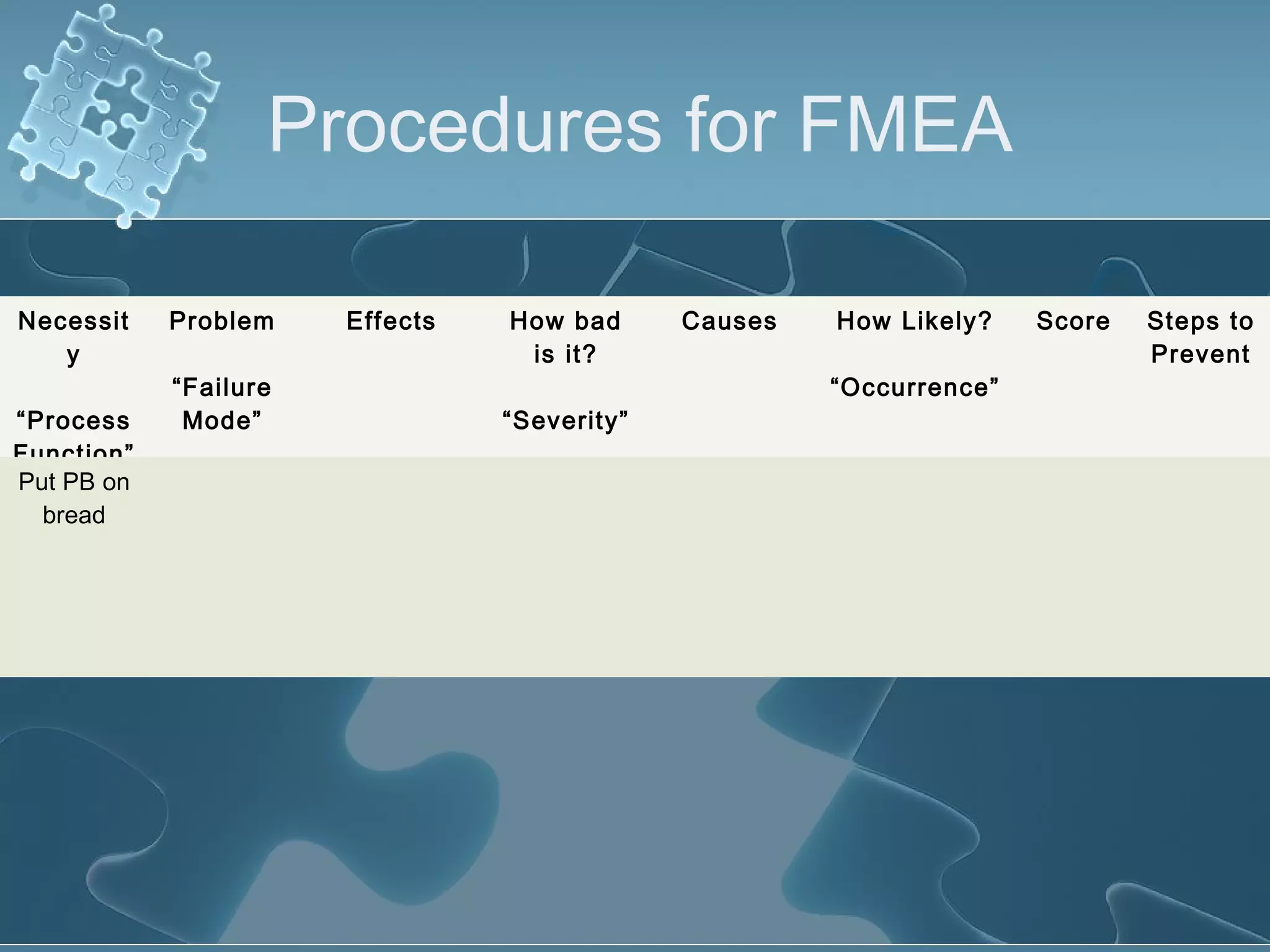
Put PB on
bread
Procedures for FMEA
Necessit
y
“Process
Function”
Problem
“Failure
Mode”
Effects How bad
is it?
“Severity”
Causes How Likely?
“Occurrence”
Score Steps to
Prevent
Put PB on
bread
No PB
Procedures for FMEA
Necessit
y
“Process
Function”
Problem
“Failure
Mode”
Effects How bad
is it?
“Severity”
Causes How Likely?
“Occurrence”
Score Steps to
Prevent
Put PB on
bread
No PB Jelly Sandwich
Procedures for FMEA
Necessit
y
“Process
Function”
Problem
“Failure
Mode”
Effects How bad
is it?
“Severity”
Causes How Likely?
“Occurrence”
Score Steps to
Prevent
Put PB on
bread
No PB Jelly Sandwich 5/5
Procedures for FMEA
Necessit
y
“Process
Function”
Problem
“Failure
Mode”
Effects How bad
is it?
“Severity”
Causes How Likely?
“Occurrence”
Score Steps to
Prevent
Put PB on
bread
No PB Jelly Sandwich 5/5 Out of Stock
Past
Expiration
Procedures for FMEA
Necessit
y
“Process
Function”
Problem
“Failure
Mode”
Effects How bad
is it?
“Severity”
Causes How Likely?
“Occurrence”
Score Steps to
Prevent
Put PB on
bread
No PB Jelly Sandwich 5/5 Out of Stock
Past
Expiration
2/5
Procedures for FMEA
Necessit
y
“Process
Function”
Problem
“Failure
Mode”
Effects How bad
is it?
“Severity”
Causes How Likely?
“Occurrence”
Score Steps to
Prevent
Put PB on
bread
No PB Jelly Sandwich 5/5 Out of Stock
Past
Expiration
2/5 10
Procedures for FMEA
Necessit
y
“Process
Function”
Problem
“Failure
Mode”
Effects How bad
is it?
“Severity”
Causes How Likely?
“Occurrence”
Score Steps to
Prevent
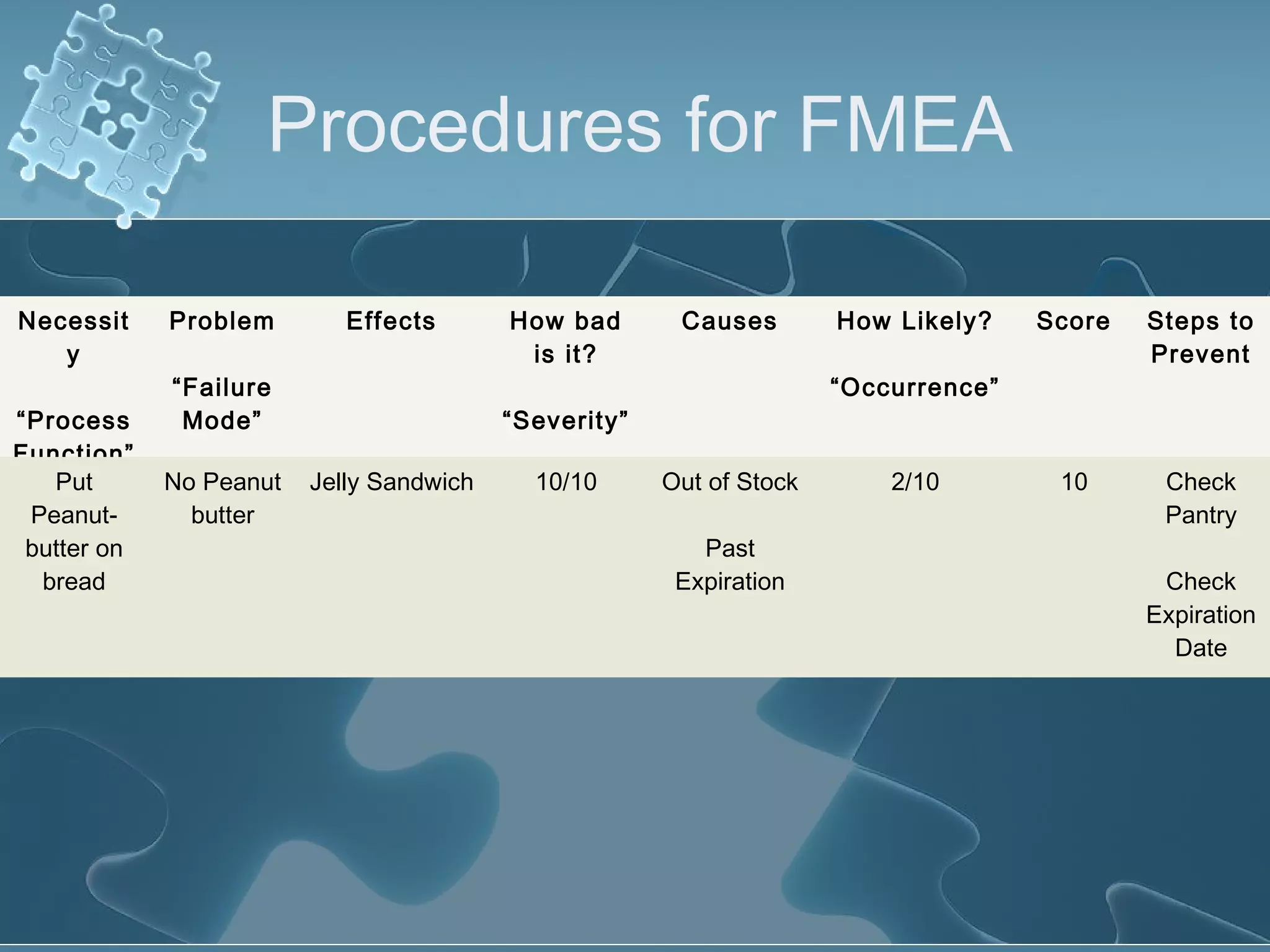
Put
Peanut-
butter on
bread
No Peanut
butter
Jelly Sandwich 10/10 Out of Stock
Past
Expiration
2/10 10 Check
Pantry
Check
Expiration
Date
Summary
28
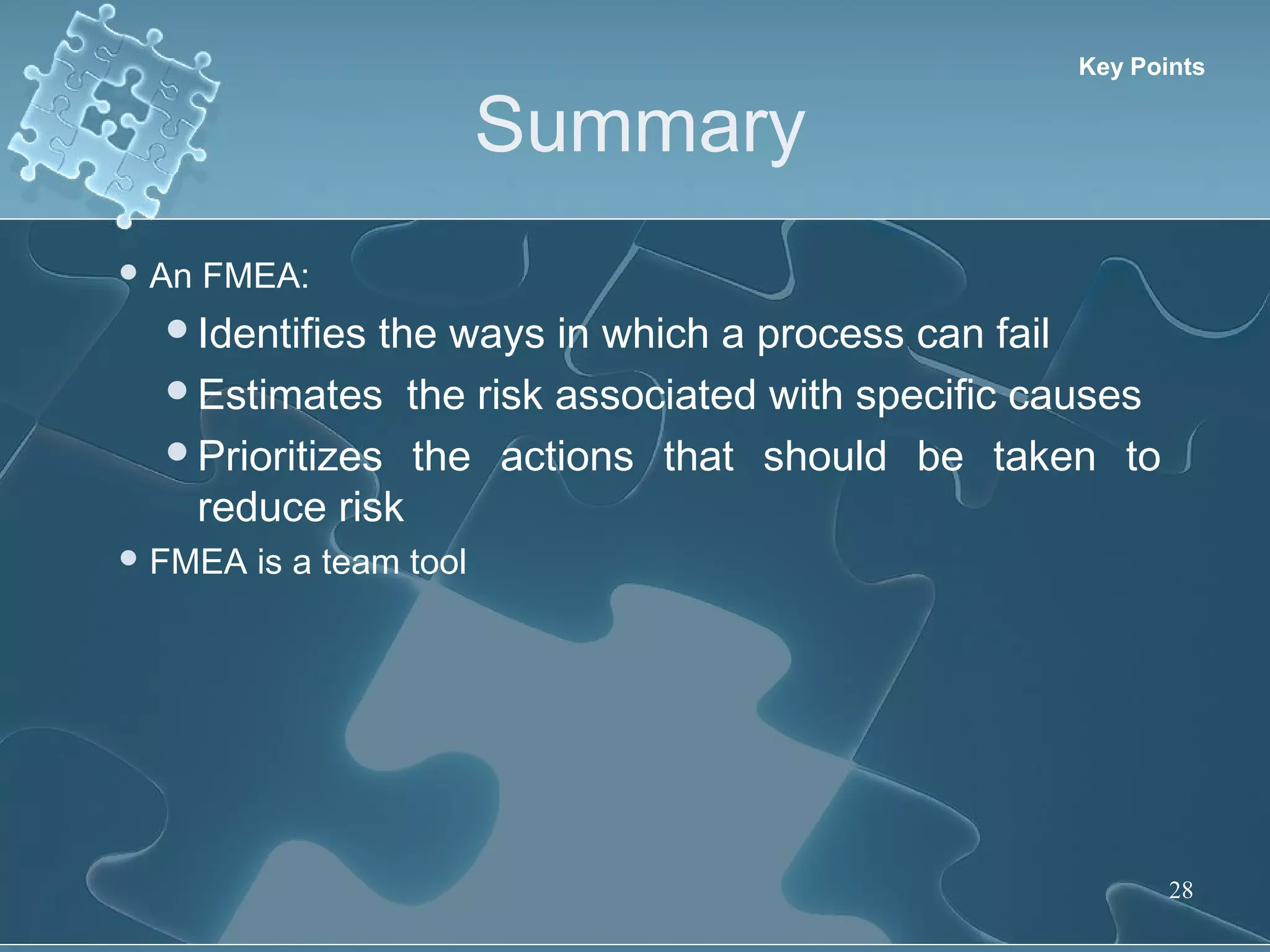
 An FMEA:
Identifies the ways in which a process can fail
Estimates the risk associated with specific causes
Prioritizes the actions that should be taken to
reduce risk
 FMEA is a team tool
Key Points
Failure mode and effect analysis

Failure mode and effect analysis

  • 1.
    Failure Mode andEffect Analysis Dr. Shailendra.V.L. Director of Patient Safety
  • 2.
    Objectives What is FMEA? Historyof FMEA Why is an FMEA important? Benefits of FMEA Limitations of FMEA How to conduct an FMEA?
  • 3.
    Failure Mode andEffect Analysis FMEA is: a process that identifies all the possible types of failures that could happen to a service and potential consequences of those failures
  • 4.
    FMEA  A structuredapproach to:  Identifying the ways in which a process can fail  Estimating risk associated with specific causes  Prioritizing the actions that should be taken to reduce risk  Evaluating design validation plan (design FMEA) or current control plan (process FMEA)
  • 5.
    History of FMEA First used in the 1960’s in the Aerospace industry during the Apollo missions to check the space hardware  In 1974, US Navy developed MIL-STD-1629 regarding the use of FMEA  In the late 1970’s, the automotive industry was driven by liability costs to use FMEA  Later, the automotive industry saw the advantages of using this tool to reduce risks related to poor quality
  • 6.
    What Is AFailure Mode? A Failure Mode is: Things that could go wrong The way in which the steps and / or the process could fail to perform its intended function Failure modes may be the result of upstream operations or may cause downstream operations to fail
  • 7.
    Why should weuse FMEA  Methodology that facilitates process improvement  Improve internal and external customer satisfaction  Focuses on prevention  FMEA may be a customer requirement  Identifies and eliminates concerns early in the development of a process or design  FMEA may be required by an applicable Quality Management System Standard (CBAHI)
  • 8.
    The Reasons forFMEA  Get it right the first time  Indentifies any inadequacies in the development of the process  Continuous improvement  Preventive approach  Team building  Required procedure from regulatory bodies
  • 9.
    FMEA Terms  Failuremode - the way in which something might fail  Effects analysis – studying the consequences of the various failure modes to determine their severity to the customer
  • 10.
    Process FMEA  Indentifypotential failures related to process failure modes  Assess the potential customer effects of the failures  Identify the potential causes on which to focus on  Develop a ranked list of potential failure modes  Document the results
  • 11.
    FMEA Procedure 11 1. Foreach process input (start with high value inputs), determine the ways in which the input can go wrong (failure mode) 2. For each failure mode, determine effects  Select a severity level for each effect 3. Identify potential causes of each failure mode  Select an occurrence level for each cause 4. List current controls for each cause  Select a detection level for each cause Process Steps
  • 12.
    FMEA Procedure (Cont.) 12 5.Calculate the Risk Priority Number (RPN) 6. Develop recommended actions, assign responsible persons, and take actions  Give priority to high RPNs  MUST look at severities rated as 10 7. Assign the predicted severity, occurrence, and detection levels and compare RPNs Process Steps
  • 13.
    FMEA: A TeamTool 13 A team approach is necessary. Team should be led by the Process Owner who is the technical person, or other similar individual familiar with FMEA. The following should be considered for team members: – process leaders – process employees – QM professional Team Input Required
  • 14.
    Risk Assessment Factors Severity(S): A number from 1 to 10, depending on the severity of the potential failure mode’s effect 1 = no effect 10 = maximum severity Probability of occurrence (O): A number from 1 to 10, depending on the likelihood of the failure mode’s occurrence 1 = very unlikely to occur 10 = almost certain to occur
  • 15.
    Risk Assessment Factors Probabilityof detection (D): A number from 1 to 10, depending on how unlikely it is that the fault will be detected by the system responsible (process control) 1 = nearly certain detention 10 = impossible to detect Risk Priority Number (RPN): The failure mode’s risk is found by the formula RPN = S x O x D. RPN = Severity x Probability of Occurrence x Probability of Detection. RPN will be a number between 1 (virtually no risk) and 1000 (extreme risk)
  • 16.
  • 17.
    Risk Priority Number(RPN) 17 RPN is the product of the severity, occurrence, and detection scores. Severity Occurrence Detection RPNRPNX X = Calculating a Composite Score
  • 18.
    The FMEA Form 18Identifyfailure modes and their effects Identify causes of the failure modes and controls Prioritize Determine and assess actions A Closer Look
  • 19.
    Procedures for FMEA Necessit y “Process Function” Problem “Failure Mode” EffectsHow bad is it? “Severity” Causes How Likely? “Occurrence” Score Steps to Prevent
  • 20.
    Procedures for FMEA Necessit y “Process Function” Problem “Failure Mode” EffectsHow bad is it? “Severity” Causes How Likely? “Occurrence” Score Steps to Prevent Put PB on bread
  • 21.
    Procedures for FMEA Necessit y “Process Function” Problem “Failure Mode” EffectsHow bad is it? “Severity” Causes How Likely? “Occurrence” Score Steps to Prevent Put PB on bread No PB
  • 22.
    Procedures for FMEA Necessit y “Process Function” Problem “Failure Mode” EffectsHow bad is it? “Severity” Causes How Likely? “Occurrence” Score Steps to Prevent Put PB on bread No PB Jelly Sandwich
  • 23.
    Procedures for FMEA Necessit y “Process Function” Problem “Failure Mode” EffectsHow bad is it? “Severity” Causes How Likely? “Occurrence” Score Steps to Prevent Put PB on bread No PB Jelly Sandwich 5/5
  • 24.
    Procedures for FMEA Necessit y “Process Function” Problem “Failure Mode” EffectsHow bad is it? “Severity” Causes How Likely? “Occurrence” Score Steps to Prevent Put PB on bread No PB Jelly Sandwich 5/5 Out of Stock Past Expiration
  • 25.
    Procedures for FMEA Necessit y “Process Function” Problem “Failure Mode” EffectsHow bad is it? “Severity” Causes How Likely? “Occurrence” Score Steps to Prevent Put PB on bread No PB Jelly Sandwich 5/5 Out of Stock Past Expiration 2/5
  • 26.
    Procedures for FMEA Necessit y “Process Function” Problem “Failure Mode” EffectsHow bad is it? “Severity” Causes How Likely? “Occurrence” Score Steps to Prevent Put PB on bread No PB Jelly Sandwich 5/5 Out of Stock Past Expiration 2/5 10
  • 27.
    Procedures for FMEA Necessit y “Process Function” Problem “Failure Mode” EffectsHow bad is it? “Severity” Causes How Likely? “Occurrence” Score Steps to Prevent Put Peanut- butter on bread No Peanut butter Jelly Sandwich 10/10 Out of Stock Past Expiration 2/10 10 Check Pantry Check Expiration Date
  • 28.
    Summary 28  An FMEA: Identifiesthe ways in which a process can fail Estimates the risk associated with specific causes Prioritizes the actions that should be taken to reduce risk  FMEA is a team tool Key Points

Editor's Notes

  • #3 Our objectives for this class is for each person to be knowledgeable of the following things: What is FMEA? Why is an FMEA important? History of FMEA Benefits of FMEA Limitations of FMEA How to conduct an FMEA?
  • #4 Simply put an FMEA is: a process that identifies all the possible types of failures that could happen to a product and potential consequences of those failures. The Failure Mode is what could go wrong and The Effect Analysis is how it would happen; how likely is it to go wrong; how bad would it be
  • #9 There are many reason to do an FMEA, several of the reason were already mentioned and this is a list of other reasons that one would want top conduct an FMEA. The main reason to do an FMEA is to identify any inadequacies in the product and to get it right the first time so that there are no costly mistakes later.
  • #10 Failure mode - the way in which something might fail. For example, a car’s tire might fail by puncture from a sharp object. It might also fail from a blowout resulting from wear. Puncture and blowout are two of the many tire failure modes. Effects analysis – studying the consequences of the various failure modes to determine their severity to the customer. Of the two tie failure modes we just talked about, the blowout is likely to have the most serious consequence, since when a tire suddenly explodes the speeding car usually goes out of control, often with dire consequences. On the other hand, a puncture problem usually allows the tire pressure to decrease gradually, allowing the driver time to sense the problem before he looses control. Neither failure mode is something the driver wants but of the two the puncture is preferred.
  • #11 A process FMEA is used to identify potential process failures and it assess the potential customer effects.
  • #15 These are the risk assessment factors used in an FMEA. Severity is a rating of how severe the failure would be. Probability of Occurrence is a rating of how likely it is to happen.
  • #16 The probability of detection is a rating on how likely it is to detect the failure And the risk priority number is found by multiplying the severity rating by the probability of occurrence by the probability of detection. The auto industry says that a risk priority number of 75 is acceptable. Anything more than that is unacceptable.
  • #17 These flow charts are a visual on how to obtain the risk priority number. The risk priority number is found by multiplying the severity rating by the probability of occurrence by the probability of detection.
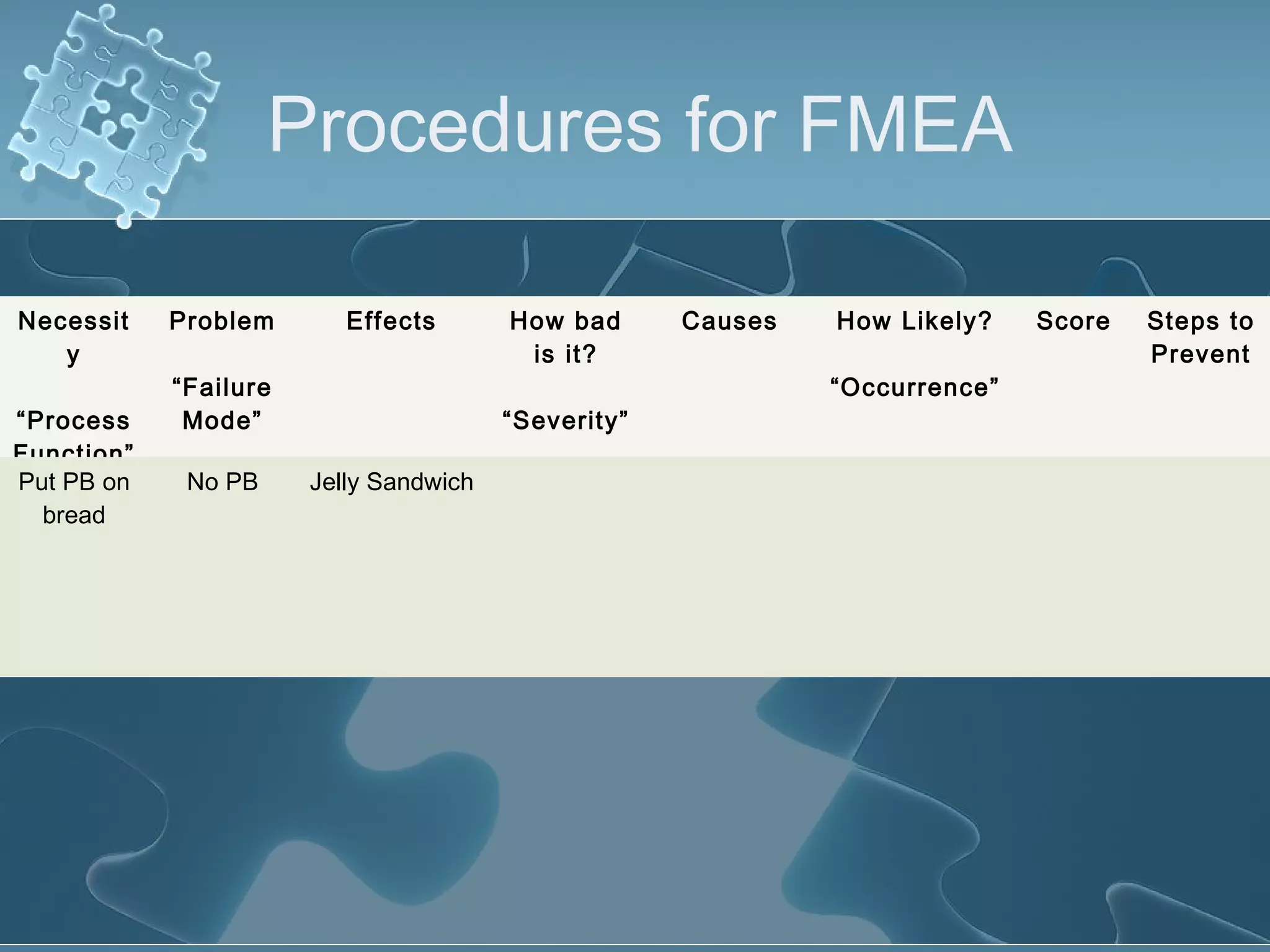
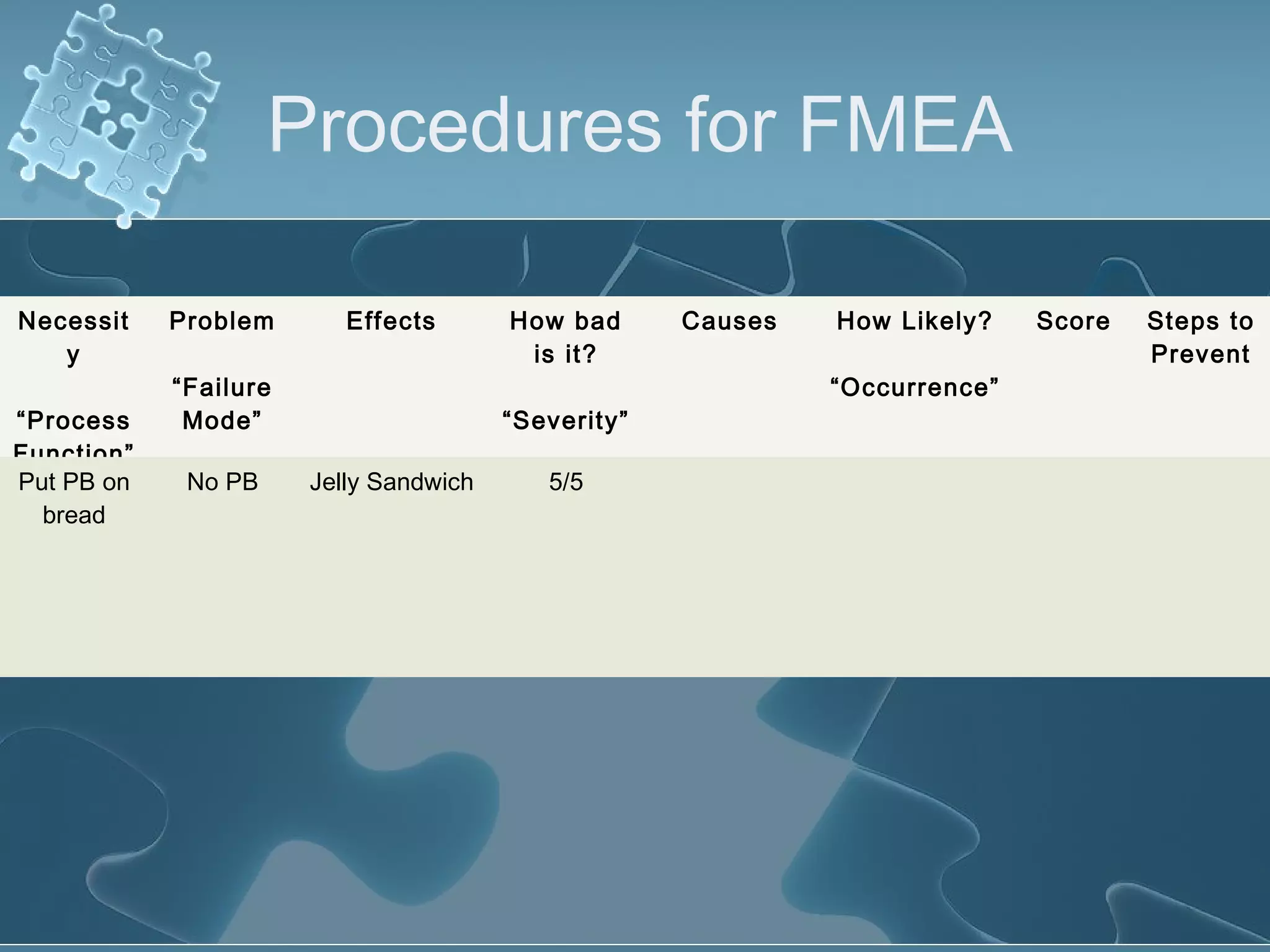
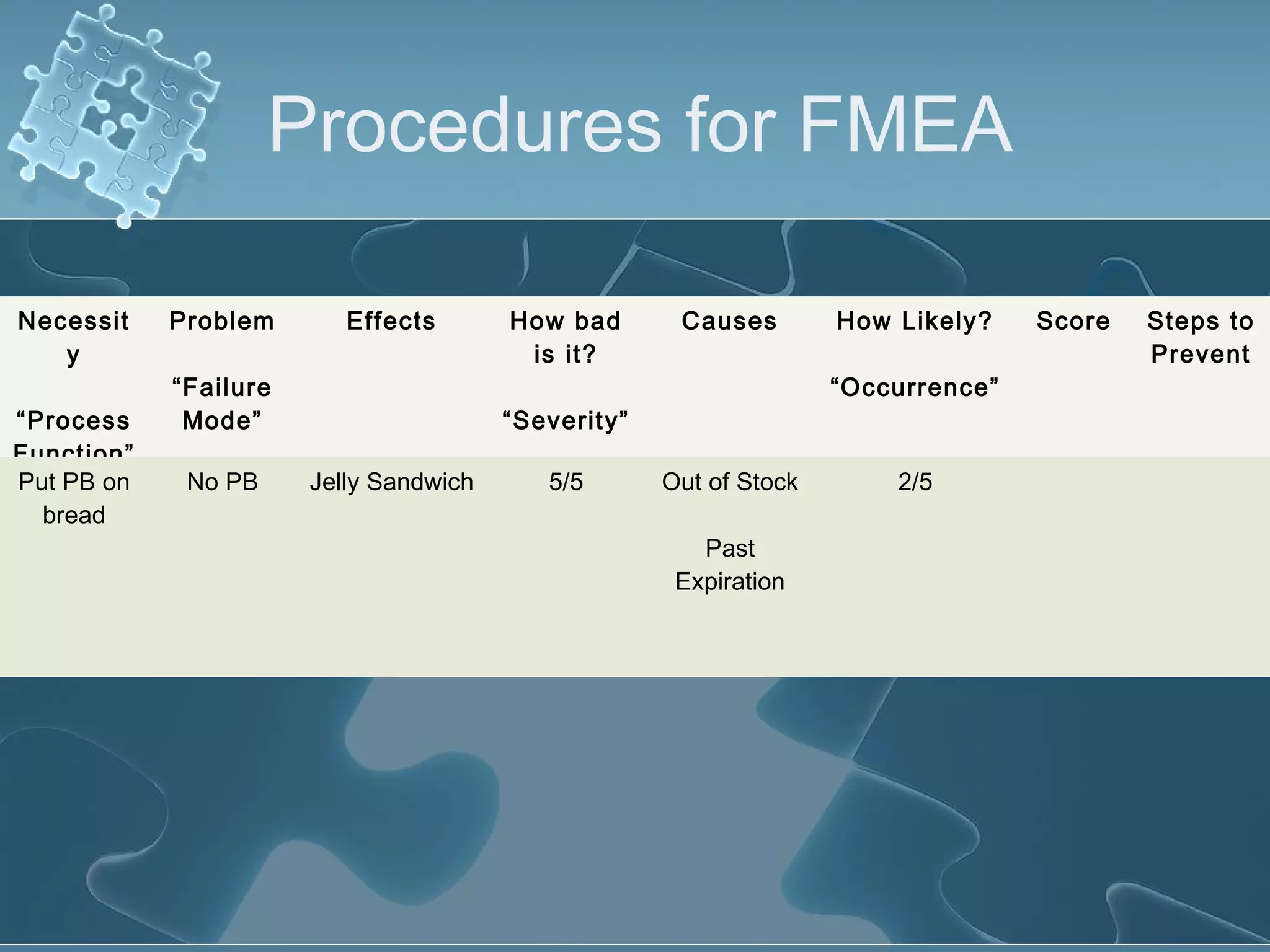
  • #20 It is important to know what an FMEA looks like. You want to gather all your smart people together. The process is tedious, time consuming and exhausting. The FMEA process can be summed up in a special worksheet. We’ve created one to show the example of creating a peanut butter and jelly sandwich. This is an example of a process FMEA. CLICK Our necessity of process function is to put peanut butter on the bread. Another function would be to put jelly on the bread. CLICK Next up is the problem or failure mode. My problem is that I have no peanut butter in my house. Peanut butter is essential to getting peanut butter on the bread. Other problems could be I don’t have a knife or I don’t have bread or my hands are not working or I cant open the jar. CLICK The effect of having no peanut butter is that I end up with a jelly sandwich rather than a peanut butter and jelly sandwich. CLICK The next column is how bad that is or the severity of the effect. Here I will use a 0 to 5 scale with 5 being the worst thing that could happen. In healthcare if a patient could die then that is obviously a rating of 5. I am giving this a high rating because if I have no PB then I have no PB and jelly sandwich. CLICK The next column is all the reasons why this happened. All the reasons why I don’t have peanut butter. It could be that I don’t have any in the pantry or that what I do have is expired. CLICK The next column is another rating on how likely this is to occur. At my house since I have kids that really like to eat PB I would rate this a 2 out of 5. CLICK Next we multiply the score of how likely something is to happen with the how bad it is or severity rating. And this creates a “Hazards Score” CLICK The next column is the steps to prevent this.
  • #30 So who knows : What is FMEA? -to figure out everything that could go wrong and what can be done to keep those things from happening Why is an FMEA important? -It’s for procedures or inventions that would be very risky or very expensive to correct History of FMEA -designed by the military 60 years ago Benefits of FMEA -Identify potential and known failures -Reduce the number of engineering changes -Reduce product development time -Lower start-up costs -Greater customer satisfaction -Increased cooperation and teamwork between various functions -Continuous improvement Limitations of FMEA -There are employee training requirements. -There may be an impact on product and manufacturing schedules -And there is a financial impact due to upgrading a design, adjusting manufacturing, or needing new equipment and tools How to conduct an FMEA? -find severity rating -find probability of occurrence -find probability of detection -find the risk priority number is found by multiplying the severity rating by the probability of occurrence by the probability of detection.