26 August 2016 Safety features in modern cars 1
Introduction
 When you hear the words radar, lasers and infrared
cameras you might think the conversation is about
guidance systems for modern fighter jets but
surprisingly, those three technologies could just as
easily be used in a conversation about automotive
safety. We’ve come a long way in auto safety since
Volvo introduced the three point seat belt in 1959.
26 August 2016 Safety features in modern cars 2
Introduction
 Automobile safety is the study and practice of
design, construction, equipment and regulation to
minimize the occurrence and consequences of
automobile accidents.
 According to the U.S. Insurance Institute for Highway
Safety (IIHS), 1 in 3 fatal crashes and 1 in every 5
serious or moderate injury crashes in passenger
vehicles could have been prevented if the vehicle had
been equipped with crash-avoidance features such as
blind-spot detection, lane-departure warning systems,
side view assistance and adaptive headlights.
26 August 2016 Safety features in modern cars 3
Introduction
 We’ve watched how automotive safety technology has
evolved over the years and we are no longer amazed at
the number of people who walk away from
catastrophic crashes. Energy dispersing designs,
passenger cabins encased in safety cages, air bags
everywhere, smart dash designs and supplemental
restraint systems have all contributed significantly to
passenger safety and survival.
26 August 2016 Safety features in modern cars 4
Road traffic accident (RTA)
 A traffic collision, also known as a road traffic
accident, occurs when a vehicle collides with another
vehicle, pedestrian, animal, road debris, or other
stationary obstruction, such as a tree or utility pole.
Traffic collisions may result in injury, death, vehicle
damage, and property damage.
26 August 2016 Safety features in modern cars 5
Road traffic accident
 A number of factors contribute to the risk of collision,
including vehicle design, speed of operation, road
design, road environment, driver skill and/or
impairment, and driver behavior.
 Worldwide, motor vehicle collisions lead to death and
disability as well as financial costs to both society and
the individuals involved.
26 August 2016 Safety features in modern cars 6
Head-on collision
26 August 2016 Safety features in modern cars 7
Roll over accident
26 August 2016 Safety features in modern cars 8
Side-impact
26 August 2016 Safety features in modern cars 9
Collision into a tree
26 August 2016 Safety features in modern cars 10
Active safety
 The terms "active" and "passive" are simple but
important terms in the world of automotive safety.
“Active safety" is used to refer to technology assisting
in the prevention of a crash.
26 August 2016 Safety features in modern cars 11
Passive safety
 The components of the vehicle like primarily airbags,
seatbelts and the physical structure of the vehicle that
help to protect occupants during a crash belong to
passive safety.
26 August 2016 Safety features in modern cars 12
Safety features in cars
26 August 2016 Safety features in modern cars 13
26 August 2016 Safety features in modern cars 14
26 August 2016 Safety features in modern cars 15
Safety features & their capacity
for reducing the risk of injury
26 August 2016 Safety features in modern cars 16
Seat belts
 A properly worn seat belt provides good protection but does not
always prevent injuries. Three point lap/sash seat belts offer
superior protection to two point seat belts and should be
installed in all seating positions.
 Recent improvements to seat belt effectiveness include:
 webbing clamps that stop more seat belt reeling out as it tightens on
the spool
 pretensioners that pull the seat belt tight before the occupant starts
to move
 load limiters that manage the forces applied to the body in a crash
 seat belt warning systems to remind you if seat belts have not been
fastened.
26 August 2016 Safety features in modern cars 17
Seat belts
26 August 2016 Safety features in modern cars 18
Belt Alert
 This safety feature provides an audible and visual
warning to alert driver & front passenger when their
seat belt is unfastened.
 A sensor detects the front passenger seated and gives
audible & visual warning to fasten the seat belt.
26 August 2016 Safety features in modern cars 19
Height-adjustable Front Seat Belts
 This safety feature allows the
driver and front passenger to
raise and lower the shoulder belt.
 This feature encourages seat-belt
usage by offering a more
comfortable fit.
26 August 2016 Safety features in modern cars 20
Seatbelt Interlock
 The seatbelt interlock is a technology that takes the
existing seatbelt reminder systems one step further
and prevents the driver from starting up the car, unless
seatbelts are worn.
 The technology in SafeCar is active for the driver and
front passenger seats.
26 August 2016 Safety features in modern cars 21
SRS
 Stands for Supplemental Restraint System. This
comprises a network of systems designed to minimize
the chance of injury to all occupants of the vehicle in
the event of a collision. It features airbags and seatbelt
pre-tensioners that deploy immediately upon impact.
26 August 2016 Safety features in modern cars 22
Airbags
 Airbags are designed to supplement the protection
provided by seat belts - they are not a substitute. The
best protection in frontal crashes is achieved using a
properly worn seat belt in combination with an airbag.
 Drivers’ airbags or frontal airbags typically deploy from
the steering wheel to protect the driver from striking
other parts of the car in a frontal crash.
 Drivers’ airbags are designed to be used in conjunction
with seatbelts and do not offer protection in the event
of a side impact crash.
26 August 2016 Safety features in modern cars 23
Airbags
26 August 2016 Safety features in modern cars 24
Airbags inflated
26 August 2016 Safety features in modern cars 25
SRS & air bags
26 August 2016 Safety features in modern cars 26
Side cushion or Curtain airbags
 Curtain airbags are designed to protect the driver's and
passenger's heads in a crash.
How do they work?
 The curtain airbag activates instantaneously in the event of a
side impact crash, deploying from the top of the door rails above
the side window. They form a cushion between the driver or
passenger and the window and stay in place if the car rolls over to
protect their head.
Why do I need them?
 Research conducted in the USA estimates that head protecting
airbags can reduce driver deaths in the event of a side impact
crash by close to 40%*. Without them, in a side impact crash
there is little to protect your head from striking the side of the
car or rigid objects like trees or poles.
26 August 2016 Safety features in modern cars 27
26 August 2016 Safety features in modern cars 28
26 August 2016 Safety features in modern cars 29
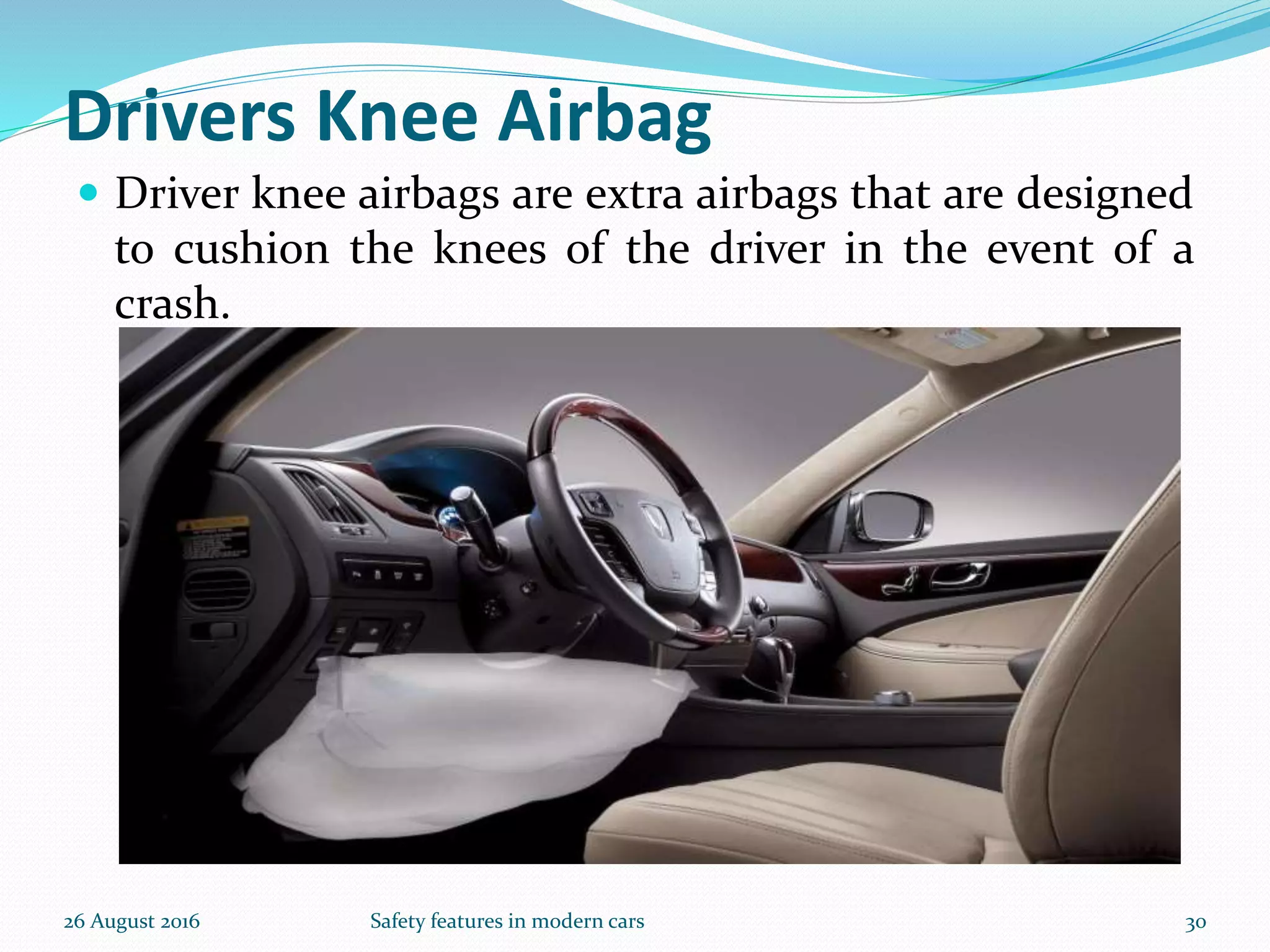
Drivers Knee Airbag
 Driver knee airbags are extra airbags that are designed
to cushion the knees of the driver in the event of a
crash.
26 August 2016 Safety features in modern cars 30
Thorax Airbags With Head
Protection
 Thorax airbags with head protection provide
protection to both the body and the head in the event
of a side impact crash, but are less effective than
curtain airbags in rollover crashes.
 Thorax airbags with head protection mostly activate
from the seat but some types deploy from the door.
26 August 2016 Safety features in modern cars 31
Occupant-sensitive/dual-stage
airbags
 All humans are not created equal, and airbags are
evolving to compensate in the form of low-risk,
multistage and occupant-sensitive deployment.
Technology can now sense the different sizes and
weights of occupants as well as seatbelt usage,
abnormal seating position (such as reaching for the
radio or bending to pick something off the floor), rear-
facing child seats and even vehicle speed.
26 August 2016 Safety features in modern cars 32
Advanced multi-stage air bags
 Front-passenger air bags that use unique shape, venting,
folding patterns, advanced inflators or a combination of
these four technologies to position and inflate the restraint
properly for a belted passenger while also meeting federal
safety requirements for out-of-position, small occupants
and rear-facing infant seats.
 Occupants are advised to always sit properly in their seats
with the seat belt fastened. Children 12 and younger
should always be seated in a back seat, correctly using an
infant- or child-restraint system, or have the seat belt
positioned correctly for their age and weight.
26 August 2016 Safety features in modern cars 33
26 August 2016 Safety features in modern cars 34
Head rests
 Head rests are important safety features and should be
fitted to all seats - front and back. Head rest position is
critical for preventing whiplash in rear impact crashes.
Whiplash is caused by the head extending backward
from the torso in the initial stage of rear impact, then
being thrown forward.
 To prevent whiplash the head rest should be at least as
high as the head's centre of gravity (eye level and
higher) and as close to the back of the head as
possible.
26 August 2016 Safety features in modern cars 35
Head rests
26 August 2016 Safety features in modern cars 36
Shatter proof Windscreen
 The car windscreen is actually two glass glued together
to prevent splinting in an event of collision.
 The safety glass is specially designed to break into
large, circular pieces instead of shattering into
dangerous glass shards in a car collision. This prevents
severe injury for the person inside the car.
26 August 2016 Safety features in modern cars 37
Damaged windscreen
26 August 2016 Safety features in modern cars 38
Damaged windscreen
26 August 2016 Safety features in modern cars 39
Crumple zones
 Modern cars protect drivers and passengers in frontal,
rear and offset crashes by using crumple zones to
absorb crash energy. This means that the car absorbs
the impact of the crash, not the driver or passengers.
 The passenger safety cell and the side impact bars are
car safety features which works the same way as the
like the front and rear crumple zones. Both absorbs the
impact of any force which acts upon them and scatters
it away to the areas around the person inside the car.
26 August 2016 Safety features in modern cars 40
Crumple zone - frontal
26 August 2016 Safety features in modern cars 41
Crumple zone – rear
26 August 2016 Safety features in modern cars 42
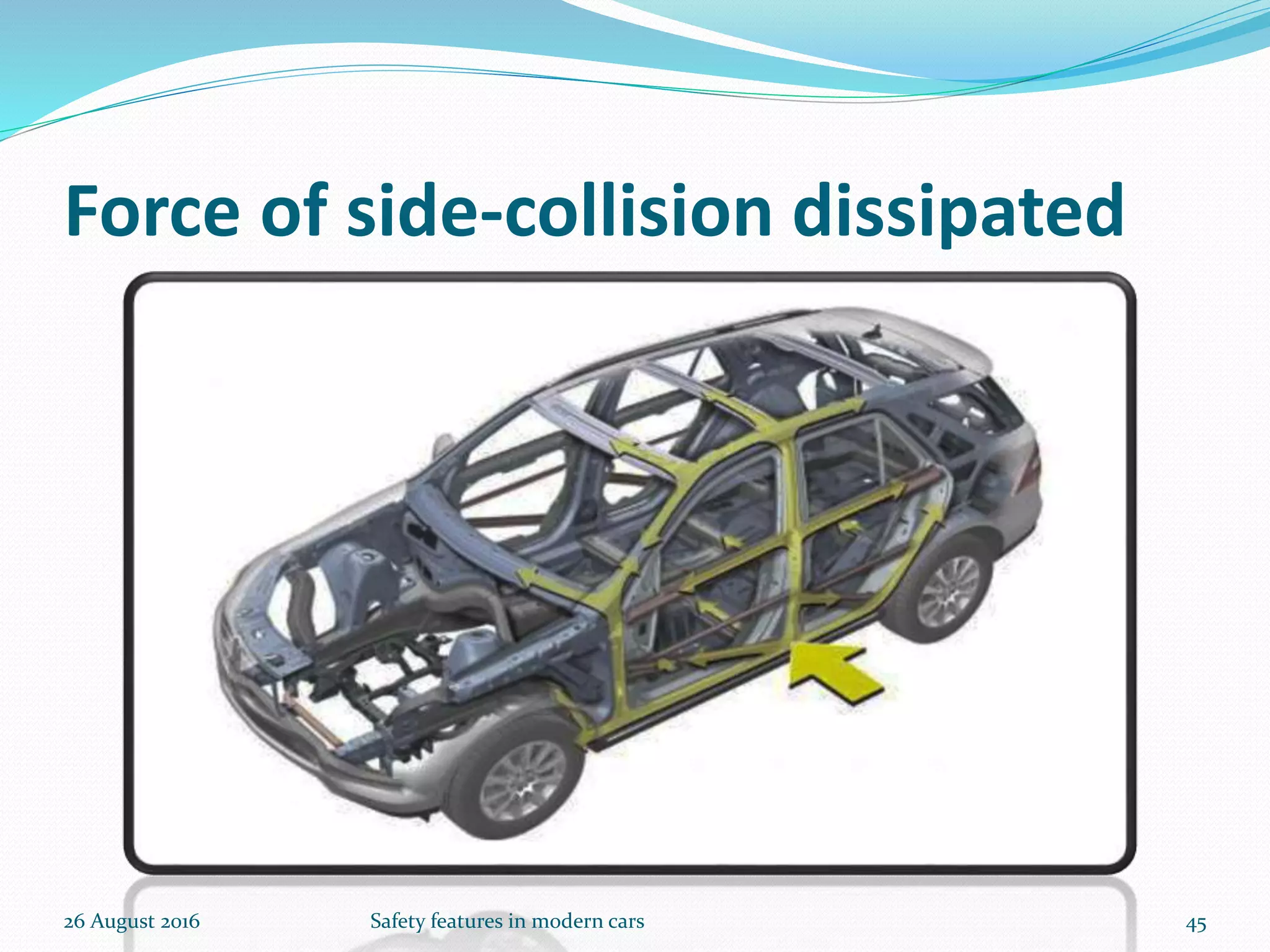
Side impact protection
 Increased side door strength, internal padding and
better seats can improve protection in side impact
crashes. Most new cars have side intrusion beams or
other protection within the door structure. Some cars
also have padding on the inside door panels.
 Increasingly, car manufacturers are installing side
airbags that provide protection from severe injury.
Head-protecting side airbags, such as curtain airbags,
are highly effective in side impact and rollover crashes.
26 August 2016 Safety features in modern cars 43
Side impact protection
26 August 2016 Safety features in modern cars 44
Force of side-collision dissipated
26 August 2016 Safety features in modern cars 45
Strong occupant compartment
 The cabin of the car should keep its shape in frontal
crashes to protect the driver and passenger’s space.
The steering column, dashboard, roof pillars, pedals
and floor panels should not be pushed excessively
inwards, where they are more likely to injure drivers
and passengers. Doors should remain closed during a
crash and should be able to be opened afterwards to
assist in quick rescue, while strong roof pillars can
provide extra protection in rollover crashes.
26 August 2016 Safety features in modern cars 46
Strong occupant compartment
with side impact protection
26 August 2016 Safety features in modern cars 47
Strong occupant compartment
26 August 2016 Safety features in modern cars 48
Energy-absorbing Steering Column
 This safety feature utilizes two hydro-formed coaxial
tubes that can move relative to each other to allow the
column to move forward for enhanced energy-
absorption during a frontal crash.
 The power-adjust steering column employs a
calibrated bending element that deforms during
column stroke for optimal energy management.
26 August 2016 Safety features in modern cars 49
Energy-absorbing Steering Column
26 August 2016 Safety features in modern cars 50
Car seat by child’s age chart
26 August 2016 Safety features in modern cars 51
Child restraints
26 August 2016 Safety features in modern cars 52
Infant car seat – till 2 years of age
 Infant car seats can only be used rear-facing, and must
never be placed forward-facing in a vehicle.
 Infant car seats should always be installed in the back
seat. Used till 2 years or 35 pounds weight.
 This is the best seat for your young child to use. It has a
harness and, in a crash, cradles and moves with your
child to reduce the stress to the child's fragile neck and
spinal cord.
26 August 2016 Safety features in modern cars 53
Infant rear facing seat
26 August 2016 Safety features in modern cars 54
Forward facing convertible seat
 Positions the seat belt so that it fits properly over the
stronger parts of your child's body.
26 August 2016 Safety features in modern cars 55
Booster Seat
26 August 2016 Safety features in modern cars 56
 Booster seats lift children and
position lap and shoulder belts so
they offer the best protection in a
crash.
 The shoulder belt should fit snug
across the center of the shoulder
and not across the neck or face or
slipping off the shoulder.
 The lap belt should lie flat across
the upper thighs and not on the
tummy.
Child-protection Rear Door Locks
 This safety feature disable the rear doors’ inside-
release handle via a small lever on the door-shut face.
 The rear doors can be opened only from outside and
not accidentally by children from inside.
 The feature is activated manually by depressing the
small lever down.
26 August 2016 Safety features in modern cars 57
Child protection rear door lock
26 August 2016 Safety features in modern cars 58
Antilock Braking System
 ABS (Antilock Braking System) reduces the risk of
tyres skidding under heavy braking and allows the
driver to maintain steering control of the car.
 ABS only operates under heavy braking or on slippery
surfaces.
26 August 2016 Safety features in modern cars 59
Anti-lock braking system (ABS)
26 August 2016 Safety features in modern cars 60
Active Braking Systems
 Active braking systems are a new safety technology
that provide drivers with braking support during
emergency situations.
 Brake Assist, measure the speed and force of brake
application to determine whether the driver is
attempting an emergency stop. If such an emergency is
determined, the system applies additional brake
pressure to allow the driver to take full advantage of
the Anti-lock braking system (ABS) which prevents
wheel lock up.
26 August 2016 Safety features in modern cars 61
How will Active Braking Systems
help me?
 Active braking can be of assistance to the driver by:
 preventing rear collisions by assisting with maximum
brake force in emergency situations
 warning of the potential for a collision with an
upcoming car or obstacle
 preventing rear collisions by partially applying the
braking and assisting with maximum brake force in
emergency situations
26 August 2016 Safety features in modern cars 62
Brake/Park Interlock
 Prevents an automatic transmission or transaxle from
being shifted out of Park until the brake pedal is
applied.
26 August 2016 Safety features in modern cars 63
Electronic Stability Control
 Electronic Stability Control (ESC)
helps drivers to avoid crashes by
reducing the danger of skidding, or
losing control as a result of over-
steering. ESC becomes active when a
driver loses control of their car. It uses
computer controlled technology to
apply individual brakes and help
bring the car safely back on track,
without the danger of fish-tailing.
26 August 2016 Safety features in modern cars 64
Electronic Stability Control
 Electronic stability control is a fancy name for a bunch
of sensors mounted throughout your vehicle that tell
the computer at the heart of your vehicle what is
happening. This way the computer can make minute
adjustments to your vehicle to keep it on the road and
keep you and your passengers safe.
 Electronic stability control is one of the least flashy
safety features, but its effectiveness at preventing
deaths cannot be denied.
26 August 2016 Safety features in modern cars 65
Electronic Stability Control
How it works?
 ESC works by using a number of intelligent sensors
that detect any loss of control and automatically apply
the brake to the relevant wheel, putting your car back
on the intended path.
 ESC is of assistance to the driver in:
 correcting impending over-steering or under-steering
 stabilizing the car during sudden evasive manoeuvres
 enhancing handling on gravel patches, such as road
shoulders
 improving traction on slippery or icy roads.
26 August 2016 Safety features in modern cars 66
Electronic stability control system
26 August 2016 Safety features in modern cars 67
Is ESC different to Antilock Braking
(ABS) and Traction Control?
 ABS and Traction control are integral components of
an ESC system. Whilst every car with ESC has ABS
and Traction Control, those with ABS and Traction
control do not necessarily have ESC. ABS and Traction
Control only work in the driving (longitudinal)
direction. ESC can help drivers to cope with sideways
(lateral) movements which create instability. Unlike
ABS and Traction Control, ESC is a holistic system that
can control a car’s entire movements.
26 August 2016 Safety features in modern cars 68
Electronic stability control
26 August 2016 Safety features in modern cars 69
Traction Control
 Traction Control systems optimize grip and stability of
the car on the road during acceleration by measuring
wheel rotation. It stops wheel spin by reducing engine
power or temporarily applying the brakes to that
wheel, allowing the car to accelerate smoothly, even on
slippery surfaces.
 Limited slip differentials also help provide a more even
distribution of traction forces when the car is on a
slippery surface.
26 August 2016 Safety features in modern cars 70
Traction Control
 Traction Control detects wheel slippage (one or more
wheels spinning faster than the others) during
acceleration and applies brake pressure to the
appropriate wheels, which subsequently transfers
power and torque to the opposite wheels.
 Traction Control also helps in cornering and handling
situations in both normal and inclement conditions to
prevent understeer and oversteer.
26 August 2016 Safety features in modern cars 71
Traction Control
26 August 2016 Safety features in modern cars 72
26 August 2016 Safety features in modern cars 73
Traction Control
26 August 2016 Safety features in modern cars 74
 Traction
control
systems
limit power
to the drive
wheels to
prevent
wheel-spin
under
acceleration
Understeer
 Understeer and
oversteer are vehicle
dynamics terms used to
describe the sensitivity of
a vehicle to steering.
 Understeer is what occurs
when a car steers less
than (under) the amount
commanded by the
driver.
26 August 2016 Safety features in modern cars 75
Oversteer
 Oversteer is what
occurs when a car
turns (steers) by more
than (over) the
amount commanded
by the driver.
26 August 2016 Safety features in modern cars 76
Vertical stability control - VSC
 It is a safety feature that deploys when cornering. As a
car enters a curve, the VSC system monitors any loss of
traction or slippage on any of the individual wheels. In
doing so it eliminates both understeer and oversteer,
which reduces the control the driver has over the
vehicle.
 In either instance, the VSC system will take control to
orientate the vehicle in such a way as to prevent the
rear slipping or the front pushing forward.
26 August 2016 Safety features in modern cars 77
Traction control - TRC
 This feature detects wheel spin and either applies
pressure to the brakes or slows the engine to stop it.
Typically it deploys when driving in wet road
conditions, the system constantly monitors how the
tires are performing against the road.
 TRC is also beneficial if one half of the car is on a
different surface, one that provides less traction, such
as grass or gravel.
26 August 2016 Safety features in modern cars 78
Daytime Running Lights
 Daytime Running Lights (DRLs) are headlights that
are illuminated during the day in order to make
vehicles more visible and thus reduce their
involvement in crashes. It is possible to fit vehicles
with a device that will automatically activate DRLs
when the ignition is switched on but is overridden by
full strength headlights.
 DRLs have been found to increase driver’s peripheral
perception of vehicles. It is also easier for drivers to
estimate the distance to vehicles with DRLs.
26 August 2016 Safety features in modern cars 79
Daytime running lamps (DRL)
26 August 2016 Safety features in modern cars 80
Fog Lamps
 Fog lamps have a low, flat, fan shaped beam designed
to improve the driver’s ability to view the road. Fog
lamps must only be used in low visibility conditions
such as fog or snow.
26 August 2016 Safety features in modern cars 81
Reversing camera
 It is a special type of video camera that is produced
specifically for the purpose of being attached to the
rear of a vehicle to aid in backing up, and to alleviate
the rear blind spot. Backup cameras are alternatively
known as 'reversing cameras' or 'rear view cameras'. It
is specifically designed to avoid a Backup collision. The
area directly behind vehicles has been described as a
"killing zone" due to the associated carnage
26 August 2016 Safety features in modern cars 82
Reversing camera
 The design of a backup camera is distinct from other
cameras in that the image is horizontally flipped so
that the output is a mirror image. This is necessary
because the camera and the driver face opposite
directions, and without it, the camera's right would be
on the driver's left and vice versa. A mirrored image
makes the orientation of the display consistent with
the physical mirrors installed on the vehicle. A backup
camera typically sports a wide angle or fish-eye lens.
26 August 2016 Safety features in modern cars 83
Reversing Camera
 Reversing cameras improves the rearward view and
can assist drivers in detecting persons or objects in the
path of a reversing vehicle.
26 August 2016 Safety features in modern cars 84
Reverse camera
26 August 2016 Safety features in modern cars 85
Reverse backup sensors
 These are proximity sensors for automobiles designed to
alert the driver to obstacles while parking. These systems,
use either electromagnetic or ultrasonic sensors. Rear
sensors activated when reverse gear is selected and
deactivated as soon as any other gear selected.
 Ultrasonic sensors: These sensors emit acoustic pulses, with a
control unit measuring the return interval of each reflected
signal and calculating object distances.[2] The system in turns
warns the driver with acoustic tones, the frequency indicating
object distance, with faster tones indicating closer proximity
and a continuous tone indicating a minimal pre-defined
distance.
26 August 2016 Safety features in modern cars 86
Reverse backup sensors
 For use with or without a camera, this equipment
beeps if you are about to hit something while backing
up.
26 August 2016 Safety features in modern cars 87
Parking assist
26 August 2016 Safety features in modern cars 88
 Parking aid offers greater
comfort and support when
parking. Visual and/or
audible warnings are
issued with escalating
urgency when the vehicle is
within 250 cm of an
obstacle. The driver has a
reliable indicator of how
much space remains, even
if the line of sight is
blocked. Even the smallest
parking spaces can be used
as a result.
Active parking assist
 It uses ultra-sonic based sensing system & electric
powered steering system to position the vehicle for
parallel parking .
 Drivers can operate the system with a touch of the
button & without touching the steering wheel.
26 August 2016 Safety features in modern cars 89
Active parking assist
26 August 2016 Safety features in modern cars 90
Rear view mirror
 A rear-view mirror is a mirror in automobiles and
other vehicles, designed to allow the driver to see
rearward through the vehicle's backlight.
 In cars, the rear-view mirror is usually affixed to the
top of the windshield on a swivel mount allowing it to
be adjusted to suit the height and viewing angle of any
driver and to swing harmlessly out of the way if
impacted by a vehicle occupant in a collision.
 The rear-view mirror is augmented by one or more
side-view mirrors.
26 August 2016 Safety features in modern cars 91
Objects in mirror are closer than
they appear – Engraved Warning
 Safety warning that is required to be engraved on
passenger side-mirrors of motor vehicles in the USA,
Canada and India.
 While these mirrors' convexity gives them a useful
field of view, it also makes objects appear smaller.
Since smaller-appearing objects seem farther away
than they actually are, a driver might make a maneuver
such as a lane change assuming an adjacent vehicle is a
safe distance behind, when in fact it is quite a bit
closer.[
26 August 2016 Safety features in modern cars 92
Rear view mirror
26 August 2016 Safety features in modern cars 93
Side mirror
 A door mirror/side mirror is found on the exterior
of motor vehicles for the purposes of helping the
driver see areas behind and to the sides of the vehicle,
outside of the driver's peripheral vision.
26 August 2016 Safety features in modern cars 94
Side mirror
26 August 2016 Safety features in modern cars 95
Day-night mirror
 This can be tilted to reduce the brightness and glare of
lights, mostly for high-beam headlights of vehicles behind
which would otherwise be reflected directly into the
driver's eyes at night.
 On manual tilt versions, a tab is used to adjust the mirror
between "day" and "night" positions. In the day view
position, the front surface is tilted and the reflective back
side gives a strong reflection. When the mirror is moved to
the night view position, its reflecting rear surface is tilted
out of line with the driver's view. This view is actually a
reflection off the low-reflection front surface; only a much-
reduced amount of light is reflected into the driver's eyes.
26 August 2016 Safety features in modern cars 96
Day-night mirror
26 August 2016 Safety features in modern cars 97
Blind spots
 As one is driving an
automobile, blind spots
are the areas of the road
that cannot be seen
while looking forward
or through either the
rear-view or side
mirrors.
26 August 2016 Safety features in modern cars 98
Blind spots
26 August 2016 Safety features in modern cars 99
Society of Automotive Engineers
recommendation (SAE)
 Adjust the outside mirrors so far outward that the viewing
angle of the side mirrors just overlaps that of the cabin’s
rearview mirror. This can be disorienting for drivers used to
seeing the flanks of their own car in the side mirrors. But
when correctly positioned, the mirrors negate a car’s blind
spots. This obviates the need to glance over your shoulder
to safely change lanes as well as the need for an expensive
blind-spot warning system.
 The only problem is getting used to the SAE-recommended
mirror positions. The cabin’s rearview mirror is used to
keep an eye on what is coming up from behind, while the
outside mirrors reflect the area outside the view of the
inside rearview mirror.
26 August 2016 Safety features in modern cars 100
26 August 2016 Safety features in modern cars 101
Blind-spot Warning System
 Blind spot warning systems detect the distance and closing
speed of objects in adjacent lanes and alert the driver if a
collision is imminent.
 On a highway, a car which is far behind can be clearly seen
in the rear view mirrors. However, as the car approaches, a
point is reached where the car cannot be seen in either the
interior or exterior mirrors. Typically this occurs when the
car is just behind and to one side of the vehicle it is
overtaking. It is a common mistake for drivers to change
lanes when there is a vehicle in this so-called "blind spot", a
manoeuvre which causes many crashes.
26 August 2016 Safety features in modern cars 102
Head lights
26 August 2016 Safety features in modern cars 103
Low beam
 Low beam (dipped beam) headlamps provide a
distribution of light designed to provide adequate
forward and lateral illumination, with limits on light
directed towards the eyes of other road users to control
glare. This beam is intended for use whenever other
vehicles are present ahead, whether oncoming or
being overtaken.
26 August 2016 Safety features in modern cars 104
Low beam of head lights (Dim)
26 August 2016 Safety features in modern cars 105
Low beam pattern for right hand
traffic
26 August 2016 Safety features in modern cars 106
High beam
 High beam (main beam, driving beam, full beam)
headlamps provide a bright, centre-weighted
distribution of light with no particular control of light
directed towards other road users' eyes. As such, they
are only suitable for use when alone on the road, as the
glare they produce will dazzle other drivers.
26 August 2016 Safety features in modern cars 107
High beam of head lights (Dip)
26 August 2016 Safety features in modern cars 108
High beam pattern for right hand
drive
26 August 2016 Safety features in modern cars 109
Adaptive headlights
 Adaptive headlights follow the direction of the vehicle
(bending the light as you go around corners).
 The Adaptive Headlights cast their beam in the direction of
the curve and ensure better visibility and more safety during
night drives on winding roads.
 Sensors measure speed, steering angle and yaw (degree of
rotation around the vertical axis). Based on this information,
small electric motors turn the headlights left or right so the
beam falls on the road ahead, guiding you into the bend.
 Headlight beam throw control means the front headlights are
raised at high speeds and lowered at slower speeds, which
results in a wider beam for inner-city driving.
26 August 2016 Safety features in modern cars 110
Adaptive headlights
Dotted line indicates usual range of light
Continuous line shows light adapted to the curve of the road
26 August 2016 Safety features in modern cars 111
Automatic headlamps
 A sensor activates the headlights on at dusk and off at
dawn, or more often when the car enters a dark
underground parking or tunnels in broad day light
 This feature alerts the driver by the head lights turning
on encountering sudden darkness.
26 August 2016 Safety features in modern cars 112
Inside Emergency Trunk Release
 This safety feature with a glow-in-the-dark release
handle, can be activated in the event of an adult or
child being inadvertently trapped inside the trunk.
26 August 2016 Safety features in modern cars 113
Keyless entry system
 It is an electronic lock that controls access to a vehicle
without using a traditional mechanical key.
 It is also called remote central locking, refers to a
lock that uses an electronic remote control as a key
which is activated by a handheld device.
26 August 2016 Safety features in modern cars 114
Keyless entry system
26 August 2016 Safety features in modern cars 115
Smart key
 Cars have a proximity system that is triggered if a key like
transducer is within a certain distance of the car.
 With the smart key system, a vehicle can be unlocked
without the driver needing to physically push a button on
the key fob to lock or unlock the car and is also able to start
or stop the ignition without physically having to insert the
key and turning the ignition. Instead, as you approach the
vehicle, the vehicle senses that the key (located in a pocket,
purse, etc.) is approaching the vehicle. When the key fob is
within the car's required "bubble" distance, the car will
sense & unlock the doors.
26 August 2016 Safety features in modern cars 116
Smart key
26 August 2016 Safety features in modern cars 117
 The Start/Stop engine
button. On pressing
with the smart key
with you the engine is
started.
Speed alert system
 A speed alert system, common on many cars, only
provides an audiovisual warning if the speed
programmed by the driver is exceeded. ISA
automatically provides warnings in all speed zones
once the posted speed limit is exceeded by a set
amount (eg. 2km/hr or more).
 ISA uses GPS and digital mapping to determine the
cars location and the speed limit for the road on which
the car is travelling.
26 August 2016 Safety features in modern cars 118
Cross Traffic Alert system
 Have you ever gone to reverse out of a nose-in car park
only to be blasted by a vehicle driving perhaps too fast
behind you?
 This system uses sensors in the rear corners of the car
to determine if it is safe or not to reverse out. If the
sensors detect a vehicle, the dash gives you a beep to
warn you.
26 August 2016 Safety features in modern cars 119
Cross Traffic Alert system
26 August 2016 Safety features in modern cars 120
Road-Sign Recognition system
 Sensors in the front of the car automatically ‘read’ road
signs for you.
 The speed limit is continuously displayed inside the
speedo area and updates every time it sees a new
sign/speed limit.
 It can also pick up ‘narrow bridge’ and ‘no overtaking’
signs.
 If you’ve ever been on a journey and thought to
yourself, ‘gee, I can’t remember what the speed limit is’,
this completely eradicates that.
26 August 2016 Safety features in modern cars 121
Road-Sign Recognition system
26 August 2016 Safety features in modern cars 122
Road-Sign Recognition system
26 August 2016 Safety features in modern cars 123
 Road-sign recognition
systems help drivers to
navigate the “road-sign
jungle.” The system’s video
camera reliably reads road
signs, variable message
signs, and overhead
signage. A symbol in the
cockpit display then
communicates
information to the driver,
for example about
restrictions on overtaking
or speed limits.
Intelligent Speed Assist (ISA)
 Intelligent Speed Assist (ISA) is a safety technology
that alerts drivers when they exceed the speed limit.
ISA activates when a driver exceeds the posted speed
limit for a section of road by a set speed (eg. 2km/hr or
more). Audio and visual warnings activate to remind
the driver that they are going too fast.
 ISA can also be fitted with a speed limiting function
which increases the pressure on the accelerator when
you exceed the posted speed limit, making it harder to
accelerate.
26 August 2016 Safety features in modern cars 124
ISA - How does it work?
 ISA determines the location of the car through global
positioning (GPS) navigation and cross references this
information to a digital road map containing speed limit
information for each road. It then analyses the speed of
the car and issues a visual and audio warning to notify the
driver if they are travelling at a defined amount
(eg. 2km/hr) or more over the speed limit.
 If ISA is used as an active speed limiter it can physically
prevent the driver from exceeding the posted speed limit by
reducing the throttle signal going to the car's computer if it
detects excessive throttle for the current speed limit zone
the car is travelling in.
26 August 2016 Safety features in modern cars 125
ISA can be of assistance to driver by
 Advising when the speed limit is being exceeded.
 Advising when speed limits change along a stretch of
road such as those associated with traffic conditions,
weather or school zones.
 Advising of the current posted speed limit in any
location.
 Preventing excessive speeding.
26 August 2016 Safety features in modern cars 126
Adaptive cruise control
 This uses forward-looking sensors like radar and
cameras to monitor the distance to a lead vehicle.
 The system will automatically slow the vehicle down in
traffic to maintain a safe following distance without
the driver having to do anything.
 As traffic speeds up, the vehicle accelerates to maintain
the preset speed.
 A radar or laser sensor setup allowing the vehicle to
slow when approaching another vehicle ahead and
accelerate again to the preset speed when traffic
allows.
26 August 2016 Safety features in modern cars 127
26 August 2016 Safety features in modern cars 128
Schematic of Intelligent Cruise Control. The red
car automatically follows the blue car
Lane Departure Warning
 This is a mechanism designed to warn a driver when
the vehicle begins to move out of its lane(unless a turn
signal is on in that direction) on freeways and arterial
roads.
 These systems are designed to minimize accidents by
addressing the main causes of collisions: driver error,
distractions and drowsiness.
 Lane warning/keeping systems are based on:
 Video sensors in the visual domain (mounted behind
the windshield, typically integrated beside the rear
mirror)
 Laser sensors (mounted on the front of the vehicle)
26 August 2016 Safety features in modern cars 129
Lane Departure Warning
 Many technologies warn the driver when their car is getting close
to the lane marking. Different systems use different warnings:
some give an audible signal, while others use a vibrating steering
wheel to simulate the feeling of the car running over a 'rumble
strip'. The intention is simply to make the driver aware that the
car is in danger of crossing the line. Some systems need a line
only on one side of the car, while other systems rely on having a
distinct marking on both sides.
 Lane departure warning systems rely on distinct lane markings:
their effectiveness is reduced if lines cannot be clearly
distinguished such as in heavy rain or fog, or if the road
markings are obscured by mud or snow. In such cases, an
indication is given to the driver that the system is unable to
assist.
26 August 2016 Safety features in modern cars 130
Roadways with lane markings
26 August 2016 Safety features in modern cars 131
Sensor for lane departure system
26 August 2016 Safety features in modern cars 132
Sensor for lane departure system
26 August 2016 Safety features in modern cars 133
Windshield camera tracking lane
markings
26 August 2016 Safety features in modern cars 134
Lane departure warning displayed
26 August 2016 Safety features in modern cars 135
Lane departure system in action
26 August 2016 Safety features in modern cars 136
Lane Departure Warning
26 August 2016 Safety features in modern cars 137
Lane Keep Assist
 Lane keep assist proactively steers the car back into the
lane. When the car is close to a marking, the system
gently steers the car away from the line until it is safely
within the lane.
 The system can steer the car either by applying gentle
braking to one wheel, or in the case of electric steering
systems, by applying a direct steering input.
26 August 2016 Safety features in modern cars 138
Predictive emergency braking
system (PEBS)
 PEBS is based on the networking of a radar sensor with
Electronic Stability Control (ESC).
 It can assist in reducing rear-end crashes through its
three-stage approach, thus offering drivers advanced
warning for improved braking reaction time in critical
situations, and assistance in avoiding crashes or
reducing the risk of injury in crashes that are
unavoidable.
26 August 2016 Safety features in modern cars 139
Predictive emergency braking
system (PEBS)
26 August 2016 Safety features in modern cars 140
Forward collision avoidance
system
 Using the same forward-looking sensors, these pre-
crash warning systems alert drivers with visual or
auditory cues when the vehicle is getting too close to
the one in front.
26 August 2016 Safety features in modern cars 141
Collision avoidance systems
26 August 2016 Safety features in modern cars 142
Collision avoidance systems
 Collision Avoidance systems is part of adaptive cruise
control, which helps to avoid collisions.
 The technology uses radar to keep a check on the
vehicles ahead, and decreases the speed automatically
by autonomous braking and by reducing the throttle.
26 August 2016 Safety features in modern cars 143
Tyre Pressure Monitor
 Tyre pressure monitors detect when a tyre drops below
the designated pressure and alerts the driver.
 Sensors at the wheels are able to alert you if the air
pressure is too low by an audible warning, a light on
the instrument panel, or both.
26 August 2016 Safety features in modern cars 144
Add-on tyre pressure monitor
26 August 2016 Safety features in modern cars 145
Driver Drowsiness Detection (DDD)
 DDD utilizes a driver’s steering input to determine
their level of drowsiness.
 A visual and/or audible alert is delivered to the driver
when drowsiness is detected.
26 August 2016 Safety features in modern cars 146
Driver Drowsiness Detection
26 August 2016 Safety features in modern cars 147
Color
 You might think black is chic, but a white car could
save your life!
 A Monash University Accident Research Centre study
demonstrated that white cars had the lowest crash risk
in all types of light conditions (night/overcast/bright
sun), while black cars were more likely to be involved
in a crash, particularly in daylight hours. Opt for white
or lighter color cars to improve your visibility on the
road.
26 August 2016 Safety features in modern cars 148
White color car
26 August 2016 Safety features in modern cars 149
Black color car
26 August 2016 Safety features in modern cars 150
Security Alarm
 This safety feature blows the horn intermittently and
flashes the turn signal lamps to deter vandalism and
theft.
 It protects the vehicle from theft by monitoring both
the door- and lift gate-ajar switches and the ignition
circuit for unauthorized entry.
26 August 2016 Safety features in modern cars 151
Engine Immobilizer
 This safety feature utilizes an engine key that has an
embedded transponder with a preprogrammed
security key code to shut the engine off.
 An electronic chip in the key contains an electronic
code that is transmitted to the vehicle. Only when the
electronic code in the chip corresponds to the vehicle's
registered code can the immobiliser
system be cancelled allowing you
to start the engine.
26 August 2016 Safety features in modern cars 152
Hands-free Communication
System
 This feature uses
Bluetooth technology to
provide voice-activated
wireless communication
between the occupants’
compatible cell phone and
the vehicle’s onboard
receiver.
 The hands-free option
promotes safety, freedom,
value and flexibility.
26 August 2016 Safety features in modern cars 153
Dashboard with Instrument
cluster
 Items located on the dashboard at first included the
steering wheel and the instrument cluster. The instrument
cluster pictured to the right contains gauges such as a
speedometer, tachometer, odometer and fuel gauge, and
indicators such as gearshift position, seat belt warning
light, parking-brake-engagement warning light and an
engine-malfunction light. There may also be indicators for
low fuel, low oil pressure, low tire pressure and faults in the
airbag (SRS) system. Heating and ventilation controls and
vents, lighting controls, audio equipment and automotive
navigation systems are also mounted on the dashboard.
26 August 2016 Safety features in modern cars 154
Dashboard with Instrument
cluster
26 August 2016 Safety features in modern cars 155
Warning- Engine oil low
26 August 2016 Safety features in modern cars 156
Warning – Radiator water
temperature high
26 August 2016 Safety features in modern cars 157
Warning- Battery not charging
26 August 2016 Safety features in modern cars 158
Warning – Air bag malfunction
26 August 2016 Safety features in modern cars 159
Warnings – Door open
26 August 2016 Safety features in modern cars 160
Warning – Fuel very low
26 August 2016 Safety features in modern cars 161
Warning – Speed more than 120
kms/hour
26 August 2016 Safety features in modern cars 162
Warning – Engine needs service
26 August 2016 Safety features in modern cars 163
Warning – High beam activated
26 August 2016 Safety features in modern cars 164
Warning – Indicators on
26 August 2016 Safety features in modern cars 165
Seat belt reminder
26 August 2016 Safety features in modern cars 166
Hazard warning lights on
26 August 2016 Safety features in modern cars 167
Glow plug warning – in diesel cars not
to start the car till the light goes off
26 August 2016 Safety features in modern cars 168
Pedestrian protection
 Cars with a more 'pedestrian friendly' front end should
reduce the severity of injury if you're unfortunate
enough to hit a pedestrian -- particularly at speeds of
up to 30mph.
26 August 2016 Safety features in modern cars 169
Pedestrian protection
26 August 2016 Safety features in modern cars 170
Pedestrian airbag technology
 In order to mitigate the consequences if a collision
with a pedestrian is unavoidable, the Volvo V40,
launched in 2012, comes equipped with the world’s
first Pedestrian Airbag Technology.
 Seven sensors embedded in the front of the car
transmit signals to a control unit. When the car comes
into contact with an object, the control unit evaluates
the signals and if it registers a human-like leg form,
the pedestrian airbag is deployed.
26 August 2016 Safety features in modern cars 171
Pedestrian airbag technology
 The bonnet hinges are equipped with pyrotechnical release
mechanisms which, when the system is activated, pull out a
pin and release the rear of the bonnet. At the same time,
the airbag is inflated. During the inflation sequence, the
airbag raises the bonnet. It is lifted 10 centimetres and stays
in the raised position.
 The added gap between the bonnet and the hard
components in the engine compartment gives space for the
bonnet to deform, absorbing energy and dampening the
impact of the pedestrian’s head and chest.
 It helps to cushion the impact by covering the hard parts
around the windscreen.
26 August 2016 Safety features in modern cars 172
Pedestrian protection
26 August 2016 Safety features in modern cars 173
Pedestrian protection
26 August 2016 Safety features in modern cars 174
Pedestrian protection
26 August 2016 Safety features in modern cars 175
Collision avoidance systems
26 August 2016 Safety features in modern cars 176
Blind-spot detection/side
assist/collision warning
 This technology is designed to alert you to cars or
objects in your blind spot during driving or parking, or
both. Usually it will respond when you put on your
turn signal; if it detects something in the way, it may
flash a light in your mirror, cause the seat or steering
wheel to vibrate, or sound an alarm. This is more of a
short-range detection system.
26 August 2016 Safety features in modern cars 177
Rollover prevention/mitigation
 If the system senses a potential rollover (such as if you
whip around a corner too fast or swerve sharply), it will
apply the brakes and modulate throttle as needed to
help you maintain control. DaimlerChrysler calls it
Electronic Roll Mitigation, Ford named it Roll Stability
Control
GM's is Proactive Roll Avoidance
Range Rover's is Active Roll Mitigation
Volvo's is called Roll-Over Protection System
26 August 2016 Safety features in modern cars 178
Enhanced Accident Response
System (EARS)
 This safety feature makes it easier for emergency
personnel to see and reach occupants in the event of
an accident by turning on the interior lighting and
unlocking the doors after air-bag deployment. Also
shuts off the flow of fuel to the engine.
26 August 2016 Safety features in modern cars 179
Night-vision assist
 Night vision can be executed in different forms, such
as infrared headlamps or thermal-imaging cameras.
But no matter the science, the goal is the same: to help
you see farther down the road and to spot animals,
people or trees in the path — even at nearly 1,000 feet
away. An image is generated through a cockpit display,
brightening the objects that are hard to see with the
naked eye.
26 August 2016 Safety features in modern cars 180
26 August 2016 Safety features in modern cars 181
Run-flat tire
 A run-flat tire is a pneumatic vehicle tire that is
designed to resist the effects of deflation when
punctured, and to enable the vehicle to continue to be
driven at reduced speeds up to 80 km/h, and for
limited distances of up to 160 km.
 These tires contain an extra lining within the tire that
self-seals in the event of a small hole due to a nail. In
this way, the loss of air is prevented from the outset
such that the tire is either permanently self-repairing
or at least loses air very slowly.
26 August 2016 Safety features in modern cars 182
Run flat tire
26 August 2016 Safety features in modern cars 183
 Modern run-flat tires rely on strong,
stiff sidewalls to carry the vehicle’s
weight when air pressure dissipates.
Extracting 50 miles of use from a
flat tire, however, requires more
than strength.
 Driving on a deflated tire—run-flat
or not—initiates a destructive cycle:
As the sidewall collapses, increased
friction generates more heat, which
softens the rubber and causes the
sidewall to sag even further. A run-
flat tire must support the weight of
the vehicle and endure this
damaging heat buildup.
Brake assist - BA
 A safety feature linked to the braking mechanism of a
car – works in conjunction with ABS – is Brake Assist.
This electronic mechanism is useful in emergency
braking situations, applying additional pressure to the
brakes over and above that supplied by the drive
depressing the pedal. The system interprets the force
with which the brake pedal is pushed and if it
determines that the driver is trying to execute an
emergency stop, will apply additional pressure as
required to bring the vehicle to a halt as soon as
possible.
26 August 2016 Safety features in modern cars 184
Paddle shift controls
 This allows the driver to keep both hands on the
steering wheel while changing gear or radio stations
26 August 2016 Safety features in modern cars 185
Traffic jam assist
 Traffic jam assist helps drivers reach their destinations
as relaxed as possible, even when traffic is heavy. It can
brake, accelerate and steer automatically in traffic jams
on the freeway. This feature will be initially put into
series production in 2015. In the following years, the
function will cover larger speed ranges and more
complex driving situations.
 Traffic jam assist is a major milestone in the road to
automated driving.
26 August 2016 Safety features in modern cars 186
26 August 2016 Safety features in modern cars 187
26 August 2016 Safety features in modern cars 188
26 August 2016 Safety features in modern cars 189
26 August 2016 Safety features in modern cars 190
26 August 2016 Safety features in modern cars 191
26 August 2016 Safety features in modern cars 192
26 August 2016 Safety features in modern cars 193
26 August 2016 Safety features in modern cars 194
26 August 2016 Safety features in modern cars 195
26 August 2016 Safety features in modern cars 196

Safety features in our cars

  • 1.
    26 August 2016Safety features in modern cars 1
  • 2.
    Introduction  When youhear the words radar, lasers and infrared cameras you might think the conversation is about guidance systems for modern fighter jets but surprisingly, those three technologies could just as easily be used in a conversation about automotive safety. We’ve come a long way in auto safety since Volvo introduced the three point seat belt in 1959. 26 August 2016 Safety features in modern cars 2
  • 3.
    Introduction  Automobile safetyis the study and practice of design, construction, equipment and regulation to minimize the occurrence and consequences of automobile accidents.  According to the U.S. Insurance Institute for Highway Safety (IIHS), 1 in 3 fatal crashes and 1 in every 5 serious or moderate injury crashes in passenger vehicles could have been prevented if the vehicle had been equipped with crash-avoidance features such as blind-spot detection, lane-departure warning systems, side view assistance and adaptive headlights. 26 August 2016 Safety features in modern cars 3
  • 4.
    Introduction  We’ve watchedhow automotive safety technology has evolved over the years and we are no longer amazed at the number of people who walk away from catastrophic crashes. Energy dispersing designs, passenger cabins encased in safety cages, air bags everywhere, smart dash designs and supplemental restraint systems have all contributed significantly to passenger safety and survival. 26 August 2016 Safety features in modern cars 4
  • 5.
    Road traffic accident(RTA)  A traffic collision, also known as a road traffic accident, occurs when a vehicle collides with another vehicle, pedestrian, animal, road debris, or other stationary obstruction, such as a tree or utility pole. Traffic collisions may result in injury, death, vehicle damage, and property damage. 26 August 2016 Safety features in modern cars 5
  • 6.
    Road traffic accident A number of factors contribute to the risk of collision, including vehicle design, speed of operation, road design, road environment, driver skill and/or impairment, and driver behavior.  Worldwide, motor vehicle collisions lead to death and disability as well as financial costs to both society and the individuals involved. 26 August 2016 Safety features in modern cars 6
  • 7.
    Head-on collision 26 August2016 Safety features in modern cars 7
  • 8.
    Roll over accident 26August 2016 Safety features in modern cars 8
  • 9.
    Side-impact 26 August 2016Safety features in modern cars 9
  • 10.
    Collision into atree 26 August 2016 Safety features in modern cars 10
  • 11.
    Active safety  Theterms "active" and "passive" are simple but important terms in the world of automotive safety. “Active safety" is used to refer to technology assisting in the prevention of a crash. 26 August 2016 Safety features in modern cars 11
  • 12.
    Passive safety  Thecomponents of the vehicle like primarily airbags, seatbelts and the physical structure of the vehicle that help to protect occupants during a crash belong to passive safety. 26 August 2016 Safety features in modern cars 12
  • 13.
    Safety features incars 26 August 2016 Safety features in modern cars 13
  • 14.
    26 August 2016Safety features in modern cars 14
  • 15.
    26 August 2016Safety features in modern cars 15
  • 16.
    Safety features &their capacity for reducing the risk of injury 26 August 2016 Safety features in modern cars 16
  • 17.
    Seat belts  Aproperly worn seat belt provides good protection but does not always prevent injuries. Three point lap/sash seat belts offer superior protection to two point seat belts and should be installed in all seating positions.  Recent improvements to seat belt effectiveness include:  webbing clamps that stop more seat belt reeling out as it tightens on the spool  pretensioners that pull the seat belt tight before the occupant starts to move  load limiters that manage the forces applied to the body in a crash  seat belt warning systems to remind you if seat belts have not been fastened. 26 August 2016 Safety features in modern cars 17
  • 18.
    Seat belts 26 August2016 Safety features in modern cars 18
  • 19.
    Belt Alert  Thissafety feature provides an audible and visual warning to alert driver & front passenger when their seat belt is unfastened.  A sensor detects the front passenger seated and gives audible & visual warning to fasten the seat belt. 26 August 2016 Safety features in modern cars 19
  • 20.
    Height-adjustable Front SeatBelts  This safety feature allows the driver and front passenger to raise and lower the shoulder belt.  This feature encourages seat-belt usage by offering a more comfortable fit. 26 August 2016 Safety features in modern cars 20
  • 21.
    Seatbelt Interlock  Theseatbelt interlock is a technology that takes the existing seatbelt reminder systems one step further and prevents the driver from starting up the car, unless seatbelts are worn.  The technology in SafeCar is active for the driver and front passenger seats. 26 August 2016 Safety features in modern cars 21
  • 22.
    SRS  Stands forSupplemental Restraint System. This comprises a network of systems designed to minimize the chance of injury to all occupants of the vehicle in the event of a collision. It features airbags and seatbelt pre-tensioners that deploy immediately upon impact. 26 August 2016 Safety features in modern cars 22
  • 23.
    Airbags  Airbags aredesigned to supplement the protection provided by seat belts - they are not a substitute. The best protection in frontal crashes is achieved using a properly worn seat belt in combination with an airbag.  Drivers’ airbags or frontal airbags typically deploy from the steering wheel to protect the driver from striking other parts of the car in a frontal crash.  Drivers’ airbags are designed to be used in conjunction with seatbelts and do not offer protection in the event of a side impact crash. 26 August 2016 Safety features in modern cars 23
  • 24.
    Airbags 26 August 2016Safety features in modern cars 24
  • 25.
    Airbags inflated 26 August2016 Safety features in modern cars 25
  • 26.
    SRS & airbags 26 August 2016 Safety features in modern cars 26
  • 27.
    Side cushion orCurtain airbags  Curtain airbags are designed to protect the driver's and passenger's heads in a crash. How do they work?  The curtain airbag activates instantaneously in the event of a side impact crash, deploying from the top of the door rails above the side window. They form a cushion between the driver or passenger and the window and stay in place if the car rolls over to protect their head. Why do I need them?  Research conducted in the USA estimates that head protecting airbags can reduce driver deaths in the event of a side impact crash by close to 40%*. Without them, in a side impact crash there is little to protect your head from striking the side of the car or rigid objects like trees or poles. 26 August 2016 Safety features in modern cars 27
  • 28.
    26 August 2016Safety features in modern cars 28
  • 29.
    26 August 2016Safety features in modern cars 29
  • 30.
    Drivers Knee Airbag Driver knee airbags are extra airbags that are designed to cushion the knees of the driver in the event of a crash. 26 August 2016 Safety features in modern cars 30
  • 31.
    Thorax Airbags WithHead Protection  Thorax airbags with head protection provide protection to both the body and the head in the event of a side impact crash, but are less effective than curtain airbags in rollover crashes.  Thorax airbags with head protection mostly activate from the seat but some types deploy from the door. 26 August 2016 Safety features in modern cars 31
  • 32.
    Occupant-sensitive/dual-stage airbags  All humansare not created equal, and airbags are evolving to compensate in the form of low-risk, multistage and occupant-sensitive deployment. Technology can now sense the different sizes and weights of occupants as well as seatbelt usage, abnormal seating position (such as reaching for the radio or bending to pick something off the floor), rear- facing child seats and even vehicle speed. 26 August 2016 Safety features in modern cars 32
  • 33.
    Advanced multi-stage airbags  Front-passenger air bags that use unique shape, venting, folding patterns, advanced inflators or a combination of these four technologies to position and inflate the restraint properly for a belted passenger while also meeting federal safety requirements for out-of-position, small occupants and rear-facing infant seats.  Occupants are advised to always sit properly in their seats with the seat belt fastened. Children 12 and younger should always be seated in a back seat, correctly using an infant- or child-restraint system, or have the seat belt positioned correctly for their age and weight. 26 August 2016 Safety features in modern cars 33
  • 34.
    26 August 2016Safety features in modern cars 34
  • 35.
    Head rests  Headrests are important safety features and should be fitted to all seats - front and back. Head rest position is critical for preventing whiplash in rear impact crashes. Whiplash is caused by the head extending backward from the torso in the initial stage of rear impact, then being thrown forward.  To prevent whiplash the head rest should be at least as high as the head's centre of gravity (eye level and higher) and as close to the back of the head as possible. 26 August 2016 Safety features in modern cars 35
  • 36.
    Head rests 26 August2016 Safety features in modern cars 36
  • 37.
    Shatter proof Windscreen The car windscreen is actually two glass glued together to prevent splinting in an event of collision.  The safety glass is specially designed to break into large, circular pieces instead of shattering into dangerous glass shards in a car collision. This prevents severe injury for the person inside the car. 26 August 2016 Safety features in modern cars 37
  • 38.
    Damaged windscreen 26 August2016 Safety features in modern cars 38
  • 39.
    Damaged windscreen 26 August2016 Safety features in modern cars 39
  • 40.
    Crumple zones  Moderncars protect drivers and passengers in frontal, rear and offset crashes by using crumple zones to absorb crash energy. This means that the car absorbs the impact of the crash, not the driver or passengers.  The passenger safety cell and the side impact bars are car safety features which works the same way as the like the front and rear crumple zones. Both absorbs the impact of any force which acts upon them and scatters it away to the areas around the person inside the car. 26 August 2016 Safety features in modern cars 40
  • 41.
    Crumple zone -frontal 26 August 2016 Safety features in modern cars 41
  • 42.
    Crumple zone –rear 26 August 2016 Safety features in modern cars 42
  • 43.
    Side impact protection Increased side door strength, internal padding and better seats can improve protection in side impact crashes. Most new cars have side intrusion beams or other protection within the door structure. Some cars also have padding on the inside door panels.  Increasingly, car manufacturers are installing side airbags that provide protection from severe injury. Head-protecting side airbags, such as curtain airbags, are highly effective in side impact and rollover crashes. 26 August 2016 Safety features in modern cars 43
  • 44.
    Side impact protection 26August 2016 Safety features in modern cars 44
  • 45.
    Force of side-collisiondissipated 26 August 2016 Safety features in modern cars 45
  • 46.
    Strong occupant compartment The cabin of the car should keep its shape in frontal crashes to protect the driver and passenger’s space. The steering column, dashboard, roof pillars, pedals and floor panels should not be pushed excessively inwards, where they are more likely to injure drivers and passengers. Doors should remain closed during a crash and should be able to be opened afterwards to assist in quick rescue, while strong roof pillars can provide extra protection in rollover crashes. 26 August 2016 Safety features in modern cars 46
  • 47.
    Strong occupant compartment withside impact protection 26 August 2016 Safety features in modern cars 47
  • 48.
    Strong occupant compartment 26August 2016 Safety features in modern cars 48
  • 49.
    Energy-absorbing Steering Column This safety feature utilizes two hydro-formed coaxial tubes that can move relative to each other to allow the column to move forward for enhanced energy- absorption during a frontal crash.  The power-adjust steering column employs a calibrated bending element that deforms during column stroke for optimal energy management. 26 August 2016 Safety features in modern cars 49
  • 50.
    Energy-absorbing Steering Column 26August 2016 Safety features in modern cars 50
  • 51.
    Car seat bychild’s age chart 26 August 2016 Safety features in modern cars 51
  • 52.
    Child restraints 26 August2016 Safety features in modern cars 52
  • 53.
    Infant car seat– till 2 years of age  Infant car seats can only be used rear-facing, and must never be placed forward-facing in a vehicle.  Infant car seats should always be installed in the back seat. Used till 2 years or 35 pounds weight.  This is the best seat for your young child to use. It has a harness and, in a crash, cradles and moves with your child to reduce the stress to the child's fragile neck and spinal cord. 26 August 2016 Safety features in modern cars 53
  • 54.
    Infant rear facingseat 26 August 2016 Safety features in modern cars 54
  • 55.
    Forward facing convertibleseat  Positions the seat belt so that it fits properly over the stronger parts of your child's body. 26 August 2016 Safety features in modern cars 55
  • 56.
    Booster Seat 26 August2016 Safety features in modern cars 56  Booster seats lift children and position lap and shoulder belts so they offer the best protection in a crash.  The shoulder belt should fit snug across the center of the shoulder and not across the neck or face or slipping off the shoulder.  The lap belt should lie flat across the upper thighs and not on the tummy.
  • 57.
    Child-protection Rear DoorLocks  This safety feature disable the rear doors’ inside- release handle via a small lever on the door-shut face.  The rear doors can be opened only from outside and not accidentally by children from inside.  The feature is activated manually by depressing the small lever down. 26 August 2016 Safety features in modern cars 57
  • 58.
    Child protection reardoor lock 26 August 2016 Safety features in modern cars 58
  • 59.
    Antilock Braking System ABS (Antilock Braking System) reduces the risk of tyres skidding under heavy braking and allows the driver to maintain steering control of the car.  ABS only operates under heavy braking or on slippery surfaces. 26 August 2016 Safety features in modern cars 59
  • 60.
    Anti-lock braking system(ABS) 26 August 2016 Safety features in modern cars 60
  • 61.
    Active Braking Systems Active braking systems are a new safety technology that provide drivers with braking support during emergency situations.  Brake Assist, measure the speed and force of brake application to determine whether the driver is attempting an emergency stop. If such an emergency is determined, the system applies additional brake pressure to allow the driver to take full advantage of the Anti-lock braking system (ABS) which prevents wheel lock up. 26 August 2016 Safety features in modern cars 61
  • 62.
    How will ActiveBraking Systems help me?  Active braking can be of assistance to the driver by:  preventing rear collisions by assisting with maximum brake force in emergency situations  warning of the potential for a collision with an upcoming car or obstacle  preventing rear collisions by partially applying the braking and assisting with maximum brake force in emergency situations 26 August 2016 Safety features in modern cars 62
  • 63.
    Brake/Park Interlock  Preventsan automatic transmission or transaxle from being shifted out of Park until the brake pedal is applied. 26 August 2016 Safety features in modern cars 63
  • 64.
    Electronic Stability Control Electronic Stability Control (ESC) helps drivers to avoid crashes by reducing the danger of skidding, or losing control as a result of over- steering. ESC becomes active when a driver loses control of their car. It uses computer controlled technology to apply individual brakes and help bring the car safely back on track, without the danger of fish-tailing. 26 August 2016 Safety features in modern cars 64
  • 65.
    Electronic Stability Control Electronic stability control is a fancy name for a bunch of sensors mounted throughout your vehicle that tell the computer at the heart of your vehicle what is happening. This way the computer can make minute adjustments to your vehicle to keep it on the road and keep you and your passengers safe.  Electronic stability control is one of the least flashy safety features, but its effectiveness at preventing deaths cannot be denied. 26 August 2016 Safety features in modern cars 65
  • 66.
    Electronic Stability Control Howit works?  ESC works by using a number of intelligent sensors that detect any loss of control and automatically apply the brake to the relevant wheel, putting your car back on the intended path.  ESC is of assistance to the driver in:  correcting impending over-steering or under-steering  stabilizing the car during sudden evasive manoeuvres  enhancing handling on gravel patches, such as road shoulders  improving traction on slippery or icy roads. 26 August 2016 Safety features in modern cars 66
  • 67.
    Electronic stability controlsystem 26 August 2016 Safety features in modern cars 67
  • 68.
    Is ESC differentto Antilock Braking (ABS) and Traction Control?  ABS and Traction control are integral components of an ESC system. Whilst every car with ESC has ABS and Traction Control, those with ABS and Traction control do not necessarily have ESC. ABS and Traction Control only work in the driving (longitudinal) direction. ESC can help drivers to cope with sideways (lateral) movements which create instability. Unlike ABS and Traction Control, ESC is a holistic system that can control a car’s entire movements. 26 August 2016 Safety features in modern cars 68
  • 69.
    Electronic stability control 26August 2016 Safety features in modern cars 69
  • 70.
    Traction Control  TractionControl systems optimize grip and stability of the car on the road during acceleration by measuring wheel rotation. It stops wheel spin by reducing engine power or temporarily applying the brakes to that wheel, allowing the car to accelerate smoothly, even on slippery surfaces.  Limited slip differentials also help provide a more even distribution of traction forces when the car is on a slippery surface. 26 August 2016 Safety features in modern cars 70
  • 71.
    Traction Control  TractionControl detects wheel slippage (one or more wheels spinning faster than the others) during acceleration and applies brake pressure to the appropriate wheels, which subsequently transfers power and torque to the opposite wheels.  Traction Control also helps in cornering and handling situations in both normal and inclement conditions to prevent understeer and oversteer. 26 August 2016 Safety features in modern cars 71
  • 72.
    Traction Control 26 August2016 Safety features in modern cars 72
  • 73.
    26 August 2016Safety features in modern cars 73
  • 74.
    Traction Control 26 August2016 Safety features in modern cars 74  Traction control systems limit power to the drive wheels to prevent wheel-spin under acceleration
  • 75.
    Understeer  Understeer and oversteerare vehicle dynamics terms used to describe the sensitivity of a vehicle to steering.  Understeer is what occurs when a car steers less than (under) the amount commanded by the driver. 26 August 2016 Safety features in modern cars 75
  • 76.
    Oversteer  Oversteer iswhat occurs when a car turns (steers) by more than (over) the amount commanded by the driver. 26 August 2016 Safety features in modern cars 76
  • 77.
    Vertical stability control- VSC  It is a safety feature that deploys when cornering. As a car enters a curve, the VSC system monitors any loss of traction or slippage on any of the individual wheels. In doing so it eliminates both understeer and oversteer, which reduces the control the driver has over the vehicle.  In either instance, the VSC system will take control to orientate the vehicle in such a way as to prevent the rear slipping or the front pushing forward. 26 August 2016 Safety features in modern cars 77
  • 78.
    Traction control -TRC  This feature detects wheel spin and either applies pressure to the brakes or slows the engine to stop it. Typically it deploys when driving in wet road conditions, the system constantly monitors how the tires are performing against the road.  TRC is also beneficial if one half of the car is on a different surface, one that provides less traction, such as grass or gravel. 26 August 2016 Safety features in modern cars 78
  • 79.
    Daytime Running Lights Daytime Running Lights (DRLs) are headlights that are illuminated during the day in order to make vehicles more visible and thus reduce their involvement in crashes. It is possible to fit vehicles with a device that will automatically activate DRLs when the ignition is switched on but is overridden by full strength headlights.  DRLs have been found to increase driver’s peripheral perception of vehicles. It is also easier for drivers to estimate the distance to vehicles with DRLs. 26 August 2016 Safety features in modern cars 79
  • 80.
    Daytime running lamps(DRL) 26 August 2016 Safety features in modern cars 80
  • 81.
    Fog Lamps  Foglamps have a low, flat, fan shaped beam designed to improve the driver’s ability to view the road. Fog lamps must only be used in low visibility conditions such as fog or snow. 26 August 2016 Safety features in modern cars 81
  • 82.
    Reversing camera  Itis a special type of video camera that is produced specifically for the purpose of being attached to the rear of a vehicle to aid in backing up, and to alleviate the rear blind spot. Backup cameras are alternatively known as 'reversing cameras' or 'rear view cameras'. It is specifically designed to avoid a Backup collision. The area directly behind vehicles has been described as a "killing zone" due to the associated carnage 26 August 2016 Safety features in modern cars 82
  • 83.
    Reversing camera  Thedesign of a backup camera is distinct from other cameras in that the image is horizontally flipped so that the output is a mirror image. This is necessary because the camera and the driver face opposite directions, and without it, the camera's right would be on the driver's left and vice versa. A mirrored image makes the orientation of the display consistent with the physical mirrors installed on the vehicle. A backup camera typically sports a wide angle or fish-eye lens. 26 August 2016 Safety features in modern cars 83
  • 84.
    Reversing Camera  Reversingcameras improves the rearward view and can assist drivers in detecting persons or objects in the path of a reversing vehicle. 26 August 2016 Safety features in modern cars 84
  • 85.
    Reverse camera 26 August2016 Safety features in modern cars 85
  • 86.
    Reverse backup sensors These are proximity sensors for automobiles designed to alert the driver to obstacles while parking. These systems, use either electromagnetic or ultrasonic sensors. Rear sensors activated when reverse gear is selected and deactivated as soon as any other gear selected.  Ultrasonic sensors: These sensors emit acoustic pulses, with a control unit measuring the return interval of each reflected signal and calculating object distances.[2] The system in turns warns the driver with acoustic tones, the frequency indicating object distance, with faster tones indicating closer proximity and a continuous tone indicating a minimal pre-defined distance. 26 August 2016 Safety features in modern cars 86
  • 87.
    Reverse backup sensors For use with or without a camera, this equipment beeps if you are about to hit something while backing up. 26 August 2016 Safety features in modern cars 87
  • 88.
    Parking assist 26 August2016 Safety features in modern cars 88  Parking aid offers greater comfort and support when parking. Visual and/or audible warnings are issued with escalating urgency when the vehicle is within 250 cm of an obstacle. The driver has a reliable indicator of how much space remains, even if the line of sight is blocked. Even the smallest parking spaces can be used as a result.
  • 89.
    Active parking assist It uses ultra-sonic based sensing system & electric powered steering system to position the vehicle for parallel parking .  Drivers can operate the system with a touch of the button & without touching the steering wheel. 26 August 2016 Safety features in modern cars 89
  • 90.
    Active parking assist 26August 2016 Safety features in modern cars 90
  • 91.
    Rear view mirror A rear-view mirror is a mirror in automobiles and other vehicles, designed to allow the driver to see rearward through the vehicle's backlight.  In cars, the rear-view mirror is usually affixed to the top of the windshield on a swivel mount allowing it to be adjusted to suit the height and viewing angle of any driver and to swing harmlessly out of the way if impacted by a vehicle occupant in a collision.  The rear-view mirror is augmented by one or more side-view mirrors. 26 August 2016 Safety features in modern cars 91
  • 92.
    Objects in mirrorare closer than they appear – Engraved Warning  Safety warning that is required to be engraved on passenger side-mirrors of motor vehicles in the USA, Canada and India.  While these mirrors' convexity gives them a useful field of view, it also makes objects appear smaller. Since smaller-appearing objects seem farther away than they actually are, a driver might make a maneuver such as a lane change assuming an adjacent vehicle is a safe distance behind, when in fact it is quite a bit closer.[ 26 August 2016 Safety features in modern cars 92
  • 93.
    Rear view mirror 26August 2016 Safety features in modern cars 93
  • 94.
    Side mirror  Adoor mirror/side mirror is found on the exterior of motor vehicles for the purposes of helping the driver see areas behind and to the sides of the vehicle, outside of the driver's peripheral vision. 26 August 2016 Safety features in modern cars 94
  • 95.
    Side mirror 26 August2016 Safety features in modern cars 95
  • 96.
    Day-night mirror  Thiscan be tilted to reduce the brightness and glare of lights, mostly for high-beam headlights of vehicles behind which would otherwise be reflected directly into the driver's eyes at night.  On manual tilt versions, a tab is used to adjust the mirror between "day" and "night" positions. In the day view position, the front surface is tilted and the reflective back side gives a strong reflection. When the mirror is moved to the night view position, its reflecting rear surface is tilted out of line with the driver's view. This view is actually a reflection off the low-reflection front surface; only a much- reduced amount of light is reflected into the driver's eyes. 26 August 2016 Safety features in modern cars 96
  • 97.
    Day-night mirror 26 August2016 Safety features in modern cars 97
  • 98.
    Blind spots  Asone is driving an automobile, blind spots are the areas of the road that cannot be seen while looking forward or through either the rear-view or side mirrors. 26 August 2016 Safety features in modern cars 98
  • 99.
    Blind spots 26 August2016 Safety features in modern cars 99
  • 100.
    Society of AutomotiveEngineers recommendation (SAE)  Adjust the outside mirrors so far outward that the viewing angle of the side mirrors just overlaps that of the cabin’s rearview mirror. This can be disorienting for drivers used to seeing the flanks of their own car in the side mirrors. But when correctly positioned, the mirrors negate a car’s blind spots. This obviates the need to glance over your shoulder to safely change lanes as well as the need for an expensive blind-spot warning system.  The only problem is getting used to the SAE-recommended mirror positions. The cabin’s rearview mirror is used to keep an eye on what is coming up from behind, while the outside mirrors reflect the area outside the view of the inside rearview mirror. 26 August 2016 Safety features in modern cars 100
  • 101.
    26 August 2016Safety features in modern cars 101
  • 102.
    Blind-spot Warning System Blind spot warning systems detect the distance and closing speed of objects in adjacent lanes and alert the driver if a collision is imminent.  On a highway, a car which is far behind can be clearly seen in the rear view mirrors. However, as the car approaches, a point is reached where the car cannot be seen in either the interior or exterior mirrors. Typically this occurs when the car is just behind and to one side of the vehicle it is overtaking. It is a common mistake for drivers to change lanes when there is a vehicle in this so-called "blind spot", a manoeuvre which causes many crashes. 26 August 2016 Safety features in modern cars 102
  • 103.
    Head lights 26 August2016 Safety features in modern cars 103
  • 104.
    Low beam  Lowbeam (dipped beam) headlamps provide a distribution of light designed to provide adequate forward and lateral illumination, with limits on light directed towards the eyes of other road users to control glare. This beam is intended for use whenever other vehicles are present ahead, whether oncoming or being overtaken. 26 August 2016 Safety features in modern cars 104
  • 105.
    Low beam ofhead lights (Dim) 26 August 2016 Safety features in modern cars 105
  • 106.
    Low beam patternfor right hand traffic 26 August 2016 Safety features in modern cars 106
  • 107.
    High beam  Highbeam (main beam, driving beam, full beam) headlamps provide a bright, centre-weighted distribution of light with no particular control of light directed towards other road users' eyes. As such, they are only suitable for use when alone on the road, as the glare they produce will dazzle other drivers. 26 August 2016 Safety features in modern cars 107
  • 108.
    High beam ofhead lights (Dip) 26 August 2016 Safety features in modern cars 108
  • 109.
    High beam patternfor right hand drive 26 August 2016 Safety features in modern cars 109
  • 110.
    Adaptive headlights  Adaptiveheadlights follow the direction of the vehicle (bending the light as you go around corners).  The Adaptive Headlights cast their beam in the direction of the curve and ensure better visibility and more safety during night drives on winding roads.  Sensors measure speed, steering angle and yaw (degree of rotation around the vertical axis). Based on this information, small electric motors turn the headlights left or right so the beam falls on the road ahead, guiding you into the bend.  Headlight beam throw control means the front headlights are raised at high speeds and lowered at slower speeds, which results in a wider beam for inner-city driving. 26 August 2016 Safety features in modern cars 110
  • 111.
    Adaptive headlights Dotted lineindicates usual range of light Continuous line shows light adapted to the curve of the road 26 August 2016 Safety features in modern cars 111
  • 112.
    Automatic headlamps  Asensor activates the headlights on at dusk and off at dawn, or more often when the car enters a dark underground parking or tunnels in broad day light  This feature alerts the driver by the head lights turning on encountering sudden darkness. 26 August 2016 Safety features in modern cars 112
  • 113.
    Inside Emergency TrunkRelease  This safety feature with a glow-in-the-dark release handle, can be activated in the event of an adult or child being inadvertently trapped inside the trunk. 26 August 2016 Safety features in modern cars 113
  • 114.
    Keyless entry system It is an electronic lock that controls access to a vehicle without using a traditional mechanical key.  It is also called remote central locking, refers to a lock that uses an electronic remote control as a key which is activated by a handheld device. 26 August 2016 Safety features in modern cars 114
  • 115.
    Keyless entry system 26August 2016 Safety features in modern cars 115
  • 116.
    Smart key  Carshave a proximity system that is triggered if a key like transducer is within a certain distance of the car.  With the smart key system, a vehicle can be unlocked without the driver needing to physically push a button on the key fob to lock or unlock the car and is also able to start or stop the ignition without physically having to insert the key and turning the ignition. Instead, as you approach the vehicle, the vehicle senses that the key (located in a pocket, purse, etc.) is approaching the vehicle. When the key fob is within the car's required "bubble" distance, the car will sense & unlock the doors. 26 August 2016 Safety features in modern cars 116
  • 117.
    Smart key 26 August2016 Safety features in modern cars 117  The Start/Stop engine button. On pressing with the smart key with you the engine is started.
  • 118.
    Speed alert system A speed alert system, common on many cars, only provides an audiovisual warning if the speed programmed by the driver is exceeded. ISA automatically provides warnings in all speed zones once the posted speed limit is exceeded by a set amount (eg. 2km/hr or more).  ISA uses GPS and digital mapping to determine the cars location and the speed limit for the road on which the car is travelling. 26 August 2016 Safety features in modern cars 118
  • 119.
    Cross Traffic Alertsystem  Have you ever gone to reverse out of a nose-in car park only to be blasted by a vehicle driving perhaps too fast behind you?  This system uses sensors in the rear corners of the car to determine if it is safe or not to reverse out. If the sensors detect a vehicle, the dash gives you a beep to warn you. 26 August 2016 Safety features in modern cars 119
  • 120.
    Cross Traffic Alertsystem 26 August 2016 Safety features in modern cars 120
  • 121.
    Road-Sign Recognition system Sensors in the front of the car automatically ‘read’ road signs for you.  The speed limit is continuously displayed inside the speedo area and updates every time it sees a new sign/speed limit.  It can also pick up ‘narrow bridge’ and ‘no overtaking’ signs.  If you’ve ever been on a journey and thought to yourself, ‘gee, I can’t remember what the speed limit is’, this completely eradicates that. 26 August 2016 Safety features in modern cars 121
  • 122.
    Road-Sign Recognition system 26August 2016 Safety features in modern cars 122
  • 123.
    Road-Sign Recognition system 26August 2016 Safety features in modern cars 123  Road-sign recognition systems help drivers to navigate the “road-sign jungle.” The system’s video camera reliably reads road signs, variable message signs, and overhead signage. A symbol in the cockpit display then communicates information to the driver, for example about restrictions on overtaking or speed limits.
  • 124.
    Intelligent Speed Assist(ISA)  Intelligent Speed Assist (ISA) is a safety technology that alerts drivers when they exceed the speed limit. ISA activates when a driver exceeds the posted speed limit for a section of road by a set speed (eg. 2km/hr or more). Audio and visual warnings activate to remind the driver that they are going too fast.  ISA can also be fitted with a speed limiting function which increases the pressure on the accelerator when you exceed the posted speed limit, making it harder to accelerate. 26 August 2016 Safety features in modern cars 124
  • 125.
    ISA - Howdoes it work?  ISA determines the location of the car through global positioning (GPS) navigation and cross references this information to a digital road map containing speed limit information for each road. It then analyses the speed of the car and issues a visual and audio warning to notify the driver if they are travelling at a defined amount (eg. 2km/hr) or more over the speed limit.  If ISA is used as an active speed limiter it can physically prevent the driver from exceeding the posted speed limit by reducing the throttle signal going to the car's computer if it detects excessive throttle for the current speed limit zone the car is travelling in. 26 August 2016 Safety features in modern cars 125
  • 126.
    ISA can beof assistance to driver by  Advising when the speed limit is being exceeded.  Advising when speed limits change along a stretch of road such as those associated with traffic conditions, weather or school zones.  Advising of the current posted speed limit in any location.  Preventing excessive speeding. 26 August 2016 Safety features in modern cars 126
  • 127.
    Adaptive cruise control This uses forward-looking sensors like radar and cameras to monitor the distance to a lead vehicle.  The system will automatically slow the vehicle down in traffic to maintain a safe following distance without the driver having to do anything.  As traffic speeds up, the vehicle accelerates to maintain the preset speed.  A radar or laser sensor setup allowing the vehicle to slow when approaching another vehicle ahead and accelerate again to the preset speed when traffic allows. 26 August 2016 Safety features in modern cars 127
  • 128.
    26 August 2016Safety features in modern cars 128 Schematic of Intelligent Cruise Control. The red car automatically follows the blue car
  • 129.
    Lane Departure Warning This is a mechanism designed to warn a driver when the vehicle begins to move out of its lane(unless a turn signal is on in that direction) on freeways and arterial roads.  These systems are designed to minimize accidents by addressing the main causes of collisions: driver error, distractions and drowsiness.  Lane warning/keeping systems are based on:  Video sensors in the visual domain (mounted behind the windshield, typically integrated beside the rear mirror)  Laser sensors (mounted on the front of the vehicle) 26 August 2016 Safety features in modern cars 129
  • 130.
    Lane Departure Warning Many technologies warn the driver when their car is getting close to the lane marking. Different systems use different warnings: some give an audible signal, while others use a vibrating steering wheel to simulate the feeling of the car running over a 'rumble strip'. The intention is simply to make the driver aware that the car is in danger of crossing the line. Some systems need a line only on one side of the car, while other systems rely on having a distinct marking on both sides.  Lane departure warning systems rely on distinct lane markings: their effectiveness is reduced if lines cannot be clearly distinguished such as in heavy rain or fog, or if the road markings are obscured by mud or snow. In such cases, an indication is given to the driver that the system is unable to assist. 26 August 2016 Safety features in modern cars 130
  • 131.
    Roadways with lanemarkings 26 August 2016 Safety features in modern cars 131
  • 132.
    Sensor for lanedeparture system 26 August 2016 Safety features in modern cars 132
  • 133.
    Sensor for lanedeparture system 26 August 2016 Safety features in modern cars 133
  • 134.
    Windshield camera trackinglane markings 26 August 2016 Safety features in modern cars 134
  • 135.
    Lane departure warningdisplayed 26 August 2016 Safety features in modern cars 135
  • 136.
    Lane departure systemin action 26 August 2016 Safety features in modern cars 136
  • 137.
    Lane Departure Warning 26August 2016 Safety features in modern cars 137
  • 138.
    Lane Keep Assist Lane keep assist proactively steers the car back into the lane. When the car is close to a marking, the system gently steers the car away from the line until it is safely within the lane.  The system can steer the car either by applying gentle braking to one wheel, or in the case of electric steering systems, by applying a direct steering input. 26 August 2016 Safety features in modern cars 138
  • 139.
    Predictive emergency braking system(PEBS)  PEBS is based on the networking of a radar sensor with Electronic Stability Control (ESC).  It can assist in reducing rear-end crashes through its three-stage approach, thus offering drivers advanced warning for improved braking reaction time in critical situations, and assistance in avoiding crashes or reducing the risk of injury in crashes that are unavoidable. 26 August 2016 Safety features in modern cars 139
  • 140.
    Predictive emergency braking system(PEBS) 26 August 2016 Safety features in modern cars 140
  • 141.
    Forward collision avoidance system Using the same forward-looking sensors, these pre- crash warning systems alert drivers with visual or auditory cues when the vehicle is getting too close to the one in front. 26 August 2016 Safety features in modern cars 141
  • 142.
    Collision avoidance systems 26August 2016 Safety features in modern cars 142
  • 143.
    Collision avoidance systems Collision Avoidance systems is part of adaptive cruise control, which helps to avoid collisions.  The technology uses radar to keep a check on the vehicles ahead, and decreases the speed automatically by autonomous braking and by reducing the throttle. 26 August 2016 Safety features in modern cars 143
  • 144.
    Tyre Pressure Monitor Tyre pressure monitors detect when a tyre drops below the designated pressure and alerts the driver.  Sensors at the wheels are able to alert you if the air pressure is too low by an audible warning, a light on the instrument panel, or both. 26 August 2016 Safety features in modern cars 144
  • 145.
    Add-on tyre pressuremonitor 26 August 2016 Safety features in modern cars 145
  • 146.
    Driver Drowsiness Detection(DDD)  DDD utilizes a driver’s steering input to determine their level of drowsiness.  A visual and/or audible alert is delivered to the driver when drowsiness is detected. 26 August 2016 Safety features in modern cars 146
  • 147.
    Driver Drowsiness Detection 26August 2016 Safety features in modern cars 147
  • 148.
    Color  You mightthink black is chic, but a white car could save your life!  A Monash University Accident Research Centre study demonstrated that white cars had the lowest crash risk in all types of light conditions (night/overcast/bright sun), while black cars were more likely to be involved in a crash, particularly in daylight hours. Opt for white or lighter color cars to improve your visibility on the road. 26 August 2016 Safety features in modern cars 148
  • 149.
    White color car 26August 2016 Safety features in modern cars 149
  • 150.
    Black color car 26August 2016 Safety features in modern cars 150
  • 151.
    Security Alarm  Thissafety feature blows the horn intermittently and flashes the turn signal lamps to deter vandalism and theft.  It protects the vehicle from theft by monitoring both the door- and lift gate-ajar switches and the ignition circuit for unauthorized entry. 26 August 2016 Safety features in modern cars 151
  • 152.
    Engine Immobilizer  Thissafety feature utilizes an engine key that has an embedded transponder with a preprogrammed security key code to shut the engine off.  An electronic chip in the key contains an electronic code that is transmitted to the vehicle. Only when the electronic code in the chip corresponds to the vehicle's registered code can the immobiliser system be cancelled allowing you to start the engine. 26 August 2016 Safety features in modern cars 152
  • 153.
    Hands-free Communication System  Thisfeature uses Bluetooth technology to provide voice-activated wireless communication between the occupants’ compatible cell phone and the vehicle’s onboard receiver.  The hands-free option promotes safety, freedom, value and flexibility. 26 August 2016 Safety features in modern cars 153
  • 154.
    Dashboard with Instrument cluster Items located on the dashboard at first included the steering wheel and the instrument cluster. The instrument cluster pictured to the right contains gauges such as a speedometer, tachometer, odometer and fuel gauge, and indicators such as gearshift position, seat belt warning light, parking-brake-engagement warning light and an engine-malfunction light. There may also be indicators for low fuel, low oil pressure, low tire pressure and faults in the airbag (SRS) system. Heating and ventilation controls and vents, lighting controls, audio equipment and automotive navigation systems are also mounted on the dashboard. 26 August 2016 Safety features in modern cars 154
  • 155.
    Dashboard with Instrument cluster 26August 2016 Safety features in modern cars 155
  • 156.
    Warning- Engine oillow 26 August 2016 Safety features in modern cars 156
  • 157.
    Warning – Radiatorwater temperature high 26 August 2016 Safety features in modern cars 157
  • 158.
    Warning- Battery notcharging 26 August 2016 Safety features in modern cars 158
  • 159.
    Warning – Airbag malfunction 26 August 2016 Safety features in modern cars 159
  • 160.
    Warnings – Dooropen 26 August 2016 Safety features in modern cars 160
  • 161.
    Warning – Fuelvery low 26 August 2016 Safety features in modern cars 161
  • 162.
    Warning – Speedmore than 120 kms/hour 26 August 2016 Safety features in modern cars 162
  • 163.
    Warning – Engineneeds service 26 August 2016 Safety features in modern cars 163
  • 164.
    Warning – Highbeam activated 26 August 2016 Safety features in modern cars 164
  • 165.
    Warning – Indicatorson 26 August 2016 Safety features in modern cars 165
  • 166.
    Seat belt reminder 26August 2016 Safety features in modern cars 166
  • 167.
    Hazard warning lightson 26 August 2016 Safety features in modern cars 167
  • 168.
    Glow plug warning– in diesel cars not to start the car till the light goes off 26 August 2016 Safety features in modern cars 168
  • 169.
    Pedestrian protection  Carswith a more 'pedestrian friendly' front end should reduce the severity of injury if you're unfortunate enough to hit a pedestrian -- particularly at speeds of up to 30mph. 26 August 2016 Safety features in modern cars 169
  • 170.
    Pedestrian protection 26 August2016 Safety features in modern cars 170
  • 171.
    Pedestrian airbag technology In order to mitigate the consequences if a collision with a pedestrian is unavoidable, the Volvo V40, launched in 2012, comes equipped with the world’s first Pedestrian Airbag Technology.  Seven sensors embedded in the front of the car transmit signals to a control unit. When the car comes into contact with an object, the control unit evaluates the signals and if it registers a human-like leg form, the pedestrian airbag is deployed. 26 August 2016 Safety features in modern cars 171
  • 172.
    Pedestrian airbag technology The bonnet hinges are equipped with pyrotechnical release mechanisms which, when the system is activated, pull out a pin and release the rear of the bonnet. At the same time, the airbag is inflated. During the inflation sequence, the airbag raises the bonnet. It is lifted 10 centimetres and stays in the raised position.  The added gap between the bonnet and the hard components in the engine compartment gives space for the bonnet to deform, absorbing energy and dampening the impact of the pedestrian’s head and chest.  It helps to cushion the impact by covering the hard parts around the windscreen. 26 August 2016 Safety features in modern cars 172
  • 173.
    Pedestrian protection 26 August2016 Safety features in modern cars 173
  • 174.
    Pedestrian protection 26 August2016 Safety features in modern cars 174
  • 175.
    Pedestrian protection 26 August2016 Safety features in modern cars 175
  • 176.
    Collision avoidance systems 26August 2016 Safety features in modern cars 176
  • 177.
    Blind-spot detection/side assist/collision warning This technology is designed to alert you to cars or objects in your blind spot during driving or parking, or both. Usually it will respond when you put on your turn signal; if it detects something in the way, it may flash a light in your mirror, cause the seat or steering wheel to vibrate, or sound an alarm. This is more of a short-range detection system. 26 August 2016 Safety features in modern cars 177
  • 178.
    Rollover prevention/mitigation  Ifthe system senses a potential rollover (such as if you whip around a corner too fast or swerve sharply), it will apply the brakes and modulate throttle as needed to help you maintain control. DaimlerChrysler calls it Electronic Roll Mitigation, Ford named it Roll Stability Control GM's is Proactive Roll Avoidance Range Rover's is Active Roll Mitigation Volvo's is called Roll-Over Protection System 26 August 2016 Safety features in modern cars 178
  • 179.
    Enhanced Accident Response System(EARS)  This safety feature makes it easier for emergency personnel to see and reach occupants in the event of an accident by turning on the interior lighting and unlocking the doors after air-bag deployment. Also shuts off the flow of fuel to the engine. 26 August 2016 Safety features in modern cars 179
  • 180.
    Night-vision assist  Nightvision can be executed in different forms, such as infrared headlamps or thermal-imaging cameras. But no matter the science, the goal is the same: to help you see farther down the road and to spot animals, people or trees in the path — even at nearly 1,000 feet away. An image is generated through a cockpit display, brightening the objects that are hard to see with the naked eye. 26 August 2016 Safety features in modern cars 180
  • 181.
    26 August 2016Safety features in modern cars 181
  • 182.
    Run-flat tire  Arun-flat tire is a pneumatic vehicle tire that is designed to resist the effects of deflation when punctured, and to enable the vehicle to continue to be driven at reduced speeds up to 80 km/h, and for limited distances of up to 160 km.  These tires contain an extra lining within the tire that self-seals in the event of a small hole due to a nail. In this way, the loss of air is prevented from the outset such that the tire is either permanently self-repairing or at least loses air very slowly. 26 August 2016 Safety features in modern cars 182
  • 183.
    Run flat tire 26August 2016 Safety features in modern cars 183  Modern run-flat tires rely on strong, stiff sidewalls to carry the vehicle’s weight when air pressure dissipates. Extracting 50 miles of use from a flat tire, however, requires more than strength.  Driving on a deflated tire—run-flat or not—initiates a destructive cycle: As the sidewall collapses, increased friction generates more heat, which softens the rubber and causes the sidewall to sag even further. A run- flat tire must support the weight of the vehicle and endure this damaging heat buildup.
  • 184.
    Brake assist -BA  A safety feature linked to the braking mechanism of a car – works in conjunction with ABS – is Brake Assist. This electronic mechanism is useful in emergency braking situations, applying additional pressure to the brakes over and above that supplied by the drive depressing the pedal. The system interprets the force with which the brake pedal is pushed and if it determines that the driver is trying to execute an emergency stop, will apply additional pressure as required to bring the vehicle to a halt as soon as possible. 26 August 2016 Safety features in modern cars 184
  • 185.
    Paddle shift controls This allows the driver to keep both hands on the steering wheel while changing gear or radio stations 26 August 2016 Safety features in modern cars 185
  • 186.
    Traffic jam assist Traffic jam assist helps drivers reach their destinations as relaxed as possible, even when traffic is heavy. It can brake, accelerate and steer automatically in traffic jams on the freeway. This feature will be initially put into series production in 2015. In the following years, the function will cover larger speed ranges and more complex driving situations.  Traffic jam assist is a major milestone in the road to automated driving. 26 August 2016 Safety features in modern cars 186
  • 187.
    26 August 2016Safety features in modern cars 187
  • 188.
    26 August 2016Safety features in modern cars 188
  • 189.
    26 August 2016Safety features in modern cars 189
  • 190.
    26 August 2016Safety features in modern cars 190
  • 191.
    26 August 2016Safety features in modern cars 191
  • 192.
    26 August 2016Safety features in modern cars 192
  • 193.
    26 August 2016Safety features in modern cars 193
  • 194.
    26 August 2016Safety features in modern cars 194
  • 195.
    26 August 2016Safety features in modern cars 195
  • 196.
    26 August 2016Safety features in modern cars 196