FMEA
(FAILURE MODE EFFECTS ANALYSIS )
Presented by :
Soumyajit Bhuin
WHAT IS FMEA ?
 Systematic method of identifying and
preventing system.
 Focused on preventing problems,
enhancing safety, and increasing
customer satisfaction.
 Ideally, FMEA’s are conducted in the
product design or process development
stages.
HISTORY OF FMEA
First used in the 1960’s in the
Aerospace industry during the Apollo
missions.
In 1974, the Navy developed MIL-STD-
1629 regarding the use of FMEA.
In the late 1970’s, the automotive
industry was driven by liability costs to
use FMEA.
Later, the automotive industry saw the
advantages of using this tool to reduce
risks related to poor quality.
WHY DO A FMEA ?
 Preventing problems is cheaper and easier than
cleaning them up.
 Some things are too risky or costly to incur
mistakes.
 ISO requirement-Quality Planning
 “ensuring the compatibility of the design, the
production process, installation, servicing,
inspection and test procedures, and the
applicable documentation”
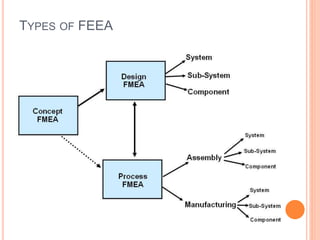
TYPES OF FEEA
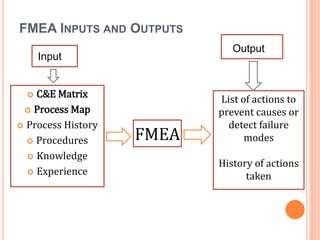
FMEA INPUTS AND OUTPUTS
 C&E Matrix
 Process Map
 Process History
 Procedures
 Knowledge
 Experience
List of actions to
prevent causes or
detect failure
modes
History of actions
taken
FMEA
Input
Output
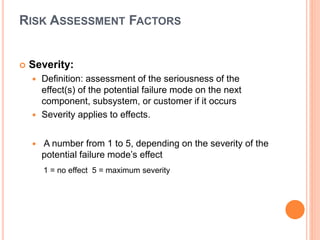
RISK ASSESSMENT FACTORS
 Severity:
 Definition: assessment of the seriousness of the
effect(s) of the potential failure mode on the next
component, subsystem, or customer if it occurs
 Severity applies to effects.
 A number from 1 to 5, depending on the severity of the
potential failure mode’s effect
1 = no effect 5 = maximum severity
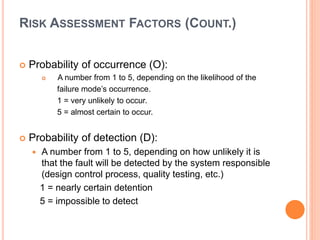
RISK ASSESSMENT FACTORS (COUNT.)
 Probability of occurrence (O):
 A number from 1 to 5, depending on the likelihood of the
failure mode’s occurrence.
1 = very unlikely to occur.
5 = almost certain to occur.
 Probability of detection (D):
 A number from 1 to 5, depending on how unlikely it is
that the fault will be detected by the system responsible
(design control process, quality testing, etc.)
1 = nearly certain detention
5 = impossible to detect
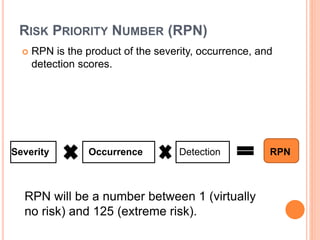
RISK PRIORITY NUMBER (RPN)
 RPN is the product of the severity, occurrence, and
detection scores.
Severity Occurrence Detection RPN
RPN will be a number between 1 (virtually
no risk) and 125 (extreme risk).
LIMITATIONS
 Employee training requirements
 Initial impact on product and manufacturing
schedules
 Financial impact required to upgrade design,
manufacturing, and process equipment and tools
Thank You 

FMEA - Failure mode and effects analysis

  • 1.
    FMEA (FAILURE MODE EFFECTSANALYSIS ) Presented by : Soumyajit Bhuin
  • 2.
    WHAT IS FMEA?  Systematic method of identifying and preventing system.  Focused on preventing problems, enhancing safety, and increasing customer satisfaction.  Ideally, FMEA’s are conducted in the product design or process development stages.
  • 3.
    HISTORY OF FMEA Firstused in the 1960’s in the Aerospace industry during the Apollo missions. In 1974, the Navy developed MIL-STD- 1629 regarding the use of FMEA. In the late 1970’s, the automotive industry was driven by liability costs to use FMEA. Later, the automotive industry saw the advantages of using this tool to reduce risks related to poor quality.
  • 4.
    WHY DO AFMEA ?  Preventing problems is cheaper and easier than cleaning them up.  Some things are too risky or costly to incur mistakes.  ISO requirement-Quality Planning  “ensuring the compatibility of the design, the production process, installation, servicing, inspection and test procedures, and the applicable documentation”
  • 5.
  • 6.
    FMEA INPUTS ANDOUTPUTS  C&E Matrix  Process Map  Process History  Procedures  Knowledge  Experience List of actions to prevent causes or detect failure modes History of actions taken FMEA Input Output
  • 7.
    RISK ASSESSMENT FACTORS Severity:  Definition: assessment of the seriousness of the effect(s) of the potential failure mode on the next component, subsystem, or customer if it occurs  Severity applies to effects.  A number from 1 to 5, depending on the severity of the potential failure mode’s effect 1 = no effect 5 = maximum severity
  • 8.
    RISK ASSESSMENT FACTORS(COUNT.)  Probability of occurrence (O):  A number from 1 to 5, depending on the likelihood of the failure mode’s occurrence. 1 = very unlikely to occur. 5 = almost certain to occur.  Probability of detection (D):  A number from 1 to 5, depending on how unlikely it is that the fault will be detected by the system responsible (design control process, quality testing, etc.) 1 = nearly certain detention 5 = impossible to detect
  • 9.
    RISK PRIORITY NUMBER(RPN)  RPN is the product of the severity, occurrence, and detection scores. Severity Occurrence Detection RPN RPN will be a number between 1 (virtually no risk) and 125 (extreme risk).
  • 10.
    LIMITATIONS  Employee trainingrequirements  Initial impact on product and manufacturing schedules  Financial impact required to upgrade design, manufacturing, and process equipment and tools
  • 11.