
How do Enzymes bring about such High Rates of
Chemical Conversions?
Nature of Enzyme Action
DR.HARINATHAREDDY M.Sc, Ph.D.
Department of Microbiology
Sri krishnadevaraya University, Anantapur,
A,P, INDIA
At active site substrate convert to product:
• The chemical which is converted into a product is called
‘substrate’.
• Hence enzymes, i.e. proteins with three dimensional
structures including an ‘active site’, convert a substrate
(S) into a product (P).
• SP
Enzyme Substrate (ES) complex
• ES complex formation is a transient phenomenon.
• During the state where substrate is bound to the enzyme active
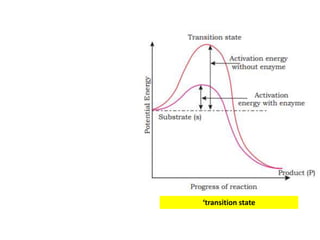
site, a new structure of the substrate called transition state
structure is formed.
• Very soon, after the expected bond breaking/making is
completed, the product is released from the active site.
At active site of enzyme
Substrate  Products
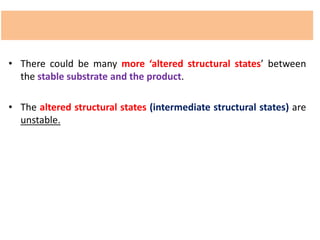
• There could be many more ‘altered structural states’ between
the stable substrate and the product.
• The altered structural states (intermediate structural states) are
unstable.
‘transition state
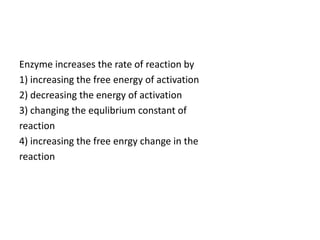
Enzyme increases the rate of reaction by
1) increasing the free energy of activation
2) decreasing the energy of activation
3) changing the equlibrium constant of
reaction
4) increasing the free enrgy change in the
reaction
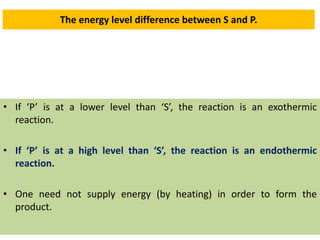
The energy level difference between S and P.
• If ‘P’ is at a lower level than ‘S’, the reaction is an exothermic
reaction.
• If ‘P’ is at a high level than ‘S’, the reaction is an endothermic
reaction.
• One need not supply energy (by heating) in order to form the
product.
• Whether it is an
Exothermic
Endothermic
spontaneous reaction or an energy requiring reaction,…
• The ‘S’ has to go through a much higher energy state or transition
state.
The difference in average energy content of ‘S’ from that of this
transition state is called ‘activation energy’.
• Enzymes eventually bring down this energy barrier making the
transition of ‘S’ (substrate) to ‘P’ (product) more easy.
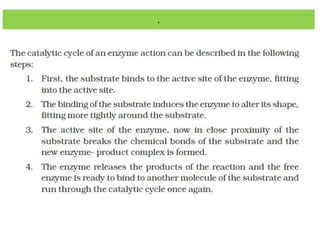
Nature of Enzyme Action
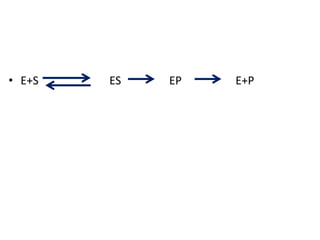
• E+S ES EP E+P
.
Factors Affecting Enzyme Activity
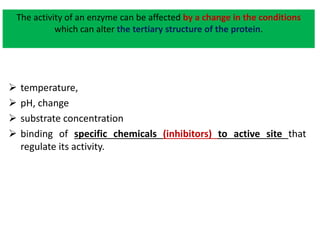
The activity of an enzyme can be affected by a change in the conditions
which can alter the tertiary structure of the protein.
 temperature,
 pH, change
 substrate concentration
 binding of specific chemicals (inhibitors) to active site that
regulate its activity.
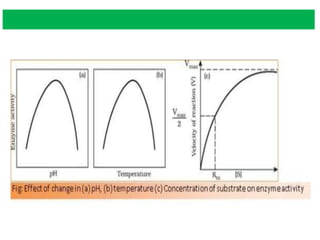
Temperature and pH
• Each enzyme shows its highest activity at a particular
temperature and pH called the optimum temperature and
optimum pH.
Enzyme activity declines both below and above the optimum value.
• Low temperature preserves the enzyme in a temporarily
inactive state.
• Whereas high temperature destroys enzymatic activity because
proteins are denatured by heat.
Concentration of Substrate
• With the increase in substrate concentration, the velocity of the
enzymatic reaction rises at first.
• The reaction ultimately reaches a maximum velocity (Vmax)
which is not exceeded by any further rise in concentration of the
substrate.
• The enzyme molecules are fewer than the substrate molecules
and after saturation of these molecules.
• There are no free enzyme molecules to bind with the additional
substrate molecules
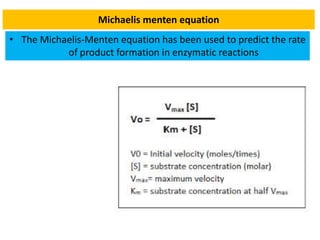
Michaelis menten equation
• The Michaelis-Menten equation has been used to predict the rate
of product formation in enzymatic reactions
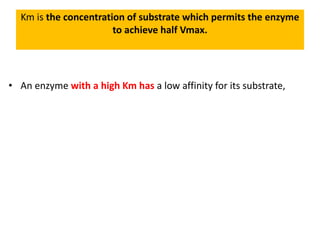
Km is the concentration of substrate which permits the enzyme
to achieve half Vmax.
• An enzyme with a high Km has a low affinity for its substrate,
Inhibitor or Chemicals
• The activity of an enzyme is also sensitive to the presence of
specific chemicals that bind to the enzyme.
• When the binding of the chemical shuts off enzyme activity.
• The process is called inhibition and the chemical is called an
inhibitor.
Competitive inhibitor
• When the inhibitor closely resembles the substrate in its
molecular structure and inhibits the activity of the enzyme, it is
known as competitive inhibitor
• Due to its close structural similarity with the substrate, the
inhibitor competes with the substrate for the substrate binding
site of the enzyme.
• Consequently, the substrate cannot bind and as a result, the
enzyme action declines,
.
• e.g., inhibition of succinic dehydrogenase by malonate which
closely resembles the substrate succinate in structure.
• Such competitive inhibitors are often used in the control of
bacterial pathogens.
• In the case of competitive inhibition of an
• enzyme
• 1) max V is increased
• 2) m K is increased
• 3) The extent of inhibition remains the
• same in high substrate concentrations
• 4) none above
Thank you

Factors effect enzyme function

  • 1.
    How do Enzymesbring about such High Rates of Chemical Conversions? Nature of Enzyme Action DR.HARINATHAREDDY M.Sc, Ph.D. Department of Microbiology Sri krishnadevaraya University, Anantapur, A,P, INDIA
  • 2.
    At active sitesubstrate convert to product: • The chemical which is converted into a product is called ‘substrate’. • Hence enzymes, i.e. proteins with three dimensional structures including an ‘active site’, convert a substrate (S) into a product (P). • SP
  • 3.
    Enzyme Substrate (ES)complex • ES complex formation is a transient phenomenon. • During the state where substrate is bound to the enzyme active site, a new structure of the substrate called transition state structure is formed. • Very soon, after the expected bond breaking/making is completed, the product is released from the active site. At active site of enzyme Substrate  Products
  • 4.
    • There couldbe many more ‘altered structural states’ between the stable substrate and the product. • The altered structural states (intermediate structural states) are unstable.
  • 5.
  • 6.
    Enzyme increases therate of reaction by 1) increasing the free energy of activation 2) decreasing the energy of activation 3) changing the equlibrium constant of reaction 4) increasing the free enrgy change in the reaction
  • 7.
    The energy leveldifference between S and P. • If ‘P’ is at a lower level than ‘S’, the reaction is an exothermic reaction. • If ‘P’ is at a high level than ‘S’, the reaction is an endothermic reaction. • One need not supply energy (by heating) in order to form the product.
  • 8.
    • Whether itis an Exothermic Endothermic spontaneous reaction or an energy requiring reaction,… • The ‘S’ has to go through a much higher energy state or transition state.
  • 9.
    The difference inaverage energy content of ‘S’ from that of this transition state is called ‘activation energy’. • Enzymes eventually bring down this energy barrier making the transition of ‘S’ (substrate) to ‘P’ (product) more easy.
  • 10.
  • 11.
    • E+S ESEP E+P
  • 12.
  • 13.
  • 14.
    The activity ofan enzyme can be affected by a change in the conditions which can alter the tertiary structure of the protein.  temperature,  pH, change  substrate concentration  binding of specific chemicals (inhibitors) to active site that regulate its activity.
  • 15.
    Temperature and pH •Each enzyme shows its highest activity at a particular temperature and pH called the optimum temperature and optimum pH.
  • 16.
    Enzyme activity declinesboth below and above the optimum value. • Low temperature preserves the enzyme in a temporarily inactive state. • Whereas high temperature destroys enzymatic activity because proteins are denatured by heat.
  • 17.
  • 18.
    Concentration of Substrate •With the increase in substrate concentration, the velocity of the enzymatic reaction rises at first. • The reaction ultimately reaches a maximum velocity (Vmax) which is not exceeded by any further rise in concentration of the substrate.
  • 19.
    • The enzymemolecules are fewer than the substrate molecules and after saturation of these molecules. • There are no free enzyme molecules to bind with the additional substrate molecules
  • 20.
    Michaelis menten equation •The Michaelis-Menten equation has been used to predict the rate of product formation in enzymatic reactions
  • 21.
    Km is theconcentration of substrate which permits the enzyme to achieve half Vmax. • An enzyme with a high Km has a low affinity for its substrate,
  • 23.
  • 24.
    Inhibitor or Chemicals •The activity of an enzyme is also sensitive to the presence of specific chemicals that bind to the enzyme. • When the binding of the chemical shuts off enzyme activity. • The process is called inhibition and the chemical is called an inhibitor.
  • 25.
    Competitive inhibitor • Whenthe inhibitor closely resembles the substrate in its molecular structure and inhibits the activity of the enzyme, it is known as competitive inhibitor
  • 26.
    • Due toits close structural similarity with the substrate, the inhibitor competes with the substrate for the substrate binding site of the enzyme. • Consequently, the substrate cannot bind and as a result, the enzyme action declines,
  • 27.
    . • e.g., inhibitionof succinic dehydrogenase by malonate which closely resembles the substrate succinate in structure. • Such competitive inhibitors are often used in the control of bacterial pathogens.
  • 28.
    • In thecase of competitive inhibition of an • enzyme • 1) max V is increased • 2) m K is increased • 3) The extent of inhibition remains the • same in high substrate concentrations • 4) none above
  • 29.