Biosynthesis of
amino acids
Anam Sharif
Lecturer (University of Okara)
WHAT ARE
AMINO ACIDS?
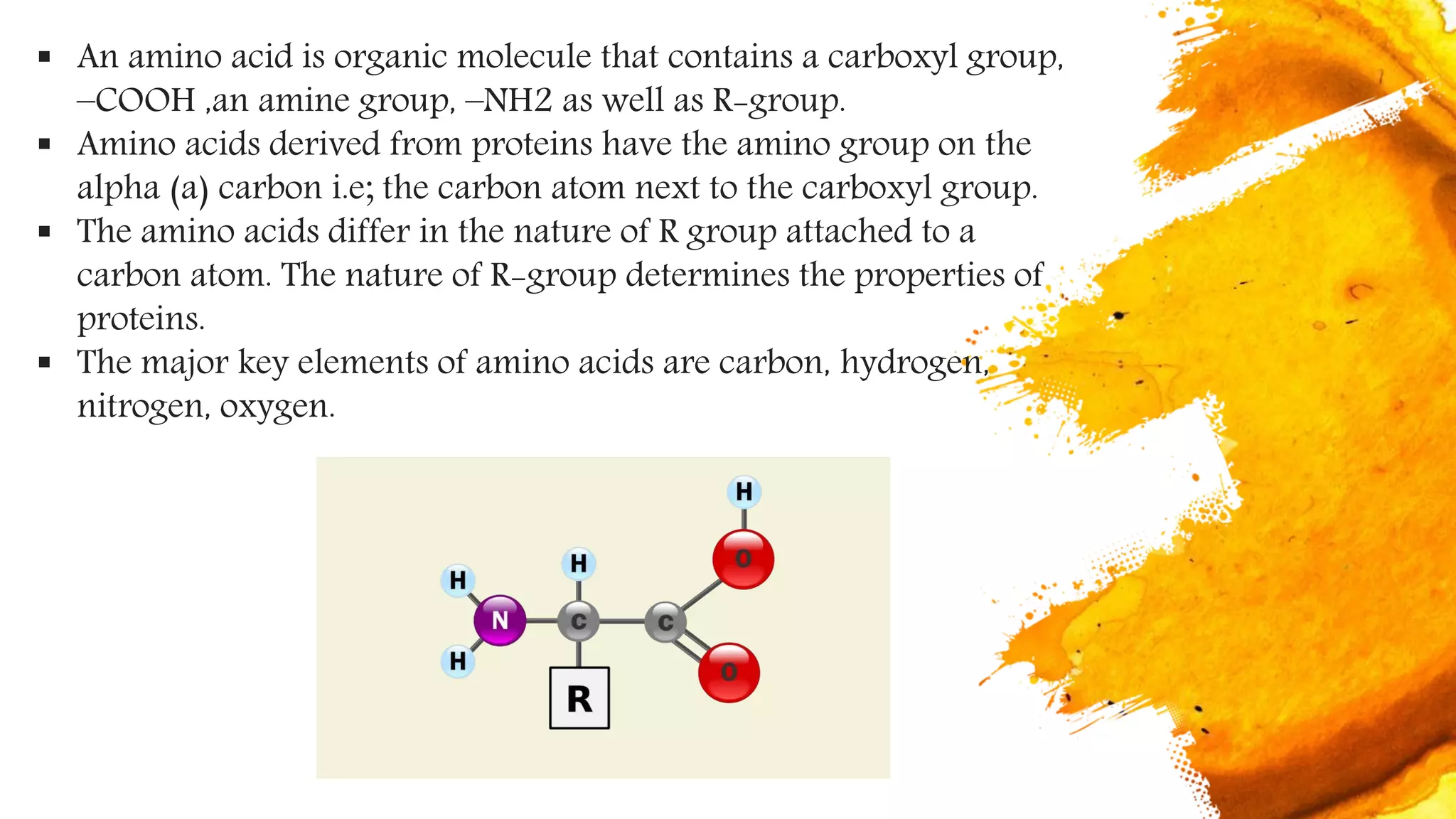
 An amino acid is organic molecule that contains a carboxyl group,
–COOH ,an amine group, –NH2 as well as R-group.
 Amino acids derived from proteins have the amino group on the
alpha (a) carbon i.e; the carbon atom next to the carboxyl group.
 The amino acids differ in the nature of R group attached to a
carbon atom. The nature of R-group determines the properties of
proteins.
 The major key elements of amino acids are carbon, hydrogen,
nitrogen, oxygen.
• Amino acids are the structural units that make up proteins.
They join together to form short polymer chains called
peptides or longer chains called either polypeptides or
proteins.
• These polymers are linear and un branched, with each
amino acid within the chain attached to two neighboring
amino acids.
• In proteins, almost all of these carboxyl and amino groups
are combined through peptide linkage and, in general, are
not available for chemical reaction except for hydrogen
bond formation.
Tpyes of Amino acid based
on nutritional requirements:
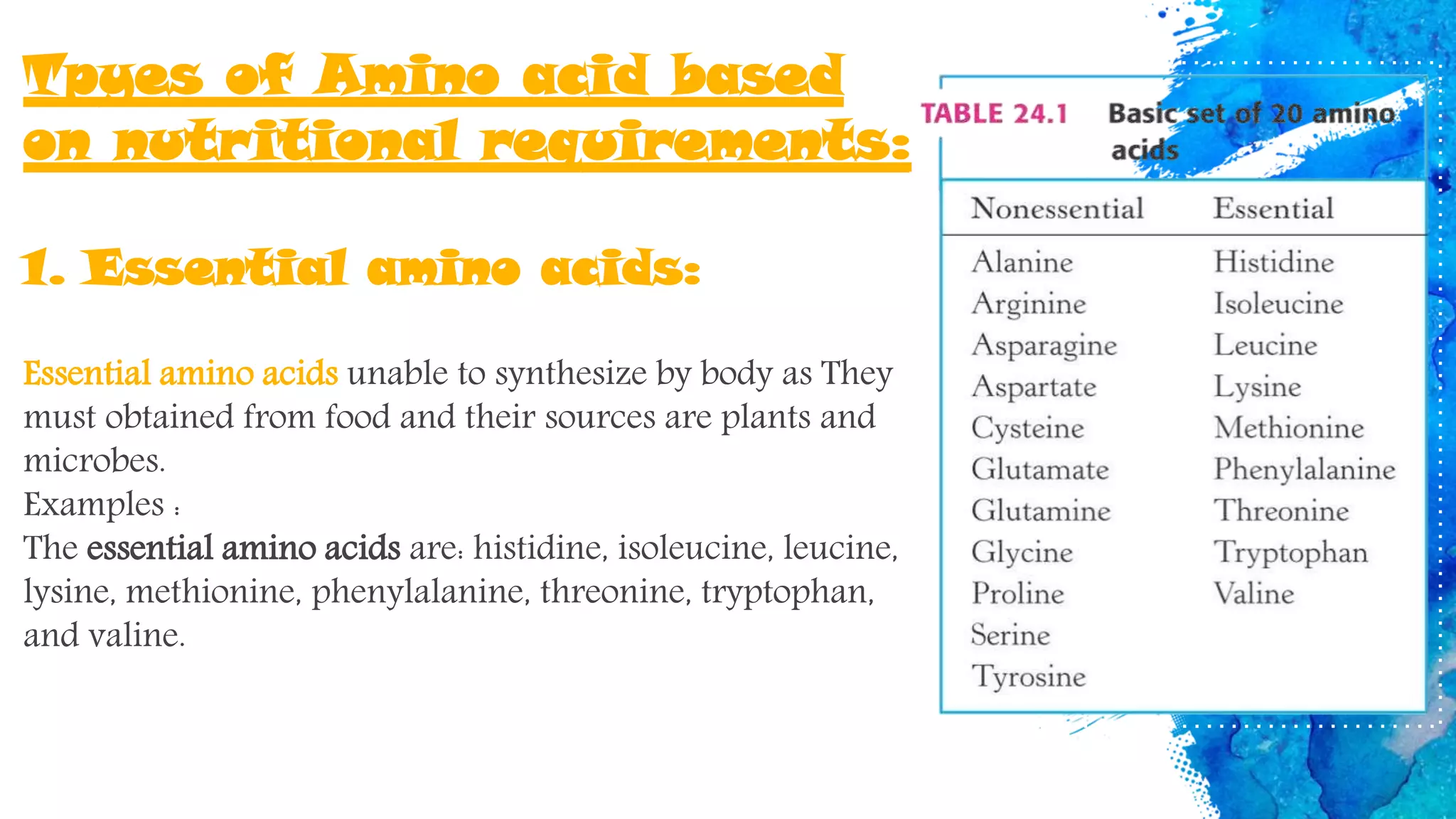
1. Essential amino acids:
Essential amino acids unable to synthesize by body as They
must obtained from food and their sources are plants and
microbes.
Examples :
The essential amino acids are: histidine, isoleucine, leucine,
lysine, methionine, phenylalanine, threonine, tryptophan,
and valine.
2. Non essential amino acids:
Non essential amino acid if they are not supplied in our diet
we can synthesized that. Most of the amine group come
from glutamate and glutmine. Some of them synthesize from
essential amino acid .
e.g tyrosine is synthsize from phenylalanine
and Cysteine depends on methionine
Examples:
The nonessential amino acids: Arginine, Alanine, asparagine,
aspartic acid, cysteine, glutamic acid, glutamine, glycine,
proline, serine, and tyrosine.
• Amino acids precursors are intermediates
in glycolysis, the citric acid cycle, or the
pentose phosphate pathway . They are
used to make nucleotide.
• Histidine comes from Ribose 5-phosphate
that is product of pentose phosphate
pathway.
• Serine comes from 3-phosphoglycerate
and from serine we can make more amino
acids like glycine and cysteine.
• Tryptophane and tyrosine comes from
phosphoenolepyruvate.
• Pyruvate used to make alanine, valine,
leucine and isoleucine.
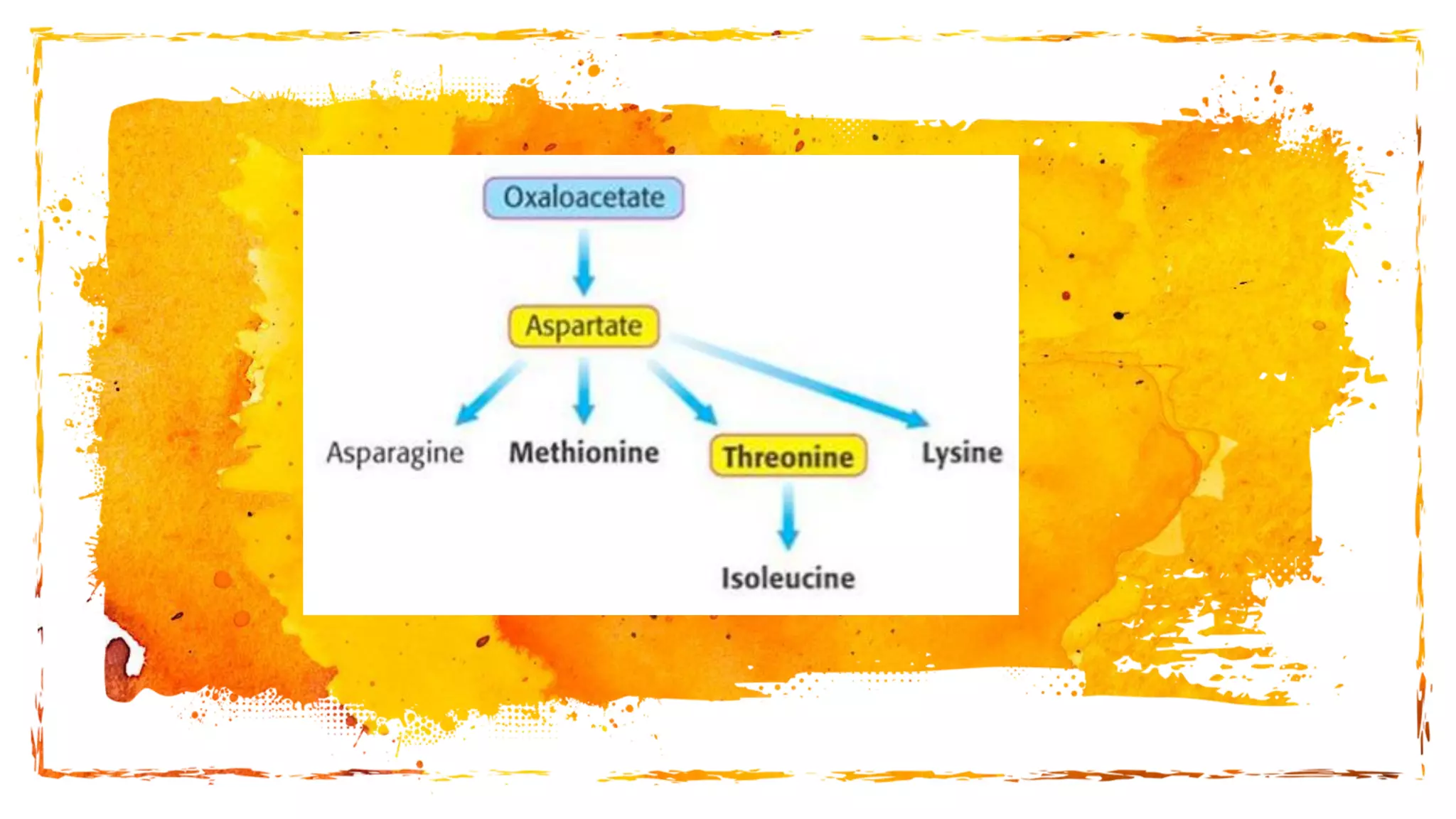
• we can make aspartate
from oxaloacetate and we
can use aspartate to make
other amino acids like
aspargine, methionine,
threonine and lysine.
• Glutamate is synthesized
from @ ketoglutarate
.And from glutamate we
can make more amino
acids like glutamaine,
proline and arginine .
SYNTHESIS
OF
NON-ESSENTIAL
AMINO ACIDS
Glutamate Synthesis from ketoglutarate
• Glutamate is synthesized by the reductive amination of 2-oxoglutarate (α-
ketoglutarate) catalyzed by glutamate dehydrogenase (GDH); it is thus a
nitrogen-incorporating reaction.
• Glutamate dehydrogenase represents an important "gateway" enzyme in that
it can catalyze reactions in two different directions dependent upon overall
cellular energy and metabolic needs.
• When energy and carbon levels are high glutamate can incorporate nitrogen
(from NH4
+) into 2-oxoglutarate. which is driven by the increased levels of
NADPH generated from oxidation of glucose in the Pentose Phosphate
Pathway.
• when energy levels are reduced glutamate can be oxidatively deaminated in
the opposite direction allowing 2-oxoglutarate to be utilized in the TCA
cycle for production of energy.
Glumatine Synthesis From Glutamate
• Glutamine is synthesized from glutamate via the action of glutamine
synthetase. The synthesis of glutamine is a two-step one in which
glutamate is first "activated" to a gema-glutamylphosphate
intermediate, followed by a reaction in which NH3 displaces the
phosphate group
Aspartate Synthesis From Oxaloacetate
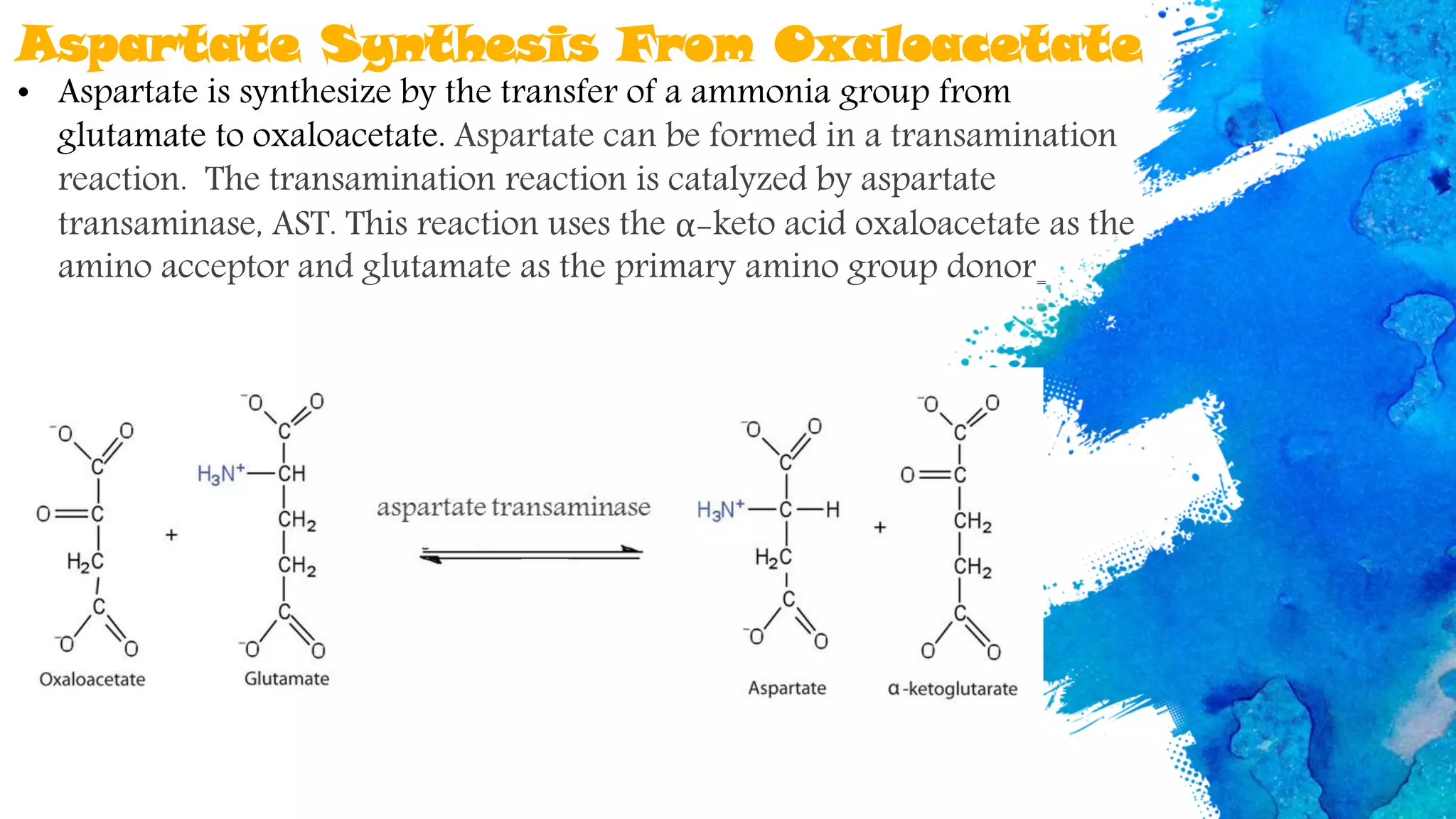
• Aspartate is synthesize by the transfer of a ammonia group from
glutamate to oxaloacetate. Aspartate can be formed in a transamination
reaction. The transamination reaction is catalyzed by aspartate
transaminase, AST. This reaction uses the α-keto acid oxaloacetate as the
amino acceptor and glutamate as the primary amino group donor=
Synthesis of Asparagine from Aspartate
• Asparagine is synthesized from aspartate via an amidotransferase reaction
catalyzed by asparagine synthetase.
Alanine synthesis from Pyruvate
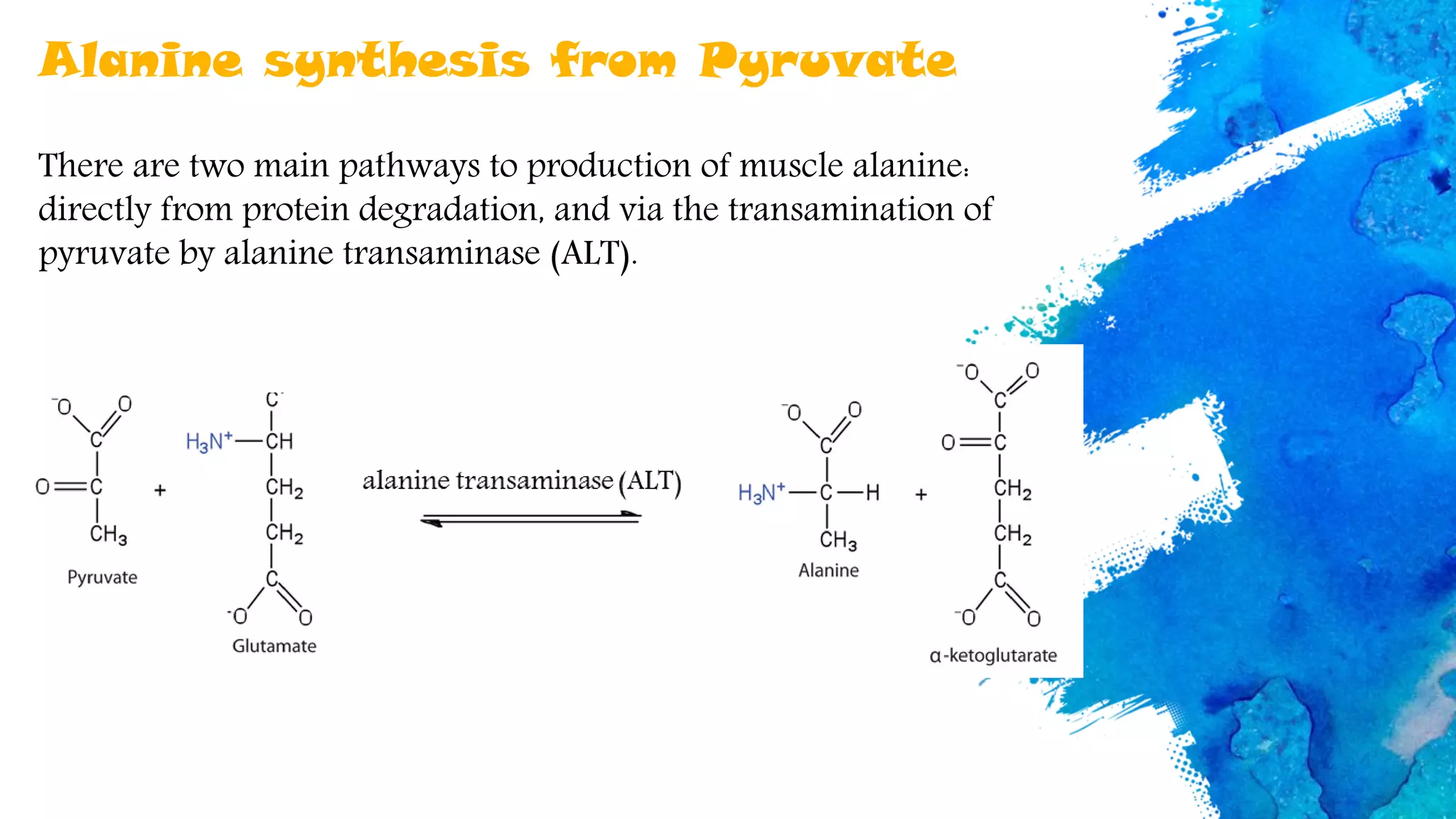
There are two main pathways to production of muscle alanine:
directly from protein degradation, and via the transamination of
pyruvate by alanine transaminase (ALT).
Synthesis of serine
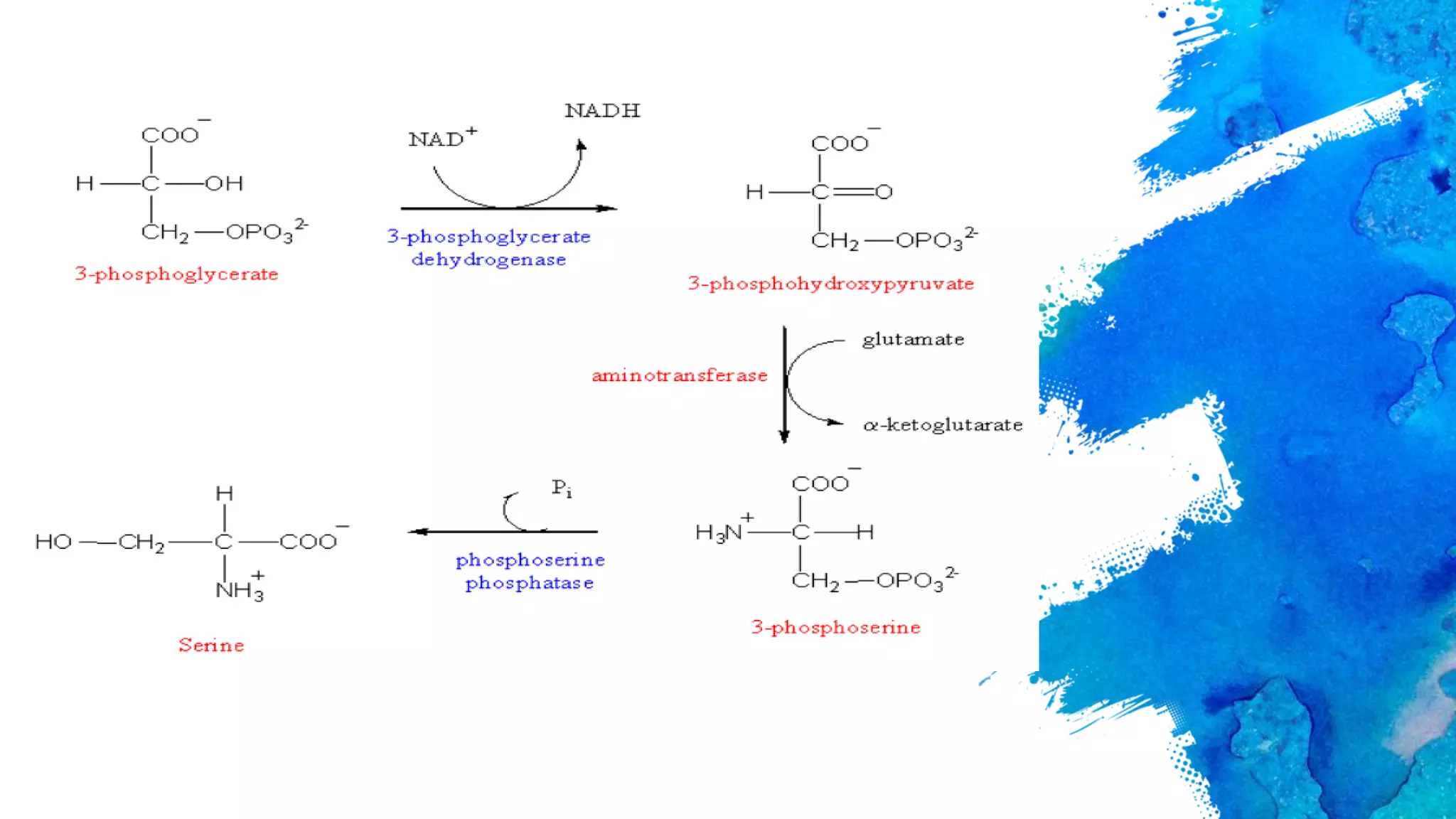
• Serine can be derived from the glycolytic intermediate, 3-
phosphoglycerate, in a three-step reaciton pathway.
• The first reaction is catalyzed by phosphoglycerate dehydrogenase
(PHGDH) in which oxidation of the hydroxyl group of 3-
phosphoglycerate by NAD+ to produce 3-phosphohydroxy
pyruvate.
• The second reaction is a simple transamination catalyzed by
phosphoserine aminotransferase (PSAT) which utilizes glutamate
as the amino donor and releases 2-oxoglutarate (α-ketoglutarate).
• The last step in the reaction pathway is catalyzed by
phosphoserine phosphatase (PSPH). Finally, hydrolysis and
removal of the phosphate group yields serine.
Synthesis of Glycine from serine
The main pathway to glycine is a one-step reversible reaction
catalyzed by serine hydroxymethyltransferase (SHMT). This enzyme
is a member of the family of one-carbon transferases and is also
known as glycine hydroxymethyltransferase. This reaction involves
the transfer of the hydroxymethyl group from serine to the cofactor
tetrahydrofolate (THF), producing glycine and
N5,N10-methylene-THF.
SYNTHESIS
OF
ESSENTIAL
AMINO
ACIDS
Synthesis of Essential Amino Acids
The synthetic pathways for the essential amino acids are:
(1) present only in microorgansims
(2) considerably more complex than for nonessential amino acids
(3) use familiar metabolic precursors
(4) show species variation
For purposes of classification, consider the following
4 "families" which are based upon common precursors:
(1) Aspartate Family: lysine, methionine,threonine
(2) Pyruvate Family: leucine, isoleucine, valine
(3) Aromatic Family: phenylalanine, Tyrosine, Tryptophan
(4) Histidine
Synthesis of valine and leucine
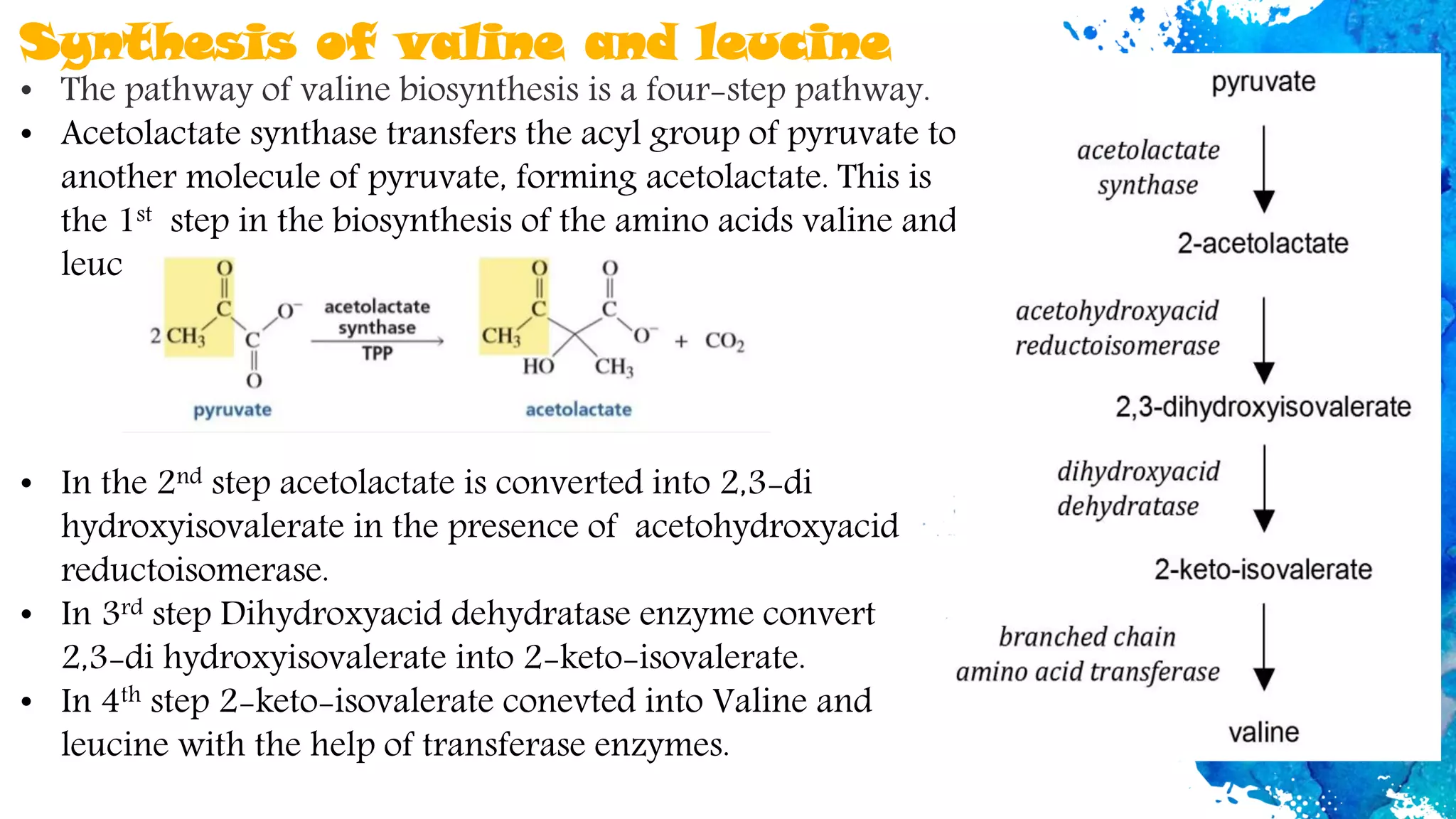
• The pathway of valine biosynthesis is a four-step pathway.
• Acetolactate synthase transfers the acyl group of pyruvate to
another molecule of pyruvate, forming acetolactate. This is
the 1st step in the biosynthesis of the amino acids valine and
leucine
• In the 2nd step acetolactate is converted into 2,3-di
hydroxyisovalerate in the presence of acetohydroxyacid
reductoisomerase.
• In 3rd step Dihydroxyacid dehydratase enzyme convert
2,3-di hydroxyisovalerate into 2-keto-isovalerate.
• In 4th step 2-keto-isovalerate conevted into Valine and
leucine with the help of transferase enzymes.
Synthesis of phenylalanine and tyrosine
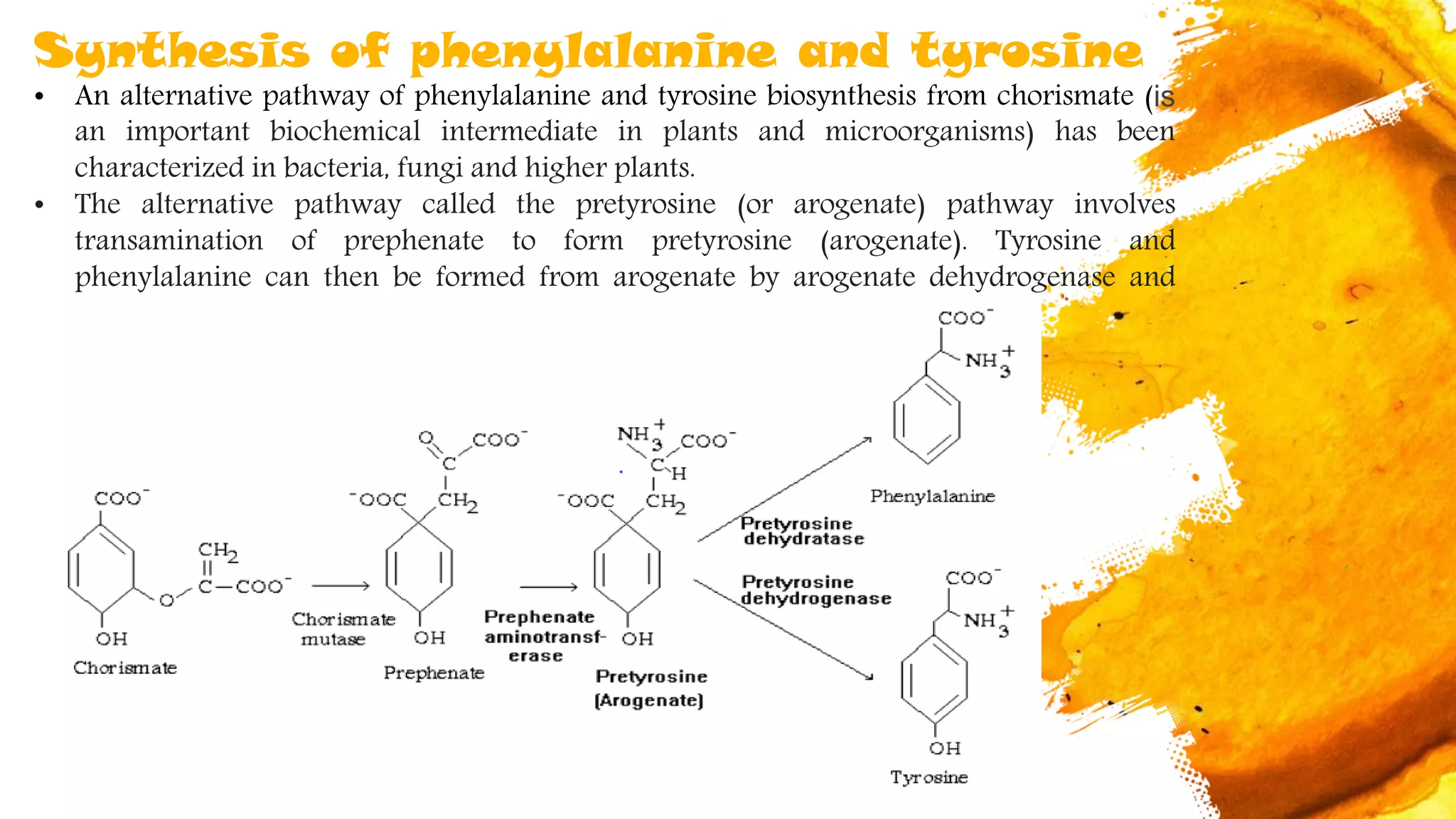
• An alternative pathway of phenylalanine and tyrosine biosynthesis from chorismate (is
an important biochemical intermediate in plants and microorganisms) has been
characterized in bacteria, fungi and higher plants.
• The alternative pathway called the pretyrosine (or arogenate) pathway involves
transamination of prephenate to form pretyrosine (arogenate). Tyrosine and
phenylalanine can then be formed from arogenate by arogenate dehydrogenase and
arogenate dehydratase, respectively.
Dehydratases are a group of lyase enzymes
that form double and triple bonds in a
substrate through the removal of water
Dehydrogenases are a group of biological
catalysts (enzymes) that mediate in
biochemical reactions removing hydrogen
atoms [H] instead of oxygen [O]

Biosynthesis of amino acid (essential and non essential)

  • 1.
    Biosynthesis of amino acids AnamSharif Lecturer (University of Okara)
  • 2.
  • 3.
     An aminoacid is organic molecule that contains a carboxyl group, –COOH ,an amine group, –NH2 as well as R-group.  Amino acids derived from proteins have the amino group on the alpha (a) carbon i.e; the carbon atom next to the carboxyl group.  The amino acids differ in the nature of R group attached to a carbon atom. The nature of R-group determines the properties of proteins.  The major key elements of amino acids are carbon, hydrogen, nitrogen, oxygen.
  • 4.
    • Amino acidsare the structural units that make up proteins. They join together to form short polymer chains called peptides or longer chains called either polypeptides or proteins. • These polymers are linear and un branched, with each amino acid within the chain attached to two neighboring amino acids. • In proteins, almost all of these carboxyl and amino groups are combined through peptide linkage and, in general, are not available for chemical reaction except for hydrogen bond formation.
  • 5.
    Tpyes of Aminoacid based on nutritional requirements: 1. Essential amino acids: Essential amino acids unable to synthesize by body as They must obtained from food and their sources are plants and microbes. Examples : The essential amino acids are: histidine, isoleucine, leucine, lysine, methionine, phenylalanine, threonine, tryptophan, and valine.
  • 6.
    2. Non essentialamino acids: Non essential amino acid if they are not supplied in our diet we can synthesized that. Most of the amine group come from glutamate and glutmine. Some of them synthesize from essential amino acid . e.g tyrosine is synthsize from phenylalanine and Cysteine depends on methionine Examples: The nonessential amino acids: Arginine, Alanine, asparagine, aspartic acid, cysteine, glutamic acid, glutamine, glycine, proline, serine, and tyrosine.
  • 7.
    • Amino acidsprecursors are intermediates in glycolysis, the citric acid cycle, or the pentose phosphate pathway . They are used to make nucleotide. • Histidine comes from Ribose 5-phosphate that is product of pentose phosphate pathway. • Serine comes from 3-phosphoglycerate and from serine we can make more amino acids like glycine and cysteine. • Tryptophane and tyrosine comes from phosphoenolepyruvate. • Pyruvate used to make alanine, valine, leucine and isoleucine.
  • 8.
    • we canmake aspartate from oxaloacetate and we can use aspartate to make other amino acids like aspargine, methionine, threonine and lysine. • Glutamate is synthesized from @ ketoglutarate .And from glutamate we can make more amino acids like glutamaine, proline and arginine .
  • 9.
  • 11.
    Glutamate Synthesis fromketoglutarate • Glutamate is synthesized by the reductive amination of 2-oxoglutarate (α- ketoglutarate) catalyzed by glutamate dehydrogenase (GDH); it is thus a nitrogen-incorporating reaction. • Glutamate dehydrogenase represents an important "gateway" enzyme in that it can catalyze reactions in two different directions dependent upon overall cellular energy and metabolic needs. • When energy and carbon levels are high glutamate can incorporate nitrogen (from NH4 +) into 2-oxoglutarate. which is driven by the increased levels of NADPH generated from oxidation of glucose in the Pentose Phosphate Pathway. • when energy levels are reduced glutamate can be oxidatively deaminated in the opposite direction allowing 2-oxoglutarate to be utilized in the TCA cycle for production of energy.
  • 12.
    Glumatine Synthesis FromGlutamate • Glutamine is synthesized from glutamate via the action of glutamine synthetase. The synthesis of glutamine is a two-step one in which glutamate is first "activated" to a gema-glutamylphosphate intermediate, followed by a reaction in which NH3 displaces the phosphate group
  • 14.
    Aspartate Synthesis FromOxaloacetate • Aspartate is synthesize by the transfer of a ammonia group from glutamate to oxaloacetate. Aspartate can be formed in a transamination reaction. The transamination reaction is catalyzed by aspartate transaminase, AST. This reaction uses the α-keto acid oxaloacetate as the amino acceptor and glutamate as the primary amino group donor=
  • 15.
    Synthesis of Asparaginefrom Aspartate • Asparagine is synthesized from aspartate via an amidotransferase reaction catalyzed by asparagine synthetase.
  • 17.
    Alanine synthesis fromPyruvate There are two main pathways to production of muscle alanine: directly from protein degradation, and via the transamination of pyruvate by alanine transaminase (ALT).
  • 19.
    Synthesis of serine •Serine can be derived from the glycolytic intermediate, 3- phosphoglycerate, in a three-step reaciton pathway. • The first reaction is catalyzed by phosphoglycerate dehydrogenase (PHGDH) in which oxidation of the hydroxyl group of 3- phosphoglycerate by NAD+ to produce 3-phosphohydroxy pyruvate. • The second reaction is a simple transamination catalyzed by phosphoserine aminotransferase (PSAT) which utilizes glutamate as the amino donor and releases 2-oxoglutarate (α-ketoglutarate). • The last step in the reaction pathway is catalyzed by phosphoserine phosphatase (PSPH). Finally, hydrolysis and removal of the phosphate group yields serine.
  • 21.
    Synthesis of Glycinefrom serine The main pathway to glycine is a one-step reversible reaction catalyzed by serine hydroxymethyltransferase (SHMT). This enzyme is a member of the family of one-carbon transferases and is also known as glycine hydroxymethyltransferase. This reaction involves the transfer of the hydroxymethyl group from serine to the cofactor tetrahydrofolate (THF), producing glycine and N5,N10-methylene-THF.
  • 22.
  • 23.
    Synthesis of EssentialAmino Acids The synthetic pathways for the essential amino acids are: (1) present only in microorgansims (2) considerably more complex than for nonessential amino acids (3) use familiar metabolic precursors (4) show species variation For purposes of classification, consider the following 4 "families" which are based upon common precursors: (1) Aspartate Family: lysine, methionine,threonine (2) Pyruvate Family: leucine, isoleucine, valine (3) Aromatic Family: phenylalanine, Tyrosine, Tryptophan (4) Histidine
  • 24.
    Synthesis of valineand leucine • The pathway of valine biosynthesis is a four-step pathway. • Acetolactate synthase transfers the acyl group of pyruvate to another molecule of pyruvate, forming acetolactate. This is the 1st step in the biosynthesis of the amino acids valine and leucine • In the 2nd step acetolactate is converted into 2,3-di hydroxyisovalerate in the presence of acetohydroxyacid reductoisomerase. • In 3rd step Dihydroxyacid dehydratase enzyme convert 2,3-di hydroxyisovalerate into 2-keto-isovalerate. • In 4th step 2-keto-isovalerate conevted into Valine and leucine with the help of transferase enzymes.
  • 25.
    Synthesis of phenylalanineand tyrosine • An alternative pathway of phenylalanine and tyrosine biosynthesis from chorismate (is an important biochemical intermediate in plants and microorganisms) has been characterized in bacteria, fungi and higher plants. • The alternative pathway called the pretyrosine (or arogenate) pathway involves transamination of prephenate to form pretyrosine (arogenate). Tyrosine and phenylalanine can then be formed from arogenate by arogenate dehydrogenase and arogenate dehydratase, respectively.
  • 26.
    Dehydratases are agroup of lyase enzymes that form double and triple bonds in a substrate through the removal of water Dehydrogenases are a group of biological catalysts (enzymes) that mediate in biochemical reactions removing hydrogen atoms [H] instead of oxygen [O]