Structure of Enzyme
Presented by-
Bivash Dutta
CONTENT-
Enzyme
Structure of enzyme
Active site
Co-factor
Substrate
Intracellular enzyme and Extracellular enzyme
Enzyme
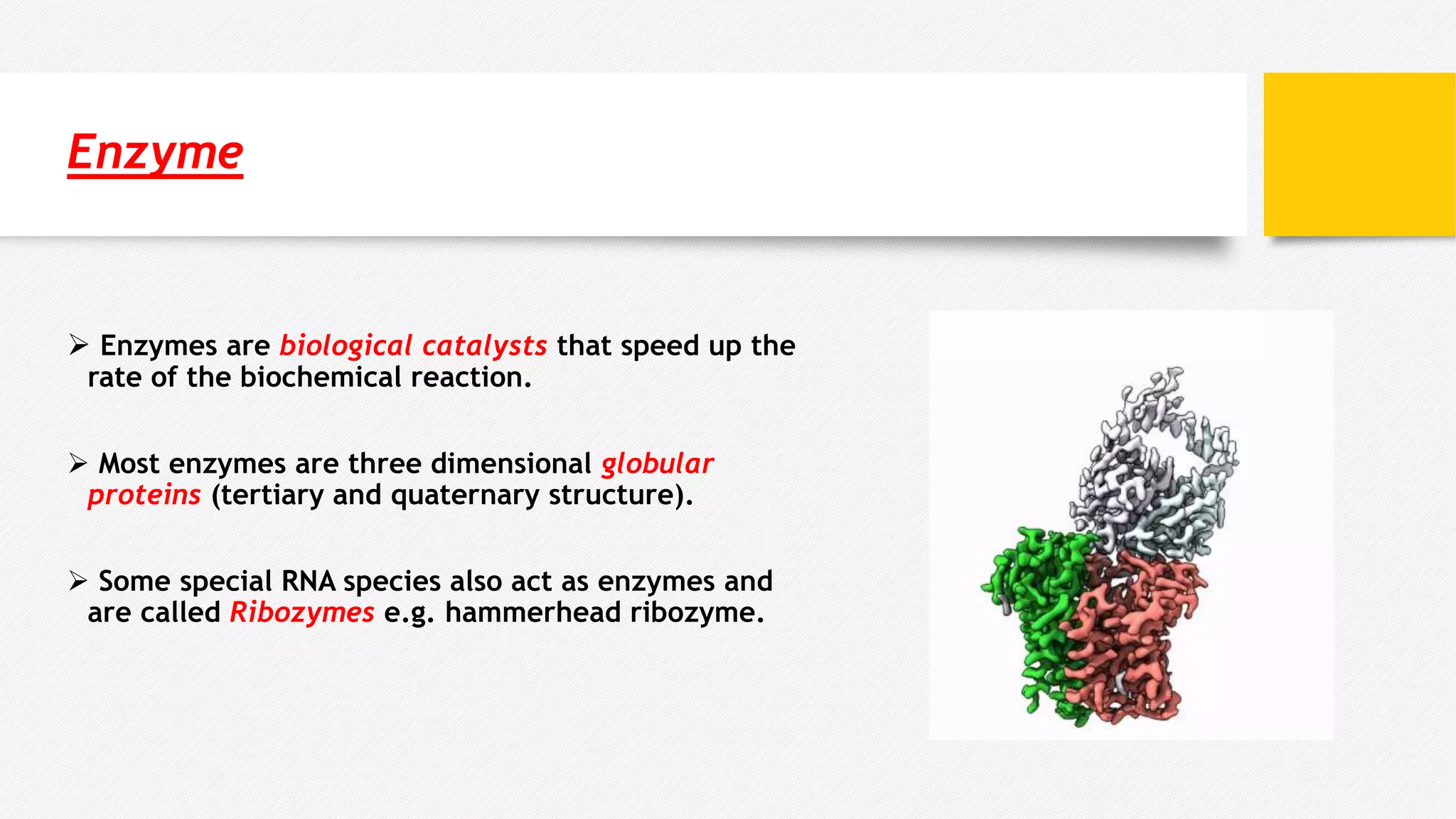
 Enzymes are biological catalysts that speed up the
rate of the biochemical reaction.
 Most enzymes are three dimensional globular
proteins (tertiary and quaternary structure).
 Some special RNA species also act as enzymes and
are called Ribozymes e.g. hammerhead ribozyme.
Structure of Enzyme
Enzyme have either tertiary or quaternary structure.
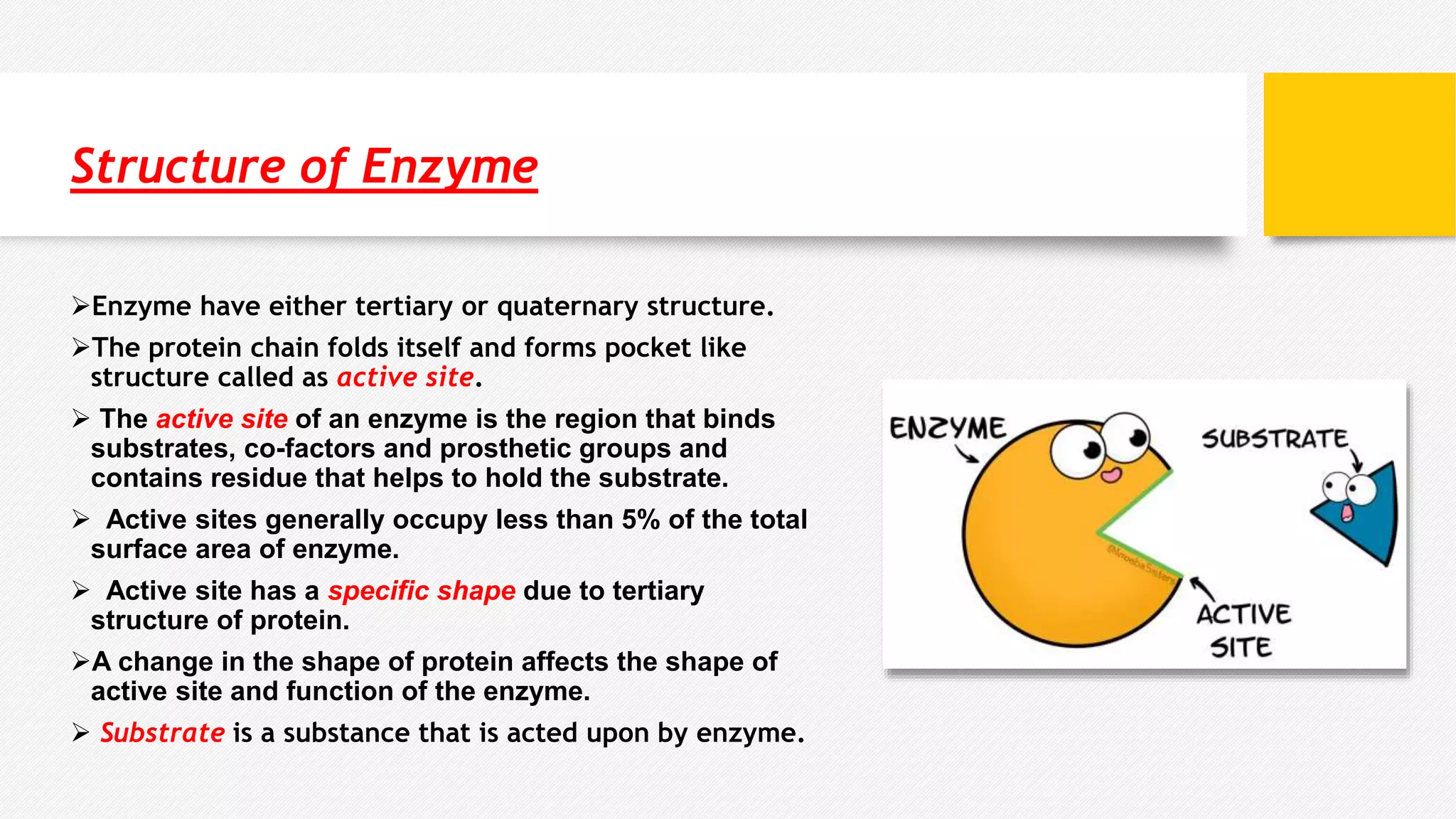
The protein chain folds itself and forms pocket like
structure called as active site.
 The active site of an enzyme is the region that binds
substrates, co-factors and prosthetic groups and
contains residue that helps to hold the substrate.
 Active sites generally occupy less than 5% of the total
surface area of enzyme.
 Active site has a specific shape due to tertiary
structure of protein.
A change in the shape of protein affects the shape of
active site and function of the enzyme.
 Substrate is a substance that is acted upon by enzyme.
Active Site
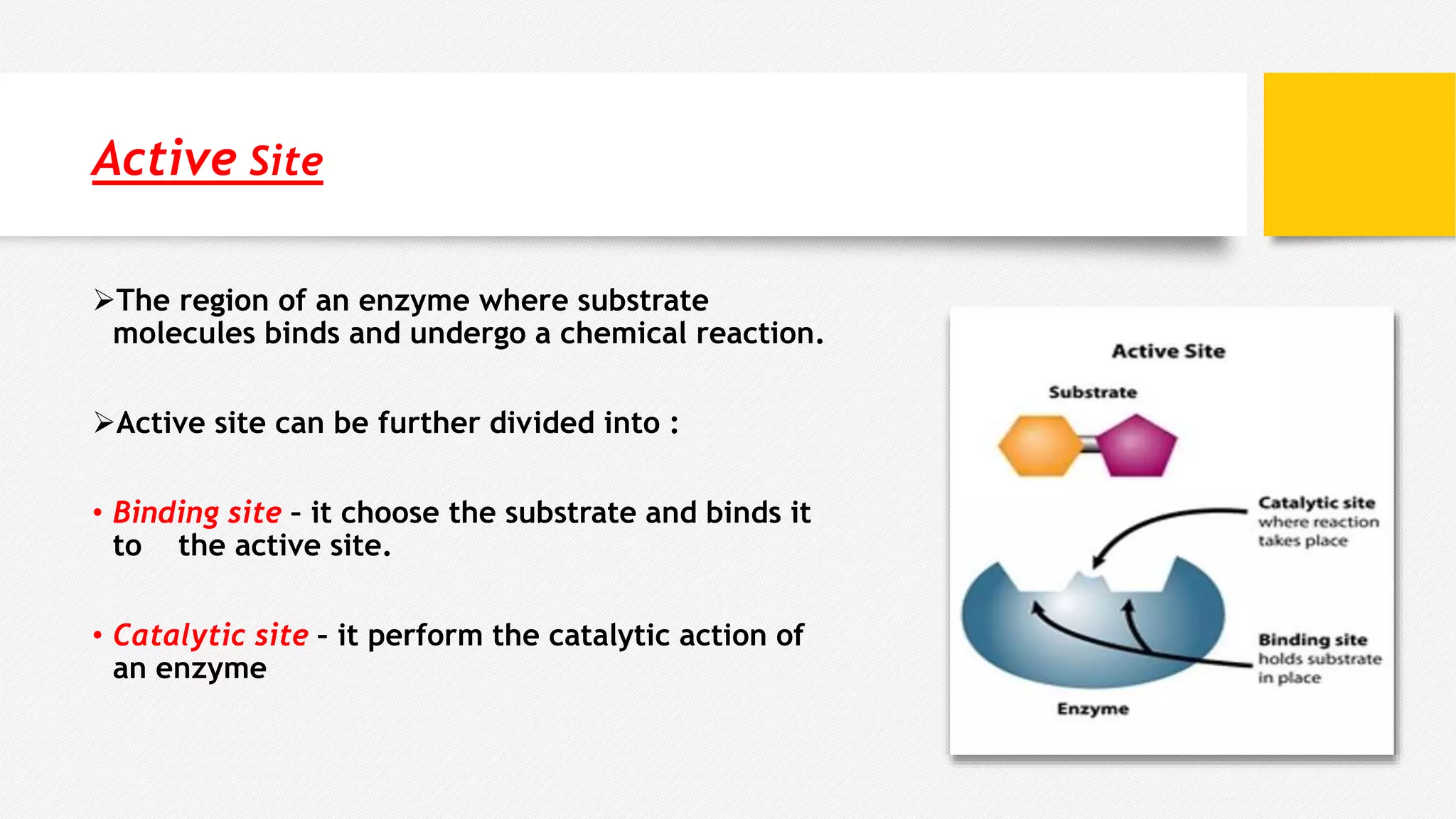
The region of an enzyme where substrate
molecules binds and undergo a chemical reaction.
Active site can be further divided into :
• Binding site – it choose the substrate and binds it
to the active site.
• Catalytic site – it perform the catalytic action of
an enzyme
Co-factors
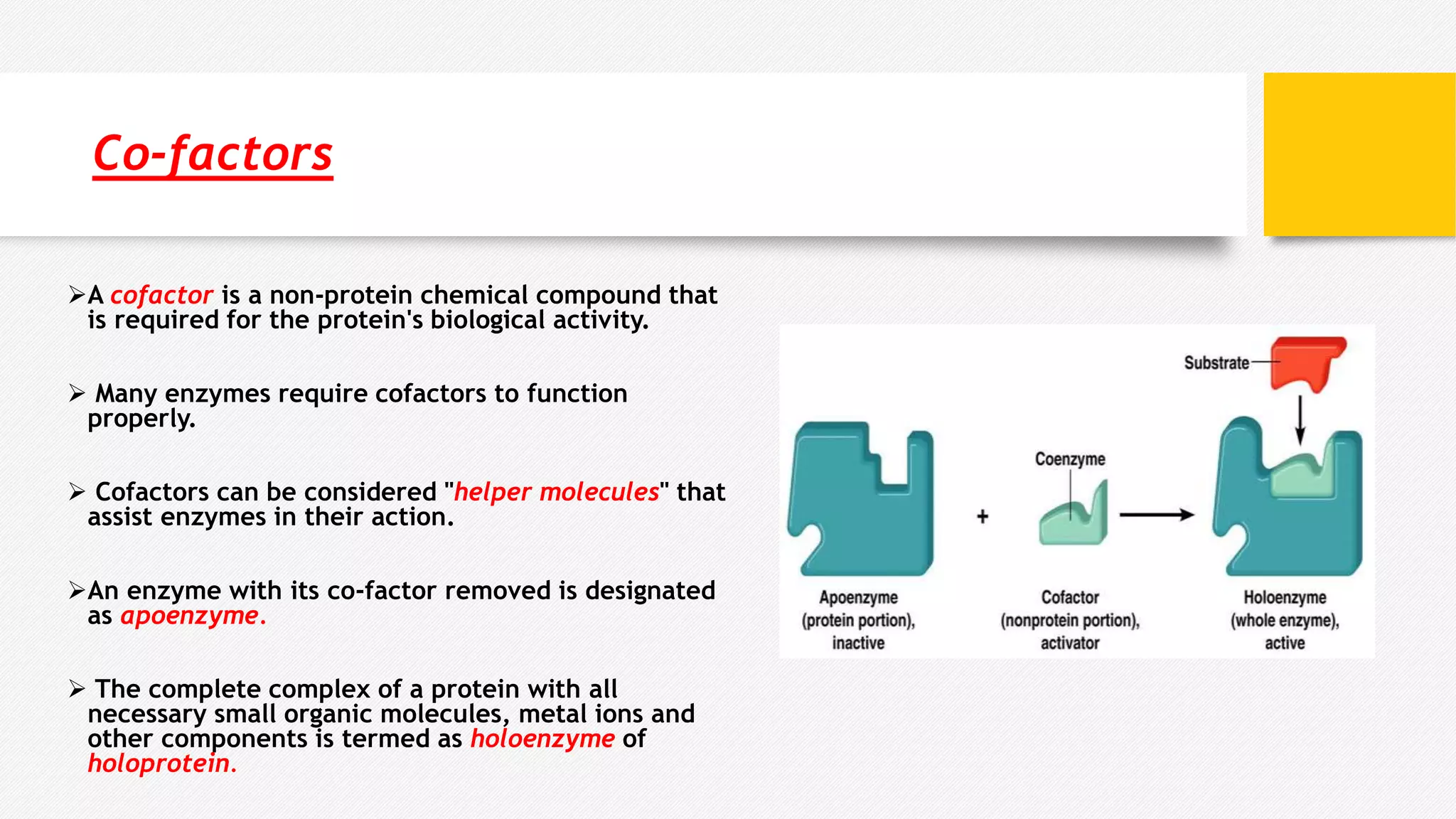
A cofactor is a non-protein chemical compound that
is required for the protein's biological activity.
 Many enzymes require cofactors to function
properly.
 Cofactors can be considered "helper molecules" that
assist enzymes in their action.
An enzyme with its co-factor removed is designated
as apoenzyme.
 The complete complex of a protein with all
necessary small organic molecules, metal ions and
other components is termed as holoenzyme of
holoprotein.
Substrate
The reactant in a biochemical reaction is termed as substrate.
Enzymes catalyze chemical reactions involving the substrate(s).
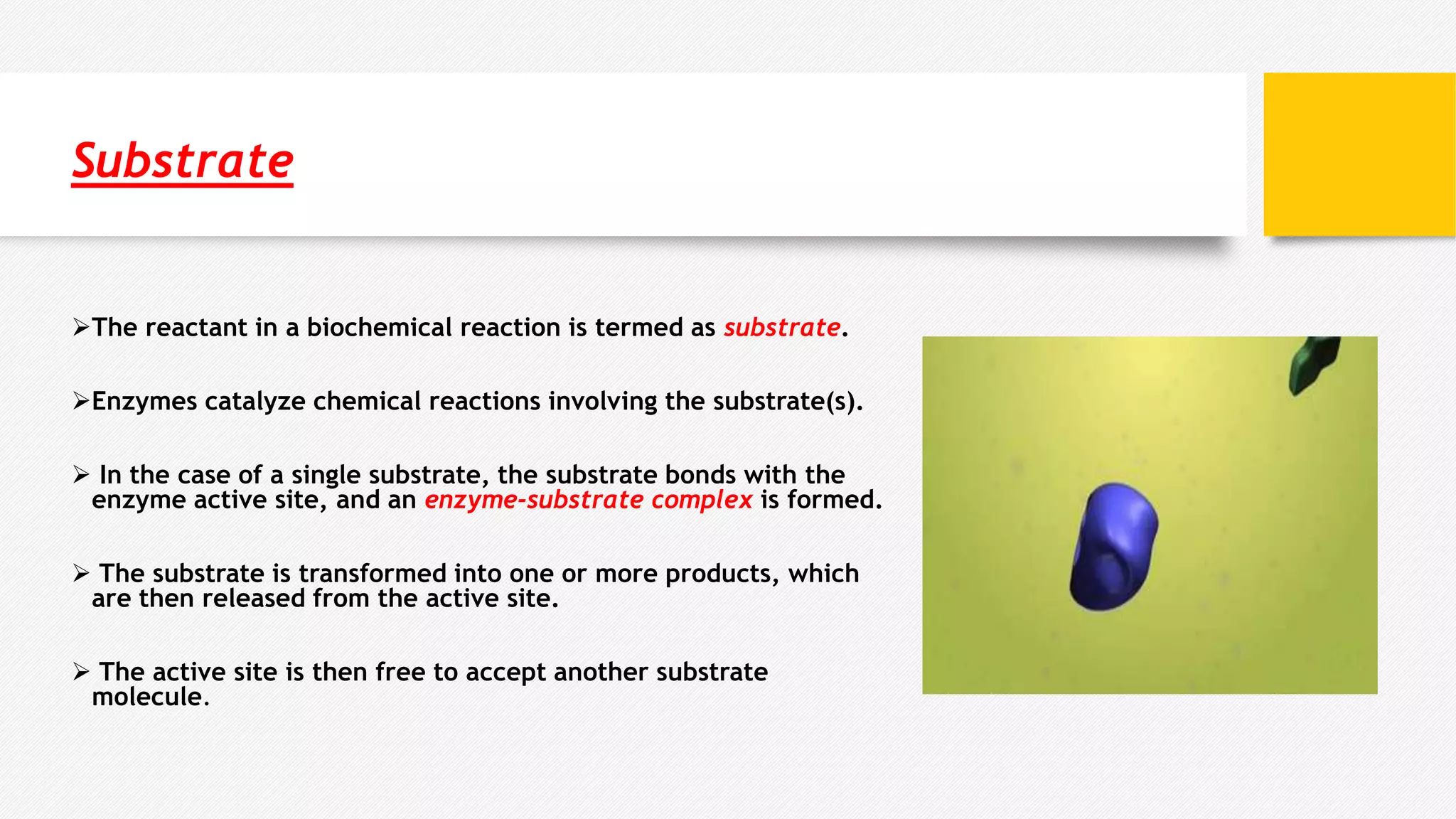
 In the case of a single substrate, the substrate bonds with the
enzyme active site, and an enzyme-substrate complex is formed.
 The substrate is transformed into one or more products, which
are then released from the active site.
 The active site is then free to accept another substrate
molecule.
Intracellular enzyme and Extracellular enzyme
Intracellular enzymes are synthesized and retained in the cell for the use of cell itself.
They are found in the cytoplasm, nucleus, mitochondria and chloroplast.
 Example :
 Oxidoreductase catalyse biological oxidation.
 Enzymes involved in reduction in the mitochondria.
 Extracellular enzymes are synthesized in the cell but secreted from the cell to work externally.
 Example :
 Digestive enzyme produced by the pancreas, are not used by the cells in the pancreas but are transported to the
duodenum.
Reference
https://www.slideshare.net/fatimasaleh94214/enzymes-2-30256325
https://en.wikipedia.org/wiki/Active_site
https://tenor.com/view/enzyme-active-site-substrate-love-gif-14527202
https://bio.libretexts.org/Bookshelves/Microbiology/Book%3A_Microbiology_(Boundless)/2%3A_Chemistry
/2.7%3A_Enzymes/2.7.2%3A__Enzyme_Active_Site_and_Substrate_Specificity
https://www.britannica.com/science/cofactor
Structure of enzyme

Structure of enzyme

  • 1.
  • 2.
    CONTENT- Enzyme Structure of enzyme Activesite Co-factor Substrate Intracellular enzyme and Extracellular enzyme
  • 3.
    Enzyme  Enzymes arebiological catalysts that speed up the rate of the biochemical reaction.  Most enzymes are three dimensional globular proteins (tertiary and quaternary structure).  Some special RNA species also act as enzymes and are called Ribozymes e.g. hammerhead ribozyme.
  • 4.
    Structure of Enzyme Enzymehave either tertiary or quaternary structure. The protein chain folds itself and forms pocket like structure called as active site.  The active site of an enzyme is the region that binds substrates, co-factors and prosthetic groups and contains residue that helps to hold the substrate.  Active sites generally occupy less than 5% of the total surface area of enzyme.  Active site has a specific shape due to tertiary structure of protein. A change in the shape of protein affects the shape of active site and function of the enzyme.  Substrate is a substance that is acted upon by enzyme.
  • 5.
    Active Site The regionof an enzyme where substrate molecules binds and undergo a chemical reaction. Active site can be further divided into : • Binding site – it choose the substrate and binds it to the active site. • Catalytic site – it perform the catalytic action of an enzyme
  • 6.
    Co-factors A cofactor isa non-protein chemical compound that is required for the protein's biological activity.  Many enzymes require cofactors to function properly.  Cofactors can be considered "helper molecules" that assist enzymes in their action. An enzyme with its co-factor removed is designated as apoenzyme.  The complete complex of a protein with all necessary small organic molecules, metal ions and other components is termed as holoenzyme of holoprotein.
  • 7.
    Substrate The reactant ina biochemical reaction is termed as substrate. Enzymes catalyze chemical reactions involving the substrate(s).  In the case of a single substrate, the substrate bonds with the enzyme active site, and an enzyme-substrate complex is formed.  The substrate is transformed into one or more products, which are then released from the active site.  The active site is then free to accept another substrate molecule.
  • 8.
    Intracellular enzyme andExtracellular enzyme Intracellular enzymes are synthesized and retained in the cell for the use of cell itself. They are found in the cytoplasm, nucleus, mitochondria and chloroplast.  Example :  Oxidoreductase catalyse biological oxidation.  Enzymes involved in reduction in the mitochondria.  Extracellular enzymes are synthesized in the cell but secreted from the cell to work externally.  Example :  Digestive enzyme produced by the pancreas, are not used by the cells in the pancreas but are transported to the duodenum.
  • 9.