By-
Mr. Samarth H. Giri
Ashokrao Mane College Of Pharmacy
TOPIC –
Factors affecting
Fluorescence and
Phosphorescence,
Applications of
Fluorimetry.
Factors Affecting Fluorescence and Phosphorescence -
1) Nature of Molecule
2) Nature of Substituent
3) Effect of Concentration
4) Adsorption
5) Light / Radiation
6) Oxygen
7) pH
8) Photodecomposition
9) Temperature
10)Viscosity
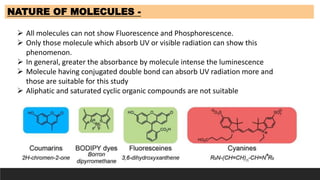
NATURE OF MOLECULES -
 All molecules can not show Fluorescence and Phosphorescence.
 Only those molecule which absorb UV or visible radiation can show this
phenomenon.
 In general, greater the absorbance by molecule intense the luminescence
 Molecule having conjugated double bond can absorb UV radiation more and
those are suitable for this study
 Aliphatic and saturated cyclic organic compounds are not suitable
NATURE OF SUBSTITUENT -
 Substituents often exhibit a marked effect on the fluorescence and phosphorescence of
molecules.
 Different groups show different types of effect on fluorescence and phosphorescence.
 Electron donating groups like -NH₂ and OH often enhance fluorescence.
 Electron withdrawing groups like -COOH, -NO₂, -N=N- and halides decrease or destroy
fluorescence.
 Groups like -SO3H, NH4 and alkyl groups do not have much effect on both
phosphorescence and fluorescence.
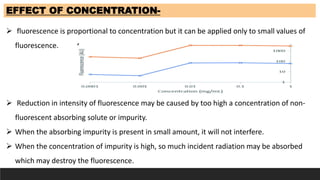
EFFECT OF CONCENTRATION-
 fluorescence is proportional to concentration but it can be applied only to small values of
fluorescence.
 Reduction in intensity of fluorescence may be caused by too high a concentration of non-
fluorescent absorbing solute or impurity.
 When the absorbing impurity is present in small amount, it will not interfere.
 When the concentration of impurity is high, so much incident radiation may be absorbed
which may destroy the fluorescence.
ADSORPTION-
 Adsorption of substance on the wall of the sample cells may cause a serious problem.
 This happens when the concentration of substance solution is strong hence the strong
stock solution must be diluted.
 The method require a very dilute solution (10-100 times) weaker than those used in
absorption study.
RADIATION-
 Monochromatic light is essential for the excitation and fluorescence.
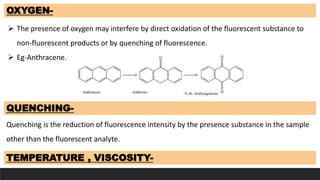
OXYGEN-
 The presence of oxygen may interfere by direct oxidation of the fluorescent substance to
non-fluorescent products or by quenching of fluorescence.
 Eg-Anthracene.
TEMPERATURE , VISCOSITY-
QUENCHING-
Quenching is the reduction of fluorescence intensity by the presence substance in the sample
other than the fluorescent analyte.
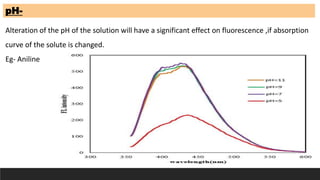
pH-
Alteration of the pH of the solution will have a significant effect on fluorescence ,if absorption
curve of the solute is changed.
Eg- Aniline
APPLICATIONS OF FLUORIMETRY-
1) Determination of vitamin B1 (Thiamine):Thiamine is non-fluorescent but its oxidation
product thiochrome have fluoresces with blue colour. The property is used for the
determination of thiamine in the food samples like meat, cereal etc.
2) Determination of vitamin B2 (Riboflavin):Determination of vitamin B2 is done by a
fluorescence method because the fluorescent power depends upon the exact conditions
and upon the nature and amount of impurities.
3) Organic analysis: To carry out qualitative as well as quantitative analysis of aromatic
compounds present in cigarette smoke, air-pollutant, concentrate and automobile exhaust.
4) Analysis of pharmaceuticals : The substances such as allyl morphine, PAS, chloroquine,
folic acid, menadione, phenobarbitone, procaine, thymol can be analysed by coupling with
suitable reagents.
5) Determination of indoles, phenols, phenothiazines , Napthols , proteins plant pigment and
steroids .
6) Detection of impurities at nanogram quantities.
Factors affecting fluorescence and phosphorescence.pptx

Factors affecting fluorescence and phosphorescence.pptx

  • 1.
    By- Mr. Samarth H.Giri Ashokrao Mane College Of Pharmacy TOPIC – Factors affecting Fluorescence and Phosphorescence, Applications of Fluorimetry.
  • 2.
    Factors Affecting Fluorescenceand Phosphorescence - 1) Nature of Molecule 2) Nature of Substituent 3) Effect of Concentration 4) Adsorption 5) Light / Radiation 6) Oxygen 7) pH 8) Photodecomposition 9) Temperature 10)Viscosity
  • 3.
    NATURE OF MOLECULES-  All molecules can not show Fluorescence and Phosphorescence.  Only those molecule which absorb UV or visible radiation can show this phenomenon.  In general, greater the absorbance by molecule intense the luminescence  Molecule having conjugated double bond can absorb UV radiation more and those are suitable for this study  Aliphatic and saturated cyclic organic compounds are not suitable
  • 4.
    NATURE OF SUBSTITUENT-  Substituents often exhibit a marked effect on the fluorescence and phosphorescence of molecules.  Different groups show different types of effect on fluorescence and phosphorescence.  Electron donating groups like -NH₂ and OH often enhance fluorescence.  Electron withdrawing groups like -COOH, -NO₂, -N=N- and halides decrease or destroy fluorescence.  Groups like -SO3H, NH4 and alkyl groups do not have much effect on both phosphorescence and fluorescence.
  • 5.
    EFFECT OF CONCENTRATION- fluorescence is proportional to concentration but it can be applied only to small values of fluorescence.  Reduction in intensity of fluorescence may be caused by too high a concentration of non- fluorescent absorbing solute or impurity.  When the absorbing impurity is present in small amount, it will not interfere.  When the concentration of impurity is high, so much incident radiation may be absorbed which may destroy the fluorescence.
  • 6.
    ADSORPTION-  Adsorption ofsubstance on the wall of the sample cells may cause a serious problem.  This happens when the concentration of substance solution is strong hence the strong stock solution must be diluted.  The method require a very dilute solution (10-100 times) weaker than those used in absorption study. RADIATION-  Monochromatic light is essential for the excitation and fluorescence.
  • 7.
    OXYGEN-  The presenceof oxygen may interfere by direct oxidation of the fluorescent substance to non-fluorescent products or by quenching of fluorescence.  Eg-Anthracene. TEMPERATURE , VISCOSITY- QUENCHING- Quenching is the reduction of fluorescence intensity by the presence substance in the sample other than the fluorescent analyte.
  • 8.
    pH- Alteration of thepH of the solution will have a significant effect on fluorescence ,if absorption curve of the solute is changed. Eg- Aniline
  • 9.
    APPLICATIONS OF FLUORIMETRY- 1)Determination of vitamin B1 (Thiamine):Thiamine is non-fluorescent but its oxidation product thiochrome have fluoresces with blue colour. The property is used for the determination of thiamine in the food samples like meat, cereal etc. 2) Determination of vitamin B2 (Riboflavin):Determination of vitamin B2 is done by a fluorescence method because the fluorescent power depends upon the exact conditions and upon the nature and amount of impurities. 3) Organic analysis: To carry out qualitative as well as quantitative analysis of aromatic compounds present in cigarette smoke, air-pollutant, concentrate and automobile exhaust.
  • 10.
    4) Analysis ofpharmaceuticals : The substances such as allyl morphine, PAS, chloroquine, folic acid, menadione, phenobarbitone, procaine, thymol can be analysed by coupling with suitable reagents. 5) Determination of indoles, phenols, phenothiazines , Napthols , proteins plant pigment and steroids . 6) Detection of impurities at nanogram quantities.