An Assignment on
Hypoxia
Submitted by
Roll:-14308
Reg:-1086
Date of Submission:-25/02/21
Submitted to
Dr. Abu Sadat MD Sayem
Assistant professor
Department of Pharmacy,
University of Science and Technology
Chittagong (USTC)
Department of Pharmacy
Course Name: Physiology-III
Course No:-PHR-303
Hypoxia is a condition in which the body or a region of the body is deprived of
adequate oxygen supply at the tissue level. In its extreme form, where oxygen is
entirely absent, the condition is called anoxia.
Hypoxemia (low oxygen in our blood) can cause hypoxia (low oxygen in our
tissues) when our blood doesn't carry enough oxygen to our tissues to meet our
body's needs. The word hypoxia is sometimes used to describe both problems.
Although they can vary from person to person, the most common hypoxia
symptoms are:
Symptoms:-
 Changes in the color of your skin, ranging from blue to cherry red
 Confusion
 Cough
 Fast heart rate
 Rapid breathing
 Shortness of breath
 Slow heart rate
 Sweating
 Wheezing
Common Causes:-
 High altitude.
 Low hemoglobin level.
 Decreased oxygen supply to an area.
 Low oxygen carrying capacity.
 Poor tissue perfusion.
 Impaired ventilation.
 Decreased diffusion of oxygen.
Introduction
It is the most common form of hypoxia in which the Po2 of the arterial blood is
reduced.
Causes of Hypoxic Hypoxia:-
1. Low P02 in the inspired air which include:
 High Altitude
 Breathing Gas mixture having Low P02
 Breathing in closed space
2. Decreased Pulmonary Ventilation due to Respiratory Disorders.
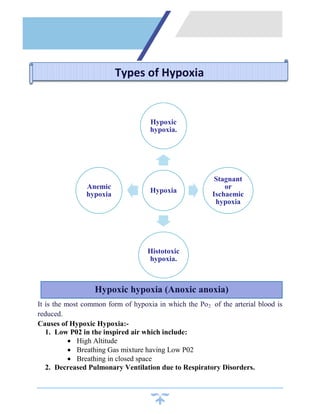
Hypoxia
Hypoxic
hypoxia.
Stagnant
or
Ischaemic
hypoxia
Histotoxic
hypoxia.
Anemic
hypoxia
Types of Hypoxia
Hypoxic hypoxia (Anoxic anoxia)
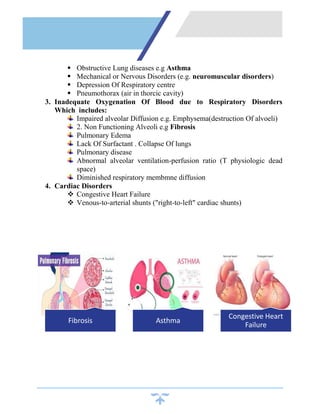
 Obstructive Lung diseases e.g Asthma
 Mechanical or Nervous Disorders (e.g. neuromuscular disorders)
 Depression Of Respiratory centre
 Pneumothorax (air in thorcic cavity)
3. Inadequate Oxygenation Of Blood due to Respiratory Disorders
Which includes:
Impaired alveolar Diffusion e.g. Emphysema(destruction Of alvoeli)
2. Non Functioning Alveoli e.g Fibrosis
Pulmonary Edema
Lack Of Surfactant . Collapse Of lungs
Pulmonary disease
Abnormal alveolar ventilation-perfusion ratio (T physiologic dead
space)
Diminished respiratory membmne diffusion
4. Cardiac Disorders
 Congestive Heart Failure
 Venous-to-arterial shunts ("right-to-left" cardiac shunts)
Fibrosis Asthma
Congestive Heart
Failure
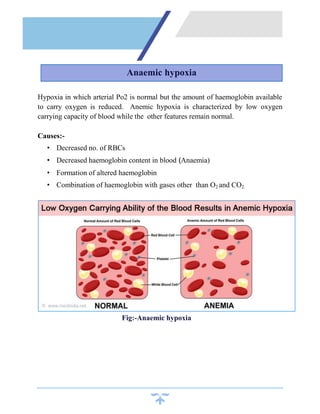
Hypoxia in which arterial Po2 is normal but the amount of haemoglobin available
to carry oxygen is reduced. Anemic hypoxia is characterized by low oxygen
carrying capacity of blood while the other features remain normal.
Causes:-
• Decreased no. of RBCs
• Decreased haemoglobin content in blood (Anaemia)
• Formation of altered haemoglobin
• Combination of haemoglobin with gases other than O2 and CO2.
Fig:-Anaemic hypoxia
Anaemic hypoxia
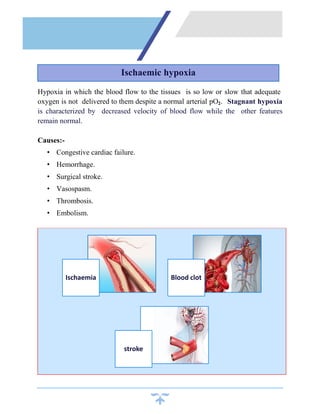
Hypoxia in which the blood flow to the tissues is so low or slow that adequate
oxygen is not delivered to them despite a normal arterial pO2. Stagnant hypoxia
is characterized by decreased velocity of blood flow while the other features
remain normal.
Causes:-
• Congestive cardiac failure.
• Hemorrhage.
• Surgical stroke.
• Vasospasm.
• Thrombosis.
• Embolism.
Ischaemia Blood clot
stroke
Ischaemic hypoxia
Hypoxia in which the amount of oxygen delivered to the tissues is adequate , but
because of the action of a toxic agent the tissue cells cannot make use of the
oxygen supplied to them.
Cause:-
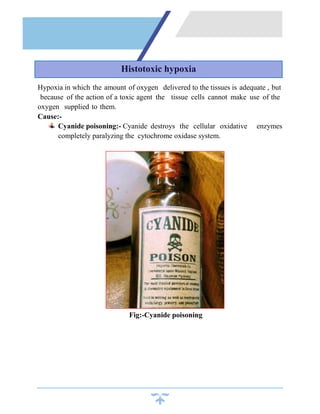
Cyanide poisoning:- Cyanide destroys the cellular oxidative enzymes
completely paralyzing the cytochrome oxidase system.
Fig:-Cyanide poisoning
Histotoxic hypoxia
If severe enough,it can cause death of cells throughout the body.
In less severe cases:-
On Nervous
System
On
Respiratory
System
On CVS On GIT On Musculo
Skeletal System
Headache
Excitement
Drowsiness
Impaired
judgement
Loss of time
sense
 Increased
respirator
y rate
 Cyanosis
 Periodic
breathing
 Tachycard
ia
 Hypertensi
on
 Nausea
 Vomirtin
g
 Anorexia
o Reduced
work
capacity of
the muscle.
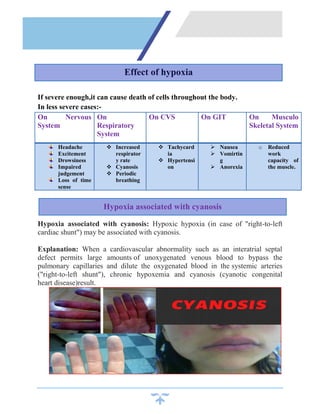
Hypoxia associated with cyanosis: Hypoxic hypoxia (in case of "right-to-left
cardiac shunt") may be associated with cyanosis.
Explanation: When a cardiovascular abnormality such as an interatrial septal
defect permits large amounts of unoxygenated venous blood to bypass the
pulmonary capillaries and dilute the oxygenated blood in the systemic arteries
("right-to-left shunt"), chronic hypoxemia and cyanosis (cyanotic congenital
heart disease)result.
Effect of hypoxia
Hypoxia associated with cyanosis
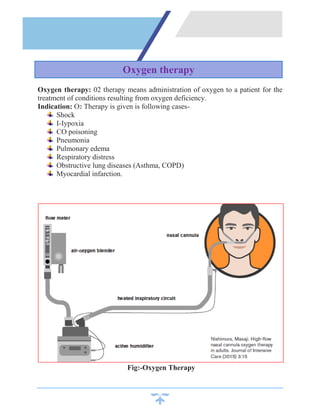
Oxygen therapy: 02 therapy means administration of oxygen to a patient for the
treatment of conditions resulting from oxygen deficiency.
Indication: O2 Therapy is given is following cases-
Shock
I-Iypoxia
CO poisoning
Pneumonia
Pulmonary edema
Respiratory distress
Obstructive lung diseases (Asthma, COPD)
Myocardial infarction.
Fig:-Oxygen Therapy
Oxygen therapy
Prevent hypoxia:-
The best way to prevent hypoxia is to keep your asthma under control, every day.
Stick with your asthma treatment plan.
 Take your medicine to help prevent flares and the need to use your rescue
inhaler.
 Eat right and stay active.
 Know your asthma triggers, and find ways to avoid them.
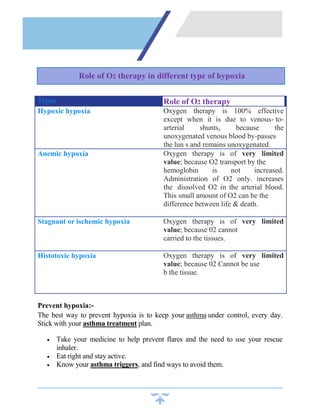
Types Role of O2 therapy
Hypoxic hypoxia Oxygen therapy is 100% effective
except when it is due to venous- to-
arterial shunts, because the
unoxygenated venous blood by-passes
the lun s and remains unoxygenated.
Anemic hypoxia Oxygen therapy is of very limited
value; because O2 transport by the
hemoglobin is not increased.
Administration of O2 only. increases
the dissolved O2 in the arterial blood.
This small amount of O2 can be the
difference between life & death.
Stagnant or ischemic hypoxia Oxygen therapy is of very limited
value; because 02 cannot
carried to the tissues.
Histotoxic hypoxia Oxygen therapy is of very limited
value; because 02 Cannot be use
b the tissue.
Role of O2 therapy in different type of hypoxia
1.Hall, John E. 2016. Textbook of Medical Physiology. 13th: Elsevier, 2016.
pp.554-557. ISBN:978-4557-7005-2.
2.Kim E. Barrett,Susan M. Barman, Jason Yuan. 2018. Ganong's Review of
Medical Physiology. 25th. New York San Francisco : Lange, 2018. pp. 646-651.
3.Nicki R. Colledge; Brian R. Walker; Stuart H. Ralston, eds. (2010). Davidson's
principles and practice of medicine. illustrated by Robert Britton (21st ed.).
Edinburgh: Churchill Livingstone/Elsevier. ISBN 978-0-7020-3085-7.
4. Gore CJ, Clark SA, Saunders PU (September 2007). "Nonhematological
mechanisms of improved sea-level performance after hypoxic exposure". Med
SciSportsExerc. 39 (9):160009. doi:10.1249/mss.0b013e3180de49d3. PMID 17805
094
Bibliography

Hypoxia

  • 1.
    An Assignment on Hypoxia Submittedby Roll:-14308 Reg:-1086 Date of Submission:-25/02/21 Submitted to Dr. Abu Sadat MD Sayem Assistant professor Department of Pharmacy, University of Science and Technology Chittagong (USTC) Department of Pharmacy Course Name: Physiology-III Course No:-PHR-303
  • 2.
    Hypoxia is acondition in which the body or a region of the body is deprived of adequate oxygen supply at the tissue level. In its extreme form, where oxygen is entirely absent, the condition is called anoxia. Hypoxemia (low oxygen in our blood) can cause hypoxia (low oxygen in our tissues) when our blood doesn't carry enough oxygen to our tissues to meet our body's needs. The word hypoxia is sometimes used to describe both problems. Although they can vary from person to person, the most common hypoxia symptoms are: Symptoms:-  Changes in the color of your skin, ranging from blue to cherry red  Confusion  Cough  Fast heart rate  Rapid breathing  Shortness of breath  Slow heart rate  Sweating  Wheezing Common Causes:-  High altitude.  Low hemoglobin level.  Decreased oxygen supply to an area.  Low oxygen carrying capacity.  Poor tissue perfusion.  Impaired ventilation.  Decreased diffusion of oxygen. Introduction
  • 3.
    It is themost common form of hypoxia in which the Po2 of the arterial blood is reduced. Causes of Hypoxic Hypoxia:- 1. Low P02 in the inspired air which include:  High Altitude  Breathing Gas mixture having Low P02  Breathing in closed space 2. Decreased Pulmonary Ventilation due to Respiratory Disorders. Hypoxia Hypoxic hypoxia. Stagnant or Ischaemic hypoxia Histotoxic hypoxia. Anemic hypoxia Types of Hypoxia Hypoxic hypoxia (Anoxic anoxia)
  • 4.
     Obstructive Lungdiseases e.g Asthma  Mechanical or Nervous Disorders (e.g. neuromuscular disorders)  Depression Of Respiratory centre  Pneumothorax (air in thorcic cavity) 3. Inadequate Oxygenation Of Blood due to Respiratory Disorders Which includes: Impaired alveolar Diffusion e.g. Emphysema(destruction Of alvoeli) 2. Non Functioning Alveoli e.g Fibrosis Pulmonary Edema Lack Of Surfactant . Collapse Of lungs Pulmonary disease Abnormal alveolar ventilation-perfusion ratio (T physiologic dead space) Diminished respiratory membmne diffusion 4. Cardiac Disorders  Congestive Heart Failure  Venous-to-arterial shunts ("right-to-left" cardiac shunts) Fibrosis Asthma Congestive Heart Failure
  • 5.
    Hypoxia in whicharterial Po2 is normal but the amount of haemoglobin available to carry oxygen is reduced. Anemic hypoxia is characterized by low oxygen carrying capacity of blood while the other features remain normal. Causes:- • Decreased no. of RBCs • Decreased haemoglobin content in blood (Anaemia) • Formation of altered haemoglobin • Combination of haemoglobin with gases other than O2 and CO2. Fig:-Anaemic hypoxia Anaemic hypoxia
  • 6.
    Hypoxia in whichthe blood flow to the tissues is so low or slow that adequate oxygen is not delivered to them despite a normal arterial pO2. Stagnant hypoxia is characterized by decreased velocity of blood flow while the other features remain normal. Causes:- • Congestive cardiac failure. • Hemorrhage. • Surgical stroke. • Vasospasm. • Thrombosis. • Embolism. Ischaemia Blood clot stroke Ischaemic hypoxia
  • 7.
    Hypoxia in whichthe amount of oxygen delivered to the tissues is adequate , but because of the action of a toxic agent the tissue cells cannot make use of the oxygen supplied to them. Cause:- Cyanide poisoning:- Cyanide destroys the cellular oxidative enzymes completely paralyzing the cytochrome oxidase system. Fig:-Cyanide poisoning Histotoxic hypoxia
  • 8.
    If severe enough,itcan cause death of cells throughout the body. In less severe cases:- On Nervous System On Respiratory System On CVS On GIT On Musculo Skeletal System Headache Excitement Drowsiness Impaired judgement Loss of time sense  Increased respirator y rate  Cyanosis  Periodic breathing  Tachycard ia  Hypertensi on  Nausea  Vomirtin g  Anorexia o Reduced work capacity of the muscle. Hypoxia associated with cyanosis: Hypoxic hypoxia (in case of "right-to-left cardiac shunt") may be associated with cyanosis. Explanation: When a cardiovascular abnormality such as an interatrial septal defect permits large amounts of unoxygenated venous blood to bypass the pulmonary capillaries and dilute the oxygenated blood in the systemic arteries ("right-to-left shunt"), chronic hypoxemia and cyanosis (cyanotic congenital heart disease)result. Effect of hypoxia Hypoxia associated with cyanosis
  • 9.
    Oxygen therapy: 02therapy means administration of oxygen to a patient for the treatment of conditions resulting from oxygen deficiency. Indication: O2 Therapy is given is following cases- Shock I-Iypoxia CO poisoning Pneumonia Pulmonary edema Respiratory distress Obstructive lung diseases (Asthma, COPD) Myocardial infarction. Fig:-Oxygen Therapy Oxygen therapy
  • 10.
    Prevent hypoxia:- The bestway to prevent hypoxia is to keep your asthma under control, every day. Stick with your asthma treatment plan.  Take your medicine to help prevent flares and the need to use your rescue inhaler.  Eat right and stay active.  Know your asthma triggers, and find ways to avoid them. Types Role of O2 therapy Hypoxic hypoxia Oxygen therapy is 100% effective except when it is due to venous- to- arterial shunts, because the unoxygenated venous blood by-passes the lun s and remains unoxygenated. Anemic hypoxia Oxygen therapy is of very limited value; because O2 transport by the hemoglobin is not increased. Administration of O2 only. increases the dissolved O2 in the arterial blood. This small amount of O2 can be the difference between life & death. Stagnant or ischemic hypoxia Oxygen therapy is of very limited value; because 02 cannot carried to the tissues. Histotoxic hypoxia Oxygen therapy is of very limited value; because 02 Cannot be use b the tissue. Role of O2 therapy in different type of hypoxia
  • 11.
    1.Hall, John E.2016. Textbook of Medical Physiology. 13th: Elsevier, 2016. pp.554-557. ISBN:978-4557-7005-2. 2.Kim E. Barrett,Susan M. Barman, Jason Yuan. 2018. Ganong's Review of Medical Physiology. 25th. New York San Francisco : Lange, 2018. pp. 646-651. 3.Nicki R. Colledge; Brian R. Walker; Stuart H. Ralston, eds. (2010). Davidson's principles and practice of medicine. illustrated by Robert Britton (21st ed.). Edinburgh: Churchill Livingstone/Elsevier. ISBN 978-0-7020-3085-7. 4. Gore CJ, Clark SA, Saunders PU (September 2007). "Nonhematological mechanisms of improved sea-level performance after hypoxic exposure". Med SciSportsExerc. 39 (9):160009. doi:10.1249/mss.0b013e3180de49d3. PMID 17805 094 Bibliography