MODERN PHARMACEUTICAL ANALYTICAL
TECHNIQUES
SPECTROFLUORIMETRY
Presented By :
Pranali V. Lende
M.Pharm Pharmaceutics
(Sem-I)
Guided By :
Dr. Minakshi N. Rajgire
Assistant Professor, ACP
CONTENT
Theory
Factors affecting fluorescence
Quenchers
Instrumentation of Spectrofluorimetry
Application of Spectrofluorimetry
SPECTROFLUORIMETRY
Definitions :
When a beam of light is incident on a system, it absorbs the electromagnetic radiations (EMR) and
their occurs either an increase in the internal energy of the system or its electrons gets activated
and move to higher energy levels.
The electrons in the excited energy level are unstable and collide with the neighbouring atoms or
molecules, loss a part of their energy in the form of heat and fall into a lower energy level with
simultaneous emission of the remaining energy in the form of EMR whose wavelength is longer
than that absorbed. This process of emission of EMR is known as Luminescence.
Luminescence can be classified as-
• Fluorescence : It is the luminescence that occurs during the transition of an electron from
the singlet exited state to a lower energy singlet ground state.
• Phosphorescence : It is the luminescence that occurs during the transition of an electron from
an excited triplet state to a lower energy singlet state or ground state.
THEORY
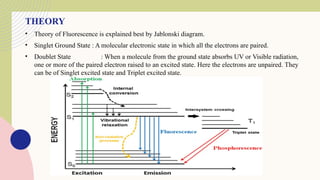
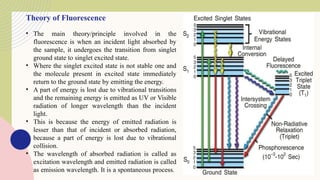
• Theory of Fluorescence is explained best by Jablonski diagram.
• Singlet Ground State : A molecular electronic state in which all the electrons are paired.
• Doublet State : When a molecule from the ground state absorbs UV or Visible radiation,
one or more of the paired electron raised to an excited state. Here the electrons are unpaired. They
can be of Singlet excited state and Triplet excited state.
Theory of Fluorescence
• The main theory/principle involved in the
fluorescence is when an incident light absorbed by
the sample, it undergoes the transition from singlet
ground state to singlet excited state.
• Where the singlet excited state is not stable one and
the molecule present in excited state immediately
return to the ground state by emitting the energy.
• A part of energy is lost due to vibrational transitions
and the remaining energy is emitted as UV or Visible
radiation of longer wavelength than the incident
light.
• This is because the energy of emitted radiation is
lesser than that of incident or absorbed radiation,
because a part of energy is lost due to vibrational
collision.
• The wavelength of absorbed radiation is called as
excitation wavelength and emitted radiation is called
as emission wavelength. It is a spontaneous process.
Factors Affecting Fluorescence & Phosphorescence
1. Nature of molecule
Absorbance of a molecule is directly proportional to the intensity of its luminescence. Fluorescence or
Phosphorescence is exhibited.
2. Functional Groups
Electron donating groups improve fluorescence, electron withdrawing groups decrease or completely
destroy fluorescence whereas groups like show no effect on the intensity of fluorescence as well as
phosphorescence.
3. Structure of Compound
Rigid molecules like metal complexes exhibit decreased fluorescence. For example, under similar
conditions of measurement, the efficiency of fluorene in exhibiting fluorescence is much more than that with
biphenyl.
4. Molecular Weight :
Elements with high atomic number exhibit de creased fluorescence. Therefore, it can be said that with
the decrease in molecular weight of compounds, the ability if elements to exhibit fluorescence increases.
5. pH
pH has a marked effect on the ability of compounds to emit fluorescence. Depending upon the
acidity or alkalinity, a substance can be ionized or unionized form and hence can be fluorogenic or non-
fluorogenic.
6. Temperature and Viscosity
A decrease in viscosity or an increase in temperature results in an increase in intermolecular
collisions and may deactivate the excited molecules ultimately destroying the fluorescence.
7. Oxygen
The intensity of fluorescence decreases in presence of oxygen. Direct Photochemical
oxidation of fluorogenic material to non-fluorogenic material Indirectly due to quenching.
8. Impurities
Compounds other than the solute molecules are considered as impurities presence of high
amounts of impurities extinguishes fluorescence as the impurities absorbs major proportion of
the incident radiations leaving very few radiations to excite electrons for fluorescence.
9.Concentration
There exists a linear relationship between the concentration of sample and fluorescence. In
dilute solutions, high intense fluorescence produced while in concentrated solutions results in
decreased fluorescence.
QUENCHING
The term ‘Quenching’ refers to many factors that reduce or quench fluorescence.
Quenching of fluorescence is physicochemical process which leads to reduction of fluorescence intensity of the
sample in the presence of substance other than the fluorescent analyte.
The substance which causes quenching is called Quenchers.
Quenching may occurs due to the following factors-
pH, concentration, temperature, viscosity, presence of O2 , heavy metals or specific chemical substances.
Types of quenching
1. Self Quenching / Concentration Quenching
2. Collisional Quenching / Dynamic Quenching
3. Chemical Quenching
4. Static Quenching
1. Self quenching
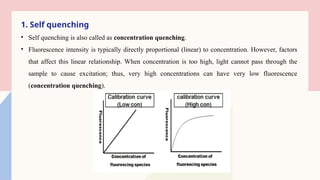
• Self quenching is also called as concentration quenching.
• Fluorescence intensity is typically directly proportional (linear) to concentration. However, factors
that affect this linear relationship. When concentration is too high, light cannot pass through the
sample to cause excitation; thus, very high concentrations can have very low fluorescence
(concentration quenching).
• At low concentration linearity of fluorescence intensity is observed, but as concentration of fluorescing
molecule increases in a sample solution the fluorescence intensity decreases.
The linearity of a sample is related to many factors,
including-
1. The chemical composition of the sample and
2. The path length through which the light must travel.
2. Collisional Quenching
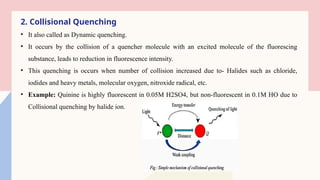
• It also called as Dynamic quenching.
• It occurs by the collision of a quencher molecule with an excited molecule of the fluorescing
substance, leads to reduction in fluorescence intensity.
• This quenching is occurs when number of collision increased due to- Halides such as chloride,
iodides and heavy metals, molecular oxygen, nitroxide radical, etc.
• Example: Quinine is highly fluorescent in 0.05M H2SO4, but non-fluorescent in 0.1M HO due to
Collisional quenching by halide ion.
3. Chemical Quenching
• Chemical quenching decrease in fluorescence intensity due to the factors like change in pH,
presence of oxygen, halides &heavy metals.
• pH- Aniline at pH 5-13 gives fluorescence, but at pH <5 &>13 it does not exhibit fluorescence.
• Halides- like chloride, bromide, iodide & electron withdrawing groups like -NO2, -COOH etc. leads
to quenching.
• Heavy metals- leads to quenching, because of collisions of triplet ground state.
• Oxygen- leads to the oxidation of fluorescence substance to non-fluorescent substance and thus,
cause quenching.
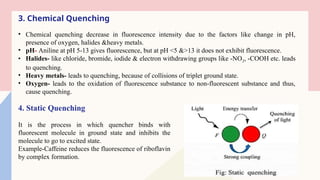
4. Static Quenching
It is the process in which quencher binds with
fluorescent molecule in ground state and inhibits the
molecule to go to excited state.
Example-Caffeine reduces the fluorescence of riboflavin
by complex formation.
5. Resonance Energy Transfer
• Also called Fluorescence Resonance Energy Transfer (FRET) occurs when two fluorophores are
in proximity and one of them (the donor) has an emission spectrum that overlaps the excitation
spectrum of the other (the acceptor).
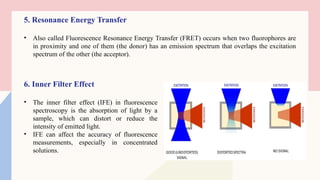
6. Inner Filter Effect
• The inner filter effect (IFE) in fluorescence
spectroscopy is the absorption of light by a
sample, which can distort or reduce the
intensity of emitted light.
• IFE can affect the accuracy of fluorescence
measurements, especially in concentrated
solutions.
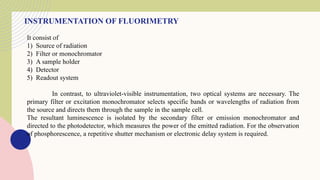
INSTRUMENTATION OF FLUORIMETRY
It consist of
1) Source of radiation
2) Filter or monochromator
3) A sample holder
4) Detector
5) Readout system
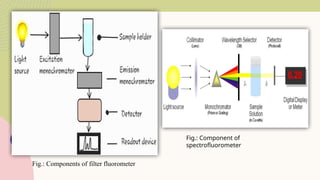
In contrast, to ultraviolet-visible instrumentation, two optical systems are necessary. The
primary filter or excitation monochromator selects specific bands or wavelengths of radiation from
the source and directs them through the sample in the sample cell.
The resultant luminescence is isolated by the secondary filter or emission monochromator and
directed to the photodetector, which measures the power of the emitted radiation. For the observation
of phosphorescence, a repetitive shutter mechanism or electronic delay system is required.
Fig.: Components of filter fluorometer
Fig.: Component of
spectrofluorometer
SOURCES OF RADIATION
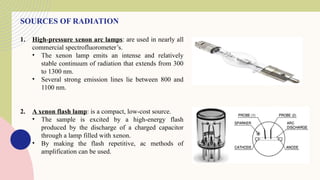
1. High-pressure xenon arc lamps: are used in nearly all
commercial spectrofluorometer’s.
• The xenon lamp emits an intense and relatively
stable continuum of radiation that extends from 300
to 1300 nm.
• Several strong emission lines lie between 800 and
1100 nm.
2. A xenon flash lamp: is a compact, low-cost source.
• The sample is excited by a high-energy flash
produced by the discharge of a charged capacitor
through a lamp filled with xenon.
• By making the flash repetitive, ac methods of
amplification can be used.
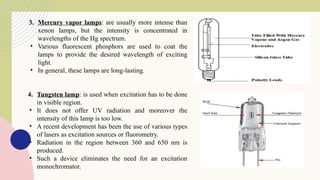
3. Mercury vapor lamps: are usually more intense than
xenon lamps, but the intensity is concentrated in
wavelengths of the Hg spectrum.
• Various fluorescent phosphors are used to coat the
lamps to provide the desired wavelength of exciting
light.
• In general, these lamps are long-lasting.
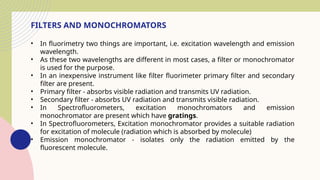
4. Tungsten lamp: is used when excitation has to be done
in visible region.
• It does not offer UV radiation and moreover the
intensity of this lamp is too low.
• A recent development has been the use of various types
of lasers as excitation sources or fluorometry.
• Radiation in the region between 360 and 650 nm is
produced.
• Such a device eliminates the need for an excitation
monochromator.
FILTERS AND MONOCHROMATORS
• In fluorimetry two things are important, i.e. excitation wavelength and emission
wavelength.
• As these two wavelengths are different in most cases, a filter or monochromator
is used for the purpose.
• In an inexpensive instrument like filter fluorimeter primary filter and secondary
filter are present.
• Primary filter - absorbs visible radiation and transmits UV radiation.
• Secondary filter - absorbs UV radiation and transmits visible radiation.
• In Spectrofluorometers, excitation monochromators and emission
monochromator are present which have gratings.
• In Spectrofluorometers, Excitation monochromator provides a suitable radiation
for excitation of molecule (radiation which is absorbed by molecule)
• Emission monochromator - isolates only the radiation emitted by the
fluorescent molecule.
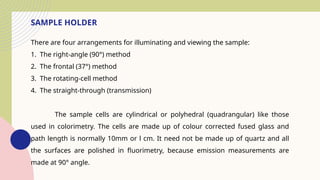
SAMPLE HOLDER
There are four arrangements for illuminating and viewing the sample:
1. The right-angle (90°) method
2. The frontal (37°) method
3. The rotating-cell method
4. The straight-through (transmission)
The sample cells are cylindrical or polyhedral (quadrangular) like those
used in colorimetry. The cells are made up of colour corrected fused glass and
path length is normally 10mm or l cm. It need not be made up of quartz and all
the surfaces are polished in fluorimetry, because emission measurements are
made at 90° angle.
DETECTORS
• The intensity of fluorescence is usually low. In order to measure the concentration of sample
accurately, the intensity should measure accurately.
• Hence a large amplification factor is required for its measurements.
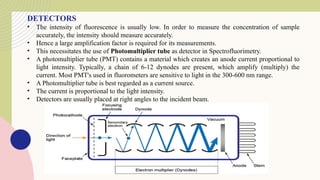
• This necessitates the use of Photomultiplier tube as detector in Spectrofluorimetry.
• A photomultiplier tube (PMT) contains a material which creates an anode current proportional to
light intensity. Typically, a chain of 6-12 dynodes are present, which amplify (multiply) the
current. Most PMT's used in fluorometers are sensitive to light in the 300-600 nm range.
• A Photomultiplier tube is best regarded as a current source.
• The current is proportional to the light intensity.
• Detectors are usually placed at right angles to the incident beam.
READ OUT SYSTEM
The intensity of fluorescence can be recorded on a recorder and print out using a printer.
ADVANTAGES
1. Sensitivity
2. Specificity
3. Wide Concentration Range
4. Simplicity and Speed
5. Low Cost
APPLICATION
6. The use of fluorimetry in the fields of medicine and biological samples is well established.
Highly selective and sensitive biochemical determinations such as total protein
content, blood glucose, blood serum, Ca++
in biological systems and creatinine
phosphokinase can be accomplished by fluorimetry.
7. The analysis of environmental pollutants can be done by fluorescence methods. Such as
• gaseous pollutants as atmospheric pollutants like NO - NO2.
• air pollution like SO2.
• metal pollutants like Al, Zn, and the anion, F in the aquatic environment.
3. Several minerals and alloys contain metals and many of such metals are analyzed by
fluorescence spectroscopy.
4. Fluorimetry is applicable for analysis of minerals as several minerals like calcite, fluorite,
rubies and zircon on exposure to UV radiation start emitting fluorescence.
5. Several metal ions like transition elements (Cu, Zn, Nb, Gd) as well as s-block elements
have been analyzed by phosphorimetry. In addition, those elements which cause fluorescence
quenching (e.g., Fe, Cu, Co, Ni, Cr) can be analyzed by phosphorimetry.
6. Fluorimetry has been used to carry out qualitative as well as quantitative analysis for
many compounds present in cigarette smoke, air pollution concentrates and
automobile exhausts.
THANK
YOU

SPECTROFLUORIMETRY (Modern pharmaceutical analytical techniques).pptx

  • 1.
    MODERN PHARMACEUTICAL ANALYTICAL TECHNIQUES SPECTROFLUORIMETRY PresentedBy : Pranali V. Lende M.Pharm Pharmaceutics (Sem-I) Guided By : Dr. Minakshi N. Rajgire Assistant Professor, ACP
  • 2.
    CONTENT Theory Factors affecting fluorescence Quenchers Instrumentationof Spectrofluorimetry Application of Spectrofluorimetry
  • 3.
    SPECTROFLUORIMETRY Definitions : When abeam of light is incident on a system, it absorbs the electromagnetic radiations (EMR) and their occurs either an increase in the internal energy of the system or its electrons gets activated and move to higher energy levels. The electrons in the excited energy level are unstable and collide with the neighbouring atoms or molecules, loss a part of their energy in the form of heat and fall into a lower energy level with simultaneous emission of the remaining energy in the form of EMR whose wavelength is longer than that absorbed. This process of emission of EMR is known as Luminescence. Luminescence can be classified as- • Fluorescence : It is the luminescence that occurs during the transition of an electron from the singlet exited state to a lower energy singlet ground state. • Phosphorescence : It is the luminescence that occurs during the transition of an electron from an excited triplet state to a lower energy singlet state or ground state.
  • 4.
    THEORY • Theory ofFluorescence is explained best by Jablonski diagram. • Singlet Ground State : A molecular electronic state in which all the electrons are paired. • Doublet State : When a molecule from the ground state absorbs UV or Visible radiation, one or more of the paired electron raised to an excited state. Here the electrons are unpaired. They can be of Singlet excited state and Triplet excited state.
  • 5.
    Theory of Fluorescence •The main theory/principle involved in the fluorescence is when an incident light absorbed by the sample, it undergoes the transition from singlet ground state to singlet excited state. • Where the singlet excited state is not stable one and the molecule present in excited state immediately return to the ground state by emitting the energy. • A part of energy is lost due to vibrational transitions and the remaining energy is emitted as UV or Visible radiation of longer wavelength than the incident light. • This is because the energy of emitted radiation is lesser than that of incident or absorbed radiation, because a part of energy is lost due to vibrational collision. • The wavelength of absorbed radiation is called as excitation wavelength and emitted radiation is called as emission wavelength. It is a spontaneous process.
  • 6.
    Factors Affecting Fluorescence& Phosphorescence 1. Nature of molecule Absorbance of a molecule is directly proportional to the intensity of its luminescence. Fluorescence or Phosphorescence is exhibited. 2. Functional Groups Electron donating groups improve fluorescence, electron withdrawing groups decrease or completely destroy fluorescence whereas groups like show no effect on the intensity of fluorescence as well as phosphorescence. 3. Structure of Compound Rigid molecules like metal complexes exhibit decreased fluorescence. For example, under similar conditions of measurement, the efficiency of fluorene in exhibiting fluorescence is much more than that with biphenyl. 4. Molecular Weight : Elements with high atomic number exhibit de creased fluorescence. Therefore, it can be said that with the decrease in molecular weight of compounds, the ability if elements to exhibit fluorescence increases.
  • 7.
    5. pH pH hasa marked effect on the ability of compounds to emit fluorescence. Depending upon the acidity or alkalinity, a substance can be ionized or unionized form and hence can be fluorogenic or non- fluorogenic. 6. Temperature and Viscosity A decrease in viscosity or an increase in temperature results in an increase in intermolecular collisions and may deactivate the excited molecules ultimately destroying the fluorescence. 7. Oxygen The intensity of fluorescence decreases in presence of oxygen. Direct Photochemical oxidation of fluorogenic material to non-fluorogenic material Indirectly due to quenching. 8. Impurities Compounds other than the solute molecules are considered as impurities presence of high amounts of impurities extinguishes fluorescence as the impurities absorbs major proportion of the incident radiations leaving very few radiations to excite electrons for fluorescence. 9.Concentration There exists a linear relationship between the concentration of sample and fluorescence. In dilute solutions, high intense fluorescence produced while in concentrated solutions results in decreased fluorescence.
  • 8.
    QUENCHING The term ‘Quenching’refers to many factors that reduce or quench fluorescence. Quenching of fluorescence is physicochemical process which leads to reduction of fluorescence intensity of the sample in the presence of substance other than the fluorescent analyte. The substance which causes quenching is called Quenchers. Quenching may occurs due to the following factors- pH, concentration, temperature, viscosity, presence of O2 , heavy metals or specific chemical substances. Types of quenching 1. Self Quenching / Concentration Quenching 2. Collisional Quenching / Dynamic Quenching 3. Chemical Quenching 4. Static Quenching
  • 9.
    1. Self quenching •Self quenching is also called as concentration quenching. • Fluorescence intensity is typically directly proportional (linear) to concentration. However, factors that affect this linear relationship. When concentration is too high, light cannot pass through the sample to cause excitation; thus, very high concentrations can have very low fluorescence (concentration quenching).
  • 10.
    • At lowconcentration linearity of fluorescence intensity is observed, but as concentration of fluorescing molecule increases in a sample solution the fluorescence intensity decreases. The linearity of a sample is related to many factors, including- 1. The chemical composition of the sample and 2. The path length through which the light must travel.
  • 11.
    2. Collisional Quenching •It also called as Dynamic quenching. • It occurs by the collision of a quencher molecule with an excited molecule of the fluorescing substance, leads to reduction in fluorescence intensity. • This quenching is occurs when number of collision increased due to- Halides such as chloride, iodides and heavy metals, molecular oxygen, nitroxide radical, etc. • Example: Quinine is highly fluorescent in 0.05M H2SO4, but non-fluorescent in 0.1M HO due to Collisional quenching by halide ion.
  • 12.
    3. Chemical Quenching •Chemical quenching decrease in fluorescence intensity due to the factors like change in pH, presence of oxygen, halides &heavy metals. • pH- Aniline at pH 5-13 gives fluorescence, but at pH <5 &>13 it does not exhibit fluorescence. • Halides- like chloride, bromide, iodide & electron withdrawing groups like -NO2, -COOH etc. leads to quenching. • Heavy metals- leads to quenching, because of collisions of triplet ground state. • Oxygen- leads to the oxidation of fluorescence substance to non-fluorescent substance and thus, cause quenching. 4. Static Quenching It is the process in which quencher binds with fluorescent molecule in ground state and inhibits the molecule to go to excited state. Example-Caffeine reduces the fluorescence of riboflavin by complex formation.
  • 13.
    5. Resonance EnergyTransfer • Also called Fluorescence Resonance Energy Transfer (FRET) occurs when two fluorophores are in proximity and one of them (the donor) has an emission spectrum that overlaps the excitation spectrum of the other (the acceptor). 6. Inner Filter Effect • The inner filter effect (IFE) in fluorescence spectroscopy is the absorption of light by a sample, which can distort or reduce the intensity of emitted light. • IFE can affect the accuracy of fluorescence measurements, especially in concentrated solutions.
  • 14.
    INSTRUMENTATION OF FLUORIMETRY Itconsist of 1) Source of radiation 2) Filter or monochromator 3) A sample holder 4) Detector 5) Readout system In contrast, to ultraviolet-visible instrumentation, two optical systems are necessary. The primary filter or excitation monochromator selects specific bands or wavelengths of radiation from the source and directs them through the sample in the sample cell. The resultant luminescence is isolated by the secondary filter or emission monochromator and directed to the photodetector, which measures the power of the emitted radiation. For the observation of phosphorescence, a repetitive shutter mechanism or electronic delay system is required.
  • 15.
    Fig.: Components offilter fluorometer Fig.: Component of spectrofluorometer
  • 16.
    SOURCES OF RADIATION 1.High-pressure xenon arc lamps: are used in nearly all commercial spectrofluorometer’s. • The xenon lamp emits an intense and relatively stable continuum of radiation that extends from 300 to 1300 nm. • Several strong emission lines lie between 800 and 1100 nm. 2. A xenon flash lamp: is a compact, low-cost source. • The sample is excited by a high-energy flash produced by the discharge of a charged capacitor through a lamp filled with xenon. • By making the flash repetitive, ac methods of amplification can be used.
  • 17.
    3. Mercury vaporlamps: are usually more intense than xenon lamps, but the intensity is concentrated in wavelengths of the Hg spectrum. • Various fluorescent phosphors are used to coat the lamps to provide the desired wavelength of exciting light. • In general, these lamps are long-lasting. 4. Tungsten lamp: is used when excitation has to be done in visible region. • It does not offer UV radiation and moreover the intensity of this lamp is too low. • A recent development has been the use of various types of lasers as excitation sources or fluorometry. • Radiation in the region between 360 and 650 nm is produced. • Such a device eliminates the need for an excitation monochromator.
  • 18.
    FILTERS AND MONOCHROMATORS •In fluorimetry two things are important, i.e. excitation wavelength and emission wavelength. • As these two wavelengths are different in most cases, a filter or monochromator is used for the purpose. • In an inexpensive instrument like filter fluorimeter primary filter and secondary filter are present. • Primary filter - absorbs visible radiation and transmits UV radiation. • Secondary filter - absorbs UV radiation and transmits visible radiation. • In Spectrofluorometers, excitation monochromators and emission monochromator are present which have gratings. • In Spectrofluorometers, Excitation monochromator provides a suitable radiation for excitation of molecule (radiation which is absorbed by molecule) • Emission monochromator - isolates only the radiation emitted by the fluorescent molecule.
  • 19.
    SAMPLE HOLDER There arefour arrangements for illuminating and viewing the sample: 1. The right-angle (90°) method 2. The frontal (37°) method 3. The rotating-cell method 4. The straight-through (transmission) The sample cells are cylindrical or polyhedral (quadrangular) like those used in colorimetry. The cells are made up of colour corrected fused glass and path length is normally 10mm or l cm. It need not be made up of quartz and all the surfaces are polished in fluorimetry, because emission measurements are made at 90° angle.
  • 20.
    DETECTORS • The intensityof fluorescence is usually low. In order to measure the concentration of sample accurately, the intensity should measure accurately. • Hence a large amplification factor is required for its measurements. • This necessitates the use of Photomultiplier tube as detector in Spectrofluorimetry. • A photomultiplier tube (PMT) contains a material which creates an anode current proportional to light intensity. Typically, a chain of 6-12 dynodes are present, which amplify (multiply) the current. Most PMT's used in fluorometers are sensitive to light in the 300-600 nm range. • A Photomultiplier tube is best regarded as a current source. • The current is proportional to the light intensity. • Detectors are usually placed at right angles to the incident beam.
  • 21.
    READ OUT SYSTEM Theintensity of fluorescence can be recorded on a recorder and print out using a printer. ADVANTAGES 1. Sensitivity 2. Specificity 3. Wide Concentration Range 4. Simplicity and Speed 5. Low Cost APPLICATION 6. The use of fluorimetry in the fields of medicine and biological samples is well established. Highly selective and sensitive biochemical determinations such as total protein content, blood glucose, blood serum, Ca++ in biological systems and creatinine phosphokinase can be accomplished by fluorimetry. 7. The analysis of environmental pollutants can be done by fluorescence methods. Such as • gaseous pollutants as atmospheric pollutants like NO - NO2. • air pollution like SO2. • metal pollutants like Al, Zn, and the anion, F in the aquatic environment.
  • 22.
    3. Several mineralsand alloys contain metals and many of such metals are analyzed by fluorescence spectroscopy. 4. Fluorimetry is applicable for analysis of minerals as several minerals like calcite, fluorite, rubies and zircon on exposure to UV radiation start emitting fluorescence. 5. Several metal ions like transition elements (Cu, Zn, Nb, Gd) as well as s-block elements have been analyzed by phosphorimetry. In addition, those elements which cause fluorescence quenching (e.g., Fe, Cu, Co, Ni, Cr) can be analyzed by phosphorimetry. 6. Fluorimetry has been used to carry out qualitative as well as quantitative analysis for many compounds present in cigarette smoke, air pollution concentrates and automobile exhausts.
  • 23.