Unit 2 – Fluorescence Spectrophotometry
Luminescence
Emission of previously absorbed radiation.
Luminescence is two types.
Florescence.
Phosphorescence.
Fluorescence
 When a beam of light is incident on certain
substances, they emit visible light or radiations.
 Thesubstance is fluorescent substance.
Measurement is called as fluorimetry.
Phosphorescence
 When a beam of light isincident on certain
substances, they emit radiations continuously even after the
incident light is cut off.
 The substance is phosphorescent. Measurement of radiations
is Phosphorimetry.
Theory of Luminescence
 A molecular electronic state in which all of the
electrons are paired are called singlet state.
 In a singlet state molecules are diamagnetic.
 Most of the molecules in their ground state are
paired.
 When such a molecule absorbs uv/visible radiation, one or
more of the paired electron raised to an
excited singlet state /excited triplet state.
Singlet/Triplet State
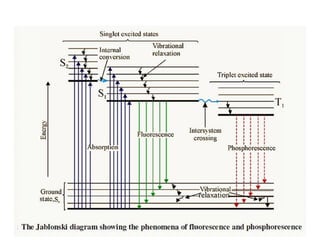
From the Excited Singlet State one of the
following phenomenon occurs:
Fluorescence.
Phosphorescence.
Radiation less processes.
Vibration relaxation.
Internal conversion.
External conversion.
Intersystem crossing.
Fluorescence & Phosphorescence
Types of Fluorescence
Based upon the wave length of
emitted radiation when compared to
absorbed radiation:
Stokes's fluorescence.
Anti- Stokes's fluorescence.
Resonance fluorescence.
 Stokes's fluorescence: Stokes fluorescence is the emission of a longer-
wavelength photon (lower frequency or energy) by a molecule that
has absorbed a photon of shorter
wavelength (higher frequency or energy). (e.g. Conventional
Fluorimetry Experiments).
 Anti- Stokes's fluorescence: If the emitted photon has more energy,
than the absorbed photon, the energy difference is called an anti-
Stokes shift. (e.g. Thermally Assisted Fluorescence).
 Resonance fluorescence: If the emitted photon has more or less equal
energy, as the absorbed photon, then it is called resonance
fluorescence. (e.g. Mercury Arc Lamp at 254nm).
Theory
 Singlet and Triplet states.
 Excited-state process in molecules.
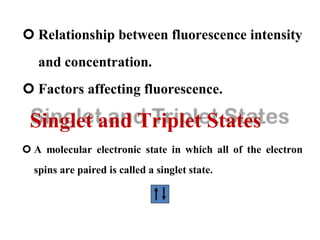
 Relationship between fluorescence intensity
and concentration.
 Factors affecting fluorescence.
Singlet and Triplet States
 A molecular electronic state in which all of the electron
spins are paired is called a singlet state.
 If ‘no’ un pair electrons are present (n=0), there is only n+1
or 0+1 spin state. Such state is called a
singlet state.
 Similarly, systems having1,2,3,4…… unpaired
electrons refer to doublet, triplet, quartet etc. state
respectively.
Excited state processes in molecules
 Collisional Deactivation: Collisional deactivation (external
conversion) leading to nonradiative relaxation.
 Intersystem Crossing (10-9
s): In this process, if the energy states of
the singlet state overlaps those of the triplet state, vibrational coupling
can occur between the two states. Molecules in the single excited state can
cross over to the
triplet excited state.
 Phosphorescence: This is the relaxation of the molecule from the
triplet excited state to the singlet ground state with emission of light. The
triplet state has a long lifetime and the rate of phosphorescence is slow
(10-2
to 100 sec).
Excited state processes in molecules
 Fluorescence:
Corresponds to the relaxation of the molecule from the singlet
excited state to the singlet ground state with emission of light.
Fluorescence has short lifetime (~10-8
sec) so that in many
molecules it can compete favorably with collisional
deactivation, intersystem crossing and
phosphorescence.
The wavelength (and thus the energy) of the light emitted is
dependent on the energy gap between the ground state and the
singlet excited state.
Relation between intensity of fluorescence
and concentration
We know that “less number of molecules absorb
lesser radiation and so emit lesser
radiation”.
 “Similarly more number of molecules
absorb more radiation”.
Factors affecting Fluorescence
 Nature of molecule.
 Nature of substituent.
 Effect of concentration.
 Adsorption, Light.
 Oxygen, pH.
 Temp & Viscosity.
 Intensity of incident light.
 Path length.
 Quenching.
Factors affecting Fluorescence
 Nature of Molecule:
All the molecules cannot show the phenomenon of
fluorescence.
Only the molecules absorbs UV/Visible radiation can show
this phenomenon.
Greater the absorbency of the molecule the more intense its
fluorescence.
 Nature of Substituent:
Electron donating group enhances fluorescence –
e.g.: NH2,OH etc.
Electron withdrawing groups decrease or destroy
fluorescence. e.g.: COOH, NO2, N=N etc.
Factors affecting Fluorescence
High atomic no: atom introduced into electron system
decreases fluorescence.
 Effect of Concentration:
Fluorescence is directly proportional to
concentration.
Factors affecting Fluorescence
 Adsorption:
Factors affecting Fluorescence
Extreme sensitiveness of the method requires very dilute
solution.
Adsorption of the fluorescent substances on the container
wall create serious problems.
Hence strong solutions must be diluted.
 Light:
Monochromatic light is essential for the excitation of
fluorescence because the intensity will vary with wavelength.
 Oxygen:
The presence of oxygen may interfere in 2 ways. 1] by direct
oxidation of the fluorescent substances to non fluorescent. 2]
by quenching of fluorescence.
Factors affecting Fluorescence
 pH:
Alteration of the pH of the solution will have significant effect
on fluorescence.
Fluorescent spectrum is different for ionized and unionized
species.
 Temp & Viscosity:
Increase in temperature/decrease in viscosity will decrease
fluorescence.
 Intensity of Incident Light:
Increase in intensity of light incident on sample increases
fluorescence intensity.
The intensity of light depends upon, 1) light emitted from the
lamp, 2) Excitation monochromators,
3) Excitation slit width.
Factors affecting Fluorescence
 Path Length:
The effective path length depends on both the excitation and
emission slit width.
Use of microcuvette does not reduce the fluorescence.
Use of microcell may reduce interferences and increases the
measured fluorescence.
 Quenching:
Decrease in fluorescence intensity due to specific effects of
constituents of the solution.
Due to concentration, pH, pressure of chemical substances,
temperature, viscosity, etc.
Factors affecting Fluorescence
 Types of Quenching:
Self quenching.
Chemical quenching.
Static quenching.
Collision quenching.
 Self quenching / Conc quenching:
Factors affecting Fluorescence
 Chemical quenching:
Here decrease in fluorescence intensity is due to the factors like
change in pH, presence of oxygen, halides & heavy metals.
pH - Aniline at pH 5-13 gives fluorescence but at pH <5 & >13,
does not exhibit fluorescence.
Halides like chloride, bromide, iodide & electron withdrawing
groups like NO2, COOH etc. leads to quenching.
Heavy metals leads to quenching, because of
collisions of triplet ground state.
Factors affecting Fluorescence
 Static quenching:
This occurs due to complex formation.
E.g. Caffeine reduces the fluorescence of riboflavin by complex
formation.
 Collision quenching:
It reduces fluorescence by collision. i.e. when no. of collisions
increased, quenching takes place.
Factors affecting Fluorescence
 Fluorescence intensity is proportional to the
concentration of the substance.
 If the concentration is high it does not follow due to quenching
effect.
Fluorescence and Chemical Structure
 Fluorescence is most commonlyobserved in
compounds containing aromatic functional groups with low
energy.
 Most unsubstituted aromatic hydrocarbons show
fluorescence - quantum efficiency increases with the no: of
rings and degree of condensation.
Fluorescence and Chemical Structure
 Simple heterocyclic do not exhibit fluorescence.
 The n - * singlet quickly converts to the n - * triplet and
prevents fluorescence.
Fluorescence and Chemical Structure
 Fusion of heterocyclic nucleus to benzene ring
increases fluorescence.
Fluorescence and Chemical Structure
 Substitution on the benzene ring shifts wavelength of
absorbance maxima and corresponding changes in
fluorescence peaks.
Fluorescence decreases with increasing atomic no: of the
halogen.
Substitution of carboxylic acid or carboxylic group on
aromatic ring inhibits fluorescence.
Fluorescence and Chemical Structure
 Structural Rigidity:
Fluorescence is favored in molecules with
structural rigidity.
organic chelating agents complexed with metal ion
increases fluorescence.
Instrumentation
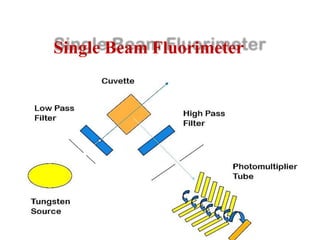
 Light Source: Mercury vapor lamp, Xenon arc lamp,
Tungsten lamp.
 Filters and Monochromators:
Primary filter (Excitation Filter).
Secondary filter (Emission Filter).
 Sample cell.
 Detector - PMT.
Single Beam Fluorimeter
Double Beam Fluorimeter
Applications
 Inorganic chemistry.
 Organic chemistry.
 Biological.
 Food products.
 Pharmaceutical.
 Clinical.
 Natural products.
1 UNIT 2.......................................pdf

1 UNIT 2.......................................pdf

  • 1.
    Unit 2 –Fluorescence Spectrophotometry
  • 2.
    Luminescence Emission of previouslyabsorbed radiation. Luminescence is two types. Florescence. Phosphorescence.
  • 3.
    Fluorescence  When abeam of light is incident on certain substances, they emit visible light or radiations.  Thesubstance is fluorescent substance. Measurement is called as fluorimetry.
  • 4.
    Phosphorescence  When abeam of light isincident on certain substances, they emit radiations continuously even after the incident light is cut off.  The substance is phosphorescent. Measurement of radiations is Phosphorimetry.
  • 5.
    Theory of Luminescence A molecular electronic state in which all of the electrons are paired are called singlet state.  In a singlet state molecules are diamagnetic.
  • 6.
     Most ofthe molecules in their ground state are paired.  When such a molecule absorbs uv/visible radiation, one or more of the paired electron raised to an excited singlet state /excited triplet state.
  • 7.
  • 8.
    From the ExcitedSinglet State one of the following phenomenon occurs: Fluorescence. Phosphorescence. Radiation less processes. Vibration relaxation. Internal conversion. External conversion.
  • 9.
  • 10.
  • 13.
    Types of Fluorescence Basedupon the wave length of emitted radiation when compared to absorbed radiation: Stokes's fluorescence. Anti- Stokes's fluorescence.
  • 14.
    Resonance fluorescence.  Stokes'sfluorescence: Stokes fluorescence is the emission of a longer- wavelength photon (lower frequency or energy) by a molecule that has absorbed a photon of shorter wavelength (higher frequency or energy). (e.g. Conventional Fluorimetry Experiments).  Anti- Stokes's fluorescence: If the emitted photon has more energy, than the absorbed photon, the energy difference is called an anti- Stokes shift. (e.g. Thermally Assisted Fluorescence).
  • 15.
     Resonance fluorescence:If the emitted photon has more or less equal energy, as the absorbed photon, then it is called resonance fluorescence. (e.g. Mercury Arc Lamp at 254nm). Theory  Singlet and Triplet states.  Excited-state process in molecules.
  • 16.
     Relationship betweenfluorescence intensity and concentration.  Factors affecting fluorescence. Singlet and Triplet States  A molecular electronic state in which all of the electron spins are paired is called a singlet state.
  • 17.
     If ‘no’un pair electrons are present (n=0), there is only n+1 or 0+1 spin state. Such state is called a singlet state.  Similarly, systems having1,2,3,4…… unpaired electrons refer to doublet, triplet, quartet etc. state respectively. Excited state processes in molecules  Collisional Deactivation: Collisional deactivation (external conversion) leading to nonradiative relaxation.
  • 18.
     Intersystem Crossing(10-9 s): In this process, if the energy states of the singlet state overlaps those of the triplet state, vibrational coupling can occur between the two states. Molecules in the single excited state can cross over to the triplet excited state.  Phosphorescence: This is the relaxation of the molecule from the triplet excited state to the singlet ground state with emission of light. The triplet state has a long lifetime and the rate of phosphorescence is slow (10-2 to 100 sec).
  • 19.
    Excited state processesin molecules  Fluorescence: Corresponds to the relaxation of the molecule from the singlet excited state to the singlet ground state with emission of light. Fluorescence has short lifetime (~10-8 sec) so that in many molecules it can compete favorably with collisional deactivation, intersystem crossing and phosphorescence.
  • 20.
    The wavelength (andthus the energy) of the light emitted is dependent on the energy gap between the ground state and the singlet excited state. Relation between intensity of fluorescence and concentration We know that “less number of molecules absorb lesser radiation and so emit lesser radiation”.
  • 21.
     “Similarly morenumber of molecules absorb more radiation”. Factors affecting Fluorescence  Nature of molecule.  Nature of substituent.  Effect of concentration.  Adsorption, Light.  Oxygen, pH.
  • 22.
     Temp &Viscosity.  Intensity of incident light.  Path length.  Quenching.
  • 23.
    Factors affecting Fluorescence Nature of Molecule: All the molecules cannot show the phenomenon of fluorescence. Only the molecules absorbs UV/Visible radiation can show this phenomenon. Greater the absorbency of the molecule the more intense its fluorescence.  Nature of Substituent: Electron donating group enhances fluorescence – e.g.: NH2,OH etc. Electron withdrawing groups decrease or destroy fluorescence. e.g.: COOH, NO2, N=N etc.
  • 24.
    Factors affecting Fluorescence Highatomic no: atom introduced into electron system decreases fluorescence.  Effect of Concentration: Fluorescence is directly proportional to concentration.
  • 25.
  • 26.
    Factors affecting Fluorescence Extremesensitiveness of the method requires very dilute solution. Adsorption of the fluorescent substances on the container wall create serious problems. Hence strong solutions must be diluted.  Light: Monochromatic light is essential for the excitation of fluorescence because the intensity will vary with wavelength.  Oxygen: The presence of oxygen may interfere in 2 ways. 1] by direct oxidation of the fluorescent substances to non fluorescent. 2] by quenching of fluorescence.
  • 27.
    Factors affecting Fluorescence pH: Alteration of the pH of the solution will have significant effect on fluorescence. Fluorescent spectrum is different for ionized and unionized species.  Temp & Viscosity: Increase in temperature/decrease in viscosity will decrease fluorescence.  Intensity of Incident Light: Increase in intensity of light incident on sample increases fluorescence intensity.
  • 28.
    The intensity oflight depends upon, 1) light emitted from the lamp, 2) Excitation monochromators, 3) Excitation slit width. Factors affecting Fluorescence  Path Length: The effective path length depends on both the excitation and emission slit width. Use of microcuvette does not reduce the fluorescence. Use of microcell may reduce interferences and increases the measured fluorescence.  Quenching:
  • 29.
    Decrease in fluorescenceintensity due to specific effects of constituents of the solution. Due to concentration, pH, pressure of chemical substances, temperature, viscosity, etc. Factors affecting Fluorescence  Types of Quenching: Self quenching. Chemical quenching. Static quenching. Collision quenching.  Self quenching / Conc quenching:
  • 31.
    Factors affecting Fluorescence Chemical quenching: Here decrease in fluorescence intensity is due to the factors like change in pH, presence of oxygen, halides & heavy metals. pH - Aniline at pH 5-13 gives fluorescence but at pH <5 & >13, does not exhibit fluorescence. Halides like chloride, bromide, iodide & electron withdrawing groups like NO2, COOH etc. leads to quenching. Heavy metals leads to quenching, because of collisions of triplet ground state.
  • 32.
    Factors affecting Fluorescence Static quenching: This occurs due to complex formation. E.g. Caffeine reduces the fluorescence of riboflavin by complex formation.  Collision quenching: It reduces fluorescence by collision. i.e. when no. of collisions increased, quenching takes place.
  • 33.
    Factors affecting Fluorescence Fluorescence intensity is proportional to the concentration of the substance.  If the concentration is high it does not follow due to quenching effect.
  • 34.
    Fluorescence and ChemicalStructure  Fluorescence is most commonlyobserved in
  • 35.
    compounds containing aromaticfunctional groups with low energy.  Most unsubstituted aromatic hydrocarbons show fluorescence - quantum efficiency increases with the no: of rings and degree of condensation. Fluorescence and Chemical Structure  Simple heterocyclic do not exhibit fluorescence.
  • 36.
     The n- * singlet quickly converts to the n - * triplet and prevents fluorescence. Fluorescence and Chemical Structure  Fusion of heterocyclic nucleus to benzene ring
  • 37.
  • 38.
     Substitution onthe benzene ring shifts wavelength of absorbance maxima and corresponding changes in fluorescence peaks. Fluorescence decreases with increasing atomic no: of the halogen. Substitution of carboxylic acid or carboxylic group on aromatic ring inhibits fluorescence.
  • 39.
    Fluorescence and ChemicalStructure  Structural Rigidity: Fluorescence is favored in molecules with structural rigidity. organic chelating agents complexed with metal ion increases fluorescence.
  • 40.
    Instrumentation  Light Source:Mercury vapor lamp, Xenon arc lamp, Tungsten lamp.  Filters and Monochromators:
  • 41.
    Primary filter (ExcitationFilter). Secondary filter (Emission Filter).  Sample cell.  Detector - PMT.
  • 42.
  • 43.
  • 44.
    Applications  Inorganic chemistry. Organic chemistry.  Biological.  Food products.  Pharmaceutical.  Clinical.
  • 45.